
Trevor Schmidt's Blog, page 2
April 17, 2015
New Music Video to Accompany My Upcoming Novel, The Corsair Uprising #3: Death Wish
Dirge of the Corsairs is a song that will appear in the upcoming novel, The Corsair Uprising #3: Death Wish, which will be released in the summer of 2015. If you just can't wait for the novel, check out the first two in the series over at Amazon.
The song is something sung by a mournful Dinari (A sort of lizard-like alien), lamenting the fall of a proud group of warrior-ships and vowing to continue their plight, even if it takes one thousand more years of war.
Lyrics:
One thousand years
All must bear burdens
Taken from their beds
All bear their burdens
The Corsair’s Ride
The beasts will fly
Aether sings tonight
The Aether sings
The legends tell
Four dozen fell
Two lost by time itself
Two lost by time
The beasts of myth cry tears of souls (Kill Ansarans)
Lost by the dark in-between (Kill the Kraven)
Corsairs live to kill their foes (Kill Ansarans)
Dinari rising free (Kill the Kraven)
This war won’t end
This message send
One thousand years
One thousand more
One thousand more
Amazon: http://www.amazon.com/Trevor-Schmidt/...


April 15, 2015
Writing Wednesday: 3 Steps to Planning a Novel
Stay tuned every Wednesday for tips on writing, social media, and the publishing industry. If I can't get around to a video, there will generally be a written blog on a new exciting subject!
I know some authors eschew the thought of video, so for those of you interested in reading the transcript rather than watch the video, read on!
"Hi everyone, I'm Trevor Schmidt, science fiction writer and general geek (General Geek). Today's show is going to help you plan that novel you've been thinking about writing. So, break out that pen and paper and let's get started.
These days it seems like everyone is writing a novel, but what sets apart the good from the bad? I'm willing to bet it's planning. Today I've got a few tips to help you plan out that novel that will take your book to the next level. This will also have the benefit of helping to prevent writer's block.
So, let's get into it.
Step 1: The Synopsis:
The first thing I do when writing a story or novel is to write a one to two paragraph synopsis. This will help me later on as a quick reference guide. This also helps you if someone asks what your novel is about. Then you have a pre-made elevator speech ready to go.
Step 2: The Characters:
The next thing I do is write out a little bit about each character; just a short description and a little bit of backstory. This is something I often add to later because after I go through a novel I'll be adding extra characteristics and then I'll put it into that character description sheet so I can refer to it later on. Once you have your cast of characters sorted out it's on to...
Step 3: The Breakdown:
One thing I've learned from experience is that I like to write about thirty chapters, give or take a few. For everyone else that might be a little different. One thing you can do is look at your favorite books or authors and see about how many chapters they write. Finding what's right for you will be a little bit of a learning process. You don't have to know exactly how many chapters you're going to end up with, because this is just a starting point.
What I like to do with this is to write a paragraph for each chapter, and it's just what happens. None of the technical details. The reason I do this is then I have a reference guide for when I write. Every day when I start writing, I can look back at where I left off and where I'm going. Having this quick reference guide is really helpful when you write yourself into a corner.
It is worth noting that I have never made it through a novel without changing this chapter breakdown. It is just a starting point. Sometimes not even this quick reference guide will help you. Sometimes you just have to write something sub-par and come back to it later with fresh eyes. That's what the editing process is for. I've started every novel with these three steps and I'm currently on my sixth one.
Regardless of whether you want to use these reference guides later on, it's a great exercise to help you really understand what your story is about and where you want to go with your novel. Sometimes just creating this reference guide is enough to give me insight into where I need to deviate from the plot in order to create a good twist.
I hope this short guide will help you as you plan out your novel. Subscribe to my channel for more videos in which I break down writing, social media, and that pesky publishing industry. I put out new videos every Wednesday so stay tuned for more tips."
(Watch the end of the video for a special appearance by my cat, cringer. He's a little shy).
April 13, 2015
The Azure Key is FREE on Amazon Today Only!
Get The Azure Key for
Free
on Amazon. Hurry, because this offer expires April 14, 2015!
Synopsis:
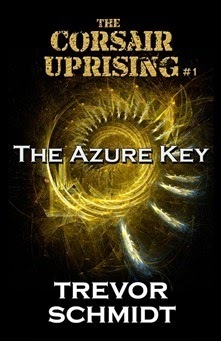 "Liam Kidd was a freelancer for Vesta Corporation, Earth's largest and most corrupt asteroid mining company. Through a series of events he finds himself working the mines, a fate worse than death. When an opportunity presents itself, he and two other miners escape through a nearby wormhole. They find themselves across the galaxy in the middle of a conflict between three alien species. Liam's only chance of getting home lies in finding a device rumored to be capable of opening a singularity. Now, he and his crew must face the horrors of war to return to their own system, a challenge that might prove deadly."
Interview with the Author:
Q - What sets The Corsair Uprising Series apart from the other science fiction series' out there?A - The Corsair Uprising Series is really a mix of genres told at a lightning-fast pace that will keep readers entertained. There are faint elements of steampunk, though, without giving anything away, it's related to various alien races rather than 19th century Earth. At its core, The Corsair Uprising is a space opera. I've heard readers describe the series as Star Wars meets Firefly and I don't think they'd be wrong. I was definitely influenced by big screen romps as well as small-screen gems that were cancelled too soon.
Q - Why should I give the series a try?A - The series is very fast-paced with twists that get more complex and potentially shocking as it progresses. Fans of classic sci-fi will enjoy the relatively shorter novels (about 200-250 pages) and an increased release rate. I've been on pace to release multiple novels in the series a year and each book adds a new dynamic that will make the reader hungry for more.
Synopsis:
"Liam Kidd was a freelancer for Vesta Corporation, Earth's largest and most corrupt asteroid mining company. Through a series of events he finds himself working the mines, a fate worse than death. When an opportunity presents itself, he and two other miners escape through a nearby wormhole. They find themselves across the galaxy in the middle of a conflict between three alien species. Liam's only chance of getting home lies in finding a device rumored to be capable of opening a singularity. Now, he and his crew must face the horrors of war to return to their own system, a challenge that might prove deadly."Interview with the Author:
Q - What sets The Corsair Uprising Series apart from the other science fiction series' out there?A - The Corsair Uprising Series is really a mix of genres told at a lightning-fast pace that will keep readers entertained. There are faint elements of steampunk, though, without giving anything away, it's related to various alien races rather than 19th century Earth. At its core, The Corsair Uprising is a space opera. I've heard readers describe the series as Star Wars meets Firefly and I don't think they'd be wrong. I was definitely influenced by big screen romps as well as small-screen gems that were cancelled too soon.
Q - Why should I give the series a try?A - The series is very fast-paced with twists that get more complex and potentially shocking as it progresses. Fans of classic sci-fi will enjoy the relatively shorter novels (about 200-250 pages) and an increased release rate. I've been on pace to release multiple novels in the series a year and each book adds a new dynamic that will make the reader hungry for more.
April 10, 2015
Epic Channel Trailer for my Youtube Channel!
I talk about Writing, Social Media, and the Publishing Industry! Don't miss my latest video meow!
New Videos every Wednesday!
New Videos every Wednesday!
99 Cent Book Blast! Get more than a hundred books for 99 cents each!
 Over 175 ebooks from over 150 authors--including USA Today Bestsellers--are on sale for 99 cents. This promo will last only April 10th, 11th, and 12th. Find paranormal, fantasy, romance, and much more. Don't forget to tell your friends so they can one-click too! Visit the 99 Cent Book Blast.
Grab The Azure Key for 99 cents this weekend!
April 8, 2015
5 Steps to Setting the Scene in a Novel or Story
April 1, 2015
A 4-Step Guide To World-Building: Not Just For Sci-Fi/Fantasy Authors
World-Building has long been associated with thousand-page epic fantasy novels and off-world sci-fi books in which the setting and rules of that world directly affect what happens in the story and why it happens. I'm here to tell you that world-building does not just have to be for sci-fi/fantasy novels. I'm going to present you with a few reasons you might want to take a second look at the practice.
Many assume that world-building exists because the author wants to set their fictional world apart from the world we live in, and for the most part, they would be right. However, I'm going to argue that world-building exists to set up expectations for the reader. The human mind loves to make patterns, and putting everything into their own sorted boxes is not just for the OCD among us. Humans subconsciously do this all the time whether they admit to it or not. The practice of world-building, in my option, exists to feed into the reader's subconscious desire to categorize everything, only to shatter those expectations at a later time. Notice that I haven't mentioned sci-fi or fantasy at all in my description, which will come into play later. Getting too heady for you yet? Let's break it down into a few steps that will get you started.
1. Fysiks (Not just for Newton)
Generally speaking, the concept of physics from world to world varies only minimally between novels because most of us have a notion that there is gravity on Earth and differing amounts on other planets/planetoids/moons and none at all in outer space. This goes beyond gravity, but it's important that if you're going to mess with this whole physics thing, you should do it early in your novel. Nothing will throw off a reader more than finding out halfway through a novel that all of the previous action took place in half gravity. Can you have a different set of physics in a non-sci-fi/fantasy world? Maybe. What if one of your characters believes physics acts differently for him than for everyone else. Maybe he has a psychological disorder. Does the reader know he's crazy? What if it was from the perspective of the delusional man? Is he actually delusional, or is everyone else crazy? Something to think about.
2. Back Story
This is definitely something that applies to stories outside the sci-fi/fantasy realm. In your novel, are historical events exactly as they happened in the real world, where your fictional characters fit in precisely somehow, or is something different? If you're going to create alternate histories or detailed back stories for your characters I have a few suggestions that could help. As a reader, I find long descriptions that last for pages talking about someone's ancestry boring. I just don't have that kind of attention span. What I suggest is that you introduce a few factoids early that introduce this history as it relates to your character, and then keep putting in bits and pieces as you go along that add depth to your character. One of my favorite things to do is to give a reader very little information about a character upfront, such that they form their own opinion about that character. Then, as I introduce more information about that character, the reader starts to realize that their initial opinions were dreadfully wrong. Maybe that good guy isn't so good. Maybe that bad guy isn't so bad. Or, maybe that rogue is exactly what you initially thought and they can seldom be trusted. The point is that every novel needs a history, a back story, somewhere. How you implement it is key. I'm a fan of sprinkling details throughout the novel to add depth at the least expected times.
3. Rule Systems
This extends beyond the systems of magic, power, and more that you might find in a sci-fi/fantasy novel. In those types of novels, it's important to show that certain characters hold certain levels of power or influence, especially early on, because then your reader knows what to expect going forward. For instance, in Star Wars Episode IV: A New Hope, what is the first thing Darth Vader does? He kills a guy. He uses the Force to strangle someone who displeased him. This set him up as a powerful villain who possesses some kind of supernatural powers. Even though he doesn't do a whole lot until much later in the series and we don't yet understand what he was able to do with his powers, we as viewers still see him as dangerous and evil. But now I'm going down the sci-fi rabbit hole. I digress...
Rule systems don't have to be just for sci-fi/fantasy. Let me give you an example. What if your novel took place in a concentration camp during World War II. There are certainly lots of rules there, right? The commander of that camp could be introduced as evil, or perhaps even likable but in an unfortunate situation. The guards could enforce certain rules early on that give your characters reason to be afraid. In each of these situations, it's important to set it up early. If it were me, I would set up my readers' expectations in the first three chapters or so. That way, they know what to expect and I will have them in my clutches.
4. You've got me, what now?
So, you've set up your reader's expectations, defined the physics, back stories, and rule systems for your world, now what do you do? This is when you exercise every sadistic muscle in your body. If you've done your job correctly, your reader will manifest these expectations with little argument, after all, they want to put everything in little boxes. However, not many books 'make it' that don't shatter these expectations in some way. This doesn't have to be done by killing off a beloved character, but there are times when this could certainly help. What does have to happen is a moment in the book that makes the reader stop, backtrack a few sentences, and read again. If you make your reader stumble because you've added a surprise twist or shattered their expectations in some way, you're doing your readers a service. Readers will remember your work, if only for that moment, and that is half the battle in this sea of new authors.
For some examples of World-Building, I suggest you check out The Azure Key, the first in my science fiction series The Corsair Uprising! It's just 99 cents!
How about it gang? What are your thoughts on world-building, expectations, and Earth-Shattering Revelations? Leave a comment below and your argument could be addressed in a future post!
UPDATE (4/3/2015): Read Devan Stormont's article that uses my steps listed above and applies them to writing code. When World's Collide: How Writing Fiction Intersects with Writing Code. Note: Devan is the creator of the popular app Weather Route, who I interviewed in an earlier post.
Many assume that world-building exists because the author wants to set their fictional world apart from the world we live in, and for the most part, they would be right. However, I'm going to argue that world-building exists to set up expectations for the reader. The human mind loves to make patterns, and putting everything into their own sorted boxes is not just for the OCD among us. Humans subconsciously do this all the time whether they admit to it or not. The practice of world-building, in my option, exists to feed into the reader's subconscious desire to categorize everything, only to shatter those expectations at a later time. Notice that I haven't mentioned sci-fi or fantasy at all in my description, which will come into play later. Getting too heady for you yet? Let's break it down into a few steps that will get you started.
1. Fysiks (Not just for Newton)
Generally speaking, the concept of physics from world to world varies only minimally between novels because most of us have a notion that there is gravity on Earth and differing amounts on other planets/planetoids/moons and none at all in outer space. This goes beyond gravity, but it's important that if you're going to mess with this whole physics thing, you should do it early in your novel. Nothing will throw off a reader more than finding out halfway through a novel that all of the previous action took place in half gravity. Can you have a different set of physics in a non-sci-fi/fantasy world? Maybe. What if one of your characters believes physics acts differently for him than for everyone else. Maybe he has a psychological disorder. Does the reader know he's crazy? What if it was from the perspective of the delusional man? Is he actually delusional, or is everyone else crazy? Something to think about.
2. Back Story
This is definitely something that applies to stories outside the sci-fi/fantasy realm. In your novel, are historical events exactly as they happened in the real world, where your fictional characters fit in precisely somehow, or is something different? If you're going to create alternate histories or detailed back stories for your characters I have a few suggestions that could help. As a reader, I find long descriptions that last for pages talking about someone's ancestry boring. I just don't have that kind of attention span. What I suggest is that you introduce a few factoids early that introduce this history as it relates to your character, and then keep putting in bits and pieces as you go along that add depth to your character. One of my favorite things to do is to give a reader very little information about a character upfront, such that they form their own opinion about that character. Then, as I introduce more information about that character, the reader starts to realize that their initial opinions were dreadfully wrong. Maybe that good guy isn't so good. Maybe that bad guy isn't so bad. Or, maybe that rogue is exactly what you initially thought and they can seldom be trusted. The point is that every novel needs a history, a back story, somewhere. How you implement it is key. I'm a fan of sprinkling details throughout the novel to add depth at the least expected times.
3. Rule Systems
This extends beyond the systems of magic, power, and more that you might find in a sci-fi/fantasy novel. In those types of novels, it's important to show that certain characters hold certain levels of power or influence, especially early on, because then your reader knows what to expect going forward. For instance, in Star Wars Episode IV: A New Hope, what is the first thing Darth Vader does? He kills a guy. He uses the Force to strangle someone who displeased him. This set him up as a powerful villain who possesses some kind of supernatural powers. Even though he doesn't do a whole lot until much later in the series and we don't yet understand what he was able to do with his powers, we as viewers still see him as dangerous and evil. But now I'm going down the sci-fi rabbit hole. I digress...
Rule systems don't have to be just for sci-fi/fantasy. Let me give you an example. What if your novel took place in a concentration camp during World War II. There are certainly lots of rules there, right? The commander of that camp could be introduced as evil, or perhaps even likable but in an unfortunate situation. The guards could enforce certain rules early on that give your characters reason to be afraid. In each of these situations, it's important to set it up early. If it were me, I would set up my readers' expectations in the first three chapters or so. That way, they know what to expect and I will have them in my clutches.
4. You've got me, what now?
So, you've set up your reader's expectations, defined the physics, back stories, and rule systems for your world, now what do you do? This is when you exercise every sadistic muscle in your body. If you've done your job correctly, your reader will manifest these expectations with little argument, after all, they want to put everything in little boxes. However, not many books 'make it' that don't shatter these expectations in some way. This doesn't have to be done by killing off a beloved character, but there are times when this could certainly help. What does have to happen is a moment in the book that makes the reader stop, backtrack a few sentences, and read again. If you make your reader stumble because you've added a surprise twist or shattered their expectations in some way, you're doing your readers a service. Readers will remember your work, if only for that moment, and that is half the battle in this sea of new authors.
For some examples of World-Building, I suggest you check out The Azure Key, the first in my science fiction series The Corsair Uprising! It's just 99 cents!
How about it gang? What are your thoughts on world-building, expectations, and Earth-Shattering Revelations? Leave a comment below and your argument could be addressed in a future post!
UPDATE (4/3/2015): Read Devan Stormont's article that uses my steps listed above and applies them to writing code. When World's Collide: How Writing Fiction Intersects with Writing Code. Note: Devan is the creator of the popular app Weather Route, who I interviewed in an earlier post.
March 28, 2015
Blog Tour: Stifled by Rainy Kaye is Out Now!
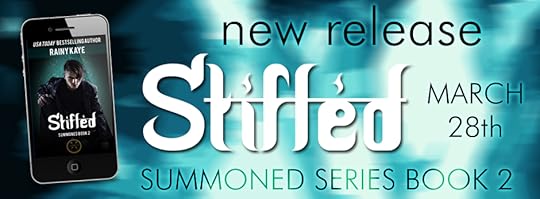 Today we're celebrating the release of STIFLED, book two in the SUMMONED series by USA Today Bestselling author, Rainy Kaye. A dark twist on genie folklore, SUMMONED follows a reluctant criminal as he unravels the mystery of the paranormal bond controlling him. In STIFLED, Dimitri trails an elusive jinn and finds himself in the middle of a community keeping dark secrets. The SUMMONED series is represented by Rossano Trentin of TZLA. Scroll down to pick up your copy of STIFLED, get SUMMONED for free for a limited time, and enter to win a $10 Amazon gift card.
 Dimitri would like nothing more than to live a low-key life in Naples, Italy. His girlfriend, Syd, has other plans. After three months of researching, she is positive she has found a jinn on a killing spree in San Diego, California. Since Syd gave Dimitri the one thing he thought was out of reach, he feels obligated to use his ill-gained talents for her cause. A few hours back in the US proves that Dimitri and Syd didn't quite make the clean escape they had thought. As they trail the elusive jinn, someone else trails them. What should have been a simple trip to confirm once and for all if the jinn are living among humans, instead reveals a community keeping dark secrets. Unfortunately for Dim, the only way out is in. Get your copy here! Haven't read book one yet? No problem! It's currently FREE on Amazon.
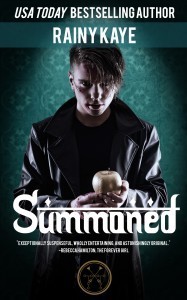 Twenty-three year old Dimitri has to do what he is toldóliterally. Controlled by a paranormal bond, he is forced to use his wits to fulfill unlimited deadly wishes made by multimillionaire Karl Walker. Dimitri has no idea how his family line became trapped in the genie bond. He just knows resisting has never ended well. When he meets Sydóassertive, sexy, intelligent Sydóhe becomes determined to make her his own. Except Karl has ensured Dimitri canít tell anyone about the bond, and Syd isnít the type to tolerate secrets. Then Karl starts sending him away on back-to-back wishes. Unable to balance love and lies, Dimitri sets out to uncover Karlís ultimate plan and put it to an end. But doing so forces him to confront the one wish he never saw comingóthe wish that will destroy him.

 Rainy Kaye is an aspiring overlord. In the mean time, she blogs at RainyoftheDark and writes paranormal novels from her lair somewhere in Phoenix, Arizona. She is represented by Rossano Trentin of TZLA. Someone told her she's a USA Today Bestselling author. She thought there would be cake.
  a Rafflecopter giveaway
March 25, 2015
How To Get The Most Out Of Twitter: For Authors
What the tweet are you doing with your twitter account? If you're just retweeting what others say or hardly tweeting at all, you're doing it wrong. After reading this short primer, hopefully you can take your twitter account from useless space on the internet, to something useful that will drive sales and help you make a name for yourself. A tall order? Maybe. But not as tall as you might think.
Note: some people have asked how much time I spend on Twitter. The answer is less than an hour a day spread out as much as possible. Step 2 takes me about 10 minutes a day, and the rest is spent crafting tweets or goofing around looking for something cool to retweet. I could probably do it in less time if I was a little more foc--Squirrel!
If you'd like to follow me on Twitter, now's your chance! I follow other authors, readers, and real people I find interesting!
1. Who are you following and what do they do? (Using Arnold Schwarzenegger's Voice, of course)
Twitter is a funny thing. If you're sitting around wondering why people aren't following you and you think it has something to do with your tweets, you could be right, but there's probably something bigger at play. Unless you're a celebrity or well-known and already established as an author, you probably won't get any meaningful number of followers at first. Not only that, but your ratio of followers to the number of people you are following will probably be about even, or even skewed more toward following. Is that a bad thing? No. I would contend that it just 'is.' If you're just starting out and you want more followers, guess what you have to do? Follow other people! But how?
2. Crowdfire.
Crowdfire is a free (with premium options) website that allows you to unfollow those people who have not followed you back. If that sounds familiar, it could be because they changed their name from JustUnfollow recently. So, step 1, follow a bunch of people, step 2, unfollow those that don't follow you back. That's not so hard I guess. Hold on. Using the website, you can also do a search of twitter users using keywords that is a little more in depth than the search on twitter, and follow 50 people this way every day. There are a number of other options you can use that make the process more complicated, but also more effective. But who the heck do you follow?
3. Who the heck do I follow?
I would start with other authors for two reasons. Number 1, authors are generally readers themselves, and I've had a number of people tweet me and tell me that they've bought my books after following me (verified with KDP's sales tracker). Number 2, authors tend to follow back, meaning if you follow them, then they follow you. If you use Crowdfire, these people will not show up in your list of people to unfollow, and if they use the same service, you will always follow one another. Beyond authors, who are plentiful on Twitter, I would search for readers or fans of genres similar to the one in which you write. But don't stop there! Also add people and businesses around where you live. I have a number of followers in the Reno area who consistently retweet my tweets to support a local author. People dig this stuff.
4. What do I tweet?
Here, I would say refrain from anything too political unless your writing concerns politics or political thrillers and it's relevant. You can do a lot on twitter without offending or alienating your readers. Most of my posts are more personal, with the occasional retweet from a celebrity I like or a scientist who posts something interested related to my work. About 10-20% of my tweets are actually promotion for my novels with links to Amazon or this blog.
5. How do I know it's working?
With recent updates to Twitter, there's actually a number of ways to know if you're having an impact. There's a little symbol found near the star (favorite) icon at the bottom of each tweet. This will bring up the stats for that tweet, including how many people have seen it and how many have clicked the link, etc. Beyond that, I look at the Google analytics on my blog and can see when I get traffic from twitter or a boom in views right after a tweet. Finally, you can use your number of followers as a gauge of how effective your twitter campaign is. For instance, my number of followers has continued to grow consistently since I broke the 2,000 follower mark. Since then, I've gained about 1,000 a month and that number keeps going up. It turns out, the more followers you have the more attractive you become to other authors who are on the same path as you. They likely see that I have around 7,200 followers and am following 7,500 people (as of this writing) so it's likely that I'll follow another author back. (Which I always try to do).
6. Engagement.
Authors on twitter have a sort of unspoken community. When you can, reply to other authors' tweets or retweet something they say if it's interesting. What goes around comes around, and you'll be building up a relationship with that other author. Twitter sort of revolves around this pay it forward system, where if you give out retweets and favorites you'll likely get a return from them or someone else in spades.
7. Promocave.
This is a newer website and Twitter community that is anything but unspoken. If you're an author, definitely look them up on Twitter, follow them, and then sign up on their website and promote your books. Promocave's purpose is to help authors network with each other. When I post something and add #Promocave to the end of it, I'll often get around 50 retweets, allowing my post to be seen by thousands of people. The more people that get involved with this, the more effective it will be for everyone!
8. And another thing: Hashtags ###
A post without a Hashtag will likely only be seen by a select few who stumble across it. I often use #Amwriting, #Amreading, #Promocave, or something more specific to my post. Try to leave room at the end for a Hashtag and you'll end up seeing random people follow you. Going back to Crowdfire, you might want to be selective about the 'fans' section (which is people who follow you that you don't follow). You'll get some bots and some crazies that aren't worth following. However, if you see another author or an actual person who seems like they might like your work, I would definitely follow them back, if only to prevent them from unfollowing you. Most readers would love it if an author they dig follows them on Twitter. They might even tell their friends.
Do you have any more suggestions for being successful on Twitter? Sound off in the comments below if you have something to add or have a question about Twitter or other social media sites.
Note: some people have asked how much time I spend on Twitter. The answer is less than an hour a day spread out as much as possible. Step 2 takes me about 10 minutes a day, and the rest is spent crafting tweets or goofing around looking for something cool to retweet. I could probably do it in less time if I was a little more foc--Squirrel!
If you'd like to follow me on Twitter, now's your chance! I follow other authors, readers, and real people I find interesting!
1. Who are you following and what do they do? (Using Arnold Schwarzenegger's Voice, of course)
Twitter is a funny thing. If you're sitting around wondering why people aren't following you and you think it has something to do with your tweets, you could be right, but there's probably something bigger at play. Unless you're a celebrity or well-known and already established as an author, you probably won't get any meaningful number of followers at first. Not only that, but your ratio of followers to the number of people you are following will probably be about even, or even skewed more toward following. Is that a bad thing? No. I would contend that it just 'is.' If you're just starting out and you want more followers, guess what you have to do? Follow other people! But how?
2. Crowdfire.
Crowdfire is a free (with premium options) website that allows you to unfollow those people who have not followed you back. If that sounds familiar, it could be because they changed their name from JustUnfollow recently. So, step 1, follow a bunch of people, step 2, unfollow those that don't follow you back. That's not so hard I guess. Hold on. Using the website, you can also do a search of twitter users using keywords that is a little more in depth than the search on twitter, and follow 50 people this way every day. There are a number of other options you can use that make the process more complicated, but also more effective. But who the heck do you follow?
3. Who the heck do I follow?
I would start with other authors for two reasons. Number 1, authors are generally readers themselves, and I've had a number of people tweet me and tell me that they've bought my books after following me (verified with KDP's sales tracker). Number 2, authors tend to follow back, meaning if you follow them, then they follow you. If you use Crowdfire, these people will not show up in your list of people to unfollow, and if they use the same service, you will always follow one another. Beyond authors, who are plentiful on Twitter, I would search for readers or fans of genres similar to the one in which you write. But don't stop there! Also add people and businesses around where you live. I have a number of followers in the Reno area who consistently retweet my tweets to support a local author. People dig this stuff.
4. What do I tweet?
Here, I would say refrain from anything too political unless your writing concerns politics or political thrillers and it's relevant. You can do a lot on twitter without offending or alienating your readers. Most of my posts are more personal, with the occasional retweet from a celebrity I like or a scientist who posts something interested related to my work. About 10-20% of my tweets are actually promotion for my novels with links to Amazon or this blog.
5. How do I know it's working?
With recent updates to Twitter, there's actually a number of ways to know if you're having an impact. There's a little symbol found near the star (favorite) icon at the bottom of each tweet. This will bring up the stats for that tweet, including how many people have seen it and how many have clicked the link, etc. Beyond that, I look at the Google analytics on my blog and can see when I get traffic from twitter or a boom in views right after a tweet. Finally, you can use your number of followers as a gauge of how effective your twitter campaign is. For instance, my number of followers has continued to grow consistently since I broke the 2,000 follower mark. Since then, I've gained about 1,000 a month and that number keeps going up. It turns out, the more followers you have the more attractive you become to other authors who are on the same path as you. They likely see that I have around 7,200 followers and am following 7,500 people (as of this writing) so it's likely that I'll follow another author back. (Which I always try to do).
6. Engagement.
Authors on twitter have a sort of unspoken community. When you can, reply to other authors' tweets or retweet something they say if it's interesting. What goes around comes around, and you'll be building up a relationship with that other author. Twitter sort of revolves around this pay it forward system, where if you give out retweets and favorites you'll likely get a return from them or someone else in spades.
7. Promocave.
This is a newer website and Twitter community that is anything but unspoken. If you're an author, definitely look them up on Twitter, follow them, and then sign up on their website and promote your books. Promocave's purpose is to help authors network with each other. When I post something and add #Promocave to the end of it, I'll often get around 50 retweets, allowing my post to be seen by thousands of people. The more people that get involved with this, the more effective it will be for everyone!
8. And another thing: Hashtags ###
A post without a Hashtag will likely only be seen by a select few who stumble across it. I often use #Amwriting, #Amreading, #Promocave, or something more specific to my post. Try to leave room at the end for a Hashtag and you'll end up seeing random people follow you. Going back to Crowdfire, you might want to be selective about the 'fans' section (which is people who follow you that you don't follow). You'll get some bots and some crazies that aren't worth following. However, if you see another author or an actual person who seems like they might like your work, I would definitely follow them back, if only to prevent them from unfollowing you. Most readers would love it if an author they dig follows them on Twitter. They might even tell their friends.
Do you have any more suggestions for being successful on Twitter? Sound off in the comments below if you have something to add or have a question about Twitter or other social media sites.
March 15, 2015
Science Sunday: Jupiter's Moon Houses Salty Ocean
Using the Hubble Space Telescope, scientists have found that Ganymede, Jupiter's moon, has a salt ocean with more water than the Earth. Scientists believe the ocean is 60 miles thick, which is about 10 times the depth of Earth's oceans. If this doesn't get Jules Verne-ians excited, I don't know what will. In addition to pictures of the moon from Hubble, scientists have measure the magnetic field of the moon, which provides even stronger evidence of such a body of water underneath the surface potentially caused by Cryo-Volcanoes. What's more,scientists are looking beyond Ganymede to Europa and Callisto as other icy moons with likely sources of water and, thus, the potential for life whether past or present.
But why, Trevor? Why should I care? This means that our solar system is a wet place, where oceans and salt water is not confined to Earth, but rather, exists in abundance. If there are oceans on moons as well as Earth here in the Sol System, then it can be extrapolated that there are oceans on planets outside of our solar system. Generally, life as we know it requires water to survive. Going further, this could mean life on other planets or moons outside of our solar system.
In my opinion we would be silly to believe there is not life somewhere else in the universe, whether it exists presently, or at some point in the past or will exist at some time in the future. Astronomers estimate that there are more than 100 billion galaxies in the universe and our own galaxy, The Milky Way, is home to over 300 billion stars. Now, math is not my strong suit, but even I know that the odds are against being alone in the universe.
What do you think? Are we alone? Or are there super-intelligent plant-people out there somewhere? Leave a response in the space below, the wackier the better.
Don't forget to download a free copy of my Sci-Fi Thriller Symbiote, which deals with one possible form of life arriving on Earth via meteorite.
But why, Trevor? Why should I care? This means that our solar system is a wet place, where oceans and salt water is not confined to Earth, but rather, exists in abundance. If there are oceans on moons as well as Earth here in the Sol System, then it can be extrapolated that there are oceans on planets outside of our solar system. Generally, life as we know it requires water to survive. Going further, this could mean life on other planets or moons outside of our solar system.
In my opinion we would be silly to believe there is not life somewhere else in the universe, whether it exists presently, or at some point in the past or will exist at some time in the future. Astronomers estimate that there are more than 100 billion galaxies in the universe and our own galaxy, The Milky Way, is home to over 300 billion stars. Now, math is not my strong suit, but even I know that the odds are against being alone in the universe.
What do you think? Are we alone? Or are there super-intelligent plant-people out there somewhere? Leave a response in the space below, the wackier the better.
Don't forget to download a free copy of my Sci-Fi Thriller Symbiote, which deals with one possible form of life arriving on Earth via meteorite.


