Daniel Whyte III's Blog, page 2
March 16, 2019
Read the Introduction for “Gratitude Is…,” by Daniella Whyte
For the past year, I have been on an intentional journey of discovering what gratitude is. From a previous book that I compiled and edited two years ago, I have carefully looked at Scripture, research, articles, and quotes about what gratitude is, what it means to be grateful, and the effects it has on and in our lives when we choose it. While gratitude is many things, I have discovered that gratitude is much more than an idea, much more than a feeling, and much more than a simple thank you. It is a way of life that does not often come naturally, but can be developed, cultivated, and nurtured on a daily basis.
This journey has been much more than just a study of Bible verses or a research project. For me, this journey is a personal journey — one that I am still on. As in most journeys that lead to a fruitful place, this uphill climb is not easy. From time to time, God, in His grace and mercy, will show me things that are not right in my heart, responses to situations that are less than reflective of a grateful attitude, and thoughts that are not up to the standards I encourage others to live by.
This process is very much needed in my life. And I am grateful that God uses people and situations to bring me out of my own finite perspective into a perspective that is more beautiful and beneficial than I could ever imagine. Many people have already proven that no experience in life, whether outward or inward, good or bad, is ever wasted if we learn from it and strive to make the changes.
There is a reason that the Bible is replete with admonitions and commands to be grateful. Gratitude is an often overlooked virtue, but it is not an overlooked biblical principle. God warrants appreciation and doing so draws us closer to Him and allows us to experience certain inner and outer blessings that we may not otherwise experience. Gratitude is very close to grace and grace is very close to the heart of God. We are all living because of grace, and God, in all His glory and power, wants us to feel gratitude in our hearts in such a way that it forces us to express it at any given time.
Gratitude Is… is an opportunity for you to discover the things I discovered about gratitude. It is an invitation to join me on this journey of developing a lifestyle of gratitude and experiencing the joy and freedom that such a lifestyle brings. Gratitude brings more than just a new attitude to situations, it brings a new heart, a new mind, and a new outlook on life.
While gratitude brings many blessings, both seen and unseen, if I am not careful, I can fall back into ingratitude. I can start focusing on what is going wrong instead of what is going right, what I don’t have instead of what I do have. A lack of gratitude pulls us into doubt, fear, depression, worry, bitterness, frustration, selfishness and complaining. All of these things tear at our lives and keep us confined to a dangerous cycle of negative thoughts and behaviors that hinder us from making progress and living the abundant life that is ours to live.
Choosing gratitude saves us from all these feelings. It holds us back from falling into these attitudes that our human nature pulls us to – attitudes of entitlement, pride, and greed. Gratitude causes us to see the best even in the worst situations. It gives us joy for the journey, contentment beyond measure, and a wonderful perspective on life. It is easy to say with our mouth, I’m going to be grateful, but it is a consistent, mindful, heartfelt decision that actually causes us to live life in a grateful manner.
In Gratitude Is… you will find that gratitude is joy, contentment, peace, freedom, and a host of other things that are too numerous to name. Gratitude is… also a wonderful way of life that requires us to make a daily choice that not only benefits us, but also can inspire the people around us to experience gratitude in their own lives.
As we will see in the pages of this book, gratitude is not just something we do; it offers us something in return. It changes our lives, our minds, and our perspectives if we let it. Firmly planted in God’s grace, gratitude changes our response to everything in life. Even when things are not the best, gratitude beckons us to sing “it is well, it is well with my soul.”
So join me as we embark on an adventure of discovering what Gratitude Is. I hope that this journey will help you to experience all of the benefits that gratitude has to offer and will draw you closer to living the wonderful life that we all have an opportunity to live.


March 13, 2019
3 Reasons to Be Thankful (from “365 Days of Thanking God,” by Daniella Whyte)
God expects thanksgiving from His creation.
Psalm 100:4 says, “Enter into His gates with thanksgiving…” What kind of God would God be if He kept on blessing us, but He did not expect some praise in return? When we thank God for things He does for us everyday, He appreciates that. You might be saying, ‘Well, I don’t have a job’ or ‘My family is in trouble’ or ‘Someone close to me is seriously ill.’ God understands all of that because He knew where you would be and what you would be doing right now before you were even born. The point is, inspite of everything else that is going on in our lives, if we are alive, we need to be thankful.
People react differently to thankful people.
Not only does God expect thankfulness, but human beings react differently to people who are thankful. If you do something for someone and he or she does not show appreciation to you, will you be more or less eager to do something else for that person the next time around? That’s a question you can answer. Thankfulness is a very simple concept; it is very elementary. Being thankful not only shows good manners, but a simple expression of thankfulness can go a long way in relationships and communication with others. It not only enhances our own lives, but makes other people feel appreciated.
We feel better about ourselves if we exhibit thankfulness.
Not only does God expect our thankfulness and praise and not only do other people react differently to our thankful attitude, but on the inside, we feel better about ourselves if we exhibit a thankful attitude and behaviour. Thankfulness is not just about words because words can be said without meaning, and they often are. Thankfulness is about the condition of our heart because everything that is done from the heart is sincere. Many of us can ask for what we want and oftentimes will get it. But if we are not truly thankful from the heart for what we already have, then we block our opportunities to obtain more.
I believe that contentment in life begins with having a thankful heart. Things change when we exhibit thankfulness and mean it. So, may I encourage you to let yourself be reminded of all the good (and the not so good) things that have happened in your life. As an old hymn says, “Count your blessings, name them one by one.” And you will soon realize that even if you aren’t rich, even if you’re not in the best situation, even if you aren’t popular or powerful, you and I have a lot to be thankful for.
Read an Excerpt from “Resurrection Sunday”
John Dyer glanced at his watch as he placed the key in the car’s ignition. “Only two p.m.,” he sighed. He looked into the rear-view mirror and watched the other employees going to their vehicles. Never in my twenty years at Carrier Air Conditioning Systems have I thought I would be laid off—just like that—without any prior notice whatsoever, he thought.
John Dyer and five of his co-workers had been summoned by Mr. Davies, their manager, to meet with him in his office. John thought it was going to be another meeting to discuss a problem or a new opportunity, but what he heard hit him like a ton of bricks.
“Gentlemen, I have some unfortunate news for you,” Mr. Davies said. “The company has downsized to keep costs under control, and we’ve decided to let you go two weeks from now. I’m sorry.” Davies paused and looked down at his clasped hands. “I hate that we’ve had to do this… but if I can help you in any way—”
“Yeah, you can give me my job back,” one employee said.
“Mr. Davies, I invested fifteen years of my life here at Carrier. You can’t just drop me like that,” another employee said.
“How am I supposed to take care of my wife and children?” a third employee asked. “Two weeks is not enough time to find a job with comparable pay. Do you know what the job market is like out there?”
“Men, I understand what you are going to go through. I was without a job for a few months before I secured one here,” Mr. Davies said. “All I do is deliver the mail. I wish I didn’t have to. Any complaints you have, you’ll have to take it up with higher management. I tried to put in a good word for each of you, but that didn’t help.”
“Do you know of any job leads, Mr. Davies?” John Dyer asked.
“John, I wish I knew of some right now, but I’ll keep my eyes and ears open. Feel free to use me as a reference. I’ll definitely put in a good word for you, and good luck.”
John shook hands with Mr. Davies before following his co-workers out the door. “Thank you for all you have done for us. It’s been great working here.”
Mr. Davies was touched by his kind words considering the bad news he had just delivered. John had always been a good worker. “I’m sorry, John. I wish I could have stopped it.”
“What are you going to do?” Marvin asked John as they walked down the hallway back to their work room.
“Beats me,” John replied with a shrug of the shoulders. “Try to get another job somewhere, I guess.”
“Yeah, if you can find one.”
March 12, 2019
Read an Excerpt from “The Thanksgiving Letters”
Gretchen McMillan pulled into the parking lot of the Executive Suites office complex. She gracefully stepped out of her silver Maxima. Pushing the car door shut, she looked up at the tallest of the buildings — The Patriarch — standing twelve stories tall. Well, that’s a biblical name, she thought with a smile as she pushed the double glass doors open. She stopped by the receptionist’s desk.
“Yes, ma’am, may I help you?” a receptionist asked. Her name tag read Cressida.
“I’m here to see Alexander Fleming, Attorney Alexander Fleming,” Gretchen said.
“He’s on the twelfth floor. Should I notify him that you are on your way up?” Cressida asked.
“No need to do that. He’s expecting me,” Gretchen said pushing her glasses up on her nose.
“Okay, well, the elevators are down to your left next to the vending machines. Have a wonderful day.”
“Thank you and you have a God-blessed day as well.”
Gretchen entered the elevator and after pressing the button for floor twelve, she turned her thoughts to the business at hand.
Alexander Fleming. She had never heard of him before. She had taken the opportunity to look him up online and she was quite impressed with what she saw and read from the testimonials. His personal secretary summoned him as soon as she reached his office.
“Ms. McMillan, it is good to meet you,” Alexander Fleming said, reaching out to shake her hand. “How can I help you?”
Gretchen McMillan pulled an envelope out of her purse. She passed it to Mr. Fleming. “This should explain why I am here,” she said, handing him the envelope. Gretchen made herself comfortable on one of the soft leather chairs in front of his mahogany desk. As he read the contents of the letter, Gretchen observed him carefully.
Alexander Fleming seemed to be in his early forties. He was well-dressed in a tailor-made, grey suit. His silk red tie added a rich touch. Silver cuff links and a silver watch complimented his outfit. Gretchen took special note of his wedding band — silver plated with three small stones. Mmmm, he must be doing well financially, she observed.
She took note of how he pursed his lips together, quivering his eyebrows as he read the letter. He blinked twice in rapid succession. He never once took his eyes off the letter except for one brief glance at her.
Read an Excerpt from “Easter According to the Apostles’ Creed”
If you have ever attended a Lutheran, Anglican, Methodist, or Presbyterian church, you may have heard something similar to the words which are referred to as the Apostles’ Creed. Now, Baptists (I am an ordained minister in the Baptist denomination), as a rule, do not subscribe to any creed. Coming out of the Protestant Reformation, Baptists decided that, unlike other Protestant denominations, they would be non-creedal. Baptists state that “the final authority for faith and practice is the Bible, not words about the Bible.” However, while I do not hold any creed to the level of inspired Scripture, I believe that there are some elements from other parts of the church that are good that we should at least be aware of and that we can learn from.
The Apostles’ Creed is one of those things.
What is a creed? According to Merriam-Webster Dictionary, a creed is a “statement of basic beliefs; an idea or set of beliefs that guides the actions of a person or group.” Thus, the Apostles’ Creed is a statement of what the apostles of Jesus Christ believed.
The earliest written version of the Apostles’ Creed is known as the “old Roman creed” (or “old Roman symbol”). According to the Oxford Dictionary of the Christian Church, it was put in written form by 180 AD. Tradition states that, on the day of Pentecost, the twelve Apostles each contributed one line to this creed to make up the twelve lines of the “old Roman creed” that we have today. It goes as follows:
I believe in God the Father almighty;
and in Christ Jesus His only Son, our Lord,
Who was born from the Holy Spirit and the Virgin Mary,
Who under Pontius Pilate was crucified and buried,
on the third day rose again from the dead,
ascended to heaven,
sits at the right hand of the Father,
whence He will come to judge the living and the dead;
and in the Holy Spirit,
the holy Church,
the remission of sins,
the resurrection of the flesh
(the life everlasting)
March 11, 2019
Read an Excerpt from “The Unsung Heroes of Easter”
 The Unsung Heroes of Easter
Neither the Bible nor history tells us much about Pilate’s wife. Church tradition indicates that her name was Claudia Procula, and that she later became a follower of Christ. The Greek Orthodox Church regards her as a saint. Other than that, her page in history is blank, but we do have this one verse in Matthew that shows us how her story intersected with the story of Jesus Christ.
Matthew 27:19 says, “When he (that is, Pilate) was set down on the judgment seat, his wife sent unto him, saying, Have thou nothing to do with that just man: for I have suffered many things this day in a dream because of him.”
Scientists tell us that our minds generate dreams based on events in daily life. Our dreams are also affected by what we eat and drink before we go to sleep. While most dreams of this nature are meaningless, the Bible tells us that God sometimes sends people dreams that they should pay attention to. Pilate’s wife, whom we will refer to as Claudia for the purposes of this chapter, experiences one of these kinds of dreams — a dream so terrible and dreadful that it caused anxiety or mental torment or anguish. It was a nightmare from Heaven.
It is interesting that Matthew’s Gospel begins and ends with dreams. What is of particular interest is the dreams that were sent to Gentiles: at the beginning of this Gospel, God saves the Wise Men from Herod’s wrath by sending them a dream with a warning to escape, and at the end of this Gospel, God sends a dream to Pilate’s wife which prompts her to send a warning to Pilate so that her husband would not condemn an innocent man.
We do not know the contents of Claudia’s dream. Spurgeon and other theologians have speculated that Claudia may have dreamed of one of three things. Perhaps she saw Jesus Christ suffering on the cross. Surely, the blood streaming down His body, His anguished cries, and the crown of thorns cruelly crushed atop His head would have vexed this woman’s heart. Surely it would have moved her to send a message to Pilate to have nothing to do with this “just Man.”
Perhaps she saw Christ seated in all His glory at the Great White Throne Judgment and she and her husband standing there before Him. The same One whom Pilate had judged was about to judge him and decree his eternal fate. Certainly that would have moved her greatly.
Or, perhaps, and most terribly of all, she saw her husband being tormented by flames in the dark pit that knows no bottom. Such a terrible dream — a nightmare from Heaven — would have moved her to plead with her husband for the innocent Christ to be left alone.
These are just the ideas that some have proposed down through the centuries regarding what Pilate’s wife may have dreamed about on that day when Jesus was sentenced to die. But, whatever the contents of her dream, God thought it necessary for one of the Gospel writers to include it in his account of the events of Holy Week. I believe there are three messages that are given to us through this simple, one-verse record.
March 10, 2019
Read the Introduction to “The Thanksgiving That Almost Wasn’t”
The Thanksgiving That Almost Wasn’t is based on a true story of how the devil attacked and tried to destroy a Christian family that was trying to live right for the glory of God. As the story unfolds, you will laugh, cry and rejoice with the Johnson family as they go through a temporary but tough separation. But all is not lost. Through love, forgiveness, hope, much prayer and a strong faith in God, read and see how this family was brought back together on their favorite holiday—Thanksgiving—a holiday they had never missed celebrating together. This event in their lives truly testifies to the truth of God’s Word, which says: “All things are possible with God.”
My prayer is that all children and parents who read this book will know that there is hope for your family because faith in God can and will bring you through any difficulty you may go through.
–Daniella Whyte (age 12)
Read the Introduction to “Money Under the Car Seat”
 Money Under the Car Seat & Other Things to Thank God For
As so many American families do, my family loves Thanksgiving. Even though our family is only twenty-seven years old, we have made Thanksgiving a rich tradition in our home that we all look forward to each year.
This book has been in my heart and on my mind, and I have been mentally putting this book together for several years now. As all writers know, a true writer is always writing even when he is not writing. Well, I am glad now that the long pregnancy has come to an end, and the baby has been delivered.
Money Under The Car Seat is simply a light and fresh celebration of an old holiday called Thanksgiving. This book is designed to be taken seriously and it is designed not to be taken seriously. It is largely a fun book that looks at Thanksgiving through fresh eyes. Thanksgiving is a big deal to us and we hope that it is to you as well. This book is intentionally not about the Pilgrims, the Indians, the first Thanksgiving, and all of that “stuffing” most people think of when they think about Thanksgiving.
This book is written to help us remember Who we are thanking, and it is written to encourage people to enjoy thanking Him. We hope that this little book will rekindle an excitement for Thanksgiving in the heart of some who have allowed that fire to dim a little over the years. We also hope that this little book will inspire the Thanksgiving lovers to love this holiday even more and to celebrate it better. We hope that most importantly, it would be used by God to truly turn hearts toward Him so that others, too, can know Him and have a lot to be thankful for, not only on Thanksgiving Day, but every day of the year.
HAVE A GLORIOUS THANKSGIVING!
Read the Introduction to “The Most Exciting and Eventful Week in History”
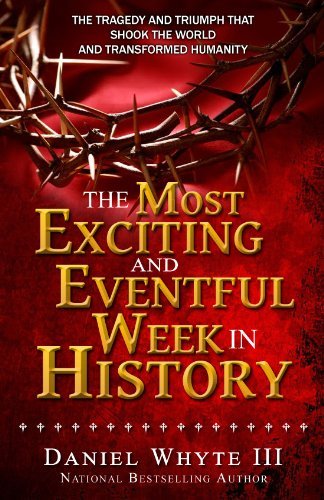
Every year, Christians around the world commemorate a special time of the year called “Holy Week” or “Passion Week” that ends with Easter Sunday or Resurrection Sunday. This week-long period is a time when we remember the greatest event in history – the death, burial, and resurrection of Jesus Christ.
The Lord led me to preach an entire series on Holy Week describing the day-by-day events of that week over 2000 years ago, and bringing out lessons that we can apply to our lives today. These messages, all of which are included in this book, look at the events of Holy Week in a fresh, new light. More than a Sunday-to-Sunday account of what happened in those dramatic days, this book draws on the historical Biblical record and Christ’s own words to paint a vivid picture of Jesus’ actions leading up to his trial and crucifixion. The darkness and despair of the necessary act of sacrifice is felt, and the ultimate triumph of the resurrection is proclaimed and explained.
In eight exciting and eventful days, one Man changed the world and transformed humanity forever. This writer would like to think that this is a fresh look at the most important week in the history of the world.
–Daniel Whyte III
February 28, 2019
Read An Excerpt from “The Lost Souls of Black Folk and White Folk”
 The Lost Souls of Black Folk and White Folk
Five score and eighteen years ago, an educated, visionary black man by the impressive name of William Edward Burghardt Du Bois, better known as W.E.B. Du Bois, who was not a prophet but said these prophetic words in his famous book, The Souls of Black Folk:
Herein lie buried many things which if read with patience may show the strange meaning of being black here at the dawning of the Twentieth Century. This meaning is not without interest to you, Gentle Reader; for the problem of the Twentieth Century is the problem of the color line.
For
the wonderful and yet strange experiment called America, W.E.B. Du
Bois was right, and showed great vision, for the problem of the 20th
century was and to many still is the color line. But why has the
color line stubbornly persisted as one of the biggest problems in
American society on into the 21st century? Well, there is what the
rather conservative Condoleezza Rice calls America’s “birth
defect” that continues to manifest itself in our society. That
is how the greatest country in the world was born, with a significant
number of its most important and productive citizens in slavery. Rice
said, “Black Americans were a founding population. Africans and
Europeans came here and founded this country together: Europeans by
choice and Africans in chains. That’s not a very pretty reality of
our founding. Descendants of slaves did not get much of a head start,
and I think you continue to see some of the effects of that. That
particular birth defect makes it hard for us to confront it (race),
hard for us to talk about it, and hard for us to realize that it has
continuing relevance for who we are today.”
W.E.B.
Du Bois’ vision, however, was fatally flawed. (We know that he and
all men are flawed in that we are imperfect beings. So, we are not
talking about him being a flawed individual.) If you read any of his
writings, you will know that even he knew he was a flawed individual.
But with all of his degrees, education, and erudition, his vision was
tragically flawed and incomplete because there was no real hope in
it—no real solution to the problem of the color line—because he
was a Christless, godless individual (even though he was good at
tapping into religious themes to make his points). His soul was
blank. He was an empty, lost human being, yet erudite enough to
produce a vision that has helped trap both black and white people
into a psychology that “the color line” is not just a
problem, but a permanent problem. Oh, the power of words in the
quiver of an educated member of the “talented tenth”!
Notice
this information from the Freedom From Religion Foundation regarding
W.E.B. Du Bois:
Although
he used some religious metaphor[s] and expressions in some of his
books and writings, Du Bois called himself a freethinker (see quote
below). In “On Christianity,” a posthumously published
essay, Du Bois critiqued the black church: “The theology of the
average colored church is basing itself far too much upon ‘Hell and
Damnation’—upon an attempt to scare people into being decent and
threatening them with the terrors of death and punishment. We are
still trained to believe a good deal that is simply childish in
theology. The outward and visible punishment of every wrong deed that
men do, the repeated declaration that anything can be gotten by
anyone at any time by prayer.” Du Bois became a member of the
Communist Party and officially repudiated his U.S. citizenship at the
end of his life, dying in his adopted country of Ghana.
Further,
W.E.B. Du Bois said:
“My
‘morals’ were sound, even a bit puritanic, but when a hidebound old
deacon inveighed against dancing I rebelled. By the time of
graduation I was still a ‘believer’ in orthodox religion, but had
strong questions which were encouraged at Harvard. In Germany, I
became a freethinker and when I came to teach at an orthodox
Methodist Negro school I was soon regarded with suspicion, especially
when I refused to lead the students in public prayer. When I became
head of a department at Atlanta, the engagement was held up because
again I balked at leading in prayer. … I flatly refused again to
join any church or sign any church creed. From my 30th year on I have
increasingly regarded the church as an institution which defended
such evils as slavery, color caste, exploitation of labor and war. I
think the greatest gift of the Soviet Union to modern civilization
was the dethronement of the clergy and the refusal to let religion be
taught in the public schools.”
—W.E.B.
Du Bois, “African-American Humanism: An Anthology,” edited
by Norm R. Allen Jr. (1968)
Another
reason why the color line is still a problem is because black and
white Christians have lost their souls, so to speak. Mind you, God
has not failed America or the world, but black and white Christians,
individually and collectively, have failed God, Jesus, and the
greatest country in the history of the world outside of Israel, and,
thus, we have failed the world, “gentle reader” (to borrow one of
Du Bois’ phrases from The
Souls of Black Folk).
If
God’s “chosen people” had done what God’s Word told us to do, the
problem of the color line would not have remained as big of a problem
as it is. And, yes, I am referring to the Church of the Lord Jesus
Christ (black, white, red, and yellow) as God’s “chosen people,”
knowing full well that the Church will never take the place of God’s
chosen people, the Israelites. In fact, how God dealt with His chosen
people, the Israelites, will play a major role in this book as you
will see. But, we are God’s blood-bought chosen people for this
present evil age.
Now,
what is it that God’s Word tells us to do?
1.
Obey the Great Commission. “Go
ye therefore, and teach all nations, baptizing them in the name of
the Father, and of the Son, and of the Holy Ghost: Teaching them to
observe all things whatsoever I have commanded you: and, lo, I am
with you always, even unto the end of the world. Amen” (Matthew
28:19-20).
2.
Obey the Great Commandment. “Master,
which is the great commandment in the law? Jesus said unto him, Thou
shalt love the Lord thy God with all thy heart, and with all thy
soul, and with all thy mind. This is the first and great commandment.
And the second is like unto it, Thou shalt love thy neighbour as
thyself” (Matthew
22:36-39).
3.
Obey the repeated command to pray without ceasing for all saints and
all people. “And
he [Jesus] spake a parable unto them to this end, that men ought
always to pray, and not to faint”
(Luke 18:1). “Pray
without ceasing” (1
Thessalonians 5:17). “Praying
always with all prayer and supplication in the Spirit, and watching
thereunto with all perseverance and supplication for all saints;”
(Ephesians 6:18).
4.
Obey God’s command to confess and repent of all sins. “If
we confess our sins, he is faithful and just to forgive us our sins,
and to cleanse us from all unrighteousness” (1
John 1:9).
“From that time Jesus began to preach, and to say, Repent: for the
kingdom of heaven is at hand” (Matthew
4:17).
If
Christians in America are going to get back on track and be
victorious and helpful to this once great nation, they will need to
trust God, love God, fear God, and be faithful to God.
I
know that you will think that this is trite, however, it is still
true: “If
my people, which are called by my name, shall humble themselves, and
pray, and seek my face, and turn from their wicked ways; then will I
hear from heaven, and will forgive their sin, and will heal their
land”
(2 Chronicles 7:14).
I can hear from my writing desk hundreds of my Pharisaical, ivory tower brethren saying, “Oh, this is all so simplistic!” Let me remind them and you, “gentle reader”, that God is big on simplicity. When you think about what I call God’s wonderful system of grace, it is not complicated at all. In fact, it is very simple. Hard, but simple. Hard to give up His Son for our sins, but simple. Hard for Christ to die the cruel death He died for our sins, but simple. Anybody who walks with God and knows God will find that He is big on simplicity. In fact, the Holy Spirit moved Paul to write in 2 Corinthians 11:3, “But I fear, lest by any means, as the serpent beguiled Eve through his subtilty, so your minds should be corrupted from the simplicity that is in Christ.”
The Lost Souls of Black Folk and White Folk is available now on Amazon.