Laura Enridge Zera's Blog, page 3
January 18, 2016
Epstein-Barr Reactivation: Is It Really Bad?
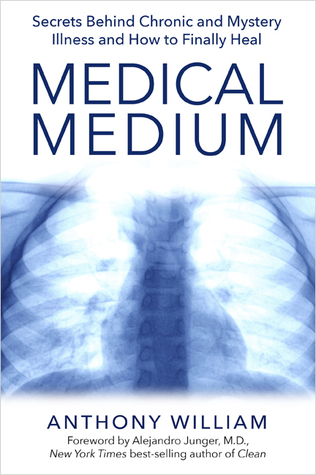
Not long ago, I read an excerpt from Anthony William’s book Medical Medium (Hay House, 2015). The chapter, titled “Epstein-Barr Virus, Chronic Fatigue Syndrome and Fibromyalgia,” starts out with a bang.
“The Epstein-Barr virus (EBV) has created a secret epidemic. Out of the roughly 320 million people in the U.S., over 225 million Americans have some form of EBV.”
Before reading this book chapter, if someone had played the word association game with me and said “Epstein-Barr,” my response would have been “mono,” as in mononucleosis (and then if they said “Christmas,” I would have said “The Pogues,” but that’s another story). In relation to EBV, that’s the only response I could have given, the only association I knew. But according to Williams, that’s merely Stage Two EBV. In its other three stages, it lives on inside us, either hanging around, waiting for the opportune time to mess around, or, in its more diabolical stages, acting as the catalyst for all sorts of ailments and diseases, from tinnitus to thyroid disorders to an inflamed liver or spleen.
As the chapter title suggests, EBV has also been linked to chronic fatigue syndrome and fibromyalgia, two highly mysterious and misunderstood illnesses. As I know a few people who suffer from symptoms that have thus far been undiagnosed, I emailed the article off to them, thinking it might shine some new light. Imagine my surprise when, days later, I visited my naturopath and we went over some recent blood test results. There, in huge, glaring numbers, were the indicators of my wildly reactivated Epstein-Barr virus. In fact, the numbers were so high that it seems the bugger has been holding a party for quite some time, keeping the noise level just low enough that nobody got ‘round to calling the cops.
 My doc immediately put me on some antiviral meds: one is a homeopathic immune system booster, the other is Valtrex, the herpes drug (and yes, when the pharmacy tech noticed what it was as she handed it over, she did jolt to a stop and stutter for a second. Stigma abounds, even with professionals). That was a month ago, and I expect to be on them for a while. And do I feel better? Well, that begs a different question: how did I feel to begin with?
That’s where it helps to examine what your normal looks like. If I’ve had a reactivated EBV for a while, then maybe my normal—the one I’d grown used to—is out of whack, and I could potentially expect a better and new normal. Prior to this diagnosis, I wasn’t complaining of anything seriously wrong with me, but I wasn’t jumping up and down with boundless energy, either. My common refrain was, “I feel like for someone of my age and fitness level, I should have more energy.” I had my thyroid tested, and it came out normal. I had my cortisol levels tested: also normal. All the other things on my blood panel were fine. So, can someone have a reactivated EBV piggybacking on their immune system and still be within standard testing ranges on common diagnostic tests?
As you might imagine, not everyone believes that a reactivated Epstein-Barr virus is linked to all of the maladies that William lists. (For those grounded in science, hearing about it from a book called Medical Medium, as in “Spirit tells me what’s wrong with you,” is sure to raise eyebrows.) As for the question I posed in the title of this post, I’m not even going to try to offer an answer. What I’m learning through my own personal health journey, however, is that the human body is far more complex than we give it time or credit for, and sometimes, accepting your state of wellness as being as good as it gets might be too narrow of an interpretation of normal.
You’ve got just one life in this very complicated body, and if it’s been running on three cylinders for a while, it may require a long and sustained recovery period before you begin to glimpse a golden horizon. To set off on that journey, it helps if you park your skepticism (and that of others, trained professionals or not), take the time to listen, learn and notice, and see where it leads you. I’ve parked mine, and I’ll continue to treat this reactivated EBV and see what happens. I don’t expect to run a marathon, but a little more get-up-and-go would be swell. And at least the herpes drug is cheap.
As an adult, have you ever been tested or treated for EBV reactivation? And if you had it, what was it like for you?
The post Epstein-Barr Reactivation: Is It Really Bad? appeared first on Laura Zera.


November 23, 2015
Mental Health: Joyable App Delivers CBT to Treat Social Anxiety
 When the team at Joyable kicked off development for its web app in 2013, its founders knew two things (well, they probably knew more things than that, but these are the two that are relevant here):
According to the National Alliance on Mental Illness, approximately 85% of mental illnesses go untreated annually (my put: because of shame or time or money or access, or any combination thereof)
Cognitive Behavioral Therapy (CBT) is the most effective treatment for anxiety disorders.
Founders Steve Marks and Peter Shalek decided to tackle this by making online CBT accessible, convenient and affordable, and to start with an app that targeted anxiety disorders. Launched in March 2015, Joyable’s early results–both number of people signed up and positive outcomes–are promising: They state that 90% of clients see a reduction in their anxiety.
The current set-up is slick. The app is salmon pink, probably because research says it’s a happy color or something (also, if you are trying to lose weight, put your food on a blue plate and you won’t eat so much. Crazy, hey?). So, yeah, salmon pink, and super easy to use. It steps you through the CBT process of identifying the situation that made you anxious, describing the thoughts you had around it, and then challenging those thoughts, all wrapped up in a series of self-paced, interactive exercises.
It seems pretty basic, right? But what happens after a CBT session at a therapist’s office, or when you read a self-help book, and then you go out into the world? You forget to practice what you’ve learned! And before you know it, you’re hightailing it out of that class or meeting or party, feeling like a total dweeb, and you don’t know who to call, or your next therapist appointment isn’t for another month.
 Ta-da! Joyable to the rescue. When you sign up, you are assigned a coach who is trained in CBT. They offer support and keep you engaged with the app, and, frankly, keep you accountable. In order to make a new thought process stick, you have to willfully invoke it for a while before it becomes an automatic deal. If you know someone is going to be asking about your week and if you practiced CBT techniques in an anxious situation, heck, you’re going to try harder.
I should mention that Joyable isn’t branding itself as a replacement for in-person talk therapy. Rather, it allows that it can be used to complement in-person therapy, or on its own. The recommended treatment period is three months, and while you can sign up for a month for $99, if you purchase three, the cost goes down to $239. Convert that to pounds sterling or euros and it’s almost free! (I mention that because last I heard, there was a two- to three-year wait to get in-person CBT in the UK.)
Last week, the company announced it had received another $8 million in funding to expand its offerings (it raised $2 million around the time of launch). They hope to one day have online solutions for obsessive compulsive disorder, post-traumatic stress disorder and depression, too. If you want to read more, here’s an excellent article in The Atlantic: The Startup That Wants to Cure Social Anxiety.
If I sound like a fan of Joyable, well, I guess I kind of am. I haven’t used it (way back in my days of harsh social anxiety, I leaned on benzodiazepines, because there was no Joyable). They’re not paying me for an endorsement. I just think it’s a fan-freaking-tastic idea. Technology for good. And offering a quiet, private, economical and easy way for people who are suffering to feel better seems quite a likeable thing. Or is it just me?
What do you think of Joyable, or just about the idea of online cognitive behavioral therapy? Yay or nay?
Images: 
The post Mental Health: Joyable App Delivers CBT to Treat Social Anxiety appeared first on Laura Zera.

October 25, 2015
Q&A with Australia Travel Blogger Michela Fantinel
As it’s been 24 years since I set foot in Australia, I wouldn’t even try to dish out travel advice for Down Under. Never fear, I’ve called in an expert! If you have any thoughts or ideas about going there–especially if you’re a female solo traveller–Michela Fantinel is a woman you need to know. (Note: in honor of this post’s subject matter and our guest’s Italian roots, we’ll be using the non-American spelling of “traveller” today.)
 Founder of the popular Rocky Travel Blog, Michela is also the author of Your Australia Itinerary, a beautifully laid out e-book with a series of comprehensive itineraries that can be chain-linked together, depending on your time allotment. Plus she’s a good sport for having put up with my questions. I hope you enjoy getting to know Michela and hearing a few of her tips.
Let’s start with stats. How many times have you presented your passport for inspection at Australian Immigration? And what’s the combined number of months you’ve spent there?
Thanks for this question, it put a smile on my face! This is the first time I’ve thought about it. My first trip to Australia was in 2004 (on a gap year); since then, I’ve been 5 more times, but in my last trip (in 2015), I had to leave to get a travel-visa extension. So, in total, I have presented my passport 14 times for inspection at Australian Immigration. And in 6 trips over 11 years, I’ve spent 17.5 months travelling alone in Australia.
You cover a huge range on your site, from the best websites for domestic flights to specifics like tips for driving to Uluru. Which topics do you feel most “proud” about, because you’ve done such extensive research, or the information isn’t widely available elsewhere, or maybe you’ve covered it with a unique angle?
 Windjana Gorge
Definitely the female solo travel aspect is what I take pride in! My website covers a niche within a niche: Australia budget travel that’s tailor-made for the solo traveller. This isn’t covered much by other bloggers. Well, there are a few travellers and bloggers who have occasionally travelled solo in Oz, but I am the only female solo traveller and blogger aged 50+ who has travelled alone in Australia extensively, over a longer time, covering nearly 100,000 kilometers and writing about my travel adventures. In addition, the second topic is the local experience; meeting the locals is my specialty, and with this, I don’t only mean humans. As a wildlife warrior (volunteer work) and Australian Zoo member, I am a proud supporter of Australian wildlife.
You’re a fair lady. Not as in “Julie Andrews in the Broadway show,” but as in “a hole in the ozone can’t be good.” What’s your favorite sunscreen?
Oh, I like this question cause I struggle with the intense Australian sun. While I do use sunscreen, this is not enough to prevent burning. The outfit is essential: I wear long-sleeved shirts and long pants almost all the time. I prefer technical outdoor wear (with UV protection 50+) as well as a wide-brim hat and good-quality glasses to protect my eyes, too.
 Tunnel Creek, Kimberley
I know you’ve fallen in love with Australia. But have you ever fallen in love in Australia?
This question makes me blush… I am a shy person.  To tell you the truth, on my first solo trips in Australia, I wasn’t interested in meeting men. When you’re on the road, time is so short to get to know someone. But in the last years, I have taken the time to stay longer in a place and be more open to getting to know the locals. As a solo traveller, I naturally attract lots of locals, and as a woman, obviously men, too! While I have had short romances, I cannot really say that I’ve ever fallen in love…but who knows what the future will bring! :))
Tell us about a place there that really surprised you, good or bad.
There are a few. One I fondly remember is Cunnamulla in South Western Queensland. This is a small Outback town in the middle of nowhere with 1,500 inhabitants. It took me one night by train and an extra half-day of car travel to get there, and my first thought was “what the heck am I going to do here?” Well, it was a big surprise. This place that at first looked like a boring village unfolded a rich natural and cultural heritage that was astounding. Not only did it offer many outdoor activities, including natural spa pools with artesian spring water, and birdwatching spots, but it also had great infrastructure that you don’t expect in a remote Outback town, including a top functional hospital, swimming pools and recreational areas, a local airport to fly into Brisbane and much more! This was a real Aussie experience, full of life and great in spirit!
Your Alexa website rank in Australia is 6,233. That’s 3,774 spots better than the Australian prime minister’s website. Are you finding you’ve become an Australia expert even to the locals? (Note: your global ranking is also 237,530 spots higher than Kylie Minogue’s, just in case you feel like feathering your cap for a sec.)
Yes, that’s true. I have become an Australia expert to the Aussies, too. I’m not bragging about this, it’s a fact. Why? Australia is a big country. If someone living in a remote village in Queensland wants to travel to the other end of the continent, for example to South Western Australia, they are likely to Google for travel tips, and this is where Rocky Travel Blog comes in, with my travel expert’s insight that helps them craft their trip.
You’re all about low-budget, solo female travel, which is one reason I’m so happy to host you, because, like, YES, traveling alone is freaking awesome and really not very scary, and it doesn’t take a lottery pay-out to do it. Can you tell us your biggest budget tip for Australia? Also, who was the oldest female solo traveler you met there?
 Melbourne
I would say make a plan, find out which expense has the biggest impact on your budget, and work around it. For instance, if this is accommodation, then try to reduce the cost and stay for free: Ask friends to host you, try out housesitting, look for a female-travel forum where you can be hosted for free, or stay in budget accommodation like hostels. Doing good research and pre-planning your Australia trip at least 4-6 months ahead is also going to save you lots of money.
Australia is one of the friendliest countries for solo travellers in the world. I personally never felt unsafe or uncomfortable. And there are many ways to save money even in an expensive country like Australia. I love travelling alone and enjoying the freedom that comes with it. Of course, it is natural to be apprehensive and feel worried about the first solo trip, but once you get started, it’s difficult to give up travelling alone, because it is very rewarding.
On my travels, I keep meeting solo travellers, mostly women, and to my great surprise, the majority are not young, they are aged 40+. The oldest was 80 years old, a mother of 4 and a grandmother. She turned into a solo traveller out of necessity. Somehow her travel plan didn’t work out, nobody wanted to join her on her road trip around Australia. So at the age of 76, she didn’t want to wait for a travel companion and went off on her own. What her children thought was going to be a 4-week road trip turned into a 6-month solo trip. This was such an amazing and inspiring experience, 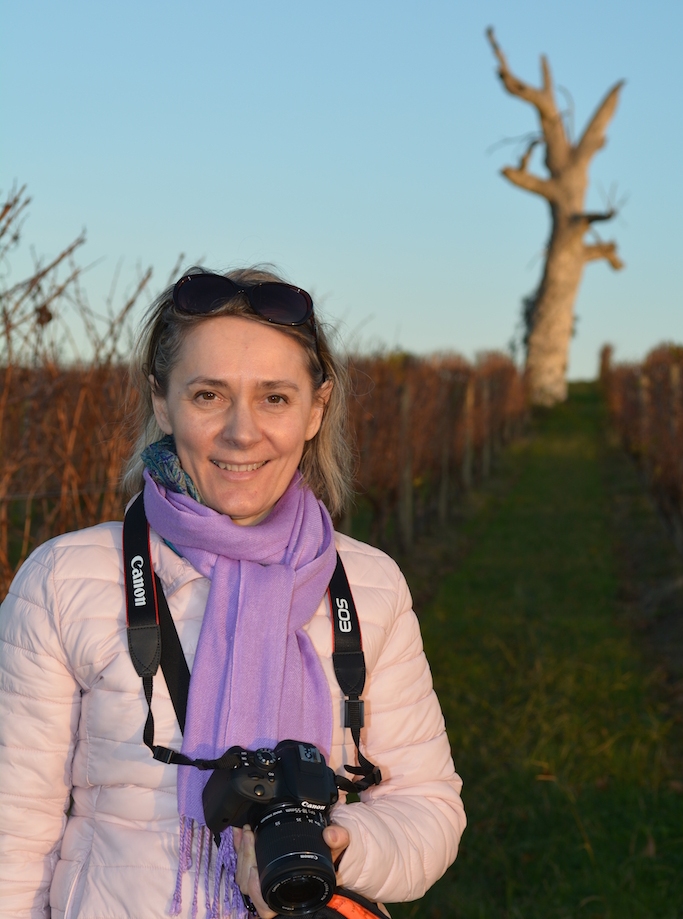 considering her age. But it also brings a clear message: Nothing is impossible, and limitations only live in our minds, when we stop dreaming. The funny thing is that she was so proud of this trip that she was planning her next adventure, at the age of 80. I loved her attitude, and I believe this serves as an example to many women wanting to venture out on a solo trip in Australia.
Michela Fantinel is the founder, blogger and publisher at Rocky Travel Blog, where she not only inspires independent-minded solo travellers, but also helps them create their travel itinerary and make the most of their time and money in Australia. You can connect with her on Twitter, Facebook and Instagram, and on her website.
Do you have any Australia travel questions or tips of your own for Michela? Share them in the comments below!
The post Q&A with Australia Travel Blogger Michela Fantinel appeared first on Laura Zera.

September 22, 2015
What Brené Brown Brings to the Stage
 My, how time flies. It has already been more than three years since I wrote about how much I was diggin’ Brené Brown and her vulnerability study. Not that what she said in that TEDx Houston talk ever left me in these intervening years. No, no, no. Her message about reaching wholeheartedness through vulnerability—reinforced at times by the wisdom in her books–has been like a beacon, a light that shines brightly at times, and at other times all but disappears in the fog. But when the fog clears, it’s still there, and I’m still going toward it.
So, one thousand two hundred days later, when tickets for her Town Hall Seattle appearance went on sale, I was on that web site right when the clock struck 10 a.m. (Good thing, because it sold out in less than 20 minutes.) She came through as part of the tour for her new book Rising Strong, and, given her inimitable way of explaining important-to-your-life concepts like you are buds sharing stories over a cup of coffee, I think everyone was totally bummed when the time came to wish her farewell.
There have been a number of heartfelt and humorous book reviews written for Rising Strong, like this one by Jill Dahl and this one by Dr. Courtney Stivers. I’m going to talk about the live version of her message that if we are brave enough, often enough, we will fall. What Brené has explored in this round of research is what it takes for a brave soul to get back up and keep going.
Her answers to this line of inquiry aren’t comfortable. (They haven’t been in the past, either.) She asks us to look squarely at our emotions and undertake our own line of inquiry. Awareness is great, but how much deeper can we go? How willing are we to noodle around inside that emotion like a calm and objective aunt, instead of a panicked squirrel? Brené has found that our willingness to go through this process is directly correlated to our resilience. Likewise, our courage to own our stories – the stories we make up for and about ourselves that are usually tied to a bigger, uglier emotion – is correlated to our ability to rewrite the story ending. After the pain comes the power.
 When she appears on stage in her jeans and black jacket with the white shirttails sticking out (like a coffee date outfit), and kicks things off with a few swear words (like a coffee date that bleeds into a wine date), and then yanks open her heart and shares her honest and authentic and vulnerable self, it’s pretty dang hard to walk away untouched. And in this lies one of Brené’s many gifts as a speaker: She grabs you in a big Texas hug, and she holds on to you through the uncomfortable part until you can relax into it. Until you are okay with it. Until you understand on a cellular level that the hard stuff she’s asking you to surrender to doing is really what you have been seeking all along. And you trust her, because she is so earnest.
She is also funny like Tina Fey, which, for her audience, has the effect of softening the angst around what you will encounter should you choose to go noodling. She laughs at herself so we can laugh at ourselves. She turns decades of interviews and research into relatable stories so we can get it, “it” being that if we don’t face all of the things which hurt us the most, we are always going to hurt. Taking the easy road out is only easy for so long, and then it turns into a highway to hell. But Brené has faith in us. She knows we can do it. And we can feel that, so we’re willing to give it a try, this reckoning and rumbling with our emotions and the stories in our heads. For her. For ourselves. For humanity.
One of Brené Brown’s early goals was to use her writing to ignite a national conversation on shame. With what she brings to the stage, she is stoking the fire of something more: a global action toward healing. And that may be her biggest gift of all.
Brené, thank you for holding on to us and not letting go.
The post What Brené Brown Brings to the Stage appeared first on Laura Zera.

August 11, 2015
A Little Inter-Artist Love Song: Show Some Respect
 Andrew (left) with my other stellar nephew, Matt
In a world full of free-flowing information and opinions, there is one piece of advice that has stuck hard in my brain, presenting itself for use during the most perfect times. This nugget of wisdom didn’t come from Oprah or Maya Angelou or Brené Brown; it is something I learned in 2013 from my then-20-year-old nephew Andrew. Sadly, it took a year for it to finally sink in to my old noggin that his perspective was sage advice for me, too, but at least I got there. Hopefully this blog post will be so convincing that it will shorten your adoption process by 11 months and 29 days, if you aren’t already preaching the same.
Our conversation was about music. My nephew is in a rock band called Little India, and I went to see them play in a competition where they had made it to the top three. Even though I thought they were the mostest awesomest act of the night, they came in third (sometimes even Hooting Aunty—almost like a “hootenanny,” but different–can’t swing the vote). The next day, we were debriefing, and I made a comment about one of the other bands, something to the effect of how they would have been better suited to an audience of tween girls. My nephew’s response was diplomatic and sincere. And it blew me away. He said, “They’re just doing their thing. It’s not my thing, but you know, they’re good at it, and it’s their thing.”
As a writer, I come across a fair amount of other writers’ work. I read a lot, and I have a wonderfully active community of writer friends. Yet what I realized (a year) after that conversation with my nephew was that I still sat in judgment, even condemnation, of other writers’ work. I didn’t like this genre or that genre or if someone was too commercial or too inaccessible—the list went on and on. I was COMPLETELY forgetting that yes, while I am a consumer of the written word and am entitled to an opinion, what is more important is that as a fellow artist, the more empathetic response is to offer my writing peers respect for doing their thing and putting it out there. Just like my nephew extended to his music peers. Just like sculptors and dancers and painters and filmmakers can do for their peers. Because that shit is hard! Creating something from scratch that is extremely personal to you, and then sharing it with everyone else in the world – HARD!
 Little India at Squamish Valley Music Festival
It serves you to take the high road, especially if you are an artist. I just attended a day of the Squamish Valley Music Festival, there to see my nephew’s band play (see? Karma is Reason One. Look where they are now). While watching a different band, one of the members made a sarcastic comment about “the advantages” of playing on the same day as another artist, one for whom he clearly had no respect. His remark wasn’t funny, it didn’t make me respect his “real music” music more, and it made him look like an asshat. So Reason Two: you won’t look like an asshat. And, by the way, up until that point, I had been thinking of buying some of that band’s music on iTunes. Now? Not so much. Reason Three: you’ll sell more music/books/paintings/movies.
The fourth reason is so important that it gets its own paragraph. I only came to understand this one through some distillation with my life coach. When you sit in judgment, you dilute your own strength and power. We are all in this world – artist or not – trying to do our best. To understand our purpose and fulfill our potential. No one can say what that is for another human being. That determination is so much bigger and far beyond us that to even apply judgment to what someone else is doing is like insisting that out of all the billions of stars in the sky, and from millions of miles away, you know which star is the brightest. Im-freaking-possible. Reason Four: Just as you are entitled to find your purpose and fulfill your potential, so is everyone else. And in some cosmic way, theirs may be intricately intertwined with yours. You never know.
But holy crap, letting go of judgment is so hard, you say. I concur. And I still judge. Daily. Other people’s clothes, hair, food choices, parking jobs (didn’t they have to pass a driving test, for God’s sake?). Mostly, I judge myself, with my husband running a close second (sorry, hon. Love you). So yes, it is hard. And it is worth working on, for everything. Thankfully, this blog post is only about mutual artist respect, so we’re going to compartmentalize for now and dole out “get out of jail free” cards for the rest. Go crazy and get it out of your system. Get it all out. Here’s a good place to start.
One final note: when I shifted my thinking around other writers’ work, I also changed my stance on posting book reviews. I know many writers who have already weighed in on this practice, so I’ll just state mine quickly. If I don’t like a book, I won’t rate it or review it. If I can’t give it at least three stars on Amazon or Goodreads—which, by the way, is a *great* rating, in my opinion, even though I know some writers feel apoplectic if they get anything less than a four—then I just bite my tongue. The author is doing their thing, like I do mine. Let the pure consumers be the critics; they’re coming at it from a different place. They have invested money, and while of considerable importance, it is slightly less vital to survival than (an artist’s) blood.
What do you think? Is this a wussy approach, constrictive of free speech? Or do you agree? And do you have a piece of advice that has become core to your daily functioning that you can share?
p.s. If you are curious about Little India, my nephew’s band, check them out on Soundcloud. They play alt-pop and rock and my plan is for them to become hysterically successful. They’re doing a good job of that on their own so far, too.
(Photo of Little India courtesy of Dallyn Hunt, drummer)
The post A Little Inter-Artist Love Song: Show Some Respect appeared first on Laura Zera.

July 12, 2015
The Third Act Is My Second Chance
 In screenwriting, the three-act structure can be broken down as exposition, rising action and resolution. In my relationship with my mother, the third act of “resolution” began in 2009, and followed the lengthy and excruciating first and second acts of “raised by crazy mom” and “estranged from crazy mom.”
The thing about our third act is that for many years, I had no idea if it would ever come. My mother could have passed away before I saw her again (and that dreadful scenario was ever-present in my imagination). We needed a transition between the second and third acts, which, mercifully, was facilitated by a social worker. Once the third act started, I didn’t know how long it would last, and still don’t, but now count every year as a bonus. And given the volatility of our first act, the nature of this final one is, well, quite bizarre.
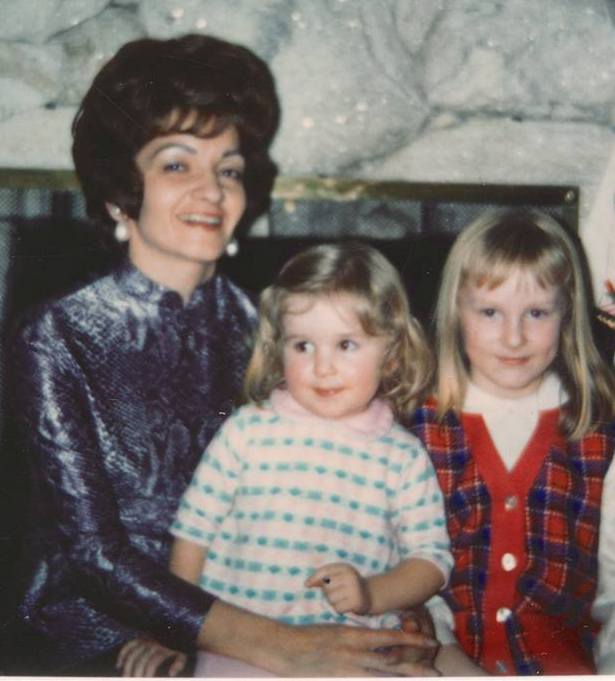 When my mother was crazy with undiagnosed schizophrenia, it was difficult to be anywhere near her. She was often in a rage, and when she wasn’t, my sister and I would be waiting on tenterhooks for the next rage to start. My sister left home at age 17 and I was out by 15 (and lived with my sister, a benefit of being the younger sibling). As I turned into a late-years teenager and then young adult, my mother behaved toward me the same way she had always interacted with the “outside world,” her rage replaced by a carefully controlled mask. It was fragile and fake, and, in the moments when cracks appeared and her behavior faltered, completely unnerving.
I tried to keep up a relationship – who doesn’t want a mother? – but the anxiety that came from dancing with the devil (or “dancing with the crazy person who is acting sane”) impacted my own mental health so much that eventually I had to sever all ties. I hid from her. She didn’t know my phone number. She didn’t know my address. She didn’t know that I got married. From my end, I knew where she was at all times, but I was painfully aware that there was nothing within the law that I could do to help her.
After all of that, Act Three opened with my mother’s diagnosis of dementia. It was already quite advanced when an aunt took Mum to the hospital. She stayed there for three months before going to a nursing home, and that is where my sister and I met her again for the first time in 17 years.
Most people don’t count dementia as a blessing, but my sister and I do. My mother is no longer paranoid, suspicious of everything that moves. She has no anger left. Her delusions are gone. So is her memory and her verbal recall, but she doesn’t miss them anyway. In a magic twist of fate, she is the happiest, most cheerful and easygoing resident in her nursing home ward. And because of this, I have my mother back in my life. She doesn’t know who I am, but boy, do we ever enjoy each other’s company.
 Mum turned 80 last Friday. To celebrate, I joined my sister, her ex-husband and their two sons, and we all took Mum for lunch and a walk in the park. We visited the petting zoo, where Mum was greatly amused by the children and I was greatly amused by the goats. We ate strawberries at a picnic table, and hamburgers and French fries at a restaurant. Mum chattered and sang and laughed. My brother-in-law, who hadn’t been near Mum for decades, was a bit freaked out. He said, “It’s almost like she’s faking it. You know, the last time I saw her, she tried to kick me in the balls.”
“Nope,” I said. “This is real. This is her.”
Our third act has been playing without intermission for six years now. Mum is physically healthy, and her dementia has leveled off quite remarkably, with no major changes in her symptoms for the last few years. I visit her whenever I can (she is in B.C., I am in Seattle) and just keep adding scene after scene to the screenplay that is our lives, filling those long-empty pages and feeling blessed that we never seem any closer to having to write an ending.
The post The Third Act Is My Second Chance appeared first on Laura Zera.

June 15, 2015
Siem Reap, Cambodia: Monkeys, Superheroes and Dr. Fish
 Siem Reap is an odd duck. Its tourism sector has grown quickly, and so in some ways, like its dense section of shops, bars and restaurants–including a “Pub Street”–it is a bit like Las Vegas, Southeast Asia-style. It isn’t until you get out of Siem Reap that you start to get a real feel for the culture. Don’t get me wrong, I thoroughly enjoyed our visit, and the nearby Angkor temple complex is spectacular, but the two do make very strange neighbors.
We spent five nights there in late Nov- early Dec 2014. I was glad to have the extra time because I was wrecked by a sinus infection so it allowed us to slow our “templing” pace (yes, it’s used as a verb there). I think our timing was perfect: temperatures start to climb in December, peaking in May, and I could not even imagine being out at the temples–which are far from all amenities, even toilets–during the most intense of Cambodia’s weather cycle. It was punishing enough as it was!
Here are a handful of snapshots from Siem Reap, the Angkor temples and the stilt-supported fishing villages that lie along the Tonlé Sap, a combined lake and river system that is the largest freshwater body in Southeast Asia.
 Free beverage included!

 Next door to the 6 pm Morning Market
 Snake-kebabs
 Big trees invade Ta Prohm

 It’s nice to be special
 Angkor Wat, the big mama


 Somebody’s been…
 …rubbing…
 …their boobs.


Hope you enjoyed these, and I’d love to hear what you think in the comments below! xo
The post Siem Reap, Cambodia: Monkeys, Superheroes and Dr. Fish appeared first on Laura Zera.

May 11, 2015
Weird Pug Things: The Definitive Guide
Google “pug” and you will read that they are charming, even-tempered, fun-loving clowns. But there are some things about pugs that no one ever thinks to talk about. But me? I think about these things. And I’m going to tell you.
I’ve used my three pugs — Ozwald (1997-2007), Yolanda (2005-2015) and Phoebe (who we just brought home on May 3, 2015) — to create a handy benchmark chart of some of the kinds of things you can expect when you own a pug.
Trait
Ozwald

Yolanda
Phoebe

Farting
Like a boss
Almost never
Selective and deadly
Obsessive licking of the air
No
Is 30-40 minutes at a time obsessive?
No
Obsessive licking of the furniture and floor
No
Is 30-40 minutes at a time obsessive?
No
Obsessive licking of you
No
“Quit licking my boobs” was a common refrain in my house
No
Anal glands that leave potato-painting-like imprints on your clothes and stink like three-week-old unrefrigerated fish in the height of summer
Yes
Yes
Yes
Plays “crazy pug” (tail tucks under body, pug rounds itself until it looks like a bloated tick, runs around in zig-zag patterns then falls to ground in a heap after 20 seconds)
Yes
Yes
Yes
Snores
Like a freight train
Like two freight trains
Like a diesel bus
Displays food aggression around other animals
Insta-Cujo
Like Billy Idol, but mean
After two pugs, the cat has finally learned to stay away from the pug’s food dish, so we haven’t seen Phoebe flip her lid *yet*
Comes when called
Yes
Never
Never gets far away enough from me to need to be called
Runs the other way when called
No
Always
No
Bark sounds like The Hamburglar
Yes
Yes
Yes
Sleeps while sitting up
Yes
Yes, until she fell over
Yes
Would make nail trims a fight to the death
Yes. Was refused service at two grooming establishments.
No, but she liked it better than getting a thermometer up her butt
No, but shakes like a pudgy little leaf
Good on road trips
Even liked to sleep in a tent
I’d almost forget I had a dog in the car
As long as the air-con is cranked
Proficient at “pug love” (sits like mushy lump on lap)
Yes, except see “Anal glands” above
No (see above under “Obsessive licking”)
Yes, and makes happy pug sounds
Ears full of wax
Like the La Brea Tar Pits. Stock up on Q-Tips.
Brave and courageous
Afraid of rejection (but aren’t we all?)
Afraid of round metal pizza pan
Afraid of airplanes overhead, sneezes, parked cars, the vacuum cleaner, the microwave door and black-and-white tile flooring
Loyal and faithful
Always there for me. Sensed when I was depressed and stayed ridiculously close during those periods.
Even when she ran in the other direction, I always knew she’d come back. Because I had the food. And I knew how to rub her belly the way she really liked.
She’s been with me for a week, and she’s already Velcro
Forever changed my life for the better
YES
YES
YES
Are you a pug owner? I’d love it if you shared something strange and/or lovable about your pug!
The post Weird Pug Things: The Definitive Guide appeared first on Laura Zera.

April 21, 2015
Mental Health: Depression Linked to Inflammation, Gut Bacteria
 What is going on in our bellies may matter more than we knew to our brains. Two interesting depression-related studies were reported earlier this year: the first links depression to inflammation, the second researches depression in the context of the “gut-brain axis.”
A summary of the inflammation research is found in The Guardian, under the title “Is Depression a Kind of Allergic Reaction?” To me, the title is misleading. People can have allergies to all kinds of foods. Inflammation, however—and possibly the associated depression—is caused by crap food. You want to live on starchy carbs and processed foods? Then you are going to puff out like a condom-turned-balloon in the hands of a ten-year-old. Fill your face with things that are fresh, raw and unprocessed and you will fare much better, as I first wrote about in this post on brain food.
The Guardian article also suggests, rather hopefully, that a shift in the perception of depression from being a mental illness to a physical one could relieve the ongoing stigma that is attached to the illness. Author Caroline Williams writes, “This time, though, the target is not any kind of brain or mind-based weakness but a basic feature of everyone’s body that could strike anyone down given the right – or wrong – turn of events. And if that doesn’t inspire a greater sympathy and understanding, then nothing will.” I like the idea of our society arriving at a place where depression no longer carries stigma, but the mind vs. body debate does still seem to be infused with discrimination in that it categorizes a body illness as more acceptable than a brain illness in the first place. How about compassion for all?
 First things first, though: let’s focus on keeping our bodies and brains healthy through better diet. And possibly add in oral supplements of omega 3 oil and curcumin, both known to have anti-inflammatory effects. I’ve been working on diet improvement for two years now. Do I see a difference? Unequivocally, YES.
On to the gut-brain axis, which is decidedly less evil and more scientific than the axis between Iran, Iraq and North Korea that George W. Bush introduced in back in ’02. Phew. Good on it, I say.
Scientific American published Charles Schmidt’s article “Mental Health May Depend on Creatures in the Gut” in February, which points out that this idea goes back more than a hundred years. More recently, oodles of studies have been conducted using mice, with some pretty amazing results. For example, mice injected with the gut microbiomes of humans with mood disorders soon start to exhibit the same behaviors. Translated into mice-world stuff, this meant they began exhibiting anxiety over jumping down from one platform to another, which leaves me wondering: if humans with mood disorders were injected with healthy mice microbiomes, would they eventually become Olympic-level divers?
 One of my favorite parts of this article is delivered via the research of John Cryan, a neuroscientist at University College Cork in Ireland. He recently published a study in which two varieties of Bifidobacterium produced by his lab were more effective than escitalopram (the antidepressant Lexapro) at treating anxious and depressive behavior in a lab mouse strain known for pathological anxiety. Hurray, make way for the development of psychobiotics, live organisms comprised not only of probiotics but also other bacteria known to produce psychotropic signals such as serotonin and dopamine. The research has a ways to go yet, so in the meantime, a good quality brand of probiotics from your local vitamin shop could go a long way to making you feel better, in both body and brain.
Have you experimented with diet change and/or the use of supplements for the benefit of your mood? I’d love to hear from you!
The post Mental Health: Depression Linked to Inflammation, Gut Bacteria appeared first on Laura Zera.

March 29, 2015
Galit Breen Turns Fat-Shaming Ordeal Into Catalyst for Good
 When Galit Breen wrote an article on happy marriages for The Huffington Post last year, the last thing she expected to see was snarky responses about her wedding photo. More specifically, the size of her body in her wedding photo. Galit had been fat-shamed.
The follow-up piece about the incident that Galit wrote for xoJane moved me to tears. She expressed how she had allowed herself to be vulnerable in the HuffPo piece–something that all of us writers, all of us women, all of us–struggle with in our bid to be courageous mothers and partners and agents of change, and for that, she was rewarded with cruelty. Her story struck a nerve, and she quickly found herself speaking about the issue on the Today show and Inside Edition.
Around the same time, one of Galit’s daughters asked if she could start posting on social media. Galit thought about the implications, and that’s when she knew she’d been presented with an opportunity to make something good out of her cyberbullying ordeal. That “something good” is Kindness Wins, a book for adults on teaching kids to be kind online.
 Author Galit Breen
My relationship with Galit goes back to 2012, when we both had essays published in the breast-cancer-fundraiser Write for the Fight. Now, just days ahead of her new book’s publication, Galit has graciously stopped by to answer a couple of questions I posed about the topic of cyberbullying.
Me: I love that you’re being proactive in helping parents coach their kids on how to be good Internet citizens. What can we do to teach the adults who don’t get it? The trolls and meanies and sometimes downright cruel people?
Galit: This question is so, so important! As we’re trying to create a culture of kindness, this includes our kids and ourselves. Each section of the book contains a guide for how to talk to our kids about maneuvering online kindly and a section for how to discuss the same topic with our peers. This can feel tricky and daunting! But we ask an awful lot of our kids in standing up to things they see or hear that don’t feel right to them, I’m (gently) suggesting we ask the same of ourselves.
For example, when I was studying to be a teacher I had a mentor who told our class to always approach kids who are having a hard time with the assumption that they just don’t know how to do something, rather than thinking that they’re purposefully being difficult. I think this works here, too. We can approach adults who are being unkind online as if they didn’t know that what they’re doing is wrong. This gives us the freedom to speak up and still be kind with our word choices and, if we choose to do so in a comment thread, then others who are reading are also given the permission to stand up, too. It changes the conversation.
Me: What do you think it will take for “the cyberbullying talk” to become as engrained in our society’s parental handbook as “the menstrual cycle talk” and “the birds and the bees talk?” Or is it already well on its way?
Galit: I love this question so much because it’s so spot on. The more open, and diligent, we are in bringing up the topic of how necessary this conversation is for our kids–and as you pointed out, for ourselves–the more “normal” and everyday it will become. Right now, this responsibility falls on those of us who already use social media regularly because we already see the impact that both online kindness and cruelty can have. Our job is to make sure those we love get the benefit of what we’ve learned. The more we share with each other, the better. When a seasoned mom tells a new mom how she got her baby to sleep, eat, or learn how to write her name, she’s helping. This is the exact same thing. The more we talk about it the more normal, and expected, it will become.
The second half of this is joining our kids on social media. I discuss in Kindness Wins what a big advocate I am of being online with our kids and watching out not just for them, but for our friend’s kids as well. This terrain is too big to go at alone. But when we agree to look out for all of our kids, we all benefit and we further normalize the important conversations around cyberbullying and online kindness.
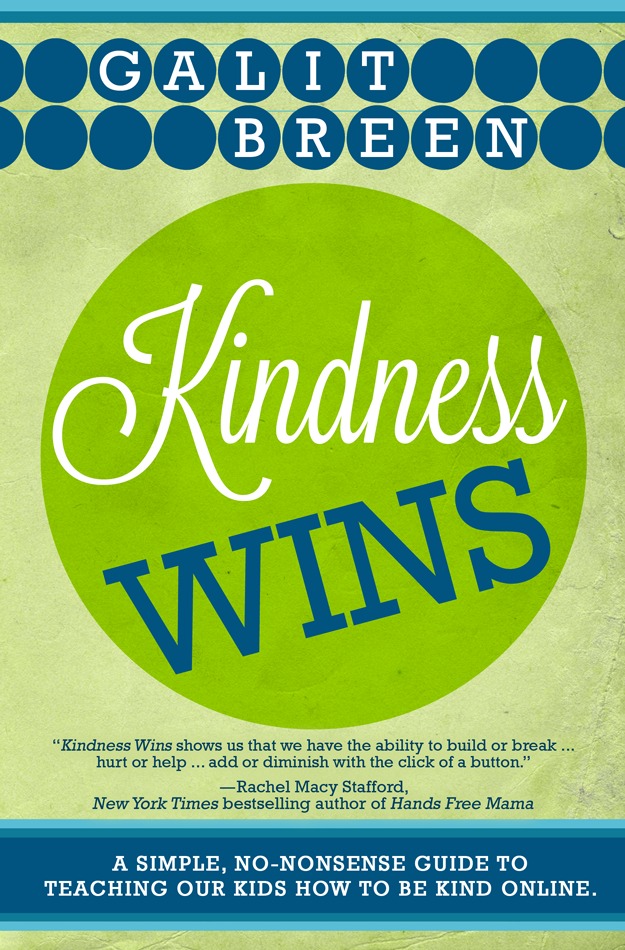 I’ll draw for a giveaway copy of Kindness Wins on Apr.3
Keep this important discussion going: Add a comment below and you’ll be entered to win a digital copy of Galit’s new book (and I hope you’ll leave a review on Amazon once you’ve read it!). As a bonus for my readers who enter but don’t win, Galit’s publisher is offering a free Lemons to Lemonade Party and Book Discussion Guide if they purchase Kindness Wins! The book is available here, and I’ll contact you after the giveaway ends with the details on how to redeem your bonus.
About the book: Approximately four out of ten kids (42 percent) have experienced cyberbullying. Kindness Wins covers ten habits to directly teach kids as they’re learning how to be kind online. Each section is written in Breen’s trademark parent-to-parent-over-coffee style and concludes with resources for further reading, discussion starters, and bulleted takeaways. She concludes the book with two contracts―one to share with peers and one to share with kids. Just like we needed to teach our children how to walk, swim, and throw a ball, we need to teach them how to maneuver kindly online. This book will help you do just that.
 About Galit: Galit Breen was a classroom and reading teacher for ten years. She has a master’s degree in education and a bachelor’s degree in human development. In 2009, she launched a career as a freelance writer and since then, her work has been featured in various online magazines including Brain, Child, The Huffington Post, TIME, and xoJane. Breen lives in Minnesota with her husband, three children, and a ridiculously spoiled miniature golden doodle. You can learn more about Galit by visiting her blog These Little Waves, Facebook, Pinterest and Twitter.
The post Galit Breen Turns Fat-Shaming Ordeal Into Catalyst for Good appeared first on Laura Zera.