Laura Enridge Zera's Blog, page 2
December 28, 2016
Sometimes You Need Medication: A Response to 2016
This year has been an endless stream of sucker punches: every time we think it couldn’t get any worse, BAM, uppercut to the jaw. I barely have any teeth left.
 No matter your political views, news sources and musical tastes, it’s hard to evade the gloom that has descended around the globe. And if you’re predisposed to or are a chronic depression sufferer like me, then these are exceptionally wonky-inducing times. Yes, wonky, which, by the way, encompasses the following:
feeling like you should do something – anything – to improve the global/local/family situation, but you are paralyzed and/or exhausted
feeling agitated but overwhelmed by global/local/family events
feeling numb, like you’re in a movie (“surreal” was Merriam-Webster’s Word of the Year for 2016, because of the serious spikes in look-ups that followed major events)
feeling like you want to hide under the bed covers until ___________
waking up in the middle of the night, sure that the end of the world is imminent
feeling sensory stimulation overload – too much noise, lights, smells, information
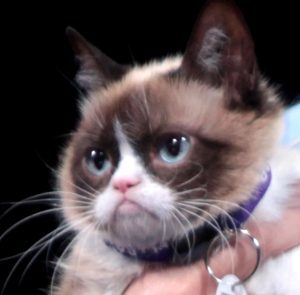
feeling like Grumpy Cat
If you’ve followed this blog, you’ll know I’ve written quite a lot about causal linkages and complementary treatments for depression: nutrition, gut microbes, yoga and meditation, neurofeedback, exercise, blue light therapy, vitamins and supplements, you name it. All good stuff. I work all these angles for my own depression.
However, sometimes you may find those treatments help you stay in minimally functioning mode, but they don’t get you over the hump and back to better living.
 What hump, you ask. Ahhhh. See, this is where I lost track of the bouncing mental health ball myself until last week. The hump is the creep. Whaaaat? (I’m not messing with you, seriously.)
There’s only one creep at this party (okay, yes, there’s two…). The creep we’re talking about is the onset of a cycle of depression. Even for the most aware and experienced, sometimes you get stuck on the hump and depression creeps up.
These are the times to look at medication. If you’ve been on it before, do you need to go back on it? If you’re currently on it, do you need to adjust the dose or try something else? If you’ve never been on it, but nothing you’re trying is working and you are feeling SO WONKY, do you need to explore medication as an option?
The reason I’m posting about this is simple: I’ve been talking to doctors and therapists about my brain for 30 years, and I’ve been on antidepressants for 20. I’m pretty darn self-aware. There ain’t nothing that’s my first rodeo (except an actual rodeo). And yet, I still don’t always notice when I’m stuck on the hump. Depression can be such a creep.
A medication adjustment came up as a side conversation in a recent visit to my doctor. Not because I said I was feeling wonky. Not because I identified that I needed help. Because I ate a protein bar, went for a three-mile walk and had such a severe sugar crash in the middle, I had to summon an Uber driver to take me back to my car. (Bonus: he gave me a Snickers.) Low serotonin is linked to low blood sugar. Whaaaaat? YES. I was surprised by this, even after all of my research and I-am-my-own-guinea-pig experiments.
My doctor increased my medication dose, and a week later, I feel SO MUCH LESS WONKY.
 Yoga, meditation, healthy food, supplements, exercise: yes, yes, yes, yes. Any other alternative and complementary therapies you use to combat depression: yes, yes, yes, yes. We are warriors, all of us. But even the strongest warrior can only handle so many body blows. Sometimes the most effective and compassionate solution is right in front of us and we don’t see it. And that, in a nutshell, is 2016.
Wishing you a heart-centered, joy-filled, small-humped 2017.
Much love,

Creative Commons images: Grumpy Cat by Gage Skidmore; Yosemite by Luke Pamer; w arrior by Henry Hustava
The post Sometimes You Need Medication: A Response to 2016 appeared first on Laura Zera.


November 27, 2016
Don’t Be So Fast To Write Off “Healing Feeling” Work
 Sometimes in my Desire Map workshops, a participant will share that they are “not a healing feeling type.” And yet, there they are. At the workshop. Which is all about feelings.
I’ve sort of learned to expect this response at least once in a while. While I wouldn’t reduce the vibe of my workshops to a cliché like “kumbaya,” we do, in fact, do a lot of meditation, we talk about levels of energetic vibration and manifestation, we hug it out, and usually, someone cries (you can count on me for that). So yes, it’s safe to say they fall into the category of “healing feeling.” And so how do we end up with the occasional cynic in the mix? The taskmaster among the daydreamers? The realist among idealists?
 It could be that a friend invited them. Or dragged them along with the promise of martinis afterward. It could be that someone paid for them to go. Or, it could be that they really needed to be there, something deep inside them told them so, and they honored that inner voice.
And so they showed up. They parked some of their disbelief at the door, and some of it came inside, sat tidily on the front end of their yoga mat next to their BPA-free water bottle, and eyed the rest of us with a measure of suspicion.
I totally understand this response. Sometimes the healing-feeling community can be like a big, wet tongue down your throat when all you really wanted was a peck on the cheek. But sometimes, this response comes from resistance.
Resistance to allowing that yes, you have old pain. It’s buried, but it’s there, like a thistle in your gut. Not life threatening, but not life enhancing, either.
Doing healing-feeling work can drudge up a ton of pain. And insecurity. And truths about yourself that might be difficult to face at first. It takes stamina and focus to do the work. And if you’ve been taught all your life that to be strong means to move on, to get over it, to forget about it, to GET IT DONE, well, then, it makes total sense that your world and this other messy world are at odds. The latter might even feel self-indulgent. Annoying. Possibly pathetic.
But I’ll tell you what I know. The folks who hold healing-feeling work at arms’ length are often the ones who need it most. They haven’t moved on. They aren’t over it. They have not forgotten. And it is holding them back from getting it done (“it” being all the super fantastic things that are possible, if you’re open to trusting that the universe has your back).
As humans, we aren’t good at stuffing our emotions down. We actually get over things by feeling—and then objectively naming or labeling—all the feels. Anger. Depression. Guilt. Shame.  Frustration. Just stating, “I had a shitty childhood,” isn’t enough, and is way, way different from acknowledging how that makes you feel. Still. After 40 years. From allowing in all the feelings that you never stopped to feel about that shitty childhood. From punching a pillow. Having an ugly cry. Writing in your journal. Forgiving that person. From giving yourself grace, and radical self-compassion. And from the staggering freedom that comes on the other side. You will be like a fucking bird with a jet-pack booster between your fucking wings. I know this. I’ve felt this. I have seen it happen in others. In the cynics and the doubters, and in the people who were so, so tired.
Freedom.
My put to you is this, doubting, tired cynical, efficient, capable, strong humans who rose from the goddamned ashes like a phoenix (I’m not saying this facetiously; I believe you and applaud you): don’t write it off. The healing-feeling work. Don’t shut the door on it. Because all the hard stuff you’ve overcome? Your triumphs over adversity? They brought you this far, and you can go farther. You can do more. And you know exactly what I mean, because something deep inside you is telling you so. (Nope, it’s never going to shut up. Not while you still have a breath left, anyway.)
Giving healing-feeling work a try doesn’t mean you have to sign up for a workshop. It isn’t an automatic three-year program (two if you go straight through summers). You can do it by yourself. You can do it with another person (someone with a license or certification of some sort, preferably). Or, you can do it in a group. Come, be the realist among the idealists. We love your spunk. Because my bet—and I’ll put money on this—is that you’re not over whatever it is that you’ve tried so hard to avoid and that you keep telling yourself you’re over. We’re here for you, in our stretchy pants and headbands, ready to listen, to bear witness to your pain, to share your humanity, and hug it out when you cross over to the freedom.
 We see who you are, when the pain falls away and pools around your feet. We see your light.
You’ll see it, too. It’s waiting for you. By the fireplace, with a S’mores and a cup of chai. How can that be a bad thing? Right?
I thought so. Kumbaya, brothers and sisters. We are you.
If this resonates, let me know in the comment section below. Or share the post. Or try some healing-feeling work. xo
Images courtesy of Unsplash
The post Don’t Be So Fast To Write Off “Healing Feeling” Work appeared first on Laura Zera.

October 24, 2016
Six Things South Africans Do Differently From Americans
South Africa clocked 348,646 visits from American tourists in 2013, and given the lure of a favorable exchange rate, screaming airfare deals, and winery tours and wild animals, there’s probably no chance of those numbers dropping off. South Africans have also gained a reputation as some of the friendliest people in the world, and well worth getting to know better. So, beyond calling a barbecue a “braai” and having enough diversity to warrant 11 official languages, here are a handful of less obvious socio-cultural traits that set inhabitants of the Rainbow Nation apart from their U.S. visitors.
 I guarantee that 5 out of every 6 people here ironed today
South Africans are committed to ironing their clothes. School uniforms, t-shirts, jeans. Women iron. Young men iron. Everybody irons. Whereas Americans have mastered the art of buying wrinkle-free fabrics, and are willing to risk looking rumpled when they don’t, South Africans still place an immense value on precision pleats. A bullet hole to enhance the view
Americans carry guns to exercise their constitutional right. South Africans carry guns because they have a legitimate reason to be concerned for their safety. Regularly featured on lists of countries with the highest murder rates, South Africa is also struggling to contain climbing numbers for armed robberies, burglaries and carjackings. If you’re planning to join the millions of international tourists who visit each year, have a read of these smart safety guidelines issued by the British government so you can be armed with knowledge.
Unlike the dull walking (or standing, or walking and then standing) style of American protests, when South Africans want to demonstrate, they do a special dance called a “toyi-toyi.” Usually accompanied by music, toyi-toying is a peaceful form of protest, used when the masses want to draw attention to unfavorable government policies or social issues. And in this hilarious step-by-step instructional YouTube video, you can learn to toyi-toyi too. I have absolutely no idea…
Despite temperatures that regularly hit 90 degrees Fahrenheit in many parts of South Africa, refrigerating dinner leftovers is considered optional. Americans fret over bacteria to the point of compulsiveness, but South Africans are more cavalier, leaving pots of chicken, rice and veg out overnight without a second thought.
Founded in California, and purchased by Facebook in 2014, the Internet-reliant, multi-media instant messaging service WhatsApp claims its largest user base in South Africa. So while Americans text away—either enjoying plans with unlimited texting, or free-text utilities like iMessage—South Africans, many of whom rely on pre-paid phone plans that charge for texting, have jumped on board so heavily that they’ve racked up a 78-percent user adoption rate, compared to 8 percent in the United States. Hoot if you like strawberry!
South African motorists allow other drivers to pass them on the highway. In America, signs that read “Keep Right Except to Pass” go largely ignored. In South Africa, not only will drivers move to the shoulder if necessary to allow faster cars by, it’s standard etiquette for the driver who did the passing to flash their hazard lights twice to say thanks, something Americans can only dream about.
The post Six Things South Africans Do Differently From Americans appeared first on Laura Zera.

September 19, 2016
The Dangerous Way “Collateral Beauty” Homogenizes Grief
 The movie Collateral Beauty is out soon. It’s a story about a father (Will Smith) who loses a child, and how his friends (Kate Winslet, Edward Norton et al) try to help him move beyond his grief and get back to living. I have a friend who lost a child, and she has a few things to say about that premise.
She asked to post anonymously, and I agreed, because her message is important. Our society is awkward around grief, sometimes showing disdain, and we make it difficult for those who are grieving to give themselves permission to do so on their own schedule (a good book on this is The Long Goodbye by Meghan O’Rourke).
Here are my dear friend’s intelligent, emotional—yes, it’s okay to show emotion!—and wise words on grief and Collateral Beauty’s flawed assertion.
Okay, can we talk about Collateral Beauty? Like, beyond the whole “Oh, look. There’s another sappy movie out in time for Christmas?” Beyond the “Will Smith can do better” convo.
Maybe it’s the “bereaved parent finds meaning again” trope that I want to complain about. Or “the death of a child changed the father’s/mother’s entire personality” trope. Or it’s Hollywood’s version of what it means to be a bereaved parent–what that looks like, what that should be–that I want to get to the heart of.
Despite what this movie trailer is trying to portray, time and love don’t heal all, and it’s both dangerous and upsetting to buy into this. It’s dangerous because this homogenized version of grief tells us there’s a right way and a wrong way to grieve, that there’s a hierarchy to grief, and that some people’s grief should be prioritized over others. That’s bullshit.
I’ve been at the grief game for a while now. I’m out of fingers and toes to deal with all the loss I’ve experienced over the years. So, hopefully you’ll believe me when I say I know a thing or two, and that there’s one truth about grief: There’s no right or wrong way to grieve. (Okay, obviously there are a few detrimental ways. Please don’t abuse yourself, physically or with drugs or alcohol, or others in the process. I could also write a lengthy dissertation on blame and grief.)
No one should tell you how to grieve. Especially Hollywood.
There’s a moment in Collateral Beauty where Edward Norton says, “I just want my friend back.” Well, your friend wants his daughter back, you dick, so how about you STFU, sit back and just be in his airspace until he comes to you? Why’s that too hard for movies and TV, or, hell, even our families and loved ones to get?
I remember being obvious about my grief to an EMS guy in a Starbucks once, and feeling horribly guilty afterwards for being obvious. But now I know it wasn’t my fault; it was society’s for telling us there’s a time and a place for grief, and it isn’t out in the open.
Fuck that. The place for grief is wherever we need it to be.
 I remember another moment, two days after my son died. I saw a boy just a little older than my son, a cute moppet with blonde curly hair, coming out of a Starbucks (I have way too many moments at my local Starbucks). All I wanted was to feel the weight of a child in my arms. I can’t tell you what compelled me, but I asked his mother if I could hold him. She agreed. It was exactly what I needed.
Why can’t we be like that as a society all the time? Why can’t we ask for what we need in our grief? Why can’t people around us help us fill those needs instead of interjecting their own? Why can’t we grieve out in the open; even if the grief isn’t recent, even if it isn’t exactly ours? I watched the Gaycation documentary regarding the Orlando shootings recently; there was a person not directly attached to the tragedy who cried about it, and then apologized.
That’s such a wasted gesture. And I’ve done it. Multiple times. Because we’re taught by unrealistic depictions of grief in the media that it needs to be hidden. We’re also taught that if we’re not over it by some prescribed amount of time, there’s something wrong with us. That, too, is bullshit. It’s six years and change since my son’s life slipped through my hands and I’m not over it. Not by a long shot. I’m okay with that.
Do Not Apologize For Your Grief! Ever!
Don’t apologize, even if you think someone has it “worse” than you. A helpful part of my first bereavement support group meeting wasn’t that I shared my story; it’s that I heard everyone else’s. We all revealed different shades of pain and hurt and remorse. Some were sharper and closer to the surface than others. It didn’t make my pain any more or less painful. It just made it more relatable.
Keeping grief close to the vest, or homogenizing it in movies like Collateral Beauty, invalidates it. It makes us think we have to go to horrible depths to make it valid. I remember a story about a person who lost his son. His wife turned to drugs and alcohol. Why? I don’t know for sure. But I can theorize plenty. Maybe she’d never seen grief up close. Maybe she’d never been exposed to grief in a way she could digest or understand. Maybe the only versions of grief she knew were dramatized or homogenized, and her grief didn’t feel that way and she needed something else to help with the pain.
 There’s a moment in the trailer in which the Time character tells Will Smith he’s missing life, and I wanted to yell a hearty “FU!” at my screen. He lost his daughter. He’s allowed to miss out on capital “L” life, capital “M” moments. Every day isn’t fucking Hallmark cards and roses when you start L-I-V-I-N again. The fact that the Dickens-esque Christmas-Carol-type characters in this movie are trying to convince us otherwise is horrible. I don’t care if Death is Helen Mirren. And let me tell you something, if Love was to suddenly embody a person, said person would not be Kiera Knightly, no offense to her (adored you in Pride and Prejudice and Bend it Like Beckham, Kiera! Call me).
The only part of the trailer I liked was that Will Smith’s character wrote letters, telling Death, Time and Love what he felt and what he was going through, because at least he found an outlet for it. (If you haven’t found an outlet for your grief, and you need someone to share it with, someone who will do whatever you need to find a balance with the grief, there are outlets.)
If everyone around you is telling you to do things JUST SO, I’m here to tell you to do what you need to do. As long as you aren’t hurting yourself or anyone else, what you need to do with your grief is the right fucking call.
If you are grieving a loss, no matter the size, grieve. Make a scene in a Starbucks. Hold a stranger’s child (you know, if they let you), hold onto a stuffed animal, scream into the void, cry really ugly tears. And whatever you do, don’t apologize for it. Your grief isn’t wrong.
Do you have opinions on how our culture deals with grief, or have you experienced a time when you found it difficult to express your grief? Please feel free to share below.
– Images courtesy of Unsplash
The post The Dangerous Way “Collateral Beauty” Homogenizes Grief appeared first on Laura Zera.

August 11, 2016
When Your Mother is Crazy, What Do You Do?
 Without fail, each month one of my site’s top search phrases is “when your mother is crazy,” or “how to deal with a crazy mom,” or something similar. (Even more popular is “does strawberry flavor come from beaver butt,” but that’s a whole other story.) It seems like there are a lot of people struggling in their relationship with a mother who has a mental illness, just like I did at one time. I’m writing this post (and stuffing it full of love) for them. For you.
A few things about this topic that I know to be true:
First and foremost: You are not alone.
Your mom may not realize she has a mental illness or is behaving irrationally
It’s difficult to get a person with a mental illness diagnosed. In most states and provinces, they don’t have to get checked out unless they’re deemed a physical threat to themselves or others, and getting to that stage usually requires police intervention.
Whether your mom gets diagnosed or not, it’s a good idea for you to find a professional to talk to. Start with a family doctor or school counselor. You don’t have to share everything that’s going on if you don’t want to, just that you need a referral for a counselor. If you’re worried about money, look for a resource that is free or low cost. The National Alliance on Mental Illness (NAMI) is a good group for support resources, and they have local chapters, too. Some organizations can offer referrals for low-fee therapy, like NW Alliance for Psychoanalytic Study and Seattle Psychoanalytic Society and Institute.
 You may never get an answer to “what’s wrong with my mom?” and it’s not always black and white anyway. So, that leaves an open question hanging in the air, but it doesn’t have to stop you from living your life and planning your future.
Your mother is doing the best that she can, given her circumstances.
Even with a mental illness, your mother is an adult, and is responsible for herself. You’re not responsible for her or her actions.
Don’t let the stigma of mental illness prevent you from getting help. Also, it’s not uncommon for a child of a mentally ill parent to experience a mental illness. For example, I suffered from depression; it started when I still lived with my mother (who has psychosis). I’ve had years of therapy. Besides helping me heal from the illness, it helped me grow as a person in a zillion different ways. I consider therapy an investment in yourself.
You deserve self-care. If you have a bad day at home with your mom, take care of yourself. Go for a run. Make a painting. Watch a movie. Hug your pet.
Your mother loves you, so hold on to that. It may seem the farthest thing from the truth sometimes—or a lot of the time. But her love for you is there, deep in her heart, hidden by “the crazy.” This I know for sure.
Here’s a list of additional resources I created a few years ago, so, possibly a bit outdated, but hopefully still helpful. ♥
Photos courtesy of Unsplash
The post When Your Mother is Crazy, What Do You Do? appeared first on Laura Zera.

July 12, 2016
Let’s Explore Your Hate. Yeah, You.
 What’s going on in America today?
I don’t want to beat around the bush in this blog post, but nor am I going to get up in your face and challenge your beliefs with my own. I only want to acknowledge that if we look at the “envy-judgment-hate” continuum right now, we’ve swung hard to the “hate” side.
I know I could be talking to the wind here, but I want to see if I can stick with plain speak and reach a few people. Maybe someone who has swung farther than they normally go. Or maybe someone who’s willing to play along to see what comes up.
I have some questions for you. That’s all. A group of questions. No judgment. We’re going to do some brain surfing, dudes, so hang loose.
First one: Have you identified any people or groups you hate? Be honest. You don’t have to report your answers to anyone. This is only for you.
Second, have you recognized that it’s hate? Like (in Valley-Girl mode for a sec here), “oh my God, I am totally feeling hate right now! That’s what it is!”
 Third, when you identify who/what you hate, how does it make you feel? And be aware, you may get kind of an adrenaline rush when you’re all like, “Fuck them and the horse they rode in on!” But after that. After the adrenaline is gone. When you’re alone. Do you feel kind of icky inside? As in, way different than when you get a kiss from your baby or a greeting from your happy dog? And I don’t mean over stupid things, like “I hate Rum Raisin ice cream.” No. I mean the important stuff. The stuff like this: “I hate Muslims” and “I hate white people.” That stuff.
Fourth, if you hate a certain group because of how (in your opinion) they act—for example, “Mexicans* are lazy”—do you know for sure it’s true? I mean, do you absolutely know for sure? And even if you know 100 Mexicans, and they are all lazy as shit, is there a chance that can mean every Mexican is lazy? Or even the majority of them? (*Substitute “Mexicans” with any group on your list.)
Last one: If you think about what’s in your heart, would you say it’s mostly full of love or hate? Don’t just think about how you feel toward your girlfriend or your grandpa or your dog or the San Francisco 49ers; think about all the things. Everything you encounter in a day, including bad drivers. Do you feel mostly love, or do you feel mostly hate?
Oops. Psych. I’ve got a bit more. However you feel at the moment—full of love or full of hate—is it how you want to feel? Is it who you want to be? Is it the best thing for you? Because you deserve the best thing for you. You really do. I’m not pulling your leg.
Peace out, dudes. I’m going to go eat an Egg McMuffin or something.
I said you didn’t have to report your answers, but if you have something else to say, don’t hold back.
Images courtesy of Unsplash
The post Let’s Explore Your Hate. Yeah, You. appeared first on Laura Zera.

May 27, 2016
Why Your Canadian Music Friends Are A Lot Sad
 “We have some very tough news to share with you today, and we wish it wasn’t so. A few months ago, in December, Gord Downie was diagnosed with terminal brain cancer.”
This was the opening for the email that fans of Canadian rock band The Tragically Hip found in their inbox on May 24. As the news spread through that country’s media outlets, an entire nation wished it wasn’t so.
The music world lost some greats in the past year—Scott Weiland, Glenn Frey, Phil Taylor and Lemmy Kilmister from Motörhead, David Bowie, Prince—and millions of global citizens mourned together. Canadian music lovers can at least take small solace in the fact that Downie, the band’s *incomparable* front man, is far from gone: on Wednesday, The Hip announced what will be an epic farewell tour for this summer.
There’s another thing about Downie and The Hip that’s different, too: They belong to Canada, fully, completely. And Canadians like it that way.
While The Hip toured internationally over their 32 years together, their fame never grew to the depths of other acts from the Great White North. Think Neil Young. Bryan Adams. Rush. Alanis Morissette. Drake. Justin Bieber. But that doesn’t mean the band hasn’t won the unwavering loyalty of millions in its home country. It’s not so much cult-like as it is one big, happy Hip family. As Canadian Prime Minister Trudeau tweeted after yesterday’s cancer announcement, “Gord Downie is a true original who has been writing Canada’s soundtrack for more than 30 years.”
 Downie has the genius creative knack for infusing The Hip’s songs with Canadian culture, which is what has made him both a national treasure and a beloved backyard-barbecue beer buddy, at least in spirit. There are lines like “in the forget-yer-skates dream” (from It’s a Good Life If You Don’t Weaken), something any Canuck who has ever figure skated or played hockey in the pre-dawn hours understands, and “Bill Barilko disappeared that summer” (from Fifty Mission Cap), a reference to the Toronto Maple Leaf player’s 1951 death in a floatplane crash. For a plucky country that rails against being lumped in with America, Canada finds cultural representation in The Hip, and its cultural archives at least partly in The Hip’s discography.
 Then there’s the matter of seeing The Hip live. Who says Canadians are polite and buttoned up? Downie vibrates with energy on the stage while legions of Hip fans scream out lyrics with him. He sweats, a lot. The audience sweats, a lot. And it’s all-the-way-round love.
Full disclosure: I’m a die-hard fan, and have sweat love with The Hip on a number of truly memorable occasions. There was the time I hollered the lyrics to Fireworks with a guy wrapped in a Canadian flag at Seattle’s Paramount Theater.
If there’s a goal that everyone remembers
It was back in old seventy two
We all squeezed the stick and we all pulled the trigger
And all I remember is sitting beside you
 There was the time I jumped up and down like I was on ecstasy (I wasn’t) to the song Poets at Burnaby’s Deer Lake Park.
And porn speaks to its splintered legions
To the pink amid the withered cornstalks in them winter regions
While aiming at the archetypal father
He said with such broad and tentative swipes why do you even bother?
And the time I belted out At The Hundredth Meridian with a six-foot-four giant in a Habs jersey (who was on ecstasy—he hugged my husband) at The Showbox in Seattle.
If I die of vanity, promise me, promise me
If they bury me some place I don’t want to be
You’ll dig me up and transport me, unceremoniously
Away from the swollen city breeze, garbage bag trees
Whispers of disease and the acts of enormity
And lower me slowly and sadly and properly
Get Ry Cooder to sing my eulogy
 There’s more, but you get my drift. The lyrics are smart. The Tragically Hip is Canada: Canada Post issued a stamp with them on it in 2013. And The Hip’s visionary leader, Gord Downie, is a poet and a gentleman. He’s a friend and a team mate. He’s a living legend who, much to the deep despair of many Canadians, is dying, as we just learned.
We are hurting for him, we are hurting for his family, and we are hurting because we can’t imagine Canada without him. Fans will celebrate his enormous presence and contributions at some point, like he no doubt wants us to; he did, after all, write the lyric “no dress rehearsal, this is our life.” But not yet. Not yet.
http://laurazera.com/wp-content/uploads/2016/05/Grace-Too-clip-Seattle-The-Tragically-Hip.mp4
Photos by Francis Zera / ZeraPhoto
The post Why Your Canadian Music Friends Are A Lot Sad appeared first on Laura Zera.

April 29, 2016
Abigail Thomas Keeps Memoir, and Life, Real
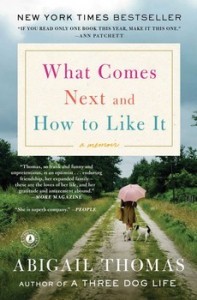 At a time when memoirists are often told the story that will sell to a publisher is the “noisy” story that can most reliably garner headlines, links and clicks—and therefore, sales—it feels like vindication that Abigail Thomas’ work stands out on the shelf for a different reason: It is real, relatable life, beautifully written. It’s car accidents and cancer and love affairs, how Thomas responds to these difficult (but not entirely uncommon) events, and how they shape her and her relationships. Woven throughout are accounts of the furniture her dogs destroyed, her latest painting, a meal cooked, pulling nettles from the garden, a visit with an old friend, drinking too much.
And thank God. Thank God for the lack of hype and drama, the absence of flash and sentimentality. Thank God for a writer and books that slowly and quietly creep into our hearts, and expand them. When I read Abigail Thomas’ work, I feel like I’ve been gifted with an important life lesson about what’s important. I breathe thanks for her willingness to examine her life, give herself grace for the parts where she behaved as a flawed human, and withhold judgment of the rest, as it gives others permission to do the same. Her honesty gives me courage. Her gratitude opens the spigot for my own. More gifts.
Thomas came through Seattle on April 27, and though I was on the tail-end of a head cold and my neck and chest were lit up with a siren-red heat rash—a special thing I get with any manner of illness—I put on mascara and wore a puffy scarf and attended the event with my friend Melinda, who is also a memoirist. On the way there, we’d driven not a hundred feet from Melinda’s house when she noted (about Thomas), “it’s the things she doesn’t say.”
It is that, too. The space that Thomas creates with “the things she doesn’t say” allows for the things she does to have more impact. Not everything has to be in neon lights, nor do we want everything to be in neon lights.
 Thomas’ reading—oh hell, I’m going to call her Abigail from now on, or even Abby. Abby’s reading was just like her writing. She is the kind of person who leaves you wishing she was your next-door neighbor, and that there was a gate in the middle of the fence between your houses, or no fence at all. At 71, she wears bright green booties, revels in old stories of young lovers and drops f-bombs. She is delightful. And, to my surprise, she glowed equally brightly when she talked about teaching others to write memoir.
This energy may be why yesterday, as I lay in congested misery on the sofa with a box of tissue and my pug, some epiphanies about what I next need to do on my own memoir started to emerge. I’d already agreed with my agent back in January that I would undertake revisions, based on thoughtful (rejection) feedback we received from the initial batch of submissions to publishers. And then I went to Africa for a month, and I wrote a bunch of short pieces, and I went to LA—all ways of putting off what wasn’t coming easily to me in the first place. But yesterday, snotty and hot, and without any effort, I remembered something Abby said: “If you end your memoir where you think it’s supposed to end, you probably haven’t ended it in the right place.” Also, the honesty part. I wasn’t dishonest in the ending of my manuscript, but I wrapped it up too neatly, and in doing so, glossed over some of the truth.
I’m finally excited about digging in to these revisions. Rather than attributing this shift to the mini-delirium that comes with a head cold, I’m going to thank Abby Thomas. In her authenticity, I found a new appreciation for the power, and necessity, of my own.
The post Abigail Thomas Keeps Memoir, and Life, Real appeared first on Laura Zera.

March 6, 2016
Travel: The Many Faces of Dubai’s Burj Khalifa
As if it wasn’t enough to build the world’s tallest building — 2722 feet (829.8 meters) — the creators of the Burj Khalifa took things a step further (because that’s Dubai’s unofficial tag line, really) and added a light-show facade. Hang around long enough (or have dinner at a restaurant that overlooks it and the dancing fountains, like my friend Andy and I did last month), and you’ll see all combinations of incredible colors and designs. And yes, my photos do cut the top off. It’s virtually impossible to get the whole thing in one frame unless you’re a mile away from it.











As for zooming to the top, you’ve got two options: For about $34 USD, you can float around on the 124th floor, but it will cost you 95 bucks if you want to go all the way to the 148th. (From what I’ve been told, it’s not really worth the extra money.) But the main thing is that you must *book ahead!* Otherwise, you may find that the time slot you want is sold out, plus tickets cost more at the door.
Here are a few shots of what it looks like to peer down onto a city’s skyscrapers. It’s crazy.



 The Burj Khalifa gift shop is filled with loads of overpriced crap your brain wouldn’t even register as desiring, including this very phallic stuffed version of the building.
And finally, if you’re curious to see the renowned dancing fountains, I’ve got you covered there, too, and all without having to pay the $14 going rate (due to Dubai’s prohibitive liquor laws) for a beer on the restaurant patio. Don’t even think about ordering wine…
http://laurazera.com/wp-content/uploads/2016/03/Movie-Dubais-dancing-fountains-Feb.2016.mp4
The post Travel: The Many Faces of Dubai’s Burj Khalifa appeared first on Laura Zera.

February 15, 2016
Travel Tips: South Africa Edition
 Cape Town’s Table Mountain
I’ve been wandering the globe for 31 years, and I still haven’t got my packing procedure and checklist nailed down (my husband will have just sprayed coffee out of his nose if he’s reading this; let’s just say we have a different flow when it comes to travel prep). I’m currently “going around” in South Africa and Botswana, as they like to say here, and seeing how in my last-minute bag stuffing I grabbed my trusted traveler (Nexus program) card instead of my permanent resident card, I’m kind of wondering if America will let me back in later this month. Ah well, in the meantime, here are some info bytes for this incredibly hospitable region.
 A dassie rat’s view atop Table Mountain
If you’ve got an unlocked cell phone (or one that’s eligible for unlocking), rather than buying an international plan at home, just pop a local SIM card in when you arrive. The carriers around South Africa and Botswana are slick, and it’s nothing to find a shop and get set up. The cost for a SIM card, enough minutes to call taxis and local booking offices, and 400-500 mb of data is between 13 and 25 USD.
Don’t bring old money. When you get cash out of the ATM or from the teller before you leave for your trip, sort through it and exchange any bills that were issued prior to 2013. Many countries treat currency as though it has an expiry date. I forgot about this, and was turned down in Gaborone when I tried to exchange a perfectly pristine fifty from 1996. ATMs remain the simplest currency-exchange solution. After some fuss, we got the car.
If you’ve booked lodging and services online, you may encounter places that insist on taking an old-fashioned imprint of your card and getting you to sign it once you’re there face to face. The problem? The new style of American credit cards doesn’t feature embossed numbers (or they’re only just barely raised). Twice already I’ve had to stand around and wait for 15-20 minutes while they fiddled with my card, and a (major name-brand) car rental agency first said they might not even be able to complete the booking.
Shared mini-van taxis are the cheapest way to get around in this part of the world, but if that seems like less than fun, then never fear: Uber is in South Africa! (In Botswana, a similar app is called Hello Cabs. It functions like Uber, except you still have to pay with cash at the end.) Oh, hai
For a South African safari, Kruger Park ain’t the only game in town. Based on a recommendation from an SA friend, we decided to try Hluhluwe-Imfolozi Park (if you don’t sound like you’ve had 8 gin & tonics when you say it, then you’re pronouncing it wrong). It’s less built up, less crowded, and equally full of animals. It’s also the second-oldest reserve in the world, after Yellowstone. What I found to be a plus is that it’s only a 2.5-hour drive away from the nearest urban center/airport (Durban), whereas Kruger is a 5.5-hour drive from Johannesburg (though you can also now fly right in and out of Kruger). That’s one well-horned rhino
I can’t help but throw in a clothing discovery. When the staff at the Seattle ExOfficio store told me last month that their underwear was a bestseller, I was skeptical. Though pricey, I bought a pair to try, as well as the even-pricier men’s version for my hubby. Well, I’m here to tell you that those folks weren’t exaggerating when they bragged about their knickers. They wick. They sink-wash and air-dry fast. They retain their shape. Best of all, they actually hold everything in place without hurting you. I will be buying more (when they go on sale).
Have anything to add? Don’t hold back!
The post Travel Tips: South Africa Edition appeared first on Laura Zera.