Sharon Skinner's Blog, page 6
November 25, 2021
2021 Holiday Season Savings on The Healer’s Legacy in eBook
The Healer’s Legacy, the ground breaking fantasy release from author Sharon Skinner, is on sale this holiday season at various eBook retailers. Here are the details for you!
Book Profile Page at publisher Brick Cave Media: brickcave.media/index.php/books-by-genre…-the-healer-s-legacy
Barnes & Noble, 50% Off
Discount Code: BNPHOLIDAY50
Valid Dates: 12/1/2021-12/31/2021
Store Link: www.barnesandnoble.com/w?ean=2940014235372
Google Play Books, 50% Off
Discount Code: N2GUW94B61E4Z
This code may only be used once per reader
Play Store Redemption URL: play.google.com/redeem?code=N2GUW94B61E4Z
Valid Dates: 11/2/21-12/31/2021
Store Link: play.google.com/store/books/details?id=n4S1G-Iu1KkC
Apple Books, 50% Off
No Discount Code Needed
Valid Dates: 11/25/2021-12/31/2021
Store Link: books.apple.com/us/book/id507909441
It is also available at Amazon through the Brick Cave Media store: http://amazon.brickcavemedia.com/
[image error]The post 2021 Holiday Season Savings on The Healer’s Legacy in eBook appeared first on Sharonskinner.com.


November 5, 2021
Understanding Pacing
Pacing/tempo: It’s all about the heart.
Pacing is an important component of effective writing, but what exactly is it and how can we use it to the best advantage in our writing?
I was on a recent call with a group of book coaching colleagues where we got into an in-depth discussion on pacing. It got me thinking about how I approach this particular craft component, the issue of using pacing effectively in writing, and how I address it with my book coaching clients.
Some of the questions that come up when we discuss pacing include:
What is pacing? Why is it important? How can we use it effectively? When do we know when the pacing is right?Pacing, like voice, can seem elusive, but as with all writing craft tools, once you know how to develop pacing, you can apply the technique throughout your work.
What is pacing?For me, pacing is all about where the narrative makes the reader’s heart race, where it gives them time to think, and where it lets them breathe. It’s about using words and sentence structure to provide an ebb and flow of energy like opening and closing a valve. Pacing is not only the rate at which a story develops, it is the rate that a reader moves through and experiences the story.
Why is pacing important?With the right pacing, the reader will experience the story in a more meaningful way. Good pacing helps create a deep emotional and visceral connection.
How do we use pacing effectively?One way to use pacing to best effect in your writing is to think of a book like a piece of music, where pacing is the tempo, the speed at which the piece should be played. Or, in this case, read.
The great thing about using musical tempo as a guide is that the pace is measured in heartbeats!
Here are a few examples from Wikipedia:
Grave — very slow (25–45 bpm)
Andante — at a walking pace (73–77 BPM)
Moderato — moderately (86–97 BPM)
Allegretto — moderately fast (98–109 BPM)
Allegro — fast, quickly and bright (109–132 BPM)
Presto — very, very fast (168–200 bpm)
Prestissimo — even faster than presto (200 bpm and over)
When we want the reader to slow down and take time with a scene or section, we use longer sentences, multi-syllabic words. Slow languorous, passages filled with engaging description offer atmosphere and feelings of peace.
To speed them up, we use shorter sentences and single syllable words. Short paragraphs and lots of white space filled with action help the reader’s eyes move down the page more quickly and create a sense of rapidity.
Word choice makes a difference, as well. Getting down to the micro level, you can use the sounds of words to increase or decrease the pace.
Words with hard vowel sounds have a quickness to them, while longer, more rounded vowel sounds tend to have a slower, more soothing effect. For more on this, I recommend you check out Darcy Pattison’s blog post on Word Sounds. (It’s an oldie, but a goodie.)
When do we know the pacing is right?Think in terms of what you want your reader to feel while reading. Match the pace to the scene, the action, and the point of what is happening. Use the musical terms and the heart rates they represent to see if your prose is making the most of pacing.
Consider the difference between:
The earth shook. Horns blared. People screamed. The ground opened. The porch lurched, and Jim fell.
And…
The ground rumbled and growled, shaking the house. The entire street filled with noise, car alarms squealed and blared, as peopled rushed outside screaming in terror. A long crack opened in front of his house, ripping away the front porch where he stood, and Jim fell in.
The next time you read a passage in a book and you find yourself getting anxious, check to see how the author has not only created tension and suspense by pulling you into the emotional realm of the character but also the way they have structured the narrative. Watch for places in an action-heavy story where the author slows the narrative to allow the reader to breathe, in a romance to draw out the sensations of the lovers’ passion, or in a thriller to raise the tension by drawing out the time it takes for the hero to hack into the villain’s alarm system, much to the consternation of the poor reader who is thinking, “hurry, hurry, hurry!”
Word choices, sentence structure, paragraph length, all contribute to the mood, tone, and pacing of a scene or story. Try applying prestissimo the next time you want a scene (and the reader’s heart) to race!
NOTE: This blog post previously published on Medium.
Sharon as Book Coach:In addition to being a speculative fiction author, I am also an Author Accelerator Certified Book Coach I help writers weave their words into stories that shine. If you want to know more about book coaching and what a book coach can do to support you on your writing and publishing journey, check out my book coaching webpage.
[image error]The post Understanding Pacing appeared first on Sharonskinner.com.
October 11, 2021
Why No NaNoWriMo For Me?
[image error]
“Why no NaNoWriMo for me?”
It’s October and all around me, people are gearing up for NaNoWriMo (National Novel Writing Month). They’re psyching themselves up, gathering their tools, stocking up on caffeine, and putting plans in place for a month-long writing sprint aimed at churning out 50,000 words in a single month.
Those who participate in this annual event and earn their badges of honor by reaching the total whopping word count range from the pre-published to the well-published and everything in between. For some writers it’s an annual tradition and a time when they punch out an entire novel draft. For others, it’s a fun way to get words on paper.
If you fall into this camp, or think you might, I highly recommend checking out the NaNoWRiMo web site. They offer tons of resources, including prep support and word tracking tools. It’s a very engaged community.
To me, NaNoWriMo is both impressive and terrifying.
It is also something I plan on never doing.
Why? Why no NaNoWRiMo for me?
Because, for me, it would be a hyper-stressful, unhealthy set-up.
Don’t get me wrong. I’m not saying NaNoWriMo is bad. On the contrary, it works for a lot of people, and I know plenty of writers who love it, people who write well beyond 50,000 words in a month. It is a super-charged writing event that builds community and ushers writers to complete work they might not otherwise complete, at least not in such a short amount of time. And I can see how it can be a valuable exercise, especially for people who are plotters and planners and anyone who preps before-hand and is ready to go right out of the gate.
But it’s not for me.
Why not? Why no NaNoWRiMo for me?
Because when I write, I want to be allowed to explore and meander a bit along the way. I want to hang out with my characters, sit with them, share a laugh, take some time to get to know them, and maybe be surprised.
I don’t want to run a race with them. Even if they could carry the baton for me. We just don’t have that kind of relationship.
Also, I have always been a short distance sprinter. (Seriously short. Like between the bases in baseball.) It’s how I roll. Novel-in-90 (750 words a day for 90 days), which I have done more than once, is more my speed. (Honestly. I have daughter who is a runner. She definitely did not get that from me!)
Plus, I want to enjoy my writing. I don’t want it to become a chore, something that I have to push and drag myself to do. For me, the daily commitment at the NaNoWRiMo level, even for thirty days, would be the opposite of fun.
Not to mention that I only get a few holidays a year to spend online gaming, and Thanksgiving is one of them. (Don’t give me that side-eye.)
And, like a lot of things, when it comes to writing, it’s important to find what works for you. Maybe that’s NaNoWRiMo, maybe it’s Novel-in-90, maybe it’s writing every day, or catch-as-catch-can. Maybe it changes over time. If it works, own it.
You do you.
So, while a few hundred thousand writers spend the month of November tapping out around 1,666 words every day, I’ll be over here, writing a bit, editing a bit, questing a bit, and cheering you all on from the sidelines. You can do this (if you want)!
So, whatever process works best for you to get your words onto the page, do that.
Like I always say, process is personal.
Happy writing!
[image error]
The post Why No NaNoWriMo For Me? appeared first on Sharonskinner.com.
September 1, 2021
Writing a Solid Synopsis
 Here is a question that has been niggling at me regarding the challenge of writing a solid synopsis:
Why is it that an author who can craft a novel by churning out an entire 50,000 or 100,000+ words, often finds writing a solid synopsis so difficult?
There are many answers to this question, one being that after you have spent months building a world and populating it with fully-realized, multi-dimensional people, it’s difficult to force yourself to filter that entire multi-layered novel down into a couple of pages containing the heart and bones of the story. It feels a bit like butchering a pet calf.
And, while in some ways a synopsis is a supposed to be the entire story boiled down to “just the facts, ma’am,” a well-written synopsis must also express the point of the story, provide insight into who the main characters are and why they matter, and include the key plot points. “Why not just read the novel?” the frustrated writer may well ask.
But in thinking about the synopsis, I have realized that a big part of why it is so difficult to write, especially for fiction writers, is because a synopsis isn’t fiction.
“What?” I imagine the fiction writer saying as they read this. “But it is a synthesized version of my book, my story, my fiction.”
All true.
However, if you think of writing a synopsis as a form of copy writing (which is very different than crafting a novel, and even a non-fiction book) and apply some of the tools used for that, it might just make the process easier.
Let’s start by exploring what Robert W. Bly calls “The 4 Cs of Effective Writing.” Bly posits that a good piece of copy is Clear, Concise, Compelling and Credible. (These are also useful tools for use in writing a good query, which is a form of persuasive writing. But let’s save that for another post.)
If you consider what makes a good synopsis, Bly’s 4 Cs are especially useful.
Clarity, because it is critical to provide a clear picture of what the book is about.Concise, because the story must often be boiled down into two pages and sometimes fewer.Compelling, because you must give the reader (generally an agent or editor) a reason to want to read the entire work.Credible, because you must convince the reader/agent/editor that the story works.How do you get clarity on your story? Know the point you are trying to make and why you must write it.
Being concise is a matter of cutting away the extraneous components and narrowing down what really matters. Subplots and set dressing are all targets for the cutting room floor.
To make it compelling, you need to show why the reader should care. What is at the heart of the story that will matter to readers?
Credibility shows in the way your plot points tie together. Things happen for a reason. Consider the Pixar Storytelling formula, “Once upon a time there was ___. Every day, ___. One day ___. Because of that, ___. Because of that, ___. Until finally ___.”
Thinking of the synopsis as copy/technical writing, might just allow you to let go of the deeper world and character that you have spent so much time crafting, and give yourself the space to step back and see your story from a different perspective. Sometimes, just a little distance from the original creative effort, a small shift in mindset, is all it takes.
If you are still struggling to get your synopsis written and you’re looking for an easier way to develop these 4Cs and get a strong start on a solid synopsis, you might want to check out Blueprint for a Book by Jennie Nash. Or consider hiring a Book Coach to help you with this work.
[image error]
The post Writing a Solid Synopsis appeared first on Sharonskinner.com.
August 1, 2021
Creative Writing and Cognitive Alchemy
When teaching or talking about creative writing and/or coaching fiction writers, I talk a lot about the subconscious act of writing and how the churn of thoughts and ideas takes place even when we are not sitting in front of the blank screen or fresh sheet of paper. This is not a new concept. However, it is sometimes the key that unlocks a writer’s pent-up emotions and worry over being able to produce perfect work on command, allowing them to understand that our brains are processing and creating, even when we are doing other things.
This is not to say that active avoidance of thinking about things will provide all the answers. We still need to set the brain the task of resolving our problems. And actively working through and digging deeper into the issues we are presenting on the page is never wasted effort.
However, we have all had moments where an idea or solution to a problem comes when we are not focused on it, while doing the dishes, standing in the shower, or taking a walk. Many of us find that focusing on other types of creativity, molding clay, bending wire, or designing and sewing a costume, are also great ways to spark the brain into a different way of thinking about the snarls of our written work.
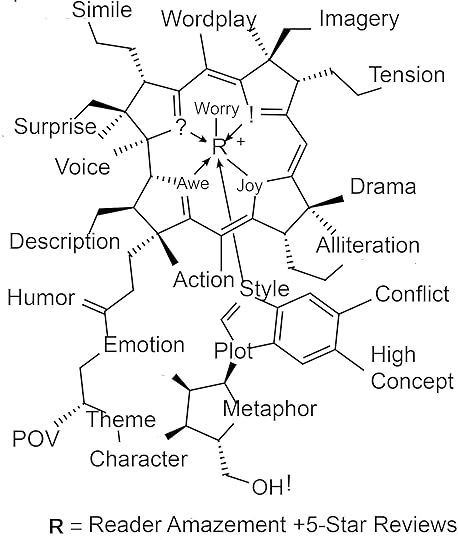
I recently read an article on creativity and the creative process that posits that forgetting can be beneficial for creativity. That “forgetting” can improve “combinatory play.” The idea is that hard-wired concepts that lose their connectedness make way for us to make creative leaps in our thinking. The author (Scott A. Small, M.D.) uses the term cognitive alchemy, which I must admit was a term I hadn’t come across before. It’s certainly in the world, but it hit me in a surprising way. Of course, I thought. What else is creativity but brain-driven chemistry based on the mixing of thoughts, ideas and techniques to create recombinant forms of art? But what of the reader? In chemistry, isn’t there typically a reactant and a reaction?
In creative writing, we use words to create pictures, to share experiences, to shift cliché into new story and world specific descriptions that elevate world-building and emotional expression and provide pathways into the hearts of our characters that allow readers access into both another’s story and often their own. It’s “a magical power or process of transmuting a common substance, usually of little value, into a substance of great value,” which is a definition of alchemy.
Storytelling is a form of sorcery. Writers conjure, using chemistry to recombine thoughts and ideas with measures of mythology, spoonfuls of philosophy, and handfuls of history, stirring the ingredients together with oodles of emotion and a volume of voice. The final product is offered up to readers, who open their brains to ingest this glorious conglomerate, and are able to step into and experience an entirely new world, and are changed by the encounter.
That’s what I call cognitive alchemy!
[image error]
The post Creative Writing and Cognitive Alchemy appeared first on Sharonskinner.com.
July 8, 2021
Extroverted Introverts Can Be Social. We Just Prefer Not To. Most Of The Time.
I recently tried to google “social discomfort.” Guess what? Every link related to this term, or to “socially awkward,” the term that pops up when trying to search out information about feeling uncomfortable in social settings, pretty much leads to articles and posts on Social Anxiety Disorder and lists of ways to overcome it.
Huh.
I am not socially awkward. No one seems to find me particularly awkward when in social settings. And I am great at one-on-one interactions. Or so I am told.
But I FEEL awkward/uncomfortable in social/group settings. I do not like crowds. I especially do not like large, uncontrolled crowds (think concerts, festivals, fairs, etc.), and I therefore prefer to avoid those types of situations.
Except, I am an author, a writing instructor, a book coach, and a presenter. I cannot completely avoid those types situations. So, I go there. I do that. And, at the end of the day, I scurry home to recuperate. Because it is exhausting to me to be in those situations.
Does that mean I have some level of social anxiety? Perhaps. But not to the point that I would call it a disorder. I don’t consider this aspect of personality a disorder, at all. It just happens to be a part of who I am in the world. Nor do I really have any desire to “fix” this aspect of who I am. In fact, I doubt that I could, if I wanted to.
I have become rather attached to the introverted extrovert label, which I now use to try and explain my relationship to the world and, well, people. To read more about this term, check out “If You Relate to These 10 Signs, You’re Probably an ‘Extroverted’ Introvert.”
While I relate to all of the signs to some degree, number 10 on the list stands out. I am not only “often” but pretty much always mistaken for an extrovert!
I have learned to work to my strengths, handling social interactions in the ways that allow me to be myself.
This requires a certain level of planning on my part.
Invitations to two (or more) closely scheduled social gatherings? I have learned I need to opt out of one (or more).
Gatherings that include complete strangers? I need to find a quiet place to settle, or limit the amount of time I spend before excusing myself.
Large events, like book festivals of conventions? Identify the easiest/fastest routes between the places I need to be (including the nearest amenities) prior to the start of the event.
And, come to find out, there are a lot more people like me than I thought. The more writers I meet, the more I have realized, I am not alone.
The world expects us to want to be social. And that is understandable. Humans are, after all, social animals. But, for some of us, a little goes a looooong, long way. Extroverted introverts can be social, we just prefer not to most of the time.
So, to all the extroverted introverts out there, I see you, but I won’t force you to hang out in public with me.
[image error]The post Extroverted Introverts Can Be Social. We Just Prefer Not To. Most Of The Time. appeared first on Sharonskinner.com.
June 7, 2021
Word-Nerds Unite! Affiliate with Supportive People and Organizations
Anyone who knows me, knows I am an eclectic and voracious reader, a writer/author, a book coach, editor, and writing mentor/teacher. In short, I am a word-nerd. I also like to affiliate with supportive people and organizations.
I have loved words since the days when, in excited anticipation of when my own turn would come to be able to attend school, I would watch my mother help my older brother sound them out. I knew that reading would grant me entrance into a world of fascination and knowledge and could already imagine savoring those magical word formulae on my tongue.
Needless to say, I learned to read long before I entered Kindergarten.
Poetry. Short stories. Books. I love them all. Stories are my homeland. Characters my besties. Authors are my people, my community.
I am also a firm believer in the cliché of the rising tide lifting all boats, which is why I support so many by volunteering as the Arizona Regional Advisor for the SCBWI (Society of Children’s Book Writers and Illustrators), continuously seek out opportunities to teach, and write blogs and SM posts on craft.
As a life-long learner, I am a skill seeker, an informational treasure hunter, a fact finder. I revel when learning a new concept, mastering a new skill, or just gaining a deeper understanding of something. When it comes to writing craft, I love leveling up, discovering new ways to look at things, and I am prone to happy dancing when I find a new and more resonant way to articulate the knowledge I already have, or exploring a new entry point into story.
All this is to say, that I am finding new ways to do this work in the world. Not only the work of writing, but the work of supporting others on this amazing journey. So, it isn’t any surprise that I became a certified Book Coach. Nor should it astonish anyone to know that I continue to align myself with incredible supportive organizations like the SCBWI.
My newest alignment is with ALLi (Alliance of Independent Authors). ALLi adheres to strict member requirements and follows a rigorous vetting process for Partners. They are “a professional business membership organisation for self-publishing authors. A non-profit, we provide trusted advice, supportive guidance, and a range of resources, within a welcoming community of authors and advisors.”
I am excited by the mission match between Book Coaching by Sharon and ALLi, and I am honored to have been approved as a Partner Member of this wonderfully supportive group.
If you are an Indie Author like me, who likes to affiliate with supportive people and organizations, looking for community and writing support/resources that have been strictly vetted, you might want to consider joining this excellent organization.
Click the link to see what benefits ALLi has to offer:

(Full disclosure, I get affiliate credit, if you use this link to join.)
[image error]The post Word-Nerds Unite! Affiliate with Supportive People and Organizations appeared first on Sharonskinner.com.
December 27, 2020
MY READING WOMEN CHALLENGE 2020: COMPLETE
I completed the Reading Women Challenge 2020 on December 26th of this year. This is the third year I have participated in The Reading Women Challenge and the third year I completed it. This annual challenge is a great way to expand your reading. I highly recommend you check it out.
“READING WOMEN CHALLENGE 2020 … All books read for this challenge must be by or about women. Please note that the spirit of this challenge is not to read books by men.”
Here is a fun shot of the covers of the books I read for this year’s Reading Women Challenge (The list had 26 categories this year, but I read multiples in a couple of categories because, why not?):
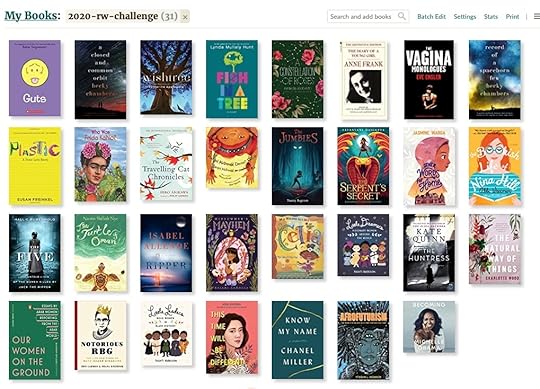
Here is the list of the Titles & Authors:
1) A Book by an Author from the Caribbean or India: The Jumbies by Tracey Baptiste
2) A Book Translated from an Asian Language: The Travelling Cat Chronicles by Hiro Arikawa, (Translated by Philip Gabriel)
3) A Book about the Environment: Plastic : A Toxic Love Story by Susan Freinkel
4) Picture Book Written/Illustrated by a BIPOC Author: Marisol McDonald Doesn’t Match by Monica Brown
5) A Winner of the Stella Prize or the Women’s Prize for Fiction: The Natural Way of Things by Charlotte Wood
6) A Nonfiction Title by a Woman Historian: The Five: The Untold Lives of the Women Killed by Jack the Ripper by Hallie Rubenhold
7) A Book Featuring Afrofuturism or Africanfuturism: Afrofuturism: The World of Black Sci-Fi and Fantasy Culture by Ytasha L. Womack
8) An Anthology by Multiple Authors: Our Women on the Ground by Zahra Hankir
9) A Book Inspired by Folklore: The Serpent’s Secret (Kiranmala and the Kingdom Beyond, #1)By Sayantani DasGupta (Also, Midummer’s Mayhem by Rajanni LaRocca)
10) A Book About a Woman Artist: Who was Frida Kahlo? by Sarah Fabiny
11) Read and Watch a Book-to-Movie Adaptation: The Diary of a Young Girl by Anne Frank (Film: The Diary of Anne Frank, Starring Kate Ashfield, 2009)
12) A Book About a Woman Who Inspires You: Becoming by Michelle Obama
13) A Book by an Arab Woman: The Turtle of Oman : a novel by Nye, Naomi Shihab.
14) A Book Set in Japan or by a Japanese Author: This Time Will be Different by Misa Sagura (Also, The Travelling Cat Chronicles by Hiro Arikawa, Philip Gabriel (Translator)
15) A Biography: Notorious RBG : the life and times of Ruth Bader Ginsburg / Irin Carmon and Shana Knizhnik
16) A Book Featuring a Woman with a Disability: Guts by Raina Telgemeier
17) A Book Over 500 Pages: The Huntress by Kate Quinn
18) A Book Under 100 Pages: Little Leaders: Bold Women in Black History by Vashti Harrison. Also, Little Dreamers by Vahsti Harrison
19) A Book That’s Frequently Recommended to You: The Wishtree by Katherine Applegate
20) A Feel-Good or Happy Book: The bookish life of Nina Hill by Abbi Waxman
21) A Book about Food: A Constellation of Roses by Miranda Asebedo
22) A Book by Either a Favorite or a New-to-You Publisher: A Fish in a Tree by Lynda Mullaly Hunt
23) A Book by an LGBTQ+ Author: A Closed and Common Orbit by Becky Chambers, Also Record of a Spaceborn Few by Becky Chambers
24) A Book from the 2019 Reading Women Award Shortlists and Honorable Mentions: Know My Name by Chanel Miller
BONUS
25) A Book by Toni Morrison: Peeny Butter Fudge
26) A Book by Isabelle Allende: Ripper
And check out the list for the READING WOMEN CHALLENGE 2021
[image error]
The post MY READING WOMEN CHALLENGE 2020: COMPLETE appeared first on Sharonskinner.com.
November 5, 2020
Authors Guild Member Spotlight Celebrates New Book Release
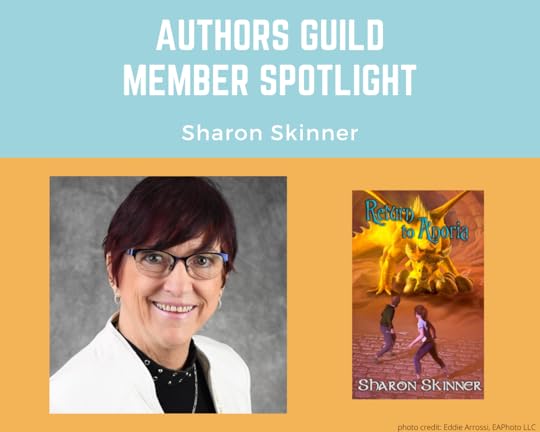
Member Spotlight post from the Authors Guild celebrates Return to Anoria, Sharon‘s latest Middle-Grade fantasy and sequel to The Nelig Stones!
[image error]
The post Authors Guild Member Spotlight Celebrates New Book Release appeared first on Sharonskinner.com.
October 18, 2020
eBook Sale at Kobo until October 31, 2020
Morning all,
Just a quick heads up that until October 31, Rakuten Kobo is offering discounts on several Sharon eBooks. You can find the following titles available at sale prices through October 31:
Collars and Curses ($2.99 US)
Mirabella and the Faded Phantom ($1.99 US)
Supernal Dawn ($2.99 US)
If you are a Kobo fan, you can find all of Sharon’s available books on the platform here.
[image error]
The post eBook Sale at Kobo until October 31, 2020 appeared first on Sharonskinner.com.