Sharon Skinner's Blog, page 2
January 6, 2025
MY YEAR IN BOOKS – 2024
It’s January and time to take a look back at my year in books.
IT’S NO SECRET THAT I BOOKS!
I love to read, which is what led me to becoming a writer (and a book coach). Not only do I love to experience the unfolding of a well-written story, but reading feeds my writing and coaching brain. We can learn so much as writers from reading other authors!
I tried to be more accurate about tracking the books I read this year. I think I did pretty well, overall. Though, I still have a tendency to read and track them in batches, as you can tell from the way the RSS feed hits my webpage.
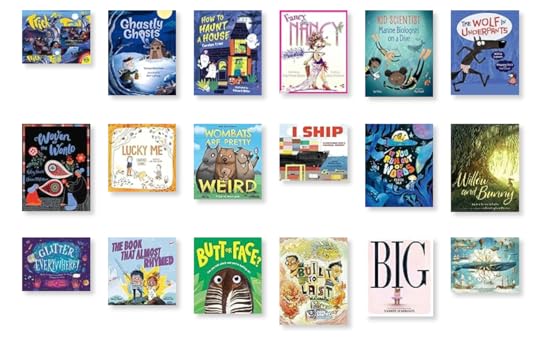
There are a lot of great book tracking tools out there. I actually use BookBuddy app to keep track of my writing craft books. But for tracking the books I read each year, I still use Goodreads. I find it user friendly, and I like the way I can set up specific book shelves and pull detailed stats for the year. I also like the way you can see all the covers at once and grab a screen shot of that, which is what I used for the header of this post.
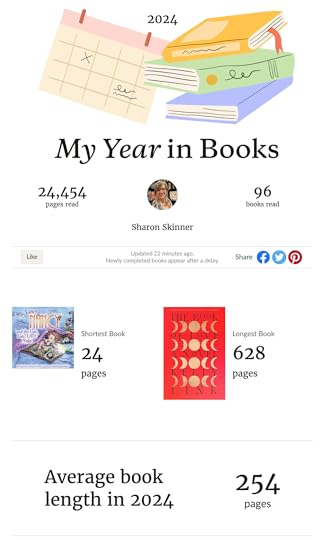 MY 2024 READING SUMMARY STATS
According to my tracking:
I read 96 books.My average number of pages per book clocked in at 254. (That’s 6 fewer pages per book than last year.)My total number of pages read was 24,454. (About 1K more than last year.)MY YEAR IN PICTURE BOOKS Because I coaching Picture Books (PB), I read a number of PBs each year. I study these books to help my clients understand the market, what’s being published, how authors and/or illustrators are creating meaningful picture books books for readers. This year, I remembered to track 18 of the PBs I read. I know I missed a few, so I really need to do a better job of tracking these next year.
BUT THAT’S NOT ALL…
As a freelance editor and book coach, my reading year includes quite a few pre-published manuscripts not represented here. This post only covers the published works that I consumed in 2024. If you have a Goodreads account, you can find me there. Pop in to my Goodreads profile and see what I am reading.
If you’re interested in reading what I write, you can check out some of my books, like The Healer’s Legacy Trilogy, or my newest MG novel, Lostuns Found.
Or, if you like something a little darker, check out my collection of dark fantasy and light horror with a bit of humor. Blood From a Rose.
– – – – – – – – – – – – – – – – – – – – – – – – – – – – – – – – – – – – – – – – – – – – – – – – – – – – – – – – – – – – – – – – – – – – – – – – – – – – –
Want more Sharon Talk?
Interested in what else I write? Check out my books!
[image error]The post MY YEAR IN BOOKS – 2024 appeared first on Sharonskinner.com.


December 15, 2024
Wishing You Wonder
This year has flown by.

It’s hard to believe it’s mid-December already.

The last few months have been some of my busiest ever! In addition to the Arizona State Writing Residency (six workshops and dozens of consultations, yay!), I have traveled for MileHiCon (Denver, CO), TusCon (Tucson, AZ), and LosCon (Los Angeles, CA).

Sometimes, I let myself get so busy I can hardly fit everything in.

But we all need space and grace in our lives, so I am taking a break from the Author Blog this month.

But I just had to take a moment to wish everyone the wonder of open eyes and an open heart, warming comfort on bright winter days, and abundant creativity.

Happy whatever you choose to celebrate this time of year!

See you in 2025.

[image error]
The post Wishing You Wonder appeared first on Sharonskinner.com.
November 21, 2024
FINDING YOUR WRITING COMMUNITY
Do You Know Where Your Writing Community Is?
It’s Con Season for me. A busy time.
In the past few weeks, I have attended two Science Fiction Fantasy Conventions (MileHi Con in Denver, CO, and TusCon in Tucson, AZ) and a summit for Grant Professionals (also in Denver), with another convention coming up in less than two weeks (LosCon in Los Angeles).
At MileHi Con, I was in the Brick Cave booth in the Vendor’s Hall, selling and signing books. At the Grant Professionals Summit, I was both an attendee and presenter. At TusCon, I was a super busy panelist. And at LosCon, I get to relax and hang out as an attendee and see what it’s all about, which is a nice switch.
All this to say that being an author and a book coach keeps me hopping, meeting readers where they are, engaging with other authors, and getting to know writers who might need my help and support on their writing journeys. In other words, I am engaging in and finding community with other writers.
The reason I am so busy is because I am constantly engaging in and finding new writing communities.
Writing is typically a solitary endeavor and the journey to publishing and marketing can feel fraught when we don’t know what we don’t know. That’s why it’s important for writers to find community. Other writers know the things we don’t and often have need of the things we do know. Sharing with one another helps us all move forward.
In a workshop I presented recently, I was asked how and where we can find other writers and writing groups, our writing community. The truth is, you need to seek them out. Go to workshops, attend webinars. Ask at your local libraries and coffee shops. Reach out online. There are tons of writing groups on places like Facebook. And you can check into global writing organizations to find out if they have online meetups or local chapters.
Most large/global writing organizations have local chapters or online meetups. Check out the (incomplete) list below.
AG (Authors Guild)ALLi (Alliance of Independent Authors)ASPS (Arizona State Poetry Society)HWA (Horror Writers Association)IBPA (Independent Book Publishers Association)NMWA (National Association of Memoir Writers)RWA (Romance Writers of America)SCBWI (Society of Children’s Writers and Illustrators)SFWA (Science Fiction & Fantasy Writers Association)SISTERS IN CRIME – Crime WritersSWW (SouthWest Writers)
If your genre is not represented, try googling and see who and what is out there. To find community, we have to seek community.
– – – – – – – – – – – – – – – – – – – – – – – – – – – – – – – – – – – – – – – – – – – – – – – – – – – – – – – – – – – – – – – – – – – – – – – – – – – – –
Want more Sharon Talk?
Interested in what else I write? Check out my books!
[image error]The post FINDING YOUR WRITING COMMUNITY appeared first on Sharonskinner.com.
October 9, 2024
Five-Word Writing Prompt Poetry
For this month’s blog post, I used a random word generator to create a five-word writing prompt, which I used to write a poem.
Yes, it went dark very quickly. But, hey, it’s October, so yay!
Here is the final result:
REFLECTION
Asylum.
The word echoes,
reverberating
against her skull.
Funny how something
that means
sanctuary
also represents
a place of
imprisoned isolation
Outside the window,
the village gleams.
Sunlight rebounding off
pale plastered walls and coral roofs,
set against the emerald hills
where they played as children,
fell to the ground as teens,
filled with
desire’s crimson madness,
alabaster limbs tangled
amid verdant stalks.
Her thoughts trend outward
and back…
The funeral procession.
The shadowed bier.
The black crepe pall.
Dark-green wreaths raveled with
bone-white carnations
and blood-red roses.
She’d gathered them,
the leftovers,
ripped petals from stems,
shoved them into
mouth,
ears,
nose.
Seeking
reconciliation,
redemption,
release.
A requiem denied.
Against sage-colored walls,
twisted ivory sheets
bloom scarlet,
a fitting reflection.
In case you were wondering, here is the five-word writing prompt the random word generator gave me: asylum, trend, leftovers, village, funeral
– – – – – – – – – – – – – – – – – – – – – – – – – – – – – – – – – – – – – – – – – – – – – – – – – – – – – – – – – – – – – – – – – – – – – – – – – – – – –
Want more Sharon Talk?
Interested in what else I write? Check out my books!
[image error]
The post Five-Word Writing Prompt Poetry appeared first on Sharonskinner.com.
September 10, 2024
Characters, Tension, and Being Bitten
Connecting the dots between characters, tension, and being bitten. Sounds like a stretch, I know. But my writing brain can’t help itself.
A week ago, last Friday, our cat was diagnosed with diabetes. She is now on an oral prescription medication, and we have to keep a handle on her glucose levels and check her ketones, as well. To that end, she now has a glucose monitor attached to her left side, which was designed for humans. It’s about as big around as a silver dollar and as thick as two or three of them stacked together. It makes monitoring her glucose level easy but, as with everything having to do with this cat, it’s not actually an “easy button.”
We have had to schlep her to the vet numerous times in the past two weeks and there are multiple follow-up appointments scheduled for her over the next couple of weeks and months. Of course, she hates all of it. Every single aspect. From the oral medication to the lack of treats now on offer to being shoved into the cat carrier and driven to the vet. All. Of. It. But that is the nature of the beast. We have a joke around our house that Gidget’s secret is the same as the Hulk’s. She’s always angry.
I tried to gently groom the mats out of her fur the other night and she bit me. Her biting is not unusual. She is a rescue, like all our cats before her. She, however, was semi-feral when she showed up in the yard after a huge dust storm in 2011, which was the first time in Arizona we started using the word haboob to describe such events.
We almost named her that. Haboob. It would have been fitting. Instead, we settled on Gidget.
Gidget and I have an ongoing love/hate relationship. When people visit and reach out to pet her, I always warn them.
“She’s a biter.”
“Aw,” they respond. “But she’s so sweet.”
I smile “Yeah. I know she comes across all ‘pet me,’ but it’s a trap.”
So, I honestly know better than to expect her not to bite. The trouble is, she’s a very pretty cat with long, soft fur, and she has the prettiest, most musical purr of any cat I have ever had the pleasure to know. She likes to get up on the bed while I am reading at night and pats me with a paw to get me to pet her. Which I do, but I have to take my focus off reading to do so. Otherwise, there is no chance I will escape unscathed.
This time last, she got me good. Three deep punctures on my right hand that have turned red and painful with mild swelling and inflammation. I am healing, but my inflamed hand reminds me to be wary.
The problem is, she doesn’t have a warning system. She goes from purring to biting in less than a twitch. As much as I know the possibility is there, I almost never see it coming.
As a writer, my brain can’t help but connect this to the use of tension in a novel. The way that we sense it coming and then are relieved when the author lets a character off the hook, or upset yet not surprised when the character gets trapped, wounded, or worse. Petting Gidget is like that stretching and releasing of the tension that keeps us on edge while reading.
For me, it’s not the tension that makes me turn the page. It’s the character(s). Like Gidget, they pull me in, make me step closer, lean in, even when I know I might get bitten. It’s the characters I keep coming back for, the reason I offer my hand even when I know it’s a trap.
– – – – – – – – – – – – – – – – – – – – – – – – – – – – – – – – – – – – – – – – – – – – – – – – – – – – – – – – – – – – – – – – – – – – – – – – – – – – –
Want more Sharon Talk?
Interested in what else I write? Check out my books!
[image error]The post Characters, Tension, and Being Bitten appeared first on Sharonskinner.com.
August 15, 2024
“Skinner Did It!”
Every now and then I recall a refrain from my past. When I think back on my time in boot camp, I hear the echo of voices saying, “Skinner did it!”
Boot camp and living in a single room with 77 other women came with a unique set of challenges, not the least of which was figuring out how to not only get along but to work as a team. That said, there were times when we were each singled out, as well. Some more than others.
I admit the passage of time has dimmed to a blur the actual schedule of daily events. One day seemed much like another, filled with learning and drilling and scrubbing and polishing. (Lather, rinse, repeat.) But a few things stand out and, while not all the big moments make me smile, I can recall some of them quite clearly.
And some of them are still funny.
The first couple of weeks were spent learning the ropes (not just in the usual clichéd sense but also getting to know the drill instructors [Recruit Division Commanders or RDCs] whom we referred to as “red ropes” and “blue ropes,” as well as the literal ropes for climbing and tying), among other things.
We learned to tie knots, grew to understand Navy jargon (a language all its own), and attempted to march in formation. Being a dancer for many years and having spent time on the high school drill team, I was unprepared for the lack of coordination of many of my new “ship mates.” I had no idea it was that hard for some people to step in time to cadence!
Because we were so bad at it, we spent a lot of time practicing our marching skills, such as they were, out on a large black top area called the grinder. (Yes, grinder. March around outdoors on a dark surface for hours on end in Florida in June and July and the name makes a lot more sense.) The weather was muggy, averaging around 95 degrees with 73% humidity. (I found the weather details scrolling through the online almanac.) While I admit do not remembering the temperature specifically, I do recall how it felt. Especially when standing at attention wearing a diverse cloud of insect life like a living, buzzing helmet that we could not swat away.
The Recruit Division Commander (RDC) discovered early on that my theater background provided me with the ability to call out cadence in a voice that carried all the way from the back of the unit to the front, and she used me to this purpose. Unfortunately, that also meant that my name was one of the first she learned. And the one name that seemed to stick with her.
No matter where we went or what we were doing, no matter that I was marching completely in time, the RDC was constantly yelling, “Skinner, get back in line!” “Skinner, move your ass!” or “Skinner, get in step!” It boggled my mind at first, as I knew I was doing what I was supposed to be doing. I was often the one calling cadence, after all. But, after a while, I simply accepted the fact that she had decided to single me out for whatever reason.
Some of the other activities that took place those first couple of weeks were visits to medical—as a group to get shots—or dental, where we went singly by appointment, to have our teeth checked. One day my name was called and I ran up and stood at attention before the RDC, who sent me “double time” over to dental. After having my teeth prodded and x-rayed, I was sent back to my unit. When I arrived back at the berthing compartment, I was met with raucous laughter.
Turns out, while I was at dental, the Training Unit continued to march and drill out on the grinder, and all the while our RDC kept yelling, “Skinner, get back in line!” “Skinner, move your ass!” or “Skinner, get in step!”
When I arrived back at the barracks and stepped inside, someone quipped, “Skinner did it!” And the room erupted in laughter.
After that, it didn’t matter who did I what. If anything went wrong, if there was any kind of blame to place, no matter what it was, the automatic response from my boot camp “crew mates” was, “Skinner did it!”
Someone misplaced something? “Skinner did it!”
No mail from home? “Skinner did it!”
Long wait for mess? “Skinner did it!”
It became a mantra and a commentary on the ridiculous nature of some of the things we were put through in boot camp.
And it was a way to lighten tension. A small bit of levity that could cause a general eruption of mirth in a place that dearly needed it. And “Skinner did it!”
I wasn’t being laughed at. I was being laughed with. And I totally leaned into it along with my 77 roomies.
What can I say? I’ll totally own that “Skinner did it!”
– – – – – – – – – – – – – – – – – – – – – – – – – – – – – – – – – – – – – – – – – – – – – – – – – – – – – – – – – – – – – – – – – – – – – – – – – – – – –
Want More Like This?To Read More About Sharon’s Time in the Navy Click Here
Interested in what else I write? Check out my books!
[image error]The post “Skinner Did It!” appeared first on Sharonskinner.com.
July 15, 2024
Writing Emotion That Cuts Deep
I know a little bit about writing emotion that cuts deep. Most authors do. How can we not?
When I tell people I am a writer, I get the usual questions and responses:
“Have you written anything I might have read?”
“Are you published?”
“Someday, I’ll write something.”
“I wish I had time to write.”
For me, writing isn’t something I want to have done. It’s something I need to do, and not just “when I have the time.” While not always cathartic, emotional writing is a necessary component in my writing. There’s just something inherent in the system.
The Emotional Writing Journey
I have been writing for years, in journals, on napkins and little scraps of paper, hoping to reach out and touch someone with my words, hoping to connect, always finding some understanding of my own feelings and emotions along the way.
I started out on this journey simply writing. Short stories and poetry came first, which led to reading my work in front of hundreds of people, attending writing seminars, joining writer’s groups, reading hundreds of books on writing, submitting to countless publishers, and entering multiple writing contests. As part of the continuous learning, I completed a BA in English and a Masters in Creative Writing.
I experienced plenty of rejection along the way. I still do! But I also managed to have a few things published in journals and magazines, and I self-published several chapbooks of my poetry. I even won a couple of local contests.
In the past few years, I have had several novels published as well as a couple of picture books and some prose and poetry collections. Along the way, I have gained a readership and have made multiple author appearances at writing conferences, book festivals, and conventions. I have been an Arizona State Library Writer in Residence four times. And now, in addition to freelance editing and teaching creative writing, I am now a certified Book Coach in Fiction and Memoir.
I am following my passion and the journey is going well. And I continue to find ways to connect with people through my writing. My favorite comments are those that come from readers who fall in love with the characters, those who become fully engaged in the journey, especially those who are emotionally moved by my stories.
The Difficulty of Writing Emotion That Cuts Deep
I know how difficult it can be, writing emotion that cuts cdeep, writing that claws into the heart and opens us up to introspection, writing that digs up emotions we might prefer remained deeply buried. How our personal flaws and foibles are stripped bare when we look too closely at our lives, our relationships.
Over the years, I shared a lot of my writing with my mother. And although much of my writing was not her cup of tea (she preferred non-fiction, while I like fantasy, etc.) I have always gotten encouragement from her. But I will never forget the one poem that finally touched her heart and moved her emotionally.
The poem isn’t very long; it contains fewer than 30 lines, but it sums up all the fears and feelings and frustration of my relationship with my abusive grandmother. My mother’s mother. A woman who had been demanding and dominating and downright mean. A woman who had become confused and helpless in her old age, and who had to be cared for in the fading years of her life.
As my grandmother lay dying, I did a lot of journaling about my relationship with her. I had plenty of time to think and write because she clung to life as stubbornly as she’d held onto her anger and prejudices during her lifetime. It was nearly ten days before she finally succumbed. During those days, she remained in a semi-unconscious state, unable to respond to questions or other stimuli. And during those days I wrote. I wrote and I swore and I cried. Then I wrote some more.
I wrote chain-of-consciousness, rambling, anger filled messages. I wrote guilty recriminating, emotional passages. I wrote poetry and fiction and memories and dreams. And finally, I wrote “Another Grandmother Poem.” (Reprinted below.) A poem that captured all of my gut feelings, my anger, my resentment, my reasoning and my personal epiphany in a few short lines.
It spoke of the disbelief, the anger, the fear, and the peace that we were both finally able to find. It was not trite. It was not self-effacing. It was not accusing, nor completely forgiving, but it was honest. And when I finally sent it to my mother, she cried. And when she shared it with a friend, he cried, too. Even though he never knew my grandmother. That poem continues to reach people and evoke emotional responses from them. It has even won a few awards. It is also extremely relevant now, as my mother disappears, her dementia having progressed to the point where she can no longer retain information, which has made reading no longer possible for her.
Writing as Emotional ConnectionSince then, I have received comments from readers telling me that my poetry and books have connected, moved them, even helped them to process their own emotions.
When I feel like my writing is failing. When I become frustrated by rejections from publishers. When my words seem to crumble before I can string them together. I know that I have connected, that I can reach out and touch someone with my words. I remember that I’ve done it before. I aim to continue to hit that mark, again.
And again and again and again.
* * *
**ANOTHER GRANDMOTHER POEM**
I don’t think she lost her mind.
She simply discarded it.
The Alzheimer’s diagnosis was wrong.
She couldn’t bear to remember anymore.
Swept up clouds of mist between herself and those she’d hurt,
Or those she’d been hurt by.
Her mind became an unused summer cottage where dust covers draped the furniture.
But selective memories become dangerous ground,
And the dust covers spread and grew like evening shadows stretching into darkness.
Soon only a corner or two stuck out
in tiny moments of clarity.
“How did you find me?” she’d ask in surprise,
Not knowing herself where she was anymore,
And we would have to tell her again who we were.
She didn’t know her own children had died
That all her friends were gone,
Couldn’t recall having moved across country
Or all the years that had passed.
But she knew the natural color of my hair
And how many times I’d been married.
And I was no longer frightened of her—
Her weakness made me laugh until I cried.
My peace was made at the side of a deathbed
Where I could never kneel.
The healing comes with time.
And now, some nights I sit up trying to remember
Everything that I have ever done.
And I wonder if I will still know myself
After all my anger is gone.
* * *
*This blog post was substantially revised from a previous version posted in 2014 on my now-retired website.
** “Another Grandmother Poem” was originally published by Brick Cave Books: In Case You Didn’t Hear Me the First Time: Poetry and Prose (2010).
– – – – – – – – – – – – – – – – – – – – – – – – – – – – – – – – – – – – – – – – – – – – – – – – – – – – – – – – – – – – – – – – – – – – – – – – – – – – –
Want more Sharon Talk? .
Interested in what else I write? Check out my books!
[image error]The post Writing Emotion That Cuts Deep appeared first on Sharonskinner.com.
June 13, 2024
LISTENING AND FOLLOWING
If you listen to your own voice unknown friends will come and find you. –Carl Jung
The Voices in My HeadPeople often ask me where my ideas come from. My usual response is “from listening to the voices in my head.”
My fiction is very character-driven. Characters get inside my brain and nag me until I tell their stories. So I do. I start there and find the story, and the plot, along the way. Yes, I have to refine the plot in revision, but the character arc tends to come with the journey.
In truth, the real answer is the same as other creators, artists, and discoverers. Ideas come from that vast roiling part of the brain known as the subconscious. Listening to the voices inside my head, I am really listening to the truths that resonate with me. The truth of personal experience. My authentic inner voice. Following where that voice leads brings me to a place of deeper understanding and allows me to create deeply layered stories, and do so in an original way.
At the 2014 SCBWI annual summer conference in Los Angeles, I attended a session by Meg Rosoff where she talked about this.
Meg talked about how the heart and soul of a story come out of the subconscious and how the more we access the subconscious the more we widen the path to reach it.
I agree.
Gaining AccessThe challenge for most is figuring out the best way to do that. For every individual, the access to that path will be different. Some find it through meditative contemplation, others by taking a walk or jogging in the park, and some in the bath or the shower.
For me, it’s typically found by getting away from the desktop, unplugging from the internet, and sitting in my living room writing on my laptop. I then enter my world by placing my characters in situations and tossing in some conflict. This is a form of discovery writing that has always worked for me.
Whether I am in full-on discovery writing mode or writing from a general outline, giving my characters a certain level of free rein is a way for me to allow my subconscious mind to take the lead, widening my access to the inner truth that drives me to write about these characters in the first place. Listening and following to hear my authentic voice.
I believe this access into the subconscious is one key to producing a unique voice and personality for the story. How we see the world, whether we are filtering it through a character lens or not, is unique to who we are and what we believe. Accessing that inner subconscious truth, getting deep into the core of who we are, colors the prose we produce, putting our mental stamp on it.
Letting the Inner Voice SpeakJust as no two fingerprints are alike, no two brains are the same, no two people think exactly the same way about everything.
So, it is inherent for us as writers to allow ourselves access into that deep inner place where we truly exist as our authentic selves. Find your path, widen your access, and let yourself in, follow your truth, listen to your inner voice, then let it speak out.
Your readers will thank you for it.
*This blog post was substantially revised from a previous version posted in 2014 on my now-retired website.
– – – – – – – – – – – – – – – – – – – – – – – – – – – – – – – – – – – – – – – – – – – – – – – – – – – – – – – – – – – – – – – – – – – – – – – – – – – – –
Want more Sharon Talk?
Interested in what else I write? Check out my books!
[image error]The post LISTENING AND FOLLOWING appeared first on Sharonskinner.com.
May 7, 2024
Shipboard Pranks
I learned a lot of new things during my time aboard ship.
A Westpac cruise is filled with all sorts of fascinating opportunities to view the world and learn about new cultures. Including shipboard culture.
It also provide opportunity to see the ocean lots of ocean sometimes nothing but ocean for days at a time. During these long stretches at sea sailors tend to make their own fun. This includes a kind of hazing that involves pranking. Not like being in a college frat hazing, just some let’s go mess with some of the noobs fun and games.
There are some imaginative pranks played aboard ship. Some have been around so long, they’re practically tradition.
Here are just a few of the shipboard pranks I saw during my tour:
Mail Buoy Watch
Imagine first time on a naval ship and you’re on your first cruise. When someone tells you that it’s important for us to not miss the mail buoy because it’s the only way we get our mail while out at sea. Not only that, but it’s your turn to stand Mail Buoy watch. It’s an extremely important duty. You’re handed a life jacket, a hardhat, a pair of binoculars, and a gaffe (a four foot pole with a hook on the end of it).
You’re assigned to stand at the prow of the ship (which in the case of the USS Jason, was about four stories above the waterline) where you are to stay for the next four hours and watch for the mail buoy. If you spot it, you are to shout out “Mail Buoy ahoy!” and prepare to hook the mail bag off the buoy.
The rest of the crew would wait to see how long it took for you to realize that hook was not long enough to reach anything.
Some people stood the entire watch.
Rare Sea Bat
A message is piped over the shops comm that a rare and unusual sea bat has been captured on the boat deck. When you arrive, a cardboard box is sitting upside down on the boat deck. Standing by is a sailor with a broom, keeping watch. He tells you that anyone who wants should feel free to bend down and lift the edge of the box and view the rare beast underneath. But be careful not to let the creature escape.
Crewmembers gather around and watch as a sailor bends down and reaches for the box, gently lifting the corner, only to be smacked on the ass with the broom.
You would think this would be a clue, but I watched in amazement as one sailor tried three times to look at the bat, becoming more and more annoyed each time they were smacked with a broom, until, that third time, no one could stop laughing and they finally got it.
BT Punch
This one is likely no longer allowed. TBH-this one would have caught me had I not watched someone else fall prey to it aboard the Jason during my assignment, who was told to go down to the tool locker and requisition a BT punch and not to come back without it.
Apparently, he had to be quite insistent as the sailor manning the locker kept stating that he did not believe he really wanted a BT punch. Finally, he got his BT punch and came back rather unhappy and with a sore shoulder.
FYI- the tool locker on the ship was always manned by Boiler Technicians.
Water Line (Relative Bearing Grease, Bucket of Steam)
Noobs could be sent after sorts of fun things. These included things like relative bearing grease, a bucket of steam, an electron counter if you worked in the ET space, or even 50 feet of waterline.
I watched sailors one after another fall for these pranks. As a life-long word nerd, I found it amusing to see how many of them didn’t immediately catch on.
One day, my division chief told me to go get a container of monkey shit. assuming it was my turn in the barrel, I laughed, shook my head and said, “Nice, try, Chief.”
Imagine my surprise when I was accused of laughing at a superior, refusing a direct order, and threatened with being written up for insubordination.
That’s the day I found out that the putty used to seal small holes around cables as they pass through the bulkhead was commonly referred to as Monkey Shit.
Yes, it was my turn in the barrel, but they came at me from a completely surprising direction.
– – – – – – – – – – – – – – – – – – – – – – – – – – – – – – – – – – – – – – – – – – – – – – – – – – – – – – – – – – – – – – – – – – – – – – – – – – – – –
Want More Like This?To Read More About Sharon’s Time in the Navy Click Here
Interested in what else I write? Check out my books!
[image error]The post Shipboard Pranks appeared first on Sharonskinner.com.
April 9, 2024
PLANNING & DISCOVERING
Planning & discovering are both key components of writing. It’s great to have a plan, but a plan by definition is generally flexible.
So here I am in the mushy middle of my work in progress and writing forward but I’m feeling a bit lost. Not lost as in not writing, more like I am hacking my way through the jungle right now.
PLANNING
I had a plan and it is/was a good plan. I developed a solid Inside-Outline. A sturdy scaffold with all the tentpole scenes mapped out. The plan was based on a solid idea of who my character is and the arc that I want her to experience. So, I already know where she starts out emotionally and what she thinks she needs at the beginning, and I know where I want her to end up.
However, things got a little squishy because I just wrote one tentpole scene and then the other and I didn’t allow my initial chapters to breathe and grow as much as I think they need to, which is fine because sometimes the characters know better what they want to accomplish and how to proceed than I do. But it is also something I need to remain aware of.
I also found that when I decided to write the scene that was supposed to be my climatic scene it felt like there was still more to the story. It felt like the character needed to do and experience more before she could get to the point of having her actual epiphany.
So, I continued to write forward to find an even worse situation to put the character in. And I think I’ve discovered that. And I’m pushing her in that direction to see what will happen next. It’s not exactly to plan, but plans can and do change.
DISCOVERING
Sometimes as you write your way into the story, and you discover more about the character and their journey, you discover that what you had planned might not be the exact path they need to follow to get to where they need to be. And sometimes your characters will do things that surprise you, things that seem to come out of nowhere, and it can be worth letting them take the lead now and again.
I’m not saying that planning isn’t important or helpful. What I am saying is that a plan is like a map you pull up when you’re traveling across country. You basically want to get from California to New York and map that out and usually what pops up is a direct route.
But sometimes you want to veer off the beaten path, you want to leave that direct route and maybe go take in the sites. Maybe there’s a giant ball of twine you really want to see and you decide to detour for that.
It’s okay because you know where you want to end up, so you can take a detour, or zigzag across that direct route. You can take in the sites, go off a little way to see what tangents might be of interest and then come back to the path and can bring your characters back in line by the end of the book.
FLEXIBILITY
A plan is just a plan. It’s not a mandatory path that must be followed no matter what.
Some writers love a solid plan that they can stick to. They love knowing every stop along the way.
Frankly, for a writer like me, that would take a lot of the fun and joy out of writing. I still like to discover new things about my characters and my stories as I go along, and yes, sometimes it feels mushy and scary and like I’m driving in the fog without my headlights on.
But I have learned to trust the process. I know that ultimately my characters will end up where they need to be and, in the meantime, I get to follow along.
For me, that is part of the joy of creating and makes the process more satisfying.
That said, when I reach the end of this first draft, it may just turn out that I need to go back and adhere more closely to the initial plan. But I am okay with that, because those detours my character takes along the way will inform my writing and may provide some great fodder for deepening the story.
– – – – – – – – – – – – – – – – – – – – – – – – – – – – – – – – – – – – – – – – – – – – – – – – – – – – – – – – – – – – – – – – – – – – – – – – – – – – –
Want more Sharon Talk?
Interested in what else I write? Check out my books!
[image error]The post PLANNING & DISCOVERING appeared first on Sharonskinner.com.