Sharon Skinner's Blog, page 5
August 1, 2022
Kirkus Reviews: Lostuns Found
Good reviews are always a cause for celebration and getting a wonderful Kirkus Reviews review of Lostuns Found, my middle-grade steampunk novel, makes my extra heart happy!
KIRKUS REVIEWS: LOSTUNS FOUND REVIEW“Skinner offers a steampunk middle-grade adventure novel about a bunch of scrappy urchins who battle bad guys and rescue their own.
The “streeters” live in a part of the city of Landings that seems straight out of the work of Charles Dickens: full of filth and choking smoke, and cold and wet all the time. These kids are orphans, for the most part, who do what they must to survive while dodging nasty cops—especially Constable Cutter. The book’s main hero is Gage, and his gang is the Lostuns. Gangs are the only society they have, and the only source of tenuous security. Gage, while looking for some Lostuns who have gone missing, comes across Wynd, who’s been forced out of her own gang, the Dartlings, because she insists on searching for her two missing young brothers. During the search, Gage encounters a tiny “clockwork” homunculus named Clax who proves invaluable to the mission, time after time. The plot takes off when it becomes clear that the missing boys have been abducted and sold to pirates and smugglers, who spirited them off to an island where they’re forced to extract a precious ore. With pluck and luck and amazing inventions (including flying machines), the heroes confront seemingly hopeless situations and hairbreadth escapes. Skinner is experienced at these sorts of stories, and it shows. The work of J.M Barrie also deserves credit as her inspiration, since foppish Captain Spindle is a barely disguised Captain Hook, his first mate is clearly Mr. Smee, and Clax is a Tinker Bell analogue; there’s even a crocodile (albeit a steampunk creation). Skinner is clearly having fun with this, but the moral—the importance of family, whether biological or only spiritual—is apt and a good lesson for young folks; such togetherness is to be encouraged.
An engaging work that should be a solid hit with young readers”
The reviewer did a great job and really picked up what I was putting down. Of course, as a book coach, as well as an author, I know how important it is to know what point you are making. So, it’s extra meaningful and you get a special level of validation when a reviewer says your work hit the mark you were aiming for.
So, thank you Kirkus Reviews and a special shout out to the reviewer assigned to read Lostuns Found!
More Lostuns Found posts.
[image error]
The post Kirkus Reviews: Lostuns Found appeared first on Sharonskinner.com.


July 1, 2022
How Long Does It Take To Write A Book?
As an author (and also as a book coach), I get asked this question a lot. How long does it take to write a book?
It’s an interesting question. One that I think is driven by both curiosity and, when it is an aspiring author doing the asking, is really about trying to pin down a solid timeline for getting from idea to completed and published book. But the answer to this question is as diverse and as varied as the authors you ask.
The Answer Is: It Varies
There are writers who can churn out solid reads at a phenomenal rate. Multiple books in a year is the norm for these writers. But for me, it often takes years from concept to final draft, not to mention the timeline to publication. And to make things even more interesting, the answer is different for every book.
Perception Versus Reality
From the outside looking in, because I have managed to produce a published book a year (this is my actual writing and production goal), it might appear to readers that I can churn out a book from start to finish in a year’s time.
But that isn’t reality.
Most of the time, I have multiple projects in various stages that I am working on. I may be toying with the concept for a book while simultaneously working on a blueprint for anther and writing on something else. I may also be in revisions for another project, or have something out to Beta readers or my editor. Some books have taken me as long as five years from idea to published book. Some take only two or three.
My picture book, Rocket Shoes, took just over two years to write and edit. Another three months to land an agent, six months to sell and negotiate final contract terms, and then another eighteen months for the book to be published.
Process Is Personal
^^This is one of my favorite mantras about writing!^^
One of the glorious things about writing, like many art forms, is there is no single right way to do it. The creative act is just that: Creative. Yes, there are craft tools, and grammar is important. Telling a good story, writing it well, editing and proofing and all the things that go into the final product to make it readable and engaging for the reader, are absolutely necessary. But when it comes to the act of creating, you get to decide what process works best for you. Write every day? Plot first? Character first? Write your way in? Heavy outlining? Puzzle-piece it together? Linear? Work-for-hire? Dance to the muse? Whatever works! You get to do you! That’s the glory of writing.
BOTTOM LINE: How long does it take to write a book?
It takes as long as it takes. We just need to remember not to judge our progress (or process) by the parameters of others.
For more about my books, click here.
To learn more about working with me as a Book Coach, go here.
For monthly writing tips, sign up for my bulletin at Book Coaching by Sharon
[image error]The post How Long Does It Take To Write A Book? appeared first on Sharonskinner.com.
June 6, 2022
Lostuns Found Added to the Store
Just a quick update for the site visitors- Lostuns Found, Sharon’s latest Steampunk adventure book, has now been added to the store here on the site. Find it and order a copy here.
[image error]The post Lostuns Found Added to the Store appeared first on Sharonskinner.com.
June 3, 2022
What Readers Want
As a writer (and a book coach), I have opinions about a lot of things, including what I think makes a satisfying book/story.
Writers are always looking for the breakout novel that will reach bestseller lists, right? Of course, was much as we wish there was a secret recipe for creating a book that will catch fire, in reality, it takes a magical combination of just the right topic, execution, and timing to turn the spark of an idea into a blaze that catches on.
But I recently found myself wondering, if there is a way to determine what readers really want from writers. Lo and behold, I didn’t have to look far to find a fabulous report that delves into just that.
While it isn’t a magical recipe, this great article from Alliance of Independent Authors (ALLi) about what readers want from writers is chock full of fascinating information.
https://selfpublishingadvice.org/what-readers-want-2022/
For more about my books, click here.
To learn more about working with me as a Book Coach, go here.
For monthly writing tips, sign up for my bulletin at Book Coaching by Sharon
[image error]The post What Readers Want appeared first on Sharonskinner.com.
May 1, 2022
Five Things I Learned Writing Lostuns Found
When writing/creating, every new work of fiction, every new story, or poem, brings along its own aspirational and inspirational moments, as well as, its own challenges, and I had many such moments when writing Lostuns Found.
Writing is an incredibly rich art form. The tools of language, word choice, character development, world building, etc., offer so many options. The final product, the book, poem, story, contains all the rich choices the creator makes, while leaving behind the infinite choices unchosen and paths not taken.
Each and every project that I take on, offers the potential for me to learn, to become a better writer, a more skilled creator.
It is always my goal and my hope to create something that is next level in some way from my previous work. Or, at the very least, to level up my craft for the next project.
Because with every project I learn/relearn. Here five things that I learned/relearned writing my newest Middle-Grade novel, Lostuns Found.
Source material can be pushy!When inspired by something already in the world, such as a story in the public domain, it can be difficult to not let that source material drive the narrative. Like a number of my books, writing Lostuns Found was a joy and a struggle. What I struggled with the most was letting some of the source material get in the way of the story. I let the source material push me in directions that just didn’t work for the characters. In the course of things, I became tangled in plot threads that just weren’t working, and I was disenchanted with the whole mess. Ultimately, I ended up ripping out the entire last third of the book and reworking the story, putting a great deal of distance between it and the sources, while still including plenty of fun referential material. The final story is one that I am happy with.
It’s important to find the right tool for the job.There is an abundance of craft books and craft tools in the world, which is great for a number of reasons. First and foremost, not everyone’s brain works the same. So, having an array of methods and ways to approach the craft of writing provides the opportunity for writers to find tools that resonate for them. This huge selection of tools and methods also means that if one tool isn’t quite working, a writer can choose another, or combine them. For Lostuns Found, when I found myself floundering, I used a combination of tools to get my head back above water. First, I took the existing story and put the beats into the Save the Cat! Writes a Novel (written by Jessica Brody) structure. This is when I ripped out the entire last third of the book and replaced the beats with new ones. Then I took those beats and put them into the Outside/Scenes of Jennie Nash’s Inside Outline. At which point, I was able to layer in the remaining Inside/Points (character journey) to test my arc before rewriting that last third of the book. There were a few more tweaks to make along the way, but I was able to then forge ahead and finish a draft I was happy with.
There’s a reason family movies contain pop culture and other references.Some of my favorite books and movies drop in little references, nods and homages to the stories, music and film that has come before. It always makes me smile and feel like I am somehow in on the joke when I see something and make the connection. Some of the most fun I had with writing Lostuns Found was having the opportunity to play with that, dropping in references and subtle homages to pop culture and some of my favorite stories and films. Now, I am having fun wondering how many people will see them and smile at that recognition.
Visual artists are amazing.I already knew this, of course, but every new opportunity to work with a visual artist, reemphasizes this fact. Every illustrator I have had the pleasure to work with has brought their mad skills to bear on the project and each and every time I am utterly blown away by how they not only have been able to take the vision that I spilled out of my head onto the page, but add rich and layered details to it. Every one of them has brought my ideas to life and made them even better than what I had originally conceived, including Keith Decesare who did the art for the Lostuns Found
It takes as long as it takes.I know there are writers who can churn out a book in a matter of weeks or months, but it takes me a long time to write and edit a publishable book. A huge part of that, I know, is that I have a very busy schedule that includes book coaching and technical writing and author appearances in addition to the writing. But it’s also just part my process. For me, the books, the stories, they take time. And, yes, I also have multiple projects going on at the same time, but again, that is part of my process and the only reason I can average publication of a book a year. When I first started writing Lostuns Found, I thought it might take me a year to get it solidly drafted. A year later, I was sure I was going to have a solid first draft in another three to six months. But, in the end, it took me almost five years from concept to published book! That said, it’s a book I am happy with, one I am proud to present to the world.
I hope readers will have as much fun reading this book as I had writing. If you’d like to grab a copy and find out for yourself, please do! And drop a review at your favorite reader or retailer site. Thanks!
[image error]The post Five Things I Learned Writing Lostuns Found appeared first on Sharonskinner.com.
April 7, 2022
AUTHOR APPEARANCES: WHAT’S YOUR ROI?
As an author, at some point, you are going to be asked (or even expected) to do author appearances. Whether by your publisher, the local school librarian, or the current organizer of that writing conference, someone will request your presence (Yay!) and you will need to decide whether or not to say yes (Hmmm).
Author appearances are a part of marketing your book, something that authors are becoming more and more responsible for these days. If you are traditionally published, your publisher may expect you to go on a book signing tour. If you are self-published, you may decide to send yourself on a book signing tour, at the very least making the rounds in your own back yard.
When you are first starting out, yes may seem like the only option, no matter how big or small the ask, even if you are a whole-hearted introvert. But, as your audience grows, the demand to write the next book increases, and your time becomes more precious, you may want to say no, more and more. That said, author appearances are a way of connecting with readers, of engaging with them outside of the written work, an opportunity to show up authentically.
Items to Consider
So, it’s important to consider the true ROI (Return on Investment) of an author appearance. The value it holds for you as an author. Yes, you (hopefully) sell some books but, other than the number of books sold, how do you know if the effort ( time, materials, and energy) you put into an author appearance is worth it? The simple answer is that you have to decide for yourself. Because there are so many variables, there is no real way of calculating the total ROI on an author school visit or appearance at an event. So, you will need to consider how an event is of value to you. Some questions to ask include:
Are you expected/obligated to attend?Will you be paid to attend?Will your target readers be attending?Is it an opportunity to increase your visibility/enhance your credentials?Does it offer a networking/relationship building opportunity where you can connect with other writers and build community?Is this a marketing opportunity where large numbers of people may not buy, but will at least see your name and book covers?Will you have fun?Types of Events Matter
The sizes and types of events that an author can attend vary greatly. They can range from vending at a free library event to being a signing author at a bookstore event to being a main guest presenter at a conference. And even these kinds of appearances range in type and size, and therefore value.
If you’re doing a school visit where you are receiving an honorarium, or the school has agreed to order a set number of books to sell to students as part of the visit, that’s great. But these days, that can be a hard sell. Plus, it limits you to schools where kids (and parents) have the resources to shell out $15 or more on a single book. Some of my best school visits have been to Title 1 schools where they were only able to pay a small honorarium to cover gas. But the teachers and the kids got so much joy from the visit, that it made it all worth it.
Pay to Play
While there are some events that are free to the author, like free library events, others require the author to pay a fee in order to participate. Some independent book stores even charge a fee for hosting a book signing!
Potential Costs:
Are you paying for a space to vend?Does it require travel?Will you need to bring your own inventory?Will you need to bring your own tent, table, chairs?Whether you are being paid to show up/present, or you are paying to participate, there are additional variables to consider. There are a number of things to take into account when deciding whether or not an event might be a good fit.
Number of Attendees:Outdoor events like book festivals and farmer’s markets are particularly sensitive to weather!Number of attendees interested in what you write:A book festival offers a great range of readers, so you are likely to see a number of people interested in your book.A culturally specific food festival might be a great place to sell a cookbook, but may not be the best place to find YA Dystopian readers, and a beer festival might not be the best place to try and sell children’s books. (For me, the AZ Renaissance Festival makes sense!)Number of people with the money to buy your book:Some libraries offer fun local author events, but many of the attendees may be at the library to borrow not buy.Number of books you need to sell to make back your financial investment.Other things to consider:Will the venue be ordering copies of your books or selling them on consignment?If you are selling direct, do you need a tax license?Do you have a system to collect payment?Bottom line:
It’s not always about the bottom line. When it comes to author appearances, there are a lot of ways to look at ROI. Whether you say yes, or decide a particular event is not for you, consider the potential value each opportunity offers before you decide.
[image error]The post AUTHOR APPEARANCES: WHAT’S YOUR ROI? appeared first on Sharonskinner.com.
March 4, 2022
DEVELOPING YOUR WRITER’S VOICE
Voice in fiction is often talked about as a mysterious component of craft. I have even heard people say, “It can’t be taught.” But developing your writer’s voice is not an impossible dream.
CLASSIC WRITER’S VOICE
When we read the classics in school, teachers would go on and on about voice and how you could always tell Hemingway from Faulkner from Joyce from Lawrence. (Sadly, during my studies, they left out all of the amazing women’s voices from these discussions.)
What they were referring to was how these writers used sentence structure and diction, the way the author’s thoughts were placed on the page, their method of conveying the thoughts and images that made up the stories they told, as well as the kinds of stories they told, and the worldview that their stories expounded on. The resulted in what was a distinct voice in every work produced by each author.
I will note that these writers, at the time they were writing, were raising their voices in a chorus that had a lot fewer voices. The reality is that it is more difficult now to read a never-before-seen page of prose by a contemporary writer, despite being one whose work we are deeply familiar with, and name that writer with 100% accuracy every time. Hemingway was concise. Faulkner was, in short, longwinded. Their voices fell at opposite ends of the spectrum. But there many voices in the world and one must have a very good “ear” to readily tell them apart. But voice still matters.
WHY VOICE MATTERS
Many readers read as much for voice as for the story an author tells. This is true not only for literary fiction, but for genre fiction.
To be clear, not all readers are aware that they are choosing authors based on voice, but readers are drawn to prose that appeals to their particular preferences. Voice is like flavor. You like chocolate (or vanilla, or mint, or strawberry) ice cream because you do. Voice is like that. Some readers prefer prose that is tight, concise and conveys ideas in an economical and understated manner. Others live for deeply emotional or highly detailed descriptive narratives. And with voice, there are multitudes of iterations to choose from.
We hear all the time that agents and editors are looking for a “fresh voice.” But what does that mean for writers? How can a writer seeking to stake a claim in the publishing realm write with a “fresh” voice? Don’t we only have the voice we were born with? Well, you can train your voice. There are tons of singers, including some of the most famous who have availed themselves of the support of voice coaches. Barbara Streisand, Katy Perry, Lada Gaga, Justin Timberlake, Rhianna, Britney Spears, just to name a few. It’s possible to develop and train your writer’s voice, as well!
DEVELOPING YOUR WRITER’S VOICE
Voice can be elusive and subtle and even tricky to pin down. But the reality is that there are ways to develop and train your writing voice.
Here are some key elements that make up voice and questions to ask yourself:
Level and Type of Detail:How much description do you provide the reader?Is your prose on the spare side, or do you How do you balance sensory details with physical details?Emotional Depth:How much of the character’s emotion is on the page?How much character interiority do you provide and in what manner?Are we right inside their heads?Or do we need to take our cues from snippets of how they view the world?Sentence Structure/Length:Are your sentences shorty and punchy or longer and more relaxed?Do you love the semicolon or eschew it?Word Choice:Do you use concise language or do you skew more poetic?Are your similes grounded in physicality?Do you love alliteration and creative use of language?Do you allow your characters to develop their own words for things?These choices are what help you to develop and train your distinct writing voice.
EXERCISING YOUR WRITER’S VOICE
Your writing voice is also changeable. Just like singers, writers have varying ranges of voice. In fact, if you are a writer who writes across genres, you will need to exercise your range in creative ways. The voice in my MG portal fantasy series The Nelig Stones & Return to Anoria (Pre-teen) is very different than the voice in my YA fantasy book, Collars & Curses (Teen snark, anyone?). And the voice of my newest book, Lostuns Found (out soon!) is completely different than any of my others, including the Chronicles of Tavara Tinker series (Adult), though both have Steampunk elements.
That’s the glory of writing. Especially with genre fiction.
Your range isn’t governed or constrained by your vocal chords, only by your mind, your imagination, and your writing craft. You can slip into character and voice like an actor taking on a role. It’s actually one of my favorite things about writing speculative fiction and KidLit!
If you are struggling with developing your writer’s voice, or any other aspect of writing your book, consider hiring a Book Coach. Just like a voice coach for singers, a book coach can help you hit just the right notes with your writing!
And if you want more helpful writing tips and updates like this blog post to land in your inbox, subscribe to my monthly email here: Book Coaching by Sharon
What is your favorite way to approach developing your writer’s voice?
[image error]The post DEVELOPING YOUR WRITER’S VOICE appeared first on Sharonskinner.com.
February 2, 2022
WRITERS AND THE CREATIVE JOURNEY
I was corresponding with a Book Coaching client recently on the topic of publishing. As I thought about and responded to the author’s questions, I realized how unique the creative journey is for each creator, including me. Especially now that there are so many options and paths open to creators for reaching the reading public.
THE SHIFTING PUBLISHING LANDSCAPE
So many things have changed and continue to evolve in the publishing world that it’s sometimes hard to keep up!
The days when the only gatekeepers were the huge traditional book publishers are long gone, as are the ways in which many writers were nurtured and their careers tended by editors who’s jobs allowed them to provide a high level of support for creators.
Now, the realm of publishing abounds with stories of authors starting out self-publishing and then moving into traditional deals as well as those who started out with big traditional publishers and then moved on to self-publish, or create their own publishing businesses. There are also numerous creators who do a combination of traditional publishing, small press publishing and self-publishing. Not to mention the successful authors who have only ever self-published but make good to excellent money from their writing.
With illustrators, many of them work in animation as well as children’s publishing. Some do art for covers. Some authors work in online gaming while also publishing their own work through various channels, including self-publishing.
THE UNIQUENESS OF THE CREATIVE JOURNEY
When we venture into the realm of publishing, while we may wonder what the standard journey might look like, the reality is that there really isn’t one single path to publication. When deciding what path to pursue, it would be nice if we could sit down and map out the various avenues and create a chart to guide us based on existing data.
But, to my knowledge, no one has collected such data. And how could they? There are simply too many variables.
Just as no two books/stories are identical, no two people’s publishing journeys are either.
Added to this is the complication that what we see and perceive about other creators and their successes is only what is visible. The tip of the iceberg. Most of the work, the striving, the querying, the rejection, etc., hides beneath the surface. When we see or hear about an author’s debut making a bestseller list or winning an award, it doesn’t include the list of starts and stops, the number of failures, the stacks of unfinished, or finished but unpublished manuscripts languishing in a drawer. It doesn’t take into account the number of years, the amount time, energy, money, and sweat equity, the creator has poured into their work.
PERSPECTIVE
As a book coach, in addition to helping make the work easier, cheering on creators, and offering encouragement, support and guidance, one of the most important things I provide is perspective on the creative journey.
So, to any and all creators who feel frustrated, confused, or stymied by a lack of progress. For those who see others seemingly making great strides without pain, or becoming overnight successes, or for whom the planets just seem to align. Stop. Take a breath. Know that you are not alone.
Stay the course, don’t fall prey to comparing your creative and publishing journey with anyone else. Be true to yourself, to the story that you have set out to tell, and the reason you are telling it. Remember why you are doing this work and you will rediscover your joy despite the challenges.
Here’s to joyful creating!
[image error]The post WRITERS AND THE CREATIVE JOURNEY appeared first on Sharonskinner.com.
January 8, 2022
I DON’T DO RESOLUTIONS
Every year, as we turn the page from old to new, I like to joke that the only resolution I have ever kept is the one made decades ago, not to make any resolutions.
DOING WHAT WORKS
Don’t get me wrong. For some people, resolutions work. They set them and embrace them and succeed and that is awesome! If you are one of those people, I applaud and celebrate you and encourage you to keep doing what works for you.
But, for me, resolutions just seem so…resolute, which is to say, inflexible. “I am going to lose 15 pounds by February” doesn’t leave much room for flexibility. Some people find that sort of firm determination works, but for me, that’s just a way to increase my stress level and set myself up for failure.
GOALS VERSUS RESOLUTIONS
Now, I do set goals and specific targets for myself. I am especially fond of taking big projects and breaking them down into more doable short-term goals. Instead of, “I will finish revising my novel this month,” I like to set myself a goal of ten pages a day. Or, if I am at the line editing level, replacing most, if not all, of the instances and variations of the word “look” or “turn” or whichever is my current word du jour. Ten pages a day, that’s doable. And if life happens (HAH!), I mean, when life happens, I can adjust around that.
Life happens. And for whatever reason goals feel more flexible to me than full-on resolutions.
THE 2021 READING WOMEN CHALLENGE: A GOAL
This past year, I had a goal of completing the 2021 Reading Women Challenge. I had previously completed the Challenge in 2018, 2019 and 2020 and felt confident that 2021 would be no different. Though I am already an eclectic reader, I truly enjoyed the way the Reading Women* challenges pushed me to stretch my reading parameters even further than normal.
I set off and happily made my list of books based on the proscribed categories and got off to a running start. That stopped when I picked up some of the new award winners from the previous year and them there were the recommendations from other book coaches that piqued my interest. Not to mention, the writing books that were brought to my attention in the course of my work. And so on and so forth and I found myself derailed from that goal.
Oh, I completed more than 60% by reading books that fulfilled better than half the categories. And I’m glad I did, but I’m also glad that I was less than resolute about completing the challenge this past year because I read so many good books that came my way via other avenues. And, there are still a number of books on my list from the challenge that I intend to read, even though the year has ended. So, as far as I am concerned, the goal of the challenge, to push me out of my reading zone and expand my horizons, especially for books written by women, was a success, despite the fact that I did not resolutely stick to the plan.
MY 2021 READING YEAR
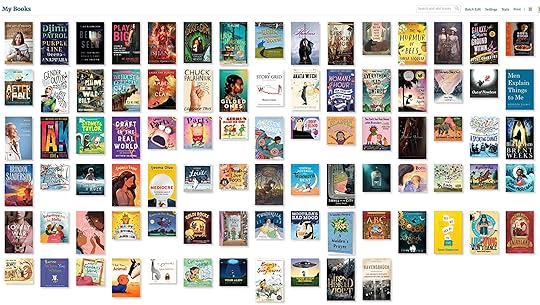
Ultimately, I read (and tracked**) 86 books, around half of those were picture books, which I regularly read to keep myself in tune with the format. On the other hand, the longest book I read, Brandon Sanderson’s The Way of Kings, fell in at an epic 1007 pages!
STACKING THEM UP
Of the books I read in 2021, some of the ones I enjoyed the most include:
Tj Klune’s Under the Whispering Door and The House in the Cerulean Sea
The Galaxy and the Ground Within and A Psalm for the Wild-Built by Becky Chambers
Space Opera by Catherynne M. Valenti
Amber & Clay by Laura Amy Schlitz
Inside Out and Back Again by Thanhha Lai
Lovely War by Julie Berry
Books that opened me up and showed me things, including exposing some of my own biases, and offered me new understanding:
Being Seen by Elsa Sjunneson
Gender Outlaw by Kate Bornstein
Mediocre by Ijeoma Oluo
Craft in the Real World by Mathew Salesses
Books that I have marked as future mentor texts, include:
The Black Prism by Brent Weeks for his absolutely well-played protagonist’s twist of character.
A Sporting Chance by Lori Alexander and The Elephants Come Home as examples of excellent non-fiction for kids.
Everything Sad is Untrue by Daniel Nayeri for its wonderful structure.
After the Fall by Dan Santat for the way it captures the truth of trauma in a relatable way filled with emotion.
Dread Nation by Justina Ireland for the voice.
2022 READING GOAL (Remember, I Don’t do Resolutions)
My reading goal for 2022 is to read at least 50 books. I won’t make it a resolution, since I don’t do resolutions, but I expect I won’t have any trouble reaching that number. After all, my TBR pile never seems to do anything but grow!
*Sadly, it appears the facilitators of the Reading Women Challenge have chosen not to create a 2022 list. But you can certainly head over to the Reading Women website and revisit the past lists for some great ideas for books to read now and in the future, or listen to episodes of their podcast.
**You can see the titles of all the books I tracked in 2021 on my Goodreads page.
[image error]The post I DON’T DO RESOLUTIONS appeared first on Sharonskinner.com.
December 10, 2021
CONQUERING REVISION
Conquering Revision: Breaking it down.
Congratulations on completing a draft of your current WIP (Work in Progress)!
Now you’ll want to revise and polish your writing to make your story shine.
It’s time to conquer revision.After all, writing is rewriting.
There are a number of ways to approach the revision process, but I recommend breaking things down a bit, so that as you go through the manuscript, you don’t lose track of the items that need fixing along the way.
A great way to do this is to pick one key component of the work to focus on as you go through each pass.
Start with the big things, then work your way down.Is plot your big strength but character development a struggle? You may want to start your revision process focused on character arc with an aim toward ensuring you have put in place all of the foundational elements and internal turning points to ensure your character’s journey is both fully realized and believable.
Are you great at delivering action, but struggle with setting and/or sensory detail? Then you’ll want to find ways to layer in the right details to ground your reader in the world and deepen the overall story.
Once you have made sure the major elements are clicking, you will be ready to dig into the details, and clean up, like replacing overused words and/or repetitive gestures.
For example, we all have favorite words that we use in early drafting, just to get the story out on the page. Writing forward can be a challenge if you are always trying to find just the wright word. So, we tend to use a lot of the same words over and again.
Clearing out overused words.Common words we tend to overuse the most include those necessary for conveying simple actions like walking and looking. Often, we fall into using these “stage directions” because we just need to move our characters around, or we need a physical action, something for them to do. Often, these stage directions are really for us, the writers, so our brains can keep track of where our characters are in space. But you may not even need them. So you want to look for words you tend to rely on to convey basic movements/actions and find ways to cut or replace them.
Additionally, it’s one thing to give a character a tic, but if they are constantly raising an eyebrow or grinding their teeth, the reader will get tired of hearing about it. Worse, if all of the characters use the same gestures to express emotion, you will want to find ways to differentiate their behaviors and make them unique.
Digging into the details.Finally, to get the tone and mood right, and creating and maintaining a believable setting/world, and establishing voice, focusing on word choice is key.
Ultimately, working from the high level/major craft elements down through the layering in of emotion on the page, then down to the elemental level of sentence structure and word choice is a great way to approach revision. As with remodeling a house, you want to go from the big elements to the smaller ones. After all, you wouldn’t paint before you’re done moving the walls or adding in those new windows!
The point is, while revision can be a major endeavor, it doesn’t have to be overwhelming. It can be broken down into small tasks, and those tasks help to keep us focused on the various elements and layers as we refine each draft. Like any big job, focusing on a single component as you go will help you stay on track and ensure you don’t overlook anything important.
Have fun conquering revision!
Want more resources for revision?Check out my Free Downloadable Revision guide for adding Sensory Details.
[image error]
The post CONQUERING REVISION appeared first on Sharonskinner.com.