Sharon Skinner's Blog, page 12
February 10, 2016
Making Emotional Connections Through Writing
Making emotional connections through writing is always at the top of my list of goals, whether I am writing poetry or prose.

When I tell people I am a writer, I get the usual questions and responses. “What have you published?” “Someday, I’ll write something.” “I wish I had time to write.”
For me, writing isn’t something I want to have done. Its something I need to do, and not just “when I have the time.”
I have been writing for years, in journals, on napkins and little scraps of paper, hoping to reach out and touch someone with my words, hoping to connect, and always finding some understanding of my own feelings and emotions.
I started out on this journey simply writing. Short stories and poetry came first, which led to reading my work in front of hundreds of people, attending writing seminars and conferences, joining writer’s groups, studying my craft, reading hundreds of books on writing, submitting to countless publishers, and entering multiple writing contests.
I managed to have a few things published in journals and magazines, and I self-published several chapbooks of my poetry. I even won a couple of local contests.
In that past few years, I have had several novels published, have gained a readership and have made multiple author appearances and now I even teach creative writing. The journey is going well and I continue to find ways to reach out and connect with people through my writing. My favorite comments are those that come from readers who fall in love with the characters, those who become fully engaged in the journey and especially those who are emotionally moved by my stories.
Now, I have shared a lot of my writing with my mother over the years. And although much of my writing is not her cup of tea (she likes non-fiction, I like fantasy, etc.) I have always gotten encouragement from her. But I will never forget the one poem that finally touched her heart and moved her emotionally.
The poem isn’t very long (no more than 30 lines), but it sums up all the fears and feelings and frustration of my relationship with my abusive grandmother. My mother’s mother. A woman who had been demanding and dominating and downright mean. A woman who had become confused and helpless in her old age, and who had to be cared for in the fading years of her life.
As my grandmother lay dying, I did a lot of journaling about my relationship with her. I had a lot of time to think and write because she clung to life as stubbornly as she’d held onto her anger and prejudices during her lifetime. It was nearly ten days before she finally succumbed, and during those days, she remained in a semi-unconscious state, unable to respond to questions or other stimuli. And during those days I wrote. I wrote and I swore and I cried. Then I wrote some more.
I wrote chain-of-consciousness, rambling, anger filled messages. I wrote guilty recriminating, emotional passages. I wrote poetry and fiction and memories and dreams. And finally, I wrote “Another Grandmother Poem.” A poem that captured all of my gut feelings, my anger, my resentment, my reasoning and my epiphany in a few short lines.
It spoke of the disbelief, the anger, the fear, and the peace that we were both finally able to find. It was not trite. It was not self-effacing. It was not accusing, nor completely forgiving, but it was honest. And when I finally sent it to my mother, she cried. And when she shared it with a friend, he cried, too. Even though he never knew my grandmother. That poem continues to reach people and evoke emotional responses from them. It has even won a few awards.
Since then, I have received comments from readers telling me that my novels have connected, moved them, even helped them to process their own emotions.
When I feel like my writing is failing. When I become frustrated by rejections from publishers. When my words seem to crumble before I can string them together. I know that I can connect, that I can reach out and touch someone with my words. I remember that I’ve done it before. I aim to continue to hit that mark.
The post Making Emotional Connections Through Writing appeared first on SharonSkinner.com.


February 3, 2016
Things I Learned Writing The Matriarch’s Devise
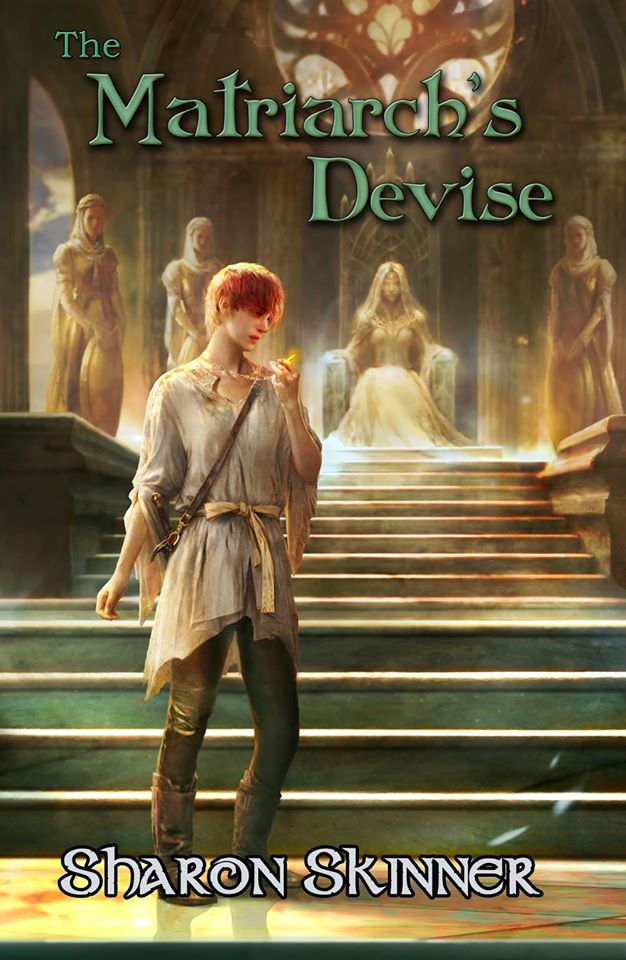
As with every new book or writing project, there are a lot of things I learned writing The Matriarch’s Devise. However, one of the key things I grew to understand on a deeper level is how much trust it takes to bring a story to life and send it out into the world. Here are five things I learned about trust while writing the sequel to The Healer’s Legacy:

Cover: The Matriarch’s Devise
Trust your process: Fear can cause you to freeze. This is as true at the keyboard as it is in the wild. The more people who told me how much they loved The Healer’s Legacy, the more worried I became that unless I did it absolutely right, they might not love, might even hate, the story’s sequel, The Matriarch’s Devise. Since I am an organic writer, what some call a “pantser,” (one who writes by the seat of her pants), this is the one and only time I have ever experienced anything like writer’s block. I spent a lot of time thinking and worrying about the story when I should have been writing it. I worried so much that, when I did sit down to write, I found myself writing fewer and fewer words, until the day that I realized I needed to go back to what had worked for me in the past and simply write the book that needed to be written. If I believed in the story and the world and wrote the best book I was capable of, if the characters remained true to who they were, and if we honed and polished the manuscript with an editorial eye, my readers would enjoy the second stage of the journey as well as the first stage.
Trust your subconscious, but be willing to try new tools: As an organic writer, I find myself deeply enmeshed in the story and the characters I have created. This can make it difficult to be objective about what is working and what isn’t. It’s very hard to kill your darlings when you are snuggled up so close to them you can’t see their flaws. I have found a number of tools, especially those related to plotting and character development that allow me to extricate myself from the story and see the shape of it more objectively. This is especially helpful when writing a story as complex as the one that takes place in The Matriarch’s Devise, which contains a larger cast and more plot lines than anything I had written before. Keeping all those character traits and agendas straight took more than my usual simple character sheet, and I ended up using a number of writing resources and tools to develop my own process for handling all that information in a manageable way, while still following and trusting my personal writing process.
Trust your editor and/or Beta readers: Sequels can be difficult and squirmy. Because I am an organic writer, I did not have a fully formed plan for what would take place after the conclusion of The Healer’s Legacy. So, writing The Matriarch’s Devise felt at times like trying to make a sand castle on the beach with the tide coming in and the waves periodically washing away bits and pieces of the story. There were times I had to remind myself to let go and, to follow Jane Yolen’s advice to just write the damn book. The editing process may be different for plotters, but for a “pantser” like me, filling in the gaps and scraping off the odd lumps and ugly bumps comes after the first draft is written, during hard content edits. Here is where it’s important to have a great editor and Beta readers. This isn’t to say that you shouldn’t also trust your own editorial eye, but once you have done all you feel you can with a story, it needs to spend time in the arms of honest Beta readers and a good editor.
Trust your gut: When you get feedback on a story, try to read it with an open heart, that way you will know which comments and suggestions resonate and will make the book better and which may push the story or characters in the wrong direction. This doesn’t mean that any feedback should be ignored completely, unless the reader is hitting completely off-base. Although, that should be a red flag, especially if it is coming from a trusted source. But some editorial remarks will make you slap your head and say duh, while others may cause a negative kneejerk reaction. For me, all feedback generally needs to stew in the subconscious mind a while before just the right fix reveals itself.
Trust your readers: The realization that I had to get back to my own mind space for writing the sequel to The Healer’s Legacy in order to give my readers a good book required me to place my trust in them just as they, by buying and spending time reading my books, placed their trust in me. Forcing myself not to worry about their expectations was really about trusting them to want to come along on the journey and spend more time with the characters they fell in love with in the first place. Rather than causing my brain and heart to freeze, trusting my readers is what ultimately enables me to bring them the next story and the next and the next. As long as I push myself to tell the best story possible and work to ensure it is as polished as it can be, I trust my readers will continue to enjoy spending time in my worlds, and readers you can trust really are the best possible company to have on this crazy writing journey.
The post Things I Learned Writing The Matriarch’s Devise appeared first on SharonSkinner.com.
January 19, 2016
A Writer’s Life: Balancing Work and Work

Like many authors, in addition to my writing and book related activities and appearances, I have a day job. Luckily, it’s a job I really enjoy and I work with good people. It is, however, a job that requires me to do a lot of writing and editing, which surprises many people. I often get asked, “How can you write all day and then go home and write?”
Part of what enables me to do this is the fact that, as stated above, I have a day job that I love. The other major contributing factor is that I am a writer. It is not just something I do. It is part of me and necessary to my mental health. When I tell people that my stories come from the voices in my head, it’s not to be funny. It is a fact that I get characters and voices in my brain that speak to me about themselves and telling their stories is the best way to quiet those voices.
Also, I am not happy when I am not writing/editing.
But getting back to the “how” of my process, some people, like me, may recall being told as children to “put our thinking caps on.” Really, what we were being directed to do was to focus on the problem or learning at hand in a studious way.
When I write, I wear a variety of hats. At work, I wear a rather professional hat, one that keeps me focused on clarity and non-emotional responses to the questions and concerns to which I am responding. When writing fiction and poetry, I wear a very different, more decorative, creative, and emotional hat covered in feathers and, buttons, and dragon scales and whatever else strikes my fancy. It’s sort of like having a switch in my brain that turns on and off the more fanciful functions.
So, it doesn’t feel like I write all day and then go home and write. It feels more like I do my day job during the day and then cut loose on the story page. All just part of the writer’s life.
I know I am not alone in this. We are all multifaceted creatures. Although, perhaps, some of us just have a thinner line between what we see as work and play.
The post A Writer’s Life: Balancing Work and Work appeared first on SharonSkinner.com.
January 12, 2016
Sensory Details Can Bring Your Story to Life
 “Good writing is supposed to evoke sensation in the reader – not the fact that it’s raining, but the feel of being rained upon.” –E. L. Doctorow
Humans use five main senses, which are our key physiological capacities for data perception. However, in most early writing, there is a tendency to focus on only two of these, sight and sound and leaves a lot of opportunity to add sensory details.
This is understandable. First off, sight and sound are what we, as humans, do really well. We primarily scan for danger by looking and listening. Also, when we are sitting in our nice comfy office or coffeehouse or wherever it is we write, it is easiest to visualize the setting we are describing in terms of what we can see or hear in our minds.
Sight tends to come first, as most of us are very visual creatures, but also because when entering the fictional (and sometimes non-fictional) setting, the author is generally “seeing” it for the first time, often through the eyes of a character we are still getting to know. When we see something for the first time, or enter unfamiliar territory, the first things we do is look around and get the lay of the land. We are also alert for sounds. After all, if something huge like a T-Rex comes crashing through the forest in our direction, we need to be prepared to run.
But focusing on sight and sound alone, leaves the reader with the impression of the story taking place in a flat world. In order to expand the setting and infuse it with reality, it is important to consider the other senses. Touch, smell and even taste.
To do this, we need to pause long enough to immerse ourselves in the setting. This is not something most writers will want to do while writing initial drafts. Early drafts are for getting the words out onto the page and filling in plot holes and focusing on character development. But during the editing phase, you have the time to fold yourself into the character, much like a method actor does in developing a role, and pause long enough to sort through the sensory details of smell and touch and taste that would surely be present in the setting.
Then it’s a simple matter of showing those sensory elements to the reader. In other words, describing them without the use of telling words like felt, tasted or smelled.
This is Chekov’s way of showing the moonlit night. The second phrase is the one that really shows rather than tells: “The dam, flooded with moonlight, showed not a bit of shade; on it, in the middle, the neck of a broken bottle glittered like a star.” –Anton Chekov, Hydrophobia (QuoteInvestigator.com, 1/6/15)
Chekov could have stopped at the semi-colon, but instead of just setting the stage for the moonlit dam, he showed us how it looked.
Here is an example of how I show smell in my WIP: “A sandalwood and jasmine smokiness that drifts off her clothes and hair, like she’s been burning incense.” –Sharon Skinner, Collars and Curses
Here’s another one that describes taste: “It bursts with a sugary sweetness, like cotton candy melting in my mouth.” –Sharon Skinner, Collars and Curses
These types of descriptions help to ground the reader in the setting, making it more real and engaging, immersing the reader in the story in a way that becomes experiential.
One way to catch and edit out telling bits and reshape them into descriptions that show is to use the find feature of your word processing software and look for sensory telling words like smell, taste, look, or feel. It isn’t necessary to remove every instance of these words, but by looking at where they have been used, and reshaping the prose to work without them, you can add depth to your setting and turn your story into a memorable journey for readers.

The post Sensory Details Can Bring Your Story to Life appeared first on SharonSkinner.com.
January 4, 2016
Writing Fiction and Making the Words Disappear
It may seem counterintuitive, since we work so hard at choosing just the right words when writing fiction, but one of my main goals during the editing phase is to make the words disappear on the page. I do this in such a way that the reader will forget she is reading, instead “seeing” the action in her head. While it sounds like a magic trick, it is in fact a fairly natural state for me. As a visual writer, I see the action as I write it. In fact, as I tell the people who ask me about my writing process, I often feel more like a journalist than a fiction writer, because I simply follow my characters around inside my head and write down what they do and say.

As a writer, one of the best things I can hear from a reader (aside from how much they loved the story and how much they want more) is that I made them late for work, or caused sleep deprivation because they stayed up all night finishing my book. The last thing I want to give them is the opportunity to set the book down to go do something else.
When the text draws attention to itself, it pulls the reader out of the story. Sadly, this is often as true for beautiful, shining prose as it is for poorly written, badly punctuated, or grammatically incorrect writing. While bad writing can be a mire the reader must slog through, glowing prose can be just as distracting. Either one can pull the reader out of the story. And the one thing a writer does not want is to allow the reader to fall out of the story realm and find themselves plunked back down in reality. A reality, mind you, filled with electronic devises, household chores or any number of real-world distractions calling out for attention.
The challenge is to keep the reader engaged and one key to ensuring it is, as Arthur Quiller-Couch wrote in his essay On the Art of Writing, to “murder your darlings.”
This sage advice has been reiterated by (and attributed to) a multitude of authors, including William Faulkner (who IMHO should have heeded it more) and even Stephen King. What it means is that when writing fiction if you find yourself stepping back and admiring a specific bit of your prose, a phrase or sentence that stands out in your writing like a sparkling gem in a field of sturdy, but functional paving stones, unless you are writing poetry (or in some cases literary fiction) it should be plucked out and tossed aside.
At first this will be painful (there may even be mental and emotional kicking and screaming involved), but no one said writing fiction was easy and if the purpose of the writing is to tell a story and take the reader on a journey, as is the case with most novels, then anything that detracts or distracts from that mission should be expunged, and I promise that over time it does get easier. And when readers tell you how they “were so absorbed in the story they couldn’t put the book down” that payoff will be worth the all hard work, including the tears and kicking and screaming.
As Pablo Casals said, “The most perfect technique is that which is not noticed at all.”
The post Writing Fiction and Making the Words Disappear appeared first on SharonSkinner.com.
December 28, 2015
Season’s Greetings & Warmest Wishes
Wishing You Holiday Season’s Greetings & Warmest Wishes for a Healthy and Prosperous Year!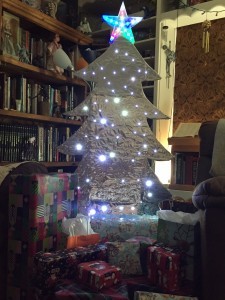
I am taking a holiday break from the blog. I’ll be back at it fresh the first week of 2016.
Meanwhile, I hope you like my hand-crafted, toddler-proof, cat-resistant Xmas Tree.
The post Season’s Greetings & Warmest Wishes appeared first on SharonSkinner.com.
December 17, 2015
Overnight Success, NOLA Visit and Book Signing Party

Royal and St. Peter: Balcony view from SidCat’s Skyscraper.
Last weekend, I was in New Orleans. This long-overdue trip finally fulfilled a promise I kept making to my fabulous BFF and Navy buddy Cathy to come and visit her and her husband at their home in NOLA. They live in a historic building in the French Quarter. Seriously historic. I understand the plans for the battle of New Orleans were mapped out on the second floor. They are also very cool people. In addition to having served in the US Navy (and being uber-smart), Cathy is an amazing seamstress and milliner, who makes spectacularly creative, to-die-for Mardi Gras costumes. Sidney, her husband, was the lead singer of Vince Vance and the Valiants from 1974-1987, famous (infamous in some circles) for their song Bomb Iran. Yep. He was even inducted into the Louisiana Rock and Roll Hall of Fame a few years back.
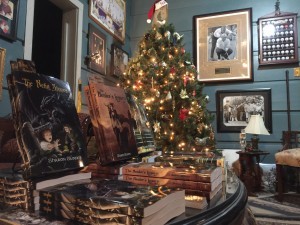
Set up for the book party!
Anywho, these two amazing people threw me an incredible wine and cheese book party in their charming and beautiful top floor apartment in that wonderful building in the French Quarter. The party was attended by fascinating people, some of them very talented artists in their own rights and many of whom bought my books. (THANK YOU!) Did I mention the building is historic? I mean, I was sleeping in a guest studio four stories up, in a building overlooking the corner of Royal and St. Peter, a mere 30 feet from one of the places Tennessee Williams lived and penned his plays!
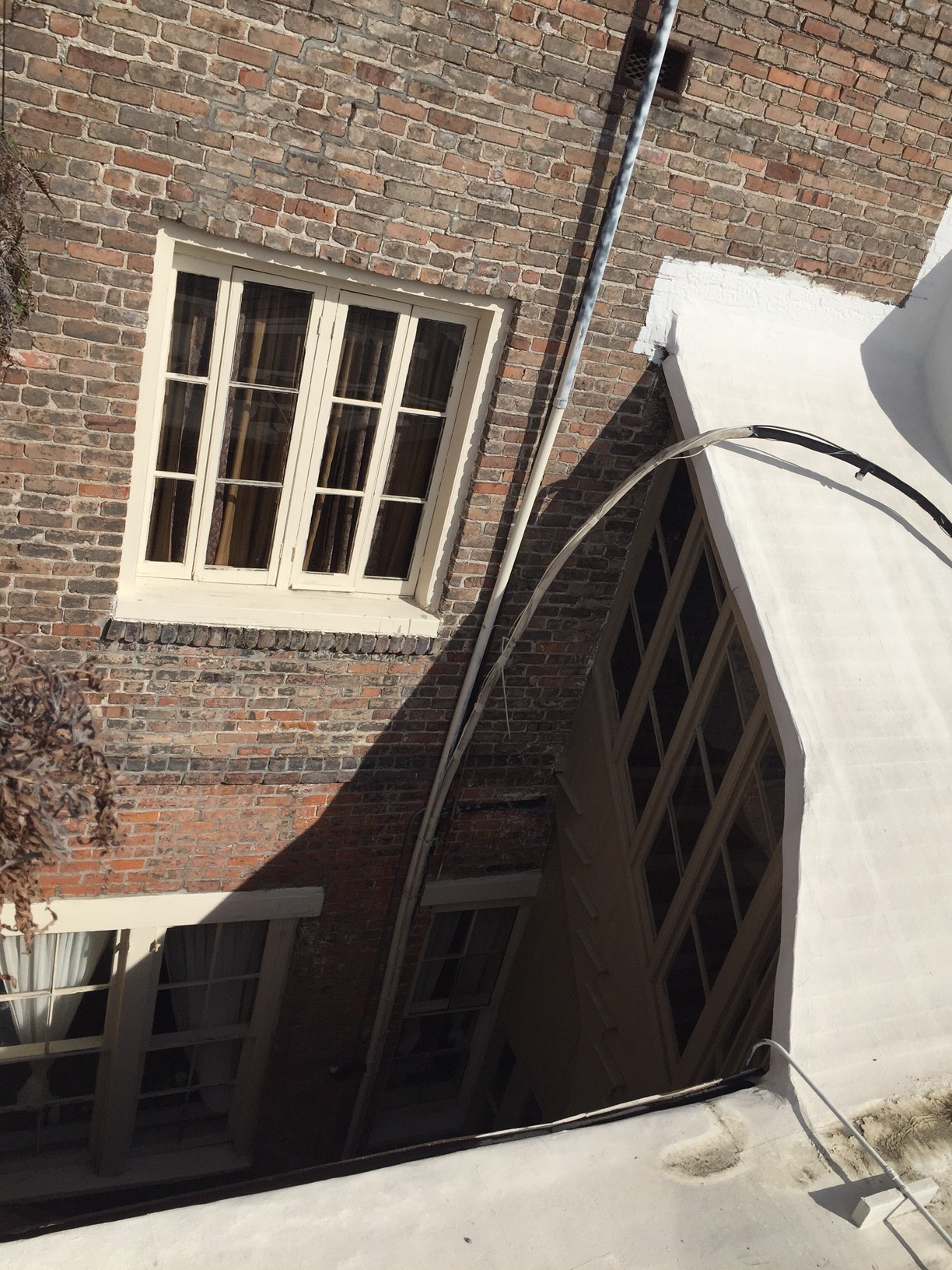
One of Tennessee Williams’ homes in the French Quarter.
And, while we were there, the Saints won, so I think they may let me visit again. ;D
Yes, some days the extra work of a “second job” as an author seems endless, but it’s really starting to pay off. Book sales are increasing and I am garnering a slew of positive reviews and recognition. Apparently, there is real truth in what fellow author, Drake, told me a while back: “It takes about 13 years to become an overnight success in this business.” (LOL) As much as I feel like Sisyphus some days, it appears that, over time, rolling that stone erodes the hill and reduces the grade.
There are other times, like this past weekend, where I am validated and supported by kind and generous people and have the most amazing experiences. These are the times that make me love life and keep me doing what I do.

The post Overnight Success, NOLA Visit and Book Signing Party appeared first on SharonSkinner.com.
December 8, 2015
RTC Orlando’s Infamous Chicken Salad Sunday

RTC Orlando, Florida. Summer 1977.
We had been at boot camp for several weeks, marching out on the burning grinder and sweltering in the muggy Florida heat, before the mess cooks decided to serve up something cold for lunch. There was palpable excitement as Training Units lined up and the word was passed along that instead of a hot dish there was chilled chicken salad on the menu.
Almost every single recruit held out their plates for a heaping mound of cool goodness. Including me.
But, as luck would have it, when I lifted the first forkful to my mouth, I just couldn’t get it past my nose. It smelled like someone’s filthy, drilled-in-all-day-and-night socks. No matter how mouth-watering it looked, I could not force myself to eat it. All around me recruits were shoveling in cool gobs of chicken salad, but the smell was so bad, I decided to pass on eating lunch that day.
Later, I was one of the few people still able bodied enough to help carry my fellow sailors out to waiting vehicles. All available ambulances were kept so busy, jeeps, trucks and even staff members’ personal cars had to be used to ferry the hundreds who had taken ill to the hospital. Afterward, those few of us who had not eaten the chicken salad had to clean and swab up the mess left by those who had. To be honest, it was such a nasty job, there were moments that night when I wondered if I would have been better off had I eaten the damn salad.
Training was cancelled the next day, because of the huge number of recruits who had taken ill. Reports came back that over 900 recruits had been struck down by food poisoning. While most were released back to the barracks within 24 hours, several were extremely ill and had to be kept in the hospital for a number of days. We heard that one person nearly died.
That day became known only as Chicken Salad Sunday.
Years later, I read somewhere that several individuals had their careers ruined by the mishandling of the chicken at Naval Training Center Orlando, which had apparently been thawed and refrozen prior to being used to make that cool and inviting summer dish.
Although, I still don’t understand, no matter how attractive that dish appeared, how anyone managed to get past the smell to eat it.
The post RTC Orlando’s Infamous Chicken Salad Sunday appeared first on SharonSkinner.com.
December 2, 2015
No Holiday Slow-Down for The Matriarch’s Devise
 A lot of businesses gear up for the holidays, a few see a distinct slow-down, while others seem to plow forward at about the same pace. Normally, there are fewer book-related trips and events for me in December, but this year with the November release of my newest book, The Matriarch’s Devise, I am staying quite busy.
The month started off with the SCBWI Book Launch Party page for The Matriarch’s Devise going live on December 1st. Check out #SCBWIparty on Twitter!
The HBS Author’s Spotlight Showcase for The Matriarch’s Devise will be posted tomorrow, December 3, 2015 thanks to the fabulous James Moushon. Follow him in Twitter: @jimhbs.
This weekend, I am headed to Las Vegas where on Saturday, December 5th, I will be signing books with fellow Amazing Wyked Writers, Gini Koch, TL Smith and Alan Black at Barnes & Noble Book Sellers 567 North Stephanie Street, Henderson, (Just outside Las Vegas), NV 89014
While I am in Vegas, signed copies of my books will be also available December 4-6th in the Brick Cave Books booth at Phoenix ComiCon’s 2016 FanFest out at the University of Phoenix Stadium in Glendale, AZ.
Then I’m off to New Orleans for a private book event. More like a party than an appearance and I am so looking forward to this trip and seeing my fab BFF Yhtac!!
Meanwhile, on the creative work side, I have turned in a SciFi short slated for an upcoming anthology.
Next up on my to do list is using feedback from my editor and hitting the next round of revisions of my urban fantasy, Collars and Curses (working title).
Wishing you all Joyful Journeys till next time!
The post No Holiday Slow-Down for The Matriarch’s Devise appeared first on SharonSkinner.com.
November 25, 2015
Gratitude 2015
Gratitude 2015 is a short list of things that I am thankful for today and everyday.
My Family: I have a wonderful, supportive, loving family. What more can one ask for from blood? (Also, my cats go here—even when they’re being butt-heads and don’t let me sleep in a few minutes—because they are part of my family. I’d like to say their love is always unconditional, but that feels debatable when they want breakfast and I want to sleep.)
My Friends: I have amazing friends. They are my biggest fans, cheerleaders who root for my success, share in my joys and comfort me when I hurt. Gems, every single one.
My Health: Yes, I have aches and pains, blah, blah, blah, but I am overall healthy and whole. The challenges I have faced on health frontier have been few and mild compared to many. I am grateful for my physical health.
My Day Job: I have worked hard since I was a teenager (long story). I have had good jobs and dirty jobs and downright ugly jobs, but every one of those helped me to discover what I wanted (or didn’t want) in my working life. My current job is the culmination of many years of studying and applying what I know in a professional arena. I get to work with professionals, experts in their fields. My co-workers are all dedicated to doing good work and a job well done at the end of the day. My boss supports me allows me the freedom to do my job without micro-managing me. And I have a great office with a view of the sunrise during the winter months.

Morning view from my office November 2015.
My Writing (aka My Other Job): If I didn’t have my writing, I would be lost and likely flailing around in the world. I have always had stories in me. I started telling them in grade school. Yes, I had to study the writing craft in order to tell them well and that has taken years, but now I have fans, actual fans, who read and love, yes love, my books. I work with a fabulous small press with other writers I admire and I have the most wonderful editor a writer could ask for.
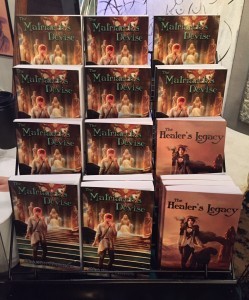
Books 1 & 2 of The Healer’s Legacy series.
People Doing Good in the World: Yes, there are a lot of people in the world who seem dead set on doing bad things, but there are also many, many good people out there doing good works. So much good and kindness in the world is often taken for granted or gets lost in the noise of the bad things that happen, but there are many people with good intent. People who work to spread kindness, to care for others, animals, the environment. People who are willing to share what they have so that others can eat and be safe and have a warm place to sleep at night. People who care for the sick and the elderly and the very, very young. People who teach. People who protect. People who risk their lives for the lives of others.
Here and Now: Being here, in this time, in this country, with all of its flaws and all of its good points. Born into a place where people have so many freedoms we can take them for granted. Where women—although we still may have a way to go for true gender equality—have come so far. Where I have hot and cold running water, electricity, and the ability to travel at will. Where I have heat in the winter and cool in the summer and food in the cupboard and so many other comforts that it’s easy to forget not everyone does. Where I can write and express my views and share them with the world from the safety of my home.
My Readers: What would a writer be without readers? A transmitter without a receiver is basically useless. Thank you to all of you who read and support my work. Without you, I would be shouting into the wind.
For all of this and more, I am truly grateful. May you all have plenty to be grateful today and throughout the future.

Happy Thanks-Giving!
The post Gratitude 2015 appeared first on SharonSkinner.com.