Sharon Skinner's Blog, page 11
April 22, 2016
Writing Picture Books: Not as Easy as it Looks (PART 1)
Since the beginning of this writing journey, I have wanted to write a picture book. And, like many authors, I have more than one abandoned picture book manuscript to my name. I sometimes imagine them huddling together in a drawer somewhere, trying to keep warm. Out of sight, but not necessarily out of mind. I still love the ideas for those stories deeply, but I just could not figure out how to make them work.

While writing novels is not particularly easy, I found myself better able to figure out the structure of the longer format. I still had to study my craft, and learn to edit with an iron fisted pen, but it has always felt more natural to me than the shorter, “easier” children’s picture book format.
Why? One reason is that I have read thousands of novels over the years. And while I read plenty of picture books when I was younger and a few hundred more when the girls were young and wanted to be read to, I hadn’t actually absorbed them the way I did the innumerable novels I have consumed over the years. Also, reading Whose Mouse Are You? by Robert Kraus to my little brother a gazillion times still only counts as one book.
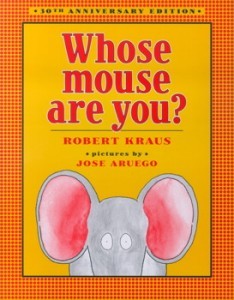
Whose Mouse Are You? by Robert Kraus
Over the years, I attended numerous picture book workshops, studied the format, and read lots and lots and lots of picture books. Still, I couldn’t make my ideas work.
I know a lot of people think picture books look easy. After all, there are so few words in them. In some cases, for example works like Molly Idle’s Caldecott Honor book Flora and the Flamingo, there are no words at all! How hard can it be to write one?
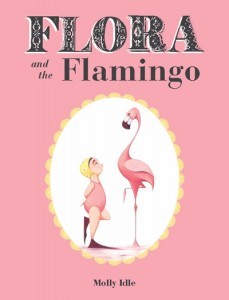
Flora and the Flamingo by Molly Idle
Finally, almost three years ago, after having pretty much given up on the idea of writing picture books, I found an idea for a book that could best be told in short form. It sparked my flagging enthusiasm into a fiery passion and revived my desire to finally create a picture book manuscript that worked.
I sketched out a rough draft. Then, needing to get another novel finished, let it sit and simmer for a bit. Over time, I went back and worked on it, still not getting it right, but knowing that the idea had merit and that I wanted to write it.
Once I had the main idea set, I sought feedback from someone who really knows picture books. I got great feedback that I was able to use to rewrite the story, with a focus on the same key things that go into a novel. In this case, my story was still missing the mark on two main counts, character development and conflict.
One might ask, “How the heck do you squeeze character development and conflict into a 500-word story?”
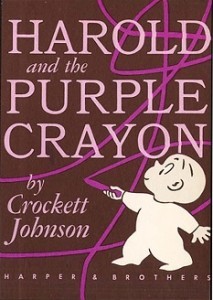
My favorite picture book when I was young: Harold and the Purple Crayon by Crockett Johnson
Well, that’s one of the reasons it’s so difficult to write a good picture book. You have to tell a complete, engaging and compelling story in about 500 words. (That’s not a hard and fast word count, of course. But it’s in the ballpark of current trends.)
Another reason is that, as a writer, you have to tell that story while also leaving plenty of room for the illustrator to create visual images that complement the words and add dimension to the story.
One of my favorite picture books now: Caldecott Medal Winning Book, Beekle by Dan Santat
Like I said, picture books are not as easy as they look. But I really wanted to write one, and since I am not an illustrator, I needed to write the words.
So, I rewrote and revised and re-visioned. Then, I rewrote some more. All in all, it took two years before I had a manuscript I thought was worth submitting. That’s about as long as it takes for me to write and polish a novel to submission readiness!
(To be continued in a future blog, tentatively titled, Submitting Picture Books or I think it’s done, I think it’s done.)
The post Writing Picture Books: Not as Easy as it Looks (PART 1) appeared first on SharonSkinner.com.


Writing Picture Books: Not as Easy as it Looks (PART 1)
Since the beginning of this writing journey, I have wanted to write a picture book. And, like many authors, I have more than one abandoned picture book manuscript to my name. I sometimes imagine them huddling together in a drawer somewhere, trying to keep warm. Out of sight, but not necessarily out of mind. I still love the ideas for those stories deeply, but I just could not figure out how to make them work.
While writing novels is not particularly easy, I found myself better able to figure out the structure of the longer format. I still had to study my craft, and learn to edit with an iron fisted pen, but it has always felt more natural to me than the shorter, “easier” children’s picture book format.
Why? One reason is that I have read thousands of novels over the years. And while I read plenty of picture books when I was younger and a few hundred more when the girls were young and wanted to be read to, I hadn’t actually absorbed them the way I did the innumerable novels I have consumed over the years. Also, reading Whose Mouse Are You? by Robert Kraus to my little brother a gazillion times still only counts as one book.
Whose Mouse Are You? by Robert KrausOver the years, I attended numerous picture book workshops, studied the format, and read lots and lots and lots of picture books. Still, I couldn’t make my ideas work.
I know a lot of people think picture books look easy. After all, there are so few words in them. In some cases, for example works like Molly Idle’s Caldecott Honor book Flora and the Flamingo, there are no words at all! How hard can it be to write one?
Flora and the Flamingo by Molly IdleFinally, almost three years ago, after having pretty much given up on the idea of writing picture books, I found an idea for a book that could best be told in short form. It sparked my flagging enthusiasm into a fiery passion and revived my desire to finally create a picture book manuscript that worked.
I sketched out a rough draft. Then, needing to get another novel finished, let it sit and simmer for a bit. Over time, I went back and worked on it, still not getting it right, but knowing that the idea had merit and that I wanted to write it.
Once I had the main idea set, I sought feedback from someone who really knows picture books. I got great feedback that I was able to use to rewrite the story, with a focus on the same key things that go into a novel. In this case, my story was still missing the mark on two main counts, character development and conflict.
One might ask, “How the heck do you squeeze character development and conflict into a 500-word story?”
My favorite picture book when I was young: Harold and the Purple Crayon by Crockett JohnsonWell, that’s one of the reasons it’s so difficult to write a good picture book. You have to tell a complete, engaging and compelling story in about 500 words. (That’s not a hard and fast word count, of course. But it’s in the ballpark of current trends.)
Another reason is that, as a writer, you have to tell that story while also leaving plenty of room for the illustrator to create visual images that complement the words and add dimension to the story.
One of my favorite picture books now: Caldecott Medal Winning Book, Beekle by Dan SantatLike I said, picture books are not as easy as they look. But I really wanted to write one, and since I am not an illustrator, I needed to write the words.
So, I rewrote and revised and re-visioned. Then, I rewrote some more. All in all, it took two years before I had a manuscript I thought was worth submitting. That’s about as long as it takes for me to write and polish a novel to submission readiness!
(To be continued in a future blog, tentatively titled, Submitting Picture Books or I think it’s done, I think it’s done.)
The post Writing Picture Books: Not as Easy as it Looks (PART 1) appeared first on Sharonskinner.com.
April 5, 2016
Plotting, Not Plodding!

Plot points, crisis, and climax, oh my! I have been reading up on plotting, taking a deep dive into process and techniques, attempting to distill the information that others have provided in books like The Plot Whisperer by Martha Alderson, Plot and Structure by James Scott Bell, Building Better Plots by Robert Kernen, and The Plot Thickens by Noah Lukeman into something that I can easily absorb and make part of my ingrained writing process and inform my teaching process, as well.
This is not the first time I have delved into plot at this level. A couple of years ago, I published an essay about plot called “Plot Isn’t Just a Four-Letter Word,” You can find it on line here for free. However, what I am currently focused on is not about the relevance of plot or how it feeds into the whole of what makes fiction work. I continue to believe that without an engaging character with some form of character arc, the reader not only has no one to travel with, but no reason to embark upon the journey. Plot, on the other hand, is also a critical element, as it includes the trials and tribulations that temper character and reveal the true nature of the protagonist with whom we have decided to hitch a ride.
Starting with plot is not how I work. While I know many talented, skillful writers who plot out the story before hanging the narrative on that initial structure, my process always starts with character. Character is what takes hold of me, what piques my interest. Character is my starting point. But I recognize that plot is also required to take the reader on an engaging adventure. In my stories, the plot evolves as I come to know the character. Because of this, I generally end up massaging and sometimes even developing many of the plot points during the revision stages of writing.
So, I decided that I wanted to explore plot more deeply, to try and see how those other writers manage it, how they come to story from the direction of plot. It’s taking me time to do this, to make my brain understand all the complicated bits that go into plotting in an objective way that (I hope) will feed my intuitive/creative brain in a manner that will help me find the plot earlier in the writing process. If not, I have lost nothing, as I still have to find my way into plot at some point, still need to infuse the story with the elements that make up plot—situation, complication, (satisfying) resolution—to ensure I give my readers a well-rounded, fully executed story, which is after all the goal.
I’m very interested to see how, and if, this journey to fill my brain with plotting techniques changes my writing process. So, let the plotting begin!
The post Plotting, Not Plodding! appeared first on Sharonskinner.com.
March 30, 2016
Home Project: Tiling My Office Window Sill
Over the past few years, we have been replacing our older, less efficient windows with newer, double paned, triple EEE rated, energy efficient ones. It took time because, well, window replacement is not cheap. (BTW-quick plug: if you are in the Phoenix area, Affordable Windows offers a great product and has the best installers on the planet. And, no, I don’t get anything for referring them, but we used another company for the first batch of windows and I can verify that I know great window installers from not-so-great.)
As you can see, my office has a great window with a view of the back yard and our amazing, prolific lemon tree. (Please, ignore the rest of the back yard, which is a still work in progress.)
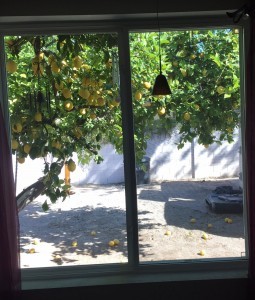
My Office Window
This window was also one of the last needing replacement as it was part of a newer add-on section of the house than those that were part of the original build. We had all the 1950-era ones replaced first, since they were the least efficient. And for those who are wondering, yes, we have seen noticeable savings on our utility bills.
The office window is a little over 4 feet wide, with a sill that is just under 4 inches deep. Because the existing window leaked dust, and the cats like to sit on the sill, what was originally a white ledge had turned gray in places, so needed some TLC. But I decided not to simply repaint. I say it’s because the cats were just going to dirty it up again, even with a fancy new non-leaky window. My husband simply nodded and said, “I can tell you need a craft fix, so carry on.”
At any rate, I decided I wanted something more creative in my writing space. Thus, began my first foray into tiling.
The room has dark green floor tile that is so dark it looks black, and the fixtures are brushed nickel. I chose a blue mosaic glass tile with hints of green because I like the way it catches the light. Also, the 4mm tile size seemed like it would be best for the size of the project. Also, they can be cut with hand-held tile cutters and I wouldn’t need a tile saw. I also opted for premixed grout that could be used as the tile set, which also simplified the task.

Blue Mosaic Tile
One issue I ran into was that the tile size I chose did not perfectly fit the sill depth. I considered cutting tiles to fit, but having to cut over four feet worth of 4mm tiles into less than 2mm slices and then filing the edges was daunting. (I wanted a pretty window sill—and possibly a craft-fix—not a month-long tedious project.) So, I found some spacer tile* I liked and decided to place a row of that at the front of the sill. It makes a nice lip, as they are a bit taller than the glass tile, and the dark color actually ties the sill in better with the floor.
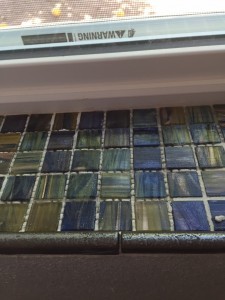
Progress: Tile Set and Spacer Tille Added to the Edge
I have to admit, once I finished, I could see that the mosaic tile is not perfectly level. I figured out that I didn’t scrape off enough of the set grout before placing the tile. However, it’s only noticeable if you are really looking for it, and I am happy with the final results.
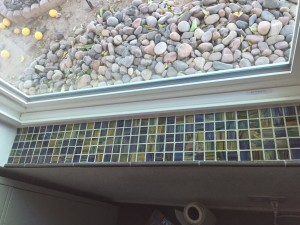
Left Side of Finished Tiled & Grouted Window Sill
Of course, I will do better on the window sill in my sewing room, which is the next project and will give me some additional tiling practice before I do the bathroom backsplash. Once those are done, I should stop “jonesing” for a hands-on home project for a bit.
*I have since discovered there is such a thing as tile edging and will be checking to see if that will work nicely for future projects.
The post Home Project: Tiling My Office Window Sill appeared first on SharonSkinner.com.
March 24, 2016
Setting: Emotional Depth Through Character Perspective

Kira, Vaith and Kelmir. Characters in setting.
When writing, I start from character, not simply because I think it’s a great place to start—although, for me, it’s mostly character engagement that keeps me reading (or writing) a book or story—but more so because that’s just the way my brain works.
So, when describing the landscape/creating the setting for the book, everything I see is filtered through the eyes of my characters. This is a huge plus in developing voice and for showing the character’s emotional journey, because the world the reader sees is from the perspective of the characters living in and experiencing it.

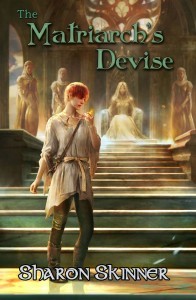
Setting in The Healer’s Legacy and The Matriarch’s Devise:
There were a few things I knew about Kira’s world before I set foot in it. As soon as she manifested in my mind, I knew some of the issues she faced, as well as some of the major parameters of her environment.
There are small “magics” at work in Kira’s home realm, but only a few individuals are “touched” by them.
The technology is primitive. Fire. Swords. Herbology.
The fauna includes mythical animals, such as the miniature wyvern she travels with, while some animals are similar to our world, such as horses and large felines.
The social structure in the first book is not only patriarchal, but also one with a social hierarchy in which status is determined by bloodline and gender.
Other than this, I knew only what Kira decided to share with me as she shared it.
For example, the first place we see in Kira’s story is the weather-worn home of her mentor, the healer, Heresta. This is the place where Kira, having been orphaned during the war, grew up. Just like first time readers of The Healer’s Legacy, I have never seen this small healer’s home from any perspective but Kira’s. Therefore, it appears even smaller than it probably is. Homes always do when we have been way for a time and then returned.
The description of the hut, with its cracked weathered walls and thatched roof with bare patches resonate with Kira’s own sadness and reflect the state of her relationship with the woman who raised her. “The yard in front of the cottage was also withered. The plot of herbs that had once grown bright and green, now a barren space of dirt spotted with weeds.” This metaphorical image of the relationship between Kira and her mentor was not consciously derived, but grew organically out of seeing the world through Kira’s eyes, and filtered by her emotional lens. This sort of emotional nuance brings a deeper meaning to story without overtly pointing it out. Not every reader will make the conscious connection here, but the description colors the world with tints and hues that convey meaning directly to the subconscious. It’s like the backlights on the television series Face-Off, which are typically purple or blue, changing to red as the competitors step onto the “chopping block” to hear which one will be eliminated. Though it happens without fanfare, the lights fading to red (a color that is subconsciously upsetting to most people), signals something bad is happening.
In fiction, the right word choice and/or turn of phrase, even when used to describe an element of the environment can provide that emotional nuance, and can elevate setting to act as a character in the story. So, whether you build from character and layer in plot, or plot first and then add character arc, seeing the world through your character’s eyes is critical in getting the right flavor and emotional nuance across to the reader.
The post Setting: Emotional Depth Through Character Perspective appeared first on SharonSkinner.com.
March 18, 2016
US Naval Station Great Lakes: Petty Officer Tennis Shoe

In 1977, despite the best efforts of some, the US Navy was not an Equal Opportunity Employer. Sexism was still a thing. Mid level Petty Officers expected lower ranking females to sit in their laps and stand under the mistletoe at the holiday party. Some even obliged. It was a difficult environment to navigate through.
Add to that a misuse of authority that cropped up in many places and you have the perfect recipe for a hostile work environment.
At my first duty assignment in 1978, I reported to a 2nd Class Petty Officer we called Petty Officer Tennis Shoe behind his back, partly because his name was akin to a brand of sneaker, partly because he had the scruffy appearance of one, and mostly because he exhibited the intelligence of a one.
Petty Officer Tennis Shoe didn’t like women in “his Navy” and made no effort to disguise his attitude toward female sailors. He was the total misogynist package, though he wouldn’t have known what the word meant. His desk and bulletin board were covered in men’s magazine centerfolds of naked women displaying themselves. So, whenever I was required to report to this man, I had to stand there staring at his collage of objectified, nude women in various sexually explicit poses.
I could not find a single reason to respect this man. In my opinion, he did not belong in uniform, much less at a rank to be telling others what to do. In short, he didn’t like me and the feeling was mutual.
My job at that time was to troubleshoot, repair and maintain the electronic equipment used for training new ETs in the electronics technician school. I was only an E-3 at the time, which was below the rank that according to documentation was supposed to fill that particular position. However, I believed that you should go where you’re told and do the best job possible.
Not having been trained to do the job, I had to learn from the written procedures, which I followed “by the book.” When a repair was needed, there was paperwork to fill out, with special coding for the type of issue encountered. All paperwork had to be approved, or the work could not be considered complete. Disapproved paperwork had to be redone.
One day, I received returned repair paperwork that was not only disapproved, but Petty Officer Tennis Shoe had used red pen to make his comments. This was annoying because in standard the paperwork was filled out in pencil, but red ink mark-up meant that the entire document had to be rewritten, rather than edited. (Keep in mind that the only person on base with the actual “authority” to use red ink was the Base Commander.)
I revised the paperwork based on the Petty Officer’s comments and resubmitted. It came back. Again. More red ink. He didn’t like the repair code I had used. I tried a different explanation for the repair. It came back again. This happened several times before I decided to hand carry the disapproved document down to Petty Officer’s office space and confront him.
When I asked him why he continued to disapprove a simple repair doc, he told me the repair code I was trying to use didn’t exist.
I countered that I always used the codes that were “in the book.”
He called me a liar.
Then he pointed to his desk, between a naked, busty blond and the bare ass of a curvy brunette, where he had placed a photocopy he had made of the repair code list from the manual.
I walked over the desk of another 2nd Class Petty Officer and asked for his copy of the manual, opened it up to the repair code list, and turned the page to show Petty Officer Tennis Shoe the second half of the list. He had only photocopied the first page and hadn’t even looked to see that the list continued on the next page. I suggested, in very clear terms, that he might want to actually read the manual he was supposed to be using.
You guessed it. I got called into the Chief’s office for insubordination. Behind closed doors, the Chief admitted that I was right in my assessment, but suggested I should find a more appropriate way to get my point across in the future. “Respect the rank, not the person” was the gist of his advice.
This was the moment that set me on a path that led me to understand the best way to work within the system was to use the written rules to get things done. From then on, I used the Navy’s own rules and procedures to question the status quo and push for logical and beneficial changes in a system wherein a lot of people were “cutting the end off the roast” because that’s how it had always been done.
More on that in future posts.
As a matter of note, within a few months of the above altercation, a new XO (Executive Officer) was assigned to Great Lakes. She made certain to make the rounds of every office within the recommend. Needless to say, Petty Officer Tennis Shoe’s magazine centerfolds were ordered removed immediately after her visit. Our XO was a person I could respect, along with her rank.
The post US Naval Station Great Lakes: Petty Officer Tennis Shoe appeared first on SharonSkinner.com.
March 9, 2016
Here and There, This and That
I have been here and there, doing this and that. So here’s a quick update on what’s been going on in my world.
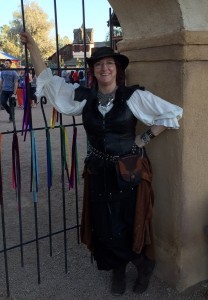
Me in my glorious RenFaire duds.
A huge shout out and thank you to Book Shoppe proprietor extraordinaire, Lady Ann Chamberlain. (She’s also an international bestselling author. Check out her website here This year’s Arizona Renaissance Faire appearance was another resounding success. Not only did I meet and speak with a huge number of new readers, as well as some fine aspiring authors, but I also received the Prince’s favor (and some lovely flattery). Huzzah! And I would be remiss if I did not thank my incredible assistant, Jen LaBuzz. Jen, I’m so glad your arms did not fall off!
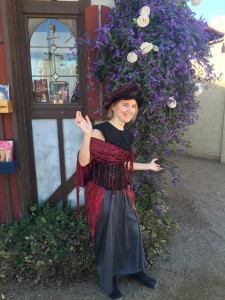
Fab Assistant, RenJen ;)
I also saw Rosencrantz and Guildenstern there, nooses and all, which was reason enough to go home and re-watch Tom Stoppard’s fabulous film, Rosencrantz and Guildenstern Are Dead.
Favorite lines: “We’re more of the love, blood and rhetoric school. Well, we can do you blood and love without the rhetoric, and we can do you blood and rhetoric without the love, and we can do you all three concurrent or consecutive. But we can’t give you love and rhetoric without the blood. Blood is compulsory. They’re all blood, you see.”
I just recovered from a knock-down drag-out brutal fight with a flu virus that I believe to be the closest kin to an evil plague I’ve ever encountered. Talk about the walking dead. Ugh!
Now that I am on the mend, I am hard at work, applying the thoughtful, focused feedback I received from my Beta Readers on the current WIP, a YA Urban Fantasy with the working title, Collars and Curses. I believe my readers are going to like this new character and her strange world almost as much as I do. And, in the arena of new books, I am hoping to be able to announce some big news soon. So, stay tuned for that.
As you can see from my “Appearances” page, I am already booked almost through the end of the year. Not as much teaching this year, as I am focused on getting the books into the hands of as many new readers as possible. However, aspiring authors and those interested in writing and publishing should definitely check out this Writer’s Conference, Cirque de Livre, where I will be presenting. It takes place in Downtown Mesa, Arizona on May 27-29, 2016. Early Bird registration is open until March 31st!
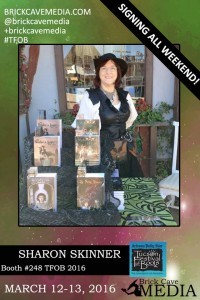 Meanwhile, this coming weekend, March 12-13, I will be in the Brick Cave Books Booth #248 at the Tucson Festival of Books. Copies of all my books will be available, including the newest, the sequel to the Healer’s Legacy, The Matriarch’s Devise, which is gathering wonderful reviews. I will be available all weekend to sign books, so look for me there!
The post Here and There, This and That appeared first on SharonSkinner.com.
March 2, 2016
Flash Fiction: Red Scarf
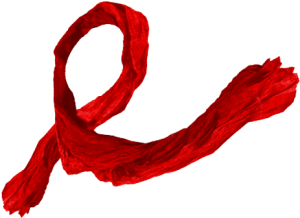
The Red Scarf
“Dammit!”
“What’s wrong now, Mother?”
“My scarf. The red one. It’s missing. Dammit!”
“Mother, please. You’re blood pressure. Remember what the doctor said about stressing your heart.”
“Doctors! Just a bunch of semi-educated guessers.”
“Now, mother, where would you be right now without all the doctors and nurses who cared for you after your . . . event.”
“Oh, stop tip-toeing around. Just say it. You never did have the guts to do or say what was needed. Heart attack. I had a damned heart attack.”
“Fine, heart attack. Are you happy now?”
“No. Someone must have stolen it.”
“Now, mother, why would anyone want to steal your old scarf?”
“You have no idea.”
“I’ll tell you what, I’ll get you another scarf. Something blue. To set off your eyes.”
“I don’t want a new damn scarf. I need to find my scarf. The one I used to . . .”
“Used to what, Mother?”
“Eh? Nothing. Nothing. It’s just I . . . I wouldn’t be so concerned, but it was a . . . a souvenir . . . from—”
Knock, Knock, Knock
“I wonder who that could be at this hour?”
“Don’t answer it. It’s them!”
“But—”
“It’s them I tell you. They took it, and now they’re back.”
“Mother. What’s wrong with you?”
“Wrong with me? What’s wrong with you. Listen to me for once in your worthless life and do not open that door.”
“Mother. Let go. You’re hurting me.”
“You are not going to answer that door.”
Knock, Knock, Knock
“You can’t let them take me.”
“Please, go back to bed, Mother. You need your rest.”
“No. Wait. I have to think. Would the DNA still be viable?”
“What on earth are you talking about?”
“That scarf! That damned red scarf! It’s the one I used when I strangled your father!”
“And here I told them they wouldn’t find anything. I guess I was wrong again, Mother.”
The post Flash Fiction: Red Scarf appeared first on SharonSkinner.com.
February 24, 2016
Five-Word Writing Prompt Poetry
This week, I was given a 5-word writing prompt for my blog post.
Here is the result:
STAGE CROSSED
She sits at the computer.
Tries to focus on the words.
Failed attempts to write
the story
that trails its way
down her cheeks.
A giant vacancy fills her chest.
The flowers should be red.
A noise startles her.
She rises slowly,
afraid of what she will see,
unable to stop herself.
Breath catches.
Heart pounds.
Tears flow.
The swing out back
sits empty.
In case you were wondering, here are the words I was given: swing, computer, red, startle, giant
The post Five-Word Writing Prompt Poetry appeared first on SharonSkinner.com.
February 19, 2016
Love of Learning Has Taught Me Well
Love of learning is one of my key personality traits. My thirst for knowledge was given to me by my mother who was always well-read, especially in the sciences. Non-fiction, informational books were her mainstay. Autobiographies and biographies were also acceptable fare, as were historical novels (preferably with plenty of historical and very little novel).

Love of Learning
My mother often played word games with us (there were six of us, four boys and two girls) and taught us to be quick thinkers. Wit is still a highly prized commodity in my family. It wasn’t until I was much older that I discovered that many of the games that she used to keep us quiet on family trips were, in fact, designed to measure and develop IQ.
Logic was her strong suit, still is, but music and art were not left out of the mix. We sang songs and learned to rhyme early on and, since there were six of us, the older ones taught the youngest.
I think sometimes it paid her back unkindly to have taught us so well. We, I especially, had a tendency to question the way things were and to debate philosophy and religion with her when many children were still playing less sophisticated games.
Because there were so many of us, individual attention at home was scarce, and school became a haven for me, a place where I could stand out from the crowd. I was a quiet child who, in my home environment, was allowed to stay in the background as younger more demanding siblings appeared on the scene. At school, however, I was a star pupil. I got all the attention I desired from teachers who found my quick mind and willingness to learn a refreshing change from farm kids whose parents didn’t care much about what their children learned aside from the usual FAA or 4H club fare.
Although my abilities made the teachers’ jobs easier, it soon made life among my peers more difficult. By the time I realized what was happening, it was too late. I was hooked. Making the grade was more important than developing social relationships. Besides, if I needed friends, I always had my books.
By age eleven, I had worked my way through the children’s section of our local public library, but when I reached for a book from the adult section, the librarian cut off my supply. It was time for mom to step in. I remember the day she walked into the library with me and quietly explained to the librarian that I was to be allowed to check-out and read any book in the library I desired. Go, Mom!
I then proceeded to work my way through the remainder of the library’s offerings. I never managed to finish. It wasn’t that the library was too big for me–I simply switched modes. I looked up from my books one day and saw the world. It was at that moment that I realized there was more learning to be had by experience than I had ever dreamed.
It was the end of the 1960’s, a time of personal experience, and I was again an avid and willing student. So began my years of harsh reality training, which I am grateful to have survived. My continued need for attention (in this much more dangerous classroom) drove me to make bad decisions, poor choices, and numerous mistakes.
In 1977, I joined the Navy and I traveled. I saw different countries and learned about different cultures. I learned enough foreign phrases to get around and to find a bathroom when necessary. But I became a dabbler, rather than immersing myself in these lessons. My method of learning was changing, becoming shallow. No longer caring to fully understand, I went through a phase, during which, I simply wanted to get by.
One day, I looked inward and realized I was sick. I had surrounded myself with sick people and created an artificial chaos, which I had pulled so tightly about myself I had been unable to see how ill I was. I realized I had only two options–change or die. I chose to change. Unfortunately those around me not only did not wish for change, they worked to dissuade me from my course. However, I had learned what it was to be sick, and now my thirst for knowledge drove me to learn what it was like to be healthy in mind, body and spirit.
I spent a lot of time in therapy, learning how to be functional.
Learning has always been a key area of focus for me. But what good is a key without someone to guide us in its use? I have been very fortunate in my life to have had a number of wonderful and knowledgeable guides. Though not all of them were formal educators, they have all been my teachers.
All of these teachers have something in common beyond what they have given to me. All of them are or were innovative, creative people. They have given more than they had to, and for that I am eternally grateful.
I have now become a teacher and mentor, offering what I have learned to those who are interested in the knowledge I have to offer. As an author, much of that knowledge is related to the craft of writing. Interestingly, with every workshop and presentation, I learn something new. I now understanding that teaching and learning are inseparable. A joyful lesson, indeed for someone with a great love of learning.
The post Love of Learning Has Taught Me Well appeared first on SharonSkinner.com.