
Gordon McAlpin's Blog: Updates from Multiplex: Deleted Scenes, page 24
May 5, 2011
VectorScribe Illustrator plug-in now available from Astute Graphics
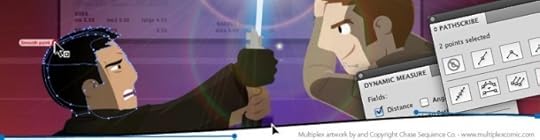
Sorry for the promotional post, but for you vector artists out there, a new Illustrator plug-in I've been helping beta test for the past few weeks is now available. It's from Astute Graphics, whose Phantasm CS plug-in I've been using for years, and it's called VectorScribe. VectorScribe's PathScribe suite of tools extends Adobe Illustrator's drawing tools in ways Illustrator users have daydreamed of for years, and (like Phantasm CS before it) I now use it every single day, routinely, while working on Multiplex.
The ability to drag a curve out (from a straight line) simply by pulling on the path and its smart point removal tool are probably the two things I do most often with PathScribe, but their presence makes drawing in Illustrator so much more intuitive and pleasant than a simple features list can convey.
Both of Astute Graphics' plug-ins have free trials, so if you are an Illustrator user, definitely check them out. There are all sorts of videos explaining the tools, too, which will give you a taste of these tools' possibilities.
(FULL DISCLOSURE: This is NOT a paid endorsement, but as a beta tester, I did receive a free copy of VectorScribe . That said, I would absolutely have paid the $65 [or so] for the VectorScribe Designer plug-in, and I think the additional VectorScribe Studio features have some terrific — if somewhat niche — uses, as well.)


January 28, 2011
Experimentation
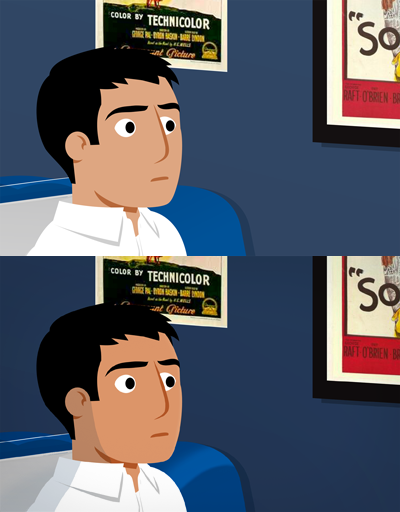
Just trying some things out for… possible future use:
January 14, 2011
Trailer Watch: Cave of Forgotten Dreams
I've always had a fascination with the beginnings of things: the origins of the universe, the origins of humans, the origins of art… So cave paintings have always been really fascinating to me. And so the upcoming 3D documentary about the Chauvet Cave in southern France certainly grabbed my attention. Cave of Forgotten Dreams, brings the audience along with Werner Herzog (Aguirre, the Wrath of God; Grizzly Man) as the filmmaker and a two-man crew explore the cave, intercut with interviews with scientists and historians.
The use of 3D is genius, because in these paintings, the artists would often incorporate the form of the walls into their paintings — a bulge in the rock could turn into part of a rhinoceros, for instance. That extra dimension is lost in photographs of the paintings, so 3D is the closest thing to actually seeing them in person.
The film premiered at the Toronto International Film Festival last September and is set for release this spring. Time will tell, but I don't expect it to be widely distributed; the number of art-house theaters with 3D projectors can't be that great. (via The Playlist)
Interview with me on the Greg & Dan Show
So yeah. I was interviewed by Greg Batton and Dan DiOrio for The Greg & Dan Show on WMDB 1470 AM this morning. Here is the audio from it! I haven't listened to it yet, but hopefully I didn't sound like too big of an idiot:
Trailer Watch: Ip Man 2: Legend of the Grandmaster
The first Ip Man (2008) was pretty freakin' sweet — corny, but chock full of terrific fights by one of my favorite martial arts action stars, Donnie Yen (Hero, Iron Monkey). The film was a "semi-biographical" tale of Ip Man (also spelled Yip Man), a martial arts master who is perhaps best known for mentoring Bruce Lee, and it covered his life through 1949, when Master Ip moved to Hong Kong. I don't know how fictionalized the first film was (quite a bit, I expect), but it's a fun story, and the action is well worth it.
The sequel, Ip Man 2: Legend of the Grandmaster, picks up shortly after the first film ends and only covers the next few years, so there's plenty of ground to cover in the series, should they decide to make more. I only caught the first film recently, so I'm pretty excited to be able to (maybe) see its 2010 sequel here in the States later this month, in limited release. You can check out the first one on video now. (It's even on Amazon On Demand, if you don't mind watching dubbed flicks.) One fight about half-way through is so brutal and awesome that it's worth watching the movie for. You can see that fight on YouTube here, but since I thought it was the best fight of the movie, if you have any inclination to see the full movie, I'd recommend waiting to see it in context.
Another film out soon — Wong Kar-Wai's The Grandmasters (starring Tony Leung Chiu-Wai and Ziyi Zhang) — is also about the life of Master Ip, and it boasts action choreography by Yuen Woo-Ping (Crouching Tiger, Hidden Dragon; Iron Monkey; and a million others). There's a teaser, but it's pretty much all in Chinese and there's no footage, so… y'know, whatever. We'll have to wait and see how that goes. It's supposedly out in February in China, though, and with the talent associated with it, it will almost definitely find its way to American theaters.
January 6, 2011
Multiplex/Wonderella book signing at Chicago Comics
If you're in the Chicago area, please come meet me and Justin Pierce (The Non-Adventures of Wonderella) out at Chicago Comics on January 22nd. We'll be signing copies of our new (-ish, in my case) books from 3pm – 8pm! Wonderella Book 2 will be brand spankin' new, and I don't know about you, but I'm looking forward to getting my greasy mitts on it.

If you'd like a high-res version of this flier to print out and post anywhere and everywhere you'd like, you can download this PDF (non-commercial uses only!).
November 29, 2010
How I Draw Hand-Drawn Comics, Part 2
In Part One, I covered how I pencil hand-drawn comics (on the relatively infrequent times that I get to do them). Next comes inking.
I left off with the finished pencils. I scan those in and print them out again onto Bristol board so that — if I screw up a page (or panel) irretrievably — I can print out a new page and take another shot.
I ink with a Winsor & Newton Series 7 #2. I've used cheaper brushes, but they've all lost their points much more quickly than some of my oldest Series 7′s. I'm sure there are other, good brands for cartooning, though; I've just never used one. I'll occasionally use a #1 for smaller details (although oftentimes, it's just as easy — or even easier — to use the larger brush), and I often pull out the old Microns for the dots of characters' eyes or other small details where an even line doesn't hurt.
If a brush gets a stray hair that will just not get back into shape, I use a cuticle trimmer and snip the stray hair out at its base. It keeps my brushes in active duty a lot longer.
One of the things I can never quite get the hang of with digital inking is turning the Cintiq in order to get the best line of attack on a line, like you can with a physical page. Clearly, other people don't have this problem, so don't take that as some sort of argument that traditional techniques are better than digital. (And, y'know, it's me. I draw Multiplex. Obviously, I don't have a problem with digital art.)
I generally avoid using a ruler at any point when I ink, because I like my inks to look organic (or maybe I'm just lazy). With this strip, I left the panel borders and lettering for the computer, so you can see that I just ran my lines off into the gutter and off the page; they'll get masked off after I scan the inks in.
I keep two jars of distilled water at my table: one for my bleedproof white brush, and one for the India ink. I use Speedball, but tend to let it sit out and evaporate a bit to thicken up before I use it — if it gets too thick, I add some distilled water. I use Winsor & Newton Bleedproof White, which will solidify after sitting around in the jar, but you can just add some distilled water and stir it up and it'll bounce back (even after months and months of sitting around).
As a leftie, I should, but I forget this a lot and end up smudging my inks sometimes. So, out comes the bleedproof white, and I'll fix any smudges and do some light touch-ups before I scan in my inks.
Below, you can see my inks without the letters and borders (left) and then with them (on the right). Apparently I forgot to ink the word "Manager" above the Manager's Station and the movie poster frame behind Jason in the last two panels. Oops.

Next comes the retouching. Some things you can fix more easily with bleedproof white and a little re-inking; other times, you need Photoshop. My hand isn't especially steady, so I almost always use Photoshop and my trusty Cintiq to do some touch-ups on the final inks. I kept that to a minimum on this page, only straightening out the top of the Manager's Station in the first panel, moving Kurt's head down a little in the second to last panel. If I've forgotten to ink anything, I'll tend to do it digitally, rather than scan in my inks again.
At this point, I'll add in the balloon pointers and call it a day (unless I need to color it, which I'm not doing for this strip).
After the cut, you can see how the finished page looks.

So there you go. Thanks again to Kirk Damman for allowing me to post this comic (he owns the original art).
If anybody's actually interested, I might get something ready about how I draw Multiplex in the future…? That'd probably be worth a few posts. :)
November 25, 2010
How I Draw Hand-Drawn Comics, Part 1
I say this a lot when I talk to kids: There's no such thing as learning "how to draw"; there's only how you draw. Me, I draw little weird.
First, obviously, you need an script. The idea for this comic was for one of the Kickstarter backers, Kirk Damman. He requested something about the Cubs/Cards rivalry. Bad news for him, though: I don't know squat about baseball. So I took it in my own direction after a little brainstorming.
When I write for myself, whether I'm drawing something by hand or in Illustrator, what I end up doing is start with a blank template and start typing dialogue. I try to keep the bare amount of dialogue to hit the beats needed to get from Point A to Point B — in this case, from the premise (movie geek sort of ranting about not getting baseball) to the inversion of it (the idea that he's basically a hypocrite). It's a common set-up, particularly with Jason.
With vector-drawn comics, one luxury I have is the ability to revise dialogue until the last minute, because I'm constantly able to recompose a panel around a larger or smaller word balloons, shift panels around, or whatever.
With hand-drawn stuff, I need to plan things out a lot better, because once I ink a page, I can't revise things nearly as easily. After the dialogue is pretty much nailed down, I open up Manga Studio Debut and scribble out little more than stick figures and a few scratches to get the general idea down.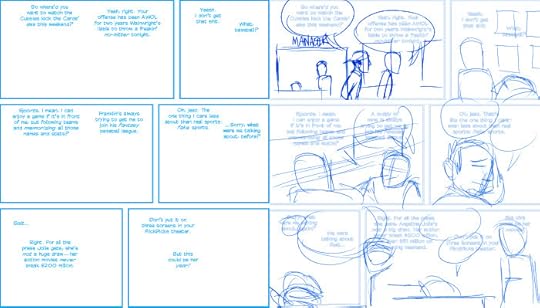
I try to do at least three passes of thumbnails, with each pass getting tighter and fine-tuning the composition. The more thumbnails I do, the better my final pencils usually turn out. (A better inker than I — or someone with a looser style, at least — could probably get away with just a couple of scribbles and jumping straight into inks, but not me.)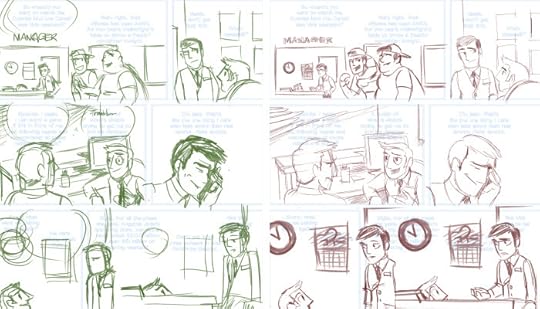
This is where my process gets a little weird. I don't like to do final pencils digitally, so what I'll do is print out the last pass of thumbnails onto Bristol paper using my large format inkjet. Printed out at about 10–15% cyan is basically the equivalent of non-photo blue. Before I got the large format printer, I would use a lightbox. It was a little slower, but it worked pretty well, too.
I do my finished pencils on top of that with a Colerase Dark Blue pencil. The final pencils, which were done at about 11″x14″ are below (after the cut). Before I do my inks, I'll scan my pencils in and print them out again, so that if I screw them up dramatically, I can just print out another page — but I'll get to that in Part Two.

October 17, 2010
Work on Multiplex: Book 2 begins…
I'm currently aiming to get Multiplex: Book 2 (not the final title, of course) ready for Summer 2012. That may or may not change, of course.
I'm not currently planning on including a long, exclusive story like the Prequel in Book 1, but there will be at least 25 pages of new material interspersed between the five chapters (6 through 10) included in the collection, some of which might be exclusive to the print collection.
Since Multiplex takes place in real time and generally update twice a week, I occasionally have to paint the story in relatively broad strokes. And, unfortunately, sometimes a story thread gets lost in the shuffle. It happens.
For Book 1, I used much of the new material to flesh out Devi and Gretchen, strengthening the narrative in the process, although it still lacks an overriding thrust over the course of the book. But adding a few finer brush strokes to the book, I think, adds a bit more dimension to the characters than you get from just the archives.
Book 2, on the other hand, has a stronger narrative in that it's centered around Jason and Becky for chapters 6–8 and, in some ways, Jason's absence in chapters 9 and 10 (although the book ends happily, with Jason returning to the theater).
So, like I did in Book 1, I'll be using the bonus comics to expand on things between the characters — in chapters 6–8, between Jay and Becky, as well as Jason and Devi's break-up. And in 9 & 10, I'll be expanding on things in and out of the Multiplex 10 during the period where Jason had quit working at the theater.
To that end, if there's a story thread from this period that you'd like a little more neatly tied up, or a movie you'd like me to touch on — basically, a deleted scene you'd like see added into the extended edition — feel free to make a suggestion! I, of course, reserve the right to disagree with you, since it's my comic. ;)
(Please keep the suggestions to the range of strips included in Book 2: numbers 103 through 216 (November 2006 – March 2008). If you'd like to look up what movies came out in that time frame, ComingSoon.net's release calendar is always a valuable tool; you just need to manually edit the URLs to find older dates.)
September 30, 2010
A note about misprinted Multiplex: Enjoy Your Show books
Apparently a few (two so far) copies of the book have repeated/missing pages around the p117–122 mark. If you got one of these, E-MAIL ME. It's definitely not in all of the books, or even 1% of them; it's a misprint. I try to flip through all the books to make sure they're clean, but these things slip through sometimes.
I can get credited for them by my printer, and I will happily send you a new book — but I do need some sort of photographic/scanned evidence.
Updates from Multiplex: Deleted Scenes

- Gordon McAlpin's profile
- 48 followers

