
How I Draw Hand-Drawn Comics, Part 1
I say this a lot when I talk to kids: There's no such thing as learning "how to draw"; there's only how you draw. Me, I draw little weird.
First, obviously, you need an script. The idea for this comic was for one of the Kickstarter backers, Kirk Damman. He requested something about the Cubs/Cards rivalry. Bad news for him, though: I don't know squat about baseball. So I took it in my own direction after a little brainstorming.
When I write for myself, whether I'm drawing something by hand or in Illustrator, what I end up doing is start with a blank template and start typing dialogue. I try to keep the bare amount of dialogue to hit the beats needed to get from Point A to Point B — in this case, from the premise (movie geek sort of ranting about not getting baseball) to the inversion of it (the idea that he's basically a hypocrite). It's a common set-up, particularly with Jason.
With vector-drawn comics, one luxury I have is the ability to revise dialogue until the last minute, because I'm constantly able to recompose a panel around a larger or smaller word balloons, shift panels around, or whatever.
With hand-drawn stuff, I need to plan things out a lot better, because once I ink a page, I can't revise things nearly as easily. After the dialogue is pretty much nailed down, I open up Manga Studio Debut and scribble out little more than stick figures and a few scratches to get the general idea down.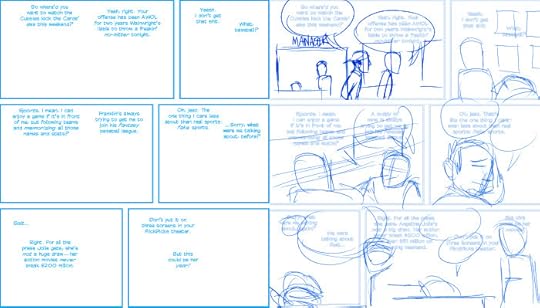
I try to do at least three passes of thumbnails, with each pass getting tighter and fine-tuning the composition. The more thumbnails I do, the better my final pencils usually turn out. (A better inker than I — or someone with a looser style, at least — could probably get away with just a couple of scribbles and jumping straight into inks, but not me.)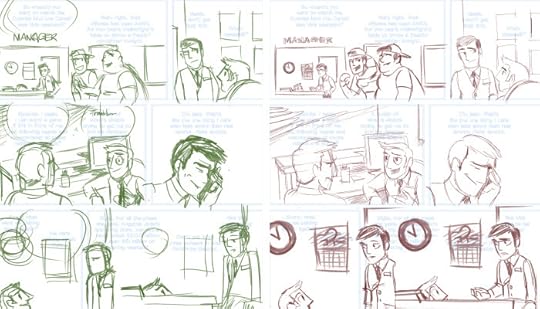
This is where my process gets a little weird. I don't like to do final pencils digitally, so what I'll do is print out the last pass of thumbnails onto Bristol paper using my large format inkjet. Printed out at about 10–15% cyan is basically the equivalent of non-photo blue. Before I got the large format printer, I would use a lightbox. It was a little slower, but it worked pretty well, too.
I do my finished pencils on top of that with a Colerase Dark Blue pencil. The final pencils, which were done at about 11″x14″ are below (after the cut). Before I do my inks, I'll scan my pencils in and print them out again, so that if I screw them up dramatically, I can just print out another page — but I'll get to that in Part Two.


Updates from Multiplex: Deleted Scenes

- Gordon McAlpin's profile
- 48 followers

