
P.M. Newton's Blog, page 5
January 11, 2011
B2 D1.5
Realising that I've been a tad slack about updating the blog - the new year is here and already into double figures!
So Happy New Year to all. May it bring stories to tell for one and all.
Busy being busy here, still working away on B2 D1.5 (that's Book 2 Draft 1.5). The 1.5 is because the majority of it is first draft plus a read through and re-draft whilst a small but significant section is fresh - very fresh - smoking, steaming fresh - some of it, in fact, is still "cookie dough" to borrow an analogy. Which is to say, I'm still at the stomach knotting, knuckle gnawing stage where I wonder if the story I have to tell and the way I want to tell it is going to work. No way to know for sure until it's finished and being read, so press on.
I've started to send out bits to be read by a trusted set of eyes. We're "doing it like Dickens" - starting at the beginning and moving on. It's good because it gives me the sense that the story is in motion, so to speak. But I'm still to get my head around releasing it into the editing/drafting process in a much rawer state than The Old School . That's when I get the stomach churning, knuckle gnawing, yips again.
I did get to take my mind off my own long-dark-tea-time-of-the-soul for the traditional five day pilgrimage to the SCG for the New Years Test. Nothing like seeing a team of cricketers being comprehensively humbled, before a huge crowd to put things in perspective. The fact it was an Ashes Test just made it hurt more.
The Barmy Army were in full voice (have to admit, it is good to see them finally get the team they deserve). Twenty thousand voices singing "The mighty - mighty - English" (and other much ruder things to Mitchell Johnson) was rather traumatising by Day 4. That's how I felt and I was only in the stands - I imagine Mitch Johnson might need therapy.
I confess to returning home and watching the South Africa V India game on the telly at night, to remind myself of what a real contests looked like. Steyn and Tendulkar both at the top of their games. Magic.
And ..... oh yes.
Indulged in a little extra-curricular fun involving a short story and a cylon.
Enjoy.
So Happy New Year to all. May it bring stories to tell for one and all.
Busy being busy here, still working away on B2 D1.5 (that's Book 2 Draft 1.5). The 1.5 is because the majority of it is first draft plus a read through and re-draft whilst a small but significant section is fresh - very fresh - smoking, steaming fresh - some of it, in fact, is still "cookie dough" to borrow an analogy. Which is to say, I'm still at the stomach knotting, knuckle gnawing stage where I wonder if the story I have to tell and the way I want to tell it is going to work. No way to know for sure until it's finished and being read, so press on.
I've started to send out bits to be read by a trusted set of eyes. We're "doing it like Dickens" - starting at the beginning and moving on. It's good because it gives me the sense that the story is in motion, so to speak. But I'm still to get my head around releasing it into the editing/drafting process in a much rawer state than The Old School . That's when I get the stomach churning, knuckle gnawing, yips again.
I did get to take my mind off my own long-dark-tea-time-of-the-soul for the traditional five day pilgrimage to the SCG for the New Years Test. Nothing like seeing a team of cricketers being comprehensively humbled, before a huge crowd to put things in perspective. The fact it was an Ashes Test just made it hurt more.
The Barmy Army were in full voice (have to admit, it is good to see them finally get the team they deserve). Twenty thousand voices singing "The mighty - mighty - English" (and other much ruder things to Mitchell Johnson) was rather traumatising by Day 4. That's how I felt and I was only in the stands - I imagine Mitch Johnson might need therapy.
I confess to returning home and watching the South Africa V India game on the telly at night, to remind myself of what a real contests looked like. Steyn and Tendulkar both at the top of their games. Magic.
And ..... oh yes.
Indulged in a little extra-curricular fun involving a short story and a cylon.
Enjoy.


December 9, 2010
Has Stendhal's Mirror had its day?
Over on the marvellous blog of Sci-Fi writer Paul Macauley, Earth and Other Unlikely Worlds a conversation began about whether neo-realistic literature has had its day. Two authors, Peter Handke and Haruki Murakami have written articles suggesting that this indeed is so. I would recommend a visit to Unlikely Worlds to enter into the wider discussion of this issue, whilst here at The Concrete Midden, I'm reposting a slightly longer version of my response, as it is somewhat tangential to the main topic under discussion at Unlikely Worlds.
First up, cards on the table. I'm a realist writer. Dunno if I'm a neo-realist, but I'm a new writer and I write crime fiction which is firmly based in reality and incorporates real events. It involves the creation of a fictional world which contains the realistic political and social atmosphere of the 1990s. I'm also a big admirer of science fiction (as can be seen in my other blog world).
What took me off on a tangent from the discussion of realism/neo-realism versus magic realism at Unlikely Worlds, was the observation, made by Murakami, that realism was no longer relevant because two events, the fall of the Berlin Wall and the attack on the twin towers in September 200,1 had " greatly transformed our mentality . . ."
This "the world changed on 9/11" thesis frankly irritates me beyond belief. And when writers start to embrace this thesis and use it as a reason to argue why certain things cannot – or should not - be written, or to suggest the way things should or shouldn't be written, then I start to vent a bit of steam.
In days following 9/11 "the world has changed" was the most common reaction. It was understable. The events were shocking. They were awful in the true sense of that word - they filled one with awe. And they were captured on film, replayed again and again, and we watched, each time hoping somehow for a different outcome.
But that "world changed" response was also dangerous as it permeated our psyche and permeated our politics. Its legacy has included such things as waterboarding and rendition, shock and awe.
It also permeated a lot of the literary responses.
High profile critic James Wood used it as a reason to bury the social novel, writing in the Guardian in October 2001 Wood claimed that the "Stendhalian mirror would explode with reflections were it now being walked around Manhattan. For who would dare to be knowledgeable about politics and society now?"
Martin Amis took to writing essays about terrorism and making up words like horrorism, as if what was available to describe criminal acts of terror were insufficient. Ian McEwan reckoned that,
"… even the best minds, the best or darkest dreamers of disaster on a gigantic scale, from Tolstoy and Wells to Don DeLillo, could not have delivered us into the nightmare available on television news channels yesterday afternoon."
OK, so I wouldn't expect McEwan to be familiar with the oeuvre of Tom Clancy and his 1994 novel Debt of Honour, in which a 747 is flown into the US Capitol during the State of Union address, wiping out the President and a fair chunk of Congress (hell, I only know about it because of a ten month stay in a Buddhist monastery in South India where reading material was …. limited) but in both Wood's and McEwan's reactions I found the retreat from the possibility of creativity and imagination to absorb and reflect what had happened on 9/11 to be overly nihilistic.
Writing in The New Statesman at the end of 2001, literary critic Jason Cowley described the reaction of the literary world to the terrorist attacks as having a:
"catastrophist - eschatological anxiety and an unconvincing sudden seriousness, as if human nature itself changed the day the towers collapsed. Or perhaps it was merely that we in the relatively benign, affluent west had forgotten that the world has always been a spectacular carnival of suffering."
It was that "spectacular carnival of suffering" that bothered me about the "world has changed" reaction as well. It contained in it a denial of other places and peoples whose "worlds had changed" but because they hadn't changed in the heart of a western power and were not captured on TV, well, somehow they didn't count.
My inchoate misgivings were captured by the phrase – the "parochialism of the present" - and by a rather unlikely source, the foreign policy analyst and editor of The National Interest, Owen Harries. He defined it as:
"[A] condition resulting from a combination of ignorance of history and an egotistical insistence on exaggerating the importance of events that more or less directly involve oneself. Horrifying and atrocious as the acts of terror were, it should be remembered that they have happened at a time when people who experienced the Somme and Verdun, the Holocaust and Hiroshima, are still alive."
Well, yes.
Imagine the stories that would never have been written had Erich Maria Remarque decided that the trenches had shattered his Stendhalian mirror, or Primo Levi been silenced by the horror he witnessed, or Bao Ninh or Kurt Vonnegut had allowed their own war experiences to so overwhelm them that they dared not be knowledgeable about politics or society.
Writing about the world we live in can take many forms, magical realism, realism, crime noir, science fiction - in fact some of the strongest writing to take on the post 9/11 world came, I think, from the world of crime writing. Sara Paretsky's Blacklist conveyed not only the fear of being the victims of terror that every American felt after the attacks but the fear of the state as it reacted to that terror with legislation that threatened the Bill of Rights. Ian Rankin, in The Naming of The Dead brought Rebus, George Bush, the G8 and the London Tube bombings into a book that was as much about the fragility of the rule of law as it was about a murder.
So, in summary, I don't believe that realism, the social novel, the social crime novel, are dead and past their use by date. I do believe in science fiction and the exciting imaginative leaps and bounds of alternate worlds and realities that end up telling me something about my own reality.
And, no the world didn't change on 9/11, anymore than it did on April 6, 1994, or August 9, 1945, or July 1, 1916 or 24 August 79AD, it just added to the layers of pain that make up what it is to be human. And that's what writers, realist, neo-realist, magical, fantastical, speculative, graphic do best, make up stories that help us work out what it means to be human.*
*And sometimes they do it by writing about humans who aren't.

November 12, 2010
A Cave of One's Own
Virginia longed for a room.
Some writers can afford something a tad grander ....
... and then there are the rest of us.
But the desire to have some place to go and make stuff up is pretty universal.
Stephen King in On Writing agrees with Virginia that "We do best in a place of our own."
And - he's right.
There are quite a few things that lend themselves to being done with a background hum, that don't really suffer from random interruptions, phones, doors, distractions, twittering. In fact, sometimes it's nice to have human company when the word track blues strike.
And then there's the other stuff.
The getting-it-out stuff. The first draft stuff, in fact the bits and pieces that come before the first draft. That stuff is better done alone. We all know what happened to the creative flow thanks to the visitor from Porlock. To quote Stephen King again, "Write with the door closed, rewrite with the door open" - and I'd add, ignore the visitors.
Ignoring family members who drop by, or those who live in, is somewhat easier said than done, and can have certain ramifications. This is one reason why I like to write by hand, in notebooks, out and about, in parks, by the pool, on the train. That's where a lot of the fresh stuff gets its first airing. Away from the screen, from the delete and back buttons. I'm not in a room alone, but I'm still alone. No distractions.
But it's finding a space for the next stage that has been trickier this time round. The Old School made its transition from pen to pixel in a study space provided by my university, UTS, where I was enrolled in a research degree. Hours would fly past. No phone. No doors. Lots of wall space to blu-tack up images. The day would turn into night and I wouldn't even notice.
I'm discovering, with Book 2, what writers always say, that every book is different. This time around I'm working from home. Not an office but a corner of a room. And sometimes I have to share it.
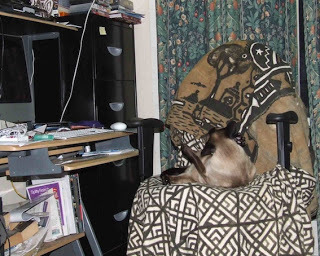
This time around is different. I find I'm wanting wall space to write on. I'm close to the end of the first draft and I have a burning need to have a space to "see" it laid out - plots and people - but even more importantly emotional touchstones.
This book has required me to step a bit out of my comfort zone. To explore, in some detail, psychological spaces I haven't (thankfully) been. I've felt the need to create a space where I can have certain truths about the wounds my characters carry, and the way those wounds effect them, "in my face" as I write and as I edit the first draft.
I need to be able to look up and weigh the truth of what I've written against the truth of what I have discovered. Such things don't really belong on the walls of rooms that non-writers, visitors and family members share.
So, I've found a cave.
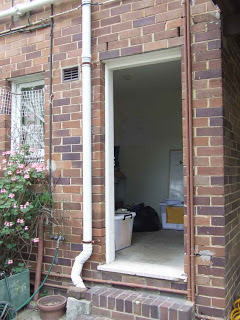
All it needed was to have some storage things crammed into other storage places and then I could cram in me.
It's a small rom. With a small window. And lots and lots of wall space.
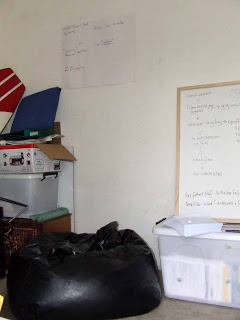
This was taken a few weeks ago. The walls have more posters blu tacked up now. Notes to self scrawled. The white board has been wiped and new notes added, subtracted, altered.
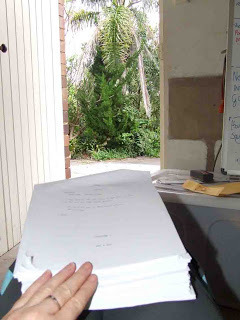
There's even a bit of a view out the door for when I want to keep it open.
Some writers can afford something a tad grander ....
... and then there are the rest of us.
But the desire to have some place to go and make stuff up is pretty universal.
Stephen King in On Writing agrees with Virginia that "We do best in a place of our own."
And - he's right.
There are quite a few things that lend themselves to being done with a background hum, that don't really suffer from random interruptions, phones, doors, distractions, twittering. In fact, sometimes it's nice to have human company when the word track blues strike.
And then there's the other stuff.
The getting-it-out stuff. The first draft stuff, in fact the bits and pieces that come before the first draft. That stuff is better done alone. We all know what happened to the creative flow thanks to the visitor from Porlock. To quote Stephen King again, "Write with the door closed, rewrite with the door open" - and I'd add, ignore the visitors.
Ignoring family members who drop by, or those who live in, is somewhat easier said than done, and can have certain ramifications. This is one reason why I like to write by hand, in notebooks, out and about, in parks, by the pool, on the train. That's where a lot of the fresh stuff gets its first airing. Away from the screen, from the delete and back buttons. I'm not in a room alone, but I'm still alone. No distractions.
But it's finding a space for the next stage that has been trickier this time round. The Old School made its transition from pen to pixel in a study space provided by my university, UTS, where I was enrolled in a research degree. Hours would fly past. No phone. No doors. Lots of wall space to blu-tack up images. The day would turn into night and I wouldn't even notice.
I'm discovering, with Book 2, what writers always say, that every book is different. This time around I'm working from home. Not an office but a corner of a room. And sometimes I have to share it.

This time around is different. I find I'm wanting wall space to write on. I'm close to the end of the first draft and I have a burning need to have a space to "see" it laid out - plots and people - but even more importantly emotional touchstones.
This book has required me to step a bit out of my comfort zone. To explore, in some detail, psychological spaces I haven't (thankfully) been. I've felt the need to create a space where I can have certain truths about the wounds my characters carry, and the way those wounds effect them, "in my face" as I write and as I edit the first draft.
I need to be able to look up and weigh the truth of what I've written against the truth of what I have discovered. Such things don't really belong on the walls of rooms that non-writers, visitors and family members share.
So, I've found a cave.

All it needed was to have some storage things crammed into other storage places and then I could cram in me.
It's a small rom. With a small window. And lots and lots of wall space.

This was taken a few weeks ago. The walls have more posters blu tacked up now. Notes to self scrawled. The white board has been wiped and new notes added, subtracted, altered.

There's even a bit of a view out the door for when I want to keep it open.
October 21, 2010
What we talk about when we talk about crime - with the Sisters in Crime
While it was an eventful journey just getting to the event, once we all landed safely we had a great night with the Sisters down in Melbourne last Friday.
The panel was chaired by Robin Bowles, who'd done her homework on Sulari Gentill and Angela Savage just as effectively as she had on me. For two completely different takes on the same night, check out Sulari's blog and Angela's blog. And just to prove the old adage that three eye-witnesses will provide three entirely different descriptions, I'll now add another.
Place is my "thing". It's what gets me excited about reading crime and it's what excites me about writing crime. With a great deal of help from a marvellous editor, Dr Malcah Effron, I have recently finished a chapter for an upcoming academic monograph on what I've dubbed "The Politics of Place" specifically how place is developed in Ian Rankin's The Naming of the Dead and Sara Paretsky's Blacklist as they chart the disintegration of western legal values and traditions in the wake of 9/11.
In both Sulari and Angela's novels, place is given a high degree of attention but in very different and interesting ways.
Sulari commented that she had had letters from elderly people whose memories of the New Guard in those days of madness in Sydney during the 1930s had been reawakened in the pages of her novel, A Few Right Thinking Men . I feel that this kind of response is a real tribute to the sense of political and cultural place Sulari created and proof, yet again, that a real sense of place involves a whole lot more than just getting the names of the streets and the numbers of the buses right. It involves creating a real sense of the place, of the culture, of the conflicts, of the news and the gossip and the violence and the struggles, just as it was in that time for those people.
Like her first novel, Angela's second, The Half-Child, is set in Thailand. When Angela began talking about writing Thailand, a place she loves and wants to share with her readers, she described her unease when she acknowledged that writing crime set there would mean dredging up all the negative stereotypes people harbour about that country; crime, corruption, drugs, vice, sex, exploitation. For her this meant she had to think carefully about how she handled the material, about making sure her characters and issues were real and complex.
This area of discussion came up towards the end of our allotted time, unfortunately, as it is something that is also of concern to me in my work. How to write about issues such as police corruption with nuance and depth, avoiding the cliches, making it real without making it repellent, keeping it authentic which means, to some degree showing how and why it occurs with subtlety, even empathy.
I related very strongly to Angela's concerns in depicting an Asian setting with both honesty and affection, as I have set the events of Book 2 in Cabramatta in early 1993. A quick glance at the headlines of that time ticks all the boxes of a great crime novel; young, violent gangs fighting and killing over a share of the drug market, home invasions and extortion, gambling and prostitution, drug sellers taking over the streets, crime out of control, police overwhelmed - every headline a story. And every headline fodder for those who did not want to see the development of an Australia where a good percentage of its population would not come from Anglo-Celtic-European backgrounds but from Vietnam, Cambodia or Laos.
No doubt about it, Cabramatta in 1993 was quite a place. A complex, rich and troubled place, where some kids went "out to play", ra choi, and ended up dead, others went to school while their parents tried to learn English, worked two jobs. Some kids went to jail and some kids went to university, carrying all the weight of expectation on their shoulders that they could claw back something of what their parents had given up to come to Australia.
It this nuanced Cabramatta I want the next book to explore. A place where kids dealt drugs and carried knives and lived in groups like little families taking care of each other, while behind closed doors, other families, damaged beyond all repair by war, just tried to hold on.
One of these days Angela and Sulari and I will have to have a good long talk about writing honestly but with nuance about places and people that are all too often seen in black and white*.
*Which is to say we're available for weddings, parties anything ....
The panel was chaired by Robin Bowles, who'd done her homework on Sulari Gentill and Angela Savage just as effectively as she had on me. For two completely different takes on the same night, check out Sulari's blog and Angela's blog. And just to prove the old adage that three eye-witnesses will provide three entirely different descriptions, I'll now add another.
Place is my "thing". It's what gets me excited about reading crime and it's what excites me about writing crime. With a great deal of help from a marvellous editor, Dr Malcah Effron, I have recently finished a chapter for an upcoming academic monograph on what I've dubbed "The Politics of Place" specifically how place is developed in Ian Rankin's The Naming of the Dead and Sara Paretsky's Blacklist as they chart the disintegration of western legal values and traditions in the wake of 9/11.
In both Sulari and Angela's novels, place is given a high degree of attention but in very different and interesting ways.
Sulari commented that she had had letters from elderly people whose memories of the New Guard in those days of madness in Sydney during the 1930s had been reawakened in the pages of her novel, A Few Right Thinking Men . I feel that this kind of response is a real tribute to the sense of political and cultural place Sulari created and proof, yet again, that a real sense of place involves a whole lot more than just getting the names of the streets and the numbers of the buses right. It involves creating a real sense of the place, of the culture, of the conflicts, of the news and the gossip and the violence and the struggles, just as it was in that time for those people.
Like her first novel, Angela's second, The Half-Child, is set in Thailand. When Angela began talking about writing Thailand, a place she loves and wants to share with her readers, she described her unease when she acknowledged that writing crime set there would mean dredging up all the negative stereotypes people harbour about that country; crime, corruption, drugs, vice, sex, exploitation. For her this meant she had to think carefully about how she handled the material, about making sure her characters and issues were real and complex.
This area of discussion came up towards the end of our allotted time, unfortunately, as it is something that is also of concern to me in my work. How to write about issues such as police corruption with nuance and depth, avoiding the cliches, making it real without making it repellent, keeping it authentic which means, to some degree showing how and why it occurs with subtlety, even empathy.
I related very strongly to Angela's concerns in depicting an Asian setting with both honesty and affection, as I have set the events of Book 2 in Cabramatta in early 1993. A quick glance at the headlines of that time ticks all the boxes of a great crime novel; young, violent gangs fighting and killing over a share of the drug market, home invasions and extortion, gambling and prostitution, drug sellers taking over the streets, crime out of control, police overwhelmed - every headline a story. And every headline fodder for those who did not want to see the development of an Australia where a good percentage of its population would not come from Anglo-Celtic-European backgrounds but from Vietnam, Cambodia or Laos.
No doubt about it, Cabramatta in 1993 was quite a place. A complex, rich and troubled place, where some kids went "out to play", ra choi, and ended up dead, others went to school while their parents tried to learn English, worked two jobs. Some kids went to jail and some kids went to university, carrying all the weight of expectation on their shoulders that they could claw back something of what their parents had given up to come to Australia.
It this nuanced Cabramatta I want the next book to explore. A place where kids dealt drugs and carried knives and lived in groups like little families taking care of each other, while behind closed doors, other families, damaged beyond all repair by war, just tried to hold on.
One of these days Angela and Sulari and I will have to have a good long talk about writing honestly but with nuance about places and people that are all too often seen in black and white*.
*Which is to say we're available for weddings, parties anything ....
October 16, 2010
Sisters in Crime and a Stitch in Time
I am a pretty uncoordinated person. Never ask me to dance. In fact, discovering aqua-aerobics was a huge boon. No longer condemned to hide in the back row of the gym, stumbling my way through another series of complicated moves, always a beat or two behind the music. Oh the joy, of thrashing away in the pool where no one can see you moving below the neck.
My uncoordinated approach to movement often sees me shoulder charge into doorways rather than moving gracefully through them, pinball off the edges of tables and somehow be able to trip over a dust mote. So on Friday night, battling the wind, the driving rain and a thick layer of treacherous slippery foliage that had been stripped from the trees by day of vicious weather, I was tiptoeing very cautiously from my hotel to the edge of the road to try to flag down a cab to attend my first Melbourne writing event.
Sisters in Crime, a meal at Bell's Hotel to be followed by a good chat about crime with two wonderful writers Sulari Gentill and Angela Savage, with Robin Bowles on hand to steer the conversation and keep us on our toes.
I was feeling pretty good, the terrible weather at least providing the excuse to give the black winter coat that goes swoosh a final trot before summer, make-up was in place, hair not looking too weird, all I had to do was find a cab. Miraculously one appeared creeping up Fitzroy Street and pulling in as I waved my hand.
Ever so carefully I stepped off the curb, my leather soled cowboy boots, a souvenir from a ski holiday in Steamboat Colorado, have a tendency to feel like they're skating on ice when its wet, but I remained upright and advanced on the cab, steadied myself on it before opening the door, leaning down to speak to the cab driver. Unfortunately, as I performed both actions simultaneously I ended up clobbering my face with the edge of the door.
Reeling back, I kept hold of the door, cabs on a wet Friday night in Melbourne were not to be given up so easily. I bent down to talk to the driver, to tell him where I wanted to go and noticed he was shrinking away from me.
"There is a little blood," he said just a little nervously.
I reached up, touched my forehead, which it was true did now feel a trifle lumpy. My fingers came away bright red and wet.
It was a similar moment, to the way I felt as I sailed through the air two days before the Joss Whedon event at the Sydney Opera House - oh nooooooooooo. But, whereas that fall had seemed to take forever as I flailed and fell through the air prior to crashing in an ungainly pile on the ground, this one seemed to have happened before I'd even realised it.
Reluctantly I released my cab back into the wilds of Friday night and ever so carefully retraced my wet slippery steps back into the Tolarno Hotel, digging a crumpled tissue out of the handbag to press against my forehead. A quick check in the mirror of the ladies room by reception was enough to convince me that a Band-Aid at least was going to be required if I was to speak at my event without blinking through blood.
At the reception desk Amanda had just started her shift, she looked up and sprinted out from the office, insisting politely that I should sit down and she would get something. I retrieved my running list for the night and managed to punch in the number of my soon-to-be-equally-marvellous-under-pressure publicist from Penguin, Dianne Biviano, and leave a message, at which point Amanda returned wearing latex gloves and bearing a fairly large dressing which she pressed against my head and started talking stitches.
At this point my natural instincts to not-feel-very-well-at-the-thought-of-blood-kicked-in and I slumped back in the lounge, feeling just a bit too warm and murmuring things like, "but I have to give a talk". Amanda took over my phone and my now slightly blood spattered running list -
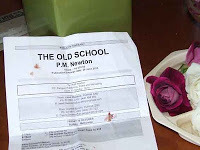
and in short order Amanda had organised Dianne to collect me, had been in contact with Carmel Shute who supplied the location of the closest doctor's clinic, for which Amanda then printed up a Google map, whilst supplying me with water and a lolly.
By the time Dianne arrived to take over and ferry me to the Acland Street St Kilda super clinic, I'd rallied to the point that I ooohed and ahhhed at my first glimpse of The Palais from the Coles Supermarket carpark. The clinic was doing brisk business but thanks to Amanda's preparatory call, we found that walking in with a head wound is a good way of getting a bed and a good lie down. There, the lovely Sara cleaned the wound and provided me with an ice pack which felt so good I didn't want to give it back and the equally wonderful Doctor Bert who, in between treating a bustling waiting room, managed to pop in an injection of anaesthetic along with a few neat stitches, and a classy little dressing to cover it up.
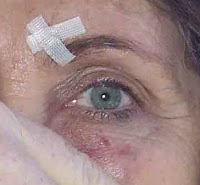
Thank you again, Amanda, Dianne, Carmel, Sarah and Dr. Bert.
And so it came to pass that on a wild and wet and stormy night in Melbourne, I was only a little bit late to my first big adventure and had an excellent night, in fine company, sharing some great conversations about crime.
Of which more later .......
My uncoordinated approach to movement often sees me shoulder charge into doorways rather than moving gracefully through them, pinball off the edges of tables and somehow be able to trip over a dust mote. So on Friday night, battling the wind, the driving rain and a thick layer of treacherous slippery foliage that had been stripped from the trees by day of vicious weather, I was tiptoeing very cautiously from my hotel to the edge of the road to try to flag down a cab to attend my first Melbourne writing event.
Sisters in Crime, a meal at Bell's Hotel to be followed by a good chat about crime with two wonderful writers Sulari Gentill and Angela Savage, with Robin Bowles on hand to steer the conversation and keep us on our toes.
I was feeling pretty good, the terrible weather at least providing the excuse to give the black winter coat that goes swoosh a final trot before summer, make-up was in place, hair not looking too weird, all I had to do was find a cab. Miraculously one appeared creeping up Fitzroy Street and pulling in as I waved my hand.
Ever so carefully I stepped off the curb, my leather soled cowboy boots, a souvenir from a ski holiday in Steamboat Colorado, have a tendency to feel like they're skating on ice when its wet, but I remained upright and advanced on the cab, steadied myself on it before opening the door, leaning down to speak to the cab driver. Unfortunately, as I performed both actions simultaneously I ended up clobbering my face with the edge of the door.
Reeling back, I kept hold of the door, cabs on a wet Friday night in Melbourne were not to be given up so easily. I bent down to talk to the driver, to tell him where I wanted to go and noticed he was shrinking away from me.
"There is a little blood," he said just a little nervously.
I reached up, touched my forehead, which it was true did now feel a trifle lumpy. My fingers came away bright red and wet.
It was a similar moment, to the way I felt as I sailed through the air two days before the Joss Whedon event at the Sydney Opera House - oh nooooooooooo. But, whereas that fall had seemed to take forever as I flailed and fell through the air prior to crashing in an ungainly pile on the ground, this one seemed to have happened before I'd even realised it.
Reluctantly I released my cab back into the wilds of Friday night and ever so carefully retraced my wet slippery steps back into the Tolarno Hotel, digging a crumpled tissue out of the handbag to press against my forehead. A quick check in the mirror of the ladies room by reception was enough to convince me that a Band-Aid at least was going to be required if I was to speak at my event without blinking through blood.
At the reception desk Amanda had just started her shift, she looked up and sprinted out from the office, insisting politely that I should sit down and she would get something. I retrieved my running list for the night and managed to punch in the number of my soon-to-be-equally-marvellous-under-pressure publicist from Penguin, Dianne Biviano, and leave a message, at which point Amanda returned wearing latex gloves and bearing a fairly large dressing which she pressed against my head and started talking stitches.
At this point my natural instincts to not-feel-very-well-at-the-thought-of-blood-kicked-in and I slumped back in the lounge, feeling just a bit too warm and murmuring things like, "but I have to give a talk". Amanda took over my phone and my now slightly blood spattered running list -

and in short order Amanda had organised Dianne to collect me, had been in contact with Carmel Shute who supplied the location of the closest doctor's clinic, for which Amanda then printed up a Google map, whilst supplying me with water and a lolly.
By the time Dianne arrived to take over and ferry me to the Acland Street St Kilda super clinic, I'd rallied to the point that I ooohed and ahhhed at my first glimpse of The Palais from the Coles Supermarket carpark. The clinic was doing brisk business but thanks to Amanda's preparatory call, we found that walking in with a head wound is a good way of getting a bed and a good lie down. There, the lovely Sara cleaned the wound and provided me with an ice pack which felt so good I didn't want to give it back and the equally wonderful Doctor Bert who, in between treating a bustling waiting room, managed to pop in an injection of anaesthetic along with a few neat stitches, and a classy little dressing to cover it up.

Thank you again, Amanda, Dianne, Carmel, Sarah and Dr. Bert.
And so it came to pass that on a wild and wet and stormy night in Melbourne, I was only a little bit late to my first big adventure and had an excellent night, in fine company, sharing some great conversations about crime.
Of which more later .......


