
Andrew Bud Adams's Blog, page 4
March 6, 2014
Batman: Arkham Knight
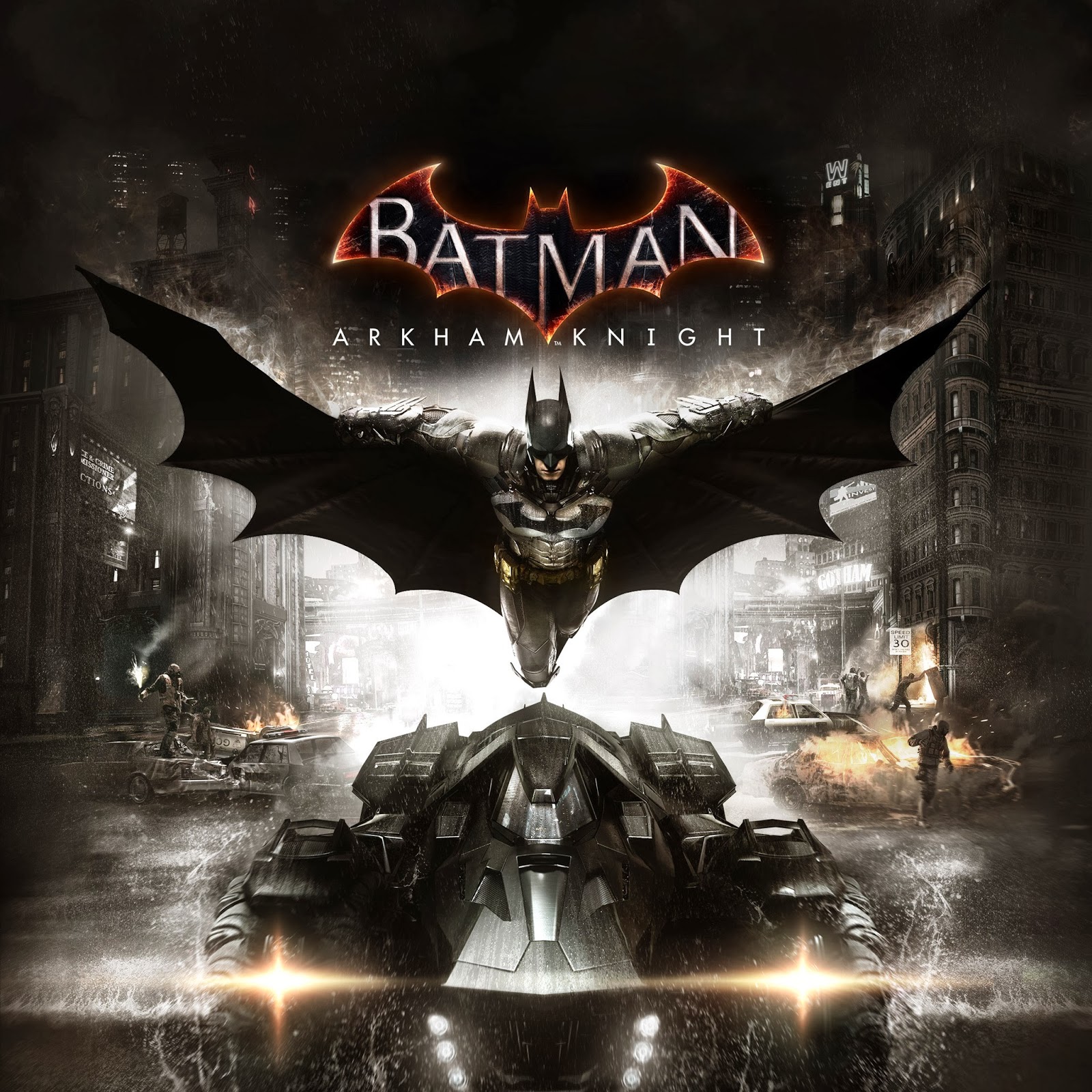 batmanarkhamknight.comTwo days ago, when Rocksteady suddenly revealed their next and last installment in the Arkham video game series with a four minute story trailer, I didn't have time to react properly. Which is to say, I freaked out, watched it several times in a row, shared it on social media with the caption "You're welcome" (as if I had something to do with it), and got back to grading papers.
Now that grading is momentarily caught up, I feel the need to explore my reaction more thoroughly. I think it might be therapeutic. Though it releases this October, the game is next-gen only, so it will be much longer before I actually get to play it. Rather than bottle up and carry all this enthusiasm around for the next months/years/however-long-before-my-wife-lets-me-buy-a-PS4, I'll dump it off here. (That's what blogs are for, right? I'm still not sure.)
I never actually took the time to review the last installment in this series, the notorious Arkham Origins that released only this past October from a different studio (Warner Bros. Games Montreal). This is partially because it took me so long to finish the story, and I'm actually still working on the side missions. (What do you want? I don't play as often as I'd like.) I remember being disappointed with the story at first, particularly many characters' throwaway roles (Barbara Gordon, Killer Croc, Alberto Falcone, most of the assassins) in favor of the Joker's big reveal. I was looking forward to Black Mask's assassin story per the wonderful set-up in the first official trailer:
However, once I made peace with that misdirection I actually really admired the story. The Joker and Bane were both wonderfully persistent, and the Blackgate finale was surprisingly satisfying. I agree with critics that the game felt a bit too easy because of certain new gadgets; I started in hard mode and never missed a beat, my slow (infrequent) progress notwithstanding. But I also agree that most boss fights were interesting and challenging -- Deathstroke's in particular. (Man, it's been fun seeing him on Arrow.) The voice acting and score were both wonderful and it was exciting to hear Quincy Sharp announce the plans for Arkham Asylum, setting up the rest of the series in true prequel fashion...not to preclude the possibility of Origins sequels produced by the same team. The Blackgate handheld spin-off is also coming to PlayStation Network this April, and I'll definitely download Mr. Freeze's "Cold, Cold Heart" add-on content.
So the thing is, I'm enough of a Batman fan now that I come into all interpretations with my own ideas for what they should be. I have favorite characters and favorite adaptations of those characters, and while I stay open to new and improved (or at least "different") versions, I live in fear of changes that are too little or not enough. As something of a completist, I hope to see every character from the Batman mythos incorporated into each retelling, and hope to be wowed anew. My big hope for The Dark Knight Rises was that it would at least pay homage to other villains not yet used in the Nolanverse, the way they did with Zsasz in Batman Begins -- the Penguin in a club, the Riddler in a computer hacker role, etc. (I had to make due with Daggett and a very underused Talia.) In other words, and as strange as it sounds, for me the worst thing a Batman arc can do is promise an ending, especially one that may not fulfill those hopes and expectations that I bring along. If it keeps going, that hope lives on.
Arkham Knight is sort of TDKR of the video game franchise because it's Rocksteady's finale. I'm not necessarily saying that's "strike one." I'm a fan of trilogy storytelling and can admit that every retelling has to end in order to make room for the new one. It just means that my expectations are higher. So how might it fulfill them (because, you know, it's all about me)?
The Good:
Developed and directed by the people responsible for the first two games.We can finally drive the Batmobile. According to Game Informer (via Batman-News.com), this is one important reason why next-gen technology is necessary, which means they're trying to make it as good as it can be.It only takes place one year after Arkham City, already avoiding a serious mistake on the part of TDKR, which jumped to eight years later in a vain attempt to invoke Frank Miller's The Dark Knight Returns (about an old, retired Batman).The title doesn't disappoint. A little thing, I know, but I was really let down by "The Dark Knight Rises," which, however thematic and appropriate, is still much less original than the other two titles in that series.Improved gameplay, graphics, etc. (Though as you can see, I'm more about the story.)The Promising:
Scarecrow is back. I missed him in City, but I'm also not sure what I think of him as the main villain, since he had a fairly prominent role in Asylum. It's a possible missed opportunity to use someone new. I'll also be annoyed if he's just a front for the actual main villain ala Black Mask in Origins, Hugo Strange in City, and Bane in TDKR.Oracle will make an appearance (again according to Gamer Informer). This could easily go in the above list except I'm waiting to see how prominent her role will be. Every game so far has taken place before or after Barbara's stint as Batgirl, and since she's one of my family's favorite Bat-characters, that's something of a sore point. I'm holding out hope that an Origins sequel or add-on will tell her story.The return of Two-Face, who might prove more interesting than he did in City.The possible (though as of yet unconfirmed) resolution to certain plot points from City, such as the return of Hush and Azrael, the fate of Talia, or Batman's strange mourning of the Joker. It's possible these were addressed by comic book tie-ins, but I hope that won't mean they're left out.Speaking of the Joker, he died in City. Presumably, that means this will be the first Arkham game without him. I'm not sure if it's that or the possibility that's he's not dead and will resurface (like so many comic book characters do) that worries me the most, but I think I'm hoping for the first. The Joker isn't vital to a Batman story.The Worrisome:Apparently, "Arkham Knight" is not only the game's title, but a reference to a new villain. Maybe that's Azrael, but it has also been said that comic book bigwig Geoff Johns created the character specifically for this game. I'll wait to be won over by this idea (maybe it will play out like the animated film Mask of the Phantasm), but for now, I'm skeptical.I don't love the return of Harley Quinn and her Arkham-verse costume. Uhg.The trailer, called "Father to Son," includes a voiceover of Thomas Wayne's will. I hope this theme isn't so heavy-handed in the actual game because it smacks too much of Jor-El/Superman's relationship. In both cases, you have to wonder why the fathers are more important than the mothers.Gotham City will be evacuated (like No Man's Land?). Will we never get a Batman game that shows him operating in regular old Gotham rescuing regular old citizens? I had the exact same complaint about TDKR, by the way.What Else I'd Like to See:Though we know it's single-player, bring back other playable characters like Catwoman in City. I would love the chance to play as Oracle (so what if she's in a wheelchair?), Robin, Nightwing, Huntress, etc. in story mode and not just challenge mode.More Killer Croc. He has been in every installment (if you count his Easter Egg cameo in City) so it just makes sense.Man-Bat! ...But without repeating the mechanics of the Origins boss battle with Firefly. I kind of doubt this one, though. He was teased in Origins, so maybe WB Games Montreal will use him later.Maxie Zeus! Come on, he was in the graphic novel that inspired the first game, so it only makes sense.Justify the name "Arkham" as more than just a reference to the original game. The story of and haunting by Amadeus Arkham gave it a depth and tone that was missing from the other two games, and I would love for Arkham Knight to revisit that legacy somehow. (Maybe Quincy Sharp is the Arkham Knight!)Considering the game comes out this year, there are likely to be more trailers and announcements soon, meaning any of the above lists could grow or shrink. But I've accomplished my goal of dumping my enthusiasm on the Internet so that I can let it go for a while...or at least until the next piece of news.


February 11, 2014
What is Creativity?
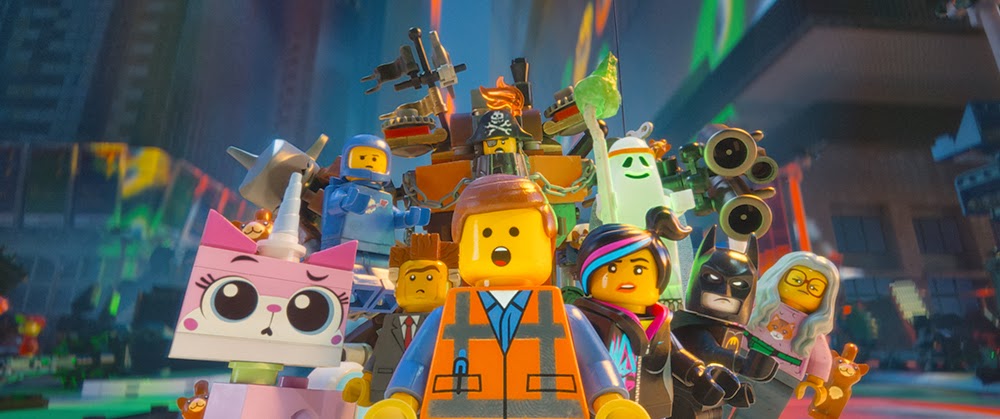 Photo credit: thelegomovie.comMy ENGL 1010 students have to complete an activity in which they read two definitions of "creativity" and discuss which one they like better. One posits that creativity is "being free to express yourself in a way that is unique to you, not having to conform to certain rules and guidelines" (qtd. in Ramage, Bean, and Johnson, The Allyn & Bacon Guide to Writing, Brief 6th Edition, 154). The other gives several contradictory definitions (creativity = making something yourself vs. something that's derivative is not creative) before arriving at a synthesis: "Creativity, therefore, is a process.... The less experienced tend to allow for less originality, while the more experienced demand real originality to classify something a 'creation'" (155). Students usually find the second stronger and more interesting because it provides a more nuanced definition of creativity.
All this went through my mind while watching The LEGO Movie with my family last weekend. Though full of laughs and certainly a good time, it quickly unveiled loftier ambitions than I had expected. For most moviegoers and critics, it succeeded; for me, those ambitions were a risk that didn't pan out. I was expecting the people behind Cloudy with a Chance of Meatballs (2009), which I loved, to suspend my awareness of reality through over-the-top goofiness. Instead, the movie's insistence on facing reality made its over-the-top goofiness something only my kids could truly enjoy...as if that's what it wanted. As if to say, "This kind of fun is not for you."
To illustrate my point I'll have to move into spoiler territory.
In retrospect, Meatballs is also about a son's emotional reunion with his father, which despite being more present in the plot, is somehow less intrusive. In The LEGO Movie, the father and son that show up only in the end are jarring for several reasons, and probably all of them are intentional:
The movie is animated until that point, where Will Ferrell the voice actor becomes Will Ferrell the live actor. It reminded me of the ending to The SpongeBob SquarePants Movie, although that series does at least have a tradition of mixing animation and live action. Either way, it's somewhat of a pet peeve for me.It "goes meta," revealing that the LEGO world and story we've been watching is merely the product of a little boy's imagination as he plays with his dad's extensive LEGO collection. Despite being a familiar and cliched fantasy device ala "it was all a dream," everyone seems to love this plot twist.It suggests that the father's way of creating with LEGO is wrong.I got some digs in on those first two points but it's the third one I want to talk about. Like my students' creativity exercise above, the movie gives us several definitions of creativity: First, we see that the main character Emmet is not creative or special because he's completely average and derives everything he does from the world around him. Next, we learn that Wyldstyle and the Master Builders are creative because they rebel and build crazy things from their own imaginations. Then -- in what I found to be a very redemptive moment -- Emmet turns out to be special by dint of not being special, with his adherence to rules and instructions making him a natural leader. In other words, there are different definitions of creativity, similar to the synthesis above.
Then there's that moment of metafiction, where Will Ferrell's live-action dad character is portrayed as villainous not because he is forcing his version of creativity on others, like Will Ferrell's other character Lord Business was, but because he has a different version of creativity and wants to preserve it. Sure, Emmet tells Lord Business that he's special, too, but that's more like the straw that broke the bad guy's back than a sincere reversal of his role. The label "bad guy" is too stuck at this point for the "special" concession to remove it. The damage is done.
I do have to admit that I had trouble giving my kids my LEGO sets a while back, and it still drives me crazy that they have mixed-and-matched the pieces to the point of no return. So maybe I'm biased. That said, I don't completely sympathize with the dad character or his need to apply Krazy Glue to everything. I get that his obsession with LEGO is meant to be funny and ironic. But isn't it also ironic that the company criticizing him for how he plays with a toy (or that he plays with it at all) is the same company that makes that toy?
This disingenuous overtone is hard to miss. The movie is full of very kitschy parodies of reality, from the catchy song "Everything is Awesome" to the popular sitcom "Where Are My Pants?" Because these are funny on the face of it, it's too bad they're also poking fun at the kind of people doing the laughing. The message that popular music and television rots your brain and ruins creativity is already ironic (as is any popular complaint against popular media), but this becomes an outright oxymoron when presented as a 100-minute commercial for an already very popular product! I think Christopher Orr of The Atlantic said it best: "its message is that we should do as Lego says, not as Lego does."
Orr's review, like most critics', is positive in spite of that quibble. I think mine would have been, too, if not for that funny feeling that the movie was making fun of me. I laughed out loud many times, always turning to see the happy looks on my kids' faces. Lines like "Come with me if you want to not die" (which I'll be quoting forever) represented the kind of creativity I was looking for: quirky and different without trying too hard. Unfortunately, these moments were in the minority, and the "bigger picture," so-to-speak, was much less original than I'd hoped:
Male protagonist who goes from zero to hero.Female supporting character who wants to be the hero but can't be. (I was reminded of Olivia Wilde's character from Tron: Legacy while watching the movie, but someone on a discussion board pointed out that Wyldstyle is even more similar to Astrid from How to Train Your Dragon.)Obligatory romance between the two.Frequent topical references and pop culture icons. (I'd actually hoped LEGO Batman's role would be limited to that seen in the trailers. I'd had my fill of him in the LEGO Batman video games and movie.)Archetypal hero's journey, including the call to action, the wise mentor, death and rebirth.Honestly, most of these probably wouldn't have bothered me if not for that self-important overtone about creativity and who defines it. I'm a huge fan of the hero's journey (see video at right) and enjoy tracking comparisons. I never expected Wyldstyle to be the protagonist, and I laughed when her backstory was drowned out by Emmet's dull-witted infatuation. Unlike the movie, I believe creativity can also mean building on existing designs. But when that movie -- or maybe just its reputation -- celebrates its creativity, it's hard not to perceive that as an invitation to closer scrutiny.
It doesn't bother me that other viewers find their definition of creativity validated by this film. What does bother me is that that definition is the only one the film wants to validate, even when it runs contrary to its own brand. It's mocking bandwagoners -- its primary audience! Maybe all this means is that they're better at laughing at themselves than I am. Touché.
February 2, 2014
Fahrenheit 451
 Fahrenheit 451 by Ray Bradbury
My rating: 5 of 5 stars
I can't believe I waited until I was 31 to read this. Then again, maybe I wouldn't have appreciated it as much as I did. Below were some quotes I saved and annotated:
"Now let’s take up the minorities in our civilization, shall we? Bigger the population, the more minorities. Don’t step on the toes of the dog-lovers, the cat-lovers, doctors, lawyers, merchants, chiefs, Mormons, Baptists, Unitarians, second-generation Chinese, Swedes, Italians, Germans, Texans, Brooklynites, Irishmen, people from Oregon or Mexico. The people in this book, this play, this TV serial are not meant to represent any actual painters, cartographers, mechanics anywhere. The bigger your market, Montag, the less you handle controversy, remember that!" –Beatty, toward the end of “The Hearth and the Salamander”
Judging from the other “minorities” Bradbury put in this list, I doubt the inclusion of Mormons was much more than arbitrary. Still, I find it kind of funny, because, as a white male Mormon, I doubt that throwing my name out there as a minority would win much sympathy. If anything, it’s Mormons that some minorities feel threatened by, and whose perspective no book, play, or TV serial is worried about representing correctly.
"Outside the door, in the rain, a faint scratching.” –from the beginning of “The Sieve and the Sand”
Obviously this line isn’t memorable for its message. It struck me because it’s incomplete. Bradbury is breaking the rules -- rules I teach my students -- but that doesn’t matter because it works. I would have written something like “Outside the door, in the rain, came a faint scratching.” One word difference. Why does his missing verb have more impact? It adds to the tension, the immediacy. My version’s “came” feels rote and redundant and robs the impact of the word “scratching,” maybe just a bit. That’s surprising and maybe even a little frustrating to me, because I have a feeling it has something to do with the difference between literary writing and regular, commercial, boring writing like mine. Hmph.
“It’s not books you need, it’s some of the things that once were in books. The same things could be in the ‘parlor families’ today. The same infinite detail and awareness could be projected through the radios and televisors, but are not. No, no, it’s not books at all you’re looking for! Take it where you can find it, in old phonograph records, old motion pictures, and in old friends; look for it in nature and look for it in yourself. Books were only one type of receptacle where we stored a lot of things we were afraid we might forget. There is nothing magical in them, at all. The magic is only in what books say, how they stitched the patches of the universe together into one garment for us.” –Faber to Montag in “The Sieve and the Sand”
I appreciate that Bradbury voices this concession through more than one character in the book -- Faber here, then Granger in the end. It reminds me of a great essay by Mortimer Adler, “How to Mark a Book,” which reminds us that there are different ways to own a book, and that the most superficial of these is literal. Like Granger and his gang, Adler wants us to own books by remembering their messages, even if it means writing in them -- defacing them, some might say (and they’d be missing the point).
“Do you know why books such as this are so important? Because they have quality. And what does the word quality mean? To me it means texture. This book has pores. It has features. This book can go under the microscope. You’d find life under the glass, streaming past in infinite profusion. The more pores, the more truthfully recorded details of life per square inch you can get on a sheet of paper, the more ‘literary’ you are. That’s my definition, anyway. Telling detail. Fresh detail. The good writers touch life often. The mediocre ones run a quick hand over her. The bad ones rape her and leave her for the flies.
“So now do you see why books are hated and feared? They show the pores in the face of life.” –Faber to Montag in “The Sieve and the Sand” (continuing above discussion)
This little tip on writing is like a buried treasure to me, especially after noting earlier that Bradbury’s writing possesses a free-spirited, literary quality that I envy.
“What traitors books can be! you think they’re backing you up, and they turn on you. Others can use them, too, and there you are, lost in the middle of the moor, in a great welter of nouns and verbs and adjectives.” –Beatty to Montag, toward the end of “The Sieve and the Sand”
Beatty is a powerful villain because he knows. He knows how the heroes think. He knows what’s important to them. Here he sounds a bit like someone who has sworn off religion because it all contradicts itself. I would have to agree with him, only unlike him, I believe there exists a correct interpretation and authority that man can’t manufacture on his own.
View all my reviews
January 28, 2014
Can't Let it Go
I did a good job holding this in until yesterday, when I unloaded it on some hapless students almost without provocation. Now, with even less provocation, I'm subjecting you to it, too. And before you tell me I'm over-analyzing, let me firstly agree, and secondly, point out that analyzing writing is sort of my job.
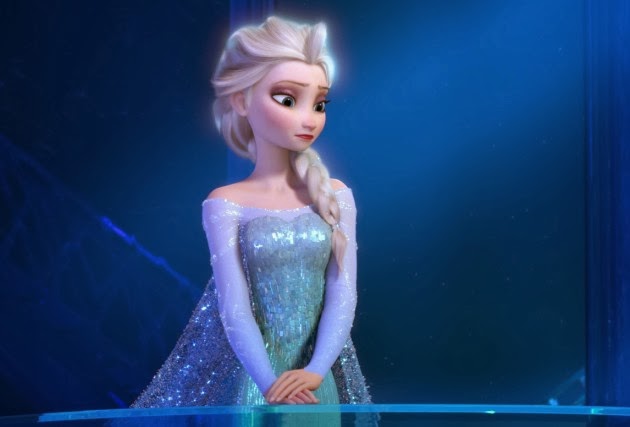
So Elsa. Elsa from that computer-animated musical Disney film called Frozen. Loosely based on Hans Christian Andersen's The Snow Queen. Voiced by Broadway actress Idina Menzel, who also appears in another Disney musical, Enchanted, but for some reason doesn't sing in it. Amy Adams does, and on screen boyfriend Patrick Dempsey does, but not the Broadway singer. She does sing for Elsa, though." Let it Go," now up for an Academy Award, is probably stuck in your head right now. Yes, that Elsa.
She bugs me.
No, I think she's a great character and all. Really, I do. In fact, I wish her role in the film was a bit more pronounced; that, after creating her ice castle, she had more to do than "sashay around 'cause I'm sexy now and then promptly chill out." (Get it?)
I know, creating that ice castle was pretty cool. In fact, Elsa's powers are undeniably awesome. Let's review:
Create unlimited amounts of snow and ice at will.Freeze someone's heart until it's a ticking clock that results in their death. (!)Summon an eternal snow storm.Immune to cold. (Re: the song: "The cold never bothered me anyway!")Imbue a snowman with life, including dreams -- by accident, no less.Build a perfect ice castle in mere seconds.Create ice clothes that don't melt.Style hair. (Maybe more a trick of animation than a true power, but I thought it was pretty cool both times she did it: Anna's hair, then her own.)Imbue yet another snowman with life -- this one abominable and completely obedient. (Basically, she can create an army of subservient snow monsters if she wants.)Turn off the aforementioned snow storm even though she had no idea how because...love?By extension of 10, basically full control over powers now.Create a tiny personalized eternal snow storm for the aforementioned snow man so he won't melt.Did I forget anything? I've only seen the movie once but I think that covers it. So what do we find? That Elsa is among the most powerful fantasy characters ever written, which is great if not for one little oversight, the very reason why she bugs me:
There's no explanation.
I don't need much. After all, the explanation for Rapunzel's powers in the opening monologue of Tangled isn't exactly realistic. (A drop of sun? Is the sun so hot, even it sweats?) Fantasy, by its very nature, doesn't have to be realistic. But a common misconception is that fantasy doesn't have to be believable. There's a big difference.
By believable I don't mean "That could so happen in real life!" All we need is "That is reasonable within the context of the world-building we've encountered." We accept the power of the One Ring because magic exists in Middle-earth (or whatever the Tolkien equivalent of magic is; sorry purists). We accept that Belle's love can transform the Beast because those were the parameters of the spell that was already explained to us. We accept that Magneto can control metal because the existence of mutant powers if a staple of his X-Men universe. You get the idea.
Frozen lacks that kind of context. To its credit, the writers make an attempt; they probably include the trolls for this reason. The trolls are, if nothing else (and they really are nothing else), evidence that mythological fantasy type stuff exists in this world. Also, Rapunzel and Eugene have an Easter Egg cameo, if that helps.

Still, doesn't it seem like Elsa should wonder where she got her powers? Her parents tell the trolls that she was born with them, like Rapunzel. So what was her magical flower? And throughout her sister's show of unexplained power, shouldn't Anna wonder why she is completely powerless? I get that she reverses that misconception by movie's end. She saves herself from Elsa's power even when Elsa can't. And I really like that twist. (Much more so than Hans's sudden, inconsistent-for-the-sake-of-shock-value switch in character.) But would that ending have less power if we understood the origins of Elsa's? In effect I'm asking, would Elsa's power have less power?
I say no, because part of that power is to transport and enchant the audience, and for me personally, that was less effective once I realized the power was more of a MacGuffin. Much of the tension I experienced was in waiting for an explanation that never came.
I haven't talked to anyone who felt similarly, so it's probably safe to say that I missed the point. I became distracted by an element of the film that was not meant to distract me. And I'm willing to take the blame for that instead of accusing the writers, because after all, the movie's combined music and message are quite the achievement.
But it still bugs me. Guess I should let it go.
January 8, 2014
PitMad
Today is #PitMad, a pitch party on Twitter that allows agents/publishers to peruse 140-character book pitches by authors and request material if they're interested (as opposed to the usual process of sifting through query letters/emails). I usually hear about these after the fact, but this time I got lucky and found out last night.
I started pitching a finished fantasy novel to agents this past summer, then slowed down quite a bit over fall semester (when I'm usually busy grading other people's writing). Even with spring semester picking up this week, I'm trying to increase my querying efforts. So #PitMad it is! See my short pitches in the Twitter feed. The project I'm pitching is described in a bit more detail after the jump:
"Winteraster" are fallen stars -- classic characters like Zeus and Hera, Cupid and Psyche, and St. George and the Dragon -- who are tired of being imaginary and build their own world by which to become Real. In this Interim they acquire new names and memories: Patraster and Bo, who possess others' bodies and create Monsters; Arrow and Psuka, whose daughters want to be heroes; and the Earth Worker and Arcain, who battled anciently and are due for a rematch.
CHILDREN OF GOLD follows honey-haired Decima, Patraster's daughter and a Helen of Troy, as she grows from a kidnapped princess to a dangerous queen. Though reliant on a mysterious white rod and haunted by Patraster and Bo, she finds that power suits her…until the next sacrifice to obtain it is her own brother. But it may be too late to convince his would-be avengers that she is not the true enemy.
CHILDREN OF GOLD is a fantasy novel complete at 99,000 words, the first of a planned series called WINTERASTER."Planned series" is a bit of an understatement -- I wrote the second installment first (and was awarded my MFA for it). Realizing it was more the middle of the story than the beginning, I started over with the story mentioned above. Some of it was written as part of my MFA program at Goddard College (authors Rachel Pollack, Susan Kim, and Jeanne Mackin were my reader-mentors) and an excerpt received an honorable mention in the Writers of the Future Contest a while back. Wish me luck!
PS: The tag #FakePitMad is trending now, too, and is a lot of fun to read.
January 3, 2014
"Desolation of Smaug" Review

I have finally seen The Hobbit: The Desolation of Smaug. What's more, I got to see it with my son James, who was, I must admit, slightly more entertaining in his enthusiasm than the film itself. But before I regale you with my unsolicited review, I should of course start by rewinding to last year and my thoughts after seeing the first installment:
I know you've been on the edge of your seats waiting for my Hobbit review (right?), so I'm going to do you one better and give you a summary of the thoughts that went through my head while watching it! Merry Christmas! (And no, this gift is not returnable.)
1. This Ian Holm-as-Bilbo frame narrative is slow and annoying -- an unnecessary reminder that this story takes place before the events of LotR. I was looking forward to NOT seeing Elijah Wood again.
2. I like the back-story on Erebor and Smaug. Works like the prologue of Fellowship did.
3. Why do dwarves have Scottish accents in almost every fantasy continuity?
4. Every year around the holidays I start pining after the D&D days of yore -- long hours of questing and snacking and getting lost in a fantasy realm. I've been trying to satisfy it by playing games like Heroica, Heroscape, and HeroQuest with my boys (yes, those are the games' actual names). But this movie really hits the spot!
5. It's a good thing I like this "Misty Mountain" musical theme because it's going to be stuck in my head for awhile.
6. Why do gross villains always have Cockney accents?
7. Tolkien makes a pretty generous DM. Who knew such valuable loot was so easy to find lying around?
8. Am I crazy or is Thorin Oakenshield a more interesting character than Aragorn was? A worthy stand-in for the reluctant leader role, but flawed, and completely lacking any heavy-handed emotional ties to Liv Tyler!
9. I don't remember that from the book. It must be part of the appendices' material they're grafting in to lengthen the story into a trilogy. (This thought reoccurred about ten times.)
10. Uh oh. This is starting to remind me of a certain other Peter Jackson movie where the main characters pass through improbable chaos unscathed. If one of the Dwarves shoots Goblins off another Dwarf's body with a machine gun without harming said Dwarf, I'm outta here.
11. It's nice that the deus ex machina (Gandalf) has his own deus ex machina (the eagles).
12. It's over and that song is definitely stuck in my head. I think I actually enjoyed the movie more than LotR, maybe because I read The Hobbit at a younger age and was therefore transported into a younger mindset. Or something. Anyway, now I'm pining for the sequel AND D&D! Sigh...Next I should point out that, in my eagerness to dive back into Middle-earth, I re-watched both the first Hobbit movie and the entire Lord of the Rings trilogy -- extended editions, no less! The latter is what my family did on New Year's Eve, and we managed to finish the whole thing by midnight. But immersing myself so thoroughly had two consequences (aside from the usual that accompany such blatant idleness):
First, I realized that the movies incorporate a whole bunch of Tolkien mythology without ever really explaining it, and so I wasted several more hours looking stuff up on wikis. (Is Sauron's disembodied-ness like Voldemort from Harry Potter? What's up with Galadriel's "I'm too angelic for this world yet still exist here for some reason" attitude? What exactly is this "West" that they're sailing to? Heaven?)
Second, I mistakenly ODed on Middle-earth-stories-as-interpreted-by-Peter Jackson, which is a none-too-desirable prelude to seeing another in the theater.
All that said, we finally come to the summary of my thoughts while watching The Desolation of Smaug. As a bonus, I'll include my son James's actual comments spoken out loud during the movie. Spoilers follow.
ME: James is going to be confused because they're starting with a flashback and he's already iffy on the chronology between the two trilogies.
JAMES: "Who's that? What's going on? Where's Frodo?"
ME: Beorn looks funny as a bear. Oh wait, he looks even weirder as a man.
JAMES: "Wow, who's that!"
ME: We're already into this a fair ways and I still haven't noticed that "Misty Mountain" theme. How disappointing.
JAMES: "Ooh, mountains!"
ME: They're not directly acknowledging that Bolg is Azog's son, but then why would they make them look alike? Speaking of which, I love the look of both albino Orcs in these movies. They seem more real than the muddy-faced LotR Orcs. Interesting how motion-capture "captures" more of the actor's performance than real world make-up can. Plus, Manu Bennett! He's fun as Slade in TV's Arrow. Crap, James will need help with their subtitles.
JAMES: "What did they just say?"
ME: Lindon [my eldest] would hate these spiders.
JAMES: "Lindon would hate these spiders!"
ME: All right, I really wanted to be okay with Tauriel and this whole love triangle thing I've been hearing about...but really? She falls for him that fast? It takes Legolas three movies to overcome the Elf/Dwarf rivalry and call Gimli his "friend," and Tauriel manages to shrug off her Elf-ness -- hatred for Dwarves, loyalty to her king -- in a matter of minutes? I guess they do provide some precedent for it in that Tauriel clearly doesn't sit comfortably inside the king's good graces...plus there was that extended scene in the first movie showing Kili's interest in Elves...but still. If it added something fun/interesting I'd be all for it, but it's really rather distracting. And is it just me, or do these Hobbit movies allow more anachronistic dialogue than LotR did? I mean, the pants joke? Come on.
JAMES: "Did you see what she did to that Orc? Ah-ah-awesome!"
ME: James is right. The action is pretty spectacular. But you have to wonder how a bunch of incompetent Dwarves that constantly need help from a Hobbit can suddenly pull out all kinds of mad tricks in the midst of a car chase river barrel escape. I guess that's Peter Jackson for you. He should design amusement park rides.
JAMES: (Incomprehensible squeals of excitement.)
ME: Orlando Bloom is looking a bit chubby in the face. And holy cow, did he just get hurt by Bolg? Legolas never gets hurt! Am I actually starting to root for the albino Orcs?
JAMES: "Why is Legolas bleeding? Did he bite his lip?"
ME: I've heard a lot of hype about how great Smaug looks, and yeah, he's a worthy homage to Vermithrax Pejorative. But Benedict Cumberbatch is so cool he makes me sick.
JAMES: "Now that's a big dragon!"
ME: In terms of expectations, I haven't remembered or adhered much to the book. However, I do remember thinking that Bilbo outsmarted Smaug more impressively than this. And I assume the Dwarves' involvement is new. Lucky all that mechanical engineering held up after all these years. But wait...it's over? Well overall it was fun, but I have to admit I didn't enjoy it as much as the first one. I guess filling my D&D fix with Descent this past year, plus ODing on Tolkien lately, has made me less agreeable. But I'm still looking forward to the third installment with its dual coverage of both the Battle of Five Armies and the Battle of Dol Guldur.
JAMES: "Best. Movie. EVER!"
June 12, 2013
Superman vs. Batman

The DC fighting game “Injustice: Gods Among Us” premiered April 16th after a three-month-long online promotional tournament that ended in a fight between Batman and Superman. The fan-chosen champion? Batman.
This isn’t the first time, either. Batman has defeated Superman on multiple occasions in past comics and cartoons, most notably in Frank Miller’s graphic novel “The Dark Knight Returns” and its 2013 animated movie adaptation.
What does this mean for this week’s “Man of Steel,” which is following in the footsteps of Christopher Nolan’s Dark Knight Trilogy and is already down to 65% on Rotten Tomatoes as of this post? Would more people prefer Nolan to direct another Batman movie than produce a Superman reboot?
Last summer, in anticipation of the theatrical release of “The Dark Knight Rises,” I explained on KSL why the wave of marketing and leaked plot details didn’t deflate my enthusiasm. Everything from an unoriginal title to early issues with Bane’s voice raised serious concerns among fans, but I stubbornly expected a Batman experience as satisfying as the first two installments – maybe more so. The article was optimistically titled “I Believe in ‘The Dark Knight Rises.’”
I wish I still felt that way.
Yes, most of my hopes and predictions came true: Cillian Murphy had a cameo (as Jonathan Crane, not his alter ego the Scarecrow); Marion Cotillard really was Talia al Ghul; Nolan made a nod to Robin after all. But this predictability was the problem.
The truth is, when asked to share my opinion on the film, my answer is never the same. If, at that moment, I’m remembering how Bruce Wayne escapes from Bane’s prison by letting go of his securities (almost literally cutting the cord), my reply is more positive. I like that visual metaphor and the rousing music that accompanies it.
Conversely, I’m not always willing to fill in the dozen or so plot holes with comic book canon or a game of thematic connect-the-dots. John Blake knew Bruce was Batman because he’s an amalgam of all the Robins. Batman had to waste time rigging that giant flaming Bat-Signal because he’s all about theatricality and inspiring people. We were tricked into thinking he died because he similarly faked his death at the end of the Frank Miller book I mentioned earlier.
In fact, it’s the clumsy homage to said graphic novel that discourages me the most; it just doesn’t translate that well to this retold continuity (nor does “No Man’s Land,” for that matter).
Thankfully, one of the few things that don’t carry over from “The Dark Knight Returns” is Superman…though he might have provided a better explanation for how Batman survives the nuclear blast. Instead he’ll debut separately.
Though there were a lot of rumors that Warner Bros was trying to tie the two DC franchises together, building up to a “Justice League” movie Marvel style, that has more or less been denied by Christopher Nolan. Though producing “Man of Steel,” he has stated that he will not be involved with “Justice League.”
Regardless, and in spite of what the critics are currently saying, I’m betting that “Man of Steel” will disappoint less than “Rises” did, if only because expectations are lower. What’s more puzzling is why that is. In other words, why don’t we like Superman as much as we like Batman?
Granted, I’m just assuming Batman’s fanbase is larger. True, Superman is the classic American hero, seen earlier in movies and in several successful live-action TV series. But his last film, “Superman Returns” (2006), was much less popular than Nolan’s Batman trilogy – hence the reboot.
But it's worth noting that "Superman Returns" has a 76% on Rotten Tomatoes. One fan was Quentin Tarantino, whose own “Kill Bill” movie series includes a monologue in honor of Superman. However, if anything, it might actually do more to explain why that character doesn’t sit well with some people:
Superman didn’t become Superman; Superman was born Superman. When Superman wakes up in the morning, he’s Superman. His alter ego is Clark Kent. … What Kent wears, the glasses, the business suit, that’s the costume. That’s the costume Superman wears to blend in with us. Clark Kent is how Superman views us. And what are the characteristics of Clark Kent? He’s weak. He’s unsure of himself. He’s a coward. Clark Kent is Superman’s critique on the whole human race.
Common reasons for disliking Superman is that he’s too super; for being stronger than a locomotive and faster than a speeding bullet, he’s hard to identify with. He’s also too bright and colorful and nice – unlike Batman, whose dark, brooding, vigilante attitude is “cool” nowadays.
Or as comic writer Jeff Parker said in a 2012 interview with Comicbooked.com, “[Batman] works in so many genres at once – he is a pulp hero at the same time as being a super-hero, but he works in detective, spy, horror, fantasy – several types of stories all while not changing as a character.” Unlike Superman, who pretty much requires big sci-fi plot conventions if there’s any chance of conflict.
But maybe there’s such as thing as too much conflict. In a recent New York Times article about BYU’s computer-animation program and its emphasis on family-friendly fare, one student describes Batman film “The Dark Knight” as “just so dark,” saying it leaves viewers feeling worse about themselves and humanity. (She must not have stuck around for the ending.)
But what about Superman? Can kids of all ages love and admire this guy? Todd VanDerWerff, writing for the A. V. Club, actually thinks it’s impossible not to:
Superman resonates because he’s a mirror, in some ways. We can all project onto him the things we best like about ourselves and about humanity. He’s the guy we want to see in ourselves, the thing we secretly hope we are, even when we know we’re nowhere near that, or even capable of it.
He goes on to review the Jewish heritage of Superman’s creators, Jerry Siegel and Joe Shuster, who “came up with an alien superhero because they felt like aliens in their own land….” Similarly, Superman is often described as a Messianic figure, living in but not of the world, a savior for those unable or unwilling to save themselves.
What's more, a peer-reviewed journal published a study concluding “that embodying the ability to fly in [virtual reality] primes concepts and stereotypes related to superheroes in general or to Superman in particular, and thus facilitates subsequent helping behavior in the real world.” In other words, if you get to be Superman in a video game, you’re going to want to be more heroic in the real world.
Yet it’s Batman that fans voted to win in that “Injustice” duel. It’s Batman that gets a separate series of popular video games, namely the “Arkham” franchise (continuing this October with the release of “Arkham Origins”). It’s Batman we want to be, proven by the popularity of his gravely intonation, “I’m Batman!”
Maybe “Injustice” is aptly named. It’s not fair that Superman – an American icon, a savior immune to world issues like cancer and mass shootings, an all-around good guy – should lose out to an angry ninja dressed like a bat and obsessed with revenge. But the dark night is over for now, and come this weekend, I won't mind if Superman’s day in the sun convinces me that brighter is better...however unlikely that is.
Mormon Faith, Fantastic Transformation, and Free Will
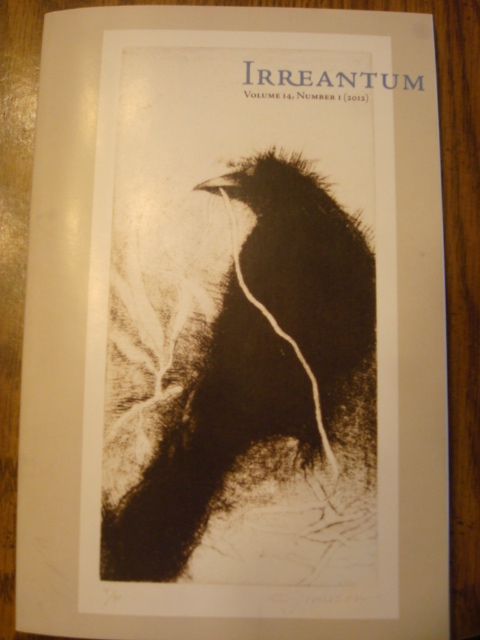
I received my copy of Irreantum volume 14, issue 1 about a month ago and have been waiting for it to be available from the Association for Mormon Letters, but it looks like the Irreantum site is undergoing maintenance. The issue includes my essay "Mormon Faith, Fantastic Transformation, and Free Will," which is an updated version of a college essay I wrote five years ago. But since it doesn't look as if non-subscribers can obtain a copy, an excerpt appears below:
I intend to argue that a Mormon reading of fantasy literature in particular reinforces Biblical archetypes of personal transformation and accountability. To do so, I will first define fantasy as “supernatural transformation”; second, show how different types of transformation are demonstrated through the Old Testament; and third, fully define a paradigm through a reading of the New Testament.
April 5, 2013
The Conference I Remember Best

...Or at least one I remember well. This was the theme of a series of Deseret News articles running this week in anticipation of the 183rd Annual General Conference of The Church of Jesus Christ of Latter-day Saints (broadcasting worldwide this Saturday and Sunday). My short contribution came out today.
See, I write about more than just superheroes. Then again, to Latter-day Saints, that's pretty much exactly what prophets and apostles are!
March 11, 2013
My Love Letter to WILLOW

My Nerdy With Children contributions are easy enough to find over there in my Twitter feed, but I need to make a special post about today's, which is a love letter to my all-time favorite movie Willow. It's finally getting its Blu-ray release tomorrow!
Andrew Bud Adams's Blog

- Andrew Bud Adams's profile
- 4 followers
Andrew Bud Adams isn't a Goodreads Author
(yet),
but they
do have a blog,
so here are some recent posts imported from
their feed.

