Bronwyn Mauldin's Blog, page 5
April 25, 2014
Glendale's Brand Library: New, improved and worth the wait
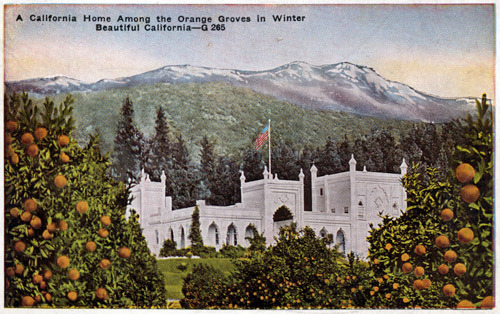 Brand Library still looks like this, minus the orange trees. The renovations have made quite a difference. Drop ceilings have been removed. Original murals have been recreated. Window frames have been restored. Where the space was once dim and a bit dingy with fluorescent lighting, it's now bright and airy. The front rooms are filled with comfortable chairs and tables that I'm going to check out next time I need a quiet place to write. The floors are covered by what look like early 20th century-style rugs. Be sure to take a look at the small, framed recreation of what the original walls looked like in the front room. Library materials and the check-out desk have been moved to the back of the building, where they connect with the art galleries.
 The only sad note was that the front doors to Miradero are no longer the main entrance to the building. It's worth walking around to the front for a look at those doors, the historical marker, and the palm-lined view down to Grandview Avenue. (That's where I took my newest author photo.)
Today, you enter through these modern glass doors on the side:
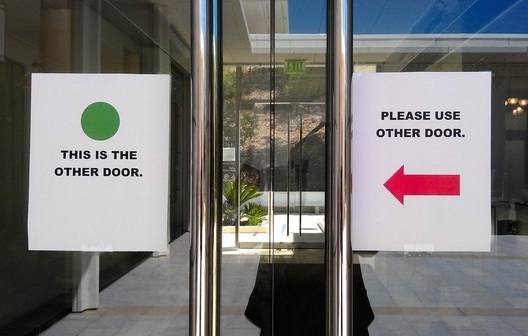 Lest there be any confusion. If you think the Jewel City is only about the Boulevard of Cars, the Americana or great Middle Eastern food (and it is all those things too), visit the Brand Library too. Just be sure to save one of those comfy chairs for me.


April 24, 2014
How does that stack of books-to-read keep getting taller?
The Watchers by Tahar Djaout (bought at the Friends of the Santa Monica Library bookstore)
The Powerbook by Jeanette Winterson (ditto)
Plucked from a Far-Off Land by Taner Baybars (bought at the amazing Moufflon Bookshop in Cyprus)
Camelot and Vine by Petrea Burchard (I shot a GuerrillaReads video of the author and she gave me a copy. Score!)
The Gray File by Aris Fioretos (thank you, Pop Hop Books & Print)
Nigerians in Space by Deji Bryce Olukotun (thank you, Skylight Bookstore and LA Times Festival of Books)
Cutting for Stone by Abraham Verghese (gift from a friend)
Other Electricities by Ander Monson (gift from another friend who knows about my deep and abiding interest in electricity)
Not so long ago, it dawned on me that I won't live long enough to read all the books I want to, perhaps not even all the books sitting right here in my house. That was a sobering brush with mortality. With all the busy-ness going on in life, sometimes I forget to set aside time for reading. Then I find myself in a bookstore making some amazing discovery, and I walk out the door with another gem (or two) in my hands. I reckon that's how they pile up. At least they're not lonely while they sit there, waiting for me to find time for them.
I'll keep buying books, that's for sure. And listening to them, downloading them and checking them out from the library. They'll keep piling up, and I'll be happy to see them every day.
What books are waiting for you?
April 22, 2014
Ukraine and the Persistent Problem of the Nation State
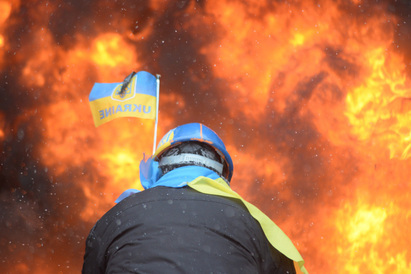 Photo by Mstyslav Chernov of Unframe, via Wikimedia Commons If you're having trouble tracking sides and positions in the current Ukraine crisis, you're not alone. It's a complicated place that doesn't usually get a lot of media coverage in the West. A trio of political scientists recently surveyed Americans and found only about 16 percent could place it on a map with any accuracy. They also found that the more wrong Americans are about where Ukraine actually is, the more they want the US to intervene militarily.
 The whole region of Central and Eastern Europe has a complicated history. Empires have risen and fallen over many hundreds of years. Wars have been fought and borders have moved back and forth across the map.
Then there's also the pesky little problem of the nation state, which boils down to this: a state is a political entity, while a nation is a self-identified group of people. During the Treaty of Versailles negotiations in 1919 at the end of World War I, the idealistic US President Woodrow Wilson proposed the idea that every nation in existence should get its own state, unless the winners of the war decreed they weren't smart enough to manage themselves. It was more complicated than that, of course, and was glossed over in more polite terms, but in its essence, that was the basis of many terms of the treaty.
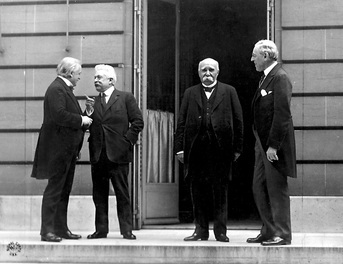 Big Four negotiators at the Paris Peace Conference, 1919 It didn't work out for everyone. For example, Ho Chi Minh led a group that went to Versailles to petition for an end to French colonial rule in their nation and establishment of the independent country of Vietnam. The Western powers ignored him, and we see how well that went for both the French and the Americans.
 The Paris Peace Talks that led to the Treaty of Versailles met 145 times, during which the winners of the war debated where lines would be drawn that separated, for example, the state called Romania from one called Hungary, Austria from Czechoslovakia, and so on. They divided up Africa amongst themselves, and decided the Kurds didn't need their own homeland. Trouble was, the lines they drew didn't line up nicely with where "nations" lived, because people have a habit of moving around and mixing amongst themselves. As a result of how lines were drawn, many thousands of people had to pack up and leave the homes where they'd lived for generations because the "state" allotted to their "nation" was on the other side of a border from where they lived. Margaret Macmillan's terrific book, Paris 1919 , describes the positions and negotiations in a way that clarifies many of today's political troubles.
While the idea of providing a homeland (or state) for every self-identified group of people (or nation) might sound fair or reasonable, nationalism itself tends to be thuggish. Its most extreme manifestations have been genocidal, as in Rwanda in 1994 or Germany from 1933-1945. State borders created by the Versailles treaty were meant to diminish conflict between nations. Some argue they did exactly the opposite.
In the wake of World War II and the Holocaust, the Marxist argument for ending the nation state entirely found fertile ground in some circles. At least in theory, the Soviets sought to build a single international union that would ultimately become one big happy family where differences of nation, language and culture fell away and all would be treated equally. As part of that plan they sent large numbers of Russians to settle in places from Ukraine to Lithuania to Turkmenistan. They also rounded up hundreds of thousands of nationals of those countries and shipped them off to Siberian work camps, where more than a million people died.
This isn't the only explanation for what's happening in Ukraine right now, but it's one point that should be better understood. Many Ukrainians - as well as nationals of other former republics - have bitter memories of when their parents or grandparents were sent to the camps. At the same time, Russians whose parents and grandparents were moved to one of the far-flung Soviet republics, were born and have lived their whole lives there. Other Russian-speakers in Eastern Ukraine have even deeper roots there.
As the Treaty of Versailles taught us, drawing lines between states in a way that will please nations is a difficult task at best, fraught with risks that may not be fully understood until it is far too late.
April 17, 2014
Why I love editing (and you can too!)
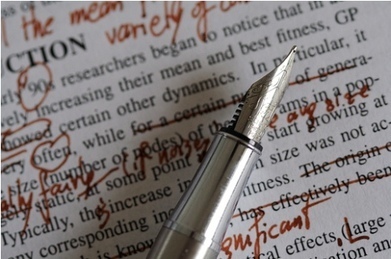 I heart red ink. I probably love editing more than I love the struggle of putting one word down after another on a blank page. Sharpening up a workaday sentence that communicated the basics into one that glitters just enough to make you smile without distracting you from the story: that's what I love to do.
 When I'm writing, I'm focused more on plot and character. When editing, I have Chekov's gun and Orwell's directive to never use a long word when a short word will do. I'm looking for every word that ends in -ly and asking it to politely (oops, there's another one) take its leave.
There must be a million and a half blog posts out there like this one, authors extolling the sublime pleasures of killing their darlings, hacking away at the words until the text is lean and ripped as an Olympic swimmer.
I'm currently in round three of line edits on Love Songs of the Revolution. It's amazing how you can find errors to fix or improvements begging to be made on every pass through a manuscript. Every single one!
A friend recently asked me how could I edit my own work. The honest answer is a rather dull one: practice. It also comes from knowing that the editing and even the deleting is the writing just as much as the original task was of putting those first words on virtual paper. The rather more metaphysical answer I'd like to give you is that I'm forever chasing an idealistic vision in my mind of the book I'm trying to write. Perhaps one day I'll get there.
April 15, 2014
Your Soviet guide to Vilnius, circa 1981
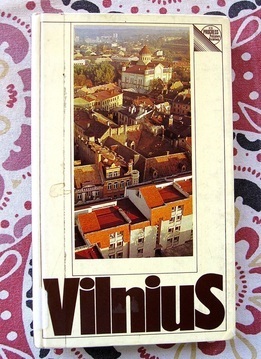 Vilnius, circa 1981 The book was written in Russian by Lithuanian author Antanas Papšys and translated into English by J.C. Butler. It was published by Progress Publishers in Moscow. Here's an excerpt from the introduction:
 "Vilnius is a city whose rich past is marked by the most important historical events in the life of the Lithuanian people. It is rightly famed for its revolutionary and international traditions; its name is dear not only to Lithuanians but also to peoples of other nationalities living in Lithuania since time immemorial."
Some of what's in the guidebook is standard travel material: recommended walking tours, information about the opera and ballet, and what to see if you have only one, two or three days in town.
Then there is the uniquely Soviet material, like the full-color photo of a Shop in the Drill Factory. There's a two-page spread devoted to Lenin Square, with both a bird's-eye shot of the park and a closeup of the central statue of the man called Leninas in Lithuanian.
During the Soviet era, I learned, the Church of St. John, housed a Museum of Scientific Thought. In 1981, a bus ride from the airport to Vilnius city center would set you back 20 kopecks. If you preferred a taxi, you could order it on the plane from a stewardess.
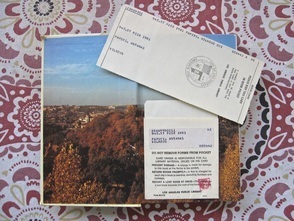 The other great find in this book is this old library card and sleeve inside the front cover. I wonder if anyone else has checked it out since the last time I did.
 The final page of the book is devoted to this rather charming request to readers:
"Progress Publishers would be glad to have your opinion of this book, its translation and design and any suggestions you may have for future publications. Please send all your comments to 17 Zubovsky Boulevard, Moscow, USSR."
I was sad when Google maps couldn't find that address, though I did stumble upon this little gem of a website instead.
Here are a few more images from this wonderful time capsule of a book:
April 11, 2014
How the LA Times BooK Fest is LA
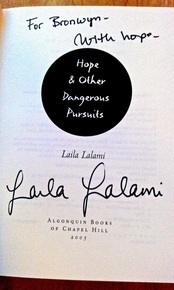 This weekend marks the 18th annual LA Times Festival of Books, an event that draws some 150,000 introverted book people out in the open to politely share their affection for the written word. It's one of the top book festivals in the US.
 I love the book fest and attend almost every year, even when it frustrates me. As I was going over the schedule the other day to plan my weekend, it dawned on me that in many ways, the LATFOB is a microcosm of the things I love and hate about LA. By which I mean…
It's April in LA, so the weather will be sunny and beautiful. Guaranteed. It's LA, so I'll spend almost as much time planning how to get there and where I'll park as I'll spend at the festival itself.
Keep the cross-town rivalry alive! The LATFOB moved the festival from UCLA to USC in 2011, and there are book people who still argue about which venue is better. Why does Hollywood seem to overshadow everything arts-related in this town? Drives me nuts to sit in a half-empty room listening to a panel of amazing, creative, intelligent authors, only to step outside and see hundreds of people lined up to get autographs from Valerie Bertinelli or Carol Burnett for their ghost-written tomes. Sequelmania! I've seen a lot of this year's panelists at the book fest in previous years. They're brought back year after year, even when they don't have a new book out. A few lucky authors are appearing on more than one panel this year. Some of the panels themselves look like retreads. They may be crowd pleasers, but I wish festival organizers would make more effort to bring in new authors and new ideas. Latinos make up nearly 50 percent of the LA County population, but the book fest still treats them like a niche audience. The book fest isn't alone in this, which is unfortunate. The LATFOB is a reminder that LA is, in fact, an incredibly literary city. The LA Times Festival of Books has introduced me to some amazing authors, like Laila Lalami and Dinaw Mengestu, so of course you'll see me there. Wishing for a little more risk-taking and a little less Hollywood, enjoying the beautiful weather.
April 8, 2014
Ukraine and the End of History
 Photo by Mstyslav Chernov of unframe.com In 1989, neocon political scientist Frances Fukuyama published an essay arguing that the impending breakup of the Soviet Union marked “the end of history.” It was highly controversial in its day and generated plenty of ink. We still used ink to print newspapers and magazines back then.
 The phrase “end of history” sounds ridiculous on its face, and Fukuyama didn’t mean it literally. Of course time would march onward and stuff would continue to happen. What he was arguing instead was that all the great “isms” had been tried and proven to be failures. He believed what was left – what every country in the world was on its way toward – was Western-style liberal democracy.
From there on out, he argued, the major battles in society would no longer be over Great Ideas like communism versus capitalism, but over small mechanistic things, like increasing worker productivity and figuring out how to access Game of Thrones without having to pay for fifty other channels of crap.
Recent events in Ukraine might suggest that the demise of history has been overstated. Residents of Crimea and eastern Ukraine, we’re told, want to reunite with Russia, while those in the west of the country want to join the European Union. The current crisis was set off when then-president of Ukraine refused to sign a free trade treaty with the EU during a November summit in Vilnius.
Does Ukraine signal a return to grand ideological struggles? Kleptocracy versus technocracy? Or are we simply feeling the aftershocks of the end of Cold War? Which may themselves be aftershocks of the end of the Ottoman and Austro-Hungarian empires.
Or are we looking at a fight over who will control the oil and natural gas resources needed to fuel the globe’s insatiable appetite for power of an electrical kind?
Many countries calling themselves democracies certainly aren’t. There are others that have refused to become Western-style liberal democracies and are doing fairly well for themselves, like Iran and China. Arguments against Fukuyama’s thesis on the end of history have come from both the left and the right.
It’s been nearly 25 years since his essay appeared. Eliane Glaser - not a fan of his work - has a thoughtful piece at The Guardian about it. She looks back on the past quarter century and explores some the things Fukuyama may have unfortunately gotten right. It’s definitely worth a read.
April 3, 2014
Where's Vilnius?
That’s how it begins, the first line in my novel, Love Songs of the Revolution . Martynas, your not-so-humble narrator, is in love with his city, even after he is so many years gone from it.
Vilnius is the capital of Lithuania, the southernmost of the three Baltic nations (the other two are Latvia and Estonia). It’s 115 miles northwest of Minsk in Belarus, 283 miles northeast of Warsaw in Poland. For those of you watching the news these days, it’s 450 miles northwest of Kiev in Ukraine.
Grand Duke Gediminas established the city of Vilnius in the 1300s. While out on a hunting trip, Gediminas dreamt of an iron wolf howling on a hilltop, which a priest interpreted as a call for him to establish a city on the hill. Today, the downtown historic center of Vilnius is officially designated as a UNESCO World Heritage site, for its beautiful mix of Gothic, Renaissance, Baroque and classical buildings.
 Vilnius panorama by Lestat (Jan Mehlich), via Wikimedia Commons Lithuania was the last pagan country in Europe to convert to Christianity. It’s said that Napoleon called Vilnius the “Jerusalem of the North,” as it was a flourishing center of Jewish culture in Eastern Europe for many years.
 It's is one of those cities like Reykjavik or Kinshasa that you’ve never thought of visiting, though you probably should. TripAdvisor says there are at least 165 different things you can see and do, from the "miracle stone" in Cathedral Square to the statue of Frank Zappa in the Užupis district. (Yes, that Frank Zappa.)
March 13, 2014
GuerrillaReads No. 86: Rhonda Langley
Fresno’s own locally-grown writer Rhonda Langley knows quite a lot about about music, gardening and writing. More than that, she loves to share the things that matter to her. She’s written a number of books, both fiction and nonfiction.
In this guerrilla reading, Langley reads from her novel, Good Friday, and captures the sights and sounds of Fresno, California. Especially the sounds. Listen for the lovely songs of the birds that accompany her reading.
You can read more about Langley on her website.
Tagged: author, Fresno, guerrilla, literature, Mennonite, reading, Rhonda Langley, writing

February 20, 2014
GuerrillaReads No. 85: George Cattan
George Cattan is a life-long political junkie. He was born in Palestine, lived for many years in Syria, and has been writing about political struggles his whole life. He writes in Arabic, and we are fortunate to have this video of him reading in English translation from his memoir.
“Politics,” Cattan tells us, “is like an addiction.” In this reading, he explains how his thinking about politics has evolved over more than seventy years of life experience.
Cattan read for GuerrillaReads as part of a program run by Orange County-based Tiyya Foundation, which provides basic necessities for refugees and displaced American families.
Tagged: author, guerrilla, literature, memoir, Palestine, reading, Syria, writing