Rachel Maddow's Blog, page 3368
July 19, 2013
'Trayvon Martin could've been me'
Last weekend, not long after the jury delivered its verdict in the George Zimmerman trial, President Obama issued a written statement, urging all Americans to "respect the call for calm reflection from two parents who lost their young son." Today, however, the president made an unexpected appearance at the White House press briefing room to speak to the issue in more detail.
For those who can't watch the video posted above, this was a rather remarkable moment for the nation's first African-American president, who reflected on the story and race in America with an eloquence that has sometimes been lacking of late.
President Barack Obama emerged Friday to give voice to African Americans' reaction to last weekend's verdict in the George Zimmerman case, saying that Trayvon Martin "could have been me 35 years ago."
He also suggested that the outcome of the case could have been different if Martin were white. "If a white male teen would have been involved in this scenario," he said, "both the outcome and the aftermath might have been different."
Obama went on to reflect on his own experiences as a black man, drawing scrutiny in department stores, hearing car-door clicks as he walked down sidewalks, and seeing women clutch their purses nervously with him in an elevator. "The African-American community is looking at this through a set of experiences and history that doesn't go away," he said.
Obama also broached the subject of "racial disparities in the application of our criminal laws" -- including the death penalty and drug laws -- which generally is left out of our public conversation.
But perhaps most provocatively, the president reflected on an imaginary scenario. "If Trayvon Martin was of age and was armed, could he have stood his ground on that sidewalk?" Obama asked. "If the answer to that question is at least ambiguous, then it seems to me that we should examine those laws."
It was a rather remarkable display. A transcript of the remarks is below.
The president said the following:
I wanted to come out here, first of all, to tell you that Jay is prepared for all your questions and is very much looking forward to the session. The second thing is I want to let you know that over the next couple of weeks, there's going to obviously be a whole range of issues -- immigration, economics, et cetera -- we'll try to arrange a fuller press conference to address your questions.
The reason I actually wanted to come out today is not to take questions, but to speak to an issue that obviously has gotten a lot of attention over the course of the last week -- the issue of the Trayvon Martin ruling. I gave a preliminary statement right after the ruling on Sunday. But watching the debate over the course of the last week, I thought it might be useful for me to expand on my thoughts a little bit.
First of all, I want to make sure that, once again, I send my thoughts and prayers, as well as Michelle's, to the family of Trayvon Martin, and to remark on the incredible grace and dignity with which they've dealt with the entire situation. I can only imagine what they're going through, and it's remarkable how they've handled it.
The second thing I want to say is to reiterate what I said on Sunday, which is there's going to be a lot of arguments about the legal issues in the case -- I'll let all the legal analysts and talking heads address those issues. The judge conducted the trial in a professional manner. The prosecution and the defense made their arguments. The juries were properly instructed that in a case such as this reasonable doubt was relevant, and they rendered a verdict. And once the jury has spoken, that's how our system works. But I did want to just talk a little bit about context and how people have responded to it and how people are feeling.
You know, when Trayvon Martin was first shot I said that this could have been my son. Another way of saying that is Trayvon Martin could have been me 35 years ago. And when you think about why, in the African American community at least, there's a lot of pain around what happened here, I think it's important to recognize that the African American community is looking at this issue through a set of experiences and a history that doesn't go away.
There are very few African American men in this country who haven't had the experience of being followed when they were shopping in a department store. That includes me. There are very few African American men who haven't had the experience of walking across the street and hearing the locks click on the doors of cars. That happens to me -- at least before I was a senator. There are very few African Americans who haven't had the experience of getting on an elevator and a woman clutching her purse nervously and holding her breath until she had a chance to get off. That happens often.
And I don't want to exaggerate this, but those sets of experiences inform how the African American community interprets what happened one night in Florida. And it's inescapable for people to bring those experiences to bear. The African American community is also knowledgeable that there is a history of racial disparities in the application of our criminal laws -- everything from the death penalty to enforcement of our drug laws. And that ends up having an impact in terms of how people interpret the case.
Now, this isn't to say that the African American community is naïve about the fact that African American young men are disproportionately involved in the criminal justice system; that they're disproportionately both victims and perpetrators of violence. It's not to make excuses for that fact -- although black folks do interpret the reasons for that in a historical context. They understand that some of the violence that takes place in poor black neighborhoods around the country is born out of a very violent past in this country, and that the poverty and dysfunction that we see in those communities can be traced to a very difficult history.
And so the fact that sometimes that's unacknowledged adds to the frustration. And the fact that a lot of African American boys are painted with a broad brush and the excuse is given, well, there are these statistics out there that show that African American boys are more violent -- using that as an excuse to then see sons treated differently causes pain.
I think the African American community is also not naïve in understanding that, statistically, somebody like Trayvon Martin was statistically more likely to be shot by a peer than he was by somebody else. So folks understand the challenges that exist for African American boys. But they get frustrated, I think, if they feel that there's no context for it and that context is being denied. And that all contributes I think to a sense that if a white male teen was involved in the same kind of scenario, that, from top to bottom, both the outcome and the aftermath might have been different.
Now, the question for me at least, and I think for a lot of folks, is where do we take this? How do we learn some lessons from this and move in a positive direction? I think it's understandable that there have been demonstrations and vigils and protests, and some of that stuff is just going to have to work its way through, as long as it remains nonviolent. If I see any violence, then I will remind folks that that dishonors what happened to Trayvon Martin and his family. But beyond protests or vigils, the question is, are there some concrete things that we might be able to do.
I know that Eric Holder is reviewing what happened down there, but I think it's important for people to have some clear expectations here. Traditionally, these are issues of state and local government, the criminal code. And law enforcement is traditionally done at the state and local levels, not at the federal levels.
That doesn't mean, though, that as a nation we can't do some things that I think would be productive. So let me just give a couple of specifics that I'm still bouncing around with my staff, so we're not rolling out some five-point plan, but some areas where I think all of us could potentially focus.
Number one, precisely because law enforcement is often determined at the state and local level, I think it would be productive for the Justice Department, governors, mayors to work with law enforcement about training at the state and local levels in order to reduce the kind of mistrust in the system that sometimes currently exists.
When I was in Illinois, I passed racial profiling legislation, and it actually did just two simple things. One, it collected data on traffic stops and the race of the person who was stopped. But the other thing was it resourced us training police departments across the state on how to think about potential racial bias and ways to further professionalize what they were doing.
And initially, the police departments across the state were resistant, but actually they came to recognize that if it was done in a fair, straightforward way that it would allow them to do their jobs better and communities would have more confidence in them and, in turn, be more helpful in applying the law. And obviously, law enforcement has got a very tough job.
So that's one area where I think there are a lot of resources and best practices that could be brought to bear if state and local governments are receptive. And I think a lot of them would be. And let's figure out are there ways for us to push out that kind of training.
Along the same lines, I think it would be useful for us to examine some state and local laws to see if it -- if they are designed in such a way that they may encourage the kinds of altercations and confrontations and tragedies that we saw in the Florida case, rather than diffuse potential altercations.
I know that there's been commentary about the fact that the "stand your ground" laws in Florida were not used as a defense in the case. On the other hand, if we're sending a message as a society in our communities that someone who is armed potentially has the right to use those firearms even if there's a way for them to exit from a situation, is that really going to be contributing to the kind of peace and security and order that we'd like to see?
And for those who resist that idea that we should think about something like these "stand your ground" laws, I'd just ask people to consider, if Trayvon Martin was of age and armed, could he have stood his ground on that sidewalk? And do we actually think that he would have been justified in shooting Mr. Zimmerman who had followed him in a car because he felt threatened? And if the answer to that question is at least ambiguous, then it seems to me that we might want to examine those kinds of laws.
Number three -- and this is a long-term project -- we need to spend some time in thinking about how do we bolster and reinforce our African American boys. And this is something that Michelle and I talk a lot about. There are a lot of kids out there who need help who are getting a lot of negative reinforcement. And is there more that we can do to give them the sense that their country cares about them and values them and is willing to invest in them?
I'm not naïve about the prospects of some grand, new federal program. I'm not sure that that's what we're talking about here. But I do recognize that as President, I've got some convening power, and there are a lot of good programs that are being done across the country on this front. And for us to be able to gather together business leaders and local elected officials and clergy and celebrities and athletes, and figure out how are we doing a better job helping young African American men feel that they're a full part of this society and that they've got pathways and avenues to succeed -- I think that would be a pretty good outcome from what was obviously a tragic situation. And we're going to spend some time working on that and thinking about that.
And then, finally, I think it's going to be important for all of us to do some soul-searching. There has been talk about should we convene a conversation on race. I haven't seen that be particularly productive when politicians try to organize conversations. They end up being stilted and politicized, and folks are locked into the positions they already have. On the other hand, in families and churches and workplaces, there's the possibility that people are a little bit more honest, and at least you ask yourself your own questions about, am I wringing as much bias out of myself as I can? Am I judging people as much as I can, based on not the color of their skin, but the content of their character? That would, I think, be an appropriate exercise in the wake of this tragedy.
And let me just leave you with a final thought that, as difficult and challenging as this whole episode has been for a lot of people, I don't want us to lose sight that things are getting better. Each successive generation seems to be making progress in changing attitudes when it comes to race. It doesn't mean we're in a post-racial society. It doesn't mean that racism is eliminated. But when I talk to Malia and Sasha, and I listen to their friends and I seem them interact, they're better than we are -- they're better than we were -- on these issues. And that's true in every community that I've visited all across the country.
And so we have to be vigilant and we have to work on these issues. And those of us in authority should be doing everything we can to encourage the better angels of our nature, as opposed to using these episodes to heighten divisions. But we should also have confidence that kids these days, I think, have more sense than we did back then, and certainly more than our parents did or our grandparents did; and that along this long, difficult journey, we're becoming a more perfect union -- not a perfect union, but a more perfect union.


'Detroit's not going into bankruptcy' (so much for that)
Update: A county judge has blocked Detroit's emergency manager and the Michigan governor from filing bankruptcy proceedings for Detroit. They had rushed the paperwork through five minutes ahead of a hearing on challenges by retirees who stand to lose benefits in a bankruptcy. "I have some very serious concerns because there was this rush to bankruptcy court that didn’t have to occur and shouldn’t have occurred," the judge said.
On June 14, 2011, Michigan Governor Rick Snyder talked to reporters after returning from financial meetings in New York. From the Detroit Free Press account:
"Detroit's not going into bankruptcy," Snyder told reporters, as he beamed with encouragement from his meetings Monday with three top bond rating agencies in New York. He said he hopes Michigan's rating returns to the highest levels possible.
"We're going to work hard to make sure we don't need an emergency manager, and bankruptcy shouldn't be on the table," Snyder said of Detroit.
Snyder went on to appoint an emergency manager for Detroit, in March, and now that emergency manager has filed for bankruptcy for Detroit, with Snyder's blessing. The emergency manager and Rick Snyder control what happens in Detroit now. The city is not really a democracy, not at the moment.
With that in mind, I'll paste Snyder's explanation yesterday in full after the jump. H/t Eclectablog.
Watch on YouTube
From the video posted by Gov. Snyder yesterday:
Today I authorized the emergency manager for the city of Detroit to seek federal bankruptcy protection.
This is a difficult, painful decision, but I believe there are no other viable options.
Why did I do this? What's the rationale and what's the impact for both the city of Detroit and the state of Michigan?
Well let me start with the fact that this is a situation that has been 60 years in the making, in terms of the decline of Detroit. From a financial point of view, let me blunt: Detroit's broke. It's been spending 38 cents on the dollar towards legacy costs. That number was projected to grow into 65 cents on the dollar. That's not a sustainable situation.
But more important than the financial situation, are the poor services that are being delivered to the citizens of Detroit. They simply deserve better. If you look at it in terms of public safety, Detroit has been on the top-ten list of the most violent cities in 24 of the last 27 years. Response times for police calls are at 58 minutes versus the national average of 11 minutes. The clearance rate on cases is 8.7 percent. Then you can go on to fire, EMS, street lights -- the list goes on. This is not viable nor appropriate for the citizens of the city.
What will federal bankruptcy do for the city? It's an opportunity for a fresh start. It's an opportunity to say, Let's make realistic promises to creditors by revising those debts. And more importantly, let's put in place a plan to invest in the city, to get improved services to citizens. That's critically important and something they deserve.
What does it mean to the state of Michigan? The state of Michigan is the comeback state, but for Michigan to be a great state again, it can only happen if Detroit is on the path to being a great city. This is a critical step in making that happen. Let's move forward and get this done together.
What Snyder skips over, in assigning blame for the fall of Detroit to 60 years of history and calling for new investment in the city, is the state's recent role in withholding revenue from Detroit. Once Republicans got ready to take over the city, they got interested in sending over dollars.
A new government-shutdown threat emerges
Getty Images
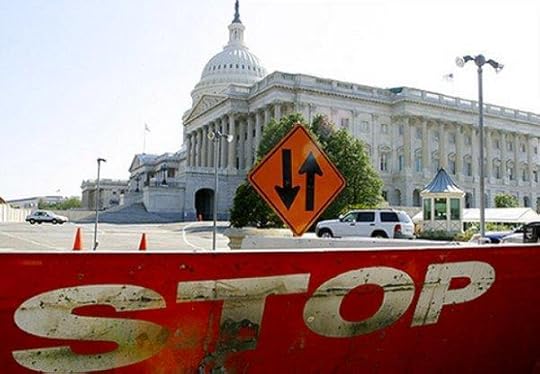
Both the House and Senate have passed budget resolutions, which would ordinarily mean the two sides would begin the process of trying to find a compromise in something called a conference committee. But that's not happening -- Republicans have spent the last few months refusing to have negotiations.
With that in mind, Congress will soon need a need a temporary spending measure -- a "continuing resolution" -- to keep the government's lights on until something can be worked out. Last week, Sen. Marco Rubio (R-Fla.) said he'll oppose any stopgap measure unless Democrats agree to a spending bill that "defunds Obamacare." In other words, Rubio would prefer a government shutdown to a functioning federal health care system.
It's impossible to take demands like these seriously, but the argument is apparently .
Growing numbers of Republicans in Congress are setting their sights on a new target in looming fiscal showdowns this autumn over government funding and the debt limit: "Obamacare."
Several Republicans are pledging to oppose a stopgap government spending bill that will be needed by October 1 unless it withholds funds from the implementation of President Barack Obama's signature healthcare law -- especially its core requirement that uninsured Americans obtain health coverage.
The core requirement that uninsured Americans obtain health coverage, by the way, was a Republican idea.
Anyway, this argument is apparently en vogue on the far-right -- Sen. Ted Cruz (R-Iowa) traveled to Iowa this week, where he said he'll also oppose funding unless the Affordable Care Act is "fully" defunded.
If Democrats are really lucky, Cruz and Rubio will convince other Republicans to join in on this.
Look, there's obviously no realistic way Democrats are going to say, "To prevent a government shutdown, we give up -- it took us 100 years of work to get heath care reform done, and it's making a huge difference in the lives of countless American families, but we've decided to trash the whole thing to make the GOP happy." This just isn't going to happen. Even the most unhinged congressional loon realizes this is unrealistic.
And yet, Rubio, Cruz, and others appear committed to this talking point anyway, and I'm sure right-wing audiences consistently applaud when they repeat it.
One of two things is going to happen. Either (a) these Republicans will back down, signaling weakness in advance of their likely national campaigns; or (b) Republicans will shut down the government, insisting that it's Democrats' fault for not taking health care benefits away from tens of millions of Americans.
Either way, this is an exceedingly bad idea. Democrats would love to get a huge national boost in advance of the 2014 midterms -- a ridiculous government shutdown based on radical partisanship ought to do the trick.
When a 'bombshell' is a dud
Associated Press
House Oversight Committee Chairman Darrell Issa (R-Calif.), struggling to shake his well-deserved reputation as a "laughably inept" clown, did his level best this week to revive the discredited IRS "scandal." Relying on a partial transcript -- one of his favorite tactics -- Issa fed the media what he said was a scoop.
When IRS officials in Cincinnati needed guidance on how to deal with questionable tax-exempt applications, they solicited feedback from the agency's office Washington. Among those who weighed in was the IRS's lawyer, which obviously makes sense given the circumstances.
The Wall Street Journal's Peggy Noonan, whose uncontrollable contempt for President Obama has become difficult to watch, found this revelation fascinating.
The IRS scandal was connected this week not just to the Washington office -- that had been established -- but to the office of the chief counsel.
That is a bombshell -- such a big one that it managed to emerge in spite of an unfocused, frequently off-point congressional hearing.... Still, what landed was a bombshell. And Democrats know it.
Sigh.
It troubles me that the right doesn't realize the extent to which it's embarrassing itself. The revelation isn't a "bombshell"; it's trivia we learned in mid-May. Indeed, Peggy Noonan herself knows this. I don't mean she should know this; I mean there's evidence she literally knows it -- she wrote a column in May that referenced the same boring tidbit she now considers a "bombshell."
Here's what probably happened. Noonan learned a fairly mundane detail in May and wrote about it in a column. Then she forgot it. Two months later, Darrell Issa said he wants the media to take the mundane detail seriously for no particular reason, and Noonan, unwilling to reference her own work, rediscovers her fascination with the unimportant point.
Ben Smith recently characterized Noonan as the "last interesting columnist standing." If by "interesting" he meant "lazy and blindly partisan," I'm inclined to agree.
Of course, Noonan isn't the only Republican who's failing miserably to revive the ridiculous IRS "scandal."
Issa's hearing was itself an attempt to convince the political world the story still deserves to be taken seriously. It arguably had the opposite of the intended effect.
The inspector general behind the critical report about the IRS' targeting of tea party groups acknowledged Thursday that the information in his report was not complete.
J. Russell George, the IRS inspector general, told the House Oversight Committee that only in the past few weeks has he become aware of documents showing that the IRS screened progressive groups in addition to conservative ones. George said he was "disturbed" by the fact that these documents were not provided to his team of investigators prior to the audit's release and that he was continuing to investigate the issue.
"I am concerned that there may be additional pieces of information that we don't have," he said. "I'm very concerned about that sir."
Oh, you mean "additional pieces of information" such as the fact that liberal groups were subjected to the same scrutiny as conservative groups? And there was no targeting of conservative organizations? And that politics had nothing to do with the added scrutiny?
And that this entire controversy is based on a report that by its author's own admission, presents an inaccurate picture of reality?
Perhaps my favorite moment of yesterday's hearing came when George was asked why his report failed to mention that he found literally zero evidence of political motivations on the part of the IRS, even after he reviewed 5,500 emails on the matter. George responded that he couldn't have known "if there was an email that was destroyed."
Oh my.
Making matters much worse, the hearing devolved into farce when Issa accused Oversight Committee Ranking Member Elijah Cummings (D-Md.), who is African American, of reminding him of a "little boy." Issa later clarified he didn't mean for the comment to sound so racist.
I'm not going to say the IRS scandal is officially over now, because for anyone who gives a darn about reality, this point came and went weeks ago. I will say that to continue to believe this story has merit and deserves to be taken seriously is deeply, painfully foolish.
Students' voting rights targeted in North Carolina

Now that North Carolina Republicans hold all the reins of power in state government for the first time in over a century, they've making up for lost time. Just over the last few months, GOP state policymakers have gutted unemployment benefits, cut funding for struggling public schools, blocked Medicaid expansion, repealed the Racial Justice Act, and crafted TRAP laws intended to close nearly every women's health clinic in the state.
What's next? Voting rights, of course.
Resurrecting one of the legislative session's most contentious issues, Senate Republicans unveiled a new voter ID bill Thursday that would further restrict the forms of photo identification accepted at the polls.
The new measure would require voters to show one of seven types of photo identification issued by the government, such as driver's licenses, passports, non-driver IDs and military or veteran cards.
There's a major exception to that list.
Remember, as Rachel has noted on the show recently, North Carolina Republicans were prepared to scale back their proposed voting restrictions, assuming they'd never be cleared by the Justice Department under the Voting Rights Act. But now that five U.S. Supreme Court justices have gutted the civil-rights law, the North Carolina GOP is eager to do precisely what they wanted to do in the first place.
Of particular interest to state Republicans is curbing the youth vote. My colleague Laura Conaway has reported extensively on Ohio Republicans' efforts to approve a voter-ID system that prohibits the use of student IDs -- an effort that proved to be so indefensible that GOP policymakers in the Buckeye State eventually backed off.
North Carolina appears to be picking up where Ohio left off.
As The Nation's Ari Berman reported yesterday, the latest version of the pending voting restrictions prohibits the use of student IDs as a recognized form of identification.
Why? According to state Sen. Tom Apodaca (R), the bill's chief sponsor, college IDs "could be manipulated." Does Apodaca have any evidence of anyone, anywhere ever using a manipulated student ID to commit voter fraud? No, but he and his party are pushing this line anyway.
Berman added:
According to the state's own numbers, 316,000 registered voters don't have state-issued ID; 34 percent are African-American and 55 percent are registered Democrats. Of the 138,000 voters without ID who cast a ballot in the 2012 election, 36 percent were African-American and 59 registered percent Democrats. The new draft of the bill does not allow student IDs for voting, making it among the most restrictive laws in the country. [...]
The actions of the North Carolina legislature are a case study for why Congress needs to revitalize Sections 4 and 5 of the VRA and strengthen other parts of the law.
One wonders if Congress is paying attention.
Incidentally note that since 2000, there are exactly two incidents involving voter impersonation in North Carolina, out of several million votes cast. We're not talking about two percent; we're talking about two individual people.
Republican policymakers in the state are eager to solve a problem that doesn't exist, apparently because they hope voting restrictions will help the GOP win elections.
A tale of two narratives on Obamacare
Even by Washington standards, the disconnect between the left and right on health has been especially jarring this week. To hear Republicans tell it, the Affordable Care Act is unraveling before our very eyes, collapsing under its own weight, and desperately needs to be repealed.
Meanwhile, Democrats and their allies are practically taking a victory lap, as evidenced by President Obama's event in the White House yesterday.
Watch on YouTubeTake a look at the transcript of the president's remarks and you'll notice he has quite a bit to boast about, starting with the checks millions of families are receiving in the mail from their insurance companies. It's part of "Obamacare" that technically called the medical loss ratio, but the idea isn't as complicated as the name: under the law, insurers are required to spend 80% of your premiums on actual health benefits, rather than company overhead (marketing, lobbying, executive salaries, etc.). When an insurer spends less than 80% on care, the company is required to send you a check for the difference.
As the president asked at the event, "I'm curious -- what do opponents of this law think the folks here today should do with the money they were reimbursed? Should they send it back to the insurance companies? Do they think that was a bad idea to make sure that insurance companies are being held accountable?"
They were rhetorical questions, though I wouldn't mind hearing the answer from the congressional Republicans who keep voting over and over again to repeal the law.
But Obama went further, noting falling premiums and slowing costs. This line from his remarks also stood out for me: "In states that are working hard to make sure this law delivers for their people, what we're seeing is that consumers are getting a hint of how much money they're potentially going to save because of this law."
In states that are working hard. In other words, the law is proving to be quite effective in those states where policymakers are actually trying to do the right thing. It was a subtle message to Republican policymakers in states trying to sabotage the law: all you're doing is undermining the interests of your own constituents.
Looking at yesterday's event in the larger context, however, we see Democrats continuing to go on the offensive on health care at a critical time.
Indeed, it's not just the White House -- Americans United for Change, a progressive activist group, launched this new ad in D.C. this week.
Watch on YouTubeAnd while Republicans vow more pointless repeal votes, Jamelle Bouie makes the case that their desperation is coming from a position of weakness.
As the law comes online in the next five months, untold numbers of uninsured Americans will either receive benefits through Medicaid, or they'll begin to enter the exchanges, receive subsidies, and purchase health insurance. In short order, the Affordable Care Act will have created a constituency for itself -- the millions of voters who receive benefits as a result of the law. It will yield countless politicians -- at all levels of government -- who will want to capitalize on this constituency by working to implement it as best as possible. And this isn't just true for blue states -- you'll see a similar dynamic in red states, where exchanges will also exist.
It's Republicans who are caught in a bind. Soon, they'll either have to accommodate the law in order to satisfy their constituents, or continue their quest for repeal, and in the process, further harm their political standing.
As for Obamacare's implementation challenges, they are real and there's an enormous amount of work for the administration and its allies to do. But as Jonathan Cohn explained yesterday in a very good piece, the recent developments surrounding the Affordable Care Act are "genuinely encouraging."
Why? Because insurers' bids "are coming in lower than most experts had predicted," the overall price of Obamacare "is going to be even lower than predicted," and insurers are making assumptions now based on expectations of success.
With Cuccinelli, the fine print matters
Associated Press
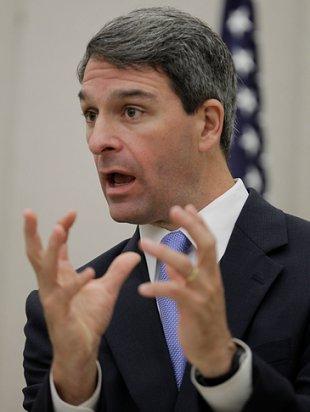
We've been following Virginia gubernatorial hopeful Ken Cuccinelli (R) and the questions surrounding his role in the Jonnie Williams/Star Scientific scandal, and yesterday, there was a fairly important development. An independent investigator issued a report saying that the far-right state Attorney General did not, in fact, violate state ethics rules by failing to disclose various gifts he received from Williams.
But if all you read is the headline -- "Investigators Clear Virginia's Cuccinelli in Ethics Probe" -- you're going to miss some key details. For example, the same report notes that Cuccinelli, far from doing nothing to help his generous benefactor, may have helped Williams after all.
Star sued the state to reverse a $1.7 million tax bill in 2011, shortly before Cuccinelli made a second, $10,000 investment in its shares and before the attorney general asked Williams if his family could stay for a third time at Williams' Smith Mountain Lake vacation home.
Cuccinelli has said he never talked to Williams about the lawsuit, though he has said Williams had earlier complained about the disputed taxes.
The attorney general told the ethics investigators "that he may have suggested that Williams contact a certain attorney at a Richmond law firm 'to assist him and his company with the Tobacco Fund,' " according to a report issued by Richmond Commonwealth's Attorney Michael Herring, quoting an investigators' findings.
So, Williams sued Virginia, and it was up Cuccinelli to defend the state in the case. It was around this time that Cuccinelli started buying stock in Williams' company and taking trips to Williams' lovely vacation home. And it was also around this time that Cuccinelli "may have" offered legal advice to Williams, too.
The report issued yesterday added, "[O]ne cannot help but question whether [Cuccinelli's] repeated omissions of Williams [in his disclosure forms] are coincidence or a pattern reflecting intent to conceal."
Given all of this, why is Cuccinelli off the hook? Probably because Virginia has pretty weak ethics laws, making it easier to get away with dubious conduct.
The entirety of the report issued yesterday is online here (pdf).
Morning Maddow: July 19
VA Gov. Bob McDonnell's attorney says Jonnie Williams got no special treatment.
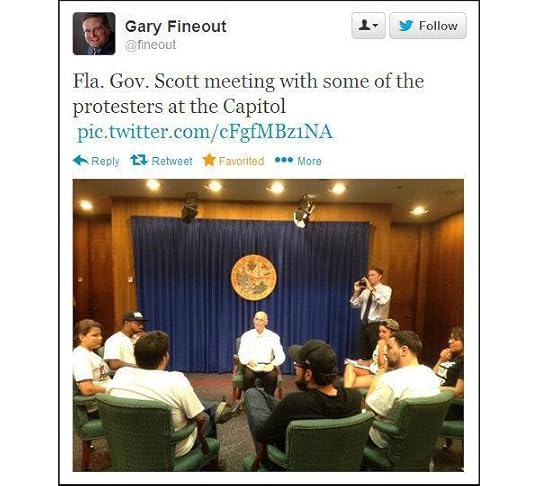
Protesters in the Florida capitol are not happy with what they heard at a meeting with Gov. Rick Scott.
NY Times reports Pres. Obama may cancel his trip to Russia.
The IRS Inspector General is now going to look to see whether progressive groups also got extra scrutiny.
George Zimmerman won't be getting his gun back soon.
Year-long federal study finds fracking chemicals did not spread into drinking water.
New York State's comptroller is using the power of his purse to push feds to recognize same-sex marriages.
July 18, 2013
Links for the 7/18 TRMS
Citations for Thursday's show are listed after the jump.
Steve's coverage of the latest McDonnell development is here, but if you'd like to see the specific e-mail Rachel referenced on the show, it's page 8 of this pdf uploaded by The Washington Post.
Scott cuts short press conference after Stand Your Ground question
Rep. Williams: Come home, Rick Scott
Florida approves 'force with force' measure
Pistol-Packing Grandma Helps NRA Push State Pro-Gun Laws
Florida Expands Right to Use Deadly Force in Self-Defense
Florida 'stand your ground' law yields some shocking outcomes depending on how law is applied
NRA: Holder exploiting Trayvon Martin death to push gun control agenda
Justifiable homicides by private citizens
First Florida, now Pittsburgh: Sitting in against Stand Your Ground
ALEC scorecard: Castle Doctrine Act
Companies Flee Group Behind 'Stand Your Ground'
Johnson & Johnson Becomes 19th Company to Withdraw Support From ALEC
Moms Urge Gun Control, Background Checks With Cow Costumes
Former US Rep. Giffords, supporters bring their call for gun legislation to Maine
Black Dems ready racial profiling bill in response to Florida verdict
NRA: Holder exploiting Trayvon Martin death to push gun control agenda
McDonnell letter for Williams meeting with Virginia health secretary (pdf)
EXCLUSIVE: Governor McDonnell is disappointed, hurt
McDonnell helped benefactor get meeting with Va. health secretary, e-mails show
McDonnell 'directly intervened' to assist scandal-plagued benefactor
Evans v. United States - 504 U.S. 255 (1991)
'LungGuard' has long road before success (pdf)
Star Scientific had to return Va. money from economic development project
Star Scientific's Made-Up, Misleading Relationship With Johns Hopkins
Video: Perry Signs Abortion Bill into Law
Planned Parenthood to shut down three Texas clinics
Dewhurst tweet says bill attempt to close clinics
Planned Parenthood to shut down three Texas clinics
Rome goes public with `transport to torture' case
Ex-CIA Milan chief held in Panama over cleric abduction
In Italy, trial of CIA agents begins
CIA retiree loses appeal in Italy
Italy Convicts 23 Americans for C.I.A. Renditions
Robert Seldon Lady, Ex-CIA Station Chief, Arrested In Panama
Trinity College experiment succeeds after 69 years
Slow-Speed Photography: Pitch Tar Drop Caught on Camera After 69-Year Wait
Ahead on the 7/18 Maddow show
Tonight's guests:
Marc Caputo, political writer for the Miami Herald
Amy Hagstrom Miller, Founder and CEO of Whole Woman's Health, expects to have to close some Texas clinics
And here's executive producer Bill Wolff with a looks at what's in store (cue soundtrack):