Misha Angrist's Blog, page 3
March 12, 2012
Murakami on the Shore
Why I agreed to read more than 1000 pages of fiction in two weeks while swamped with deadlines and teaching responsibilities of various sorts I don't know. I'm an idiot? Plausible. Or maybe I just can't say no to Rosecrans Baldwin. He's dreamy. And ridiculously talented.
As a judge in the Tournament of Books, I agreed to read 1Q84 by Haruki Murakami and The Last Brother by Nathacha Appanah. The whole review is here. But if that exceeds your Why Should I Care quotient, here is a snippet:
In the end, Murakami, the avid runner, limps across the finish line needing an IV. But his canvas is so broad, his imagination so deep and his cojones so big, you've got to hand it to the guy. 1Q84 is long, yes, but it presents a fully realized world, with two moons in the sky and sex, drugs, and Little People saying "ho-ho" on the ground. Tengo and Aomame are palpable, memorable characters waging existential struggles, both micro and macro. Could 1Q84 have been 400 pages shorter? Probably. But I'd say the same thing about War and Peace. And Proust.


“And you’re ugly too”
If your doctor orders a genetic test for a single-gene disorder (often one that might be caused by variants in any of several genes), chances are that the gene or genes being tested in you have been patented. This has provoked 25 years of debate and, more recently, litigation. The most salient question of the moment is, if a patented genetic test is offered by only one lab, then what can and should a patient do?
As part of the implementation of the Leahy-Smith America Invents Act, Congress has directed the United States Patent and Trademark Office “to study effective ways to provide independent, confirming genetic diagnostic test activity where gene patents and exclusive licensing for primary genetic diagnostic tests exist.” To that end, the USPTO has requested public comments and held public hearings in order to gather information for the genetic testing study it must submit to Congress by 16 June 2012.
All of this, of course, was precipitated by AMP v. USPTO (“The Myriad Case”), in which patients with family histories of breast cancer asserted that they have not been able to get confirmatory or “second opinion” testing because there is but a single, exclusive licensee of the patents on the most clinically important genes that predispose to hereditary breast and ovarian cancer, BRCA1 and BRCA2.
I attended the public hearing at the USPTO in Alexandria, VA on 16 February 2012. I was so appalled by what I heard that I attended the second one in San Diego on 9 March 2012 and testified. I am still adding links to my testimony in order to submit it before public comment closes on 26 March 2012. Here is a brief excerpt on Myriad’s unwillingness to share its mutation data:
Unlike the NIH-funded Breast Cancer Information Core, unlike the international collaborative mutaDATABASE (Myriad is the only one of two genetic diagnostic labs I know of that does not participate in this database), unlike databases for virtually every other Mendelian condition I know of, Myriad’s mutation data are not open to independent verification, scientific scrutiny, or use by the breast cancer genetics community for interpretation of variants of unknown significance. For Myriad’s legal counsel to stand here this morning and take credit for the mutation data resident in the Breast Cancer Information Core despite not having contributed data to it for more than seven years (November 2004 was the company’s last significant deposit of mutation data [and Cook-Deegan et al., in preparation], is what my mother would call chutzpah. This same nondisclosure of mutation data was practiced by Clinical Data when it held the exclusive license to long QT syndrome IP over a period of several years. Only after my colleagues and I started asking obnoxious questions in 2008 did Clinical Data announce with great fanfare that it would release its mutation data. As a monopoly Myriad’s behavior has direct, unilateral effects on 1) the practice of medicine; 2) who sets the standard in breast cancer genetic diagnostics; and 3) the availability of data that would otherwise be shared. Data, by the way, that could only have been generated because of research underwritten by American taxpayers (pdf) since the 1990s.
Whether mutation data should be treated as trade secrets a la the formula for Coke or as freely available information in the interests of science and public health is a question that captures the sharp edges of this debate. Gene patenting, it seems to me, is often like abortion: a divisive, polarizing subject in which the two sides tend to talk past each other, with neither particularly interested in what the other is saying. My sense is that Congress, the USPTO and the courts are trying to navigate a middle ground that assuages angry patients without antagonizing a biotech community that insists on patents as a necessary incentive to innovation.
I don’t envy them.

"And you're ugly too"
If your doctor orders a genetic test for a single-gene disorder (often one that might be caused by variants in any of several genes), chances are that the gene or genes being tested in you have been patented. This has provoked 25 years of debate and, more recently, litigation. The most salient question of the moment is, if a patented genetic test is offered by only one lab, then what can and should a patient do?
As part of the implementation of the Leahy-Smith America Invents Act, Congress has directed the United States Patent and Trademark Office "to study effective ways to provide independent, confirming genetic diagnostic test activity where gene patents and exclusive licensing for primary genetic diagnostic tests exist." To that end, the USPTO has requested public comments and held public hearings in order to gather information for the genetic testing study it must submit to Congress by 16 June 2012.
All of this, of course, was precipitated by AMP v. USPTO ("The Myriad Case"), in which patients with family histories of breast cancer asserted that they have not been able to get confirmatory or "second opinion" testing because there is but a single, exclusive licensee of the patents on the most clinically important genes that predispose to hereditary breast and ovarian cancer, BRCA1 and BRCA2.
I attended the public hearing at the USPTO in Alexandria, VA on 16 February 2012. I was so appalled by what I heard that I attended the second one in San Diego on 9 March 2012 and testified. I am still adding links to my testimony in order to submit it before public comment closes on 26 March 2012. Here is a brief excerpt on Myriad's unwillingness to share its mutation data:
Unlike the NIH-funded Breast Cancer Information Core, unlike the international collaborative mutaDATABASE (Myriad is the only one of two genetic diagnostic labs I know of that does not participate in this database), unlike databases for virtually every other Mendelian condition I know of, Myriad's mutation data are not open to independent verification, scientific scrutiny, or use by the breast cancer genetics community for interpretation of variants of unknown significance. For Myriad's legal counsel to stand here this morning and take credit for the mutation data resident in the Breast Cancer Information Core despite not having contributed data to it for more than seven years (November 2004 was the company's last significant deposit of mutation data [and Cook-Deegan et al., in preparation], is what my mother would call chutzpah. This same nondisclosure of mutation data was practiced by Clinical Data when it held the exclusive license to long QT syndrome IP over a period of several years. Only after my colleagues and I started asking obnoxious questions in 2008 did Clinical Data announce with great fanfare that it would release its mutation data. As a monopoly Myriad's behavior has direct, unilateral effects on 1) the practice of medicine; 2) who sets the standard in breast cancer genetic diagnostics; and 3) the availability of data that would otherwise be shared. Data, by the way, that could only have been generated because of research underwritten by American taxpayers (pdf) since the 1990s.
Whether mutation data should be treated as trade secrets a la the formula for Coke or as freely available information in the interests of science and public health is a question that captures the sharp edges of this debate. Gene patenting, it seems to me, is often like abortion: a divisive, polarizing subject in which the two sides tend to talk past each other, with neither particularly interested in what the other is saying. My sense is that Congress, the USPTO and the courts are trying to navigate a middle ground that assuages angry patients without antagonizing a biotech community that insists on patents as a necessary incentive to innovation.
I don't envy them.
February 27, 2012

February 8, 2012
Open season
I loves me some Soapbox. Thanks to the Nature blogs folks for letting me rant on a favorite theme:
As a graduate student, I studied the genetics of Hirschsprung disease, a congenital disorder of the nervous system in the gut (and, as I describe in my book, a disease that would affect my own family many years later). Among the things I found to be most gratifying (and yes, occasionally frustrating) in my doctoral studies were the interactions with Hirschsprung patients and families. We students had pledged our fealty to Science writ large, yes, but we weren't studying roundworms or fruit flies. Our "subjects" (a descriptor of research participants that, in my opinion, is condescending and should be retired ASAP) were thinking feeling human beings. If we found a highly penetrant mutation in their DNA, it had the potential to alter their reproductive decisions and their lives. It meant something to them.
Read the rest here.

February 3, 2012
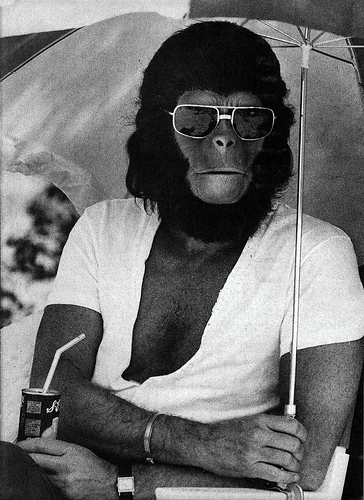
Phenotype of the day
hey man, nice shot!

January 17, 2012
Good Evening, Mr. and Mrs. America…

…and all the ships at sea. It is I, the blogger who can't be bothered to blog. My kids–and my publicist, if she weren't so nice–would say various permutations of "LAME" and "FAIL." And they would be right…So, let me pledge my troth that next week will bring with it actual content. Meanwhile, here's my near-term "dillio:"
Wednesday January 18, 7PM: I will be at The Regulator Bookshop in beautiful Durham, NC celebrating the paperback release of Here is a Human Being. Rather than read from my book in somnambulent tones ad nauseam, I hope to show a few slides and have something more freewheeling and organically psycho-interactive. Please come…there will be no obligation and no salesman will visit your home.
Thursday January 19 to Sunday January 22: ScienceOnline at North Carolina State University! This is my favorite meeting evah, the only downside being the hard choices one must make when choosing between concurrent sessions. On Friday morning Paul Raeburn and I will be talking about teaching science writing in the age of social media and on Saturday afternoon I will join Kristi Holmes and Sandra Porter in a discussion about–wait for it–personal genomics. I am totally psyched…as I am every year!
Next week: the aforementioned "actual content." Gory details to follow!

December 23, 2011
The Ethication of Little Jew
We're nothing if not incestuous around here. A few weeks ago, I had the pleasure of interviewing renegade bioethicist Carl Elliott. His brother and nemesis, Britt Elliott (aka The Ethicator), has generously returned the favor:
BE: I sometimes think of myself as the Steve Jobs of bioethics. Not that I would put words in your mouth or anything.
MA: Well, I guess if the shoe fits, right? But I imagine that that's quite a heavy burden, no?
BE: Yes, a heavy burden indeed — but not as heavy as Carl's burden, which is being known only as the brother of the Steve Jobs of bioethics. I'm sure he can manage that, though.
On to your book. What is it about — genetics or something? I forget.
Read our entire not-at-all-awkward conversation here.
In other What Narcissism Means to Me news, a recent podcast I did with the fabulous folks at American Scientist is now up. (And by the way, is there a better name for a band than Ardent Octopus? I didn't think so.)

December 8, 2011
“Something genetic”
About a month ago I implored you to donate to The Rare Genomics Institute, which is an organization that is not trafficking in airy-fairy promises about what genomics can do for you or your executive health program or worrying about the therapeutic misconception or possible anxiety caused by return of genetic results. No, it is trying to use large-scale DNA sequencing to help families with really sick kids get diagnoses. Among those families is the Nieders, whose three-year-old daughter Maya…
…has global developmental delays of unknown origin (probably something genetic that we haven’t found yet). She’s been through a barrage of testing, but nothing has been figured out. She has a normal brain MRI, normal karyotype, normal FISH, and normal microarray. She has had 2 surgeries: her adenoids were removed, and ear tubes were inserted. Her hearing raises questions—in behavioral testing, she seems to hear normally (or close to normal), which directly contradicts a sedated ABR that said she had mild/moderate hearing loss. She can’t speak (aside from 1 or 2 words), but communicates through making sounds, using signs, gesturing, using her iPad, and using communication boards.
Six months ago, someone put the Nieders in touch with RGI and the family began to consider the prospect of getting Maya’s exome sequenced in order to end her diagnostic odyssey. Last week the family visited Yale, which would perform the sequencing. The catch: the family had to raise the $2500 necessary to pay for it.
Yesterday I got this email from RGI staffer Naira Rezende:
I think we broke some record somewhere…This weekend, we setup her fundraising site and prepared to sequence [her and her parents'] exomes. Tuesday, the patient’s mother told the world (via blog) about this effort. We raised the funds needed to sequence 3 exomes in SIX HOURS!

This is what I’m talking–and getting verklempt–about.

"Something genetic"
About a month ago I implored you to donate to The Rare Genomics Institute, which is an organization that is not trafficking in airy-fairy promises about what genomics can do for you or your executive health program or worrying about the therapeutic misconception or possible anxiety caused by return of genetic results. No, it is trying to use large-scale DNA sequencing to help families with really sick kids get diagnoses. Among those families is the Nieders, whose three-year-old daughter Maya…
…has global developmental delays of unknown origin (probably something genetic that we haven't found yet). She's been through a barrage of testing, but nothing has been figured out. She has a normal brain MRI, normal karyotype, normal FISH, and normal microarray. She has had 2 surgeries: her adenoids were removed, and ear tubes were inserted. Her hearing raises questions—in behavioral testing, she seems to hear normally (or close to normal), which directly contradicts a sedated ABR that said she had mild/moderate hearing loss. She can't speak (aside from 1 or 2 words), but communicates through making sounds, using signs, gesturing, using her iPad, and using communication boards.
Six months ago, someone put the Nieders in touch with RGI and the family began to consider the prospect of getting Maya's exome sequenced in order to end her diagnostic odyssey. Last week the family visited Yale, which would perform the sequencing. The catch: the family had to raise the $2500 necessary to pay for it.
Yesterday I got this email from RGI staffer Naira Rezende:
I think we broke some record somewhere…This weekend, we setup her fundraising site and prepared to sequence [her and her parents'] exomes. Tuesday, the patient's mother told the world (via blog) about this effort. We raised the funds needed to sequence 3 exomes in SIX HOURS!
This is what I'm talking–and getting verklempt–about.