
Sarah MacLaughlin's Blog, page 2
October 22, 2012
How to Help a Child Become More Resilient
I care about kids. I care about kids and I care about you—the parent who is trying to do the absolute best job you can while raising your young ones. The truth is that every parent is doing the best job they can with the resources they have access to. Just like your parents and their parents did. Parenting is hard, joyful, frustrating, rewarding work.
Aside from parenting, my full time job is recruiting, licensing, and training foster parents in Southern Maine. This is also hard work. I would rather see resources spent (my own and those of others) on prevention. I’d much prefer the cycles of violence, addiction, and poverty be broken with sustained support and education for those who need it. All parents want to do a good job—and we all could use support in it! My passion lies in helping moms and dads fulfill their desire to be their best, connected, loving selves in parenthood.
In the field of social work, there is a lot of attention given to resiliency. Disadvantaged youth, in spite of the hardships they have endured, can have positive outcomes. Research shows that their resiliency and view of themselves is dramatically improved if they receive two consistent messages from a trusted adult. It doesn’t matter who the adult is—coach, teacher, or foster parent—what matters is the message.
Whether a child has every advantage or faces many challenges, they need to believe these two things. No child can hear them too often. Here they are, in their simplest forms, and in a variety of verbal and nonverbal ways. Also included are a few ways in which you could inadvertently negate these important messages.
Message #1: “YOU MATTER.”
• Other ways to say it: “You are important.” “I care about you.” “Tell me your opinion.” “I love you very much.” “I’m glad you’re part of my family/tribe/life.”
• How to show it: Eye contact and smiles. Hugs. Remember and honor their preferences. Give them the heads-up on transitions and family changes. Validate feelings and listen.
• Try to avoid: Interrupting while your child is talking. Speaking with other adults about them as if they are not there. Ignoring them.
Message #2: “YOU ARE CAPABLE.”
• Other ways to say it: “I believe in you.” “You can do it—even if it’s hard.” “You know how to keep at it.” “You can succeed.” ”I trust you.”
• How to show it: Beam them with confidence. Stand back and give space. Let them fail, feel that, and then try again.
• Try to avoid: Equating a child’s developmental phase with their personality or capabilities. Rushing in with advice or comfort. Hovering.
Build confidence and true self-esteem in your child by ensuring they know these two very important messages. Increase resilience in any child by keeping these tips in mind. If heard repeatedly, whole-heartedly, and in many different ways, children will feel the positive impact— and they will be virtually inoculated against hopelessness and despair.

Aside from parenting, my full time job is recruiting, licensing, and training foster parents in Southern Maine. This is also hard work. I would rather see resources spent (my own and those of others) on prevention. I’d much prefer the cycles of violence, addiction, and poverty be broken with sustained support and education for those who need it. All parents want to do a good job—and we all could use support in it! My passion lies in helping moms and dads fulfill their desire to be their best, connected, loving selves in parenthood.
In the field of social work, there is a lot of attention given to resiliency. Disadvantaged youth, in spite of the hardships they have endured, can have positive outcomes. Research shows that their resiliency and view of themselves is dramatically improved if they receive two consistent messages from a trusted adult. It doesn’t matter who the adult is—coach, teacher, or foster parent—what matters is the message.
Whether a child has every advantage or faces many challenges, they need to believe these two things. No child can hear them too often. Here they are, in their simplest forms, and in a variety of verbal and nonverbal ways. Also included are a few ways in which you could inadvertently negate these important messages.
Message #1: “YOU MATTER.”
• Other ways to say it: “You are important.” “I care about you.” “Tell me your opinion.” “I love you very much.” “I’m glad you’re part of my family/tribe/life.”
• How to show it: Eye contact and smiles. Hugs. Remember and honor their preferences. Give them the heads-up on transitions and family changes. Validate feelings and listen.
• Try to avoid: Interrupting while your child is talking. Speaking with other adults about them as if they are not there. Ignoring them.
Message #2: “YOU ARE CAPABLE.”
• Other ways to say it: “I believe in you.” “You can do it—even if it’s hard.” “You know how to keep at it.” “You can succeed.” ”I trust you.”
• How to show it: Beam them with confidence. Stand back and give space. Let them fail, feel that, and then try again.
• Try to avoid: Equating a child’s developmental phase with their personality or capabilities. Rushing in with advice or comfort. Hovering.
Build confidence and true self-esteem in your child by ensuring they know these two very important messages. Increase resilience in any child by keeping these tips in mind. If heard repeatedly, whole-heartedly, and in many different ways, children will feel the positive impact— and they will be virtually inoculated against hopelessness and despair.


October 13, 2012
I want your help!
Hi there Mindful Mama or Papa,
I love helping children, families and parents have more peaceful homes, and I want to help more! I offer gentle support and creative tools for sustaining positive changes in families. I've created a short survey from which to gather information about who you are and what kind of support you believe would work best for you. I'd love your opinion and you can help me by filling out the survey here.
Thank you so much for taking the time. I really appreciate it. ~Sarah
I love helping children, families and parents have more peaceful homes, and I want to help more! I offer gentle support and creative tools for sustaining positive changes in families. I've created a short survey from which to gather information about who you are and what kind of support you believe would work best for you. I'd love your opinion and you can help me by filling out the survey here.
Thank you so much for taking the time. I really appreciate it. ~Sarah
September 24, 2012
Three Things You Can Model Better Than You Can Teach
Our children learn a lot from us. They ask us many questions, and we certainly do our best to answer. We also teach in other ways, such as providing our kids with new materials and experiences. But (and it's a big but) we are actually teaching our kids 100% of the time in another huge way — through our own actions. Some things are best taught through example, so why not take advantage of the fact that our children are biologically inclined to attune to us and watch and imitate our every move? Here are three areas where you can put a little attention and end up teaching your child a whole lot:
Respect: Sure, we can ask our kids to respect us and others. We can prompt them to use polite words and a kind tone of voice. But, how do they really learn respect? By being on the receiving end, that's how! I know it can be hard to remember that drooling toddlers and defiant preschoolers (not to mention feisty school-agers and surly teens!) are intelligent human beings, but it's true, they are. Intelligent, whole humans, completely deserving of your love, attention and respect. Developmental drives push their behavior in directions we dislike, but if we can keep their wholeness at the forefront of our minds, we can likely respond better, and with more love and respect.
Humility: We want our kids to know how and when to admit they are wrong. When they are young and in the ego development phase of their lives, they will not be inclined to do so. This is where your consistent modeling of admitting fault and apologizing comes in. Our children need to know we are human and make mistakes just like they do. Since we have the more fully developed brains in the relationship, the onus fall on us to go first. Admit it when you mess up. Say you're sorry. Mean it. Make amends if needed and move on. They will eventually learn to do the same — what a valuable lesson.
Emotional Literacy: Children experience emotions intensely, just as we once did before we learned that expressing strong feelings was looked down upon. It seems like it would be helpful to show children that we "maintain" or keep it under wraps, but this is essentially inauthentic. Kids need to know that emotions are okay to have: fear, sadness, grief, anger, joy, delight. All emotions are part of being human. Feelings are messages from within, they let us know where we are internally ("How am I doing right now"), and also help us assess where we are externally ("Whoa — is this alley safe?"). As social creatures we are wired to tune into the emotions of others. When we cover up how we feel, our children still know how we feel. Our denial of it doesn't make it go away, for us, or for them. It merely confuses them and sends a mixed message. Instead, share your feelings by honestly showing them, and talking about them as well.
It's the double-edged sword in parenting that your children are always watching you. What you say and do speaks volumes — aim to be a positive example — try for mindful, not perfect. Your kids will thank you. Eventually. You might have to model a little patience first.

Respect: Sure, we can ask our kids to respect us and others. We can prompt them to use polite words and a kind tone of voice. But, how do they really learn respect? By being on the receiving end, that's how! I know it can be hard to remember that drooling toddlers and defiant preschoolers (not to mention feisty school-agers and surly teens!) are intelligent human beings, but it's true, they are. Intelligent, whole humans, completely deserving of your love, attention and respect. Developmental drives push their behavior in directions we dislike, but if we can keep their wholeness at the forefront of our minds, we can likely respond better, and with more love and respect.
Humility: We want our kids to know how and when to admit they are wrong. When they are young and in the ego development phase of their lives, they will not be inclined to do so. This is where your consistent modeling of admitting fault and apologizing comes in. Our children need to know we are human and make mistakes just like they do. Since we have the more fully developed brains in the relationship, the onus fall on us to go first. Admit it when you mess up. Say you're sorry. Mean it. Make amends if needed and move on. They will eventually learn to do the same — what a valuable lesson.
Emotional Literacy: Children experience emotions intensely, just as we once did before we learned that expressing strong feelings was looked down upon. It seems like it would be helpful to show children that we "maintain" or keep it under wraps, but this is essentially inauthentic. Kids need to know that emotions are okay to have: fear, sadness, grief, anger, joy, delight. All emotions are part of being human. Feelings are messages from within, they let us know where we are internally ("How am I doing right now"), and also help us assess where we are externally ("Whoa — is this alley safe?"). As social creatures we are wired to tune into the emotions of others. When we cover up how we feel, our children still know how we feel. Our denial of it doesn't make it go away, for us, or for them. It merely confuses them and sends a mixed message. Instead, share your feelings by honestly showing them, and talking about them as well.
It's the double-edged sword in parenting that your children are always watching you. What you say and do speaks volumes — aim to be a positive example — try for mindful, not perfect. Your kids will thank you. Eventually. You might have to model a little patience first.
August 17, 2012
Recipe Book Review
I am so excited to share this Slow Cooker Recipe Book with you! Stephanie over at Mama and Baby Love has written a supremely useful cookbook for busy families. Whether you work or not, you will find these recipes useful. It would also make the perfect gift for an expecting mama or papa. Better still, drop off a prepared recipe all set to go in a gallon Ziploc along with the cookbook! This is easy, good food.
I received a free copy of the ebook and I read through it. Stephanie had suggested that I try one of the recipes and take photos to share as part of my review. You may have noticed that I don't ever post photos on my blog. Not because I don't like photos or have 10 trillion images to choose from if I cared to do so, but because I never figured out how to do it. Aha~a challenge!
So here goes. I set about to making the Cinnamon-Cumin Beef Stew, which sounded fabulous. Coincidentally, I had just started a cleanse/elimination diet so I was worried I wouldn't be able to find a recipe in the book that would meet my needs, but au contraire! I only had to swap out sweet potatoes for white ones and I was all set.
All the recipes are ingeniously portioned for TWO batches so you do a little extra chopping up front, but then you've prepared dinner twice in no time. So I chopped the veggies and it looked like this:

Then I cubed the meat and mixed the spices together.

(Dude, why didn't someone tell me how easy it is to insert photos? Geez!)
Anyway. Then I divided it into two gallon-sized bags.

See how it's the perfect size for your Crock Pot? (It can't be one of those tiny round ones though, needs to be the larger oval version.)
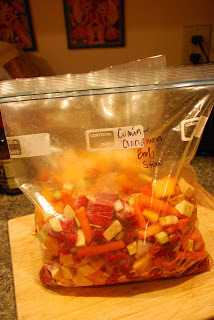
Then I popped them both in the freezer. I knew I'd be cooking one the next morning, but I wanted to truly test the whole freeze-then-cook thing to make sure I didn't run into any issues. The next morning, I pulled it out, tore the bag off, (yeah, you have to sacrifice the bag, but it's sooo worth it) and viola!

The lid even fit. I set it on low and went to work. Came home to this:

That stew was delicious! Sweet and savory, with just enough heat. Now, I took a little creative license. As I said, I'm on a weird diet so I couldn't use the white potatoes. I thought I'd do a straight substitution for the sweet potatoes, but then one of them was rotten (the story of my life) so I added some butternut squash that was not rotten along with some onions and celery and it came out just fine. I'm sure that there are many places in the various recipes that you could feel free to improvise.
This cookbook is well organized with shopping lists and detailed instructions. A heads-up to vegetarians that not all, but most of the recipes have meat in them. The meals are easy to prepare, healthy, and with only chopping and assembling as prep, serious time-savers. Again, you can grab the cookbook here for under six dollars! I can't imagine you would be disappointed in your investment. And if you are a parent and don't have a slow-cooker yet....go get one!

I received a free copy of the ebook and I read through it. Stephanie had suggested that I try one of the recipes and take photos to share as part of my review. You may have noticed that I don't ever post photos on my blog. Not because I don't like photos or have 10 trillion images to choose from if I cared to do so, but because I never figured out how to do it. Aha~a challenge!
So here goes. I set about to making the Cinnamon-Cumin Beef Stew, which sounded fabulous. Coincidentally, I had just started a cleanse/elimination diet so I was worried I wouldn't be able to find a recipe in the book that would meet my needs, but au contraire! I only had to swap out sweet potatoes for white ones and I was all set.
All the recipes are ingeniously portioned for TWO batches so you do a little extra chopping up front, but then you've prepared dinner twice in no time. So I chopped the veggies and it looked like this:

Then I cubed the meat and mixed the spices together.

(Dude, why didn't someone tell me how easy it is to insert photos? Geez!)
Anyway. Then I divided it into two gallon-sized bags.

See how it's the perfect size for your Crock Pot? (It can't be one of those tiny round ones though, needs to be the larger oval version.)
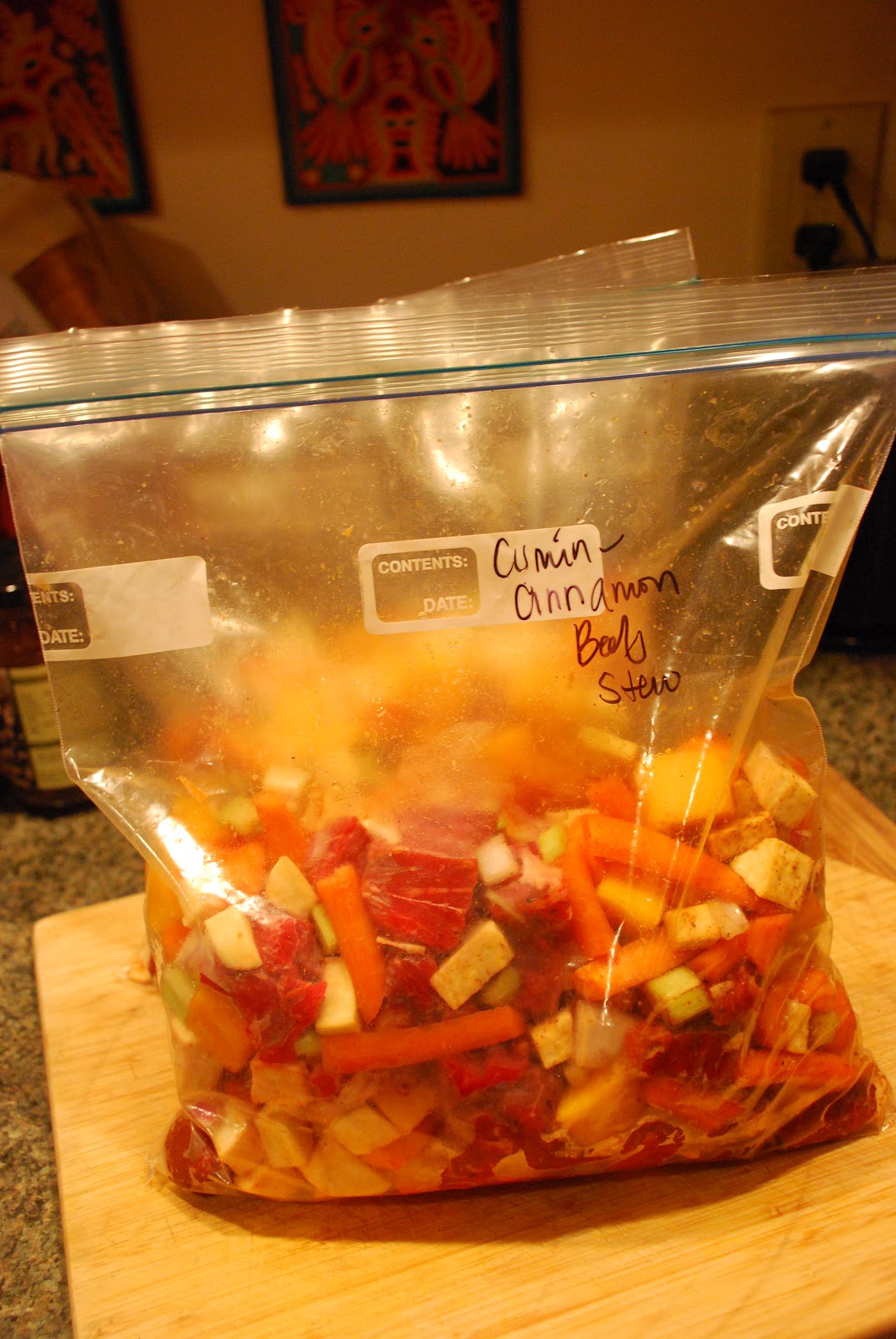
Then I popped them both in the freezer. I knew I'd be cooking one the next morning, but I wanted to truly test the whole freeze-then-cook thing to make sure I didn't run into any issues. The next morning, I pulled it out, tore the bag off, (yeah, you have to sacrifice the bag, but it's sooo worth it) and viola!

The lid even fit. I set it on low and went to work. Came home to this:

That stew was delicious! Sweet and savory, with just enough heat. Now, I took a little creative license. As I said, I'm on a weird diet so I couldn't use the white potatoes. I thought I'd do a straight substitution for the sweet potatoes, but then one of them was rotten (the story of my life) so I added some butternut squash that was not rotten along with some onions and celery and it came out just fine. I'm sure that there are many places in the various recipes that you could feel free to improvise.
This cookbook is well organized with shopping lists and detailed instructions. A heads-up to vegetarians that not all, but most of the recipes have meat in them. The meals are easy to prepare, healthy, and with only chopping and assembling as prep, serious time-savers. Again, you can grab the cookbook here for under six dollars! I can't imagine you would be disappointed in your investment. And if you are a parent and don't have a slow-cooker yet....go get one!
July 30, 2012
How to Set Limits: 10 Helpful Suggestions
Setting limits is tough. I’ve found it to be a muscle I had to grow and exercise over time. I was way better at it when I was interacting with someone else’s child. Once my own boy became mobile, I ran smack into the ever-triggering world of a driven-to-explore toddler. Behold: my top ten tips for making boundaries a breeze.
1. Think ahead. In other words, make a plan and strategize. In parenting, you really do have to be one step ahead. Luckily, we have the cerebral cortexes our young ones lack. We often know the places where our kids will push. Whether it’s mealtime or bedtime, you can take the time to plan ahead. Thinking things through and knowing where your limit lies, is a huge help.
2. Don’t use wishy-washy language. One of the best tips I ever got as a teacher was to record myself in the classroom for an hour and play it back to myself later. I caught myself in quite a few verbal habits I wanted to break. Using weak language when giving directives or setting limits was one of them. Aim to be mindful of statements like, “I don’t really want you to do that,” (really?) and the ubiquitous, “Okay?” at the end of sentences.
3. Check your body language and facial expression. Even though I wrote a book about saying the right thing, studies show that these nonverbal cues carry huge importance. Don’t go all sing-song-y if you mean business. Always, always, always: get low. You are huge and intimidating to a child, period. You can mean what you say with a neutral facial expression. No need to furrow your brow in frustration. Aim to convey quiet confidence that the child in your care can do what is necessary.
4. Ensure that your tone is warm, but firm. A sharp tone or staccato cadence can be overstimulating and scary to a young child, setting off their "fight or flight" alarm. High volume (aka yelling) can trigger this as well. A scared child is not likely to comply until they are so scared you’ve hugely diminished their feelings of connection with you. If and when they do comply, it is not because they learned anything, actual learning takes place in a different part of the brain.
5. Don’t expect a child to comply without upset. Set the limit where the limit is for you. Then make and hold space for the feelings a child may have about it. It is unrealistic to expect a child to accept “No” with “Okay Mommy.” Be prepared—this will rarely happen. However, it will actually happen more if you are calm and reassuring in your setting and holding of limits: “I said ‘no’ to another cookie. You really wanted it. I will listen to your upset.” That’s all that is required. Have faith they can work through the tough feelings of not getting what they want. Accepting is way better than annoyed in this scenario.
6. Have developmentally appropriate expectations. A one-year-old will get into everything no matter what you do or say. A two-year-old cannot share without protest. A three-year-old will say “no” often. A four-year-old must know “why.” No one, no matter what their age really likes limits. Yet limits are needed. Brush up on where your child is developmentally. This will help you weather the storm of their upcoming “developmental leap” (they are always about to make one). Remember how much they are growing on every level—emotional, physical, mental, and psychological. That they hold it together and are pleasant as often as they are is the real miracle!
7. Stay decisive, even when you can change your mind. That sounds like I’m talking out of both sides of my mouth, and I am. Your confidence in your decisions is crucial. If you aren’t sure whether or not you should let them jump on the bed, that is more problematic than if on Tuesday you say, “Yes, today you may jump on the bed,” (You checked in with yourself and are well-rested, focused, and able to keep this activity comfortable and safe for everyone.) then on Wednesday you say, “No, today is not a jumping on the bed day.” (You had insomnia, got a fat parking ticket, and have a headache.) Staying consistent in your decisiveness is way more important that a rule being unwavering.
8. Be physical if you need to. Unless you are feeling angry and frustrated, it is okay to corral a child physically to keep her safe. (In your lap facing outward so you don’t get hit is a useful one.) Check in with yourself and stay calm. Pay close attention so you know you are not hurting her. Sometimes only a moment of contact is need, such as when a child tries to hit another. Simply block the blow gently and say, “I can’t allow hitting,” or, "I won't let you hurt your friend." Again, use your tone wisely, this statement should be matter-of-fact, not shaming.
9. Don’t explain the reason for the limit more than once. It can be helpful to give a child the reason for the limit. But do not repeat yourself, you will only get irritated. Give the explanation once and then keep quiet. Hold your tongue—or as Carrie Contey says, “Zip it!” Especially if a child deteriorates into an emotional meltdown. When he is in his emotional, limbic brain, language is not as accessible. You are truly wasting your breath. If you are going to have a mantra for when a child is really losing it, “You are safe,” is my favorite.
10. Use humor. Last but not least: BE FUNNY! I cannot stress enough how well this works. Try on a silly voice or tone, invent a character. Not long ago I got a ton of mileage out of using a British accent during limit setting. Animate and imbue with wit objects like a toothbrush or the tub water. My son has been known to request this, as in, “Make the toothbrush ask me that question again!” I can’t tell you how fast he opened his mouth after that imaginative play. I guarantee this does not take any longer than bargaining, hollering, or bribing.
Try on some of these suggestions. See if they fit. You will definitely know if they are working better than, “You better get dressed right now,” “How dare you talk to me like that!” or “Fine, have the damn cookie.” Try it, you’ll like it. Then let me know how it goes.

1. Think ahead. In other words, make a plan and strategize. In parenting, you really do have to be one step ahead. Luckily, we have the cerebral cortexes our young ones lack. We often know the places where our kids will push. Whether it’s mealtime or bedtime, you can take the time to plan ahead. Thinking things through and knowing where your limit lies, is a huge help.
2. Don’t use wishy-washy language. One of the best tips I ever got as a teacher was to record myself in the classroom for an hour and play it back to myself later. I caught myself in quite a few verbal habits I wanted to break. Using weak language when giving directives or setting limits was one of them. Aim to be mindful of statements like, “I don’t really want you to do that,” (really?) and the ubiquitous, “Okay?” at the end of sentences.
3. Check your body language and facial expression. Even though I wrote a book about saying the right thing, studies show that these nonverbal cues carry huge importance. Don’t go all sing-song-y if you mean business. Always, always, always: get low. You are huge and intimidating to a child, period. You can mean what you say with a neutral facial expression. No need to furrow your brow in frustration. Aim to convey quiet confidence that the child in your care can do what is necessary.
4. Ensure that your tone is warm, but firm. A sharp tone or staccato cadence can be overstimulating and scary to a young child, setting off their "fight or flight" alarm. High volume (aka yelling) can trigger this as well. A scared child is not likely to comply until they are so scared you’ve hugely diminished their feelings of connection with you. If and when they do comply, it is not because they learned anything, actual learning takes place in a different part of the brain.
5. Don’t expect a child to comply without upset. Set the limit where the limit is for you. Then make and hold space for the feelings a child may have about it. It is unrealistic to expect a child to accept “No” with “Okay Mommy.” Be prepared—this will rarely happen. However, it will actually happen more if you are calm and reassuring in your setting and holding of limits: “I said ‘no’ to another cookie. You really wanted it. I will listen to your upset.” That’s all that is required. Have faith they can work through the tough feelings of not getting what they want. Accepting is way better than annoyed in this scenario.
6. Have developmentally appropriate expectations. A one-year-old will get into everything no matter what you do or say. A two-year-old cannot share without protest. A three-year-old will say “no” often. A four-year-old must know “why.” No one, no matter what their age really likes limits. Yet limits are needed. Brush up on where your child is developmentally. This will help you weather the storm of their upcoming “developmental leap” (they are always about to make one). Remember how much they are growing on every level—emotional, physical, mental, and psychological. That they hold it together and are pleasant as often as they are is the real miracle!
7. Stay decisive, even when you can change your mind. That sounds like I’m talking out of both sides of my mouth, and I am. Your confidence in your decisions is crucial. If you aren’t sure whether or not you should let them jump on the bed, that is more problematic than if on Tuesday you say, “Yes, today you may jump on the bed,” (You checked in with yourself and are well-rested, focused, and able to keep this activity comfortable and safe for everyone.) then on Wednesday you say, “No, today is not a jumping on the bed day.” (You had insomnia, got a fat parking ticket, and have a headache.) Staying consistent in your decisiveness is way more important that a rule being unwavering.
8. Be physical if you need to. Unless you are feeling angry and frustrated, it is okay to corral a child physically to keep her safe. (In your lap facing outward so you don’t get hit is a useful one.) Check in with yourself and stay calm. Pay close attention so you know you are not hurting her. Sometimes only a moment of contact is need, such as when a child tries to hit another. Simply block the blow gently and say, “I can’t allow hitting,” or, "I won't let you hurt your friend." Again, use your tone wisely, this statement should be matter-of-fact, not shaming.
9. Don’t explain the reason for the limit more than once. It can be helpful to give a child the reason for the limit. But do not repeat yourself, you will only get irritated. Give the explanation once and then keep quiet. Hold your tongue—or as Carrie Contey says, “Zip it!” Especially if a child deteriorates into an emotional meltdown. When he is in his emotional, limbic brain, language is not as accessible. You are truly wasting your breath. If you are going to have a mantra for when a child is really losing it, “You are safe,” is my favorite.
10. Use humor. Last but not least: BE FUNNY! I cannot stress enough how well this works. Try on a silly voice or tone, invent a character. Not long ago I got a ton of mileage out of using a British accent during limit setting. Animate and imbue with wit objects like a toothbrush or the tub water. My son has been known to request this, as in, “Make the toothbrush ask me that question again!” I can’t tell you how fast he opened his mouth after that imaginative play. I guarantee this does not take any longer than bargaining, hollering, or bribing.
Try on some of these suggestions. See if they fit. You will definitely know if they are working better than, “You better get dressed right now,” “How dare you talk to me like that!” or “Fine, have the damn cookie.” Try it, you’ll like it. Then let me know how it goes.
The Ten Commandments of Limit Setting
Setting limits is tough. I’ve found it to be a muscle I had to grow and exercise over time. I was way better at it when I was interacting with someone else’s child. Once my own boy became mobile, I ran smack into the ever-triggering world of a driven-to-explore toddler. Behold: my top ten tips for making boundaries a breeze.
1. Think ahead. In other words, make a plan and strategize. In parenting, you really do have to be one step ahead. Luckily, we have the cerebral cortexes our young ones lack. We often know the places where our kids will push. Whether it’s mealtime or bedtime, you can take the time to plan ahead. Thinking things through and knowing where your limit lies, is a huge help.
2. Don’t use wishy-washy language. One of the best tips I ever got as a teacher was to record myself in the classroom for an hour and play it back to myself later. I caught myself in quite a few verbal habits I wanted to break. Using weak language when giving directives or setting limits was one of them. Aim to be mindful of statements like, “I don’t really want you to do that,” (really?) and the ubiquitous, “Okay?” at the end of sentences.
3. Check your body language and facial expression. Even though I wrote a book about saying the right thing, studies show that these nonverbal cues carry huge importance. Don’t go all sing-song-y if you mean business. Always, always, always: get low. You are huge and intimidating to a child, period. You can mean what you say with a neutral facial expression. No need to furrow your brow in frustration. Aim to convey quiet confidence that the child in your care can do what is necessary.
4. Ensure that your tone is warm, but firm. A sharp tone or staccato cadence can be overstimulating and scary to a young child, setting off their "fight or flight" alarm. High volume (aka yelling) can trigger this as well. A scared child is not likely to comply until they are so scared you’ve hugely diminished their feelings of connection with you. If and when they do comply, it is not because they learned anything, actual learning takes place in a different part of the brain.
5. Don’t expect a child to comply without upset. Set the limit where the limit is for you. Then make and hold space for the feelings a child may have about it. It is unrealistic to expect a child to accept “No” with “Okay Mommy.” Be prepared—this will rarely happen. However, it will actually happen more if you are calm and reassuring in your setting and holding of limits: “I said ‘no’ to another cookie. You really wanted it. I will listen to your upset.” That’s all that is required. Have faith they can work through the tough feelings of not getting what they want. Accepting is way better than annoyed in this scenario.
6. Have developmentally appropriate expectations. A one-year-old will get into everything no matter what you do or say. A two-year-old cannot share without protest. A three-year-old will say “no” often. A four-year-old must know “why.” No one, no matter what their age really likes limits. Yet limits are needed. Brush up on where your child is developmentally. This will help you weather the storm of their upcoming “developmental leap” (they are always about to make one). Remember how much they are growing on every level—emotional, physical, mental, and psychological. That they hold it together and are pleasant as often as they are is the real miracle!
7. Stay decisive, even when you can change your mind. That sounds like I’m talking out of both sides of my mouth, and I am. Your confidence in your decisions is crucial. If you aren’t sure whether or not you should let them jump on the bed, that is more problematic than if on Tuesday you say, “Yes, today you may jump on the bed,” (You checked in with yourself and are well-rested, focused, and able to keep this activity comfortable and safe for everyone.) then on Wednesday you say, “No, today is not a jumping on the bed day.” (You had insomnia, got a fat parking ticket, and have a headache.) Staying consistent in your decisiveness is way more important that a rule being unwavering.
8. Be physical if you need to. Unless you are feeling angry and frustrated, it is okay to corral a child physically to keep her safe. (In your lap facing outward so you don’t get hit is a useful one.) Check in with yourself and stay calm. Pay close attention so you know you are not hurting her. Sometimes only a moment of contact is need, such as when a child tries to hit another. Simply block the blow gently and say, “I can’t allow hitting,” or, "I won't let you hurt your friend." Again, use your tone wisely, this statement should be matter-of-fact, not shaming.
9. Don’t explain the reason for the limit more than once. It can be helpful to give a child the reason for the limit. But do not repeat yourself, you will only get irritated. Give the explanation once and then keep quiet. Hold your tongue—or as Carrie Contey says, “Zip it!” Especially if a child deteriorates into an emotional meltdown. When he is in his emotional, limbic brain, language is not as accessible. You are truly wasting your breath. If you are going to have a mantra for when a child is really losing it, “You are safe,” is my favorite.
10. Use humor. Last but not least: BE FUNNY! I cannot stress enough how well this works. Try on a silly voice or tone, invent a character. Not long ago I got a ton of mileage out of using a British accent during limit setting. Animate and imbue with wit objects like a toothbrush or the tub water. My son has been known to request this, as in, “Make the toothbrush ask me that question again!” I can’t tell you how fast he opened his mouth after that imaginative play. I guarantee this does not take any longer than bargaining, hollering, or bribing.
Try on some of these suggestions. See if they fit. You will definitely know if they are working better than, “You better get dressed right now,” “How dare you talk to me like that!” or “Fine, have the damn cookie.” Try it, you’ll like it. Then let me know how it goes.
1. Think ahead. In other words, make a plan and strategize. In parenting, you really do have to be one step ahead. Luckily, we have the cerebral cortexes our young ones lack. We often know the places where our kids will push. Whether it’s mealtime or bedtime, you can take the time to plan ahead. Thinking things through and knowing where your limit lies, is a huge help.
2. Don’t use wishy-washy language. One of the best tips I ever got as a teacher was to record myself in the classroom for an hour and play it back to myself later. I caught myself in quite a few verbal habits I wanted to break. Using weak language when giving directives or setting limits was one of them. Aim to be mindful of statements like, “I don’t really want you to do that,” (really?) and the ubiquitous, “Okay?” at the end of sentences.
3. Check your body language and facial expression. Even though I wrote a book about saying the right thing, studies show that these nonverbal cues carry huge importance. Don’t go all sing-song-y if you mean business. Always, always, always: get low. You are huge and intimidating to a child, period. You can mean what you say with a neutral facial expression. No need to furrow your brow in frustration. Aim to convey quiet confidence that the child in your care can do what is necessary.
4. Ensure that your tone is warm, but firm. A sharp tone or staccato cadence can be overstimulating and scary to a young child, setting off their "fight or flight" alarm. High volume (aka yelling) can trigger this as well. A scared child is not likely to comply until they are so scared you’ve hugely diminished their feelings of connection with you. If and when they do comply, it is not because they learned anything, actual learning takes place in a different part of the brain.
5. Don’t expect a child to comply without upset. Set the limit where the limit is for you. Then make and hold space for the feelings a child may have about it. It is unrealistic to expect a child to accept “No” with “Okay Mommy.” Be prepared—this will rarely happen. However, it will actually happen more if you are calm and reassuring in your setting and holding of limits: “I said ‘no’ to another cookie. You really wanted it. I will listen to your upset.” That’s all that is required. Have faith they can work through the tough feelings of not getting what they want. Accepting is way better than annoyed in this scenario.
6. Have developmentally appropriate expectations. A one-year-old will get into everything no matter what you do or say. A two-year-old cannot share without protest. A three-year-old will say “no” often. A four-year-old must know “why.” No one, no matter what their age really likes limits. Yet limits are needed. Brush up on where your child is developmentally. This will help you weather the storm of their upcoming “developmental leap” (they are always about to make one). Remember how much they are growing on every level—emotional, physical, mental, and psychological. That they hold it together and are pleasant as often as they are is the real miracle!
7. Stay decisive, even when you can change your mind. That sounds like I’m talking out of both sides of my mouth, and I am. Your confidence in your decisions is crucial. If you aren’t sure whether or not you should let them jump on the bed, that is more problematic than if on Tuesday you say, “Yes, today you may jump on the bed,” (You checked in with yourself and are well-rested, focused, and able to keep this activity comfortable and safe for everyone.) then on Wednesday you say, “No, today is not a jumping on the bed day.” (You had insomnia, got a fat parking ticket, and have a headache.) Staying consistent in your decisiveness is way more important that a rule being unwavering.
8. Be physical if you need to. Unless you are feeling angry and frustrated, it is okay to corral a child physically to keep her safe. (In your lap facing outward so you don’t get hit is a useful one.) Check in with yourself and stay calm. Pay close attention so you know you are not hurting her. Sometimes only a moment of contact is need, such as when a child tries to hit another. Simply block the blow gently and say, “I can’t allow hitting,” or, "I won't let you hurt your friend." Again, use your tone wisely, this statement should be matter-of-fact, not shaming.
9. Don’t explain the reason for the limit more than once. It can be helpful to give a child the reason for the limit. But do not repeat yourself, you will only get irritated. Give the explanation once and then keep quiet. Hold your tongue—or as Carrie Contey says, “Zip it!” Especially if a child deteriorates into an emotional meltdown. When he is in his emotional, limbic brain, language is not as accessible. You are truly wasting your breath. If you are going to have a mantra for when a child is really losing it, “You are safe,” is my favorite.
10. Use humor. Last but not least: BE FUNNY! I cannot stress enough how well this works. Try on a silly voice or tone, invent a character. Not long ago I got a ton of mileage out of using a British accent during limit setting. Animate and imbue with wit objects like a toothbrush or the tub water. My son has been known to request this, as in, “Make the toothbrush ask me that question again!” I can’t tell you how fast he opened his mouth after that imaginative play. I guarantee this does not take any longer than bargaining, hollering, or bribing.
Try on some of these suggestions. See if they fit. You will definitely know if they are working better than, “You better get dressed right now,” “How dare you talk to me like that!” or “Fine, have the damn cookie.” Try it, you’ll like it. Then let me know how it goes.
July 27, 2012
Huge Gratitude
I've been taking a little rest after all that blogging. Thanks for your patience. I've never been much of a runner, but I only imagine that completing a marathon feels a little like that blog tour!
I am so encouraged and insired by the great work that every single person/site/blog that I "visited" is doing. I can see the future that is filled with children who were raised with respect, love, emotional literacy and conscious care. Thank you everyone for swimming up the stream of the mainstream. Small shifts matter. The messages we send, in all our varied and beautiful ways, have impact on families who seek and read. I look forward to connecting again and collaborating more down the road. Also, huge thanks to the seekers and readers, friends and family. I so apprecaite your support.
AND~ All that work paid off in the mysterious (to me) land of SEO (search engine optimization) as Redbook magazine found me through a Goolge search and interviewed me for this great article about parent-child communication on Shine from Yahoo! Please read it and tweet/post/share.
More blogging will continue here soon. Just catching my breath and pausing in this moment of gratefulness. Thank you, thank you, thank you!
I am so encouraged and insired by the great work that every single person/site/blog that I "visited" is doing. I can see the future that is filled with children who were raised with respect, love, emotional literacy and conscious care. Thank you everyone for swimming up the stream of the mainstream. Small shifts matter. The messages we send, in all our varied and beautiful ways, have impact on families who seek and read. I look forward to connecting again and collaborating more down the road. Also, huge thanks to the seekers and readers, friends and family. I so apprecaite your support.
AND~ All that work paid off in the mysterious (to me) land of SEO (search engine optimization) as Redbook magazine found me through a Goolge search and interviewed me for this great article about parent-child communication on Shine from Yahoo! Please read it and tweet/post/share.
More blogging will continue here soon. Just catching my breath and pausing in this moment of gratefulness. Thank you, thank you, thank you!
July 15, 2012
"Praise is Boring" at Positive Parenting Connection
The blog tour is wrapping up. I feel like a supervisor announcing that someone is leaving: "Is is with mixed feelings that I inform you that the blog tour will be ending." Oh blog tour, how you have kicked my butt and taught me so much! Thank you all for joining me along the way.
Here is a last excerpted post over at the fabulous Positive Parenting Connection. Love their site. It is chock full of great articles and thought-provoking musings. Also wonderful reminders about how to stay positive and create what I would call a "play-rich" environment. Well done!
Here is a last excerpted post over at the fabulous Positive Parenting Connection. Love their site. It is chock full of great articles and thought-provoking musings. Also wonderful reminders about how to stay positive and create what I would call a "play-rich" environment. Well done!
Book Review at The Hippie Housewife
Thanks to the Hippie Housewife for this great review of my book! As usual, if you comment after her post, you have a chance to win a ebook copy of What Not to Say: Tools for Talking with Young Children. The Hippie Housewife describes herself as "a 28-year-old WAHM, daughter of the King, wife of my childhood sweetheart, and mother of two little boys and a third on the way." She also says, "Join us on our journey as we seek a more intentional life." I love that.
While perusing this site, I noticed that I did not always agree in the political realm with the posts, and that we have different religious beliefs, which actually made it all the cooler to see the many thing we did agree on: connected parenting, gentle guidance, self-care and reflection. I was brought to tears by her post, I am your safe place. Enjoy!
While perusing this site, I noticed that I did not always agree in the political realm with the posts, and that we have different religious beliefs, which actually made it all the cooler to see the many thing we did agree on: connected parenting, gentle guidance, self-care and reflection. I was brought to tears by her post, I am your safe place. Enjoy!
July 14, 2012
Book Review Swap with The Consciously Parenting Project
Today I am reviewing Rebecca Thompson's great book, Consciously Parenting: What it Really Takes to Raise Emotionally Healthy Families and she is reviewing mine! Rebecca's site: The Consciously Parenting Project is totally helpful. There are online parenting forums, tele-classes, and more. You community of support for better parenting can start here! Creating, nurturing, repairing....that says it all. Enjoy the review below and read Rebecca's write-up of mine here.
Before I even cracked open my copy of Rebecca’s book, I was struck by the nuance in the title. I noticed that she said “emotionally healthy families,” not, “emotionally healthy kids.” She intentionally, I am guessing, took into consideration the entire family unit. Wise woman—I hadn’t yet opened the book and already I was learning something.
Once I dove in and start reading, I got to about page six before I started folding down pages and reaching for my highlighter. This book is a treasure trove of good, solid information for parents. It is truly connection-based and teaches parents step-by-step how to shift the way we are looking at our children, not just their behavior.
The approaches in this book are rooted in neuroscience, but are written in language that is accessible to anyone with a high school diploma. Rebecca gives the reader a framework for “beginning the journey of change” from the parent you are (with good explanation for how that came to be!) to the parent you may want to become.
Chapter seven which is entitled, Feelings: Messages from Our Internal Guidance Systemis such an excellent guide for understanding emotional intelligence and literacy that it alone is worth the price of the book. The repurposed story of The Three Bears brilliantly illustrates how easily we humans can become emotionally dysregulated. Through the tale of Goldilocks, she shows what hyperarousal and hypoarousal actually look like when they play out in family dynamics, including how one regulated person can help others maintain their equilibrium.
Rebecca uses a warm, encouraging tone and weaves personal and real-life stories throughout. She takes the time to dissect interactions thoroughly enough for many “a-ha” moments to occur. She also underscores the importance of self-reflection at the end of each chapter with a list of Questions to Ponder. Rebecca’s insights about setting limits, supporting children, honoring adults’ feelings, and decoding behavior are all well organized and very easy to understand.
I love this book’s stake-in-the-ground tenet that relationship is the foundation for everything. This is well described in chapter three: “Only the Relationship Matters: The parent-child relationship is more important than any behavioral intervention, consequence, or punishment.” Who doesn’t want to read more about that? Consciously Parenting is a hugeresource for families all on its own, so the great news is that it is book one in a series of four. Stay tuned for more helpful advice from Ms. Thompson.


