
Marsha Canham's Blog, page 6
July 15, 2012
Sneak Peek Sunday
Today’s sample offering comes from Shirley Jump, one of about 400 authors on an eloop that supports new and troglodyte authors like myself as we trek through this new world of ebook publishing. Grab a coffee, settle in for a few, and check out her snippet. *g*

Thanks so much for having me on the blog! I love reading samples and getting that great little taste of a book. Then again, I also love sample days at the grocery store, and the warehouse club. And the makeup counter…I think that explains the size of my Macy’s bill!
Today, I’ve got a sample of one of my Sweet and Savory Romances. The idea for those came from my love of cooking and reading. I subscribe to several cooking magazines and love trying new dishes. The ones in these books are my own—tested in my kitchen, and my hips  . THE DEVIL SERVED DESIRE features Maria Pagliano, who is desperate to diet down to her high school size before her reunion and Dante Del Rosso, the sexy chef who is determined to tempt her with his kisses and his pasta. Maria joins a quirky support group called the Chubby Chums, but can’t deny her attraction to Dante, who is oh-so-wrong for her diet and her heart.
Here’s the excerpt from The Devil Served Desire:
Chapter 4
She’d managed to escape without having to classify herself as either a mammal or crustacean, thank God and all the saints. Maria slipped her arms into her coat, ignored the growling in her belly that told her she should have at least taken the time to eat before she made her mad dash fromArnold, and picked up the pace. At home, there was a fork waiting for her. And in her hands, her leftovers.
Who needed men when she had that combination in her kitchen?
“Maria, wait!”
That was notArnold’s voice—it was Dante’s. She’d do well to keep on walking and not turn around. That man had “linguine in bed” written all over him.
Well… maybe stopping was a better idea than trying to outrun him. She was, after all, in heels. And linguine in bed wasn’t always a bad idea.
Maria spun around, the Styrofoam to-go box from Vita in her hand. “I’m on my way home.”
“I gathered that. But I couldn’t let you leave, not yet.”
“Don’t you have a customer to attend to?”
“He’s eating. I have a few minutes. Besides, if I stayed in the restaurant, I’d hover over the guy and if there’s anything that’s sure to piss him off again, it’s a hovering chef.”
She laughed. “I bet you’re right.”
“So why don’t you help me pass the time?”
Damn, he had nice eyes. The kind that seemed to bore into a woman and read every thought she’d ever had. He’d be the type—she knew—to anticipate what she wanted in bed, just by reading the signals in her gaze.
The volcano in her pelvis began to stir.
Dante took a step forward, his gaze never leaving hers. “I’m sure we could find something to while away the minutes.”
Antonio was the man she was supposed to be focused on. Antonio was the man she was starving herself half to death for. Antonio was expecting her to be ready and waiting, pom-poms in hand, when he arrived for the reunion.
But right now, she couldn’t even remember what Antonio looked like.
From somewhere beside them, violin music began to play, an old Italian love song Maria had heard her grandfather sing to Nonna after a few too many grappas.
“See? They’re even setting the mood for us.”
She smirked. “I bet you planned that.”
“Wish I could take the credit, but it’s Crazy Carlo. He opens his window, year-round, and practices his violin. Damned good thing he’s got some talent or I think the neighbors would kill him.”
“Why the open window?”
“He says it lets in his creativity.” Dante shrugged. “I think he just likes to put on a performance, whether it’s eighty degrees out or eight.”
Maria shivered in the chilly March night air and drew her coat closer around her body. “Dedicated, or insane.”
Dante laughed. “Maybe a little of both. Most people with a passion for something usually are.” He took a second step closer, bringing him within inches of touching her. His eyes met hers, connecting across the short divide between them, increasing the heat in the small space. “Don’t you agree?”
“Yes,” she said, exhaling the word more than speaking it.
What were the objections she’d had to Dante again? Something about another man? A man far, far away, who was probably out with another woman right now, not even giving her a second thought. Then there’d been something about a diet.
Well, hell, she was holding an antipasto. She’d covered the diet thing. And Dante did need to take his mind off the difficult day he’d had. She’d be doing him a favor.
Yeah, that was it.
The violin music continued, the melody carrying along the air like hummingbirds around them. The vibrations of the sound intensified everything stirring within Maria.
“Dance with me, Maria,” Dante said, his voice low and intimate.
“Here? In the middle of the sidewalk?”
“It’s late, there aren’t any cars. I can’t think of a better place.” He took her hands in his. He had a large, strong grip, firm around her own, as if he could hold her up, no matter the storm. “Or a prettier partner.”
“I’m not very good.”
“I’m not going to care.” With his other hand, he took the Styrofoam container and put it on a stoop beside them, then wrapped his arm around her waist.
Had she really objected to his touch? She had to have been crazy. Thinking with a half-starved brain. Because Dante felt good. No, he felt damned good.
Crazy Carlo segued smoothly into an aria Maria had heard before. Veracini was the composer, she thought absently, then wondered why she even cared about the detail when Dante was right there gazing so intently at her.
He stepped to the right and Maria moved with him, their bodies pressing together with the movement. The volcano in her gut began to erupt into hot, molten arousal. The music, deep and heartfelt, swirled around them, like an ancient rhythm of desire. She tried to step to the left, to pull him with her, but he insistently moved again in the same direction as before, completing a circle.
His hand drifted down to the small of her back, pressing against the valley just above her buttocks. A nerve existed there, and he’d hit it, igniting something within her that Harry hadn’t even been able to get a smolder on, despite his ten-minute effort at starting a fire with his stick and no kindling.
Dancing in the street in the middle of March was an insane idea. And yet, it was the exact kind of thing Maria knew her friends wouldn’t be surprised to see her doing. She, of all people, was the least conventional, the one voted Most Likely to Do Something Unexpected.
This was about as unexpected and unconventional as a woman could get while staying fully clothed.

Check out Shirley’s website: www.shirleyjump.com
and her cooking blog! www.shirleyjump.blogspot.com








July 7, 2012
Sneak Peek Sunday with Patricia Rosemoor
I don’t know what it’s been like around the rest of the planet this week, but in my little corner of the world, we were breaking heat records and topping it with humidity readings that made it feel like walking outside into a wall of hot water. Ugly. blah. An alternate solution was to stay inside and…read a good book.
With that nifty segue, today’s sneak peek comes from Patricia Rosemoor, so grab a coffee, sit back, and enjoy.

From Patricia: I’m a dinosaur in this business, because I’ve been writing since the dark ages. That is, pre-personal computer. I started in the early 80s and wrote my first three books on a typewriter. I used my advances to buy my first desktop computer and a daisy wheel printer and thought it was hot stuff. Incredible how technology has advanced in thirty years. And what we authors can do with it, like digitizing our own books.
After writing 90 novels for traditional publishers—Dell, Silhouette, Harlequin, Harper, Del Rey—and after getting into indie publishing with a few backlist books, I decided to try an indie original, an thriller that never sold because it straddled the line between thriller and romance. I hope you enjoy this sample.
An excerpt from SKIN by Patricia Rosemoor
NO ONE could save her now.
Thrown across the backseat of the car, her hands cuffed behind her back and her feet trussed together, Hannah knew her time had come.
She was exhausting herself thrashing, screaming through the foul-tasting gag in her mouth. If only she could talk. Plead. Maybe she could say something, make some promise that would give her a break. Buy her some time.
She rubbed her face against the seat and was elated when she felt the cloth give a little. Dislodging the gag bit-by-bit, she rubbed until her face was raw. Finally she was able to spit out the disgusting material and take a normal breath.
“I don’t understand why you’re doing this,” she gasped. “Where are you taking me? You’re not really going to hurt me, are you?”
She couldn’t say kill.
She stared at the back of the dark-clothed figure behind the wheel. No answer. He had to be from the club, all right, but here she was without a clue. The dark clothes were baggy, hiding the guy’s body, and a billed cap was pulled down low, hiding any hint of hair.
Tears burned the back of her eyes, but she refused to cry. “Say something, damn you!”
She might as well be talking to herself for all the response she got. Nothing. Like the times she’d pleaded with her stepfather to leave Mama alone. He’d hurt her instead. She’d put herself in this situation, too.
This time, she would be lucky if all she got was hurt.
So this bastard was the killer. The one who’d done the waitress and the prostitute. How could she have been around him and not known? How could she have gotten so close, probably night after night, and not smelled death on him? How could she not know who he was even now?
The vehicle slowed and stopped. When the car door opened, Hannah swallowed a sob and fought the pain of being pulled from the car by her hair. Of hitting the ground awkwardly, arm twisted beneath her. The pain of knowing she wasn’t going to come out of this alive. She bit her lip, tasted her own blood and the salt of her tears and turned to get a look at the face beneath the billed cap.
No dice. The face smeared with camouflage paint and eyes covered by heavy dark glasses were too disguised to figure it out. Even now her intended killer didn’t want her to know his identity.
He pulled a gun and indicated she should move toward the abandoned building. The whole neighborhood looked abandoned, though the parked cars told her otherwise. Where the hell was she? A quick look around revealed high rises in the distance. They were somewhere west of the Loop. In the real inner city.
“What is it you want?” she asked, stopping so suddenly the gun barrel smacked into her.
She whipped around and stepped back, unable to believe she’d been so stupid, that she hadn’t seen beneath the bastard’s disguise. Whoever the hell he was, he’d played her. She’d never been a sucker before. Men were the suckers. Not that she’d ever hurt anyone beyond lightening up their wallets a little.
Why her? What had she done to encourage such hatred?
“What did I do to you?” she choked out.
Hannah knew this was her own fault. Lilith had warned her, but she’d waited too long to get out. Shooting a hand to her throat, to the heart-half, she tried to find courage in this link to the sister who’d done what she hadn’t been able to.
In a low raspy whisper, her captor commanded, “Open the door and get inside, bitch!”
When she didn’t immediately move, he shoved the gun barrel into her gut and reached behind her for the door.
As if he knew Hannah thought to fight him, he growled softly into her ear, “Try it and die now.”
Die now…
She was going to die. At least that was the bastard’s plan. But not now. They’d said he’d kept the other women for a while before he’d killed them. That gave her wiggle room, opportunity for escape. She’d always managed to take care of herself, to get out of dangerous jams, right? So why should now be any different?
She had time… days… more than a whole week to figure him out before he decided to end her life. At least that’s what he’d given the other women.
But what was he going to do to her in the meantime?
Hannah choked back tears. She’d learned long ago not to show her true feelings. It was how she had survived until now.
And now she feared there might be worse things than dying.
***
LILITH MITCHELL SAT still as death in the glass-walled inner office. Pucinski exchanged a look with DeSalvo. His partner backed off and went to investigate the coffeepot. Pucinski figured it was understandable that the Mitchell woman should be stunned and looking as if she were unable to comprehend that her sister might now be beyond her reach forever.
“An old street lady saw it happen,” Pucinski told her. “Some guy was waiting for your sister when she came home last night. They went inside for a few minutes, then the door burst open, and he dragged her out, hands tied behind her back, something covering her mouth. She tried fighting. Unfortunately, the woman was too far away to give us a description.”
“Okay, so some guy dragged her off. That doesn’t make him a killer.”
The poor woman appeared a little green around the gills, like she was fighting heaving her cookies. Thank God she didn’t – his desk was messy enough. She sat frozen next to it as if she herself were dead. Pucinski knew he might look hard as leather on the outside, but inside his gut twisted tight.
“Neighbors told us she worked at Club Paradise, and we started putting it together. Part of The Hunter Case. Anna Youngheart fits the description, a lot like the other two women associated with the club who were taken. We found this in her locker.” He showed her a scrap of paper with her own address and that of Hamilton, Smith and Willis. “Someone at your workplace knew you would be at the gym tonight,” he explained. “We figured you might be able to tell us something about her. Didn’t guess you were related.”
Voice catching, Lilith whispered, “Hannah left me a message at work sometime last night. She was going to call me today.” She blinked and tears rolled down her cheeks. “She ran away when she was thirteen.” She turned to him, her expression stricken, her eyes dark pools of pain. “After all these years, I just found her, and now it’s too late for anything.”
Pucinski said, “Thousands of kids disappear without a trace every year, Miss Mitchell. Most of their families never know what happens to them.”
“Maybe that would have been better,” she said, though she didn’t look like she meant it. “I-I feel as if I was given a second chance, and somehow I b-blew it. I couldn’t get her out of that damn club. I failed her again.”
Pucinski stood there like some sap, wanting to comfort her while needing to get as much info as he could. He did neither, rather waited her out.
She sniffed and took a deep breath. “So what now?” She bit her lips, perhaps to stop herself from crying. Her eyes were rheumy-looking. “Tell me, Detective Pucinski, what are the chances you’ll find her alive?”
Making nice with the family members wasn’t his favorite part of the job. “We’re going to do everything we can, but truthfully, we don’t have much to go on.”
“Was Hannah friends with the other women?”
“She hadn’t worked the joint long enough to know the first victim, a waitress. But the second – the prostitute – maybe.”
He paced as if the activity could work off his frustration with the case. Even having an officer working undercover hadn’t kept Hannah Mitchell from being taken. But she wasn’t dead yet, he reminded himself. She still had a shot.
“They weren’t all dancers, then,” Lilith was saying. “Could there be some connection between them other than the club?”
“All three women were tall, good looking and had long, dark hair.”
The description could fit a thousand women in the city. As if she knew it, too – that the description could fit her – Lilith shifted uncomfortably.
“How long do we have?” she asked.
“The first one he held for two weeks. The second only ten days.”
“So his patience is getting shorter.”
“Seems like. No guarantees of how long this time.”
“Then the clock is already ticking. What are you doing about it? Why aren’t you interviewing everyone at the club?”
“Who says we aren’t?” He probably shouldn’t tell her this. “And we have an officer working undercover.”
“Undercover…”
She wasn’t looking at him, Pucinski realized, but past him. He glanced over his shoulder to see what had her attention. Gabe O’Malley was at his desk, doing paperwork.
Pucinski turned back to Lilith, whose attention was on him again. She seemed to be trying to digest it all. He only wished he was convinced that having someone working undercover was enough to catch a murderer. He remembered seeing the bodies of the women who had been hunted and shot. He hoped Lilith Mitchell never had to see her sister like that.
Pucinski felt like crap. He should have let DeSalvo handle this one. While green behind the ears, the kid had to learn to deal with the hard stuff sometime.
“I already called the Feds. They’re working up a profile on this creep.”
The next hour passed with Lilith seeming in a daze even while trying to be helpful. When the question and answer session was over, she asked for the keys to her sister’s loft. Since the evidence technicians were done with the place, Pucinski didn’t see the harm. She needed the connection, and maybe spending some time in the place would give her some helpful ideas. He also gave her his cell number and offered to take her home or to call someone who could stay with her, but she declined.
So Pucinski watched her walk off toward the bus stop, hoping she was as strong as she wanted him to believe.
She’d need a strong stomach if she had to ID her kid sister on a morgue slab.
***
A PLAN WAS FORMING in Lilith’s mind. She couldn’t do nothing. Couldn’t wait until the news of Hannah’s death hit the media. No, no! Hannah was still alive, she reminded herself. Pucinski said he kept them.
Knowing what she had to do, Lilith returned to Hannah’s place to implement her budding plan. Pucinski’s telling her about the undercover cop working the club had given her the idea.
She went through her sister’s wardrobe, far more extensive and expensive than her own. Not exactly her style, but that was the point. She picked out a lavender dress that she hoped would fit her. The bodice was fairly modest, showing off shoulders rather than cleavage. She popped the heart-half beneath the material. The dress was so tight in the hips she wouldn’t be able to move if it weren’t equally short.
Ignoring the feeling of being a little overexposed, Lilith next found her sister’s scrapbook and removed a glossy of Hannah – one of the publicity shots taken at the club.
Placing it in the corner of the bathroom mirror, she used the photo as a guide to her own transformation. First the makeup. Base, blush, powder, eyeliner and shadow, mascara, lip liner and gloss. She loosened her French braid and brushed it out, then pulled it up into a fancy ponytail trailing over one shoulder.
Lilith was startled by her own reflection, so much more sophisticated and in-your-face than she’d ever seen it before. The resemblance between the woman in the mirror and the glossy of Anna Youngheart was eerie. Thinking about what she was committing herself to, she swallowed hard and stared at Hannah’s photo.
“I promise I won’t do what’s easiest this time.”
She and Hannah could almost be twins, she thought.
Her own mother wouldn’t recognize her.
But maybe the man who had her sister would.
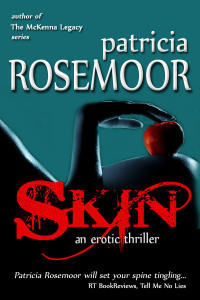
Thanks for reading! If you enjoyed the sample, you can find SKIN at Amazon (http://tinyurl.com/skin.rosemoor) and Barnes & Noble (http://tinyurl.com/7gfu9rm)
You can find me at my website (http://PatriciaRosemoor.com), at Facebook (https://www.facebook.com/PatriciaRose...) and on Twitter (@Prosemoor).







July 1, 2012
Sneak Peek today with Miriam Minger
Today’s Sneak Peek Sample comes from Miriam Minger who has been around almost as long as I have. ‘Walks with Dinosaurs’…would be a good title for an anthology with contributions from those of us who recall tapping out our books with stone and chisel *G*. Anyway, sit back with a coffee and enjoy. And by the way… HAPPY CANADA DAY!

From Miriam:
I was inspired to write The Pagan’s Prize because I love Viking stories! My first historical romance Twin Passions was a Viking novel in honor of my Norwegian heritage. Ever since I visited Norway with my Norwegian grandmother when I was 17 years old, I had dreamed of writing a novel set in that amazingly beautiful country with its deep fjords, thundering waterfalls, and towering mountains. Along every fjord I envisioned dragon-prowed Viking ships and ruggedly handsome Vikings manning the oars, and I even fell in love with a Norwegian sailor. What more evocative setting could I find for my very first romance novel–and when I made a big jump to a new publisher I decided it was the perfect time to write my second Viking historical romance, The Pagan’s Prize. But instead of revisiting Norway I set the story in medieval Russia, which has a history rich in Viking lore. It was truly a thrill to write that novel and bring such a fascinating era alive for my readers. Here’s an excerpt from The Pagan’s Prize that I hope you’ll enjoy:
“You’re a spy, aren’t you?” Zora accused, not surprised when Rurik briefly met her eyes. “For Yaroslav, my uncle.”
He did not answer, but she knew from the way he clenched his jaw that she had guessed the truth.
“And I?” she demanded. “What have I become, Lord Rurik?”
“A pawn.”
His blunt reply was horribly final, and Zora was seized by sudden desperation. “Please…” she begged, though it galled her that she even found it within herself to do so. “Please let me go. What use can I be to Grand Prince Yaroslav? He must know that I am a—”
“Enough!” Rurik cut in harshly. “It is not my authority to release you. The grand prince alone can decide your fate. I only escort you to him.”
Zora held her reckless tongue then. She must keep calm; use her head. It was a good thing that he had interrupted her before she had given away her baseborn status. A very good thing.
If she had revealed to him that she was a bastard daughter, Rurik might think her less valuable and decide that he could still take liberties with her. It was possible. He had assaulted her when he thought her a mere concubine, hadn’t he? Usually, bastards counted as no more than slaves in Rus, and even though her father had offered an incredible reward for her, Rurik might hold the more common view.
Suddenly an idea came to her, filling her with nervous excitement and almost bringing a smile to her lips.
Why not make this journey as difficult for him as possible? Since he must protect her until they reached Novgorod, he would be loathe to touch her or punish her no matter what she did to frustrate him. And frustrate him she would! This pagan would wish a thousand times that he had left her in Chernigov!
Now Zora did smile. If she escaped somewhere along the route to Novgorod, so much the better. How humiliating it would be for him to return to her uncle’s kreml with the news that he had captured her, but she had eluded him! If Rurik was a lord indeed, as his title suggested, her escape would discredit him. A proud Varangian warrior bested by a mere woman! He would be dishonored forever.
Zora glanced furtively at Rurik to find that he was paying her no heed, his expression grim and his gaze narrowed as if searching the forest for signs of danger.
Why not begin? It would make a fine test and maybe, if she was lucky, she would bring some of her father’s troops down upon them. They might still be close enough to Chernigov that someone might hear her.
Inhaling deeply, Zora let out such a piercing scream that a flock of blackbirds perched high in the branches above them took to the sky, screeching and cawing in protest. Rurik was so startled that she managed to scream once more, this time right in his ear, before he could clap his hand over her mouth.
“By Odin, woman, what are you trying to do?” he shouted, his face flushed dark with anger. Yanking the gag back into her mouth, he called to his warriors. “The wench might have given away our position. Ride hard, men, as if the black hounds of Hel were upon us! They might be now!”
Zora gasped as Rurik jerked her hard against his chest and kicked his mount into a faster canter, his tone menacing as he added, “And if they find us, wench, I swear—”
“I hope they do find us!” she retorted in spite of her gag, and to enrage him further, she started to laugh.
“Minx! Do you think this a game? Thor’s blood, royal princess or no, you’ll soon discover that you’ve more than met your match!”
“So will you, you cloddish pagan,” Zora replied under her breath, grinning just for his benefit. “So will you.”
Electronic Version Copyright © 2010 by Miriam Minger
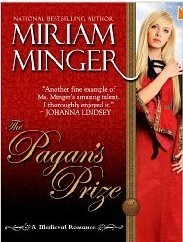
“Another fine example of Ms. Minger’s amazing talent. I thoroughly enjoyed it!” – New York Times bestselling author Johanna Lindsey
“Brilliantly imaginative! The Pagan’s Prize will totally engross the reader.” – I’ll Take Romance
***Best Medieval Historical Romance of the Year Award from Romantic Times***
Be sure to check out Miriam’s website at http://walker-publishing.com/
Facebook: http://www.facebook.com/#!/MiriamMingerfans
Twitter: https://twitter.com/#!/miriamminger







June 24, 2012
Sneak Peek Sunday featuring Julie Ortolon

Hope everyone is relaxing over a morning coffee. Today’s sneak peek is between the covers of Almost Perfect. I think I’ve mentioned the Loopies a time or two before, a group of pretty cool gals who all wrote for Dell way back when. It’s been about fifteen years now that we’ve been on an email loop together, sharing, laughing, venting. Some of us even banded together and wrote an anthology, Masters of Seduction, featuring stories written in our own unique styles and genres.
Julie Ortolon is the Loopie who got most of us roused into reissuing our backlists and climbing on board the ebook self publishing wave. I know she gave me a hard kick in the butt, not just for the reissuing, but for picking up the pen and starting to write again. So, with no further smarm, here’s a peek into book one of Jules’s Perfect trilogy:

Maddy, Christine and Amy are thrilled that their old college suite-mate has written a bestselling book, How to Have the Perfect Life—until they realize she used them as negative examples of how women let fear screw up their lives. The worst part is…it’s sort of true. Together they make a pact: they each have one year to face down their fears—and maybe show Miss Perfect a thing or two!
A Free Spirit and a Reformed Bad Boy — a Perfect Match?
Maddy was always the artistic one of the group, alive with color and mischief from her saucy red curls to her vintage hippie skirts. Her challenge, the friends decide, is to get her artwork accepted at a gallery. A job as arts director at a summer camp near Santa Fe—with its multitude of galleries—seems like a start in the right direction.
There’s just one catch: The camp is run by Maddy’s high school flame, Joe, whose heart she broke—okay, smashed—and his anger towards Maddy hasn’t cooled one bit. But neither has their attraction.
Old desires burn hotter than ever as Joe makes it clear there’s only one way back to his heart: She has to get serious about her art. But will falling in love help or hinder Maddy as she struggles to meet her challenge?
Excerpt from Almost Perfect:
Maddy managed to control her excitement during the paperwork. It broke free, though, as she and Joe left the gallery.
“Can you believe that?” she asked the minute they stepped outside. “She likes the pastels!”
“I like them too.”
“Really? You mean that?”
“I do.” He smiled at her as if suppressing laughter at her enthusiasm.
She didn’t care if he did laugh. “She took all of them on consignment! And she wants to see more. Oh my God!” She did a little dance as they crossed the parking lot.
Joe did laugh at that. “Congratulations.”
“My work is in a gallery. In Santa Fe!” She twirled about, making the skirt of her dress flare, then wrap around her legs. “And not just any gallery, but Images of the West. An art publishing house. I can’t believe this! I can’t wait to tell Christine and Amy. This is so great!”
They’d reached the truck and Joe hit the remote to unlock the doors. Maddy climbed into the passenger seat as he slipped behind the wheel.
“Oh, Joe.” She crossed her hands over her heart and sighed. “This means so much to me. I can’t even tell you. Why didn’t you tell me this was a publishing house?”
“If I had, would you have gone in?”
“No way!” She laughed.
“Exactly. I picked this place because it looks so unassuming, I knew you wouldn’t chicken out.”
“You didn’t expect her to take me on, did you?”
“I knew it was a long shot—but you know what they say: Start at the top. And damn, Maddy, you nailed it.”
“I did.” Her body sagged as realization hit her. “Holy cow, I really did.” She looked at him, overcome, then threw her arms about his neck. “Thank you!”
He returned the hug without thinking. Then the feel of her in his arms slammed into his senses on one blinding wave. He closed his eyes as the impact sucked him under. Desire delivered a second blow, sending him into a roll.
Before he knew how it had happened, his hands were in her hair and his mouth was on hers. The taste of her made joy flood his veins. Her name beat in time with the pounding of his heart. After years of starving for her, he was holding Maddy, kissing Maddy.
He tipped his head and deepened the contact, thrilling to the feel of her kissing him back the way she always had—with an eagerness to match his own. His whole body came alive as their mouths opened and mated. He wanted to lift her over the gearshift and onto his lap, slip his hands under her dress and feel her warm skin. She moaned again, and arched toward him as if wanting the same thing.
Maddy! His heart sang. He was kissing Maddy!
Good God!
His brain kicked in and his body froze.
He was kissing Maddy!
He jerked back and held her at arm’s length, his pulse pounding like surf against rocks. She stared back at him, her eyes wide, her breath coming as hard and fast as his. “What just happened here?”
She blinked as if stunned. “I don’t know.”
Releasing her as if she’d turned to fire, he plastered his back against the truck door. “We are not doing this.”
“I think we just did.”
“It was habit.” He put his hands on the steering wheel. “A knee-jerk reaction. Put us in a vehicle and bam, we’re back in high school making out in the front seat of the Colonel’s station wagon.”
“Actually, it usually progressed to the back of the station wagon.” She looked at the bed of his pickup. “I don’t think that’s a good idea, considering where we’re parked. Unless we want to get arrested for public indecency.”
“I don’t care where we’re parked.” His hand shook as he inserted the key into the ignition. “This will not happen again.”
“Of course not.” Maddy clasped her hands in her lap and stared straight ahead. “Not if you don’t want it to.”
“I don’t.” Was she saying she did? The thought made him edgy with panic as he drove out of the parking lot. What had he been thinking to kiss her like that? Or had she kissed him? He honestly didn’t remember. The only thing he knew was that barely forty-eight hours had passed, and already she was slipping past his defenses. Had he learned nothing from his last go-round with this woman?
The Rangers had taught him how much physical pain his body could endure, but he refused to spend the summer letting Maddy back inside his heart, only to have her walk away come fall. That much pain he couldn’t handle.
*********
Almost Perfect is available through:
Amazon
B&N
Sony
Kobo
Apple
Be sure to check out Julie’s website at www.JulieOrtolon.com
AND…the clock is ticking down on the last few days to pick up a free copy of my own high seas pirate adventure, Across A Moonlit Sea. Get it while you can, this is the last freebie promotion for a book in the Pirate Wolf Trilogy.








June 18, 2012
I wonder if Joan Brady and Jody Picoult buy the same brand of koolaid.
Okay, so I couldn’t resist. I wasn’t going to blog about this, but WTF, I quit smoking, that’s already one trauma this year to strain my willpower.
I’ve quoted James Hall, Consumer Affairs Editor of the Telegraph, from his column today.
If you haven’t read the full article I posted on my Facebook page, let me highlight a few pointers here.
Joan Brady, who won the literary prize in 1993 for Theory of War, a novel about a young boy sold into white slavery in post-Civil War America, said that paper books will never disappear because people use them to “confirm their social identity” and want to be seen carrying them.
Meanwhile lowbrow “pulp” such as “celebrity biographies, Mills & Boon and porn” will “disappear into e-books”, she said.
Ms Brady said that although e-books are convenient for holidays, they lack the social importance of real books because they can not be displayed, lent to friends or passed on as a collection when their owner dies.
She said that once an e-book has been bought, it is “more worthless than used toilet paper, which can at least end up as compost”.
Ms Brady said that e-books can not be conversational “ice-breakers” in the way that real books are.
“People look at your [real] books and say ‘I see you have the new Costa winner. What do you think of it?’ You can’t do that with an e-book.
“Well, I suppose you could pick the gadget up, turn it on and file through the home page, but that’s really like poking into your host’s bathroom cupboard. Suppose you found dirty pictures there? Porn is already sold in plain wrappers, just like the e-books you read on the Tube,” she said.
And this is my favorite part, someone please whip out the Irony Knife….
The author, whose new novel The Blue Death is released in both e-book and physical versions, said that the threat posed to real books by digital ones will keep traditional publishers on their toes.
So…does that mean, because she is having her next book released as an ebook, that she’s calling her own book low-brow porn? That it should be sold in a plain wrapper, no cover art at all? That it should be kept in the bathroom? That no one will discuss it or use it as an ice-breaker in conversation? That it lacks social importance? And that it denies her “social identity?”
Who the F* does Joan Brady think she is? I think, on occasion, I shake my head at the stupidity of some of the articles and quotes and comments I see in blogs and newspapers and on some chat boards. But this one takes a huge chunk of the cake. I am actually left pretty speechless, so no need to worry about the f-bomb falling into every other sentence. Just the big huge Irony Knife.
Sheesh.
And in case you missed the Jody Picoult reference, my blog on that is here http://marshacanham.wordpress.com/2012/04/06/i-hope-jodi-picoult-likes-worms/







June 16, 2012
Sample Sunday with Maryann Miller

HAPPY FATHERS DAY to all you father’s out there. Hopefully you get to sit back, relax, catch a game on TV…read a book! My son is in Michigan this weekend at the Nascar races, an annual Father’s Day event for the past eight years or so, with half a dozen other fathers whose wives are quite happy to take possession of the TV converters for the weekend. I understand Jefferson met his fav driver, Randy Newman, so he’ll be grinning ear to ear all day and I imagine I’ll be posting pics of the Grand Event.
Today, however, I’m turning the spotlight over to my guest blogger Maryann Miller so sit back, relax over a coffee and enjoy.
~~
First of all I want to say “Happy Father’s Day” to all the fathers out there celebrating today. Enjoy your day. Then I want to thank Marsha for inviting me to share a sample from my romantic suspense, One Small Victory. For a while last year, my book and her, Swept Away, were neck and neck on some best-sellers lists on Amazon, a fact I found a bit surprising since my book has less romance. However, we were both pleased to share the spotlight for a while.
In One Small Victory, Jenny Jasik loses her son, Michael, in a car accident and drugs are found at the scene. A single mother who has been busy raising her family, Jenny did not know drugs were so prolific in her small Texas town. She decides to channel her grief into something pro-active, and that complicates her life in ways she did not even imagine.

an excerpt from:
Chapter Six
“I want to join this task force.” Jenny dropped the newspaper on top of an open folder on Steve’s desk.
“Wha—”
“This.” Jenny pointed to a headline CITY LAUNCHES DRUG TASK FORCE.
Steve glanced at the paper then raised his eyes to meet hers. They appeared to burn with intensity. “You can’t”
“Why not? Aren’t the police always complaining about lack of cooperation from the public?”
Steve regarded her, noting the defiant tilt of her chin. “This isn’t what we’re looking for.”
“I’ve been watching them for two weeks.” Jenny threw a notebook down on top of the paper. It opened to reveal a page dotted with scribbles of numbers and notations. “They’re out there like the freakin’ ice-cream man.”
Jenny didn’t realize how her voice had risen until Trudy popped her head in. “You okay in here, Steve?”
He held Jenny’s gaze. “We okay?”
She released a deep breath and nodded. He waved the other woman off and motioned to a chair. After Jenny perched on the edge of it, he rocked back in his and regarded her. “Do you have any idea what you’re asking?”
“No.” She let a smile touch the corner of her mouth.
The smile looked good, and that realization startled him. Not that he was immune to a pretty woman, but this…
“Civilians have no place in this kind of operation.” He tapped the news story with the tip of his pencil.
“I’m not just any civilian. I’m a woman with a great deal of emotion-driven energy. You ever see what a bit of anxiety can do when it comes to cleaning a house?”
He leaned back in his chair and studied her. Jenny wasn’t sure if he was considering her request or trying to sort out her example. Finally, he sighed. “I hardly think—”
“Are you the final authority, or is there someone else I can talk to?”
The interruption seemed to rattle him and he glanced around quickly as if looking for backup. When he faced her again he tapped his cheek with the end of his pen. “You’re not going away, are you?”
“No.” Again she allowed a small smile.
Steve sighed and stood up. “Come on.”
Grabbing her notebook and the newspaper, Jenny followed him out of the office. They went down the hall and paused in front of a closed door. Steve knocked, then opened it when a voice inside said, “Yo.”
The Hispanic man behind a large, pristine desk looked at Steve, then at Jenny, then back to Steve. He raised one bushy eyebrow in question.
“Mrs. Jasik, this is Chief Gonzales.”
“It’s Ms. Jasik.” She stepped forward and offered a hand. “But you can call me Jenny.”
Gonzales sent another questioning look around her, and she turned to see Steve leaning against the wall with an impassive expression. He spoke to the Chief with a brief nod in her direction. “Ms. Jasik is the one who lost her son in that accident a while back.”
“Oh.” Gonzales spoke softly and gave her a look that she interpreted as sympathetic. “My sincere condolences.”
“Thank you.”
He continued to look at her as if waiting for her to get to the point of this impromptu meeting.
“She wants to join the new Drug Task Force.” Steve said.
“Oh.” This time the intonation was different, and Gonzales wiped at his stubble of beard.
“I told her we don’t use civilians,” Steve continued.
“That’s right.”
In the face of his steady gaze, a wave of uncertainty washed over Jenny. What the hell did she think she was doing? Extreme frustration had driven her to the station this morning, but did she really think they’d accept her. It wasn’t like she was brimming with qualifications. A florist? A mother? A woman?
But even as the mental debate raged, Jenny’s heart told her she couldn’t back off without a bit of a fight. Scrapping was second nature to her. Anyone who wondered just had to ask Ralph. For all his faults, she was big enough to admit that she didn’t always make it easy to live with her.
“This is highly unorthodox,” Gonzales said.
Jenny resisted the urge to say, “Sure. Sorry I bothered you.” She forced herself not to fidget under the force of his gaze.
Gonzales leaned back and cradled his head in his hands. “What makes you think you can do this?”
“Determination.” It was the first and only thing that came to mind.
“Determination’s good,” Steve said.
“I was thinking in terms of practical experience,” Gonzales said. “Something that would catch my eye on a resume.”
Jenny stifled a laugh. I can arrange a mean centerpiece.
Gonzales released his hands and sat forward. He studied her for a long moment, then sighed. “Tell you what. Pass the fitness test and I’ll consider your request.”
Fitness test? A picture of Marine boot camp training flashed through her mind. How the hell could she pass a fitness test? Was this the moment she should say, ‘thank you very much’ and take her leave? “What exactly do I have to do?”
The man seemed as surprised by her question as she was. “A modified form of our cadet requirements.”
“Which are?”
“Run a mile without passing out. Twenty-five sit-ups. Twenty-five push-ups. A few more things I can’t recall. It’s been a while since I looked at the training manual.”
Jenny kept her feet planted firmly in place despite her inclination to run like hell. She couldn’t even remember the last time she’d done a sit-up. “How long do I have to get ready?”
Gonzales seemed to consider her slight frame for a second longer than necessary. “Four weeks.”
Driving home, Jenny’s mind whirled with the effort of trying to sort out the complications she’d never considered before making that brash decision to storm the police station.
Not the least of which was keeping everything a secret.
Gonzales had explained that the only way they could make this happen-if she passed the physical challenge-was to run her as a confidential informant. That meant not telling anyone. “Not your kids. Not your mother. Not even your dog can know where you go or what you do.”
That had struck her as funny at the station, but now as she approached her driveway anxiety tore through her. Her whole relationship with the kids had been built on honesty. How could she lie to them? And hide things from her mother, or Carol? There was a good reason Jenny never played poker.
After the car rolled to a stop in front of the house, Jenny killed the engine and sat for a moment. Through her open window she heard the chatter of a blue jay that was worrying a robin in the elm tree. As she watched the birds, she couldn’t help but notice that the branches of the tree dipped dangerously close to the roof. Pretty soon they’d be scraping across the shingles. Something else to fix. Maybe she should just forget this nonsense and take care of her house. Take care of the family that she had left. Forget the drugs and forget-
No. She couldn’t just forget. Otherwise there would be no way to make any sense of Michael’s death. And somehow there was this burning need for reason, for order, for retribution.
* * * * *
The pain in her side finally brought Jenny to a halt and she bent over to get her breath. Good thing she’d toted deliveries around for all these years. No upper-arm wobble for her. But the stamina could use work. She jogged a few blocks and broke out in a huff.
Surprisingly, Carol had outdistanced her. Who would’ve thought short and a little pudgy would have beat skinny as a rail?
Her friend now came back with a broad grin. “I still have it.”
“What?”
“How quickly you forget. High school track? Who beat you then?”
“Bite me.” Jenny headed down the street at a slow lope that Carol easily matched.
“Tell me again why we’re doing this?”
“So we can enjoy our old age together.”
“Who says I want to spend it with you?”
Jenny managed a semblance of a laugh in between huffs. That had been an on-going joke with them for years. Carol lost her husband to cancer two years after Ralph had run off. Neither of them had been able to decide which loss was worse; finally deciding that it didn’t have to be a contest. But what they both agreed on was a real reluctance to make that kind of emotional commitment again. Maybe it was enough to have one good friend and plenty of extended family to love and be loved by.
It had seemed to be a good philosophy until some other basic human needs, the kind that could only be met by someone of the opposite sex, had clamored for attention.
While Jenny had been too busy with kids and eking out survival to tend to those needs, Carol had the means and the opportunity to seek out someone new. Six months ago George had entered her life; complete with the family she and Barry had never been able to have. Granted, they were only every-other-weekend kids, but it was better than the nothing Carol had had previously. And it looked like the relationship was going to last.
Jenny was happy for her friend. Glad to see the dreamy smiles and hear the contented sighs when she talked about George and his two kids. But a little part of her couldn’t help but be envious. Oh, that old green snake.
She shook off the thoughts and coaxed her trembling leg muscles into action. She only had a week left. No time for loafing.
Chapter Seven
Jenny’s muscles turned to Jello. She felt the quiver and knew her arms were about to give out. She struggled to hold, but knew there was no way she was going to push her weight up one more time. Damn. I was so close.
Steve stood on the other side of the mat but didn’t say anything when her arms collapsed and she fell flat on her face. He threw her a towel. “Come on.”
Wiping the sweat off her face, Jenny followed him out of the gym. “Twenty-two was pretty good, wasn’t it?”
“Come to the Chief’s office as soon as you’re changed.”
She waved an acknowledgement before stepping into the locker room and closing the door. She quickly mopped the rest of the sweat from her body with the towel, and then pulled her sweats on over her workout clothes. She wasn’t comfortable using the big open showers.
After putting her hair in some semblance of order, Jenny went through the door that led to a long hall back to the office area of the station. She stopped at the door to Gonzales’ office and knocked. His distinctive voice told her to come in, so she pushed the door open and stepped through. Steve was leaning against the wall beside the desk. Gonzales motioned her to close the door. “Steve was waiting for you before he gave his report.”
Jenny nodded, afraid if she opened her mouth she’d whimper.
Gonzales turned to face Steve.
“She passed.”
Jenny almost fainted. That was not what she expected to hear. Obviously, Gonzales didn’t either. He looked at her, dark eyes wide with surprise. “She did?”
Steve stepped over and passed a sheet of paper to his boss, avoiding eye contact with her as he stepped near. “Got the results right here.”
Gonzales studied the paper for a moment, then shook his head. “Now what the hell are we supposed to do?”
Steve stepped back from the desk. “I think we sign her up.”
“She’s a civilian for Pete’s sake. We can’t sign her up.”
“A deal’s a deal.”
Gonzales huffed and his face turned an alarming shade of crimson. He turned to her. “Uh, give us a few minutes.Tracycan get you coffee.”
Jenny stepped out but stayed by the door. She could hear Gonzales clearly, “I never dreamed she’d actually do it.”
Did that mean he was just stringing me along? That thought made her want to storm back in the room and confront him, but practicality held her back. Venting her anger would probably destroy any chance she had – slim as it was. She put her ear to the door, trying to make out what Steve was saying, but his response was muffled.
She had to step back when Gonzales shouted again, “Christ, it’s my ass if she screws up and gets injured. Or worse.”
Again, she couldn’t hear what Steve said, and for the next few minutes both voices were muffled. A short, scrawny officer in blues stepped out of the break room, stopped and stared at her. “Can I help you?”
She motioned to the door. “Just waiting for Steve.”
Wariness controlled his expression and he made no move to leave. “I can show you to his office.”
“No need.” Jenny turned and walked down the hall, feeling the officer’s eyes on her as she went. The door to Steve’s office was open and she stepped in, nodding to the officer who still had not moved.
The perpetual coffee pot on the tall filing cabinet was half full of what looked like sludge, but it was better than nothing. She found a Styrofoam cup and poured it half full of the dark liquid that flowed like two-year-old motor oil. She doctored it with two creamer packets, and that made it almost drinkable.
Fifteen minutes later, she was contemplating another cup of the coffee. Just to keep her hands busy so they didn’t respond to the temptation to read some of the case files strewn on Steve’s desk. The Wanted posters tacked to a bulletin board had only provided five minutes of interest.
Her stomach was given a reprieve when Steve stepped through the doorway. She looked at him, letting her expression ask the question.
“Come on. The Chief wants to talk to you.”
She tossed her empty cup in an overflowing trashcan and followed Steve back down the hall. He opened the door to the Chief’s office, and Jenny walked in. Gonzales still sat behind his desk, and he motioned her to sit in the chair facing him. Steve pulled up another visitor chair and sat beside her.
“You have to sign this waiver.” Gonzales slid a document across to Jenny. “You’re still a civilian and the department can’t be held responsible.”
Her heart skipped a beat. “You mean I’m in?”
Gonzales nodded toward Steve. “You’ve got quite an advocate.”
Jenny shot Steve a quick glance and noted the little smile that softened the hard planes of his face. She whispered a thank you, then picked up the paper. It had a bold heading:
CONFIDENTIAL INFORMANT
“It’s not too late,” Gonzales said. “You can still back out.”
His tone made the statement sound a plea and she glanced at him, realizing it would probably be easier for him if she did. Too bad, Chief. You’re stuck with me.
She scanned the document. It had general wordage to the effect that should she be injured or killed while acting in a limited capacity for the Little Oak’s police department, there would be no compensation. Short, sweet, and to the point.
Jenny put the paper back on the desk. “Where do I sign?”
“Right here.” Gonzales pointed to a line at the bottom of the page.
“May I borrow your pen?”
After the slightest hesitation, Gonzales pulled a thin silver pen out of the inside pocket of his jacket and handed it across to her.
As Jenny scrawled her name in the space, he kept up a running commentary. “You call in every day. Even if you don’t think you have anything important to report. Despite what it says on this paper, we are responsible for you. It doesn’t look good if people die on our watch.”
“I’ll be your contact,” Steve said, handing her a piece of paper. “Here’s my cell number. Use it to set up a time and place for a meet or a secure phone call. When we do meet it will be out of this area. A different place each time.”
“Pretty cloak-and-dagger kind of stuff.”
“It’s essential. We’re dealing with the worst of the bad boys.”
The seriousness on his face kept her from a flip comment about chewing the paper after she memorized the number. And she wasn’t quite sure why her mind was going in silly directions. Maybe to keep from latching on to just how dangerous this could be? She’d been so busy just getting in shape; the effort had crowded out any scary thought that dared raise a monster head. But she couldn’t ignore the reality today and a tight fist of panic squeezed her stomach. What on earth have I done?
An instinct for self-preservation tempted her to back out of the room with some lame apology for wasting their time. But the desire to squash the drug-dealing vermin held her resolute.
“When do I start?” she asked.
“After I show you what you’re facing.” Steve took her arm and led her to a conference room that had several long tables with a multitude of chairs. “This is our version of a roll-call room.”
He disappeared for a moment, then returned with coffee in two heavy, ceramic mugs. “Got this fresh from the break room.”
“Good. I’m not sure I could stomach another cup from your office.”
Steve set the mugs down, then motioned for her to sit across from him.
“I saw you at the funeral yesterday,” he said as he spread a folder on the scarred surface of the table.
“You were there?”
“Yeah.” He grinned. “Way in the back on the other side. Made it easier to slip out when I wanted to.”
Jenny flushed at his obvious reference to her early escape. “It was just too—”
“I know.” His smile vanished. “It was nice of you to show up at all.”
“It was the right thing to do.”
His expression turned so serious for a moment, Jenny wondered if her comment had come across too pompous. But then he gave her a slight nod and touched her hand lightly. “Yes it was,” he said.
She shifted slightly and motioned to the folder. “Maybe we should get started.”
“Yeah. Right.”
Later, driving home, Jenny’s mind swam in a jumbled sea of all the information she’d tried to assimilate in the past hour and a half. That big beautiful ranch just outside of town that she’d always admired so much; Steve said it was the headquarters of a Cuban man who controlled the drug business inNorth Texas,Oklahomaand part ofNew Mexico. And here she’d been naïve enough to think that the price of cattle must have taken an upswing to support a spread like that.
She also realized how incredibly naïve she was about the whole drug scene. Steve had bandied terms about – mule, runner, dealer, distributor, and main man. Other than mule, the rest sounded like they could be applied to any legitimate business. When she’d voiced this thought, Steve had assured her that except for the product and some of the means, the drug trade was run very much like a legal enterprise.
Her first challenge would be to make a connection with the street dealers. She’d have no trouble locating them. God knows she’d seen them often enough around town. But she’d have to actually approach them and convince them she was a customer. Not something she felt adequately prepared to pull off, but then Steve had said they’d meet with someone from DEA tomorrow. Maybe she could learn how to be a druggie in one easy lesson.
*****************
You can find information about all Maryann’s books at her website www.maryannwrites.com







June 15, 2012
Banging your head against the wall
Have publishers not heard the old adage that if you stop banging your head on the wall, the pain will stop too?
They’ve got the Department of Justice after them for colluding on price fixing, they’ve got feedback from authors and readers alike who leave comments and write blogs and are now even leaving one star reviews on Amazon and other places simply because the ebook is priced to high and they refuse to buy it. Nothing to do with the quality of the writing or the author. No, the one star is to let the publisher know the price is too high. That’s a head-banger on two levels, though, because a one star review affects the author’s rankings and publishers don’t even bat an eye. I doubt they even read the reviews and care even less for the author’s reaction to seeing her book plunge to the bottom of the ratings heap.
I suspect they don’t care, period. They don’t listen to the bloggers and posters. They certainly don’t listen to the authors. They just bang their heads on the wall and wail and moan over their falling sales and the evils of Amazon taking over the world.
Wah wah.
Have they done anything about it? Have they thought about competing instead of just whining?
Have they thought of negotiating better royalties to keep their bestselling authors from jumping ship and testing the waters of self publishing? Nooooo.
Have they *lowered* (gasp) the price of ebooks so they at least match the price of the same book in paperback? Noooooooo.
Has it occurred to them yet that without any authors they will have no company? No product? What if, Big Six, every author currently under contract did not sign another one. What if they honored the current contract then turned to self publishing? I have this vision of a multi-storey glass office tower in Manhattan, filled with editors, art directors, marketing folk all sitting at their desks looking around at the guy next to them who has nothing to do either but shoot paperclips down the empty halls.
It ain’t Amazon’s fault, people. It’s your own damn short-sighted pig-headedness. With us, you carry on. Without us, you fail. You want to stop the pain? Stop banging your head on the wall wailing about something that has nothing to do with why you’re growing increasingly unpopular. You’ve had a great run of about three, four centuries of calling all the shots and paying your most valuable commodity the lowest percentage on the totem pole. But guess what. The authors are getting smarter and more secure in their independence every day. They see the math. They get the checks in the mail every month. They connect with the reading public in more ways than were dreamed of ten years ago, even five years ago. The readers are getting savvy too. They aren’t going to pay $14.99 for an ebook that costs the publisher next to nothing to produce and gives them a 70% profit. (with only 12.5% of that going to the author) Pffffffffft.
Give the authors the respect they are owed.
Give the readers the respect they deserve.







June 9, 2012
Sample Sunday returns!

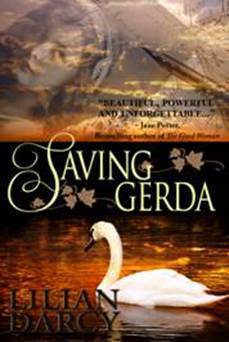
Sample Sunday is back and I’m pleased to bring you a Sneak Peek from Lilian Darcy’s new book, Saving Gerda, to enjoy with your morning coffee.
 Thanks so much for having me on your blog, Marsha. I’m thrilled to be here amongst all these very fine-looking men gazing out at me from your covers. I particularly like the one in The Following Sea. Actually, there are even more of them over on your website. If you’ll excuse me, I’ll just pop on over there as soon as I’m done here. Or Amazon. I could go to Amazon and buy some of those fine-looking men and keep them on my Kindle…
Wait, is this what I’m supposed to be talking about?[Note from blog owner: YES, of course you are!!!] I don’t think so. [Bummer]
I’m here to introduce Saving Gerda, out this month in ebook on all major platforms. This was a hugely challenging yet satisfying book to write, haunting my headspace for years before I finally got it down on paper the way it needed to be, and I very much hope readers will respond to it. Here’s a little more about it, and an excerpt to give a real taste:
Out of the smoke and shattered glass of Nazi Germany’s Kristallnacht in November 1938, two families in impossibly different circumstances become linked by tangled bonds. Wealthy and privileged Kitty von Kolhausen must somehow draw something from this dangerous new relationship that can save her precious child.
In Chapter Four, we see Johannes Fruehauf just after his first meeting with Kitty. He has come to Paula zu Greitz’s house to paint her portrait, and Paula has urged her friend Kitty to commission a portrait from him as well, but the atmosphere has become very awkward following Kitty’s departure…
Chapter Four
Potsdam , July 1938
Paula zu Greitz’s body in the nude was not sensual, Johannes had quickly realised. Her torso was boxy and too short, and her shoulders were like the shaped corners of a suitcase. Even her breasts seemed boxy, made square by the pectoral muscles beneath. Her hip at least rose in a nice shape and he made the most of that, playing with the curve, running his paintbrush across the canvas in a lush arc of exaggerated pink to mound it higher and rounder, echoing the line of the chaise longue’s rounded back.
He was very thankful for the chaise longue. It could lend some of its sensuality to Paula, and with any luck she and her husband the Count, for whose birthday gift this Bohemian portrait was intended, would not notice what he had done, and that so little of the life and beauty in the painting came from Paula herself. He could bounce reflected light from the crimson velvet upholstery onto the skin that she powdered too pale. He could paint the carved wood like the thick waves of glossy brown hair she might have had in her youth.
Johannes had his own theories about this youth of hers. She was only seven or eight years older than himself, he thought. Perhaps not yet forty. But something about her suggested the excesses of Berlin ten years earlier and made her seem older. The heavy Oriental scent she chose, the way her dyed hair had thinned, the glimpse of scars running lengthwise along her wrists, their once-garish evidence of her destructive intent now faded to three or four thin, silvery lines. He had an idea that her fifteen-year-old daughter Liesl had been born well before her advantageous marriage.
As soon as the thin, blue-eyed English beauty had left, the Countess offered a toxic variety of cocktail. Johannes declined it, trying to save them both. He could tell that the Countess had drunk too much wine at lunch. For a moment or two he’d thought that Baroness von Kolhausen might find a way to save him from Paula’s intent. She’d looked as if she wanted to, as if she understood to an embarrassing extent what was going on, but then she had let Paula hurry her away, leaving Johannes with an instant, chivalrous, ardent and unrequited infatuation, borne of her beauty and his thwarted gratitude, her perception and the twinkling, and at the same time startled, look of commiseration in her blue eyes.
He’d once felt this same way in Paris , plunged into an immediate and hopeless passion for a woman of similar appearance and manners. Fine-boned and pretty and pale, effortlessly well-bred. He’d made dozens of drawings of Daphne, in Paris , little studies of her hands or her face half-hidden by the edge of her seductive hat. He’d barely been able to utter a word in her presence, knew nothing about what she was really like, had never forgotten her, would never see her again, had had a weakness for her type ever since.
The Countess showed a moment of sheepish regret about the offered cocktail, having taken his awkwardness for disapproval. He was quite right, of course, she quickly said. Coffee would be much better. But then she was sheepish about that, too. She liked the Turkish style, thick and fragrant and strong. “It’s no wonder I don’t sleep!”
She made Johannes uneasy, but then most of the people he met had that effect on him, as soon as he was forced to engage with them. He did not know what they would think of him. He did not know with which of them he belonged. He was far better as an observer, at a distance, because then he could forget himself.
Paula’s husband had cancelled their last sitting at short notice, via a curt telephone call made to the shop, Appelfeld and Sons, Fine Repairs, Watches and Clocks. Johannes only worked there intermittently and it was purely by luck that he’d received the message about the cancellation in time.
Today, having rescheduled as if nothing was wrong and introduced him as a talented artist to her beautiful English friend, the Countess then questioned him with a little too much carelessness and innocence about his employer. What kind of a business was it, just by the way? Had he worked there for long? Was he on close terms with the proprietors? Were they relatives, perhaps?
No, he told her truthfully. Appelfeld and Sons were not relatives.
Good to know, she drawled.
While talking, she unconsciously moved her position and he had to say to her, “Please, the left arm a little lower. And the shoulder more relaxed.”
The rounded hip looked good, now. He borrowed a little more sensuality from the chaise longue beneath her and went on painting, while the smell of boot polish, resolute and somehow military, reached his nostrils via the mild late afternoon air drifting through the open window. A servant must be out on the back steps attending to the Count’s shoes. He could hear the brisk strokes of the horse-hair brush back and forth across the leather. The sound stopped, started again, went on for a very shiny and thorough length of time, punctuated by the occasional clopping sound of a boot sole on the brick.
He forgot about the boots eventually, and became lost in the paint, the swim and stipple, the…the… you could almost call it surgery, or music, of his movements with the brush. Heaven must be like this, he sometimes thought. The terrible clumsiness and consciousness of the body and the self would miraculously disappear. Only the fascinating perceptions of mind and spirit would remain, and the fierce struggle to truly see.
The Count came home, evidently earlier than expected. Paula heard the sounds of his arrival, a car engine, doors, his voice. Murmuring and frowning, “Oh, dear, he didn’t say he’d be home, perhaps I should have told him…” she sat up and reached for the flowered silk robe draped over the footstool in front of the chaise longue. Johannes had borrowed significant amounts of sensuality from the robe, too.
The Count came into the room, carrying a letter opener and an envelope already slit. He saw his wife, the easel and Johannes. “Paula!” The word contained a wealth of agitation and disapproval. “Oh, no, no, no, no, no!”
“You had appointments, Ernst, I’m sure.”
“They were cancelled. But Heller is coming with some papers to be signed.” He dropped the envelope and opener on his desk, strode over to the picture. Johannes stepped back automatically out of the way, failing to perceive the man’s intention.
He wasn’t long left in doubt. “He could be here at any moment, Paula!” The Count wiped at the painting, his fingers sliding down through the wet oil, rapid and clumsy, the heel of his hand pushing back up.
He went first for the face, obliterating its half-finished features, then smeared at the naked breasts and the triangular fold of the crotch, half-hidden by the angle of Paula’s painted thigh. He swore under his breath, looked at his sticky fingers, made a sound of regret and disgust. Not, Johannes understood, because of what he’d destroyed but because he’d made such a mess of himself. He grabbed a rag this time and went at the painting again, smearing the crimson chaise longue into the flesh, ruining the outlines of Paula’s body.
Ruining the whole thing.
Johannes couldn’t move or speak. Stupefied with creative loss, he fumbled inside himself for a reaction. He felt immediately in the wrong and at the same time deeply wronged, hurt through. Did he have any rights in this situation? It seemed not.
Paula sat and watched from the chaise, hunching over the robe in her hands. She hissed and sighed at an especially harmful scraping movement through the paint. “Oh dear, this much fuss?” she murmured again.
The Count mastered himself at last and clipped his words, wiping his hands in vain on the rag then giving another glance of distaste at the tenacious oil. “It’s not a fuss. What a word! Why must you – ? Put on your robe. Excuse me, Mr…” He couldn’t remember Johannes’s last name.
Johannes supplied it with his usual difficulty, wondering if it would be any use. “Fruehauf.” So German, with its suggestion of industrious rising before cock crow each morn. Such a torture of a name for a man who often stuttered, with the worst of all possible letters at both the beginning and the end.
“I must speak to my wife in private, Mr Fruehauf. I think you need hardly ask why I’ve had to act this way. The cunning and deceit are indeed typical, one begins to think.”
Paula wrapped herself in her robe and disappeared in his wake without another word. The Count cast a short, exasperated glance back at her. In it, Johannes thought he could read love worn thin but not vanished completely, a weary readiness to give guidance, and a habitual bad temper that had sources other than what was happening at home. In the corridor before the door closed, he heard, “I told you, no more sessions until I’d asked a few questions. The sheer foolishness – !”
“I thought I could tactfully – ”
“That’s why I cancelled the last sitting. You know that perfectly well. And yet you rescheduled and didn’t have the sense to tell me.”
“Because I knew you’d – ” Johannes couldn’t hear the next bit.
“You didn’t have the sense.”
There was more that he couldn’t hear, then, “ – ruining my fun. I’ve even recommended – ”
A rising tone. “I told you at least to put clothes on and change the pose. Do you not understand at all? Do you think your silliness and my money and position make you immune? And now the rumour’s confirmed by this man in Munster . Do you not realise that you could be taken out into the street and publicly shamed? It could ruin my – ”
“What about what you’ve ruined? Art!”
“That is scarcely significant! Art, indeed!”
After this, Johannes could not hear any more. They’d retreated to another room. He decided he’d better complete what the Count had started, and began to clean off the canvas with a rag and a palette knife. The room soon stank of turpentine and he was left with a scraped-off rectangle, a residue of streaky mauves and pinks and light browns, nothing to suggest the figure that had once lain there, and only a crimson blob on the side of the stretcher frame as a remnant of the chaise longue. The Countess came back about ten minutes later, hastily dressed in sober clothes. “Apparently…” she began, but could not find a way to finish.
Johannes did not wish to betray himself with speech, either. He began to nod, indicating, no matter if it was truthful or not, that he understood. Apparently covered the matter from several angles. He had begun to notice the proliferation of apparently in all sorts of places, afflicting all sorts of people, and apparently was all it took. The precise truth did not need to be nailed down. This or that grandparent, the red herring of Christian baptism, these things did not signify. The stigma of apparently sufficed. Should he have felt an obligation to announce his ancestry at the beginning? The Count apparently thought so.
“He finds me troublesome,” Paula said, still in apology. “I don’t think in advance. I didn’t think to establish… I really thought it was a fuss about nothing. Pack up your things. Take your own time. I’m sorry, this is all I could put my hands on.” She pressed some notes and coins into his hand and peeped at him from beneath her sparse, painted lashes, instinctively still flirting, even though he’d been trying so hard not to give her the slightest encouragement. Then she looked quickly away, aghast at herself.
When she let herself out of the room, Johannes glanced at the coins and the crumpled notes that wrapped them, and felt his stomach curdle. The portrait was well advanced after three sittings, he’d been about to pack it up and take it back to his apartment to finish it there, and the Countess had paid only a fraction of the sum due on completion. Business at Appelfeld and Sons had not been good lately, and he was only paid for the work he did, a day or two a week at most. He would not be eating well for the rest of the month.
He pocketed the notes, packed up his paints and brushes, and wrapped the wet, ruined canvas in newspaper and string. His body did not know whether to puff its lungs in indignation or bow its shoulders beneath the weight of acceptance. Even his clothes… his skin… did not seem to fit.
The Count met him at the open front door and gave him a hearty handshake. His palm was soft and still damp and soap-filmed from much washing. In the driveway, a car pulled up and out climbed the man Heller who had papers to sign, an official in Party uniform. The Count gave Johannes a moment of frank, sympathetic eye contact, as if to suggest that none of this was personal, and indeed Johannes could not fully feel that it was. It was, surely, to both of them, one of those accidents of fate that one must simply make the best of, like losing a foot in the war.
But then, when he stood on the front porch, he could not help a half-turn for one last glimpse of the reassurance he had felt in the Count’s manner, and this time he saw something else. With a series of tiny clicking sounds, as he waited for Heller to come up the path, the man was picking the paint from beneath his fingernails as though it was excrement or blood.
Lilian Darcy
Saving Gerda
Be sure to check out Lilian’s website at www.liliandarcy.com







June 4, 2012
The Fear Factor
Some of the most prominent names in romance (because those are the ones I’m most familiar with, naturally) have peeked out from behind doorways and inched up toward the strange glowing light in the center of the room. They’ve reached out a tentative hand and touched the sparkly aura, felt the warmth and seen the possibilities and potential that is self publishing. Some of these authors have 10, 20 backlist books that they haven’t known what to do with. Some only have two or three. But the glowing light has intrigued them and they want to step forward and venture into the unknown, but fear of that unknown is holding some of them back.
I admit to having a whole bunch of fears and doubts in the beginning. I’m an original troglodyte who started writing on an old Underwood typewriter, banging out words like they were gunshots, using gallons of whiteout to correct mistakes. I hammered out four manuscripts, each of them between 5 and 600 pages long and sent them all through the full circuit of publishing houses hoping that maybe this one, or that one would catch the brass ring and win a contract. It wasn’t until the 5th manuscript was accepted that I closed the thick file of rejection letters. I actually thought many times about burning it in effigy to all the nasty mean editors who couldn’t see that they had pure gold in their hands, but every now and then I read a few pages of each mss and realize the editors were right and I was wrong. The books were definitely not good enough. Each one got better, got tighter, got more focused as I found my “voice” but none of them deserved to see the light of day.
Zoom forward 25 years. Had I written those books today I might have had the hubris to self publish them because at the time I wrote them, I thought they were brilliant. It’s only now, looking back with the unforgivingly harsh, self-critical eye developed over the years, that I can see how truly amateur they were.
Twenty five years ago there were no readily available options to getting your book published. There was print and there was print. No ebooks. No internet. There *was* a little thing called Vanity Press, which was usually (in my mind anyway) reserved for poets and writers of short stories, diet and how-to self improve, and books filled with personal angst. There wasn’t a wide market for that sort of stuff and there still isn’t, I don’t imagine. But Vanity Press was more or less the bottom run on the ladder, the last resort if someone really really really wanted to see their book in print. It wasn’t cheap and you had order in volume. The books arrived on a truck and your garage got filled with boxes that you had to take around and try to flog to bookstores by yourself. Not very appealing and again, something only those with diehard convictions would resort to.
Zoom forward again. Writers now not only have the option to self publish a digital ebook, but they have Print On Demand through Amazon and other outlets. It allows authors to upload a book and have it sold either as an ebook or, with the click of a button from the reader, it can be ordered in print. No huge massive printings like those done by publishing houses. One click, one purchase, one book is printed, shipped and delivered.
I could digress here and air another pet peeve of mine to do with publishing, that being the process of printing 100,000 copies of a book, shipping them out to bookstores where a dozen or so sit on a shelf for three weeks to see if they sell. If only one copy sells, the rest are stripped of their covers and incinerated or otherwise shredded and shipped to landfill sites. The bookstore sends the ripped cover back to the publisher for a credit and the process starts all over again with the next books that are shipped out. Can you even fathom the waste involved in that system? Multiply that one book by a thousand, multiply that by fifty, sixty years…
Anyway, getting back on track here, and back to the title Fear Factor. There are still some authors out there who are in the “wait and see” mode. They have watched the ebook wave steamroll through the publishing houses and bookstores knocking some off their feet. They’ve seen the price-fixing lawsuits, they’ve heard of the mostly modest but sometimes resounding successes of authors who have taken the initiative and dusted off those out of print books hoping to find a new generation of readers. So why are they still in “wait and see” mode?
Fear.
It is, after all, a brave new world out there. Self publishing takes a lot of time and effort and chutzpah. More and more services are cropping up that will take a print book and digitize it for the author, then clean it up and format it for an ebook. There are cover designers and freelance editors, even people who will do some of the marketting for you.
But to some, there is still that stigma of vanity press attached to self publishing. There are still some books out there that should never see the light of day. They are poorly written, not edited, nary a sign that spellcheck was even used, they have crappy covers slapped together with crayons… In the past year the ebook market has exploded and while I don’t have any numbers at hand, I’m guessing of all the ebooks published a good 75% or more are by Indies. Independent writers who have never been in print before but have a yearning to write…and there is nothing wrong with that. Nothing at all. But while most of them have come to realize that publishing a good ebook is just as critical as publishing a good print book, there is still that percentage who think they don’t have to edit because their book is brilliant as is, even without spellcheck.
Wrong, my lovelies.
So, added to the fear of being associated with vanity press is the fear of stepping into that circle of glowing light. Both the author and the author’s work is exposed to the criticisms of readers and reviewers alike. A twenty year old book is just that: a twenty year old book. Historicals stand up modestly better than contemporary books (and again I’m talking romance, which is the genre I know best) simply because they don’t have to get updated from wall phones to cell phones, from telex machines to computers. I have one piddly little contemporary romance published by the Evil Empire some twenty years ago and I started reading through it after I wrangled the rights back, but to reissue it now would require a whole new rewrite. It practically reads like a historical, right down to the model and make of cars, hotel facilities, modes of transport and communication. I quietly tucked it away in a drawer knowing I would never have the time or energy to give it the attention it needs. If I published it as is…yikes. I wouldn’t even want to guess what the reviews would say. I’m in the process of updating a historical and that is proving to be monumental enough. Doing the contemp would be sheer terror.
There is also the fear of having been forgotten. I know that one first hand. I went into a seven year hiatus, which, for a writer is like dog years, about seventy. I wasn’t exactly hugely well known when I was writing full time; I was a comfortable midlist writer, always given promises that I would get moved up but, like so many promises publishers made, that never happened. So, a double whammy. Midlist author vanishes for seven years. Yikes.
Midlist author who vanished for seven years, went through a horrible divorce, was ignored by her agent and lost all sense of confidence, hauling out and revising backlist books in the hopes that somewhere out there someone might remember her…double yikes.
Formatting? Covers? Marketing?
Midlist author who vanished for seven years, went through a horrible divorce, was ignored by her agent and lost all sense of confidence, revising backlist books, having to learn how to format, how to make covers, how to upload and market the thing once it was live and in the public eye….yikes, yikes, yikes.
Yes, I can definitely see why there are some authors still peeking out from the doorway, still afraid to approach the glowing light. The thing is, if you don’t approach it, you’ll never know what happens when you touch those sparkly edges. It isn’t Vanity Press. It’s freedom. It’s regaining a sense of worth and creativity.
It’s getting your chutzpah back.







June 3, 2012
A sample for your Sunday
A happy, relaxing Sunday to all. For a treat today I’m posting an excerpt from a good friend of mine, Cynthia Wright. She climbed aboard the self-pubbing wave about a year ago along with the rest of us clever, independent, quick-thinkers and started reissuing her backlist as ebooks. She has some gorgeous covers (no, I didn’t do them, but that’s okay, I still like her *snort*) and some terrific books so if you haven’t tried Cynthia yet, here’s a sample from her stand alone Western, Brighter Than Gold.
By the way, if you would like me to bring back Sample Sundays on a regular basis, leave a comment after the excerpt *G*
**********
Columbia , California
June 1864
Riding slowly downMain Street, the man on horseback reflected that the sleepy town ofColumbiahad certainly known better days. A dozen years ago, it had been heralded as the “Gem of the Southern Mines,” the largest and most prosperous of all the towns that had sprung up during the rush for gold in the Sierra foothills. More than fifteen thousand boisterous people had lived here, making and spending fortunes inColumbia’s thriving gambling palaces, saloons, fandango halls, theaters, restaurants, and bawdy houses. Stores were stocked with merchandise delivered by a constant stream of freight wagons fromStockton. Stagecoaches rumbled downMain Streetmorning and afternoon, dislodging a colorful variety of eager newcomers, including a French chef who charged outrageous sums of money for gourmet meals and imported champagne. The town’s four theaters had hosted Edwin Booth, Lola Montez, and circuses with elephants and lions.Columbiaeven had a Chinese theater for the particular benefit of its immigrant citizenry.
In the town’s first decade, more than $87 million worth of gold had been discovered in its diggings. The scales at the Wells Fargo office weighed an average of $100,000 of gold a week, and in the heady decade of the 1850s, it seemed that the supply would never run out.
However, those days of unrivaled prosperity had passed.
On this dusty afternoon, the man on horseback rode into a town of fewer than five hundred people. Tucked behind hills that staggered down to the dramatically beautifulStanislausRiver,Columbiahad acquired a haunting serenity lacking in its heyday. Delicate trees of heaven linedMain Street, and many of the homes were embowered with climbing roses in full bloom. The clamor was over, yet the traveler felt a surge of respect and fondness for this tenacious community. It had had its share of challenges, but it simply refused to die, adapting instead to change.
Farther ahead downMain Street, the traveler spied MacKenzie’s Saloon. Hot, tired, and in need of friendly conversation, he decided to stop for refreshment.
* * *
At the far end of the polished mahogany bar, Katie MacKenzie was perched on a stool, drying glasses and reading Jane Eyre at the same time. It was a quiet afternoon. The shafts of sunlight that streamed into MacKenzie’s Saloon were mellow and golden, scented with roses. The corner tavern was large, with a magnificent carved mirror behind the bar and numerous tables ringed with chairs. Once upon a time, MacKenzie’s had echoed with the laughter and raucous conversation of men from all walks of life. Now, the place was an ornate mockery of a golden age long since passed. Katie looked up to see two lone, grimy miners, clad in red shirts and dungarees, who slouched at a distant table, dozing before their empty bottle. Farther down the bar, Brian MacKenzie poured a whiskey for his third patron, then approached his daughter.
“I’m thinking this is a fine way for you to celebrate your twentieth birthday,” he murmured, his ruddy face and curly white hair reflected in the twenty-foot mirror behind them.
Katie gave him a sweet smile. “Nonsense, Papa! You sent all the way toBostonfor this book and you gave me these beautiful flowers.” Lovingly she fingered the vivid bouquet of blue larkspur and orange Humboldt lilies that filled a vase at her elbow. “It’s a perfect birthday!”
Brian wrapped her in his bearlike embrace and smiled. “You’re a blessing, Kathleen Elizabeth. Why don’t you put away the towel and glasses and go outside? It’s not a day for chores.”
“I’m fine, Papa.” Already her attention was wandering back to Jane Eyre.
Sighing, Brian studied his daughter’s profile. It was almost a shock to realize, daily, how beautiful she had become and how much Katie resembled her mother who had died eight years before. She had inherited Mary’s lustrous ebony curls, her striking deep blue eyes, her delicate features, and radiant smile.
However, Katie’s temperament mirrored his own. Growing up in the rugged atmosphere of a mining town, Katie was used to working hard, but otherwise she dressed and behaved to please herself. Today she wore a faded rose calico dress with one petticoat, but she was just as likely to be clad in trousers and a shirt if the mood struck her. Worst of all, Katie had declared that she had no interest in marriage. And she did indeed seem to prefer helping him run the saloon or writing articles for theColumbiaGazette. Women were at a premium in the foothills, especially beauties like his daughter, and Brian prayed nightly that she would come to her senses one day soon and begin acting like a woman.
“Quite a romantic hero in that book, eh?” he inquired slyly. “What’s his name?”
“Edward Rochester.” Katie gave him a fond smile, familiar with his ways.
“Indeed? Why, seems to me that that name alone would be enough to turn a maiden’s thoughts to love!”
The swinging door creaked to announce the arrival of a customer and Brian trundled back to work. He squinted as the man approached the bar, then smiled broadly as recognition dawned.
“Why, it’s Jack, isn’t it! Where’ve you been these past weeks?” He set a shot glass on the bar and reached for a bottle of whiskey.
Settling onto a stool, Jack spread a tanned hand over the glass. “Save your whiskey for someone who’ll appreciate it, MacKenzie,” he said in a husky voice underlaid with ironic amusement. “Do you serve water?”
“Ah, that’s right!” Brian laughed, remembering, as he poured spring water from a pitcher into a larger glass. “You don’t drink liquor. Tell me, do you belong to that Dashaway Society that’s been promoting temperance in these parts?”
Jack’s answering laughter was sufficiently roguish to make Katie look up at last. “Lord, no,” he replied. “I’ve just never seen the point in drowning what few wits I have in liquor.”
His expression and manner made it clear to Katie that Jack’s wits were far more considerable than he so modestly implied. His looks were noteworthy as well. Katie’s first impression was of a mountain lion. His hair, wind-ruffled and dusty, was a few shades darker than his sun-bronzed skin, and a two-day growth of beard glinted against his lean cheeks. There was something appealing about the slightly bent shape of his nose, the smile that lingered on his mouth, and the grooves on either side that hinted at dimples. She was most intrigued by his eyes, though, and wandered down the bar for a closer look.
Cat’s eyes, she decided after a few moments. A clear, sage green dusted with gold, slightly hooded, as if a bit weary of surveying the world, and framed by laugh wrinkles and sandy brows. Katie was disarmed by the sight of his roguish smile and the sound of his frank, husky laughter, but she sensed that, like the mountain lion he resembled, this man could be dangerous.
“Ah, here’s my girl,” Brian announced, wrapping an arm around her slim form. “Katie, have you met Jack Adams? He’s new to these parts. Came in here the first time just a couple months back. Jack, this is my pride and joy, my daughter Kathleen.”
Seeing the appraisal in his eyes, she put out her hand and smiled. “I’m pleased to meet you, Mr. Adams.”
He smiled back. “The pleasure’s mine, Miss MacKenzie,” he said in his appealing, rough-edged voice. “Call me Jack.”
“I’m Katie.” As their hands met, she glanced at the surprisingly clean, well-tended nails. It was a strong hand, tanned against the faded blue shirt he wore but only slightly callused. She wondered what he had done before coming to the gold country. “Where are you from, Jack?”
He shrugged. “Nevada, lately.Placervillelast week. I have my eye on a couple different claims, but can’t decide whether they’re worth working. One’s near here.”
“Just because the boom’s past and so many miners have moved on toNevadaorCanada, that doesn’t mean our gold’s gone!” Brian declared, seizing on one of his favorite topics. “A man with a bit of patience can still get rich and live a more civilized life in the bargain!”
“Columbiadoes look permanent these days,” Jack agreed. “Until last fall, I hadn’t been in the foothills for years. The towns were all wood and canvas when I was here in my youth; a mixture of imported luxury and make-do. A lot of them are gone now that so much of the gold’s been mined, but what’s left is more civilized.” His eyes crinkled at the corners. “Maybe the miners left because they missed the wild life.”
“There’s still enough wildness up here for any man,” Brian snorted. “And enough challenges. They’re destroying the land with that new hydraulic mining now!”
“You must admit that Jack’s right, though, Papa,” Katie remarked, pouring more water intoAdams’s glass. “Times have changed. The people who came here looking for wealth and adventure a dozen years ago have either moved on or settled in to more permanent lives.Columbia’s a different town.”
“Quieter, that much is true.” Brian sighed, gazing around the nearly deserted saloon.
Deftly, Jack changed the subject. “Missouri Dan rode down fromPlacervillewith me, and we spent last night just north of here. I didn’t get much sleep, though, because Dan made me dig most of the night….”
Katie responded to the gleam in his eyes. “Dig?”
“Seems that last fall Dan discovered some gold over nearFraserRiverand brought it here to be weighed. There was more than five thousand dollars’ worth, but he decided to put it away for safekeeping rather than take it along toPlacerville—”
“Or have it stolen by theGriffin!” Katie exclaimed.
“I think theGriffinspecializes in stagecoaches, lass,” her father murmured.
“Anyway,” Jack continued, “Dan chose a clump of five pine trees near a stream, and buried the gold there. The winter inPlacervillewas long and lean, so Dan was anxious to get to his pine trees last night and dig up that treasure.” The corners of Jack’s mouth slowly turned up as he paused to sip his water. “The stars were out as we came over the crest of the hill, but instead of lighting up Dan’s clump of pine trees, they shone down on a vast, cleared field and a newly built cabin.”
Katie gasped. “Someone had settled there!”
“That’s right.” He nodded, more than a little amused, his eyes twinkling as they met hers. “They’d not only cut down Missouri Dan’s pine trees, but they’d also planted grain. Of course, he wouldn’t give up without a fight. Made me dig alongside him all night long until that field of grain was covered with holes. I just prayed that the farmer wouldn’t wake up! As it is, I shudder to imagine the look on his face when he saw his field this morning.”
“Don’t suppose you found the gold?” Brian asked hopefully.
“Of course not! Dan’s in the blackest of moods. I left him digging one last hole before dawn, but I heard that he was at Big Annie’s this morning—” He cut himself off, realizing that he shouldn’t have mentioned Big Annie’s bawdy house in front of Katie.
“He should have put the money in the bank,” Katie said.
“Now there’s a civilized suggestion! Not Dan’s style, I’m afraid.” Jack laughed lightly as his eyes wandered over her face and settled on the thick braid that hung down Katie’s back. “You’re an uncommonly pretty girl, Miss MacKenzie. You’d have men lining up outside just to look at you if you’d change your style. Why not free your hair?”
Katie took a step backward, bumping her elbow against a decanter of brandy. “I prefer to wear it this way. It’s cooler.” Her cheeks felt hot. “And neater.”
“She’s a stubborn girl,” Brian toldAdams.
“I don’t give you men grooming advice so I suggest that you show me the same courtesy,” Katie said, recovering her composure. “Besides, why would I want to be examined by a lot of strange men?”
“I can’t imagine.” Jack bit back a smile. “I humbly apologize.”
“Apology accepted. If you are starved for the sight of female beauty, you ought to visit the new German dancing girls at Darling’s Dango Hall.” Picking up Jane Eyre, she turned to her father and said, “Papa, since you have urged me to do as I please today, I believe I’ll go over to the Gazette and write an article about Missouri Dan’s adventure. I think our readers might find the story very entertaining.”
“Wouldn’t you rather spend your birthday seeking some entertainment for yourself?”
“I love to write, so that is entertainment.” Katie kissed his cheek, then smiled politely at Jack. “Meeting you has been very interesting, Mr. Adams. Have a safe journey.”
“That’s kind of you, but I’m not leavingColumbiajust yet, Miss MacKenzie. I feel certain we’ll meet again.” He gave her a lazy smile. “Happy birthday.”
Jack watched Katie cross the saloon and stride out into the sunshine, idly noting her slim back, narrow waist, and gently curving hips. When he turned back, he discovered that Brian was contemplating him thoughtfully.
“I don’t know what to do with that lass,” MacKenzie said, sighing. “Twenty years old today and she’s acting like there’s no hurry to marry. I don’t think it even crosses her mind! Not that any of the men around here are worthy of her. Many of the best are off fighting in the war between the North and South.” He shook his head. “It’s a difficult bride who’s not only beautiful but also smarter than most men. She’s hardworking and has a mind of her own, but she’s quick to laugh, too, and—”
“MacKenzie,” Jack put in softly, his expression knowing yet amused, “why are you telling me this?”
He looked down the bar at the bouquet of lilies and larkspur and heaved a sigh. “I don’t know.”
“Neither do I.” He patted the older man’s shoulder, then stood up and brushed the dust from his smooth buckskin pants. “I’m off to have a bath and a shave, get my clothes laundered, and take a room above the U.S. Bakery and Coffee Saloon.” He put some coins on the bar. “Thanks for the water and conversation, MacKenzie. Buy Missouri Dan a drink for me when he comes in, will you?”
“Be glad to.” Brian picked up the coins and looked at them for a moment. “If you want a clean bed and home cooking, you’re welcome to stay with us. I like you.”
Jack stopped at the door and glanced back, his wide shoulders and lean hips outlined against the sunlight. “That’s a kind offer. I’ll consider it.”

Don’t forget to check out Cynthia’s gorgeous web site: http://www.cynthia-wright.com/
And, if you have a moment (shameless plug here) you might want to download a copy of Across A Moonlit Sea while it’s still free, annnnnnnnnnnnd…if you have two spare moments, check out my “Possible Jonas Dante” board at Pinterest and toss in your vote for who should be pinned over my desk as inspiration for the lusty, dangerous fellow.








