
Marsha Canham's Blog, page 14
July 4, 2011
Monday Morning Readalong
Sample Sundays seem to be a well-received success, so I thought I would add a Readalong Monday. I've posted excerpts of all my books on my website, but sometimes a reader needs more than just a snippet here and there, so my thought is to give all my readers an entire book. Each Monday, I'll post a new chapter. It's like getting a free book, folks Woot Woot! And the fun part is, if you have any questions or want to discuss it…you can post and I'll answer. Or someone else will answer. Or we'll all answer *g*

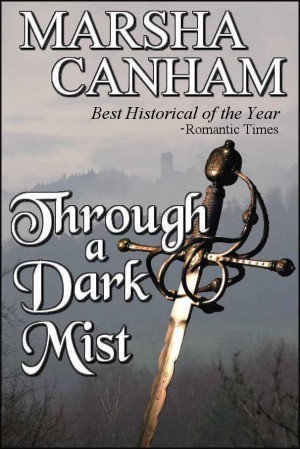
I thought I would start off with Through A Dark Mist. It was my first medieval, my first foray into the greenwood of Lincolnshire, and by the end, had planted the seeds in my brain for making it my own interpretation of the Robin Hood legend, which took me happily through two more books. This was also the book that came about from a dream. A recurring dream I'd had for years. I was having lunch one day with my editor and told her about the dream, and she said, why not write it down, it sounds kind of exciting and intriguing…I mean, why would a relatively modern woman keep having the same dream about a woman locked in a cave on a cliff, chased by men in chain mail, shot at with a bow and arrow. I took her advise, wrote it down exactly the way I dreamt it , and voila…
Through A Dark Mist Copyright 2011 © Marsha Canham
PROLOGUE
Voices!
She could swear she heard voices—not just one, but several—and she struggled painfully to her feet, her back scraping the length of the rough stone wall. The cell was small, cold, and damp. The air stank with a combination of mould and salt spray, echoed with the sound of waves crashing furiously against unseen ramparts of rock.
Servanne slid her hands up through the slime that coated the rotted wood of the narrow oak door and reached for a fingerhold on the ledge carved high above her head. A natural chink in the stone passed for the only window and was her sole means of determining if it was day or night. Even then she had to rely on her instincts to know if it was hazy sunlight or bright moonlight penetrating the tangled mat of moss and lichen that grew over the outer wall.
Scarcely average in height, she could do no more than curl her torn fingers over the lip of serrated stone and pull herself up on tiptoes to judge the source of light. Was it daylight, moonlight, or firelight? Was it voices she had heard, or was it the surf and the wind playing games with her sanity? Someone was playing games with her sanity, that much was a certainty, for between the incredible cold, the dampness, the incessant pounding of the waves, and the complete isolation, she feared the strongest of minds could not long resist the lure into madness.
Was this what De Gournay hoped for? Was he hoping madness, or the threat of it, would wear away her resistance and make her succumb to his demands like a sheep succumbs to slaughter?
Servanne's eyes were dry and burning, and she realized she must have slept for a time despite her vows against it. She could not distinguish much in the murky half-light that permeated her cell, but she could hear enough furtive rustling in the mouldered straw to know she was not the solitary inhabitant of the stone cage. The terror of waking up to find rats gnawing on her flesh had decided her against seeking refuge in sleep, but after having wept a pool of tears, her eyelids had simply grown too swollen to resist any further.
With an anguished sob she slumped against the uneven stone wall, the tears stinging hot and sudden in her eyes. There were no voices. No one had come to rescue her, no one had even come to see if she was alive or dead since she had first been flung into the cell. There were guards out there somewhere; she had heard the occasional clink of armour as they paced back and forth to warm themselves. And one of them seemed to take special delight in pausing outside the door to describe in lurid detail what he and his companions intended to do with her to relieve their boredom.
Servanne suppressed a moan as she clasped her small hands around her upper arms and hugged herself through a violent bout of shivering. Sweet Mother Mary in Heaven, but she was cold! Cold clean through to the marrow of her bones. The pale yellow silk of her tunic was no protection against elements that were causing discomfort to coarse, sweat-stained men who stood about in bullhide armour and full overlays of Damascene chain mail. Petite, slender as a willow, regal as befitting a gentlewoman of noble birth, Servanne de Briscourt had appeared before the gawping, staring guardsmen like a sylph, her gown and surcoat frothing about her ankles with the airiness of sea foam, her long blonde hair left unbraided, free of its confining wimple, and cascading in a wealth of glossy curls to her waist. For the duration of her week-long stay at Bloodmoor Keep, she had felt their hot eyes devouring her, and until this morning, she had been able to return their hungry stares coolly and disdainfully, confident they would not dare to lay so much as a fingertip to the heel of her slipper.
The yellow silk was torn in a dozen places now, soiled with the filth and muck of her stone cell. Her face felt puffed, and she knew it was bruised and badly discoloured. Her slim white arms were marbled black and blue from the steely grip of uncaring hands; she had lost one dainty silk slipper and the jewelled girdle of gold links she had worn about her hips had long been broken up among her captors to compensate them for their troubles.
Her cell measured four paces in length, three in width. The only entrance was through a low-slung oaken door, the planks of which were studded and bound in iron that was badly corroded from the sea air. Servanne had been semiconscious when she had been dragged from the castle tower, only dimly aware of the cold bite of the air and of lewd hands pinching at her breasts and buttocks. There had been talk of putting her in the donjon beneath the keep, but De Gournay had obviously believed the stone cage might be more effective in winning her cooperation.
Vague images of being pushed, dragged, and carried through the dank and cramped passageways that tunneled through the underbelly of the sprawling castle brought further distorted recollections of exiting through a postern gate in the outer walls. She remembered screaming and drawing back, for the gate opened onto a jagged ledge etched into the sheer face of a cliff. There had been only empty sky above and beyond, the angry crash and thunder of raging seas below. She had thought it was to be her end then and there, a wisp of yellow flung into the rising sheets of spume, and indeed, had it not been for the sturdy grasp of her guard, she might have quickened her meeting with fate—would surely have done so if she had known the hell of uncertainty and fear that awaited her.
Led down a hair-raising spiral of rock to a point midway along the wall of the cliff, she had scratched runnels of blood from the guard's face and arms as he had pushed her into a cell eroded naturally out of the stone, sealed unnaturally by oak and iron. She had been given neither food nor water since. Neither screams nor pleas nor bursts of pounding rage had had any effect on the thick iron bar that had been slammed across the outer surface of the door.
Lucien had tried to warn her. Dearest God, Lucien had warned her not to trifle with forces she did not understand, but she had not listened. She had … dear Christ … she had doubted Lucien instead. Doubted, questioned, even been half-convinced of his madness.
Servanne stiffened, her wide blue eyes flicking up to the window slit again. She hoarded her breath, her ears straining to hear over the booming thunder of the sea. Something was happening outside her small, dank prison cell. Someone was out there, talking to the guard … laughing!
Servanne scrambled back into the farthest corner of the cell, shocked numb by the unexpected sound.
Laughter? In a world that held only darkness, pain, and terror? Was it another of De Gournay's ploys to strip her of her sanity, or was this simply the beginning of the end? Had he finally reached a decision as to what to do with her? Had something happened to make him believe he no longer needed to keep her alive to fulfill his greedy ambitions?
Something bumped against the door once, twice, and a muffled cry was bitten short before it was fully formed. Servanne covered her mouth with her hand and tasted the metallic bitterness of blood as she tried in vain to stifle the scream rising in her own throat. She heard the iron bolt scraped slowly back out of its slot, and she watched in horror as the door began to creak open.
Her hair, filthy and matted beyond any semblance of its former beauty, whipped across her face on a gust of icy, mist-drenched wind, blinding her as effectively as the sudden glare of the torch that was thrust through the narrow entry-way. The figure holding the torch had to bend almost double to clear the low doorway, and in those first searing seconds, revealed nothing more to Servanne than the bulk of his coarse gray monk's cowling.
The intruder straightened to his full height, the top of his hooded head coming an inch shy of the moss-covered ceiling. His eyes were squinted against the smoking pitch, and as they swept around the confines of the cell, a curse marked their discovery of the pale splash of yellow silk cringing against the corner.
Her hand raised to shield her eyes against the glaring torchlight, Servanne choked back another scream as she caught sight of the steel dagger clutched in the monk's hand, its blade slicked wet and red to the hilt. A further horror greeted her eyes as she identified the huddled black bulk at his feet: the guard who had apparently shared the monk's laughter but a moment ago now lay sprawled across the threshold of the door. The head, with its conical steel helmet, was almost completely severed from the neck, and blood was gouting in thick, steaming pulsations to form a slick red pool on the stone.
"Servanne?"
She jerked her gaze upward at the same instant the monk pushed back the gray horsehair hood to reveal, not the tonsured baldness of an almoner, but a full, gleaming mane that fell thick and gloriously unkempt to the broadest pair of shoulders in all of Christendom.
"Lucien?" she gasped. "Is it … really you?"
"Name another man fool enough to chase after you on a night such as this," he said, grinning with the heartbreakingly familiar slash of strong white teeth.
"I thought you were dead," she whispered, not believing what her eyes were seeing. "When no one came … when I heard nothing … I thought you were dead."
"Did you think you could be rid of me so easily?" came the softly chiding rejoinder.
Her eyes flooded with tears, Servanne flung herself across the width of the cell and felt the long, powerful arms sweep her into a crushing embrace. The blood-slicked poniard dropped forgotten onto the ground and his hands raked into the tousled mass of her hair, holding her against him, tilting her lips up to his for a kiss as passionate and consuming as a physical act of love.
"Lucien!" a voice hissed from the doorway. "Can you not celebrate later, when we have the time and leisure to do so?"
Servanne could not withhold the cry as the hungry caress ended abruptly on a ragged curse. The taste of him, the feel of him, the scent of the courage and freedom that lingered on his skin drowned her senses and she was not aware of the hurried exchange that passed between the two men, she only knew Lucien was alive. He was here with her. He had come for her despite the treachery, the betrayal, the deceit, and the lies!
The second cowled figure crowded the doorway and for the briefest flicker of torchlight, his lean hawk-like features glowed in the saffron light.
Alaric! Sweet merciful Virgin Mary, they were both alive: Lucien and Alaric!
"My lady." Alaric's easy smile belied the concern in the soft brown eyes as he swiftly assessed her battered, deteriorated condition. "Are you well enough? Can you walk?"
"I shall run as fast as the wind if need be," she assured him without hesitation, her own beautiful smile shining through her tears.
Lucien took Servanne's hand in his and, cautioning her to duck low, led her out of the dank stone chamber and into the brisk night air. Wind snatched instantly at the shreds of her skirt, sending the silk swirling around her ankles in a yellow corkscrew. As eager as she was to flee, Servanne stumbled across the width of the rocky ledge and froze. Where the path continued down the cliff, it was barely three feet wide; the slightest misstep would send them hurling into the black and boiling frenzy of the sea two hundred yards below. The moon was on the downward slide of its journey across the sky and offered no relief from the heavy shadows. What light it shed fell mainly on the mist-shrouded walls and ramparts of the castle at the top of the cliff.
Bloodmoor Keep, perched on the very edge of the precipice above them, loomed like a black and monstrous predator, the tall battlements and jutting barbicans silhouetted against the night sky, impregnable, cold, and silent as death.
Servanne shuddered involuntarily and Lucien, noting she was as blue from cold as she was from the abuse she had endured, stripped himself of his robes and handed her the woolen garment.
"Here, put this on," he ordered. "We have a way to go yet and—"
"Lucien—" Alaric called softly. "Come quickly."
Lucien followed Alaric's outthrust finger and saw a line of bright orange dots spilling out of the postern gate at the base of the castle wall. A dozen guards carrying a dozen torches were making their way down the side of the cliff, lighting the way for a dozen more armed with swords and crossbows.
"Go!" Alaric shouted, ridding himself of the hindrance of the monk's robes. "I'll loose a few arrows their way to discourage them long enough for you to get Lady Servanne below."
Lucien hesitated, the desire for blood and revenge warring • with the need to see his love to safety.
"In God's name"—Alaric had to shout to penetrate through the fog of Lucien's rage—"we have not come this far to lose to them now! Go! I will join you in a trice, have no fear. I have no more intention of perishing on this godforsaken eyrie than I have intentions of walking back toLincoln."
Knowing there was no time to argue, Lucien took Servanne's hand tightly in his and began leading her carefully down the steep and uneven pathway. Behind them, Alaric cursed wholeheartedly as he armed himself with the crossbows of the dead sentries. An expert marksman, he struck the first two targets he aimed for, sending both to a screaming death over the lip of the cliff. He could easily have dealt with the rest, each in their turn, but a quick count showed only seven bolts in the one quiver, and three in the second, ruling out the luxury of too long a delay or of an ill-timed miss. He rearmed both bows and sat back on his haunches, his eyes wandering upward to the eerie silhouette of the castle. Was it his imagination or was the blanket of darkness giving way under the threat of dawn?
The path from the postern gate to the stone cell had been a wide, paved road in comparison to the crumbling, fragmented sill of broken stone Servanne and Lucien descended along now. Forced to travel singly and to keep one arm and hip pressed painfully against the cold rock, Servanne's boast of being able to run like the wind was mocked at every gap and eroded toehold that kept her heart lodged firmly in her throat. Her one slipperless foot seemed to find every sharp needle of rock on the path, and the monk's robe weighed her down, snagging on brambles and granite teeth, twice shunting her back and needing to be torn out of the grasp of the greedy talons of stone.
A pale wash of blue-gray along the horizon hinted that dawn was not far away, but the false light made navigation even more treacherous—at times, impossible. Lucien seemed to be guided by instinct alone and, on those occasions when the blackness erased all trace of solid footing, prayer.
The fleeing pair was soaked in sea spray when they finally rounded the face of the cliff. There, to Servanne's further astonishment, the path spread and leveled out, and in the blossoming flare of dawn, she could see the glittering swath of a small bay sheltered behind a break of boulders. Even though the air still vibrated with the tremendous roar and crash of the sea, the inlet was relatively calm—enough for a small boat to have maneuvered to within twenty feet of the shore.
The last stretch of the escape had to be made over a sharp, cutting bed of shale. Lucien, hearing Servanne's painful cry as the first step drove a shard of glasslike stone into the pad of her bare foot, swept her into his arms and, without missing a step, plunged into the knee-deep water. The sound of a second pair of splashing footsteps behind them brought the wolfish grin back to Lucien's lips as he turned and saw Alaric swerve away from the shoreline and follow them into the surf.
In the next breath the smile vanished. Alaric was waving, shouting, pointing to the score of conical steel helmets that lined the shore.
It was a trap!
Water began to plop and spout on all sides as a hail of crossbow bolts chased them deeper into the surf. Lucien commanded every ounce of strength he possessed into his legs, but the water, now waist-deep, hampered him and even though the breaker of rocks helped cut the force of the sea, there was still a wicked undercurrent that pulled and shifted the sand beneath every footstep.
Less than ten paces from the longboat they went down under a slapping wall of black water. Coughing and spluttering oaths, Lucien struggled upright again, managing to maintain his grip on Servanne, sodden clothes and all.
One of the two shadowy outlines crouched in the gunwales of the boat vaulted over the side and began swimming toward the labouring couple. The other figure, tall and slender as a reed, her short-cropped hair glinting red in the moonlight, nocked an ashwood arrow into a tautly strung longbow and calmly began to return the fire of the guardsmen who were now running in a parallel line along the shore. At intervals they paused to fit their stubby quarrels into their crossbows and knelt to release the triggers. The need to remain in one place long enough to rearm their clumsy and cumbersome weapons gave ample opportunity to the lithe shadow in the longboat to choose her targets carefully and with deadly accuracy. Many of the guards heard the singsong hiss of arrows arcing gracefully out of the darkness toward them and did not rise from the shale again. Others ran for the cover of nearby rocks along the shore and dove behind them to escape the quivering fff-thunk of the steel arrowhead punching through surcoat and armour. But they were still well within the ideal range for firing their own weapons and they did so continually, their rage fueling and improving their aim.
Servanne heard a cry and glanced over Lucien's shoulder in time to see Alaric slew sidelong into the water, an iron-tipped bolt embedded in his upper chest. Lucien shouted and released her, shoving her toward the longboat before he started back to where he had seen Alaric go under. Servanne's scream of warning went unheeded. One of De Gournay's knights, running along the shore close to where Lucien thrashed through the water, took aim with his crossbow and fired, the bolt tearing a ribbon of raw flesh from Lucien's right temple.
Stunned, he heeled sideways, the pain and blood blinding him even as his feet continued to chum toward Alaric. The knight armed his bow a second time, but before he could fire, he heard a thud and felt the hot sting of an arrow pierce cleanly through his leather breastplate. The arrowhead burst his heart and split through the vertebrae of his spine, killing him before he had time to roar his surprise.
The dead knight was no sooner swept into the foaming wash of the surf than another stepped boldly forward to take his place, seeming to rise like a Goliath out of nowhere. His sword was drawn and his face, catching a stray beam of moonlight, was a mask of pure, malevolent hatred.
Recognizing both the face and the intent in the slitted eyes, Servanne screamed again, this time to beat away the determined arm that had snaked around her waist and was dragging her toward the longboat.
"No!" she screamed. "No, let me go! Let me go to him! Lucien! Lucien … behind you!"
The arm remained fast around her waist even though she kicked and writhed and fought to be set free. Salt water was in her eyes, blurring her vision; her hair was a sodden mass wrapped around her throat, choking her. Her hands, flailing wildly about, tried to strike at the unseen force that was carrying her away from her love, her life, and smashed into something solid and wooden—the boat! A streak of white-hot pain lanced up her arm, causing her to temporarily cease her struggling and to look at the man holding her.
It was Eduard! Eduard, so badly wounded himself, yet straining valiantly to lift her into the violently rocking longboat. He grunted in agony as his wounded leg was driven by the current to smash against the leaded keel. Servanne felt his grip loosen, saw him claw desperately for a hold on the gunwale, lose it, and begin to slide under the rolling waves. Instinctively she reached out to help him … and screamed again.
It had not been the side of the boat her hand had struck. Rather, she was the one who had been struck, and not by a wooden plank, but by a twelve-inch-long crossbow bolt. The barbed iron head had split through the padding of flesh between her thumb and forefinger and embedded itself in the wooden side of the boat, pinning her there helplessly.
A wave washed over her head, filling her eyes, nose, and mouth with salt water. Without the strength or ability to resist, she was swept along with the boat as it was pushed relentlessly toward the waiting danger on the shore. The sandy bottom fell away from beneath her feet and she was dragged downward by the current, sucked into a void of muted sound and roiling darkness. Before the pain and numbness overtook her completely, a moment of absolute clarity flung her back through time, back to where it had all begun … the heaven … the hell …





July 3, 2011
Sample Sunday all about fantasy knights. Or nights. Or both *s*

Today's sample comes from Brendan Caroll, who writes fantasy with a hint of the paranormal. This is way outside my personal box for reading so I'm as intrigued as anyone else to check out his book. I haven't even read the Harry Potter books yet, for heaven's sake .
Here then is *our* sample for today *g*
********************
Greetings One and All! My name is Brendan Carroll and I love to write. Even more so, I love to have my writing read for what good is a writer without a reader? I've been writing since high school though I never thought to save any of my work from 'way back then'. I had a good friend that rode the school bus with me who loved to read my English papers. I remember quite distinctly that he told me I'd be rich and famous someday. That day hasn't come, but it is a lot closer now than it was a few years ago. The advent of eBook self-publishing has turned my frown into a smile and I am actually earning money.
A little background might be a necessary bore at this point. I was born and raised in Southeast Texas where the big pines grow and the undergrowth is so thick, it's almost impossible to take a stroll through the woods. (That could be why the Ivory-billed Woodpecker was thought to be extinct until someone spotted it in the thickets!) Of course, that did not stop us from romping through the woods, playing cowboys and Indians, spies and espionage and army. In other words, I grew up outdoors more or less. My idea of having a good time back then was going off in the woods and shooting something. Times have certainly changed. I still live in the country, but most of the kids in my neighborhood are rarely ever seen. They are all indoors by the AC vent and so am I!
Personally, I love reading and have owned three Kindles. I usually read reference books, researching material for my NYT #1 Bestseller that I am sure I will write some day. I also study quantum theory, astronomy, zoology, geology, paleontology and archaeology in my spare time. I'm a scientist at heart and have always thought I missed my calling because I'm bad with numbers.
At any rate, when I grew older, I spent more time reading and writing than running and playing. My heart turned toward creating new adventures on paper. I wanted to write something new and unusual so I picked one of the oldest topics of interest in the world to write about: Templar Knights.
I have been interested in medieval history, battles and dragons for as long as I remember and just before an elderly uncle of mine passed away, he gave him his collection of books because he knew I was interested in books, reading them and writing them. The books sat in a corner in a box for a long time. Then one day I took one out and started reading. Only then did I discover that my uncle had given me his Masonic Library!
I read the books with renewed interest and when I ran across an encyclopedia of degrees and titles, my imagination took over and the Assassin Chronicles was born.
Currently, I have 23 of 28 novels in the Assassin Chronicles uploaded to Amazon Kindle. I also have a stand-alone novel called Tempo Rubato that is a tribute to my favorite classical musician/composer: Wolfgang Mozart.
The Assassin Chronicles is considered fantasy in the main, but could also be listed under paranormal.
The Red Cross of Gold I:. the Knight of Death
Blurb: The Knight of Death chronicles the adventures of a semi-immortal Templar Knight who is a member of the ruling council of the only remaining Order of the Poor Knights of Solomon's Temple. He is the alchemist/assassin for the Order and keeps the Order in business by providing gold in his laboratory in Scotland. Whenever an assassin is needed, he takes on those duties as well.
The novel starts out with a simple mission to either return or eliminate a defector. He must find an apprentice named Anthony and bring him back to the Order dead or alive. Unfortunately, the Knight of Death runs afoul of a woman with a plan to steal the mystery of immortality from the Order. She believes that he knows the secret and plans on making him confess it, one way or another.
If this is not trouble enough, he loses his memory temporarily and falls in love, something strictly forbidden by the Rules of the Oder. As the story progresses, he not only has to try to remember and fulfill his original mission, he has to avoid losing his head to his own Brothers of the Order as they come after him.
Here is an excerpt from Book I:. The Knight of Death
"I don't understand any of this," he said when he had regained his voice. "Don't you realize that keeping me here is a crime? You can't just hold me here against my will indefinitely. Do you intend to murder me?"
"I don't think that will be necessary," she laughed. "All you have to do is give me what I want and you can be on your way. The sooner, the better. I don't like what you stand for, but like I said, I had expected some grizzled old bastard with a stinky beard and a bald head."
"I'm sorry I disappointed you," he shrugged.
"I'm not disappointed at all. I just expected you to look older," she said. "But you're not really my type if I was interested. I prefer men who are more intellectual, stylish, a bit smaller and blond. I like blonds. Men and women. What does d'Brouchart look like? I haven't been able to get much information about him personally."
"If you didn't even know what I looked like, how do you know you got the right man?" He ignored her question. The image of a large, middle-aged, balding, red-haired man sitting in a high-backed chair loomed in his mind. Not the same man he had visualized earlier when she had mentioned the title Grand Master.
"We've been through this," she sighed. "I knew you were coming. Anthony told me. He said you would come from the east in a black car. That you wear the red cross and the symbol of the alchemist just like he said. And he said you would have his head on a platter just like John the Baptist."
Mark Andrew chuckled at these descriptions which sounded like something one would hear from a Gypsy fortune teller, but the mention of St. John caused him to cringe. Blasphemy.
"You think it is funny? The poor boy was scared to death of you. He called you the Knight of Death. Chevalier du Morte. The Prince of the Grave. He said you would bring the flaming sword and cut off his head."
"Who the hell is Anthony?!" He continued to laugh. Her descriptions were laughable, yet he wondered.
"I have your sword, Sir Ramsay," she said quietly and her face took on another, more sinister expression. "It was in that your black car that you drove here from DFW. You came here from the east."
"I don't believe you. My name is John," he said simply. "I don't know what your game is, lady, but you've got the wrong man."
"I don't think so," she smiled knowingly. "You were in a black car, you came from the east, you wear the rings, you had the sword. You venerate the name of St. John. Your denials are useless. There is only one point yet to prove out." She narrowed her eyes. "Poor Anthony. I thought he was immortal." Cecile toyed with the spoon in the empty pudding dish.
"What happened to poor Anthony?" Mark asked with some reticence.
"Why? Do you still want his head? I'm afraid you missed him. He's gone."
"Just like that? Gone?" He snapped his fingers. "And I was so close."

For a full list of Brendan's books, check his blog
Wordpress: http://brendancarroll.wordpress.com/
And find him on Facebook: http://www.facebook.com/BrendanCarrollRCG







June 28, 2011
I'm going to let my wonderful readers and friends decide.
Here are the mockups for two covers, same book. When I wrote it originally, the title came from the carvings on the castle door and the myth of the dragon tree, which I shall quote here:
When a pure heart enters, the dragons will awake to fly in six directions. The dragon of the nether region will flee from despair and bring hope. The dragon of heaven will arrive with the gift of true love and from the four corners of the earth will come Peace, Health, Wisdom, and Happiness.
Not only did the quote never make it into the front of the book, but my title, which was The Dragon Tree, was changed to My Forever Love by the editor, who thought my readers might be *confused* and think I was suddenly writing science fiction fantasy.
*snort*
So now I have a choice. I can reissue the ebook with MY title, as originally planned. Or I can keep their title. If I change the title, great pains will be taken to ensure the readers are not misled into buying a book they already have. I'll post it in the book description as well as inside the copyright page.
The book is a medieval. The story involves a disgraced, excommunicated Templar Knight and a damsel genuinely in distress, being hunted by a beastly exhusband named Odo. I briefly thought of renaming HIM as well, but one change is enough to contemplate. Here then are the covers. I'll leave it to you to decide.









June 26, 2011
Sample Sunday time again

This week's guest author is Mary Ellen Dennis and I have to say she has some of the most lovely covers I've seen. *s*
Here then is Mary Ellen…
My name is Mary Ellen Dennis and I'm addicted to writing books. Reading them, too. Writing and reading and true love and chocolate—life doesn't get much better than that. Well, maybe I should add watching The Princess Bride while munching crème donuts.
When I was in grade school one of our assignments was to read a poem in front of the class. Someone read "Trees" ("I think that I will never SEE a poem as lovely as a TREE") and someone recited "Jack and Jill"—or was it "Humpty Dumpty"? I read Shakespeare's "Venus and Adonis" (I love horses).
Why yes, I was an overachiever, why do you ask?
My excerpt is from Heaven's Thunder: A Colorado Saga, which came out this month. Heaven's Thunder, circa 1893 to 1923, encompasses the Cripple Creek gold rush, the Ludlow Massacre (coal strike against John D. Rockefeller), and the rise of Denver's KKK, with an emphasis on Colorado's silent film industry. My excerpt is from the Ludlow portion of the book.
******
Mike sat on the steps. "The miners come from everywhere in the world, Miss Lytton, lured here by the promise of instant prosperity."
"Please call me Kate. I do believe I feel a bit chilled. You may stand up and put your arms around me."
He stood, shrugged off his jacket and draped it across her shoulders.
Kate smelled tobacco in the threads. "Aren't you going to kiss me?"
"What?"
"You heard me. If you've tried to frighten me away with your words, it didn't work. It's difficult to believe all you've said, but I'll make sure my father visits a company house and takes me along. And I'll kiss you if you don't kiss me first."
"Are you crazy?"
"My grandfather says if you want something badly enough, you must reach out and grab it."
"For free?"
"For fair trade. I want to kiss you. Don't you want to kiss me?"
"No."
"Because of my dress?"
"Because of your name. You'll say I'm unfair and you're not responsible for your name."
"Are you married, Mike?"
"I don't have time for courting."
"You don't have to court me. I knew how I felt the moment you entered Rosalind's parlor."
"Tomorrow I leave forLudlow. The miners plan to strike. They'll abandon their company houses and camp on the grounds, close to the mines."
"That's tomorrow. It's still tonight."
"Whatever you're feeling now, you'll feel for someone else next week."
"No, I won't." Warmed by her confession, she placed his jacket across the railing, walked down the steps, and nudged a flower with the toe of her slipper.
He followed. "I can't figure you out, Miss Lytton. I've never met anyone like you before."
"I've never met me before, either. Very well, I shall be a proper lady and visit you in Ludlow." She paused at the sound of his laughter. "What's so damn funny?"
"It's so damn tempting. I'd have a photographer handy. Kate Lytton in the midst of a union camp. Your father would shit bullets. Sorry, didn't mean to cuss. You're very sweet, but you can't possibly understand what's involved in a strike. Do you think it's noble? Romantic? There will be a city of tents and at least a thousand people. Cold weather and mud. Lice. At best, the sanitary conditions will be inadequate, the food limited. The possibility of death—"
"You'll be there. I want to be with you. I love you."
"You don't know what you're saying."
"Yes, I do. You said you had no time for courting. I accept that. But I won't wait three months or six to tell you how I feel. Won't you please kiss me before I throw myself into your arms and embarrass the both of us?"
"Because we feel a physical attraction for each other, that doesn't mean it's love."
"Define love."
He shook his head. "I've never been in love. I've never even talked about it. Frankly, I can't believe we're having this discussion. I'm leaving. Good-bye."
"No!" She stumbled forward, reached out and captured his upper arm.
Angry, Mike turned, the sudden motion causing her to release his arm. But his scathing words died unborn when he saw her flushed face and wounded eyes. Powerless, he kissed her.
He had meant to embrace her quickly and bolt through the night, but her lips parted and her body yielded. She smelled clean. How long had it been since he'd held a woman? He couldn't remember.
Kate ended the kiss and stared into Mike's smoky eyes. Miffed by his indifference, she had simply wanted revenge—at first. But her impulsive love declaration had been the truth.
Father would go through the roof, she thought. Mother would faint. I don't care. Mike leaves for Ludlow tomorrow. I have no time for flirting or secret assignations. I have no time to play the proper lady.
God, her breasts, thought Mike. Beneath the blue gown's material, they were full and up-tilted. He didn't have time for this nonsense. He was a union man. He had come to the party tonight for the purpose of securing donations, and she had caused him to forget his mission. The union. He needed to concentrate on the union.
With a groan, he ran his fingers across her bodice, felt her nipples harden, heard her indrawn breath.
"Gazebo," she gasped. "Back of the house, hidden by trees. No, please, don't touch me there again. I've never . . . I just want to talk."
He scooped her up into his arms and carried her around the side of the house, toward the trees. Seated on the gazebo floor, she snuggled against his chest. He talked, kissed her, talked some more. He told her about his childhood inGreece, his family, his years inAmerica.
She listened, waiting for his next kiss.
"Promise you won't come toLudlow," he said.
"I promise, Mike, but you must promise to visit me in Denver."
*
Kate reached Ludlow on the twenty-third of September, 1913, in time to watch strikers and their families arrive at the tent colony. They hunched over their household goods, trying to avoid the wind-driven rain. Rented horses dragged wagons through the mud. When they came to a hill, men, women and children all got out and pushed, straining against the wheels.
Next to Kate stood Don McGregor, a reporter for the Denver Express.
"Prosperity," he said. "Hah! Straw bedding. A small pile of kitchen utensils. Those pots and pans are so decrepit, they'd earn the scorn of any secondhand dealer onLarimer Street. No books. Not one single article worth protecting from the rain." He studied her face. "You look familiar. Do I know you?"
I've been on the society pages of your newspaper a dozen times. "We've never met, Mr. McGregor, but I've read your articles. My name's Katherine Lyt . . . ship."
Dear God, she'd almost blurted out Katherine Lytton. She could see her father's face if he read about his daughter in a Don McGregor piece.
Why had she traveled to Ludlow? Admittedly, she missed Mike Loutra, although he couldn't possibly be as wonderful as she remembered. Nobody could. Furthermore, Mike had told her not to come.
She was supposed to be on her way to New York, visiting her Aunt Elizabeth. Her aunt had tickets for The Sunshine Girl, a new Broadway musical starring the celebrated dance couple,Vernon and Irene Castle. Kate was an avid baseball fan, andElizabeth had suggested that, during the first week of October, Kate might attend a World Series game.
"Welcome to Ludlow, Miss Lightship." McGregor arched an eyebrow. "And what, may I ask, are you doing here?"
He was staring at her mud-spattered harem skirt and her blue velvet coat, trimmed with ermine. Her valise was of the softest leather, and her hat was the same blue straw she had worn to Rosalind's party, although the feathers were quite ruined by the rain.
She should return to theLudlowstation, take the first train back toDenver, continue on toNew York City. But first she wanted to see Mike again, visit him in this horrible place, so she could erase his image from her mind and get on with her life.
"What I'm doing here is none of your business." Leaving McGregor, Kate wended her way to the large central tent, where she found Mike doling out hot coffee to the miners as they straggled inside.
He looked tired. Yet above the dark smudges of fatigue, his gray eyes were soft with compassion. Though he stood inside the tent, his hair had captured the sun's rays. What sun?
"If there's enough coffee, I'd appreciate a cup," she said, dropping her valise and taking off her wet hat.
He stood motionless, coffee pot suspended.
"I realize you can't kiss me hello, Mike, but—"
"You promised you'd stay inDenver, Kate."
"I guess you can't trust the word of a Lytton," she teased. Then, more seriously, "I tried to tell everybody what you said about the mining towns and strikers, but they wouldn't believe me. They didn't want to believe. They'd read the coal company magazines, heard the optimistic words in the mine owners' speeches and—"
"Go home, Kate. I mean it."
"I wanted to come sooner but I caught my sister's cough. Isn't there something I can do?"
"Have you ever bandaged a wound? Have you ever cooked a meal?"
"I can learn." I'll leave tomorrow, she thought, but first I'll prove that I can help. "Where's Mother Jones?"
Mike extended his coffee pot toward the spry eighty-three-year-old woman, who wore rimless glasses, a long black skirt and a white shirtwaist. Her head bobbed up and down as she led a group in song: "The union forever, hurrah, boys, hurrah."
Mother Jones was surrounded by painted placards. One read: DO YOU HEAR THE CHILDREN GROANING, O COLORADO!
Another proclaimed: WE ARE NOT AFRAID OF YOUR GATLING GUNS, WE HAVE TO DIE ANYWAY!
A third: WE REPRESENT CF&I'S PROSPERITY SLAVES!
As Kate walked toward Mother Jones, she spied a woman with a baby at her breast. Placing her own warm coat around the nursing mother's shoulders, exchanging it for a thin shawl, Kate murmured, "Fair trade, Grandfather."
*
Hours later, after the rain had stopped and candles dotted the night-darkened colony like hundreds of grounded stars, Kate washed her hands and face with a sliver of soap. Then she searched for Mike.
She found him stretched out in back of a truck with four bald tires, and she snuggled her body against his. I'll leave the day after tomorrow, she thought. There's still so much to do. I'll leave the day after tomorrow, or maybe the day after that.
"Maggie Brown," Mike said. "The newspapers call her the unsinkable Molly Brown. She's inEurope, but she sent word that she plans to help." He yawned. "She'll donate food."
"If Molly Brown's willing to help, so am I."
Mike felt Kate's smile against his neck. His sweet Americanidhes was actually here in his arms, even though she must leave first thing tomorrow morning. Christ Pantokrator! She'd never survive the rigors of a tent city.
Would the miners accept her? Kate Lytton, who spent more on clothes in one month than a coal miner earned in a year? Kate Lytton, who had never known a hungry day in her life? He'd seen her exchange her blue coat for the nursing mother's red shawl, but she had lots of coats in her closet. Or she could buy a new coat. Oil and water didn't mix. An immigrant Greek and Ned Lytton's society daughter could never blend.
Mike knew that his culture measured history by the devastating rotation of epic victory or epic defeat. He also knew that, atLudlow, the call to arms was a silenced mine whistle, the battle uniform a patched pair of overalls, the camp standard a bucket of coal. In his war against industrialAmerica, Mike would have to first do battle with his own conception of the past.
Could Kate Lytton do the same?
*
Kate fell in love with the children.
She had been ten when her brother, Edward Steven, was born. But the long-desired heir was frail and puny while Kate was brash and sturdy, her father's favorite. Edward Steven had no more importance in Kate's former world than one of her mother's pampered poodles.
The strikers' babies didn't have canopied cribs. They didn't have infant tubs—or even pails—for bathing. They didn't have toys. On Kate's third day inLudlow, she spied a tiny girl seated in the mud. Gathering pebbles, the child threw them one by one into a dented saucepan, clapping her hands after each satisfying ping.
The little girl sang, "The you-yen fo-ev-vah, hoo-way, boys, hoo-way."
By the first week of October, children played hide-and-seek among the neat rows of tents with their painted numbers. When the sun came out, clotheslines sagged. Flags sprouted—Greek, Italian, American, and the two-colored banner with the stitched nameLUDLOW.
And Kate remained at the colony, still vowing she'd leave "tomorrow."
The camp was laid out on the prairie beneath twin canyons, which led up cedar-covered mesas to the mines. Behind the camp was a deep arroyo, a steel bridge, a pump station, and a covered well with rickety steps leading down in stages to foul-smelling water. South of the tents was a rise called Water Tank Hill and the curving tracks of theColoradoand Southern. Then came the railroad junction ofLudlow, with its yards and switches and coal cars.
The scabs began to arrive. With others, Kate queued up at the depot to jeer them as they got off the train.
On October seventh, John Lawson and Mother Jones were addressing the camp from the back of the union automobile. One CF&I clerk and two gunmen showed up on the road west of the tents. There were shots exchanged.
Naked, Kate thought later. She had never really understood before what the word naked meant. The strikers were on an open plain, caught between railroad tracks and the mine guards who camped within the hills. Every night searchlights danced over the grounds and shined through tent roofs. Exhausted, Kate managed to sleep, but she often dreamed about bullets puncturing the canvas, and sometimes she pictured herself and the children buried alive inside a deep dark hole.
Guards rode by on their horses, and strikers heard about the drunken boasts at Baca's saloon. Kate's hands blistered as she dug cellars under tent floors or shoveled rifle pits along the dry ravine. She ignored the oozing pustules and took scant notice of her pain because Mike was there. If he wasn't always by her side, his spirit, his dedication, his belief in the cause had become her own.
"My darling Americanidhes," he said one night while she scrubbed her dirty face. "Do you know how much I love you? InGreece the practice of love is smothered by impossible standards of modesty."
"Are you saying I'm immodest?" Kate ran the pitiful sliver of soap over her thin arms and beneath her breasts.
Mike grinned. "I wish I were a little bar of soap, my girl," he sang, "tied to your bath with a string. I'd slide from you slowly, and you'd catch me again, and you'd put me wherever you like."
Turning away from the basin of water, Kate flung herself at Mike's chest and tickled his ribs.
"I'd wash your sweet little body, my girl," he continued between gasps of laughter, "and foam from all my passion."
*
November. The Colorado National Guard arrived. They were commanded by aDenverophthalmologist named John Chase, who had earned his spurs during theCripple Creekstrike. There was Major Pat Hamrock, coach of the state rifle team and owner of aDenversaloon, who had been part of the shameful campaign that crushed Sitting Bull. And there was Karl Linderfelt.
Linderfelt had fought in thePhilippines, perfecting his soldiering techniques during a war in which the destruction of food stores and the burning of insurgent barrios had become unofficial policy. Now, in militia uniform, he faced those insolent foreigners who occupied theLudlowtents: Wops and anarchists! He had learned, he liked to say, that you cannot go at it with kid gloves.
The occupation began as a sort of holiday. Across from the depot and a little south of theLudlowcamp, brown conical tents were planted. Soldiers dug latrines, carried water, and piled up coal.
The militia was to be an impartial force, summoned to disarm guards as well as strikers, and keep watch against the importation of scabs. TheLudlowcommunity greeted them with loud cheers.
Outside the camp, strikers relinquished the colony's weapons. Kate counted twenty-five, maybe thirty old guns, heaped on the ground.
"Where are the rest?" John Lawson demanded.
A little boy gravely dropped a popgun on the pile.
*
"Damn my countrymen," Mike grumbled.
It was dark and cold. He and Kate huddled beneath blankets inside the tent they shared.
Their tent was large enough to hold a bed, dresser and mirror, a crude cookstove, a small icebox, two stools and a warped wooden table. A telephone had been installed, its wires leading to a nearby telephone pole, since Mike was in constant communication with John Lawson.
"What's wrong, darling?"
"The Greeks are married to their guns. Although they were supposed to turn them in to Lawson, they wouldn't give them up. They don't trust me, but because I'm a Cretan palikari, they allow me access to their section of the camp. I swear they're forming a Balkan army. My countrymen have confused this miserable tent city with the Great Idea of Byzantine reclaimed. And your reporter friend, Don McGregor, isn't helping matters."
"He's not a friend. What's McGregor doing now?"
"Pumping up the military myth of the camp with his prose. He's creating a powder keg, Katie, a goddamn powder keg."
*
Three months later there was still no sign of a settlement. Winter hit hard. The ground turned slushy or slicked over with ice. Water froze in barrels. Men hunted rabbits, but the game was being pushed back deeper into the hills. Strike benefits never stretched far enough to fill thirteen hundred empty bellies, and those same bellies often growled with hunger.
Kate dreamed about steaming bowls of oatmeal, a dish she had despised as a child. Every morning, upon awakening, she found herself licking her lips and weeping softly.
Mike no longer insisted she return toDenver. He needed her. She was his strength. She had become a symbol of courage to the camp. They knew her background and it gave them hope. If Kate Lytton believed in their cause, wouldn't others from her world commit?
Standing on the platform next to Mother Jones, Kate proudly wore the thin shawl she had traded her coat for on the day of her arrival. She stood straight and tall while Mother Jones' high-pitched Irish voice rang through the meeting hall. "You will be free. Poverty and misery will be unknown. We will turn the jails into playgrounds for the children. We will build homes, not log kennels and shacks as you have them now. There will be no civilization as long as such conditions as that abound, and now you men and women will have to stand the fight."
Kate sent letters to Aunt Elizabeth and her parents. She was fine, she wrote. Perhaps a bit hungry, she hinted. Just like Molly Brown, she wanted to help the strikers' children. There was no need to try and change her mind since her actions were charitable rather than political, and the Lyttons, like the Rockefellers, had always maintained an altruistic facade. The last line was a lie, except for the altruistic facade part, which she couldn't resist adding.
Aunt Elizabeth responded with a food donation, transported by rail. Her father sent a telegram, insisting she return home at once.
Kate's red shawl became a camp banner. She found she had an instinct for nursing. She lost count of the number of babies she had delivered. "Do you hear the children groaning,Colorado?" she'd cry, slapping the backside of a newborn.
**********

Check out Mary Ellen's website: http://www.maryellendennis.com







June 23, 2011
The Which-Way choice
Does anyone remember Which-Way books? They were written with alternative endings so whoever was reading it could decide which way the story should go. Wouldn't that be something if life was like that…if you could peek ahead and see what was going to happen depending on which choice you made?
I made the choice to retire seven years ago, and I made the choice last year around this same time, to listen to Julie Ortolon's nagging (LOL) and self publish my backlist. Since then I've learned a lot. A LOT. Hell, I've even learned how to Tweet (@marshacanham) and how to do some, not all, of the social networking stuff I'm supposed to learn how to do in order to drive the readers crazy until they throw their hands up in the air and say okay okay I'll buy your book just stop tweeting and twerping and being in my face every time I turn around. I'm sure that's how it seems sometimes, which is why I'm not a very good social networker LOL. I post new stuff on Facebook if I've uploaded a new backlist book, and I Tweet occasionally, but even though there are some who say POUND POUND POUND the cyberairwaves with your name and your books…nah. Just can't do it. I've had a great response to simply putting some of the books free for a week or two hoping that whoever downloads them will like them enough to tell two people and they'll tell two people etc. Or even if they just download them and read them…that tickles me to death.
What if you're a new author though? What if you're sitting there with your first book in hand and it had gone through all the possible vetting choices out there…been edited properly, copyedited, revised to death, spellchecked, and passed the scrutiny of an unbiased non-family-member set of eyes…someone not afraid to tell you it was a piece of crap if, indeed, it was a piece of crap (Thank you Dianne Kelly even after all these years). Suppose the book has met all of the above criteria and you're faced with the choice of sending it around to the publishing houses in the hopes of it making it onto the shelves of a bookstore one day…or bypassing the traditional route and publishing it yourself via Smashwords or Amazon.
It's a hefty enough choice for a published author to make, and there are a lot of them out there sitting on out of print backlist books who are still undecided what to do with them. And there are a lot, like Connie Brockway and myself, who have already made the decision to go straight to ebook with our next brand spanking new books. But we have the weight of past experience behind us, whereas new authors only have the weight of indecision.
Some people will throw numbers at them, trying to show how much more they can make by publishing on their own. On paper it looks great…70% royalties to the indie author vs 6-8% for the traditionally pubbed print author (25% for ebook format). That's one hell of a difference and most new authors will stop right there and go WOW…I'm IN.
Unfortunately, a lot of the time those numbers are thrown out to the world by authors who have already been published and have a track record. Or by authors who caught the wave early and write prolifically and know how to promote themselves and their books. Or by authors who lucked out, wrote a damned good book had two people tell two people who told two people…oddly enough, the same way it happens with trad publishing when a book by a first time author shoots up onto the bestseller lists.
But that's not the normal progression. If they're lucky, 99 out of 1000 indie authors will sell 2, maybe 3 books a week. If it catches some good buzz, 100/month, which is great because it boosts confidence and they write a second book and a third and…oddly enough, just like traditional publishing, their readership increases and they start selling more copies. I'm betting even the indie guru, Joe Konrath started out slow and worked his ass off to build momentum. That's another small bit of info the enthusiasts neglect to mention. You don't just sit back and watch the sales roll in. You have to promote, promote, promote. You have to spend a lot of money, sometimes, to get your book into places where it will be noticed, and don't kid yourself that the promoters haven't been catching their share of the wave too. One in particular started offering great sponsorship options starting at $52/for one day of advertising your book on their blog and web page. It's now jumped to $149, which, for a new author with a new first book, is pretty darn steep. Even for me, who has discovered the meaning of the word "budget" since my divorce last year, it's gone past reasonable.
Keep in mind, all of my experience is in the genre of romance, which happens to be the most popular genre in ebooks these days. I have no experience with horror or YA or Sci Fi, but I've read the comments from writers in those genres who aren't exactly having a booming time of it.
There are *tricks* we all try, like offering coupons over at Smashwords, or lowering the price to .99 or even free for a limited time. But again, we all have backlists to fall back on, whereas the new writer with the single title can't really afford to give it away, not unless he or she has 8 other books on the backburner ready to upload.
I briefly touched on the need for vetting books before they go live on the web. There are costs involved there too. Editing services can run into the hundreds for a big book. Covers can cost anywhere from $50 to $700. If you're not a techie, there are people who will format your book file to the specs required by Smashwords and Amazon…for a price. Just getting an ISBN is $9.95. I'm not knocking capitalism by any means. Everyone is trying to eke out a living here and if they can do it by riding the same wave, more power to them.
I'm only trying to point out to the new author who has reached the fork in the road and is trying to decide Which-Way to go, that it isn't as simple as clicking a few keys and uploading your file to Amazon.







June 22, 2011
More choices
Yesterday I rambled a bit about choices, and which ones suited me…namely, deciding to self publish my backlist books, which now number twelve, with one more to go. The only three I don't have the rights back for are my Scotland trilogy, Pride of Lions, Blood of Roses, and Midnight Honor, and once the postal strike is over up here, I may take a shot at getting those back too.
But we're talking choices, and is self publishing a good choice for everyone to make? There is so much buzz around the internet about ebooks taking over the publishing world, sales of Kindles and iPads and Nooks climbing to record amounts, book stores closing because they weren't prepared for the digital revolution or simply can't compete with it, canny authors like Konrath and Hocking and Locke making small fortunes because they caught the wave early…and traditionally printed authors taking the high road in some instances, complaining that the market is being flooded by *indie* authors.
Like anything that seems too good to be true, I tend to think there is a risk of TGND syndrome happening, and that may have something to do with the anger of the *trad* authors. TGND=The Guy Next Door. You know the one. He knows everything, has everything, can do everything better than you. TGND finds out you're an author and hey, he can write a book too, and he does. He finds out now that he can publish it himself, and he does. He sits back and waits for the millions to flood in, and when they don't, he blames it on everything but his writing because of course, his book is brilliant and should be made into a movie starring Russell Crowe and Angelina Jolie. But in the meantime, the *trad* author shakes her head, mutters that he's an idiot and goes back to work, content to know she has a contract in hand and a book on the shelves in twelve months.
I am not knocking all indie writers, so please don't throw things. There are some very good writers out there who, because of the economy and massive cutbacks in publishing, have been caught on the edge of the sword. They're good enough to be published, but the publishers just don't have the juice to buy them. These are the writers I feel for the most, because we've all been there one way or another. I was a fairly well established author with Dell when there was a massive cutback and reorganization of the publishing house. Myself along with a shocking number of good authors were told our contracts would not be renewed. Some were able to find other homes, some were not. Some became victims of "we'll keep buying your books but if you think you're getting what they paid you before, forget it and be happy you're getting half of what you got before." So in a way, we had our fingers through the brass ring, but in the blink of an eye, it was snatched away.
Publishing itself changed. Drastically. Virginia Henley has been a good friend for over 20 years. We started out together, writing Ribbon Romances for Avon. We often compare how it used to be to how it is now and both of us just shake our heads. Back then (those dreaded two words again LOL) an author was treated like someone special. Flowers came to the door with signed contracts. We used company FedEx accounts to mail manuscripts back and forth. At conferences we were treated to lavish dinners with editors and publishers, some of us even had our conference fees paid for. We were sent on book tours, met at the airport with limos and chauffered from store to store, then delivered at night to four star hotels. I remember walking into a SUITE at a Marriot in New York and wondering if there were ten other authors joining me. I recall a publisher booking flights for me to New York for a Friday LUNCH meeting then arranging for me to fly out to Indianapolis because my son had a baseball tournament that weekend and it was *just a little detour* so we could chat. We can remember being consulted about cover art and cover copy. *I* can remember days when the editor just trusted me to hand in a book on or around the contract date…no need for outlines, no worries that I wouldn't turn it in. There was a great deal of mutual respect between author and editor and even though we sometimes got pissed off with each other, once you had an editor, you stuck with her because she knew how you worked and you knew how far you could push to get what you wanted. Advances? Well, I started out with an advance of $2500 for China Rose, and I was thrilled. I still have a xerox of the cheque for the $1000.00 they paid me on signing. My second book, I was paid $5000 and thought I was on the road to El Dorado. Third book was *gasp* an astounding $15000.00. I signed a three book contract after that for the amazing (to me) sum of $50,000, which doubled again for the next two book contract, then doubled again for the next two books…point being, you were paid as if the publisher had faith in you. They also did marketing and advertising and ran promotions. They had Fabio on the stepback covers and paid big bucks for top artists to do the covers and inside artwork. I remember my first Pino cover…I knew I had "made it". I remember having dinner with my editor at a conference and pulling out a picture of a relatively unknown model, Cherif Fortin, who had introduced himself to me earlier and shown me mock ups of covers. He was gorgeous, the mockup was spectacular, and I presented it to the editor with a request that it be used on my next cover, which it was. Back then, you could do that. And the biggie: We had creative freedom to write what we wanted to write. The only caveat to that seemed to be to stay away from books about the Civil War. It had been done to death and publishers were neither looking for, nor expecting to find the next GWTW. But the bottom line was, we all knew if we kept writing good books, the publishers would be behind us 100% and our careers would grow, just like it was supposed to happen in those wildest of dreams.
Then came the Dell bloodbath and something changed in the publishing world. It wasn't subtle and it didn't happen gradually. It didn't just happen to the authors either, it happened to editors and VP's, and rippled right on down through the distribution and marketing departments. Budgets were slashed and it was like a tsunami…first wave wiped out the authors and cut them loose, second wave swept away editors, third wave cut the department heads. It was really quite a spectacular upheaval, looking back. The lucky ones were spun around and managed to land on their feet. The unlucky ones quietly disappeared.
I think one of the worst aftereffects was the devastating blow to everyone's ego. Big name authors suddenly found themselves without contracts and hearing their agents say they couldn't sell their books, not at the level they expected and had earned over the years. Advances dropped like rocks. Someone being paid 100K per book was suddenly offered 25K and told to like it or lump it and move along. I won't even rant about the publisher who offered $2000 advances with 2% royalties, no I won't. Worse still, they were told what was popular and told, basically, what to write. They were told to limit the word count, to limit the *complexity* (that was one of my favorites *snort*) and to put more sex and less content into the stories. Readers wanted sex, not history lessons. (I kid you not, that's what I was told) They wanted simple stories they could read in a day.
Some of us said f**k that and retired.
So you can see why, this whole new opportunity for self publishing has breathed new life into the publishing world. Authors are no longer restricted to sending in manuscripts and getting rejection after rejection after rejection to one publisher after another in the hope that somewhere down the line their book might make it out of the slush pile. They no longer have to "write to order" following rules of length or content or genre. I write historical romance but hey, if I wanted to write a Sci Fi adventure based on Omicron Zeggy Three…I am perfectly free to do that! But so is TGND.
He hasn't paid his dues, however. He hasn't gone the rounds of submissions and rejections. Chances are he hasn't even had the book edited or copyedited and may not have even had his spellcheck turned on. These are the shmeckles that *trad* authors are grumbling over, and to be honest, I've grumbled a bit too. Not too long ago I downloaded a book from an *indie* author who had never been published in print before, but her posts seemed intelligent and witty and I thought I'd lend some support and buy her book. Augh. There were spelling mistakes on the first page. Sentences took up whole paragraphs and there were so many "he said lovingly" and "she said beguilingly" that I wanted to start stabbing all the adverbs. I couldn't find one line of dialogue that didn't come with a "he said barfingly". The book needed editing. Badly. There was a character who appeared sporadically through the book whose hair colour changed from one chapter to the next, not just from blond to tawny, but from blond to black and back to blond. I guess they had hair dye in the 1700′s but it was a silly mistake and should have been caught on a read-through.
Again, I'm not knocking all indie authors. I've downloaded and read some good stuff too from authors who have obviously edited, re-edited, and taken care with the words that present who they are and what they can do. And I'm not saying my own writing has no faults. I just finished going through Straight For the Heart with my own heart in my throat trying not to stab every other page with a fork. I eradicated more adverbs than I care to think about, but because I've been chastised for editing too much out of some of my backlist books, I left a lot intact. Writing on the whole is a learning curve, and boy can I tell I was learning.
I used to give workshops on writing. I had a seminar once where I took some copies of a ten page excerpt from an unidentified manuscript and handed it out to the attendees, giving them two hours to read it through and find as many dumbass rookie errors as they could find. They could even try their hand at correcting them, playing editor. The results were, as expected, full of eager suggestions, thoughtful dissections, groans and laughter as one goofy mistake after another was brought to light. Paragraphs with 200 words were reduced to 20 and said basically the same thing. Adverbs were slain by the dozens. Every incident of "he said, she said" was banished and first names, when only two people were involved in the dialogue, were wiped out. Dialogue itself was read aloud with gales of laughter and much slashing of red pens.
At the end of the excercise someone would inevitably ask who the author was, and when I told them it was me, they just sat there stunned. I said it was my first book, my first attempt at writing and I'd even had it vetted through two neighbours who said wow, great book. I was, in essence, TGND who thought I could just sit down, write a book, send it off and fly to Hollywood to help with the screen play.
I wrote three others books after that one that were never published, never saw the light of day, but I learned something important each time. Learned a lot, in fact. I learned not to trust people's opinions when they read something and said it was wow, great. I learned not to trust myself when I read something and thought wow, that's pretty good. I learned to edit and edit again and again and again and when I thought I finally had it the way I wanted it, to edit it again. I walked on egg shells for weeks waiting to hear from the editor, always thinking in the back of my mind that I sent the manuscript off too soon, that I should have changed this or changed that or done just one more edit…
I'm not trying to discourage TGND from writing his brilliant story. Who knows, it might very well be brilliant. I'm just asking him to understand why traditionally printed authors might come across as a little reluctant to cheer them on.
As usual, I've rambled and probably rubbed a few people the wrong way. So I'll put on my tomato-proof armor and duck behind the couch and just say…er…stay tuned for part three? LOL







June 21, 2011
Choices
We all have them, we all make them every day. Some are minor, like what shoes to wear with what colored baseball cap (shot there at my grandson LOL who actually has more pairs of shoes than I do) to the big, major choices that can be life changing.
Over the past year the publishing world has undergone a huge upheaval. Ebooks have suddenly taken over a large sector, offering writers as well as readers the choice of whether to read a book in print, or on their Kindle or iPad or Nook. There are blogs all over the internet about writers making small fortunes because they had forsight to jump on that wave when it was just a tiny swell out in the ocean. I know from my own experience that I was cynical of all the woo hoo posts back in August of last year. I hadn't really heard any of the rumbling going on. Didn't own a Kindle, and still had the mindset from years ago when the first clunky wave of ereaders came onto the market and failed miserably. (Bear with me if I repeat some of things I've blogged about in the past.)
Then along came Kindle and iPad and the clunkiness was gone. Ereaders were flat and sharp and did tricks and could fit in a purse and be carried anywhere. They could hold more than ten books at a time…hell, they could hold an entire library at your fingertips, and writers were waking up to this. I'm sure I'm not alone in saying that over the years, I've had many emails from readers asking when books like The Wind and the Sea would be reissued. It was 25 years old, long out of print, and (according to my agent) there were no publishers wanting to reissue backlist books when their desks were flooded with new books that they didn't have the capital to publish.
Along came Julie Ortolon, a writer and a friend on an email loop, who suggested I publish my backlist myself. Huh? Myself? She was all excited over the rumblings she'd heard about places like Smashwords, that would let you upload your books for free and give you 60% royalties on the sale price. Blink blink. Most publishing houses offer 8% of the print price, and a maximum of 25% of the ebook price. She was even more excited that Amazon was allowing writers to upload their own books as well, and they paid 70%, no strings attached. Paycheck every month like clockwork, again unlike publishing houses who still work off the archaic system of paying their authors twice a year.
The little tingle started at the back of my neck. I knew I had four out of print books, so what the heck, it was worth testing out this brave new world. A couple of them needed major updating, and we all had to learn about formatting and making covers and then marketing the finished product. Those were all the things the traditional publisher handled. They also handled the editing and copyediting, catching all the spelling and grammar mistakes, and finding little inconsistencies in books that required tweaking or rewriting. By publishing ourselves, we would be without of all those things, like the emperor with no clothes. The good thing, of course, was that these were books that had already been in print, already vetted for errors in logic and spelling. The sheer fact they had been accepted at some point by a publisher meant the stories were good enough to pass that mountainous slush pile of manuscripts that land on an editor's desk every year.
BacklistEbooks was formed, a group comprised of authors who, like Jules and me, were groping our way through this new labyrinth of formatting and self publishing. We went from about 20 authors to over 200 in the course of a few months as more and more authors realized there was now a CHOICE. We had the *choice* of whether to let our backlist books remain on a dusty shelf somewhere, or haul them into the light, brush them off, put spiffy new covers on them, tidy up the writing and content, then upload them ourselves.
I must say, I held my breath when China Rose went live. I've been out of the publishing world for the past seven years…way worse than dog years in a writer's life. Most authors try to put at least one book a year in front of their readers and fans, and many try for more than that. To be gone for 7 years with nothing new…well…I honestly thought China Rose wouldn't go anywhere. Perhaps a few diehard fans would notice it and buy it as a memento or a curiosity, and in fact, it only sold a handful of copies that first month. I had committed to putting up the four books, so regardless of numbers, I kept working on the others, polishing them up and eventually, by Christmas, had all four on Amazon and Smashwords.
Some names get bandied around like ping pong balls…John Locke, Joe Konrath…both of whom have made a huge success out of getting on that wave early, pricing their books and stories at .99 and selling in the thousands *every day*. Others have sipped some of the Koolaide and while their numbers are not a fraction of what either of those gentlemen sell, they're still thrilled just to see their old books getting a second chance at life. I happen to fit into that latter catagory and while I do tweet (had to learn that sucker augh) and post to Facebook, I'm not as adept at flooding the cyberworld with promotion and marketing. Nor do I really want to spend five and six hours a day flogging 25 yr old books.
One of the surprising side effects of self publishing these backlist books has been the realization that I am the Master and Commander of my own fate now. I have a choice. Seven years ago I *chose* to retire rather than follow orders from the publishing house to write what *they* wanted me to write. My creative choice was being smothered, so I chose to be more of a grandmother and less of an author. I'd had a good career…not great, and never made it out of the midlist herd…but I had some books out there that were considered "classics", most of them with great five star reviews, and a huge shelf full of awards and acknowledgements. But after 7 years, I knew it would be nearly impossible to get my foot back in that particular door. Hell, my agent hadn't even returned my calls in about three years, and the last email I got asked me why on earth I would want the rights back to my other backlist books? What could I do with them? Even a few sales a year through the publisher were better than none.
Duh. Whole other rant possible about that, but we'll let it go for now, and get back to my surprising side effect…my epiphany if you will.
I realized I had a choice. I could now write whatever I wanted. There were no anonymous faces in New York striking down my ideas with the ubiquitous red pen. No orders to write Regencies or vampires. No ultimatums of join the herd or be cut loose. I was already cut loose and frankly, it was like a huge black and depressing cloud being lifted off my shoulders.
Someone who writes, who creates whole new worlds out of their imaginations, cannot and should not be driven into a herd and told their creativity is not currently the popular choice. I was told point blank that readers didn't want swashbucklers or pirates or knights, and certainly not the big bold lengthy novels I was accustomed to writing. But my numbers at Amazon and Smashwords have proven them wrong. Dead wrong. They've risen every month, and I'm getting wonderful letters from fans thanking me for bringing my backlist out in digital format. One email in particular, from an 18 yr old stood out from the others. She said she tried one of my books because it was free and was hooked from page one to the end, drawn in by the adventure and romance and huge swashbuckling scope of the book. She represents a whole new generation of readers, some of whom might think the only historical romances out there are all regencies or vampires LOL.
And what that has done is wakened my muse. I know I now have the choice to write what the heck I want to write, how I want to write it, and to make it as long and big and bold as I want to make it. I'm not cocky enough to think I can go this on my own. I still plan to get the finished book edited and copy edited by eyes sharper than mine (why *don't* editors let you make up words if there are no existing words to say what you want them to say…how DO new words get into the dictionary *snort*). In the meantime, my backlist is up and I'm thrilled there are readers finding it and enjoying the world of my imagination.
Do I think this choice is good for everyone? Do I think ALL authors should bypass traditonal publishers for the far easier, far more accepting worlds of Amazon and Smashwords? That might be fodder for a new blog tomorrow, but the long and short answer is: no. I don't.







June 19, 2011
Sample Sunday, everyone must be sleeping in

Including Shelly Thacker, who was supposed to be on the schedule for today LOL. In her absence, I figure I'll fill in with something from my own vast repertoire, something rough and tough and manly for Father's Day. Read any good Westerns lately?
My Dad was a great Western fan. When I was young, we were the first people on our block to get a color TV. Why? Because he'd heard that Bonanza was going to be broadcast in color. Even before that, when we only had an 8 X 10 black and white TV full of tubes and wires, in a cabinet 20 times bigger than the actual screen, he and I would sit and watch Daniel Boone and Jim Bowie together, and Roy Rogers movies, and Gene Autry and augh, the Lone Ranger! and the Cisco Kid!. Randolf Scott was second only to the Big Guy, John Wayne, and nothing…absolutly nothing got done around the house if Wayne was on TV. He and my dad were about the same age, so it felt like they were getting older together, like good friends do, and although the TV's changed over the years, everything still stopped cold if a John Wayne western was on TV.
When I started writing, my dad was as confused as the rest of the family as to why I would choose a career that kept me locked in my tiny office 12 hrs a day, 7 days a week, for very little pay that only came twice a year. Unlike my mother, he didn't try to encourage me to get a "real job". When he heard there was sex in the books, he wasn't even sure if he should read them for fear my mother (who could inhale all the oxygen in the room on a gasp) would go into shock at the idea. He did keep a copy of all of them at his desk at the Police Station…which to me would have raised more eyebrows than a little oxygen deprivation…but he was proud of anything we kids did and I never really heard him say a word to discourage either of us from doing what we wanted to do. Well, okay, just once he told my sister she was an #$@#$ for wanting to buy a pair of transport trucks, but that's intravenereal.
He did ask me once, with a twisty little smile and a twinkle in his eye, why I didn't write a Western. This was after a gothic, two sea-faring adventures, and two books on the Jacobite rebellion in Scotland. I was, after mentally being in the Highlands for three years, pretty much tapped out on writing about wars and deaths and tragedies and battles, so his question twigged something in my brain. It reminded me of the afternoon I had tossed my son and his buddy into the car and taken them to see the movie Silverado. They had both protested, with much groaning and rolling of the eyes because they were deep into GI Joe and Star Wars. But I guess they figured free hot dogs and popcorn and candy was worth a couple of hours of humoring the old girl (me). When we came out of the show, the pair of them were hooting and hollering, shooting everything and everyone in sight with cocked fingers, and, when we got home, the theme for the rest of the week was running around the neighborhood playing cowboys.
The movie itself was full of every cliche in every Western ever produced, a lot of it with the director and the actor's tongues firmly in their cheeks. It was Kevin Costner's debut role too, just as an aside. But it was a good, fun movie and it got me thinking about a good, fun book that would also contain all the cliches from all the hoot-and-hollar-inspiring movies my dad and I used to watch. The finished product was Under the Desert Moon, and when the book came off the press and I gave a copy to my dad, his grin was ten feet wide. He read it that same night, oxygen or no, and called me the next day to say he had a tear in his eye at the end, not because of any sad parts in the book, but because his little girl had written a book just for him.
Not long after that, he got ill and we lost him a few short years later. I still miss him every single day of my life and I still think of him all the time, wondering what he'd say about this or that. I plan to fill a small water glass with vodka tonight and wish him a happy Father's Day. That used to be our little secret. When my mother turned militant and banished all alcohol from their house, allowing only water at the dinner table, I used to fill his water glass–and mine–with vodka when they came over for a meal. She was blissfully unaware of that for years, which made for wonderfully mellow dinners.
Anyway, here then is an excerpt from my own book, Under The Desert Moon. By the way, when it was reviewed by Romantic Times, I nearly fell off my chair reading what Kathe Robin said. She called it the "Silverado of Western novels" and it thrilled me to know that someone else *got it*.
***************
Aubrey sighed and retreated to one of the long wooden benches. She set her carpetbag on the floor and tried not to think of what another delay would do to her plans or her nerves. She blocked out the squabble of voices behind her and stared out the fly-spotted window, but there wasn't much to see through the thick film, and after a few moments, she found her eyes wandering to the notice board hung on the wall beside her. A mosaic of scraps of paper was pasted and nailed up for display, including one for a miracle tonic that claimed to grow hair, cure warts, and prevent personal discomforts in warm weather. A gunsmith named Bullet had printed his handbills on paper cut-outs of pistols, complete with an artistic puff of smoke. Warnings were posted to be on the alert for a pair of con artists who had been seen last in the great state ofLouisiana; below that were neat rows of wanted posters, some with crudely sketched caricatures of faces, some with the ominous DEAD OR ALIVE stamped across the top.
"A fascinating overview of our society, don't you agree?"
"I beg your pardon?" Aubrey glanced beside her and was greeted by an effusive smile beamed out from beneath a handlebar moustache.
"The notices." The portly salesman pointed to the board. "Small pieces of life displayed for all to see."
"Yes," she murmured. "Quite fascinating."
"I could not help but overhear the clerk mention you were a teacher. An admirable profession, Miss—?"
"Blue."
"Miss Blue." He tipped his bowler and offered a curt bow. "Armbruster P. Shillingsworth, at your service." He opened his mouth to say more, but a further disturbance behind them changed his intent somewhat abruptly. "Oh! Oh my!"
Two new arrivals were standing in the doorway of the stage office, their presence causing a sudden and absolute silence both inside and outside on the boardwalk. The first of the pair was tall enough and broad enough for his silhouette to block most of the flaring sunlight. He was dressed in an open-necked buckskin shirt and cord pants, neither of them too new or too clean. Brass-colored hair fell long and shaggy to his collar, the unruly waves framing a face that was weathered by sun and open air to the shade of warm teak. The eyes gazing out from beneath the wide brim of his hat were slate gray and moved casually around the airless little room, observing, assessing, dismissing his surroundings with a wry twist of his lips.
Not quite so easy for the occupants of the stage office to dismiss was the sight of the second man, a Plains Indian. He was nearly as tall as the white man and every bit as formidable, judging by the bulge of muscles that swelled beneath his buckskins. His starkly chiseled features could have been hewn from granite, for all the expression he betrayed. Straight, gleaming black hair hung to mid-chest, with several thin strands plaited into a braid that originated at his temple. His eyes were bottomless brown pools, threatening in their intensity, and not the least reluctant to challenge each stare that greeted him.
The white man crossed over to the wicket and nodded perfunctorily at the clerk. "When does the next stage leave?"
"I … well, uh—" The clerk's nervous gaze flicked to the Indian and back again, "I was jest tellin' these here good folks that I wasn't too sure at all when the next coach would be headin' out,"
"There is a scheduled departure at ten, is there not?"
"Well, ah … yes."
"And that is a stagecoach pulled up out front, is it not?"
"I … uh, yes. Yes, it shore is."
"Am I wrong in assuming it is still the custom of the stage line to sell seats on board their coaches?"
"Well now—"
"Fine. How much for two seats toFortUnion?"
The clerk hesitated again, his eyes flickering now between the silent Indian and the bulging leather pouch the plainsman withdrew from his pocket. The solid chink of coin caused him to lick his lips and rub a finger nervously along the starched edge of his collar.
"Will, ah … will these seats be for you and your, ah, friend?"
The stranger's smile was easy. His voice was deceptively soft as well, tinged with the friendly slur of the plains, but his eyes were hooded with a distinct and growing animosity, as if he knew full well the cause of the agent's reluctance and was not about to make the going any easier for him.
He pushed back the brim of his hat with a tip of a finger and leaned his elbow on the counter. "I suppose you have a clever reason for asking, considering there are only the two of us standing here."
"In that case"—the clerk swallowed hard—"the fact of it is, I can't sell you two seats to nowheres."
"Is the stage full?"
"No … ah, I mean … yes"
The gray eyes fixed him with a shriveling stare. "Which is it … no, or yes?"
"Fact of it is, mister, the Kansas Stage Company plain don't allow Injuns on board their coaches."
"Sorry?" The plainsman leaned farther over the counter, a motion which triggered the instant appearance of fine beads of sweat across the ticket agent's upper lip. "I don't think I quite heard you."
The clerk cleared his throat and adjusted his pince-nez. "It ain't my rule, mister. It's the policy of the Kansas Stage Company, and I ain't about to get fired for breakin' company policy rules."
"Come now, Mr.—?"
"Gibbon," Magenta supplied smoothly. She had moved up behind the plainsman and was enjoying not only the clerk's squirming discomfort, but the extremely interesting view of hard, rippling muscles where they strained the seams of the buckskin shirt. "His name is Sidney Gibbon."
The plainsman acknowledged the inviting smile with an obliging grin of his own before he turned back to the clerk.
"Well, Mr. Sidney Gibbon, with business as poor as it is these days, shouldn't you be thankful you have customers who are willing to pay? A less accommodating fellow might simply stop the coach outside of town and insist that you pay him. Me? I could care less where I get on board—here, or ten miles down the road—but my friend there, why he might take it in his head that you insulted him deeply. You ever insulted an Ute warrior before, Mr. Gibbon?"
The clerk shook his head. "C-Can't say that I have, mister, and can't say that I particularity want to, but policy is policy. Besides … I got other passengers to consider. I doubt they'd be all that partial on the idea of havin' an Injun ride on the coach with them."
The plainsman's mouth curved thoughtfully. He turned toward the profusion of purple silk and dyed ostrich feathers and waited for Magenta's eyes to drag themselves upward from the gaping neckline of his shirt. "Ma'am. You have any objections to me or my friend joining you on the stage? I know it's a long trip at close quarters, but I can assure you that both Sun Shadow and myself are housebroken. We can act civilized when the occasion warrants it."
Magenta smiled. "And when it doesn't?"
It was his turn to take a slow, leisurely inspection of the bountiful flesh testing the constraints of the purple bodice. Two good handfuls apiece, he judged, enough to keep a man busy for a few hundred miles.
Magenta read the interest in his eyes and moistened her lips. "I have no objections whatsoever to your company, sir. On the contrary, I'm sure we would all feel so much safer with you on board … wouldn't we, Darby dear?"
Greaves was staring at the Indian, as he had been since the pair had appeared in the doorway. He made no effort to conceal his contempt or his distrust for a race he considered inferior even to slaves.
"Darby dear?" Magenta said again.
"No," he said quietly. "I have no objection."
"There"—the plainsman spread his hands easily as he addressed Sidney Gibbon again—"you heard it yourself: no objections."
"They ain't the only customers," the clerk said tightly, grasping at his last avenue of escape. "The schoolmarm and the salesman over yonder; they both paid full fares."
The gray eyes cast around again and found the dapper little man in the derby. Before he could pose his question, the salesman bustled forward, his moustache quivering around his assurances. "No indeed, sir. I have no objections whatsoever. And the name is Shillingsworth. Armbruster P. Shillingsworth. A household name for corsets and trusses, braces and splints for all areas of the body … er … not that either you or your friend look as if you require any further bracing. No indeed."
The plainsman sought the final vote, his gaze turning toward the window. Aubrey's brown worsted suit and brown hat blended perfectly with the dull brown walls of the office, a blandness not aided by the fact that a haze of sunlit dust hung suspended in a cloud around her, obscuring all but a faint impression of a pale face and glinting spectacles.
Conversely, Aubrey's view was not hampered in the least. The eyes that had narrowed slightly in an effort to see who was passing the final judgment were as cool and unperturbed as a winter sky. His hair was very thick and cut by an impatient hand so that the ends curled in ragged lengths over his collar; the shoulders beneath the buckskin were broad and powerful and barely contained by the limits of mere cloth. His mouth was immodestly sensual, shamelessly curved with the devil's own arrogance, no doubt the result of being too many years the recipient of the kind of response shining in Magenta Royale's eyes. In fact, there was a general look of casual debauchery about him—as if he had spent the past few days energetically entangled in a tumble of warm bed-sheets, and would not have been the least dismayed by the prospect of returning.
Aubrey's guess was closer to the truth than she might have wanted to know, for the plainsman had indeed been spending the better part of the last ten days and nights heartily enjoying the fleshy bounty ofGreat Bend's finest whorehouses. He had innocently lost track of the numbers of long, white limbs that had eagerly locked themselves around his waist, nor could he have identified any one prominent feature of the many blurred faces, bodies, and breasts he had worshiped with such fanatical devotion.
He was, however, reasonably certain none of them had worn bottle-bottom spectacles or presented themselves for his pleasure in tweed armor—the only two distinctive qualities of the faded, dusty schoolmarm who stood before him now. That sobering reality, had it not been counterbalanced by the swish of purple satin at his side, might have done more to send him right back into the arms of Madame Pearl's beauties than all the irritating company policies the clerk could splutter.
"Ma'am? Excuse me, but I didn't see you standing there."
Aubrey felt more than one pair of eyes turn toward her and she lowered her lashes quickly to avoid contact with any of them.
"No need to apologize, sir, and I have no objections to you or your companion traveling with us."
"Much obliged." The plainsman turned back to the clerk and tapped a long, calloused finger on the countertop. "Two tickets toFortUnion, if you don't mind."
"I tell you I don't make the rules," Gibbon declared, his complexion flooding a sullen red. "Stage company says no Injuns, it means no Injuns. You want to take it up with Mr. H. P. Nanglinger at the head office, you be my guest. Telegraph is right up the street. If'n he says he has no objections, then hell, I'll sell you two tickets toChina, you want 'em."
What might or might not have happened next was forestalled by a furious burst of energy that exploded through the rear door, bringing with him a fresh cloud of dust and the echo of a raucous oath. A small, wiry grunt of a man, he reeked of cheap hair pomade and even cheaper whiskey, both of which caused Magenta to reach for a perfumed handkerchief and flinch away from the wicket as he approached. His pants and shirt were soiled stiff with sweat and grime, his face was partially hidden behind the fuzz of a coarsely maintained beard that might have been any color beneath the layers of dust and expelled tobacco juice. A much abused Hardee hat was crammed low over his forehead, the crumpled rim level with the slits that were his eyes.
"Well, Gibby?" A bullet-shot of tobacco juice poinged against the lip of the spittoon as he wiped the cuff of his sleeve across his mouth. "You find me a gun yet?"
Gibbon's shoulders squared for battle. "No. No, I ain't. Strange as it sounds, I been busy with my own job and—"
"I ain't a goin' nowheres without a gun. Man cain't be expected ter ride six hunnerd mile with no gun an' no relief. That there coach'll jest set there where she be till I gits me one, takes a week o' Sundays to do it!"
"Now you listen here, Jim Brody," Gibbon said, relieved to be able to turn his back on the plainsman. "You were hired to drive the coach toSanta Fe—"
"I know'd my job, boy. Been doin' it five years now."
"Then you should also know that if you lost your outrider on the last run, it is your responsibility to go out and find a replacement!"
"Been lookin', ye danged syrup-ass! Ain't no one willin' to git hisself shot at ner scalped jest ter git yer blamed coach to Santy Fay." He shifted his cud into an enormous bulge in his cheek and grimaced. "I ain't neither, fer that matter. Not fer the handful o' cow chips I'm paid."
"Perhaps my friend and I can be of some assistance," the plainsman said.
"Ho!" Jim Brody raised his head and squinted along his nose as if seeing the formidable pair for the first time. "Travelin' ter Santy Fay, are ye?"
"FortUnion, actually … that is, if we can manage to overcome a slight problem with company policy."
Stink Finger Jim Brody looked at the Ute and snorted. "Policy, eh? Policy be damned. What be yer name, young fella?"
"McBride," said the plainsman. "Christian McBride."
"McBride." Brody rolled the name around on his tongue as if he were tasting day-old bread. "I know'd that name from somewheres." He peered up at the sun-bronzed face again and worked his cud with a vengeance. "Yep. I know'd that name … but the why of it 'scapes me fer the time being. You wanted fer anything, McBride?"
"Not that I am aware of."
"Mmmm." He tilted his scrawny head toward the Indian. "Either one of yus shoot worth half a damn?"
"Fair to middling," was the casual reply.
"And this y'ere Injun … he Comanche?"
"Ute."
"Ute! Cain't say as I've ever seen one this fer east afore. Cain't say it makes no never mind anyhows. My ma always told me: never trust an Injun ner a whore, they'd both as soon take a knife to yer balls the minute yer back was turned. Right then—" He crooked his head and spat juice out of the corner of his mouth. "You and yer Injun can come along so fer as one of yus is willin' to ride topside with me, and I don't rightly care which one. The other'n had best pay up to ol' Gibby there afore he ruptures a natural vessel. By the by—" He hooked a stubby thumb in Sun Shadow's direction. "He savvy English?"
"Some," McBride nodded.
"Best tell him in his own lingo anyways, so's there's no misunderstandin': he so much as blinks funny I'll plug a hole in 'im so wide the shit'll fly fer three counties. Think he'll catch my meaning?"
"I'm sure he will."
"Fair an' good." Brody scratched savagely at an armpit and bellowed over the spluttering protests of the company clerk: "Best shrink yer bladders whilst you have the chance, folks. We roll in ten minutes!"

Happy Father's Day Chief *s*.







June 16, 2011
Comfort food and other goodies
What is your comfort food? You know, the stuff you make on days when it feels like the world is crashing down around your ears and you need a steel umbrella. Or your kids have decided to move out and leave you with an empty nest (this would be after you leap up and down for joy, throw a huge party, drink champagne, knock out walls, make their bedroom into an office and totally redecorate it in all their least favourite colours so there's no chance of them wanting to come back) or you realize it's been months since your grandkids have tumbled through the front door and the first words on their lips are: can we sleep over!! Won't even mention going through the apocalypse of divorce cuz that needs way more than simple comfort food, although…much of it was required.
We're talking the stuff that makes you feel warm and fuzzy inside, the stuff that throws you back to your childhood when your mother seemed to know exactly what you needed to cheer you up after your older sister ripped the head off your favorite doll and hung it from a noose as a warning not to snoop through her diary. Just a warning, mind you, *in case* you ever thought of doing it.
My dad, for instance used to love tuna on toast. He worked shifts as a cop and used to come home at odd hours sometimes, so if he was hungry and had a rotten day dealing with car-burners (won't even go into how stupid THAT all was last night, although it does reinforce my belief about the mentality of some sports fans) and if there was no sandwich or plate of leftovers waiting in the fridge a la June Cleaver, he would take out a can of mushroom soup, a can of tuna, a can of peas and toss them all into a pot with a good dollop of worchesterchesterwhatevershire sauce. If I even smelled it from my room, behind a closed door, in the depths of a deep sleep, I was right there with him, making the toast and buttering it, then getting those warm fuzzies watching him ladle a big scoop onto my plate.
That has remained my number one comfort food. I think I tried making it a couple of times for the Clone, but he was never too keen on it, and Stupid wouldn't touch it. Said it reminded him too much of tuna casserole and he hated that. Faugh. His loss.
Number two on the list is tomato soup spaghetti. It stems, again, from childhood, when budgets were tight and no one bought spaghetti sauce out of a tin can, it was all homemade and took a day to cook and simmer and season and thicken. Some days, however, there were emergency spaghetti cravings and in a pinch, my mother would open a can of tomato soup, add butter and a heaping spoonful of Cheese Whiz and voila. We had spaghetti sauce. Oddly enough it *only* works on elbow macaroni. Long spaghetti pasta or bow ties or penne just don't work. Has to be elbow mac and has to be Campbells.
Can't have comfort food without curling up and watching a comfort movie. I read a blog yesterday, which probably inspired this one, about one of my favorite movies…Auntie Mame, with Rosalind Russell. I can't even count how many times I've watched that, and have been watching it since way back when it first came out. I've read the book down to tattered pages too, and if you think the movie is fun and funny, the book by Patrick Dennis is hysterical.
Another movie that gets popped in frequently is Pocketful of Miracles with Glen Ford. It was, possibly, his only comedy aside from the Courtship of Eddie's Father, which was so goofy it barely rates a mention. Ford was always the 3:10 to Yuma guy, the quintessential Western hero along with John Wayne, Randolf Scott, Roy Rogers, and Gene Autry. So finding him in a movie about gangsters in the roaring 20′s, with Bette Davis and Peter Falk and a whole cast of loonies all hamming it up around him while he tried to keep a relatively straight face…it struck just the right funny bone and instantly became a comfort movie. When Peter Falk mashes the end of his cigar in his mouth and picks up the phone and snarls "Talk" that sends me off the chair laughing every time. I will confess I have started to skim through all the smarmy bits with Ann Margaret, especially the five minutes worth of "we interrupt this fun movie to introduce you to Ann Margaret, Hollywood's newest starlet, while she warbles a song that has no place whatsoever in this movie but we're hoping she makes us a bazillion dollars".
Another comfort movie is The Great Escape. It's a fabulous movie and one of the networks used to run it every New Years Day without fail. I had a heck of a time finding it on DVD a few years back, but since it rarely plays on TV anymore, the effort was well worth it. Same thing with Bridge on the River Kwai and Lawrence of Arabia. Great movies that most of our kids and grandkids haven't seen and probably won't see because there are no robots or exploding planets.
Then of course there is the whole Errol Flynn section on my DVD rack. He still has the ability to make my little heart skip a few beats when they show a close-up. Even as campy and vampy as Robin Hood and Captain Blood were, I can still watch them and nosh my tuna melt or my tomato soup spaghetti and get all warm and fuzzy inside.
There are a whole bunch of other movies I haven't been able to find… Leslie Howard in the Scarlet Pimpernel for instance. I haven't looked, mind you, in a couple of years because I sort of gave up trying, but it was the definite inspiration for my book, Pale Moon Rider. Howard was perfect for the role of the Pimpernel, just as he was perfect as Ashley in Gone With The Wind, and need I even say that GWTW is right up there on the comfort list…oddly enough, only the first half though. After the intermission when Scarlet moves to Atlanta and marries Mr.Kennedy…blah. I lose interest. Might look up from the crochetting to watch Rhett sweep her into his arms and carry her up the staircase, but that's about it.
Keep in mind these are *comfort* movies, which are subtley different from *favourite* movies. That would make a whole different list, including stuff like Pearl Harbor and Titanic and Braveheart, Gladiator, Exodus, Dances with Wolves, Master and Commander, the two Elizabeth movies…augh…that list could go on and on.
But this is a comfort blog for comfort food and comfort movies. What are yours?







June 14, 2011
Superman was never my hero
When I was a kid, I was terrified of Superman. Most kids 5 and 6 used to worry about turtleheads under the bed or monsters lurking in the closet waiting for them to fall asleep so they could creak open the door, breathe a few foul breaths across the bed, then pounce and eat them limb from limb. Me? I had visions of Superman crashing through the bedroom wall, spraying bricks and mortar all over my room, letting the rain and the snow howl in through the huge gap. My dad would be all pissed and have to fix the wall. My mother would fret about an unexpected guest and what to feed him. My sister would pee her pants because he was so handsome. And me? I'd be scared sh**tless wondering what he had seen me do that made him crash through my bedroom wall. Really. It was a nightmare that all played out in my mind from the instant I put my head on the pillow at night.
That was around the time all the kids in the neighbourhood decided to dig a hole out back. We'd all heard the rumour that if you dug far enough down you'd reach China, and it was summer and we were bored. The summertimes of our memories always seemed to be endless, always hot, always sunny and never rainy or dreary. But this one truly was a long, hot summer. I know because that was the year AFTER my father decided to put a pool in the backyard. It wasn't a big yard or a very big pool. He dug the hole himself and built concrete walls with a drain in the bottom. Again with an unreliable memory because everything seemed way bigger to a kid than an adult, if I had to guess, the 'pool' was maybe four feet by ten feet and just deep enough to sit in and have the water come up to your shoulders. It also never benefitted from a liner or tiles, so every time we sat it in or played in it, we came out with no ass left in our bathing suits. I'm sure the local Woolworth's store wondered about the run on bathing suits that year. At the end of the summer, the pool got filled in again and that was the end of that, we were back to sprinklers and hoses.
However, digging out the pool gave us the idea to dig to China. Of course. A natural progression.
Back then, houses rarely came with garages attached. They usually sat at the end of the yard in a separate structure. Our house was on the corner lot, so the front of the house faced one street and the garage doors faced the other. Between the garage and the first house going down that street, there was a gap of about ten feet, where my dad stored all the junk that didn't fit in the garage, like the wheelbarrow and old bricks and stuff my mother told him to throw out but he couldn't part with so he hid back there where she never went. It was closed off from the street by a wooden fence, ditto on the side that divided our property from the neighbour. The access to the yard was gated and my dad had a lock on it just in case my mother ever did wander down that way. So it was secluded, away from the house, and not visible from any windows. Just the kind of place most parents these days would never have on their property.
But my little gang and I had taken it over as our Fort. We loosened boards so we could get in and out whenever we wanted. It was the perfect place to launch a game of cowboys and Indians or Robin Hood or turn it into the Alamo and put it under seige. One of the kids lucked out one Christmas and got a Daniel Boone hat with a racoon tail, so we played Alamo all that next summer. I, of course, had my Dale Evans fringed skirt and shirt and gun holsters, and we all had toy rifles and pistols, and most of them were cap guns. The 'gang' consisted of the five boys on the street, myself and Francis Campbell who lived two doors away. We were all about the same age, so there were no worries about older kids taking over or telling us what we could or couldn't play. We all shared a mutual disdain for older brothers and sisters anyway and dreaded the family days when we had to stay clean, remember our manners (even when a fat old aunt hugged us so hard our tongues squirted out), and pretend we liked our siblings. So the Fort was OURS. My dad clued in after the first week or so, but since we called it the Alamo he was okay with it. He even went in there one day and moved all his stuff around so we didn't sit on nails or get stabbed by sharp edges of metal. All that first summer it was our Fort, our clubhouse, our secret place. So it was only natural that when we decided to dig to China, that should be the site for the excavation.
Back then we kids had another unusual habit. We never knocked on doors or rang doorbells when we wanted to call on our friends. We stood under a window and yelled OHHHH FRANCIS! at the top of our lungs, or OHHHHH COLIN. Mornings echoed with the sound of the kids going door to door gathering up the gang to play. And that summer when we decided to visit China, there were sounds of dragging shovels and hoes and rakes too as everyone grabbed something to dig with and trooped into the Alamo. We started digging and we dug and we dug and we dug. It was slow work because after we went down a foot, someone thought of a neat game we could play. I remember Francis and I trying to turn it into a play house and we moved in plastic cups and saucers and a tea set. They got throfted over the fence and were never allowed back in again.
So we dug and dug and dug. I keep saying "back then" to characterize things, but really, back then parents didn't check on where their kids were throughout the day. There was no need. There were no perverts or child molesters, no horror stories about kids going missing, so parents just sent us out in the morning and sometimes we never showed up again until suppertime.
We dug for about three weeks before my dad thought to look and see what we were doing back there. By then the hole was about four feet deep and mothers were beginning to wonder why we all came home at night looking like tunnel rats from the Great Escape. The hole was deep enough and wide enough that it took him all night to fill it in again and the next morning, the loose board had been nailed firmly shut and we all had lectures over breakfast about doing stupid things that could cause someone to break a leg. That was the end of the Alamo, of the excavation to China and, because we moved the next year, the end of the gang itself. I never saw any of them again because…er…back then kids were never allowed to use the phone except to sing happy birthday to a grandparent. We never went back to visit. The reason WHY we moved is fodder for a whole other story but we moved to a new subdivision about fifty miles away, where people knocked on doors and used doorbells and garages were built into the houses and none of the floorboards squeeked and there were no creepy basements or attics for playing Haunted House.
And I never had the nightmare about Superman smashing through my bedroom wall again. I had a worse nightmare to face every night: I had to share a bedroom and, for the first six months until we came perilously close to beating each other black and blue every night, a bed with my older sister. Back then, that was just what you did.








