
Marsha Canham's Blog, page 13
July 28, 2011
Here's the deal…
I've recently combined Across A Moonlit Sea and The Iron Rose into one volume, The Pirate Wolf Duet, making it a little cheaper to get the books as a pair ($5.99) instead of individually ($2.99 and $3.99). Already a good deal for two award-winning swashbucklers full of action, adventure, sea battles, and romance on the high seas.

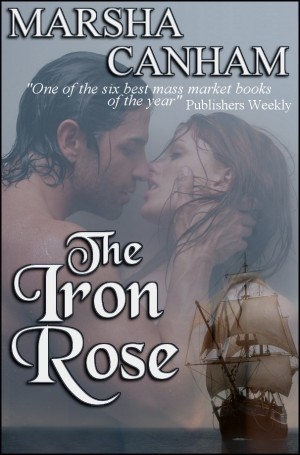

I am currently working on the third book in the series, Gabriel's story, and am aiming for a Christmas release! For a limited time after the release of The Following Sea, anyone who has already purchased the Pirate Wolf Duet will be able to download a *revised edition* of it through Amazon and Smashwords, one that will contain the third book, but at no extra cost to the reader. Simply a new version of the same book with a few hundred extra pages *G*.
After a month or so, giving everyone a chance to download the revised edition, the Duet will be replaced by the official Pirate Wolf Trilogy…with a new and revised price, I might add, ($7.99)to reflect the three books in one deal.
I hope that comes across as clear as I mean it to be. Wait. I'm a writer, I should be able to that, shouldn't I? *snort*
Ahar and avast! Back to my cannons and muskets and treasure ships…





July 24, 2011
Readalong Monday

Through A Dark Mist © Marsha Canham
WARNING…contains some explicit sexual, adult content.
CHAPTER THREE
Less than twenty miles to the north, beyond the verge of thick, dense forest known as Lincolnwoods, stretched a low-lying moor of bracken and long, slippery grasses. Spring was the only time of year there was any colour on the moor to break the monotony of metallic gray skies, dull granite cliffs, and windswept beaches that were treacherous to man or beast. Tiny crimson anemones stubbornly thrust their heads through the mire in early April and, depending upon how long it took the deluge of icy rains and merciless winds to turn the land into a bog of rotted grass and muck, the moor glowed red from morning till night. Some might have likened the sight to a carpet of scarlet silk thrown down by an apologetic god to alleviate the forbidding hostility of the sea coast. Others, especially those who had lived through wars and crusades and seen firsthand the aftermath of slaughter on a battlefield, compared the landscape to a sea of blood.
The stone keep built at the farthermost tip of the moor had been inhabited by the second kind of man. Draggan Wardieu, from the district of Gournay in Normandy, had crossed the Channel with William the Conqueror in 1066, and for his loyal, enthusiastic efforts in defeating and subjugating the Saxons, he had been awarded, among other parcels of fertile land and estates in Lincoln, this remote, desolate strip of coastline. Flanked by violent seas, fronted by an impassable moor, Draggan's eye for natural defenses bade him construct his castle there, at the very edge of the eagle's eyrie.
Towering sixty feet high, built from huge stone blocks quarried from the cliffs it sat upon, the original Bloodmoor Keep was hardly more than a three-storey square block of rock and mortar. The ground floor was without windows or doors and served as a huge storage area for the grain and livestock taken in tithes from his serfs and tenants. The second floor consisted of the great hall, and was just that: one enormous, vaulted room that served as living quarters for the entire household. Family members were only distinguished from the servants and guards by way of the small, private sleeping chambers hewn into the twelve-foot-thick walls. The rest of the inhabitants of the keep worked and slept in the common hall, which was also the dining hall, the armoury, the judiciary court when necessary, and the core of the keep's defenses. The uppermost floor was roofless, the walls high and crenellated with spaces on the battlements every few feet where archers could stand and launch a hail of arrows down on the unprotected heads of any attackers. There were no windows. Archery slits cut high on the walls of the great hall and reached by means of a narrow catwalk that surrounded the chamber, never allowed in enough light to alleviate either the gloom or the dampness. Cooking and heating fires were built on an iron grate in the centre of the hall, the smoke left to its own initiative to find the exit cut in the ceiling. Smoky, dark, perpetually damp and malodorous, the early keep was not the pleasantest of places to live, an even less accommodating place to visit unexpectedly.
Surrounding the keep was the bailey, an outer courtyard where the stables and pens were located. Protecting this was a high curtain wall, again of solid stone, forty feet high and twenty feet thick, with walkways all around to hold patrolling sentries. The outer wall was connected to the keep by a drawbridge, which could be raised against the keep wall at the first alarm to completely seal off the only entrance to the main tower. The outer wall was, in turn, surrounded by a moat and protected by a second drawbridge, guarded by a barbican tower built to hold a thick iron portcullis gate. The walls were also fitted with overhanging projections through which burning pitch or boiling oil could be poured, and were serrated with meurtrières—V-shaped vertical slots that gave the archers inside a wide range of movement to fire upon the enemy, but conversely presented a narrow, almost impossible target for returning fire.
This was the crude but effective fortification Draggan Wardieu built and successfully defended during his long lifetime. His sons, William and Crispin, along with their sons and grandsons, built on additional courtyards, halls, palisades, gatehouses, and towers until the original keep occupied only a small, isolated corner at the northernmost end of the stronghold. Within the sprawling outer bailey, there grew a self-contained village of tradesmen. The castle boasted its own smithy, tannery, armoury, alehouse, and mill, as well as vast stables, barracks, gardens and fruit orchards, all within the barrier of the stone walls. Farmers and outside tradesmen had attempted, over the years, to construct dwellings within hailing distance of the forbidding castle walls. But the terrain proved to be so unforgiving, the moor so wet and bleak, the sea such a thunderous scourge against any fishermen who tried to tame her, that the huts of mud and wattle that cringed in the shadow of the castle walls lasted only a season or two before being abandoned into ruin.
Only the immediate inhabitants of Bloodmoor suffered no lack of luxuries. The walls were thick enough and high enough to buffer the coldest and sharpest of winds. The castle was perched high enough on the cliff's edge to mock the fury of the turbulent seas churning below. No one came to Bloodmoor uninvited. No one stayed unless they were wanted. And no one dared turn back once the huge iron-clad gates were swung closed behind them.
"If you want me to leave, just say so. It is not very often my company bores a man to lethargy and great, vast lapses of silence. Frankly, I could better waste my time elsewhere."
The woman spoke with a low, sultry voice, emphasizing the more pertinent words with a moist, rolling purr of the tongue. Nicolaa de la Haye was a beauty and needed no confirming glances in polished steel mirrors to tell her so. The shocked look in men's eyes was confirmation enough. The forthright rise in the front of their tunics was proof she was as desirable now, in her thirtieth year, as she had been in her thirteenth—the age at which she had left her first lover a gasping, sweating hulk of quivering exhaustion.
There had been many lovers since then, some good, some bad. Some so exceptional she had maintained her affairs with them throughout the years, needing them as urgently and as frequently as some women required possets of henbane and opium to help them endure their dreary lives.
Slightly taller than average, Nicolaa undulated rather than walked, and was proficient in using her breasts, hips, and hands in communicating with a man in ways unknown by the spoken word. Her hair was black as coal, parted in the middle, and streamed in an ebony cascade halfway to the floor. Her eyes were so dark a green as to be almost black, heavy-lidded to suggest she was constantly on the verge of arousal—which she usually was. Her lips were full and sensuous, naturally tinted a deep shade of vermeil that teased a receptive eye into speculating where, other than on another mouth, they could bestow the most pleasure.
At the moment, most of her considerable prowess and charm was indeed being wasted. Her husband, Onfroi de la Haye—a wretched, sullen pustule of a man—was somewhere in Lincolnwoods awaiting the arrival of the widow De Briscourt. Nicolaa had hastened ahead to Bloodmoor Keep, ostensibly to help oversee the preparations for the upcoming nuptials—oh, how her teeth ground together each time she heard that word—but in reality, she had wanted this time alone with the most magnificent of her lovers, the Dragon himself, Lucien Wardieu.
Had there ever been a man created to see so perfectly to a woman's every need? The mere sight of him was enough to take anyone's breath away: a tall blond giant of a man with Herculean shoulders and eyes more dangerous than the thrust of a lance. The sound of his voice triggered liquid shivers along her spine. The scent of him encapsulated the sun and the wind and the savage primitiveness of the moor he called home. The touch … the lightest touch from the veriest tip of a long, blunted finger set rivers of heat raging through her loins, rivers that swelled and burst into torrents from the instant his flesh plunged into hers, to the moment of blinding madness that welcomed the last hot spurt of fountaining seed.
Even now, standing as he was in the shadows of the window embrasure, his back turned to the room, Nicolaa had difficulty keeping the tremors out of her voice. Moving, let alone walking, was a trial of balance and control. The slightest friction of her tunic against breast or thigh drenched her in such heady waves of erotic anticipation, she was growing concerned the eager dampness would begin to puddle at her feet.
"Lucien?" she murmured petulantly. "Have you heard a word I have said?"
"I have heard you, Nicolaa, my love. How could I not?"
"Then it must be I am disturbing you, and you would prefer your own company tonight."
The low purr of sarcasm broke his concentration and he turned slowly from the window. The cloud of distraction lingered a moment longer, dulling the incredible azure blue of his eyes, but in the next instant it was gone, brushed away by the thick sweep of lashes.
"Nicolaa," he said with a soft laugh, "any man who admitted such a sight disturbed him"—he paused and lowered his gaze to where the flimsy silk of her tunic was molded around the generous swell of her breasts—"is not much of a man."
The wife of the sheriff ofLincolnreturned his smile. "A certain Lionheart might argue the sentiment."
Wardieu shrugged and drank from the goblet of mead he was holding. "Richard has his preferences, I have mine."
"I am relieved to hear it. How the women ofLincolnwould flock in droves to hurl themselves off the nearest cliff, should the news reach them that the mighty warlord, the Dragon de Gournay, has taken to heaving himself at the buttocks of young boys."
"Tastefully put," he remarked dryly.
"Tis a distasteful image one conjures at the thought," she countered evenly, then sighed. "Especially when one considers the waste of such a splendidly virile specimen as Richard, Coeur de Lion. In truth, I did not believe it for the longest of time."
"And no doubt attempted to disprove the rumours yourself?"
"Well …" The tip of her tongue slid along her full lower lip to moisten it. "I did have an opportunity to seek a private audience with the king when Onfroi was vested as sheriff."
"I would have given a thousand crowns to witness the exchange," the baron said, his eyes glinting with humour.
"No doubt you would, you beast. I felt quite sorry for him, myself—and even sorrier now for the innocent little Berengaria, his intended bride."
"You? Feel sympathy for another woman?"
The dark eyes narrowed. "It has been known to happen a time or two."
"Usually only after you have crippled, maimed, or blinded one of them. Come now, Nicolaa, false sentiment does not become you. Turn soft and sincere and there truly would be a mass plummeting of mankind over the cliffs—out of fear."
"Melancholy. It happens whenever I am feeling neglected."
"Neglected? How so?"
Nicolaa sighed with mock frustration. "It has been over a month, my bold lusty lord. Four weeks. Thirty-two days and a good deal too many hours since these poor thighs have held a real man between them."
The azure gaze strayed downward, following the deliberately laid trail of a meandering finger as it flowed from throat to breast to waist to thigh. She wore nothing beneath the pale yellow tunic. Her nipples were clear, dark circles straining against the fabric, and where her thighs met, the nest of down bushed against the cloth like a mossy hillock.
It was rumoured she bathed in blood to keep her skin so supple and startlingly white. For a certainty, she employed the skills of several herb-women who fed her insatiable vanity by supplying creams to prevent wrinkling, powders to keep her teeth white and her lips red, possets to leave her hair smelling always like wild musk on a spring breeze. She had once ordered a clumsy dressmaker boiled in oil for scratching her flesh with a needle. Another waiting-woman had found herself impaled on a stake for daring to whisper, within Nicolaa's hearing, that her mistress made love as often to a mirror as to a man.
As for her to have gone so much as a sennight without something hard and hot between her thighs, it would have had to have been because of a grave, life-threatening illness striking her prone. Even then, she would have found better ways to raise a sweat than with hot poultices.
"How do the plans for the wedding celebration progress?" she asked sweetly. "I suppose I should ask, since it was my excuse for arriving early."
"The preparations go well. William the Marshal has sent his acknowledgment, as haveSalisburyand Tavistoke. Prince John should arrive early in the week, as will Fournier fromNormandy, and La Seyne Sur Mer from Mirebeau."
"The queen's champion?" Nicolaa arched a brow. "You should indeed be honoured that Eleanor of Aquitaine would send her favoured knight as envoy. A pity the wrinkled old sheep's bladder is too feeble to make the journey herself, but surely a feather for you that she persuaded La Seyne Sur Mer to journey in her stead. Will he participate in the tourney?"
"It remains to be seen," De Gournay said, the merest trace of pleasure betrayed in his expression. "I suspect he might be eager to establish a reputation outside ofBrittany."
"Saints assoil us," Nicolaa murmured. "You would share your own laurel wreath with the Scourge of Mirebeau? How generous of you."
"Wisdom before generosity, my love. The wisdom to see his skill firsthand and judge his mettle by mine own eyes rather than rely solely on the reports of others."
"It is said he has yet to meet his equal in the lists," Nicolaa remarked with a sly lack of subtlety.
"He has yet to venture more than a hundred miles from Mirebeau," Wardieu shot back. "Much less come toEnglandto meet his match."
Nicolaa shivered deliciously, riding the ripples of a series of small inner fluctuations. Wardieu angry, or Wardieu impugned usually set the stage for an incomparable bout of lovemaking and she felt her thighs slicken with anticipation.
"Then you intend to challenge him?"
"The notion has its merit."
"But will your bride be sympathetic to the possibility of losing her groom before she has had a chance at true wedded bliss?"
Lucien stared a moment, then gave way to a slow grin. "Ahh, the crux of the matter. I thought I detected more green in your eyes tonight than was normal."
"Plague take you, Lucien Wardieu. What, by all the saints, do I have to be jealous of? A timid little widow with knocking knees and a sallow complexion? You forget, I have seen her, my lord; I was present at her wedding to Hubert de Briscourt, and a sorrier sight could not be imagined. Three years of laying fallow beneath an invalid could not have wrought much improvement either, and if the gossip-mongers speak the truth when they say the old viper died of the pox, then she is undoubtedly riddled with the disease herself and will appeal to neither your sense of sight nor smell."
At that, a laugh escaped him. "Sir Hubert died of a sixty-year-old heart."
"Weakened, I am sure, by the sight of a poxy trull waiting in his bed each night."
"Nicolaa …" He shook his head slowly, causing sparks of candlelight to glint off the magnificent mane of golden hair. "Is it any wonder poor Onfroi sweats himself into pools when he is near you? Your tongue is sharp enough to flay any man or woman into a cowering shadow of their former self. Now, come. She cannot be as bad as all that."
"Have you seen her?" Nicolaa asked pointedly, knowing full well he had not.
"Once," he admitted. "I think. The room was very crowded, and she was standing very far away."
"There, you see? She was so ugly she was kept well out of the way to avoid giving offense."
Lucien unfolded his thickly muscled arms and moved away from the window. He set his goblet on a nearby table and crossed over to where Nicolaa stood, stopping in front of her. Reaching out, he placed a hand on either trim hip, grasping the slippery silk of her tunic between his fingers and sliding it upward.
"So what would you have me do?" he murmured, casting the flimsy garment aside and watching the fall of black hair drift back down to cover the lusciously nude body. "Let some other lout petition for her hand and win her estates?"
"Is that truly all you want her for? She is very young."
"I can have youth anytime I want it," he said, reaching out again, this time to flick aside a ribbon of hair that had tumbled over her breast. "Along with the whining, and bleating, and tears of inexperience that go hand in hand. No, Nicolaa, I am not marrying her for her youth."
Knowing the dark eyes were intent upon his face, Lucien deliberately avoided meeting them while a lazy thumb and forefinger began to trace a light pattern around one engorged nipple. The rush-lights cast a mellow golden glow over the luminous, satiny curves of her body; the fire crackling in the hearth behind them might have been the sound of the sparks leaping from one heated body to the other.
Nicolaa closed her eyes and leaned boldly into the caressing fingertips. "Will you bed her?"
"Would you have me ignore her and rouse questions concerning my … preferences?"
"I would have you kill her," came the husky whisper, shivered from between clenched teeth. "Wed her, and kill her as soon as the properties are secured in your name."
Lucien bowed his head, burying his lips in the arched curve of her throat. Her groan sent his arm curling around her waist, and the hand that had been teasing the blood-red aureole of her breast left the bountiful peaks to slide down into the soft, mossy juncture below. Nicolaa clutched at his upper arms for support and parted her quaking limbs wider, moaning feverishly as his fingers stretched deeply and deliciously into flesh that was all too ready to respond.
"You know how I abhor unnecessary violence," he said sardonically, his words muffled against a mouthful of succulent white flesh.
"I would do it," she gasped. "I would do it gladly. Gladly! Oh … !"
His fingers left a shiny wet path on her belly as they stroked upward to surround and engulf her breast again. His mouth crushed down over hers, smothering her cry of protest, the kiss as savage and mindless as the tearing fingers that scratched runnels into his skin in their haste to rid him of the short, shapeless tunic he wore. The cloth was shredded in her frenzy, but it mattered not. The hard rasp of red-gold stubble on his jaw burned her cheek and throat, but the flames were indistinguishable from the others that seared her body internally.
Running her hands beneath the torn edges of his tunic, she spread her fingers greedily over the firm planes and muscular ridges of his chest and ribs. She pushed the rent in the garment lower, baring the flat belly, the explosion of coarse blond hairs at his groin. A final tug and the fabric fell away, leaving her hands free to grasp and adore the blooded fullness that rose up between them.
"Mon Dieu," she cried hoarsely. "Mon Dieu … !"
Her mouth ravaged the taut column of his neck, the firelit expanse of his chest, the bronze discs of his nipples, and she started to slip down onto her knees, eager to worship the bold, virile body. His big hands forestalled her. They grasped her buttocks, lifting her against him, and, as he splayed his own legs wider for balance, plunged her fiercely down over the thickened spear of his flesh.
Nicolaa's head arched back. Her mouth gaped and froze around a jolt of pleasure so intense the sensation hovered somewhere between ecstasy and agony. He eased the pressure briefly, allowing her only as many moments of clarity as were necessary to wrap her arms and legs avariciously around him. Then he brought her weight slamming down again … and again … and the pleasure verged on pain before erupting in a thousand starbursts of unending rapture.
Her hair enveloped them in a silky black cocoon, the curls jumping to and fro to the rhythm of the damp, heated clash of their bodies. Their silhouettes were cast onto the wall behind them, two huge shadows undulating with wild abandon.
Lucien's great strength survived the first convulsive foray into oblivion, but as he felt the second building within him, he laughingly chastised Nicolaa to interrupt her own recurring climaxes until they could gain the support of the bed beneath them. Her answer was a guttural curse, her response a wave of such protracted gratification that she was drenching both of them in its effects as Lucien lowered her onto the high platform bed.
"By Christ's holy vows," he rasped, furrowing deeply into the sleek and trembling haven once more. "How does a man like Onfroi even begin to satisfy you?"
"He never has," she gasped, quaking through a shiver of aftershocks. "And never will. That is why I need you, my lusty lord. And this—" She arched her head back into the linens, straining into the joy of each thrust as he plunged his flesh repeatedly into hers. "This is why you need me as well. We should have married, you and I. All those years ago … we should have married."
"We would have killed each other by now," he grunted. "One way or another."
"Ahh, but what a sweet death it would have been, locked together, bound together in ecstasy forever. Admit it, damn you. Admit you have never found another woman who can satisfy you as I do!"
Lucien admitted nothing, not in so many words. His body, however, spoke eloquently, surging deeper, harder, faster; held in her pulsing grip, driven by the passion raging through every vein, muscle, and tautened sinew.
Nicolaa's nails drew ragged red gouges on his flesh as she raked them from his shoulders to his flanks. She levered her hips higher, and watched his handsome face contort in the firelight. Spasms wracked his body, rendering him as helpless and vulnerable as a babe in arms and she knew she could have stabbed a dagger into his heart at that moment and he would not have been aware of the threat. She could have slashed his throat or signaled to someone concealed in the shadows to attack him from behind, and he would not have suspected the danger until it was too late.
He should not take me for granted, she thought darkly. Nor should he doubt for a moment that I would hesitate to kill—as I have done before—in order to get what I desire most in life. A nubile young bride keening her pleasure beneath him, she most certainly did not desire. She knew full well a steady stream of girls, women, wenches, and whores frequented his sleeping couch, but never, not once had he ever contemplated marriage. Not even when the dower lands of a proposed match could have doubled or trebled his present wealth. So why this one?
Nicolaa had seen the widow De Briscourt. Tiny as a bird, delicate as a blush, as blonde and dewy with youth as the early morning sunlight.
What if Lucien saw her and … and …?
The moan that welcomed the panting, drained mass of spent ecstasy back into her arms was not entirely feigned. She held him and combed her fingers through his damp blond locks, savouring every last shiver and shudder that racked the mighty body.
Nicolaa was not going to lose him again. Not this time. She had been patient all these years, tolerant of the need for discretion and caution. But there was no one now who would dare point a finger at the Baron de Gournay and remind him his father had been branded a traitor, his brother slain as a murderer. The last of his line, he had succeeded in overcoming the taint of both tragedies. He was Richard's trusted ally and Prince John's confidant; the time for patience was rapidly drawing to an end. She would have her great golden warlord. She would live at Bloodmoor Keep as its mistress, and she would remove without qualm anything or anyone who stood in her way!






Sample Sunday CJ Archer
First, let me say…no one has come up with even a hint of what the cow book might be, featured on my last blog *sigh* I'd offer my first born son as further incentive, but if you don't talk baseball or football he pretty much tunes you out.
Secondly, I'm totally STOKED that Jimmy Thomas likes my new cover for the Pirate Wolf Duet enough to make his profile pic today. You can see it here http://www.facebook.com/JimmyThomasDotCom
On to today's sample. It comes all the way from Down Under, please give a warm welcome, and wave a touque (I'm Canadian, eh) to CJ Archer…

Hi everyone, I'm C.J. Archer. I'm an Australian writer of historical romances mostly set in Elizabethan and Victorian England. Some of the 6 ebooks I've released have paranormal elements in them and some don't. I'm eclectic that way. Even more than I like to write, I like to read. Dorothy Dunnett, Jane Austen, Juliet Marillier, Janet Evanovich and many more – like I said, eclectic.
Reading, writing and research are my passions. Yes, research is a passion. I love history. All of it, no matter the time or place. Historical documentary on TV? I'll watch it. A repeat of Time Team? Yep, I'll watch that too.
The book Marsha is featuring today is A Secret Life which is set in Shakespeare'sLondon. Like me, the heroine is passionate about her writing. In her case she writes plays in a time when female playwrights were frowned upon. Also like me, the heroine has a scientist father but I'll leave it up to you to decide if her relationship with her father parallels the one I have with my dad  . The premise for A Secret Life is a little like Remington Steele. Remember that old 80′s TV show starring Pierce Brosnan where the female P.I. uses him to be the "front" for her detective agency? I loved that show.
Here's the blurb from A Secret Life…
Minerva Peabody needs a man. Unfortunately she picked the wrong one. The impoverished playwright has a dream to see her plays performed on stage but in Elizabethan England, not only are women considered the inferior sex, they simply do NOT write plays. Faced with rejection after rejection, she decides to take one more chance with the most desperate theater manager inLondon, only this time she'll use the cover of a man. Sucked in by a pair of bright blue eyes and impressive shoulders, she chooses Blake out of the crowd, never thinking he'll actually play an active role in her ruse. But when he does, he gets under her skin in the most alarming way.
Privateer (don't call him a pirate to his face), Robert Blakewell, accepted Min's proposal in order to discover which cur among Lord Hawkesbury's Players got his sister with child. But when his mission threatens to destroy Min's fledgling career, he must make a choice: protect his family or the woman he has grown to love. Either choice will see him lose something precious.
*****
Onto the excerpt. This scene is the second meeting between Blake and Min. She has already asked him to act as the writer of her play and now he wants to find out more about it…
Min continued towards him, her head down, not watching where she was going. Again. He shook his head. Hadn't she learned from the last time? Just as she was about to pass him, he stepped in front of her.
She bumped into him and he caught her shoulders, stopping her falling on her arse.
"What—?" She shook herself free then, several moments too late, finally looked up at him. "Oh. Blake." Recognition dissolved the irritation in her gray eyes.
"Hoping to avoid me?" he said.
Her gaze didn't quite meet his. He had his answer.
"It's too late to back out now," he said. "I'm here. And I think I'd like to be a playwright."
She scanned the faces of passersby, perhaps searching for the elaborately feathered hat Style seemed to favor. Or perhaps she was simply avoiding looking at Blake. "Part of me was hoping you wouldn't be here," she admitted.
"Sorry to disappoint you."
"No you're not." She chewed her lower lip and he lifted a hand to stop her destroying the succulent morsel, but dropped it before she noticed. Touching her had shocked his senses awake. He couldn't risk touching her again.
"You see, it's just that…I really don't…"
"Want me to ruin this opportunity for you?"
"That's it!" She smiled at him, leaving her harried lip alone. "Thank you for understanding. So you'll leave?"
"No."
Her face fell. More lip chewing. Reading her emotions was like reading a book, and not a very difficult one. "Perhaps you could hide then," she said. "Just over there." She nodded in the direction of a tavern where several barrels were being unloaded from a cart. A group of men, some swaying, one singing loudly and out of tune, hovered around the barrels like flees on a dog. He grunted. If he was going to hide, he wouldn't choose a place where he'd stand out like a mermaid on a rock.
"No," he said again. "I'm staying here. I want to meet Style."
She stared at him for a long moment. He accepted the challenge and stared back. It gave him a chance to study her. A splash of freckles decorated both cheeks, and one had slipped down to the corner of her mouth, giving the impression she was constantly smiling. Her nose was slightly crooked and a tiny pock scar marked her chin. Her hair was tucked tightly beneath her hat so that not a strand escaped but he could see that it was fair with only a hint of red, not quite as dark as the queen's. It reminded him of sunrise over a Saracen desert.
Ha! Poetry. Any half-wit could do it.
Min clicked her tongue. "Very well, you may stay," she said as if it had been up to her. "But," she pointed a finger at him, "do not speak to Style unless he directly asks you a question. I'll do all the talking. And do not, under any circumstances, say anything about the play. I've told him you're shy, so…act shy. You can do that can't you?"
"I can try." He glanced towards the White Swan but Style was still nowhere to be seen. The company's performance for the day had ended a while ago and yet he'd not appeared amongst the audience leaving the inn.
The crowd was thinner today. Word must have spread through the City that it was more interesting watching two ants crawling up a wall than the dung Lord Hawkesbury's Men called a play. He wondered if Min's play was any better. It couldn't be much worse. But what if it wasn't good enough?
Blake would need to find another way, that's what. He could just barge in, fists and accusations flying, but Lilly wouldn't speak to him if she ever found out. No, he needed to be more subtle. Damn. He wasn't very good at subtle.
Thank god for Min.
"However," Blake went on, "perhaps you should tell me about your play so I can answer any questions he may ask me directly." Better to be armed and ready than caught unprepared.
"He won't."
"He might."
"Very well," she said and he was surprised that she acquiesced so easily. She'd seemed ready for a battle. He even looked forward to one. "It's set in Ancient Rome and is about a young couple who fall in love but through a series of unfortunate events directed by the Gods, they're kept apart. It's too complicated to go into more detail."
"It's a tragedy?"
"No, a comedy."
"A romance?"
"Yes."
He watched her, trying to determine if she was being serious or making fun of him. By the set of her jaw, she didn't look like she was about to laugh. Bollocks.
"You don't like romantic comedies?" The sun chose that moment to appear from behind a cloud and she narrowed her eyes against it. Or was she narrowing them against him?
"No. It's not that." A few moments ago, he'd thanked Fortune that this opportunity had fallen into his lap. Now he wasn't so sure. A romantic comedy? Min thought him a suitable candidate for writing a romantic comedy? She expected Style to believe it too? He was a privateer for God's sake, captain of his own brigantine. He'd made life hell for Spanish galleons from theLevant to theNew World. He'd been chained up in jails not fit for a dog. He'd killed pirates, got drunk with brigands and fought for his country, his honor and just because he damn well felt like it. Now this girl expected him to pass for a writer of romantic comedies? His crew would laugh him off his ship if they found out.
He blew out a breath. Perhaps it wasn't as bad as he thought. "Does anyone get murdered?" he asked. "In this play?"
She frowned. "No."
Pity. "Is there a pirate? Or an evil emperor?"
"No, no villains. Although one of the Gods is quite competitive and thinks up some cruel scenarios to keep the lovers apart."
What sort of play doesn't have a villain? He sighed. A romantic comedy apparently. "What about a cannon?"
"Not in ancientRome." She looked apologetic. "No guns either." She suddenly brightened. "But there is a sword fight."
"Just the one?"
"Yes. Sorry." There was a long pause in which he could see her warring with herself. Eventually her playwright's curiosity, as she had called it, won. "You like violence." She pulled the edges of her cloak together as if fending off the cold, but the day was reasonably mild. Did he frighten her? He spent much of his day trying to frighten people so it wouldn't surprise him. However it did surprise him to realize he didn't want to frighten her.
"If I wrote a play," he said, "it would at least have a murder in it. Probably two. And a villain. A really bloodthirsty one."
"You didn't write it," she said irritably. Irritation was better than fear.
"But if people are to think I did, there should be a dead body."
"Oh. I see what you mean." She sounded genuinely concerned. "You do seem like a man who would have no qualms killing a character."
"Thank you," he said then wondered why he'd said it. This woman addled his mind. He'd had two conversations with her and so far she'd managed to make him do things he wouldn't normally do. Like this. He was actually agreeing to act as the writer of her romantic comedy?
He'd done many foolish things in his life, but this was top of the list.
You'd better appreciate what I'm doing for you, Lilly. And you too, Mother.
"If it's a comedy, does it have a clown?" he asked. There'd better be a clown. All good comedies had clowns dancing jigs.
"There's a comedic servant," she said.
He sighed. "That'll have to do."
"Yes, it will." She crossed her arms and lifted her chin. Had he offended her?
He didn't have a chance to ask because Style appeared. When she saw him, Min caught hold of Blake's hand in a grip that could put many men to shame. Her hands weren't as soft as he thought they'd be. Small calluses marred her palm. The sort of calluses that come from continuous hard work, not the lifting of a quill.
It was wrong. Min was an educated woman of gentle birth. She should have smooth hands—perfect palms to match the perfect fingers. He rubbed his thumb along the hardened bumps, annoyed at them, at whatever had put them there, and at whoever was supposed to be taking care of her. Who could allow a daughter or sister such as Min to do a servant's work? Wrong, wrong, wrong.
With a strangled sound, she suddenly dropped her hand and stared at him like a startled cat. He flexed his fingers, still able to feel the weight of her hand, the warmth of her touch against his skin.
He formed a fist and beat back the fire spreading through him. There was no room for those kinds of fires in his world. Not the ones started by innocent, big-eyed gentlewomen.

Links
Amazon: http://www.amazon.com/dp/B0050CLM8C
Amazon UK: https://www.amazon.co.uk/dp/B0050CLM8C
My blog: http://cjarcher.blogspot.com







July 22, 2011
Does anyone recognize this book?
I had dinner last night with a great friend, Malle Vallik. When I started writing, Avon of Canada was one of the publishers I plagued with manuscripts…three which were admittedly pretty bad before the fourth landed on the desk of the then-assistant editor, Malle. She apparently grabbed it off the top of the unsolicited slush pile and took it with her when she went to the show that night, and while waiting for the feature to begin, started reading, and by morning had finished it and shown it to the editor, Margaret McLaren with a recommendation to buy. The book was China Rose and the rest, as they say in all the best of cliches, is history. I stayed with Avon for two books and met another relatively unknown author, Virginia Henley, who was also a Canuck and had been signed along with myself to launch the Avon Ribbon Romances line. Virginia already looked like "an author" with her silk suits and fur coats. I was a blue jeans T shirt kinda gal…and still am…so I was a little in awe of Mzzz Henley. Of the entire publishing world, for that matter. Me. I'd written a book. The book was going to be published. It would be in a book store. People would buy it. People would actually READ it.
Heady stuff.
When Maggie and Malle parted ways with Avon, I went with them…loyal to the editor who had taken an unknown and was now enticing her away from one publisher to go with another. I wrote The Wind and the Sea and The Pride of Lions, but just around the time the sequel, The Blood of Roses, was to be released, the publishing house declared bankruptcy and that was that. The backlist was sold, along with the company assets, to a company in California, Knightsbridge, which barely lasted long enough to print a few thousand copies of BOR before it, too, when belly up like a dead ant at a picnic.
After that came a relatively long and happy career with Dell, where I once again reunited with Virginia (she had stayed with Avon) I found myself touching toes with some of the best romance authors in the business, many of whom have stayed in touch and stayed friends all these long years. As for Maggie, she married the publisher at PaperJacks and when it went belly up, she retired and moved out to God's country. Malle? She landed squarely on her feet and got a job at Harlequin, first as an assistant editor, then a *real* editor (who talked me into writing my one and only contemp), and now, *muffled number* years later, she heads up the ebook division, specifically Carina Press. Both Maggie and Malle have remained friends through the years. Last week I spent a few days at Maggie's cottage. Last night I had dinner and many many laughs with Malle.
The wench flies all over the place to attend conferences, representing Carina Press, and had just come back from RWA in NY, and before that, Milan Italy. Rough life *snort*. But during the course of the meal, yakking up a storm as usual, we talked about Maggie and Jim and the infamous 9 hour lunch. Then the convo veered back to how I got started writing.
My son was about 4 at the time and we lived in a townhouse complex. One of the neighbours used to devour Harlequins. I had honestly never read one, so she picked through her vast collection and brought one over to me and said it was "cute". My reading habits at the time leaned toward Thomas Costain and Alastair McLean, Mickey Spillane, Leon Uris, Higgins and Follet etc. But I thought wtf, I'll see what Harlequins are all about.
So here was the premise: Heroine is driving along a lonely stretch of highway in some western state, probably Texas. She has to stop the car to avoid whacking into a baby calf standing in the middle of the road. Calf won't move. She looks around, doesn't see the mother cow in the miles and miles of vast flat land and desert, so what does she do? What would any other normal city slicker do? She loads the calf into her car and keeps driving. Few miles down the road she sees a motel/gas station so she pulls in. It's late, she's tired, and she has this calf in the car. I can't for the life of me remember what she was intending to actually DO with the calf, but since the hero of the story was the owner/manager of the motel, it didn't really matter. She tried to check in and of course he spotted the calf in the car, peering out the window, and there was some discussion about her mental state, driving around with a cow in the back seat, and he said no way was the calf spending the night in the motel room. She got all huffy and said the calf was her *pet* and pointed to the sign on the desk that said all pets were welcome…and that's when I threw the book with great gusto against a wall and never did finish it to find out what happened. I suspect they fell madly in love cuz she was such a madcap and he was so stoically macho, and in the end they named the cow Gertrude and lived happily ever after. When I gave the bashed remains of the book back to my neighbour, amidst much laughter and scoffing, she looked at me quite calmly, offended no doubt by my opinion of her reading habits, and said: "If you think you can do better, why don't you write one."
Which brings us forward all these years to where I sit now, with 17 books in print, great friends in the business, great readers who prop up the old ego with emails from around the world.
What I would dearly love now, for nostalgia sake, is to get my hands on a copy of that cow book. I have NO idea what the title was, no idea the author's name. It would have been written some time before 1978, at a time when Harlequin was releasing 20 or so books a month LOL. If someone recognizes the plot from my sketchy memory, and can help me find the actual book, I will give that person the complete set of my ebooks, including all future releases before anyone else gets to read them. How's that for incentive?



July 21, 2011
Wanted: Vice President for Big Publishing House
Interviewer: Nice to meet you, Mr. Eagerbeaver, I understand you're interested in a career in publishing?
Mr. Eagerbeaver: Indeed, I am. I've dreamed about being in publishing all my life. It's such an exciting prospect, being in charge of buying and selling a bazillion books each year, influencing the reading habits of every man woman and child on the planet. Like…Wow. Just wow.
Interviewer: Mind if I ask your qualifications?
Mr Eagerbeaver: Of course. I have law degree as well as a PHd in marketing and finance, I've worked ten years as a political advisor, writing speeches, putting the spin on some unpleasant and potentially explosive situations. I have a wife and seven kids I need to put through college, starting with the eldest who is going through med school. Big expenses there. *nod, chuckle, wink*
Interviewer: *nod, chuckle, wink back* You sound perfectly qualified for the job and we'd love to welcome you on board. You'll be overseeing the financial department… which is a huge responsibility…keeping the bottom line at the bottom and the company profits at the top.
Mr. Eagerbeaver: *cheesy grin* I can certainly do that. My last job was working with an exiled African Prince who managed to escape his country with ten billion dollars. I helped him get his money out of the country by organizing an email campaign.
Interviewer: Excellent! We can't pay top dollar just yet, you understand, not until you can prove yourself in the numbers department. We're prepared, however, to offer you an advance on your salary of $10,000 which is, I must say, a very generous amount considering you are new to publishing and have never worked in the business before.
Mr. Eagerbeaver: I see. Is that the industry standard…?
Interviewer: *waving a hand magnanamously* Most publishing houses would offer $2k- $4k to start, so you're already ahead of the game. And we do offer a generous incentive on commissions…8% of all profits your department brings in.
Mr. Eagerbeaver: Ah! Okay then. Sounds wonderful.
Interviewer: We pay twice a year, at the end of each accounting period. You may have to wait another 90 days after that for the accountants to juggle the numbers, print out statements etc etc etc, and you may need that law degree to find the bottom line, * chuckle* but don't forget, there is another VP running that department who works under the same mandates…bottom line at the bottom, profits at the top.
Mr. Eagerbeaver: I see. But…twice a year? Is that standard as well?
Interviewer: *another cheesy smile* Of course. And of course you will have to first earn out the $10,000 advance we've given you against your salary. Depending on how efficient your department is, that could take you into the second, or even third pay period.
Mr. Eagerbeaver: So…you're saying you're going to give me a $10k advance now…which I will have to earn out by relying on the performance of my department employees, which will pay me 8% on everything they earn….but I only get paid twice a year, and there's no guarantee my department will be efficient enough to earn out the 10K in the first six month period…or even the second? Do I have that right?
Interviewer: Oh, and you have to sign a contract stating that we hold exclusive rights to your services for the next ten years or so, whether your department earns anything or not.
Mr. Eagerbeaver: But…I have seven kids to put through college. I have a house, a mortgage, car payments…
Interviewer: *leaning forward with a wink* But you'll be a Vice President. It's an important job. People will look at you in awe and say: wow, I always wanted to be a Vice President.
Mr. Eagerbeaver. Hmm. That's true. And it's what I've wanted to do all my life.
Interviewer: *still smiling, sliding a contract through the slick oil spill on his desk so it blurs some of the fine print* If you're good enough and work fast enough, you can take on other departments, so you could potentially be earning another advance and another 8% from, say, the marketing people. They could always use a good spin doctor there.
Mr. Eagerbeaver: *reaching for the pen…pauses* Were you hired under the same terms? Has it worked out for you?
Interviewer: Me? Hell no. I get paid a salary every two weeks. Mind you, I can't brag that I'm a VP….
*********************
This blog was inspired by a comment from Tuesday's blog about numbers. Done with loving irreverence, of course *sweet smile*






July 19, 2011
A matter of numbers
There is a lot of talk about numbers these days, as the indie revolution spreads. Authors who have been riding the wave for a year or more write posts about their numbers being in the thousands each day, in the tens of thousands at the end of each month. They talk a lot about strategy, and campaigns and how to improve sales, how to boost numbers, and you can almost see the eyes of the newbies spinning round and round, ka-chinging with thoughts of dollar signs and taking the easy path to riches.
Unfortunately, that's not the reality.
First of all, no two authors will have the same numbers. Even if they wrote the identical book, with the identical title and posted it in all the same places…they would not have the same number of sales.
I have author friends who are doing far better in sales than I am, and some others who aren't. Every day, sales figures change. There are dips and rises, like riding on a roller coaster, and there are those who study those numbers and track them trying to find a pattern. Do books sell better on Wednesdays? OnHolidayweekends? This past July long weekend, some authors said their sales completely stalled. They sold one or two copies and they blamed this on the fact it was a holiday and people were away, they were at the beach, at a baseball game, at a cottage… Yet I had one of the best sales weekends yet…almost 900 copies in three days…great for me, phenomenal to others, a disaster to some who sell that many in an hour.
Name recognition? Yes, that could surely account for the differences between one author's sales and another's. But if you apply that to me, my name hasn't been before the reading public in over seven years, whereas others have been putting books out in print every six months.
The type of books I write? Absolutely, that is a factor. I write swashbucklers. Action-packed, sexy, sensual swashbucklers that publishers pushed out of style in favor of shorter, character-driven books featuring vampires and girlfriends sharing angst and uncomplicated plot lines that took the place of pirates and knights and highwaymen. There is a very good blog here that explains why a lot of authors got turned off the big Publishing Houses. And an even better one here about why watching numbers can drive a writer crazy.
The bottom line is, if you listen to the numbers people post, and assume that you're books will have the same results, you'll go nuts. If you assume your numbers will remain consistent or even continue to grow each month, you can go a different kind of crazy because good numbers one month can dip down to crappy numbers the next. It's just the nature of the beast, and you take the good months in with the bad, but your sales are never ever going to be as good or as bad as someone else's. The number will be unique to you.
One thing everyone has to remember is that those books stay up from now until forever. Your grandkids' grandkids will be collecting royalties on them long after you're dust. So just take each week, each month as a gift you weren't expecting, weren't counting on. Sure, it's a numbers game, but don't worry about anyone else's numbers. Don't even worry about your own. I stopped writing seven years ago because it wasn't fun anymore, the publishers had taken away my creative freedom and based all of my print runs, distribution, marketing and contract negotiations on…you guessed it…numbers.
I'm writing again because self publishing has given me back my creative freedom…something every author should treasure like the hope freaking diamond. Most new indie authors won't know the true worth of that freedom because it has never been taken away. Yet they run the greater risk of throwing it away themselves because they let the numbers consume them and they forget why they're writing in the first place.
I write because I live in a small town inSouthern Ontario. I'm afraid of sailing. I've never held a sword, never drawn a bow, never galloped down a moonlit road in the middle of the night with a patrol of soldiers chasing after me. I've never stood on a battlefield on a chilly morning and seen the steam rise off open wounds. I've never climbed a ship's rigging or fired a cannon. I've never slept with Russell Crowe, or Paul Newman or Errol Flynn, but I've I pictured them all in my mind and in my arms as I write love scenes.
That…is creative freedom. That is fun. And that is far more important to me than numbers.


July 17, 2011
Readalong Monday…Chapter Two
I hope everyone is enjoying the little readalong. I must admit, Through A Dark Mist was one of my fav books to write. Sparrow was also one of my all time favorite characters, so it was a double whammy for me *s*.
Through A Dark Mist © Marsha Canham
Chapter Two
Servanne no longer saw the beauty of the greenwood. The air no longer felt crisp and clean; rather it was cold and damp and chilled her to the bone even through the heavy layers of her clothing. She no longer paid heed to the tall, stately oaks, nor did she admire the dancing shafts of sunlight or the silvery burble of a meandering stream. She sat erect on Undine's back, her face a mask of outrage and disbelief. Relieved of the reins by the outlaw leader who now led her horse through the forest, her hands were clasped together over the frontpiece of her saddle, the knuckles white and straining with repressed anger.
She had been stunned speechless by the outlaw's preposterous claim. Lucien Wardieu indeed! But before she could recover her faculties and demand explanations, his curt commands had set the scrofulous band of followers into motion. Within moments, she and Biddy were culled from the others and led into the forest. Everything of value had been stripped from the wagons and transferred onto the backs of the pack horses, as had the bulk of the guards' weapons and armour. The outlaw had given the wounded Sir Roger de Chesnai a small, canvas-wrapped packet and a message to be delivered to Bloodmoor Keep—obviously a demand for ransom and proof that the hostage was in safekeeping.
The effrontery of the man was not to be believed! Periodically Servanne's gaze would stray from the path ahead to launch unseen poisoned darts into the broad back of the wolf's head who dared to call himself Lucien Wardieu. She had already given him a host of truer appellations—madman, poseur, traitor, charlatan, impostor, bedlamite, crack-brain …
Each seething glance resulted in a new term to describe an audacity that was beyond belief. Who, in all of England, did not know the great golden countenance of the real Baron de Gournay? What man or woman in possession of all their senses could believe for one instant that this coarse, ill-bred, unkempt, murderous creature of the forest belonged at the same table with kings and queens? The mere notion of such a ruffian even being permitted into the servants' gallery was preposterous. The stables, perhaps. The pigsty or the muck pit where the refuse from the castle latrines was collected … maybe. But as liege lord of the castle itself? As baron lord of Bloodmoor Keep?
The snort of disdain she was unable to repress caused the dark chestnut head to turn slightly. A wry smile suggested he had felt every barb and intercepted every thought that had passed through her head over the last two hours, and the sight of it fueled her anger a notch higher.
"The scenery displeases you, my lady? You see stretched before you nature at its very peak. She offers here a tranquility and solitude found nowhere else; a wild purity shared only by other virgins who have not yet experienced the taint of man's interference."
"She bears your taint, wolf's head," Servanne remarked dryly. "And that must surely spoil her for all others."
"Ahh. Spoken with the true sentiment of wedded bliss. Might I assume your previous marriage left something to be desired?"
Servanne's eyes flashed blue fire. "You may presume nothing whatsoever. My marriages—past or future—are no concern of yours. How dare you even speak to me of them, or of anything else for that matter. There is nothing your twisted tongue could say to me that could be of the least interest, and I insist you do not insult me with it again."
The outlaw's broad shoulders shrugged beneath the black wolf's pelts. "A greater hardship on you, I fear, for I have yet to encounter a woman who could maintain as good a silence as a man. Especially not when her brain is overtaxed with righteous fervour."
Servanne opened her mouth with a ready retort, saw the mockingly expectant brow arch in her direction, and pressed her lips tautly together again. She averted her gaze and stared straight ahead, but the resentment that bubbled within her could not be as easily diverted.
"I have seen Lord Lucien with mine own eyes," she declared stridently. "How dare you presume to mock him."
"Do I mock him, my lady? I thought you would be flattered I envied his choice of brides."
"Flattered!" Her voice was brittle with anger. "You could flatter us both by dropping dead this instant and saving the baron the trouble of rooting you out later! As for envying his choice of brides, I would sooner win the praise of a crimp-kneed, foul-breathed Saracen infidel than possess one attribute the likes of you would find appealing! I would sooner an arrow pierce my heart and rend it in two than find myself the object of a wolf's envy!"
The Black Wolf studied the flushed features of his hostage a moment longer before dropping the reins of her horse and unslinging his bow from his shoulder. With her tongue stuck fast to the roof of her mouth and the echo of Biddy's shrill screech reverberating along her spine, Servanne watched in horror as the outlaw braced his long legs wide apart, swung the grip of the bow from hip to shoulder, and sighted along the shaft of an arrow. At the last possible instant he corrected the aim so that when he snapped his fingers to release the missile, it did not pierce the wildly beating thing that sought to escape her breast, but hummmm-ed in a long, sweeping arc over Servanne's head and disappeared somewhere in the trees beyond.
The silence that followed was complete enough to hear the low droning of a swarm of bees in the distance. It was complete enough to hear the swish of Undine's tail as she chased away an annoying gnat. Complete enough that when a clean, sharp fff-bunggg left the quivering shaft of a returned arrow buried in a nearby tree trunk, both women nearly lifted off their saddles in fright.
"If ye'd asked," drawled the burly Welshman as he ambled by, "I would have given the signal myself, milord, and saved ye the bother."
"No bother," the outlaw replied smoothly, reslinging his bow, his eyes still locked fast to Servanne's. He took up the fallen reins and gave way to a faint, wry smile as he led her horse forward again.
Servanne's heart was still pounding against her breastbone, her senses still recovering from the shock of the outlaw's twisted sense of humour. They were recovering from something else as well, an oddity she had not noticed earlier in the excitement of the ambush.
The wolf's head shot with his left hand!
Confirming the startling discovery, she saw that he wore his sword slung on his right hip—giving ready access for the left hand—and wore his quiver of arrows tilted to the left shoulder.
A child of Satan! Bastard spawn of the Devil himself! Everyone knew a left-handed man was born with the curse of Lucifer on his soul—as if she had needed any further proof of his perfidiousness!
"Not much farther to camp now, my lady," he was saying. "From the smell of it, I would guess we are having fresh venison in honour of your presence."
Servanne smelled nothing except an admission of blatant guilt from a boastful poacher: another crime to add to his growing list. A man's life was forfeit if he was caught killing one of the king's deer. He was first blinded, then tortured over a slow fire until his skin blistered and fell off in great black flakes. He was then hung, drawn, and quartered by way of an example to others. A fitting demise for such a barbarian as this wolf, she mused.
"You may be assured, sirrah," she declared evenly, "I would rather waste away to a shell of skin and bone than defile the king's law by eating his royal due. You and your men may well choke on your treasonous repast if you so choose, but Mistress Bidwell and myself should die first."
Biddy gave a ram's snort of approval; the outlaw scoffed derisively. "Another sight mine eyes would ransom kingdoms to see: a dimpled cheek without the sheen of sweet grease upon it; a slender hand not first into the pot of roasted pheasant; a dainty belly not groaning with complaint after being stuffed to the chin with capon, pasties, and pies."
An unsubtle and prolonged rumble of agreement stirred in Servanne's stomach, reminding her she had not eaten since early morning, and that an unsatisfying meal of black bread and sour ale.
"And then there are the sweetmeats," contributed a voice from the staggered band of outlaws. "Our own goodwife Mab prepares some of the tastiest creations that have ever crossed these lips. What say you, lads?" The question was aimed generally over his shoulder. "Has Mab any equal this side of the Channel?"
"Bless the stars that found her for us," came a jovial reply. "Or mayhap just bless Gil Golden for bringing her out ofLincolnwith our last purchase of arrowheads!"
A round of solid backslapping sent Servanne's gaze across to the man who had perfunctorily shot an arrow into Sir Roger de Chesnai's thigh. He had a smooth, aquiline profile that suggested a far easier life lay behind than the one ahead. His shoulders were square and straight, if a little sparse of bulk; his legs were long and agile enough to swallow the wooded miles without visible effort. Copper-coloured locks capped his head like woolen fleece, cropped short beneath the jaunty green felt hat he wore slouched forward over his brow. His eyes were a blend of greens and golds and spicy brown flecks, and a webbing of fine lines at the corners intimated a man of easy nature and good humour. The long, ragged scar that distorted his left cheek implied it was not always so. The disfigurement in no way detracted from his handsomeness, but it did confirm the fact he was a branded thief, and would have as easily aimed for Sir Roger's heart as his thigh.
Servanne was distracted from further observations by a sudden burst of sound and activity from the woods up ahead. From high, high up in the boughs of a tree came a swoosh of air and a curled knot of flying hair and shrieking laughter. Detaching itself from the swinging vine with a whoop, the tiny figure splayed arms and legs wide, his clothes pocketing the wind to break the impact of his body slamming into that of the Black Wolf of Lincoln. As it was, the outlaw was jolted back off his feet and required several paces to reclaim his balance. Servanne's horse balked indignantly; Biddy muttered an oath which earned stares and grins from the nearby foresters.
"Sparrow!" spat the Wolf with a not altogether feigned grimace of displeasure. "By Christ's pricking thorns, one of these days I will step out of the way and let you sail clear on past into perdition!"
The squirming bundle disentangled itself from the torso of the outlaw and sprang onto the ground beside him. The man … dwarf … child … was barely tall enough to see the top of the Wolf's belt. Thin as a reed, as tanned as a roasted nut, he … or she … had huge, shining black eyes that seemed at once too large for the round, elfin face, and far too knowledgeable for such a mischievous grin.
Servanne blinked, and blinked again. She had heard fables of such creatures living in the forests; wood elves who were several centuries old, kept young and childlike through pagan rites and rituals. She had never truly believed in such tales of magic and witchcraft, of course. Magic was only for the eyes and ears of the superstitious, and as for witches and warlocks …
She found herself staring at the outlaw leader again, her mouth as dry as parched wheat.
"So so so." Sparrow's voice was as delicately pitched as a woman's. "So this was to be the Dragon's new plaything. There is not much to her, is there? But then I suppose such a child would be a welcome change from being clamped between the iron thighs of Nicolaa de la Haye. You sent our demands on ahead?"
"We accomplished what we set out to do," the Wolf responded. "And you? You found the sheriff?"
"He was waiting at the fens, just as you predicted," Sparrow nodded, grinning. "He and most of the guard fromLincolnCastle. Slutching fools! Another half league into the forest and they might have upset our plans."
"They might have tried," the outlaw replied lightly. "But I am inclined to think a few well spent arrows would have had De la Haye and his men bolting for cover regardless if it had been Richard's intended bride, Berengaria, he had been sent to meet."
"The sheriff should know by now to leave such matters to his wife. The Bawd Nicolaa would have stayed and fought us with pleasure."
"The rest of our men? They made it back without incident?"
"Bah! Old Noddypeak did not even know we had him in bowshot. Mind, he kept scritching and scratching at the back of his neck"—Sparrow gave an imitation of the sheriff scratching nervously—"and shaking off the waterfalls of sweat he leaked"—lie shook himself all over, like a dog emerging from a pond—"so I suspect he was not entirely without grand expectations."
"A pity we had to disappoint him."
"Aye," Sparrow sighed. "The lads had him sighted on their arrow tips every blink of the way."
"They will have him again, when the timing better suits our needs. Right now, Onfroi de la Haye is of more use to us alive than dead."
"Aye, my lord," the little man said, "So you keep telling us."
"So it shall be," the Wolf insisted. "The Sheriff of Lincoln is a fool, a weak incompetent puppet; one whose every move we can predict and anticipate with laughable ease. Put someone else in his stead—his sweet wife, for example—and we would see her quenching her thirst for blood in ways we have not even thought of yet."
"No shy blanchflower, our Bawd," the gnome agreed.
"And if anyone other than myself makes a target of her brass-tipped breasts"—the tall, copper-haired outlaw stepped quietly forward—"they will have me to answer to."
Sparrow looked up and, although Servanne could not swear to it, she thought the bold little elf edged a cautious inch closer to the protective bulk of the Black Wolf. "I am not forgetting, Gil of the Golden Eyes. Not wanting to feel the sting of your arrows either. She's yours, all yours, and welcome to her. God's teeth, but we are touchy about it, are we not? Not enough Norman blood shed to wet your arrows? Ho! Still most a quiver full, I see. And a string as slack as Lack Jack's back."
Gil Golden smiled slowly, ominously. "Easily enough remedied. A daub of sparrow blood should turn the trick."
"You would have to catch me first, you great lumbering hulk!"
Quick as a wink, the tiny man darted forward, planted a flying kick on Gil's shin and vanished behind a solid wall of alder bushes. His tinkling laughter, first in the alders, then beside them, then far above in an arching tangle of hawthorns indicated with what unsettling swiftness he could move, and also why he bore the name Sparrow. Moreover, before the cursing outlaw could finish hopping a circle on his uninjured leg, an arrow no longer than a man's palm zipped through the air and carried away Gil's prized green felt hat.
"That cuts it!" Gil swore. "The wretched puck is going to pay dearly for it this time."
"Are ye already forgetting what happened the last time?" roared Robert the Welshman. "It were not only yer hat what got a hole in it, but yer breeks and butt as well!"
Gil's eyes narrowed. "My thanks for reminding me. When I catch him, I will pin both his ears back for the leather he owes me."
The other foresters guffawed openly and began fishing in belts and sleeves for copper coins.
"A denier says Gil Golden wins this round," the Welshman wagered, doffing his cap and dropping the coin into the crown. A score or more coins clinked good-naturedly into the pot, some with an "aye" attached, some with a "nay." Even the two captive ladies found smiles wanting to come to their lips as they watched the agile huntsman stalk into the woods in pursuit of his diminutive quarry. Servanne caught hers just in time when she realized the icy-gray eyes of the outlaw leader were observing her.
"It appears, Biddy," she murmured brusquely, "these children have no grasp of the seriousness of their crimes."
The Wolf moved closer, his eyes glinting in the afternoon sunlight. "You should be thankful, my lady, we are still able to see some humour in the world around us."
"Humour, sirrah? In murder and kidnapping? Pray, you will forgive me if I do not share your amusement."
"You say the word murder as if we were the only ones guilty of it."
"I saw none of your men lying dead on the road, victims of a cold-blooded ambush."
"Ambushes are rarely warm affairs, nor do they lend themselves to a fanfare of trumpets."
"You mock me, sir," she said coldly.
"I mock your ignorance, madam. I mock your inability to see past the tip of your nose … although it is held so high, I should not wonder at the difficulty."
Servanne felt the redness creeping up to her brow. "I am not distressed. Your own nose, wolf's head, has been sniffing up dung heaps so long it cannot distinguish fair from foul."
Intrigued despite himself, the Wolf studied the square set to the young widow's jaw and pondered how the pearly row of small, even teeth had remained intact all these years. His own hands tingled with the urge to curl about her throat and rattle a few loose.
"Methinks I have been away fromEnglandtoo long," he mused, the slanted grin barely moving around the words. "Too long for such haughtiness and greed as I see in some to be the cause of such misery as I see in others … or are you blind as well to the starvation, the cruelty, the beatings, cripplings, and degradations to be found in every town and village throughout the kingdom?"
"If a man starves, it is because he is too lazy to work the fields. If he is punished, it is because he has committed some offense against the crown. As for the haughtiness and greed of which you speak, I suggest the worst offender is the cur of the forest who aspires to gain his wealth and recognition through thievery and murder … or do your own eyes suffer some difficulty in seeing the irony of your piousness?"
Her quickness of wit and tongue was beginning to make an impression on his men and the Wolf could sense that part of their amusement was a result of his inability to bring her under his thumb. She possessed far more spirit than was healthy or wise. Spirit bred contempt and contempt fostered rebellion—something he had neither the time nor the inclination to tolerate.
Conversely, fear bred caution, and both were qualities he would sorely prefer to see shading the vibrant blue of the widow's eyes.
"Robert … take the men on ahead and see that everything has been made ready for our guests."
"Aye. Shall I take this un for ye as well?" A thumb the size of a small anvil crooked in Servanne's direction.
"No," said the Wolf, his grin a misty suggestion about the lips. "I will bring her along myself."
He took up Undine's reins again and murmured a comforting "whoa" to the mare as the foresters and their burdened rouncies filed past. Servanne held Biddy's worried gaze until the last glimpse of her luffing wimple had disappeared behind the wall of green, then she had no choice but to look down at the outlaw … which she did with the vaguest stirrings of unease.
The Wolf was bareheaded under the blazing glare of the sun and his hair shone with red and gold threads tangled among the chestnut waves. He looked somehow bigger and broader, more powerful and far more dangerous on his own than he had surrounded by his men. And, as Servanne found herself earning the full brunt of his stare, she could not help but feel the heat of a threat behind it, a promise which coiled down her spine in a fiery ribbon and pooled hotly in her loins.
"I believe I gave you a promise that no harm would befall either you or your waiting-woman," he said in a calm, detached monotone. "But madam, as you are undoubtedly already aware, you present a worthy—nay, almost an impossible test for a man's patience."
Servanne moistened her lips and fought to keep her voice equally cool and steady. "On the contrary, sirrah. When I am treated with respect and courtesy, most men claim they enjoy my company immensely."
"I am not most men. And you are not here to fulfill my desire for … company. You are my hostage, madam. A piece of valuable property to be bartered for and released when and if a suitable price is agreed upon by both parties. If at all possible, I should like to honour my pledge to return the property to its rightful owner in an … ah, undamaged condition. However, if some damage does occur—through negligence or sheer stupidity, as the case may be—I will hardly be driven to don the horsehair shirt and whip myself raw in repentance of a broken vow. In other words, Lady Servanne, you will behave yourself … or I will not."
"I doubt your behaviour could sink to any lower depths, rogue," she fumed unwisely. "And I doubt you could cause me any further discomfort than you have already."
The outlaw sighed and turned his head away for a moment. Before Servanne could react, he reached up and clamped his broad hands around her waist, lifting her unceremoniously out of the saddle. Her legs, long ago gone numb from the hours on horseback, would have crumpled the instant her feet were set to the ground if not for his support. One of his arms snaked around her waist, forcing her to press against the iron-hard length of his body. His free hand cradled her chin and tilted her face upward at an uncomfortable angle that emphasized both his height—which was as immense and imposing as one of the towering pines that surrounded them—and her sudden vulnerability.
At once, a mindless drumming caused the blood to surge through her veins and her heart to trip over several rapid beats. Her lips trembled apart and her fists curled into tight little knots as if the fingers could not bear the even more debilitating sensation of contact with a body that offered no apology for its granite hardness. Straining with virility, he crowded against Servanne so that there was no part of her left unaware of the intimacy of heated male flesh.
"The challenge, I believe, was to cause you … discomfort?" he asked.
Servanne had to catch at her breath before answering. "Better than you … worse than you have tried and failed!"
"Is that so? And I suppose you are hardened and worldly-wise enough to know what a man's best and worst might be?"
Servanne's stare threatened to turn liquid. She knew, without a doubt, the man holding her with the possessiveness of a barbarian king was nothing so trifling as a man or a king.
"Let me go," she gasped, squirming to break out of his embrace. Her fists scraped against his chest, displacing the carelessly open V of his shirt so that her knuckles skidded into the curling mass of crisp, dark hairs. The flesh beneath was all muscle and steamy hot skin. There was no give, no indication she could have won a response with anything less than the business end of a quarterstaff.
"Let … go!" she cried. "How dare you touch me!"
"How dare I?" he repeated, his breath warm and promissory against her cheek. "You should pray I dare no more, my lady, than just touch you. Although"—the hand at the small of her back shifted lower, caressing the curved roundness of her buttocks—"the notion is fast becoming less of a trial than first imagined."
Servanne's mouth dropped wide with shock. He was pulling her forward, holding her in such a way as to boldly forge the shape and contour of his thewed limbs upon hers. Heat met heat and pressed deep, scorching her through the layers of samite and silk as if the garments were made of air. A moist shudder convulsed deep within her, a reaction to his animal maleness that was beyond her control, and his arms tightened further, as if he had felt it and was offering more.
"No!" she cried, beginning to fight like a wildcat to free herself, her arms flailing, her nails seeking to let loose rivers of blood. With a snarled curse, he merely squeezed her into the wall of his chest, pinioning her there until she discovered she could not breathe. Her struggles weakened, then ceased altogether. The simple act of clawing her fingers into the wolf pelts drained her and she sagged limply in his arms, drooping into the encroaching blackness of a faint.
The Wolf eased his grip slowly, letting the air back into her lungs, and, as the blood flooded back into her limbs, he looked down at her, his face as impassive as marble. She was quiet enough now. Subdued. Drawing her breath in soft, broken gasps. He watched the colour flow back into her cheeks, the sparks of blue fire rekindle in eyes that would soon begin to fight back in silent, guarded hatred. He admired what he saw. The lush, provocative temptation of her lips drew his gaze and for a moment, he felt an arousal so intense, so completely unexpected and unwarranted, he almost drew her forward again to kiss her.
Instead, he pushed her out to arm's length and sprang away as if she had suddenly burst into flame. The rebuke permitted Servanne to stumble haltingly well out of reach. Her fingers flew up to cover the pulsing heat of her lips and while she could swear he had not kissed her, her mouth felt scalded as if he had.
"Do you still have doubts that my behaviour could worsen?" he asked quietly.
Servanne's blood continued to roar through her temples, making it difficult for her to think, let alone speak. Her skin had seemed to shrink everywhere on her body, most urgently so wherever it had been branded with the contact of his own. Her eyes stung with unshed tears of indignation—tears he watched form and swell along the thick, honey-coloured wings of her lashes.
"Well, my lady?"
She looked up, the back of her hand still pressed against her lips, the fingers curled and trembling.
"Will your stay with us be an easy one, or will I be forced to use harsh measures to win your cooperation?"
"How … long do you intend to keep me prisoner?" she asked in a shaky whisper.
"The shortest time possible, I promise you." Aware of the tension that had caused his own body to tauten like a bowstring, the Wolf felt it break now, and the fire in his gaze burned down to smoky gray ash. "It will seem shorter still if we have no more need of these verbal jousting matches. Especially ones where the outcome is a foregone conclusion."
Servanne's lashes were still damp, but the brightness sparkled with frost. He was laughing at her; mocking her futile efforts to defy him. Smug, arrogant bastard! He had insulted her, had dared to lay his hands upon her, and now, to make the degradation complete, was addressing her with the flippancy one used to pacify a simpleton!
A hot welter of resentment rushed to fill the void so recently drained by panic and in a moment of sheer and utter desperation, she whirled around and started running toward the same wall of trees that had swallowed Sparrow and Gil Golden so efficiently. She heard an angry curse explode behind her, but ignored it. She heard Undine nicker and whinny loudly, and guessed the outlaw had tried to push her aside to pass, but the horse had taken umbrage and valiantly stood her ground. It was enough. The extra seconds it took the Black Wolf to skirt the rearing hooves, combined with every last scrap of energy Servanne could will into her pumping legs, carried her past the barricade of saplings and well into a dense weaving of juniper and alder.
Running with no thought other than escape, Servanne dashed under broken limbs and plunged through barriers of fern that closed into a solid wall behind her. Her skirts hampered her and the branches snatched at the flying wings of her wimple as she ducked and darted her way deeper into the forest, but she neither stopped nor slowed to remove any hindrances. She was aware of angry, pounding footbeats thrashing through the undergrowth behind her, but they took a wrong turn, then another, and for a time she could not hear them at all over the loud slamming of her own heartbeat.
She stopped to catch her breath and listen, and that was when she learned to move with less haste and more caution, for it became apparent that he too stopped every few paces and listened as well. But she was a good deal lighter, and fear gave her the swiftness of a startled doe. Also, the shadows were dark and cool, kinder to the prey than the hunter, offering pockets of safety that became blacker and more frequent as the sun slipped lower in the sky.
Constantly twisting and turning in the labyrinth of vines and trees, Servanne ran until her sides ached and her legs grew buttery with fatigue. She lost all sense of time and direction. Once she thought she smelled woodsmoke and, fearing she had inadvertently run straight into the outlaw camp, she backed away and fled in the opposite direction. She had no way of knowing how far she had traveled or how much farther she would have to go before a road or village might present itself. What slices of the sky she could see through the latticework of branches overhead were a dull, uniform pewter gray, indicating the sun was fading rapidly. She knew she had to find shelter and a safe place to hide before the darkness settled over the forest. There was already a thin veil of mist swimming about her ankles, soaking the hem of her gown and causing her toes to squeak with the wetness inside her shoes.
A low, hauntingly familiar sound brought her to a dead halt in the midst of a green sea of waist-high ferns.
She heard it again and released a misty puff of startled air.
A bell, by Mother Mary's holy angels! A monastery bell tolling the hour of Vespers!
With the echo still ringing hollowly in her ears, Servanne waded through the ferns and stumbled to the bottom of a steep incline. At the base of the gorge, was a thin sliver of a stream that meandered between two enormous hillocks of rock and gorse. She picked her way carefully along the moss-blanketed bank, following the stream and eventually emerging from behind the hillocks to find herself standing less than two hundred yards from the long, low, lichen-covered walls of an abbey.
Gloom and pine-scented shadows cloaked the clearing in which the abbey stood, but the bell tower was plainly visible rising above and behind the heavy oaken doors that held the inhabitants cloistered from the rest of the world.
Servanne moved toward it as if in a trance, her feet gliding soundlessly through waves of long grass, her skirts trailing fingers of displaced mist. At the gates, she spread her arms in supplication and collapsed against the support of the dew-stained wood for the time it took her to compose herself. Fighting back tears of relief, she pulled the rusted iron chain that hung down the wall, and nearly sobbed aloud when she heard the corresponding tinkle of a small bell inside the courtyard. When she rang it a second time, her attention was drawn to her hand, to the dirt and grass stains that marked not only her skin, but marched up the sleeves and down the skirt of her tunic. Her face would be in no better condition, she surmised, but for once, her appearance did not concern her. Nothing concerned her other than the welcome sound of wooden-soled sandals hurrying toward the gate to investigate the disturbance.
A small square window in the oak portal creaked open a cautious inch. A single brown eyeball peered through the gap, flicking back and forth over the span of the meadow before thinking to angle downward. A second eyeball joined the first as the window opened wider, the two eyes surmounted by a worried frown.
"My child?"
"Father … help me please."
"Good heavens—" An eyebrow arched upward in surprise, temporarily unseating the frown. "Are you alone?"
"Yes. Yes, I am alone, but there is a man chasing me—"
The window snapped shut and an instant later, the iron hinges of the gate heaved a mighty protest as one of the double doors was swung open. The cowled monk stepped out and immediately stretched out his hands in gentle concern.
"What is this about a man chasing you?"
"Please, good father," she gasped. "I beg you, please hide me. There are outlaws in the woods. They are chasing me, hunting me; they mean to kidnap me and hold me to ransom. I managed to escape them once, but … !"
"My child, my child!" The monk caught her hands in his. They were smooth and warm and not a little callused from long, thankless hours of toiling at God's labours. The face beneath the coarse gray hood was serene and unlined; a scholar's face; a face filled with compassion. "Are you hurt, my child? Did they hurt you in any way?"
Servanne struggled for breath and words. "There was an ambush. They took me hostage … killed the guards … now they are chasing me. The Wolf. The Black Wolf of Lincoln, he calls himself. He means to kill me, Father, I know he does. Please … you must hide me. You must give me sanctuary until a message can be sent to Lord Lucien, Baron de Gournay."
The name seemed to have no effect on the acolyte and she began urging him back through the abbey gates when she heard the ominous beat of horse's hooves cutting through the gorge. She did not have to look back over her shoulder to know it would be him, yet she did, and the sight of him riding out from under the canopied froth of trees caused her belly to commence a sickeningly slow slide downward.
"It is him," she managed to whisper, cowering behind the cowled shoulders. "It is him … the Black Wolf. Please … you must help me. You must not let him take me away."
"Have no fear, child," the monk declared calmly. "He will not be taking you away from this place."
Not entirely convinced by the note of assurance in the monk's voice, Servanne regarded the Black Wolf's approach with only slightly less trepidation than that with which she had welcomed the first time a chirurgeon had attached a row of slimy leeches to her arm to drain the ill humours of a fever. There was anger, cruel and unyielding, etched into every line and crevice of the outlaw's face, bristling from every tautly held muscle in his body. His jaw was clenched, the veins in his throat and temples stood out like throbbing blue snakes.
He reined the enormous black beast he rode to a halt in front of them, his figure blotted darkly against the faltering sunset. Servanne experienced another deep, moist shudder; this one pressing so heavily over her loins that her knees almost buckled from the strain.
She was terribly, physically conscious of the way the ice-gray eyes inspected every smudge and scratch she bore. And when she was summarily dismissed, like some minor annoyance, and his attention focused on the monk, she felt a further clutch of fear stab at her belly. Who was to say he was not above slaying a man of the holy order? Who was to say he would respect the sanctity of the church or obey the unwritten law of sanctuary? This wolf's head was a law unto himself, acknowledging no authority but his own, no rules but those of his own making.
The Black Wolf swung one long leg over the saddle, the leather creaking softly in the misty stillness of the air. Servanne flinched reflexively as he walked slowly toward them; if not for the monk's stalwart protection shielding her, she was certain she would have fainted from the sheer tension that approached with him.
"Friar," he said quietly.
"My son," was the equally unruffled response.
The Wolf's gaze flicked over to the pale face that was peeping from around the monk's shoulders, and he grinned like a sleepy lion.
"Ringing the bell seems to have been a worthwhile risk after all," he mused. "It saved us the time and bother of scouring the woods for you. You can thank Friar for the idea; he worried your soul might become easy prey for the Devil if you were left on your own throughout the night." A wider grin brought forth the flash of strong white teeth. "Not to mention what wild boar and wolf might make of you."
"Ahh, now," the monk sighed. "Can you not bend a little from your usual tactful and gallant self? The poor child is already half-convinced you mean to kill her and devour her whole."
"The idea has growing appeal," the Wolf replied dryly.
The monk turned then, one of his lean hands reaching up to brush back the hood that had concealed a full, untonsured shock of jet-black hair. "Forgive me, Lady Servanne, but the deception was necessary, if only to ensure you did not spend the night alone and unprotected in the woods."
Servanne was too shocked to respond, too stunned to do more than brace herself against the waves of blackness that threatened to engulf her.
"Are the others inside?" the Wolf was asking, his voice sounding low and distant, as if it was coming from the far end of a tunnel.
"All but the extra sentries Gil and Sparrow dispatched to ensure the bell did not attract any unwanted visitors. Not that I think it will. This mist is thick enough to muffle the sound and direction well."
The Wolf glanced back over his shoulder, noting with a grunt of agreement that the drifting white stuff had already obliterated the exit to the gorge. "You are probably right, but we shall keep a sharp eye out until morning anyway. There is no sense in inviting more trouble than we already have."
This last comment was said with a direct and caustic glare toward Servanne, who did not think it worthy of a rebuke.
"What is this place?" she asked. "What have you done with the real monks?"
Seeing the glint of villainy in the Wolf's eye, Friar was quick to intervene. "The abbey has been abandoned for almost a hundred years. As you will see in a few moments, the buildings are scarcely more than shells, sacked and put to the torch long ago."
"Surely the local villagers would know of its existence and direct the king's men to search here first," Servanne pointed out, somewhat surprised at the oversight.
"Local villagers," the Wolf said succinctly, "if you can find any who will admit to knowing of the existence of Thornfeld Abbey, will also tell you the ruins are haunted. Plagued by pagan Devil-worshippers. Cursed by demons who breathe fire and feed on human flesh. All of which suits our purposes well enough," he added, "if not our intent."
"If it … ah, gives you any comfort," Friar interjected hastily, "I once attended a seminary and came within a chasuble's width of being ordained. It appeases the men, who call me Friar, to have me offer daily prayers to ward off any evil spirits who may linger about the woods."
"I am not so easily frightened by tales of witchcraft and deviltry," she said, her words a little too shrill to be entirely convincing.
"Good," the Wolf remarked. "Then you will not question the source of the blood pudding you find before you on the tables this night."
With a slight, sardonic bow, he took up the stallion's reins and walked past Servanne, his stride fluid and powerful, coldly dismissive. Friar, his brows folded together in a frown, won back her startled gaze with a gentle touch on the arm.
"Come. Your maid is inside, and the chambers we have prepared are really quite warm and comfortable, despite appearances."
Appearances, Servanne thought bitterly. A monk who was not a monk; a man who was a wolf, who claimed to be another man who she was beginning to believe had only ever existed in her mind. The dream had become a nightmare. The nightmare a reality.
With weary, leaden steps, she walked through the abbey gates. Cobbles underfoot were broken and upheaved with tangles of weed and bracken growing wild from every nook and crevice. Pathways, once groomed and even from the daily shuffle of sandaled feet, were choked with brambles, overgrown to the point where only a keenly discerning eye might yet detect their true course.
As her despondent gaze roved farther afield, the shape of the ruined buildings grew out of the shadows and gloom. Roofs, once comprised of great wooden beams and slate tiles, were now grotesque arches of skeletal black ribs, strangled by ivy, jutting up over scorched walls. Two long wings of decayed stone formed the almonry and pilgrim's hall. Flanking the far end of the courtyard were the remains of a priory church and refectory, both scarred and corrupted by wind and weather. The outer wall that had seemed so formidable and protective from the greenslade, was a breached and crumbling facade, long ago conquered by an army of trees reclaiming it for the forest.
The darkness had fallen so swiftly Servanne had not noticed it. But now, being led toward the looming stone hulk of the pilgrim's hall, she could clearly see the pulsating, misty saffron glow rising from the campfires within.
Her footsteps faltered and she pulled back from the smell of roast meat, woodsmoke, and careless camaraderie. She would have preferred the company of wild wolves and boars to what awaited her here. She most desperately would have preferred to have never heard of Lucien Wardieu, Baron de Gournay; to have never suffered the prideful notion of becoming his future wife; and to never, ever have thought her former life as Lady de Briscourt dull and boring and needing a change for the better.








July 16, 2011
Sample Sunday…a twofer!

Since I was happily ensconced at a cottage in loverly Muskoka last weekend and there was no sample posted on the Sunday, you lovely readers get two today. First up is one of the Loopies and a good friend, Julia London, who is about to leap out of the nest and test her wings in self publishing. The second sample comes to you from Kathleen Valentine, an author I've met through the Kindleboards chat rooms, a very cool place to hang out and find new indie authors.
First up, welcome Julia London….
Hey! Marsha said I could come and talk about myself, and who am I to pass up an opportunity like that? I am the bestselling author of a quite a few books, and if you know me, you probably know me for my historical romances. Seriously, does a person ever get too old to imagine herself in a beautiful gown, in a castle, with a rich, powerful man to entice her? No. Well. At least I don't.
But in addition to the regency historical romances, I have also penned nine contemporary romances. Some are straight romance. Others are contemporary novels with strong romantic elements, meaning, a heroine or hero may have other equally important relationships he/she is dealing with in addition to a romance.
The Lear Sisters Trilogy (Material Girl, Beauty Queen, and Miss Fortune) fall into the latter category. I wrote these books several years ago, and loosely based them on King Lear. King Lear decided to see which daughter loved him the most. In my series, Aaron Lear is a rich and powerful man. He learns he has terminal cancer, and he thinks his daughters aren't ready to live without him there to run their lives. So he sets them out on their own, like King Lear did, to see which of them will sink and which will swim. All three daughters have their issues with the old man. All three daughters meet some men who bring out the best and the worst in them.
Today's sample is from Material Girl. Robin, the oldest fits this description. She is a pretty jet-setter who has a sense of entitlement that can make her arrogant, even when she doesn't realize it. Robin's father thinks she needs to be a little less arrogant and a little more level-headed. He removes her from her cushy job in the family business and puts her at ground level. Robin is appalled—she thinks she deserves better than that. She loves her father, but she thinks he is a meanie (although she uses a different word). It takes a man from another strata in the social hierarchy to teach her about herself and about the world. Oh, and he's a hunk. I hope you enjoy this sample!
Thanks, Marsha!
Robin scarcely noticed the coffee or anything else other than her father's voice blaring out of the answering machine. This was the call she had dreaded, the inevitability of it haunting her exhausted sleep. She grabbed the phone before Jake Manning heard Dad go off like a madman. "Dad?"
"What in the hell is going on?" he demanded the moment he heard her voice. "I heard the goddam office burned down and that you spent a night in jail for hitting a policeman!"
"I did not hit a policeman! I was arrested for driving without a license and—"
"How in the hell does someone get arrested for driving without a license!?"
Wincing at the sheer decibel level, Robin jerked the phone away from her ear for a split second, then cautiously put it back. "It's a long story, Dad, and just a really stupid mistake. I sort of talked back to him—"
"Goddammit, Robin, that is exactly what I am talking about. You are too arrogant for your own good. You think you know better than everyone else!"
"I do not think—"
"I've had enough of your bullshit—"
"You don't even know what happened!" she cried angrily. Her blood was boiling; she could feel it inflaming her face. She glanced at Mr. Fix-it, who was staring at her like she was starring in some made‑for-TV movie. Mortified, she turned and hurried to her bedroom for a little privacy.
"I don't need to know what happened!" Dad was yelling at her. "I already know that you got arrested and your goddam office—"
"Stop yelling, Dad," she said, and shut her bedroom door shut behind her.
"Ah to hell with it! I didn't do you right, Robin. I didn't teach you the ropes; I didn't show you how to run a business. I just let you prance around—"
"Oh God, not this again," she moaned, sinking onto her bed.
"I know you try hard, but you just don't know a damn thing. Now, I've given this a lot of thought. I gave you too much too fast. I think the best thing to do right now is send you to school."
"School?" She snorted. "What school?"
"The school of life. The school of the business world, of working your way up the ropes. You have no business being in a vice presidency, not with your lack of experience—"
"I've been with the company four years, Dad."
"And in four years you haven't learned enough to keep one freight yard afloat. I've talked this over with your mother and my mind is made up."
Panic set in; Robin gripped the phone tightly. "Talked what over with Mom?"
"I've decided to put you in a position where you can learn a little about the freight industry. Iverson and I've been thinking of acquiring a subsidiary company—packing materials. It's something you can do from home."
She did not like the direction this was going. "What do you mean, 'do from home'? Do what from home?"
"Put together a proposal for acquiring one of the two companies we've been considering. They teach you that in business school, don't they? Cost-benefit analysis? Acquisition strategies? I hope so, or else I paid a fortune for nothing."
Stunned, Robin collapsed back on the bed, blinked up at her ten‑foot ceilings. This could not be happening. She was stuck smack in the middle of one horrendously long nightmare.
"One of the companies we've been looking at is in Minot, North Dakota," Dad blithely continued. "They make bubble wrap, foam packing products, et cetera. The other is in Burdette, Louisiana, just this side of Baton Rouge. It's the same sort of operation, only a little bigger. You need to get out to see them."
Minot, North Dakota? Louisiana? Robin used to New York and Paris and Stockholm—not Burdette. "Dad!" she exclaimed in horror, "you aren't making any sense! You don't mean I am going to Burdette! What would I do there?"
"Well, for one, you would meet with the folks and learn about packing materials—"
"Dad! You want me to learn about the stuff that goes into boxes and crates?"
"Well . . . and boxes and crates, too. You know, how they make them, what it takes to operate an outfit like that, sales volume, revenues, the whole nine yards. And while you're at it, you are going to try and sell yourself and LTI and convince them that letting LTI buy them out is the best thing they could do for the long-term health of their company and their employees. Then you are going to study which one you think we ought to acquire and work out a deal."
"A deal for Styrofoam peanuts and bubble wrap?" she asked helplessly, teetering on the verge of torrential tears for the umpteenth time that day. "Are you trying to punish me? If you want to punish me, choose something a little more urbane, would you? I can't go to Burdette!"
"Oh yes, you can," he growled, "and if you think that is beneath you, or that, for some reason, you are entitled to your salary and perks just because of who you are instead of what you know, then I guess I have no choice."
The meds were making him crazy. Robin suddenly rolled over, propped herself on her elbows to try a different tact. "Dad," she said calmly, "let's talk about what's really bothering you. I know you are mad at me, but—"
"The good thing is that you can work from home and it won't be as time-consuming as what you were doing, although God knows what that was. Don't you see what I am doing here? I want you to slow down, get you to take the time to understand what's important in life. I'm doing this because I love you and I want to do the right thing by you, Robbie. I don't want to leave behind a spoiled kid with no idea how to succeed me, much less run my company."
Myriad emotions—anger, hurt, sadness—filled her throat, and Robin closed her eyes. "You make it sound as if I offer no value to LTI."
"You'll be a whole lot more valuable when you know what you are doing."
A tear slipped from the corner of her eye and raced down her cheek. "And if I don't want to go to Minot or Burdette?"
Dad sighed heavily. "If you don't want to go, then I guess you better find yourself another job, baby."
Stabbed through the heart.
"Now listen! You're going to learn a lot! I'm making you an acquisitions specialist, working directly for Evan. He's going to guide you every step of the way."
Robin caught her breath and abruptly sat up. "So basically, you are demoting me to bubble wrap."
"Think of it as training. Evan is the best in the business and he's been telling me for a long time you need this and he's more than happy to do it."
Well hell, thanks a lot, Evan. And now, of all the people in the universe, was going to be her mentor. Robin's fragile ego was in a death spiral.
"Now. What about this arrest? What do I need to do?"
He had already humiliated her enough; she didn't need any more of his help. "It's taken care of."
"What about the office? The operations manager at the freight yard says it is gone."
"Dad, I'm really tired, okay? I don't want to talk about it right now."
He paused, said reluctantly, "Okay, baby. You get some rest. We'll talk again on Monday."
Oh boy, she could hardly wait. "Bye," she said tightly, clicked off, and tossed the phone onto a pillow. So this was what an alternate universe looked like. Robin Through the Looking Glass, where she was not the VP of the Southwest Region any longer, but Queen of Peanuts and Bubble Wrap. With a groan, Robin pushed herself up off the bed, went to her closet and pulled, from the maybe pile, a pair of old jeans ripped at the knees and a cutoff Houston Astros T-shirt. Her mind was numb, devoid of everything but two very basic facts: She was hungry. And she needed a drink.
But when she emerged from her bedroom, Robin was startled for the thousandth time by the presence of Jacob Manning. Hadn't he gone home yet? She frowned at his back as she padded into the dining room. Well, if she was going to have to get used to him being around, at least he wasn't hard to look at. Now that she knew he wasn't a total weirdo. She casually took in the breadth of his shoulders, his lean waist, and his very nice butt. He was scraping something; she walked toward him, saw the hint of a tattoo under the sleeve of his T-shirt.
She moved closer.
Handydude glanced at her from the corner of his eye.
Her face burned. He must have heard quite a lot of her exchange with Dad. "Why are you still here?" she demanded, acutely conscious of her flush.
"Ah. I see Godzilla is up and at 'em again. You hired me, remember? Signed a contract?"
"Damn that contract," she muttered.
Fix-it Guy grinned and pointed with his blade to the brick. "See this?"
Robin peered closely.
"Antique brick. People pay a fortune for it now." He paused, stepped back to admire it. "No telling how much of it there is. We'll know when we strip away these hard layers of paint. I'm going to test different areas so we'll know how best to remove it. Then I'll get my crews started." He looked at Robin then, his gaze drifting up to her hair.
Self-conscious, Robin ran a hand over the top of her head, wincing at the wild feel of it. Embarrassed again, she glanced down and remembered she was wearing dirty, torn jeans and an ancient T-shirt cut off at the midriff. Well, looky here, she was already dressing the part of Bubble Wrap Queen. The only thing missing was the double-wide.
Not that Handy Andy seemed to notice. As he continued to brush away years of paint, Robin noticed that he had a very muscular arm. An Atlas arm, one of those you see in commercials holding up the world and babies in tires. An Atlas arm that was connected to an Atlas torso, and—
She abruptly turned away, appalled that, in spite of her total misery, she was ogling a workman in her house. Not good. Actually, pretty bad.
She stalked to the dining room, remembered the spilled coffee. A roll of paper towels later, she reminded herself she was starving, and marched to her kitchen and flung open the fridge. Like she was going to find anything there, other than a pack of AA batteries, two containers of yogurt, and a jar of crushed garlic. Ugh. She slammed that door, opened the pantry door. A box of spaghetti she figured dated to World War II, some oil, and one can of stewed tomatoes.
As the food supply wasn't looking too good, she moved to the next cabinet with the pullout wine rack, which usually held several bottles of wine. Except there were none, and Robin vaguely remembered polishing off the last couple of bottles a couple of weeks ago when Mia was fighting with Michael. There was, however, a bottle of vodka, which of course she didn't remember acquiring. Nonetheless, she took the bottle out of the cabinet and returned to the fridge hoping she had overlooked some cranberry juice. Naturally, she had not. "Damn," she exclaimed with great irritation, her voice echoing off the bare walls and floor.
"What's that?" El Contractordodo said from the dining room.
Robin took two steps back, looked at him through the arched doorway. He was wiping his hands on a dirty towel, looking pretty damn virile. "Oh, don't mind me. I'm just expiring over here with no food, one lousy bottle of vodka, and nothing to mix it with."
He actually laughed at that, the same warm laugh she had heard on the phone when they had discussed her renovations, which, upon sudden reflection, seemed like fifteen centuries ago. "You expire? I think you're too ornery," he said, still smiling.
Robin sighed. "I know you must think I am a grade-A fruitcake, but I'm not usually so . . . so . . ."
"So much trouble?" he finished for her.
Her eyes narrowed.
Hammerman brandished a charmingly lopsided, infectious smile, and Robin could feel a smile of her own spreading across her lips for the first time that day. "Aha—you do think I am a complete nutcase!"
"No, I do not think you are a complete nutcase. No more than three-quarters."
Robin couldn't help it—she laughed in spite of herself. "Well, I'm sure you've heard enough by now to know why, Mr. Manning."
"Hey, call me Jake," he said affably, dropped the towel, and put his hands on his hips to better consider her. "And for what it is worth, I figure there's a good explanation for everything."
"Really?" she asked hopefully.
Jake Manning frowned and shook his head. "No. Not really." With a chuckle, he went down on his (very fine) haunches, opened up his backpack, and extracted a soda.
Robin realized she was checking him out yet again and quickly looked at the bottle of vodka she held. Yeah well, he really was a very handsome man in a worker-guy sort of way. She looked up as he took a big swig of his soda.
"Code Red Mountain Dew," he said. "Good for what ails you and a perfect complement to any meal."
"You actually drink that stuff?" she asked, coming out of the kitchen.
"Sure. It's pretty good." His cell phone rang; he put the plastic bottle on the table and wrestled the phone off his belt. "Try some with that and you'll appreciate it," he said, nodding at the bottle she held. He answered his phone with a short "Yeah," paused for a moment, then walked out the front door.
Girlfriend, Robin mused, and strolled to the table where he had left his Code Red Mountain Dew. She picked it up, immediately flipped around to the nutrition chart and frowned. "Look at the sugar!" she muttered to herself, and carried it back into the kitchen and mixed the vodka with his drink.
By the time Jake came back in, looking a little flushed, she thought, Robin lifted the bright red drink on which she had managed to put a frothy pink head. "Salut," she said and sipped the concoction, then flopped down on a dining room chair.
Jake looked at her drink, then at the table. "You used all of it?"
Robin nodded. He'd offered it to her, hadn't he?
He frowned. He picked up a putty knife and began to scrape around the window casings with a vengeance, chipping off bigger and bigger pieces of paint. Robin sipped, watching him, wondering what she could say to break the silence. "Seems like that would go a lot quicker if you used one of those chemical peels," she observed, ignoring the fact that all she knew about chemical peels came from facials.
Jake spared her a glance. "I'll do that with the wall. Right now I am trying to see what is underneath."
"You should at least get a bigger knife."
He threw down the knife and picked up the towel. "So," he said casually, wiping his hands, "you hit a police officer, then burned down your office?"
"I didn't hit him!" Robin instantly cried. "I just mouthed off."
"Imagine that."
"The incident has been blown way out of proportion by my grandma."
Jake looked up from his hands, the copper in his eyes shining with . . . something. Inappropriate glee? "So what'd you say?"
She shrugged sheepishly, examined the ice bobbing in her drink for a moment. "I called him an idiot cop. Which probably wouldn't have been so bad if I could have found my wallet, but my wallet was being burned in the fire at my office at the time, apparently. And then . . . I refused to give him my name."
Jake nodded thoughtfully, seemed to mull it over. "Why? Was he one of your perverts or something?"
Oh, hardy har. Squirming a bit, she thought about exactly why she had done it, and winced. "Because he was bothering me," she finally muttered, realizing how ridiculous she sounded, especially since it was the God's honest truth. She was such an idiot.
To confirm it, Jake shook his head in disbelief. "So what did he say?"
"He called me a smartass and read me my rights."
Jake made a sound as if he were choking, then smiled with far too much satisfaction.
"Is that a smirk?" she asked curiously. "Are you smirking?"
"Damn straight it's a smirk," he cheerfully admitted. "So did you start the fire, too?"
"No! I was in jail, remember? There is no possible way I could have started it!"
"So let me see if I have this," he said, drawing to his full height and putting his hands on his hips. "You're just a smartass, but not an arsonist, right?" Then he laughed at his lame little joke and started to gather his things. "Probably some wiring gone bad. Happens all the time."
"See? That's exactly what I was thinking." she said, nodding emphatically. "Wiring! Old building, old wires—but a big wire, right? I mean, it would be almost impossible for something like, say, an unattended coffeepot to do it . . . right?"
He paused, gave her a look. "Don't tell me you left the coffeepot on."
Robin was on her feet before she knew it, one hand wildly gesturing, the other gripping her glass tightly. "I don't know!" she cried helplessly. "I think I unplugged it, but I don't know for sure! Oh man, could one little coffeepot do that? It was an accident! I had just come back from the ranch, and my dad told me he was dying, and then told me I was pretty useless to him, and I couldn't sleep, and I couldn't work, and I made a pot of coffee. But what if it was me? Can they arrest me for that?"
Jake shrugged. "Who knows with these idiot cops?
"Touché." Robin groaned.
Jake smiled, nodded at the glass she was holding. "You're sloshing it around," he said, nodding to several large wet splotches on the tiled floor.
Robin sat down.
"That's rough about your dad."
"Yeah," she said wearily. "It was just such a shock. He has always been so . . . so strong," she said.
"What does he do?"
"What does he do? Everything . . ."
Amazing, Robin later thought, how easily she began to talk about something as complicated as Dad. Jake was a good listener, seemed interested in what she was saying, and really, the whole thing just sort of spilled out of her. For some reason, she didn't stop with her arrest, she even gave him the humiliating news of her demotion and new status as Queen of Bubble Wrap.
By the time she had finished spilling her guts, she was feeling exhausted and a little loopy from the vodka, and was actually laughing about the absurdity of her new job. "Bubble wrap, can you imagine? Me?"
"Why not?" he asked.
Robin snorted. "In case you haven't notice, I'm not exactly a Styrofoam products kind of person."
"I don't see why not," Jake said with a shrug. "Someone's got to make it. They could call you Bubbles?"
"Not funny."
"Okay. How about Peanut?"
He was playing with her. "How about boss?" she said cheekily.
Jake chuckled, folded his, arms across his chest. "How about convict?"
"How about fired?"
"Uppity?"
"Unpaid contractor?"
"Maybe," he said, nodding, his gaze drifting to her bare middle.
"You're a nice guy, Jake," she said with a crooked smile. "You didn't have to listen to my wretched life."
"Oh, I bet you do okay most of the time, boss. Doesn't look like you're hurting."
She was about to answer that looks weren't everything when Jake's cell phone rang. He glanced at the number display. "I'd better be going," he said and stuffed the cell down inside his backpack without bothering to answer it.
Robin stood as he hoisted his backpack and pulled the do-rag from his pocket, and followed him to the back door. He paused there, smiled at her with unexpected warmth. "My advice?" he said, pushing the door open. "Don't get out of bed."
"Better safe than sorry, right?"
"No. I just think you should leave the unsuspecting public alone for a while."
She laughed, decided she liked Handy Andy. "Hey . . . sorry I called you a pervert."
Jake shrugged. "I've been called worse. Have a good weekend," he said, and with a wink, walked out the door, leaving her to stand behind the screen.
Robin stood there for a moment, admiring his form as he mounted the bike. But when he disappeared from her drive, she chastised herself for getting all worked up about his good looks. Okay, so he seemed to be a nice guy (in spite of her earlier, moronic assessments), but . . . he was the contractor renovating her house. She was only thinking of him now in a warm fuzzy way due to a general state of intoxication and hunger.
Right. Food.
Robin turned away from the door and headed for the phone book.

Visit Julia's website at www.julialondon.com
Click on the cover to zoom straight to Amazon
**********************
Next up, welcome Kathleen Valentine………….
Well, what can I tell you about myself? I grew up in a small town in Pennsylvania Duth country and started writing stories when I was old enough to write. I was always an avid reader and would read almost anything. When I was a little girl in the 1960s I spent part of every summer with my aunt and uncle who lived in Erie, Pennsylvania and I fell madly in love with both the beaches and the working waterfront. My first novel, The Old Mermaid's Tale, grew out of that love and out of the years I spent in Erie both in college and working in a waterfront diner.
After I graduated from Penn State, I moved around the country for awhile and after time in Texas and New Orleans, I moved to Maine which is the setting of my second novel, Each Angel Burns. Finally I moved to Gloucester, Massachusetts, America's oldest seaport where I met a fisherman who was also a writer. I am currently at work on my third novel, Depraved Heart, which is set on an island off the Gloucester coast and is a romantic thriller. I've also published quite a few short stories, a cookbook/memoir about growing up Pennsylvania Dutch called Fry Bacon. Add Onions, and several knitting books, including one about knitting lace shawls, The Mermaid Shawl and other beauties: Shawls, Cocoons and Wraps, which was a best-seller on Amazon. I love knitting, writing and living so close to the ocean. Thanks for inviting me to your blog!
The excerpt is from The Old Mermaid's Tale:
(Note: It is 1963 and Clair and Rosie are college roommates in a resort town on Lake Erie. They have decided to stay in town for the summer and get jobs instead of returning to their homes in Ohio. At Christmas time they met two brothers, Pio and Dante Romeo, and both girls were quite smitten by them. Rosie and Dante have had an on-going relationship but Clair's dreams crashed when Pio took a job working on an oil barge without telling her. School is almost over for the year and they are excited about the summer ahead.)
ROSIE AND DANTE BEGAN SEEING LESS OF EACH OTHER. Dante wasn't too happy about that but Rosie was remarkably disciplined. They would fight and not talk for a week or two and then be all over each other but she refused to let her feelings get in the way of her studies.
"I'm not like my mother," she said with a touch of bitterness.
At Janet Crocker's suggestion I took a class in American Folklore and was far more interested than I had expected to be. For my term project I did a research paper on the folklore of the Iroquois and included the story Pio and Tony had told me. I got an A- and encouraging comments from the instructor.
In some ways Pio's exotic absence was romantic. Instead of dealing with the realities of dating while trying to study I could escape into fantasy—a skill I had spent my life perfecting—but this time with a little basis in reality. Now, on those nights when I sat staring at the lights moving back and forth on the lake I could imagine that on one of them a gorgeous, black-eyed man stood on the deck thinking about the girl he had thrilled on a cold winter night in a Thunderbird. My ever-extravagant fantasy life took on a substance it had lacked before that night. Now my mysterious mariner had a face and hands and eyes—and a beard-enhanced kiss that suffused my dreams.
By April Rosie and I were making plans for summer. We located a rooming house two blocks off Lake Shore Drive where other young women who worked in the summer resort business lived. We arranged for a large sunny room with a tiny kitchenette and a bathroom shared with the girls next door. We spent Saturdays filling out applications and interviewing for waitress and chambermaid jobs at all the motels near the beaches.
My parents were surprisingly agreeable to the plans when I bubbled on enthusiastically about the many tourist attractions—miniature golf courses and drive-in theaters, open-air restaurants, and endless sandy beaches. My mother said it seemed like the sort of thing a young woman ought to have the chance to do. Rosie's parents were not as positive. I heard her slam down the phone several times but she never faltered in her plans. She knew what she wanted and she intended to have it.
THE DOWNTOWN PARK DIVIDED THE MARITIME Industries from the more conventional business section of Port Presque Isle. Canal Street ran parallel to Main and ended at the park. A few blocks west of Main Street, the oldest residential part of the city flourished during the prosperity brought by the shipping and commercial fishing industries. In the nineteenth century wealthy tradesmen, shipping magnates, boat owners, and other captains of industry built mansions to flaunt their wealth and status. But since the Depression that area gradually declined. Some mansions were converted to apartments or businesses, one had found new life as a planetarium.
Those still privately owned were costly to maintain and year by year they grew a little more shabby, a little more crumbled. The romantic "follies", once the pride of Victorian matrons, collapsed under the weight of climbing roses and grape vines. Fanciful old carriage houses tucked back along the alleys that ran between the blocks had broken windows and caved in roofs. Still there was that romantic echo of the balls, the teas, and the lawn parties of eras gone by.
From the faded gentility of those old neighborhoods, Sixth Street curved through a wooded park, past a large harbor-front golf course and then turned, as though by magic, into an area as festive and colorful as Canal Street was disreputable and dark, Lake Shore Drive.
The outer shore of the peninsula, that curved like a protective arm around the harbor, faced the rolling fresh water waves of Lake Erie. Thousands of tourists spent summer vacations on the sandy beaches protected by low dunes and sheltered by wind-whipped scrub pine. Long, delicious summer days were spent here lying in the sun and playing in the waves or enjoying the adjacent vacation playland with a carnival atmosphere. Rosie and I intended to work—and play—there for the summer. Our goal was simple: get jobs, get great tans, meet boys, and have as much fun as we could cram into three months.
Since most of the businesses along Lake Shore Drive were seasonal, they relied on college students to work during summer vacation. For hundreds of college kids who arrived each summer it was an embarrassment of riches.
Shopping centers sold sporting equipment, beach wear, toys, souvenirs, records and books, camping and boating equipment. Neon marquees pulsating red, purple, lime and gold marked the cinemas. Restaurants ranged from open-air fish and hamburger shacks to upscale steak houses. Motels competed for tourist dollars with elaborate decor—towering waterfalls, bucking broncos or bungalows with thatched roofs. Tucked among them were fudge shops, trampoline parks, playgrounds, and stands sending clouds of delicious fragrances into the air as they sold fried dough in thirty-two flavors, cotton candy in forty-five flavors, and hot dogs in fifty.
Students could find work at miniature golf courses, the roller skating rink, aboard the Pirate Ship or in Dino-Land where gigantic fiberglass dinosaurs and sea monsters terrified excited children and their parents. Among towering oak trees at the lake's edge was an amusement park surrounded by a massive wooden roller coaster. The clatter and creak of its speeding cars and the shrieks and screams of its riders joined the calliope music of the carousel and the sound of laughter to fill the summer nights.
All along Lake Shore Drive the air smelled like popcorn, barbecue, the burnt powder smell from exploding fireworks, and an under-note of the rich, cool scent of the Great Lake which surrounded it. To Rosie and me the choices were dazzling. We wanted to find jobs that would be fun but which would also afford us the maximum amount of opportunity for baking in the sun and taking advantage of the night life. After exhaustive research up and down the Drive and much discussion we devised a dual plan. In the morning we would work the breakfast shift at the elegant Victorian Manor, then catch a trolley to the beach for an afternoon of sun-bathing and still be back in time to shower, change, and work the evening shift at the Roller-Rama Drive-In Restaurant.
The Victorian Manor was a fanciful concoction of white gingerbread trim and wide porches with wicker rockers and hammocks. Guests played croquet on the lawn of the formal gardens and were served tea with scones and preserves by girls in long blue and white striped dresses and lacy white pinafores.
The Roller-Rama Drive-In was the opposite—a drive-in restaurant surrounded by a parking area where girls in white shorts, red bandanna-print halter tops, baseball caps, and roller skates served people in cars. I loved the idea of wearing roller skates to work but Rosie was not as thrilled.
"What if I fall?" she said looking at herself in the mirror on the back of the door in our new room as we tried on our uniforms.
"Don't worry. We'll practice."
I had a different problem. I liked the uniform for the Manor Inn. The long dresses and snowy pinafore looked demure and charming. The Roller-Rama shorts and halter-top were another matter.
"I don't know, Rosie." I stared in dismay at my reflection next to her entirely perfect one. "I'm not used to seeing this much of myself."
"Stop it, Clair!" She put her hands on her hips in perfectly fitted white shorts. "You look great."
In the same outfit Rosie managed to look pert and cute. I just looked bare. I studied the firm, curved slope of her midriff and then pinched my own.
"Who wants to look at this," I groaned. "I'm too … puffy."
She stared at me. "Trust me, Clair, no one is going to be looking at your tummy. You have gorgeous legs and those big bazooms. Nobody is going to see past that. And besides, you're not fat—you're just … voluptuous. Guys like that."
"Not lately," I muttered.
The girl in the mirror seemed so different from the farm girl I'd been all my life. In two years I hadn't cut my hair and it was now past the middle of my back. I studied my face but gave up after a minute. Rosie had given up on me, too, and gone off to show her new uniform to the other girls on our floor. Her ponytail bounced and bobbed with a sway that I couldn't begin to imitate. Every time I tried I looked ridiculous and wound up with a headache and a mouthful of hair.
Oh well, I thought. At least I was a good roller skater.
Roller-Rama had classes for new carhops in which we were taught how to weave in and out of parked automobiles while carrying trays loaded with hamburgers, french fries and giant-sized mugs of root beer. We practiced skating in the driveway of the rooming house using garbage can lids as trays and were soon swooping down the street with ease to the tune of Palisades Park on the radio. I taught Rosie how to spin and twirl and by the time we started our jobs she looked like a drive-in ballerina.
I tried not to think about how I looked.
BY THE FIRST OF AUGUST I WAS CONSIDERING a career as a professional carhop. I needed a place where summer lasted forever. My job at the Victorian Manor was going well. Rosie had given up her pinafore and hairnet in favor of shorts and a large plastic whistle. She took a job working mornings at the playground watching the children of shopping mothers. She said she got along better with little kids than with little old ladies. Every noon we caught the trolley to the beach and both of us had the great tans we had planned on and were meeting boys by the dozen.
For me the attentions of boys on vacation and boys working along Lake Shore Drive was intoxicating. For Rosie it was more problematic. She had no shortage of admirers but there was also Dante Romeo. Afternoons, while Dante painted houses with Costas, she flirted on the beach, played volleyball in the dunes, and learned to water ski with a procession of admirers. But every evening, as the parking lot of Roller-Rama filled, Dante, in his red Thunderbird, pulled into her section.
"I'm so confused," she groaned, flopping back on the beach blanket after coating herself with a slick layer of coconut oil. It was another perfect day of baking sunshine and cooling sea breezes and I was lying on my stomach listening to the sweep of the waves across the sand.
"Rosie." We'd had this conversation before. "You wanted to be here this summer so you could have a good time. I know you're crazy about Dante but he needs to understand you're not ready to go quite so steady." My current heart throb was a basketball star from Notre Dame who pumped gas beneath a rotating, red neon winged-horse during the day and kissed me breathless in the swan boats as we floated through the amusement park at night.
She dug a hole in the sand with her toes and sulked. "I really do love Dante. I just wish he'd gone somewhere else to work for the summer." She gave me a quick glance and repented. "I'm sorry, Clair, I didn't mean…"
"Don't. It's okay. I'm over him."
That was a lie. I longed for another evening with Pio and was glad for the parade of boyfriends that had filled the summer. So far none of them had come close to replacing him in my fantasies, but I wasn't pining away either.
Two weeks later my basketball player decided to go back to Chicago early and I was, once again, plagued by the mixture of disappointment and relief that had marked the end of all my summer flings. The morning after we kissed goodbye that first hint of the coolness of coming autumn tinged the air. I lifted the skirts of my blue and white striped gown as I carried a breakfast tray down the steps of the Victorian Manor and thought that going back to school wouldn't be so bad after all.
"Good thing you don't have to wear roller skates with that dress," a pleasant male voice said. "You're great on skates but I don't think even you could manage steps in a dress like that."
He was standing with his back to the morning sun so I couldn't get a good look at his face as he walked toward me. He wore a light tan suit and the sun behind him glowed through straw-colored hair.
"We met at Christmas," he said coming closer. "At Tony Romeo's house. Clair, right?" He held out his hand. "Gary Peacock."
I took his hand. "Yes. I remember you."
"Go ahead and deliver your tray. I don't want to bother you while you're working." I could see his face clearly now. He still had that great grin. "I'm having breakfast with my grandparents." He nodded toward the veranda.
"I'm sorry. It's just that we're so busy now."
"Don't worry." He flashed that grin. "I'll catch up with you before I leave. Maybe you'll give me your phone number?"
"Yes," I said, pleased and startled.
"Great." He sure knew how to use that grin.
When I got back to our room at noon, eager to tell Rosie about my surprise encounter, she was lying on her bed holding a letter, her right arm flung across her face. A thousand horrible thoughts raced through my imagination.
"Rosie." I sat down on the bed beside her. "What is it?"
She looked up at me with a blur of tears and frustration in her eyes. "You are not going to believe this. I can't believe this is happening!"
"What?" My stomach fluttered with panic.
She groaned and waved the letter. "My mother is coming to visit."
"But I thought you invited her."
She rolled onto her stomach and hugged her pillow looking away from me. "I do. I did. But I wanted her to visit while we were in school. This is just such bad timing."
We were due to return to campus the Wednesday after Labor Day, less than three weeks away. As juniors with honor roll status Rosie and I were able to move out of the lower class dorms and into upper class housing which meant private rooms in one of the old mansions. Much as I loved having Rosie as a roommate I was looking forward to having a room of my own.
"Well," I was struggling to understand the problem, "you can't blame her for wanting to come during the summer… Does she like the beach?"
"I don't know. I don't know if she has ever even been to the beach." Rosie lay quiet for a long time.
"Clair?"
"Yes?"
"I've decided that I want to have sex with Dante."
That left me speechless. Over the summer we had talked a lot about sex, debating when would be the right time to do it and with whom. With Rosie, I figured, it was going to happen soon. I was pretty sure that I wanted to do it, too. I even knew who I wanted to do it with. It was just that he was far away and so I'd have to settle for someone else if it was to happen any time soon. But Rosie's constant fretting over her relationship with Dante exhausted me and this decision was not unexpected.
"Okay," I said feeling stupid.
She rolled over and looked at me, her eyes darting back and forth across my face. "I do love him. These other boys are fun and nice but… I decided that maybe if Dante and I make love I won't want to flirt with other boys."
"I don't know…" I stood up and began changing from my Victorian uniform to a swimsuit. "That seems like a sort of backwards way to look at it."
Rosie heaved a huge sigh. "I was going to wait until Labor Day weekend—sort of an end of summer finale but…" She wadded up the letter and heaved it toward the wastebasket. "Guess we'll have to do it before she gets here now."
Friday night the Roller-Rama was jammed. All the carhops were so busy skating between cars blaring rock and roll music that I didn't have time to talk to Rosie. Half an hour before our nine o'clock shift ended I saw Dante's Thunderbird turn off Lake Shore Drive. He cruised up and down the rows of cars in Rosie's section where there were no empty spaces, then pulled into a spot in mine. He looked happy. Neil Sedaka was singing about breaking up being hard to do and Dante was singing along. I skated over executing a double twirl as I approached his window.
"Hey," he yelled as I rolled up. "Pretty fancy."
"Hi Clair."
I leaned down and looked past Dante into Gary Peacock's laughing eyes.
"Wow, double trouble."
"You bet," Dante said. "How about two extra large root beers and an extra large order of fries with gravy?"
"Sure." I scribbled on my check pad. "And what do you want, Gary?"
He laughed. "Want me to tell you the truth?"
"All right." The days were already starting to get shorter and I couldn't see his expression in the twilight.
"I want you to come with Dante and Rosie and me to a beach party out at Ferncliff."
Ferncliff was a private beach in the old manor section of the city owned by the yacht club. I'd never been there but had heard stories about bonfire parties on the beach that were rumored to be wilder than anything that took place on the well-patrolled peninsula.
"When?" This was my first Friday night all summer without plans and I was a little blue about it.
"Now, well, tonight. I thought Dante and I could pick you girls up over at your place around ten. If that's okay with you."
Gary was as fair and handsome as Dante was dark and exotic. It was an irresistible offer.
"Does Rosie know?"
"Yeah," Dante said. "She was going to ask you but I guess it's been busy here."
"All right. Sounds great," I said and skated off to get their order. A beach party at the yacht club! Not an unappealing thought.
By ten Rosie and I had showered and changed into shorts and sweaters over our swimsuits and were waiting on the rooming house porch when a little white Corvette convertible pulled into the driveway and Gary Peacock hopped out.
"Hi." He came up on to the porch and perched on the railing. "Dante wanted us to take separate cars. He should be here in a few minutes. He stopped to get some beer."
"Is that yours?" I stared at the car. It was as cute as Dante's car was flashy.
Gary grinned. "Yup. Come take a look."
It had a black leather interior and black top folded back behind the two seats and was about as darling as anything I had ever seen. Gary Peacock had style, I had to give him that. We were standing in the driveway admiring it when Dante pulled up.
"We're wasting party time," he yelled. Rosie gave me a quick hug, which surprised me, and dashed off to jump in beside him.
Gary held the door on the passenger side open. "M'lady's chariot awaits."
My Web Site: www.KathleenValentine.com
My Blog: http://www.parlezmoiblog.blogspot.com/
Book Site: http://www.oldmermaidstale.com/





July 8, 2011
Readalong Monday…er, Saturday…er Monday…
I'll be out of internet range over the weekend and possibly well into Monday so I thought I'd better post Chapter One of Through A Dark Mist, since it's only the second installment and I'd hate to be late with it. I can envision all sorts of rolling eyes and mutteres of "yeah, sure, she was going to post a chapter a week and it's only week two and she's forgotten" *mutter mutter mutter*
So, instead of being pillioried for forgetting, I'm giving you Chapter One early, that way those mutters can turn to smiles and sighs of oh gee, what a great gal.
With no further ado then, Through A Dark Mist, © Marsha Canham, Chapter One
Her eyes were green and bright and perfectly round. Her body was squat and somewhat ungainly compared to her more streamlined relatives, but she had speed and cunning, a predator's vision keen enough to detect the slightest movement in the carpet of trees hundreds of feet below. The air was crisp and clean, drenched in the pungent musk of spring. Her wings, stretching to a span of over four feet when put-thrust, carried her through the blue vault of the sky with an effortless grace that left the less blessed of God's creatures gaping upward in envy.
Soaring, gliding, testing the flow of the currents, the hawk banked into a steep left turn, and pitched into a swift spiral that brushed her so close to the tops of the trees, the slow-moving column of humans below was startled by the faint hiss of wind on her wings. The hawk had seen them long before the sharpest of their sentry's eyes could have detected the black speck in the sky. Curiosity, scorn, amusement bade her swoop low across their path; a sense of haughty superiority made her stiffen her wings and arch her hooded head as if to mock their very earthbound inadequacies.
"Blood of Christ," someone grunted, catching the splatted evidence of greenish-white disdain smack on the back of a leather-gauntleted hand. He flicked off as much of the slime as he could and wiped what remained on the pale blue saddlecloth. One of ten knights and thirty men-at-arms, he rode escort for the cavalcade that was wending its miserably slow way through the forest.
The knights all wore full armour—dull gray hoods and hauberks of oiled chain mail, the iron links closely fitted to resemble snakeskin. Overtop lay a gypon—a sleeveless tunic of sky blue embroidered with the Wardieu crest and coat of arms, identifiable at a glance by the rearing dragon and wolf locked in mortal combat. Leather belts cinched the bulky layers at the waist and held scabbards for both the long-sword and the short, wickedly sharp poniard. Each man wore the conical Norman helm with the steel nasal descending almost to the top of the uniformly grim lips. Half rode with their flowing blue mantles slung back over one shoulder to reveal crossbows held across their laps, the weapons armed and cocked. The other half formed the protective inner guard for the bright splashes of colour who rode securely in their midst.
"So this is the fearsomeforestofLincolnwe have heard so much about," one of the bolder maidservants giggled. "Imagine: grown men ready to shoot at every leaf or branch that rustles lest there be devils lurking behind. How many skewered trees do you count now, my lady? Ten? Twenty?"
The captain of the guard ignored the comment and its tinkling reply. He would have liked to turn around and address the insolent dabchicks, but the tightness of the formation on this narrow stretch of road, combined with the stiffness of his mail and armour prevented him from offering more than a grinding clench of jaws.
Half the royal forests inEnglandseethed with villains and outlaws, none of whom were laughing matters. With King Richard crusading in theHoly Land, and his brother Prince John taking full advantage of his absence, the country had fallen to lawlessness and disorder. Bands of renegade foresters were springing up everywhere. Thieves, cutpurses, traitors, and murderers alike were congealing together in pockets of scabrous vermin to challenge the rash of levies and taxes the prince had instigated. Parties of ten, twenty, even thirty knights were necessary to escort travelers safely from one point to another, and at times even so blatant a threat did not discourage a reckless attack. Only a month ago, in these very woods, a bishop and his party, traveling under the protection of Onfroi de la Haye, Lord High Sheriff of Lincoln, was waylaid, ten good men killed, another half dozen wounded, and the rest stripped of their weapons and armour and tied to their saddles like sacks of grain. The bishop, third cousin to the king himself, was relieved of the gold he was carrying to the abbey at Sleaford and, together with fourteen of his priests and acolytes, was sent on his way in a hardly less humiliating condition than his guard.
Nothing and no one was sacred to these thieves and wolf's heads. Any and all were fair game, and—the guard risked a glance over his shoulder as another burst of laughter echoed off the treetops to announce their presence—the fairer the game, the more determined the predators. But it was not only the threat from outlaws that caused the skin to shrink around the ballocks of Bayard of Northumbria at every unnecessary shout or feminine exclamation. Harm to one stray hair belonging to Servanne de Briscourt, recent widow of Sir Hubert de Briscourt, and intended bride of the powerful Lord Lucien Wardieu would mean a slow and agonizing death to the men responsible for her safe arrival at Blood-moor Keep.
The object of the captain's pointed observation, oblivious to his concerns for her welfare—and his own—sat very straight and slim upon the back of her snow white palfrey. Awed by the pure, quiet stillness of the greenwood surrounding them, her startling blue eyes moved constantly this way and that, drinking in the beauty and majesty of the tall oak trees, some of which measured a full twenty feet around the base. A tilt of her lovely chin followed the streaking rays of flickering sunlight to their source high above where branches were tangled together in a thick basket-weave, their leaves a still higher suggestion of misty green. The sun broke through in sporadic bursts, the beams splintering into a thousand foggy darts of light that shimmered to shades of palest green in the darker, musty shadows below.
How the captain of the guards would cringe if he knew what was passing through the mind of the future baroness. How shocked he would be if she dared give way to her urge to spur her mare into a caracole, to dance and prance along the earthen road to the end of the forest—if indeed there ever was an end to it. Moreover, she longed to remove the linen wimple that demurely covered her head, ached to shake her long golden hair free of its braids and confining pins, and feel the wind tug and pull at its thickness. As well, she wished she could fling aside the stiff, encumbering surcoat of samite she wore over her gown. Six depths of sky blue silk had gone into the weaving of the rich cloth, but to Servanne, who was uncomfortable from so many long hours in the saddle, it felt more like armour than the chain links worn by the guards. If she attempted to alter the positioning of her legs and rump, or shift more comfortably in the saddle, it was done without the cooperation of the heavy outer garment. If she turned too hastily, she was nearly choked by the stiff collar, which did not budge and threatened her with an awkward loss of balance.
Still, she endured the discomfort in silence. She was eager to reach her destination, eager for the first time in her eighteen years to see what the future had hidden around the next corner.
Orphaned as a child, Servanne had been placed under the wardship ofEngland's great golden King Richard, known by the soldiers who loved him as Lionheart. When his obsession with the Holy Wars had forced him to look beyond the limits of the strained royal purse for financing, Servanne had been married off to the aging Sir Hubert de Briscourt for a substantial consideration. Barely fifteen at the time, wed to a man fifty years her senior, the succeeding three years had been a trial of boredom, loneliness, and frustration. It was not that Sir Hubert was mean or miserly—indeed, near the end, she had acquired a genuine affection for the gallant old knight—it was just that, well, she was young and full of life, and impatient to do more than spin and sew and weave and be attendant upon her lord in his twilight years. His death had been a terrible blow, and she had truly mourned his loss. And when the missive had arrived bearing the king's seal, she had broken it with grave apprehension, guessing correctly that she had once again been sold in marriage to the highest bidder.
The name of the prospective groom had leapt from the page like a bolt of lightning. Lucien Wardieu! Young, handsome, virile … the kind of husband one dreamed about and envisioned behind tightly closed eyelids while a lesser truth fumbled and groped about in the dark.
Shivering deliciously, Servanne glanced down at the jewelled broach pinned to the front of her mantle. Blood-red rubies delineated the body of a dragon rampant, emeralds and diamonds marked the snarling body of the wolf. A betrothal gift from the groom, it branded her as his property and she wore it proudly for all the world to see.
"Biddy, tell me again what you have heard of my lord the baron," she whispered under her breath. "I fear, as the miles shrink between us and the hours to our meeting grow fewer and fewer, my nerves grow ever less steady."
The elderly woman who rode by her side had been nurse and maid to Servanne's mother, fiercely protective guardian to the orphaned daughter through the subsequent years. A face as round as a cherub's and as softly crinkled as an overripe peach turned to Servanne with a feigned look of surprise. "Surely your memory has gone the way of your morning ablutions, for did I not spend most of the hours after Prime reciting the long litany of your betrothed's accomplishments—both in the tourney lists and in the widows' beds? It grows tiresome, child, to have to repeat every gasp and gurgle you yourself uttered when you first saw the man, let alone recall the exaggerations and imaginations of every weak-limbed fancy who crossed his path."
Servanne blushed scarlet, warming under the smothered round of laughter her maids could not quite contain.
"I have heard," one of them tittered bawdily "that as a lover, Lord Lucien is inexhaustible, often going days and days without a pause for food or drink or … or anything!"
"I saw him once." The youngest attendant in the group gave a sigh so plaintive it caused the captain of the guard to roll his eyes and exchange a smirk with the knight who rode alongside. "In all of Christendom," she continued, "there cannot be a taller, handsomer knight. Even Helvise admitted that to see him standing beside our glorious liege lord, King Richard, a maiden would be hard-pressed to choose between the two as to which one was the more godlike in countenance and bearing."
"I said that?" a dark-eyed companion asked with a frown.
"You most certainly did," the accuser, Giselle, said earnestly. "Do you not remember? The very same night you said it, you said you also had to take two of Sir Hubert's guardsmen and—"
"Never mind! I remember," Helvise snapped, aware of the sudden attentiveness of the nearby guards.
Servanne's flush was still high on her cheeks, even though she was no longer the focus of the good-natured jesting. If anything she had grown warmer knowing she had not been the only one left with a searing impression of power and animal maleness. True, she had only glimpsed her betrothed across a crowded hall, and true the lone glimpse had occurred many months ago, but what healthy, warm-blooded woman could not have recalled his every stunning attribute, down to the last thread of flaxen hair, on much less than a half-stolen glance? Eyes the bold azure of a turbulent sea; a face that was lean and finely chiselled; a body splendidly proportioned from the incredible breadth of his shoulders to the trim waist and long, tautly muscled legs. One of the king's champions, Lord Lucien had never been bested in the lists, never emerged from any tournament less than overall victor. His skill with lance and sword was legendary; his exploits inEuropeand on the Crusades had earned him the respect of kings, and wealth beyond any mere knight-errant's wildest dreams.
Comparing Lucien Wardieu to Sir Hubert de Briscourt was like comparing a gold, jewel-encrusted sceptre to a charred stick. Servanne was under no illusions as to why he had petitioned the king for her hand—indeed, she thanked God with every breath that a portion of the vast fiefdom she had inherited upon Sir Hubert's death, was coveted arable adjoining the baron's own landholdings in Lincoln. To him she was undoubtedly just a name and faceless entity; a pawn in the game of politics and economics. He would have petitioned for her hand even if she were fat, balding, and prone to passing wind from both ends simultaneously. And did she care? Not one whit! If it was her lot in life to serve as cat's-paw to the king's obsession, it was a much easier task to suffer in the arms of a golden champion than in the bed of a feeble old man.
Servanne stroked the neck of her beautiful mare, Undine, and smiled. Her mount had been among the many extravagant gifts sent to her by Lord Lucien by way of offering apologies that he could not ride to meet her himself. He was forgiven. Besides her own snow white palfrey, there were three pairs of matching roans to carry her maids. All were furbished with white trappings, the saddles bleached to bone-coloured leather, trimmed with silver bosses and tassels that glittered like fringes of diamonds. Blue silk ribbons were braided into the manes and tails; plumes dyed to the same sky-blue shade danced on silver headpieces. The Wardieu dragon and wolf were emblazoned on saddlecloths, shields, and pennants; the Wardieu colours of blue and silver rippled from one end of the cavalcade to the other.
In the rear, flanked by the servants and pages who traveled on foot, were three wagons groaning under their burden of chests containing silks, velvets, and samites woven in every shade of the rainbow; brocades so stiffly embroidered they were unbendable; pelts of ermine, fox, and sable for trimming cloaks and gowns. There were stockings of sheer, gauzelike silk from the East, girdles crusted with gold and silver, slippers to match any whim, pearls of the finest size and colour strung on threads of pure gold. Three dressmakers accompanied the cortege. They had worked day and night for two weeks to prepare the bridal clothes and even now, as the miles and hours to their destination diminished, their hands moved in a blur with needle and thread at each rest called by the captain of the guard.
Would the baron be surprised or disappointed when the procession entered the bailey of Bloodmoor Keep? Surprised, she hoped. Possibly even … pleased? She knew she was no frog-faced behemoth; her delicate blondeness would compliment his towering sun-bronzed presence perfectly. Nor was she just an ignorant piece of pretty finery to be displayed and admired, and useful for little else than the breeding up of heirs. She could read and write with a fair enough hand to be able to cipher what she had written some time later. Groomed to fulfill a certain role, she had also learned to keep accounts and run a competent household that had numbered near to a thousand immediate dependents. Her new husband could not help but be pleased. He simply could not.
"Please, Captain," she ventured to ask, "Where are we now? Is my lord's castle much farther?"
Bayard of Northumbria contemplated his answer a moment before turning to respond. "With luck, my lady, we should reach the abbey at Alford by nightfall. From there it is but a half day's journey to Dragon's Lair."
"Dragon's Lair?"
Bayard bit his tongue over the slip. "Many pardons, my lady. I meant, of course, Bloodmoor Keep."
Servanne leaned back against the support of her saddletree, a small frown puckering her smooth brow. It was not the first time such slips of the tongue had occurred, and by no means the most discordant one. On one instance she had overheard two of the knights ridiculing the methods by which the sheriff ofLincolncoaxed information out of unwilling guests of his castle. The same information, they claimed, could have been extracted by the baron's subjugator in a tenth of the time, with none of the mess and bother of red hot irons and molten copper masks.
The use of torture in questioning prisoners was not unheard of, but it was a method usually reserved for political prisoners, and those suspected of hatching plots against the crown. It was said Prince John never traveled anywhere without his trustworthy subjugator in tow, mainly because he imagined assassins and traitors lurking behind every bush and barrel.
But what use would Lucien Wardieu have for the permanent services of a professional torturer? From all she had heard, Bloodmoor Keep was impregnable to threat from sea or land. Just to reach the outer walls—twenty feet thick and sixty feet high—one had to cross a marsh nearly a mile wide, or scale the sheer wall of a cliff that rose six hundred feet above the boiling seacoast. Moreover, it was said he did not rely only upon the services of his vassals, part of whose oath of fealty was to pledge forty days military service per annum, but preferred to hire mercenaries to guard his property and his privacy year round.
Servanne glanced slantwise at the men who comprised the bulk of her escort. They all looked as if they broke their nightly fasts by chewing nails, and as if they could and did slit throats for the sheer pleasure of it.
Which raised another question, and another icy spray of gooseflesh along her arms. Why were such fearsomely huge and bestial men flinching at every snapped twig and crinkling leaf they passed?
Servanne did not have to wait long for the answer. A faint hiss and whonk broke the silence of the forest; a gasp, followed by an agonized cry of pain sent a guard careening sideways out of his saddle, his gauntleted hand clutched around the shaft of an arrow protruding from his chest. A half dozen more grisly whonks struck in close succession, each resulting in a grunt of expended air and a bitten-off cry of pain.
Shouting an alert, Bayard of Northumbria cursed loudly and voraciously at the ineptness of the scouts he had dispatched ahead to insure against the possibility of just such an ambush occurring. In the next wild breath, he reasoned that, without a doubt, they must be as dead as the ox-brained incompetents who had allowed their concentration to wander to the curves and smiles of a flock of tittering women rather than remain fixed on the deadly dangers of the forest.
A second round of curses forced Bayard to acknowledge how efficiently the trap had been laid and sprung. Four of his best scouts had been silenced, seven guards already dead or dying, the rest of the cavalcade corralled and surrounded in a matter of seconds, with no real or visible targets yet in evidence.
"Lay down your weapons!"
The command was shouted from somewhere high up in the trees and Bayard's gaze shot upward, rewarded by nothing but swaying branches and splintered sunlight.
"Bows and swords to the ground or you shall all win the privilege of joining your fallen comrades!"
The breath hissed through Bayard's teeth with impotent fury. His keen eyes searched the greenwood but he could see nothing—no pale flash of skin or clothing, no movement in the trees or on the ground. A further lightning-quick glance identified the arrows protruding from the chests of the dead soldiers. Slim and deadly, almost three feet long and tipped in steel, they were capable of piercing bullhide or mail breastplates as if they were cutting through cheese. Moreover, the arrows were shot from the taut strings of the Welsh contraptions known as longbows. In the hands of an expert, an arrow shot from a longbow could outdistance the squatter, thicker quarrels fired from a crossbow by a hundred yards or more. Many a train of merchants had been waylaid and fired upon from such a distance that they could not even distinguish their attackers from the trees.
As was the case now, Bayard thought angrily. He and his men were like ducks on a pond and, unwilling to fall helplessly to a slaughter, he had no choice but to reluctantly give his men the signal to lower their weapons.
"Who dares to challenge our right of way?" the captain demanded, his voice a low, seething growl. "Who is this dead man? Let him step forward and show his face!"
A laugh, full and deep-throated, had the same effect on the tension-filled atmosphere as a sudden crack of thunder.
Servanne de Briscourt, her hand tightly clasped to Biddy's and her shoulders firmly encircled by the fierce protectiveness of a matronly arm, was startled enough by the unexpected sound to twist her head around and search out the source of the laughter.
A man had stepped out from behind the screen of hawthorns and had moved to position himself brazenly in the middle of the road. His long legs, clad in skin-tight deer-hide leggings, were braced wide apart; his massive torso, made more impressive by a jerkin of gleaming black wolf pelts, expanded farther as he insolently planted one hand on his waist and the other on the curved support of the longbow he held casually by his side.
Standing well over six feet tall, his body was a superb tower of muscle that commanded the eye upward to the coldest, cruellest pair of eyes Servanne had ever seen. Pale blue-gray, they were, twin mirrors of ice and frost, steel and iron. Piercing eyes. Eyes that held more secrets than a soul should want to know, or, if knowing, would live to tell. They were strange eyes for so dark a man—hair, clothing, and weathered complexion all combined to make it so—and it was with the greatest difficulty that Servanne relented to the tugging pressure of Biddy's hands and turned her face away, burying it against the muffling shield of ponderously soft bosoms.
"I bid you welcome to my forest, Bayard of Northumbria." The villain laughed softly again. "Had I known in advance it was you daring to venture across my land, I should have arranged a much warmer welcome."
The knight's eyes narrowed to slits behind the steel nasal of his helm. How, by the Devil's work, did this outlaw know his identity? And what did he mean by his forest, his land? Most tracts of forest, most measures of land that comprised the vast demesne of Lincolnwoods had been part of the Wardieu holdings since their ancestors had crossed fromNormandy with William the Bastard.
An invisible hand clawed sharply down the length of Bayard's spine, all but tearing the breath from his body.
By God's holy ordinance … it couldn't be! No! No, it couldn't be! The man was dead … dead on the hot desert sands ofPalestine! Bayard himself had seen the body, had given it an extra kick with a contemptuous boot before leaving the corpse to swell and burst in the searing sun. There was no earthly way a man could have survived such wounds as Bayard had witnessed. Flesh peeled from the bone, an arm half ripped from the socket, ribs crushed to bloody pulp … it simply was not possible. Even if the sun had not blistered him to rot, the vultures, ants, and packs of wild dogs would have finished the job.
And yet … those eyes! Where in Christendom could there be another pair so like them?
"So. You do remember me, Bayard of Northumbrian," the outlaw said quietly, noting the intense scrutiny.
"I—I do not know you apart from any other scum who roams the forest with claims of renegade sovereignty. As for giving warm welcome—" The captain raised the crossbow he had not quite convinced his fingers to relinquish into the dirt, and, with the speed of many years' practice governing his action and aim, Bayard squeezed the trigger and sent a quarrel streaking past his horse's ear to the target who all but filled the roadway ahead.
The outlaw neither jumped nor flinched out of the way. With a controlled swiftness, he raised his own bow and snapped an arrow, the aim carrying it straight and true to the eye socket on the left side of Bayard's helm. The impact of the strike jerked the knight's head back, causing his arms to be thrown upward, and the quarrel to be launched harmlessly into the trees. Bayard could not know this, for by then he was dead, sliding off the back of his mount with the same sluggish lethargy as the viscous flow of blood and brains that leaked from beneath his helmet.
Almost simultaneously a second disturbance erupted along the line of guardsmen. One of the knights, wearing not the Wardieu gypon of pale blue but the De Briscourt colours of scarlet and yellow, shouted for his men to attack and drew his sword. The shout became a scream of agony as one of the outlaws loosed an arrow that punched through the knight's thigh and pinned him to the leather guard of his saddle.
"Sir Roger!" Servanne cried, but her protest was smothered instantly and violently against Biddy's heaving breast.
Undaunted, the wounded Sir Roger de Chesnai made a second attempt to raise his sword and this time, was stopped by the bear-like hand of yet another outlaw—a huge, barrel-chested Welshman who grinned with enough ferocity to suggest he would enjoy crushing a skull or two for sport. Sir Roger's fingers flexed open, releasing the hilt of his sword. The Welshman nodded approval while behind him, the outlaw who had fired the arrow stepped out of the greenery, nocked another shaft in his bow, and swept the armed weapon slowly along the row of ashen-faced guards, his brow raised in askance.
As one, the escort of mercenaries and men-at-arms lifted their hands away from any object that might be misconstrued as a threat. Only their eyes dared to move, flinching side to side as branches bent and saplings sprang apart to bring a dozen more armed outlaws out from behind their places of concealment. A dozen! Expectations of seeing at least two or three times as many attackers brought renewed flushes of anger and outrage to the faces of the humiliated knights. Seeing this and knowing the prickly honour that governed these men, the wolf-clad leader moved to forestall any rash attempts to launch a counterattack. He turned his bow in the direction of the huddled group of women and coolly took aim at the nearest soft breasts.
"Now then, gentlemen. If you will be so kind as to step away from your weapons and mounts, my men will happily instruct you on what is required of you next." The leader paused and smiled benignly. "Any refusal to obey will, of course, result in one less lovely lady to escort to Bloodmoor Keep."
The men exchanged hostile glances, but in the end, their stringent code of chivalry left them no choice but to do as they were told. They unbuckled belts and baldrics to remove any further temptation presented by knives and swords. Disarmed, the knights were separated from the rest of the cavalcade and herded to a clearing alongside the roadway where their purses were systematically removed along with any inviting bit of silver or gold adornment. Surcoats, tunics, and shirts of chain mail were also ordered removed and tossed onto one of the carts which had been emptied of its less practical cargo of feminine underpinnings. The squires, pages, servants, and wagoners who traveled on foot at the rear of the train did not require more than a barked command to scramble en masse to the base of an enormous oak tree. There they were similarly stripped to their undergarments, bound together, and left clinging and quivering in the pungent forest chill.
This left only the women, who were still mounted, still crowded together in the middle of the road.
"Do not say a word, my lady," Biddy whispered urgently. "Not one word to draw attention, and perhaps these filthy scoundrels will send us peaceably on our way without further mischief."
Until the very instant of Biddy's warning, Servanne had not given a thought as to what "further mischief" might entail. She had never been waylaid or robbed before, but knew full well of those who had been abused, raped, or even murdered in the name of outlaw justice.
"Keep your head down, child," Biddy spluttered. "And your eyes lowered."
An easy order to issue, Servanne thought. Impossible to obey, however, especially when Biddy's own words triggered the need to search out the man who now held their fate in his hands. And what hands they were—strong and lean, with long tapered fingers that held the oversized bow with savage authority. He spoke in clear, unbastardized French, which must mean he was no common, illiterate thief. For that matter, not a man among his troop looked desperately twisted by corruption or squint-eyed with greed. Not at all like the half-starved, ragged bands of peasants who usually took to hiding in the woods to escape the administrators of the king's laws. Indeed, had they been in armour instead of lincoln green, one would be hard-pressed to distinguish between thief and guard.
Drawn by the lure of forbidden fruit, Servanne disobeyed Biddy's adamant grip and studied the bold, calmly purposeful outlaw who had so casually slain Bayard of Northumbria, and who now shamelessly threatened the life of the dark-eyed Helvise. His hair was long, curling thickly to his shoulders in rich chestnut waves. His face defied description, being too swarthy to fit the Norman ideal of golden handsomeness, too squared to imply noble birth. A Saxon? But for the eyes and the demeanor, she might have agreed, but he was no ordinary outlaw, no plow-worn peasant.
He was, however, dressed to fit the role of forester, garbed as they all were in greens and browns, the exception being the outer vest of wolf pelts. Beneath it, his loose-sleeved shirt of green linsey-woolsey opened in a carelessly deep V almost to his waist, revealing an indecent wealth of wiry sable curls matted thickly over hard, bulging muscles.
The weapon he held appeared to be nothing more than a six-foot length of slender wood forced into an arc and held taut by a bowstring of rosined gut. Far more graceful in design than the stubby, iron-bound crossbow, it was also far superior in range, swiftness, and accuracy. Bayard had been a full ten paces from her side when he had been cut down, yet there were tiny dots of crimson splashed across her mare's forequarters attesting to the power that lay behind the grace.
Her attention was briefly diverted to the dead captain and the rest of his subdued guards. Servanne could not help but wonder at the audacity, and in turn, the lunacy of the men who dared risk the ire of Lucien Wardieu, Baron de Gournay. Ambushing travelers was no small crime by anyone's standard, but raising a sword against the blazon of one ofEngland's most powerful barons was … sheer madness! De Gournay would spare no effort, even to burning down every last square inch of forest inLincoln, to respond to the insult. And his revenge upon those who had committed the offense … !
As it happened, Servanne was in the midst of contemplating—in hideously graphic detail—the many possible forms her betrothed's retribution would take, when the piercing gray-blue eyes began scanning the frightened faces of the women. An oddity in the group caused them to flick sharply back to the only gaze that was not instantly and contritely shielded behind tear-studded lashes.
If he was surprised to see instead the small, tight smile that compressed her lips, the outlaw leader did not show it. If she expected him to be rendered speechlessly contrite, or to become paralyzed with fear over the sudden realization of the enormity of his crime, Servanne was sadly disappointed.
"I had heard the Dragon had snared himself quite a beauty," he murmured speculatively. "Ah well, messengers have been known to err before on the side of generosity."
Infuriated by his insolence, not to mention the derision in his comment, Servanne pulled out of Biddy's embrace and squared her slender shoulders.
"I beg your pardon, m'sieur," she said, the chill of untold generations of nobility in her voice. "But do you know who I am?"
A swift, fierce smile stole across his face and left again without a trace as he moved forward several measured paces. "Has the excitement caused you to forget your name, Lady de Briscourt? If so, I humbly crave your pardon for our methods, but alas, stealth and haste are among our most effective weapons."
Two hot stains blossomed on Servanne's cheeks as she stared into the rain-gray eyes. "Since you obviously know who I am and where I am bound, you must also be aware of whose protection I travel under, and against whose honour you give insult."
This time the grin lingered noticeably. "My heart does palpitate with the knowledge, my lady."
"It will palpitate with a good deal more if you do not stand aside at once and let us pass on our way unmolested!"
"I am afraid I cannot do that. Why, to have gone to all this trouble to stop you, only to stand aside and let you go on your way again … surely even someone so pure and innocent as yourself can see there would be little profit for us in that. As for molesting you"—the smouldering eyes took a lazy inventory of her finer points, and there were not many readily visible through the bulk of the samite tunic—"I regret to say I have more important matters to contend with at the moment. But before you puff up with more righteous indignation, be informed that neither you nor any of your lovely ladies will come to any harm while you are under my protection. On that you have my most solemn word."
"Your protection? Your word?" she scoffed. "And just who might you be, wolf's head? You who dare to challenge the authority of Lucien Wardieu, Baron de Gournay!"
The outlaw moved closer, taking the mare's bridle in his hand to guard against any attempt by her rider to bolt.
"The name the sheriff has chosen to give me in explaining the lax condition of his spine is … the Black Wolf of Lincoln." He paused to watch the effect of his words ripple through the ranks of his rapt audience. "The name given me by God is … Lucien Wardieu, Baron de Gournay."

*whistles and looks around innocently* Did someone mention it was on sale at Amazon and Smashwords for .99? Click on the book and ….wow…it is! LOL





July 6, 2011
I'm a cop's daughter
Yesterday the town of Newmarket pretty much shut down for several hours while everyone turned out to honor the death of a police officer who was killed last week in the line of duty. He had stopped some stupid 15yr olds out joyriding in a van and when he reached in to take the keys out of the ignition, the idiot behind the wheel stood on the accelerator and dragged the cop into a field, where the van flipped, and pinned officer Garrett Styles beneath. He died shortly afterward, still pinned, but on the radio up to the last few moments trying to get help for the damned kids inside the van.
They all had cell phones. None of them called 911, not even for the driver who was badly injured when the van flipped. He'll be a paraplegic for the rest of his life and, as callus as it sounds, I don't feel sorry for him. He's being charged with first degree murder and I only hope the jury doesn't get overwhelmed with sympathy seeing him in court in a wheel chair.
Officer Styles was only 32. He left a wife, a 2yr old daughter and a 10wk old son behind.
My dad was a cop for 35 years and my mother lived in constant fear of getting that knock on the door late at night. As kids, my sister and I were just proud of the fact that our dad got all spiffed up in his uniform and headed out to work each day, and when he came home, one of us got to wear his hat, the other got to put his badge and wallet on the dresser.
He did a short stint once, as an undercover officer, which mortified my mother because he was required to wear grubby, torn clothes, go unshaven and unwashed while he pretended to be a street bum for a few weeks. I remember the fights they had when he'd come home. She wanted him to go back to the beat, he wanted to eventually become a detective and the fast track to that was doing the undercover work.
I don't recall the case he was working on, but whatever it was, they found out he was a cop and one night, while we were asleep, some men came to the house and tried to set it on fire. They burned the shrubs and set fire to the back porch. They unscrewed the cap on the oil tank and tried dropping matches inside but a neighbour had called the cops and the sirens scared them away. Scared my mother shitless too and she gave my dad the ultimatum: quit the undercover stuff or end the marriage. We moved shortly afterward, clear out to what was then practically farm country.
He wouldn't give up the force entirely, despite my mother's constant nagging, because he absolutely loved his job. He resigned himself to being a beat cop, but he was the kind who got to know every store owner, every manager, every employee on his beat. He worked right downtown Toronto and on Saturdays, used to toss me in the car and we'd go "cronie crawling". He'd go to Daiters Deli to buy cheese and cream and smoked fish. He'd go to Ungermans to buy fresh chickens, and yak with the owner, Irv Ungerman, who introduced him to a young fighter he was grooming named George Chuvalo. We'd hit half a dozen stores along his beat and basically buy groceries for the week, but at each stop, the owner would take him into the back room, open the bottom drawer of the desk and pull out a bottle of whiskey. They'd share a shot and "shoot the breeze" for a half hour or so, while I was treated to a chocolate bar and a can of pop and got to watch the guys make fresh cottage cheese, or watch the chickens getting plucked. If we had to walk any distance to get to the car, it was inevitable that another store owner would see him and call him in. He'd get the shot of whiskey, a sandwich, smoked fish, samples of whatever the store was selling… I'd get the pop and candy bar. My mother would always wonder why neither one of us had an appetite when we got home.
When I got older, he used to show up at the school sometimes in his uniform to pick me up. He'd pretend he was there to arrest me and while I used to groan and say awwww daaaaaaaad…I loved it. I loved being a cop's daughter.
Since he couldn't do the undercover work, he threw himself into his second love, guns. He was the department sharpshooter for years. He won tons of trophies and did exhibitions at the police games every year. He was an instructor at Camp Borden on weekends, driving a busload of rookies to the camp and teaching them how to shoot handguns, rifles, shotguns. He used to take me with him sometimes when he went for target practice, even let me take shots now and then. How many other kids could say that? My job was to collect all the spent casings because they were the most expensive part of the bullet. He would take them home, go down to his little workroom in the basement and refill them. Yep, he made his own bullets.
One day on the beat, he was chasing some damned kid who tried to rob one of the stores. The kid took off across a parking lot and jumped a chain link fence. My dad took off after him and hit the fence running…and almost made it over (he was a big guy, 6′ 4″ and 250lbs) but his hand got caught on the top of his fence and tore one of his fingers to shreds. He had surgery on it right away, but there was too much damage and, because it was his trigger finger, it ended his sharpshooter days. He practised like hell and tried to get the full use of it back, but despite what they show in movies when the hero gets mangled and comes back stronger than before, it doesn't work that way. He still taught the rookies and went shooting every weekend. And because of his size, he was always able to pick up extra work as a rent-a-cop. That was how he got tickets to the Beatles concert at Maple Leaf Gardens. He was hired to work security along with half the other cops in the city, and managed to wangle four tickets to see the Beatles. My sister and I were both allowed to take a friend and even though we weren't quite sure what all the fuss was about–they had just begun to take the world by storm–we were screaming and hollering right alongside the other bazillion kids who packed into the stadium. After the concert, we met my dad where we were supposed to meet him, and he had his "I'm a cop, I can do this" grin on his face, and he took us backstage.
Shortly after that, with the same grin, he took me downtown on a Saturday afternoon. The cronie crawling days had more or less ended, since I was older, so I was a bit resentful being taken away from my tennis games and boy-watching down at the local park. He said it was important, so I endured. At the time, they were talking about closing down the old Don Jail and building a new, modern jail in it's place. He took me to the Don and did a little tour, showing me the booking room and the cool cells with the thick iron bars and big brass keys. He told me to go in and see how it felt. When I was in, he closed the door and locked it. Still cool. Sorta. There were two spaced out junkies in the cells on either side. The coolness wore off fast when one of them started screaming and banging the bars, but did he let me out? Nope. He left me there for a couple of horrible hours, and when he eventually did come back and let me out, all he said was: "That's what happens when you take drugs."
It was a simple, stark lesson but it worked. I don't even take aspirin unless it's absolutely necessary. And years later, when they finally did close down the jail, he gave me a little envelope that felt pretty heavy. I opened it warily, cuz you never knew what Mr Practical Joker would be giving you..and inside was the thick brass key to one of the old jail cells. It probably wasn't for the cell I was locked in, but it was pretty darn cool to have it anyway.
He also took it upon himself to teach me how to drive. He had never, in all his years in a cruiser or out, had an accident, been involved in an accident, or even had a parking ticket and he expected both of his daughters to be able to say the same. Back then you could get your license the day you turned 16, but power steering wasn't standard, neither were power brakes, so for a 16yr old, driving a great huge honkin' Pontiac, having to crank that steering wheel to turn and almost stand on the brake pedal to stop it…it was a pretty daunting experience. Even worse…a few days before I was scheduled to take my driving test, he took me into downtown Toronto on the Friday night and made me drive back and forth along Spadina Avenue in rush hour. Spadina was the heart of the garment district and one of the main thoroughfares so I had to maneuver around insane traffic, trucks, street cars, and buses. AND he made me parallel park. Twice. Even though I was in tears, he just sat there and made me keep driving. He said we would sit there all night if we had to, but I was driving home, and if I could do that, I could pass any test they threw at me.
It was another lesson well learned. Forty five years later, I've never had so much as a parking ticket. Mind you, I've NEVER had to EVER parallel park again, although I bet could do it with my eyes closed *snort*.
The point of this ramble is to say that I'm a cop's daughter. When I think of him, I usually think of him in his uniform. I see his silly little grin and see him waving me over to hop into the cruiser. I see all his buddies at the station who knew me by name, or, if they were new, as "Big Jan's daughter". He never did make detective, never even made Sergeant though he wrote the exam a half dozen times. Years of shooting without protection damaged his ears, causing him to have horrible dizzy spells and lose his balance, so he couldn't drive a cruiser anymore or walk the beat. But he refused to retire or take a disability pension. He loved the job so much he spent the last few years working in the property room until it was mandatory for him to retire.
I have so many more terrific, wonderful, memories. Some scary ones. Some goofy, some painful. But I was always proud to be a cops daughter, and proud of the person he helped shape me into.
Officer Garrett Styles had a son and daughter who will never have a chance to know him, to build memories, to see that little "I'm a cop so I can do it" grin. My heart goes out to his wife and family. He gave his life doing a job that put his life on the line every day, but one that he loved. Some people wouldn't understand what drives a family man to do that, but I do.
I'm a cop's daughter.





