
Heidi Anne Heiner's Blog, page 148
September 20, 2012
Science Fiction vs. Fantasy from Open Road Media
"Science fiction is the literature of the possible. Fantasy is the literature of the impossible" Join Alan Dean Foster, Patricia C. Wrede, Barbara Hambly, Ellen Datlow, and John Jakes as they discuss the differences between the science fiction and fantasy genres. These renowned authors share their own interpretations and perspectives on the fields.
There are references to folklore and mythology as inspiration--not much--just enough to make you wish for the outtakes!


Infographic of Joseph Campbell's 17 Stages of The Monomyth or "Hero's Journey"
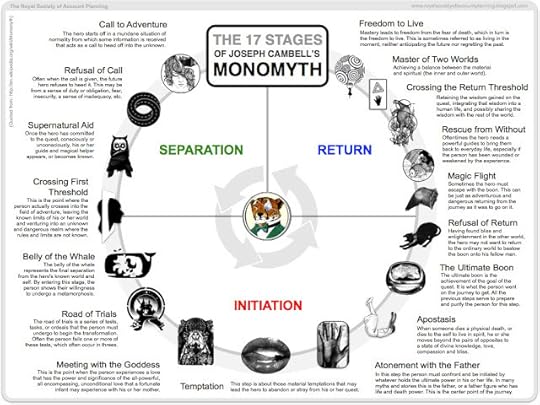
Since I apparently made today Infographic day here on the blog, I wanted to share this infographic of Joseph Campbell's 17 stages of The Monomyth or "Hero's Journey". I discovered it at Modern Mythology who credits The Royal Society of Account Planning. There's much afoot this year with the 25th anniversary of Campbell's death. But this post is just about the infographic since it makes a helpful tool or reminder for those of us who don't reference this everyday and sometimes need a refresher. Like me.
 The Hero with a Thousand Faces (The Collected Works of Joseph Campbell)
Slightly OT: Your Brain Loves Jane Austen
From Your brain loves Jane Austen: An English professor measures the brain activity of readers, and finds we respond differently when reading for fun by Laura Miller:
What have you found out so far about pleasure reading and close reading?
In the neuroscience world, it’s been more common to change what the subject is reading about (if they’re reading anything of length, which has also been rare). They thought that if you asked people to read the same thing in two different ways, you might just see nothing. They’re still just reading a chapter from Jane Austen, so why would this change the brain patterns?
I was really surprised and shocked, in a delighted way, by how much of a difference we’ve been seeing between pleasure and close reading. It was not what we expected.
In what way?
We’re really just processing the data right now, as we speak. One of the things that we saw in the pilot is that it’s not just that close reading is a more advanced form of pleasure reading. Pleasure reading also has distinct regions where it has more blood flow. They have two distinct “neurosignatures,” a term which describes complex patterns of brain activity that cross multiple regions of the brain. Pleasure reading has its own demands and close reading has its own pleasures. The value resides in being able to shift between modes. It’s a training in cognitive flexibility.
Really the biggest surprise to date is just how much the brain is shifting in moving between close reading and pleasure reading. Most people would expect to see pleasure centers activating with the more relaxed style of reading, and the regions associated with work, attention and cognitive load for the literary analysis. But what we’re finding is something else entirely. With pleasure reading, at least in the one subject for whom we have been able to fully evaluate it so far, we did see unique regions activated. That suggests that pleasure reading is not just some more lax or dormant state. And we’re seeing the whole brain activating for the close reading state.
I've wondered about this and would love to see my brain reading pleasure vs. work. I read all day and process texts and what do I do to take a break? Go read something for pleasure.
And who knew Mansfield Park was the least read of Austen's texts?

Advertising: Jack and the Beanstalk Infographic and Hinge Marketing

Jack and the Beanstalk inspired advertising infographic for Hinge Marketing. There's a book, too! Although it doesn't appear to use the Jack and the Beanstalk theme.

Fairy Tales Infographic from Universal Studios

Here is an infographic put out by Universal Studios to promote the Snow White and the Huntsman DVD/Blu-Ray release. Wanna play find the inaccuracies? There is some fodder for quibbling here but overall it's fun. And big applause for promoting fairy tales in general and not just Snow White in particular!
Any enterprising art students inspired to create a fairy tale infographic of your own? That would be a fun contest, wouldn't it?

September 19, 2012
Grimms' Anatomy Exhibit at the The Mütter Museum at The College of Physicians of Philadelphia

Grimms' Anatomy Magic and Medicine: 1812-2012
Exhibit at the The Mütter Museum at The College of Physicians of Philadelphia
The bodies of fairy tale characters are rarely ordinary. They may be injured through acts of violence, healed or harmed by medicinal potions, or altered by magical transformations. Though many fairy-tale bodies belong to the realm of the marvelous, some have real-world counterparts. In honor of the 200th anniversary of the publication of The Fairy Tales of the Brothers Grimm, this exhibit will present real-world examples of the sometimes gruesome or grotesque fairy tale bodies, along with instruments from and rare illustrated editions of these stories. On view in the Main Museum Gallery. Free with Museum Admission.
It opened September 12th, but I don't have more information than the above. Hopefully the curators, Anna N. Dhody and Linda Lee, will share more with us in a future post! I had the opportunity to hear a little about it when I talked to them at Harvard in February but I admit my brain has buried most of the conversational details deep in my psyche! February feels like years ago, instead of only months. But then again, I don't live in the same place I did then either...

Videos: Marina Warner Discusses Angela Carter
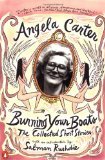
So SurLaLune reader Francisco Rodriguez commented on my post with Marina Warner's article about Angela Carter with a link to a video of Warner discussing Carter's work with Johanna Geary, editor with The Folio Society. There are three videos of the interview and one of Warner reading from Carter's work, specifically Company of Wolves.
So, of course, I must share. Enjoy!

Computational analysis of the body in European fairy tales
"The paper ’Computational analysis of the body in European fairy tales‘ by Scott Weingart and Jeana Jorgensen is in the journal Literary and Linguistic Computing, and is available to read for free for a limited time." I actually discovered it through Understanding ‘the body’ in fairy tales on the OUP Blog. Here's a lengthy excerpt from there. I need to read the article itself more carefully after reading this summary but my initial thoughts and what I will look for as I read appear below the excerpt. Don't miss those! And add your own for this is fun stuff. Really!
The biggest news to hit the streets recently combined the power of Google, a few Harvard mathematicians, and five million digitized books covering the last two centuries. They dubbed their computational study of culture “culturomics”, and several more research projects have grown in its wake.Keep in mind, I haven't read through the entire original article carefully as I write this. The following are my thoughts as I read and consider it based on the blog entry and the abstract. Sometimes it helps me to get my critical thoughts gathered first so I am not just automatically agreeing with a viewpoint.
This type of research has traditionally been limited by inadequate technology, incomplete data, and the scarcity of scholars well-versed in both computation and traditional humanities research. That scene is now changing, due largely to efforts from both sides of the cultural divide, the humanities and the sciences. It is in this context that we undertook a study of European fairy tales, yielding interesting and occasionally unexpected results.
An analysis of over 10,000 references to people and body parts in six collections of Western European fairy tales can reveal quite a bit. Understanding fairy tales pays off twofold: they reveal the popular culture and beliefs of the past, while simultaneously showing what cultural messages are being transferred to modern readers. There is no doubt that the Disney renditions of classic fairy tales both reflect assumptions of the past and helped shape the gender roles of the present.
One finding from this analysis dealt with the use of adjectives when describing bodies or body parts in the stories. The most frequently-used adjectives cluster around the themes of maturation, gaining and maintaining beauty or wealth, and the struggle for survival, all concepts that still have a prominent place in our culture.
The use of age in these stories is of particular interest. While young people are described more than twice as frequently as old, the word old (and similar words indicating old age) appears more frequently than the word young (and related terms). That means the tellers of these stories rarely find it necessary to mention when someone is young, but often feel the need to describe the age of older people.
In fact, old people tend to attract more adjectives than their younger counterparts in general. If someone is going to be described in any way at all, whether it be about their beauty or their age or their strength, it’s far more likely that those descriptions are attached to the old rather than the young. This trend also holds true with regards to gender; men are described significantly less frequently than women. Combining these facts, it appears that although old women are brought up relatively infrequently, they are described much more frequently than would be expected.
The fact that women are described more frequently than men fits with a common feminist theory suggesting Western culture treats the male perspective as universal, unmarked, public, and default. Extending that theory further, the fairy tale analysis reveals that the young perspective is also default and unmarked. Older people and especially older women must be described in greater detail and with greater frequency, marking them as old or as women or both, because otherwise the character is assumed as young and masculine, maintaining those traits which are considered defaults.
These results just scratch the surface of what can be discovered using the automated and quantitative analysis of cultural data. As technology and data sources improve, there will be an increasing number of studies which combine algorithms and statistics with traditional humanistic theories and frameworks. The holy grail, which we are reaching ever-closer to, is the successful bridging of traditional close reading approaches of humanistic inquiry and the distant reading quantitative methods being developed by researchers like Franco Moretti and the Google Ngrams Team. This is another step on that path.
Scott B. Weingart is an Information Science Ph.D. student at Indiana University studying the history of science. and Dr. Jeana Jorgensen is a recent graduate of Indiana University who specializes in folklore and gender studies. This work is from a paper they co-presented at Digital Humanities 2011, for which they won the Paul Fortier Prize for best young researchers at the conference.
Although I overall find myself agreeing with the overarching theory and conclusions, I would like to know more about the source materials. I am interested in how the diminuitive forms of words in other languages are handled, for example. I run into those quite frequently in my reading and translating. We get "Little Snow White", for example, in a literal translation of a title but we most often simply get "Snow White" in English translations. Translated texts are so very tricky and let's face it, most of the European fairy tales were not originally recorded in English so all of this includes the factor that English translators bring their cultures and expectations to translation as well as expected language norms and the demands of art and storytelling for entertaining and educations their intended audience.
But, yes, the female characters, young or old, are described more frequently in physical terms but the ageism is a little more problematic for me since the tales usually designate both pretty clearly and age often implies experience, wisdom, helpfulness more often than not. So "old" is a shortcut to an understanding of the character just as "young" is implied inexperience with a challenge to be overcome.
My experiences are anecdotal since I haven't done any ennumeration of terms and their frequency. This is a interesting spark for some great conversations!

September 18, 2012
Housekeeping: Twitter and Facebook
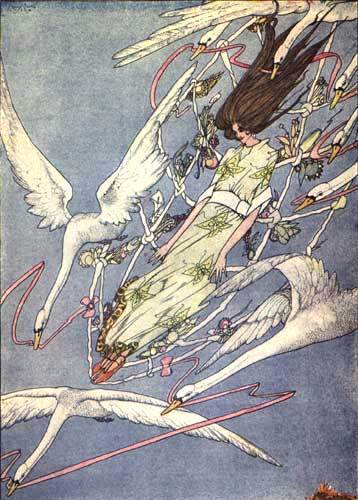 The Wild Swans by Harry Clarke
I just wanted to update readers with the news that I'm trying to be media savvy again now that I am achieving a semi-regular life routine.
Twitter: I've started tweeting the blog posts here with an occasional extra, like a favorite quote. You can follow me on Twitter at @SurLaLuneHeidi if that is your preferred method of reading about fairy tales.
Facebook: I'm still not changeable enough to want to use Facebook to its full potential. It's a personal thing--such as how the design and constant changes hurt my psyche and essentially waste my valuable time--but my Twitter tweets are feeding into Facebook so the official SurLaLune Fairy Tales Facebook page is active again. Twitter lets me hit two birds with one stone with very little recoil. So you can like the page and hopefully get updates on the blog posts if you prefer Facebook to Google or other reader methods.
On a personal note, I have a personal Facebook page so that I can operate the SurLaLune Facebook page, but I don't plan to actively post to it other than allowing the same feed from Twitter that the SurLaLune page receives.
I won't be accepting personal Facebook Friend requests out of convenience, not any desire to reject anyone. I simply don't have the bandwidth to keep a personal Facebook page active. I keep up with my friends in other ways--and my husband is very active on Facebook so I get some personal life updates through him--but some parts of my life must remain private for my own sanity.
You can also still receive email digests of the blog--I get them daily myself--using the buttons to the left to subscribe.
If there is some other feed or opportunity for reaching an audience that you feel I should pursue, please comment here and I will consider its viability.
Thanks and see you around the web!

Post 5 of 5: Brothers Grimm Story Writing Competition: The Cry Baby by Renata Hopkins
The Cry Baby by Renata Hopkins is the winner of the New Zealand Listener's Brothers Grimm story-writing competition. Congrats to Renata Hopkins for a fascinating story! You can read more about her in the 4th post for today.
I enjoyed the last lines most of all:
They didn’t live happily ever after. But they did their best.You can read the entire story on the site but here are the first few paragraphs to whet your interest. From The Cry Baby by Renata Hopkins:
Once upon a time, there was a man and a woman and they did what men and women do and then there was a baby. Such celebration! Booties, bibs and bears were bestowed, all pink and fluffy and smelling of baby powder. The assembled rellies cooed over tiny fingers and toes and then they left the new parents alone with their infant. Who began to cry. And cry and cry, until her face was puce. The mother and father rocked and shushed and bounced and sang to their squalling babe, but day after day, night after night, the din continued. At least the mother and father had each other, until they didn’t, because the father had to go up country for work. As his car drove away the mother fought the urge to chase it. All that day the clamour continued and by nightfall the mother was in a trance. She rocked and shushed and bounced and sang, but the baby was inconsolable. The cry was like another entity in the small house and the mother began to feel that it meant her harm.And since this is rather spoilerish but may encourage you to read the story, here's the words of Judge Kate de Goldi. It also lets you know some of the tales that inspired the story.
Close to midnight, the desperate mother bundled the wailing girl in a blanket and carried her outside, hoping a cold and twinkling sky would bring some peace. Outside, a windbreak of pines stood like a row of witches’ hats and the eye of the moon shone down. The child took another breath and howled afresh. Though she wouldn’t have called herself the praying sort, the mother invoked any power that might aid her. “Please,” she begged. “Please make this noise stop.” Almost immediately she heard a noise from the darkness: a rustling, then a rasping voice. “What’s in it for me?” wondered the voice. The startled mother followed the sound and saw, on the high branch of a pine, a pair of glowing eyes. A possum. “Anything you want,” replied the mother, too delirious with exhaustion to wonder at a talking marsupial. “If you can make the crying stop, anything.”
The winning story was a stand-out: The Cry Baby is a superb mash-up of Rumpelstiltskin, Clever Gretel and another old story that hovers in my head but which I can’t quite catch. The writer is completely in charge of tone, pace and structure. The sentences are musical, the vocabulary simple but freighted – contributing to the sense that this is a story that might have been told over and over again by many voices through the centuries.
The cast is kept dead simple: a mother, a baby, a witch – brilliantly transmuted into a possum (the possum appeared many times as baddie but this story easily did it the best). And the problem at the heart of the story is both simple and potentially devastating. It is in this way that the writer mines the “latent truth” of the story: the twinned emotions a mother may have for a new baby – desperate love and desperate fury.
There is sly humour (the possum’s voice is wonderfully contemporary but it has a glaring grammar slip; it is also impatient in a way that one somehow sympathises with). The story manages the swift temporal and geographic movements that fairy tale demands, but somehow never seems hurried. The baking of the substitute bread baby is rendered most sensually, the vanquishing of the possum is bloody, violent and deeply satisfying. Above all, the primitive nature of new maternity – in all its complexity – is thoroughly and lingeringly evoked.
 Photo Credits: Living in the Kitchen with Puppies blog (with a dough baby recipe, no less!) I saw this and just had to share.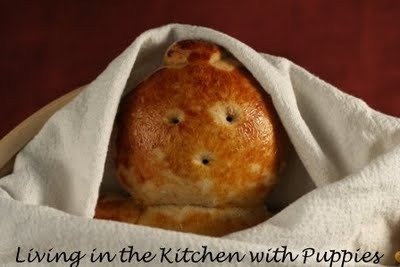

Heidi Anne Heiner's Blog

- Heidi Anne Heiner's profile
- 44 followers
Heidi Anne Heiner isn't a Goodreads Author
(yet),
but they
do have a blog,
so here are some recent posts imported from
their feed.

