Dawn Metcalf's Blog, page 31
February 15, 2012


February 6, 2012
Monsters from the Trunk
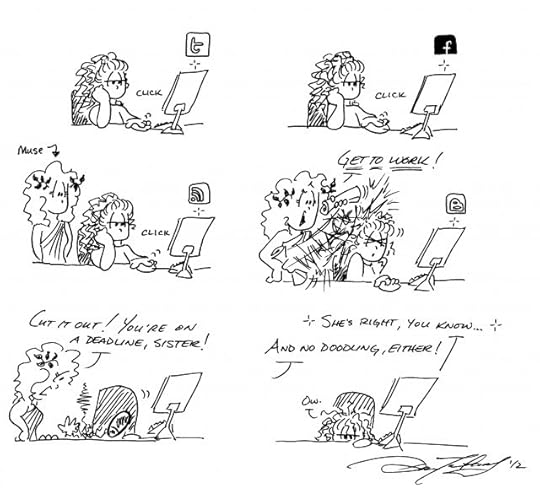
There must be something in the air, like the coming of spring. I'm evidently not the only person to have gone spelunking into my old "trunk novels" to see what may be worth salvaging (if anything) or engage in the nostalgia of revisiting old fictitious friends. And while I remembered the stories fondly, I found that the books themselves were...well...bad. Embarrassingly, why-in-the-world-did-I-ever-query-this and boy-I-hope-nobody-remembers-this bad. And, honestly, I was glad. Finding monsters in my trunk turns out to be a very good thing.
Let me explain: it's not like I'm some sort of sadist who wants to re-enter the spiked hamster wheel of "Omigawd, Do I suck!" more often than I must (because it's certainly an occupational hazard), but it's comforting to know that the things I prized five years ago, three years ago, two years ago, etc. have--with the hindsight gifts of distance and time spent on other things--allowed me some perspective and if I now look at these as being newbie-ridden, glaringly cliched, immature pieces of writing, that must mean that my writing has somehow matured. (I hope!)
It's very hard for me at this stage in the game to keep one eye on the career stuff and another on the craft. I never want to be "content" with my writing; perhaps I *am* a little crazy that I enjoy that frantic feeling of pushing my own envelope, finding myself washing the baseboards because I'm avoiding some scene that is frightening the bejeezus outta me on some level. It means that the writing is growing, and it's not called "growing pains" for nothing.
No one can succeed in a vacuum (least of all me) and I'm glad to see that, thanks to friendly faces in the biz, going on retreats, investing in conferences, talking to my agent and editor and reading a lot of great books, I have changed and therefore my writing has changed, hopefully for the better.
Every step teaches you something. Every failure is a secret success. Because it means you're still in the game, trying, drafting, experimenting, deleting, finishing, not-quite-finishing, revising, re-visioning, growing.
And you know what the funniest thing is? Amidst my dreadful monsters were the whispers of characters not yet born in other books, bits of setting and scenes that took shape in later writings, and other snips and pieces that weren't right for one tale but fit perfectly into another down the road. I'd forgotten what my typing fingers evidently remembered and to see these "baby pictures" on the page brought an unexpected smile and a promise to myself that the next step will be even better.
Go visit your monsters and, as Neil Gaiman wished for us in 2012, Make Mistakes!
Let me explain: it's not like I'm some sort of sadist who wants to re-enter the spiked hamster wheel of "Omigawd, Do I suck!" more often than I must (because it's certainly an occupational hazard), but it's comforting to know that the things I prized five years ago, three years ago, two years ago, etc. have--with the hindsight gifts of distance and time spent on other things--allowed me some perspective and if I now look at these as being newbie-ridden, glaringly cliched, immature pieces of writing, that must mean that my writing has somehow matured. (I hope!)
It's very hard for me at this stage in the game to keep one eye on the career stuff and another on the craft. I never want to be "content" with my writing; perhaps I *am* a little crazy that I enjoy that frantic feeling of pushing my own envelope, finding myself washing the baseboards because I'm avoiding some scene that is frightening the bejeezus outta me on some level. It means that the writing is growing, and it's not called "growing pains" for nothing.
No one can succeed in a vacuum (least of all me) and I'm glad to see that, thanks to friendly faces in the biz, going on retreats, investing in conferences, talking to my agent and editor and reading a lot of great books, I have changed and therefore my writing has changed, hopefully for the better.
Every step teaches you something. Every failure is a secret success. Because it means you're still in the game, trying, drafting, experimenting, deleting, finishing, not-quite-finishing, revising, re-visioning, growing.
And you know what the funniest thing is? Amidst my dreadful monsters were the whispers of characters not yet born in other books, bits of setting and scenes that took shape in later writings, and other snips and pieces that weren't right for one tale but fit perfectly into another down the road. I'd forgotten what my typing fingers evidently remembered and to see these "baby pictures" on the page brought an unexpected smile and a promise to myself that the next step will be even better.
Go visit your monsters and, as Neil Gaiman wished for us in 2012, Make Mistakes!
January 23, 2012
Happy Chinese New Year!
It's the Year of the Dragon!
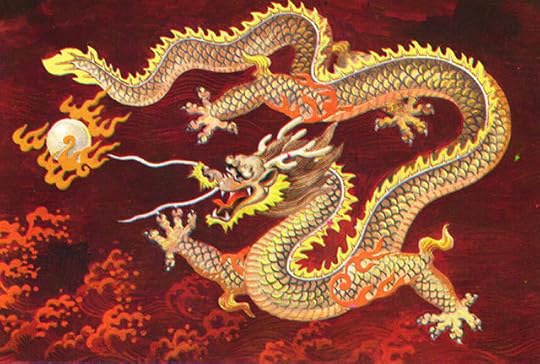
Dragon pic gakked from www.draconika.com
Better Than Boyfriend and I usually enjoy the start of the lunar new year by visiting a nearby Chinatown or hosting a banquet for our staff at one of our favorite restaurants to bring in some joy and prosperity for a breath of fresh (chilly!) air. While the Jewish New Year tastes of apples and honey, the Chinese New Year smacks of crumbly almond cookies and soft moon cakes filled with red bean paste! (It somehow always comes down to food. And fire. The kids both love and shy from the towers of red firecrackers snapping in the windows and exploding in the streets.)
Take a moment today and re-energize! Need help? Enjoy some beautiful Dragon Dance photos or take a little time out of your day to watch this:
Health and happiness to you & yours!
Dragon pic gakked from www.draconika.com
Better Than Boyfriend and I usually enjoy the start of the lunar new year by visiting a nearby Chinatown or hosting a banquet for our staff at one of our favorite restaurants to bring in some joy and prosperity for a breath of fresh (chilly!) air. While the Jewish New Year tastes of apples and honey, the Chinese New Year smacks of crumbly almond cookies and soft moon cakes filled with red bean paste! (It somehow always comes down to food. And fire. The kids both love and shy from the towers of red firecrackers snapping in the windows and exploding in the streets.)
Take a moment today and re-energize! Need help? Enjoy some beautiful Dragon Dance photos or take a little time out of your day to watch this:
Health and happiness to you & yours!
January 20, 2012
From Rough Draft to Finished Page: Blood, Sweat & Jeers
Maggie Stiefvater wrote an incredible post about the "Dissection of Revision," outlining part of the journey from rough WIP to finished page. It garnered so much online support, that she thought to share the love by contacting a bunch of other authors and inviting them to dissect their own writing in similar fashion, and since I'm all about Paying It Forward, I was thrilled to take part in taking apart!
Now, granted, I have little to no technical skill and this post gives thanks to a lot of smart people (mostly my husband, the Ever-Patient One) and due in no small part to the begging/pleading/ranting at the various machines in my office to comply with one another, but herein lies the result: the opening scene of Chapter Two of LUMINOUS, broken down into (appropriately enough) thirteen points to consider at a safe distance, preferably with a hardcover copy handy!
YE OLDE ROUGH DRAFT:

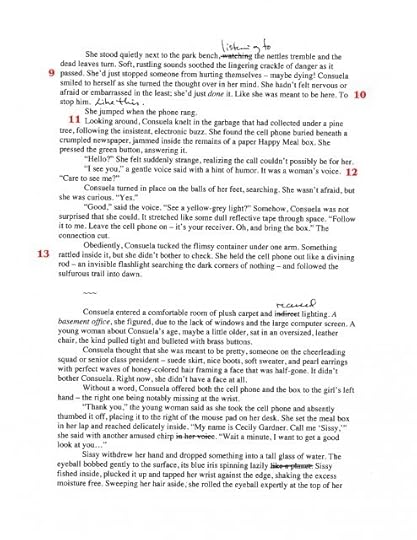
Can you tell I'm a scribbler? I always print draft copies so I can go over them longhand and read them aloud to myself without undo eye-strain. Some of it's even legible!
1) I want to open with where we are, but since it's a place that's only slightly familiar to Consuela, I want to hint at details she might remember. The most important thing for me is the powerful double-message of the last line. I prefer closers to be short cappers with punch.
2) I like to read drafts aloud to see where words might sound more or less natural to the ear. This also helps me balance how many times to use proper names versus pronouns. (This is one of the challenges of using the third person POV as opposed to the more popular first.) This is a long, meandering sentence because she is meandering along and it ends with finding what she's looking for: Rodriguez, the last shorter paragraph like a period at the end of the sentence.
3) There's another person in this scene and I better get to him quickly before it reads like an afterthought! The word that is most important is "hunched" because it shows a lot about the posture and attitude of this person without having to explain a long-winded why. I like the contrasting images of a "hunched" person in a "worn" jacket holding a "cold," "silver" butterfly knife.
4) The butterfly knife is a focal point for the majority of this scene. "Butterfly" is the type of knife, but it has light and airy connotations. Throughout the rest of the text, I'll use the more powerful and dangerous word, "knife." Rodriguez's character evolves from one back to the other.
5) This is the first time the reader will see Consuela interact with someone she's called to save. I want her to be aware of his sensory experience, but this early draft reflects a lot of my need to understand what I want to say. Many of these extraneous words will be cut.
6) I don't want Consuela to read too much into what is happening or might happen, I want her to have a more benevolent POV, but not overdo it. Again, I tend to overwrite, so when I find myself struggling to find the right word to capture exactly what I want to say, I often end up cutting the whole line. If it's too hard, I'm probably fighting with myself to preserve some darling or other. Cut.
7) This is one of those traps I often fall into: action should be attributed to the person, not a part of their body. I do a lot with eyes and hands to express thoughts and feelings...and then I more than often search and "Find" all the "look," "glare," "glance," "stare," etc. and erase/replace them. (I also liked the contrast of having something as solid as "stone" and as delicate as "moth" attributed to the same person.) I want the reader to pay attention to the intense interaction between these two people, not be distracted by their body parts.
8) Strong capper line, but it uses "like." I'd rather say something "is" than say it's "like" something else. That's stronger. I'm also thinking of pacing.
9) After the tension, I wanted to return to the sort of quiet at the beginning of the chapter and have those more human, reflective thoughts trickle in. That easing back reflects moving away from a brush with death back to life. It's good to think of the series: Action, Reaction, Reflection, Decision, then back to the next Action. Lather, rinse, repeat.
10) Short, choppy sentences are the quickest way to show rapid-fire thought patterns, IMO. It also shows Consuela's growing confidence in herself.
11) "Looking" = AHHH! And it slows down the action taking place in a new surrounding, stirring up the first clues of a mystery. Best to hurry it up.
12) Again, how many details do I really need here? Many of them are for me, the writer, and will disappear when I have more confidence in myself and my smart 'n' savvy audience. This is the first time we ever hear of Sissy and I have to capture her "voice" (quite literally) in this one first line.
13) I wanted to drop a hint of what surprises were coming next (the Toy Surprise in the Happy Meal box!) so we're compelled to read on and find out what happens next. I also liked the contrast of the otherworldly/magical along with ordinary objects, the "cell phone" and the Happy Meal box. I tend to write "bookends" where the beginning and end of a scene/chapter/story often reflect one another. Both the beginning and the ending involved smooth, gliding movement.
SHINY, HAPPY FINAL DRAFT:
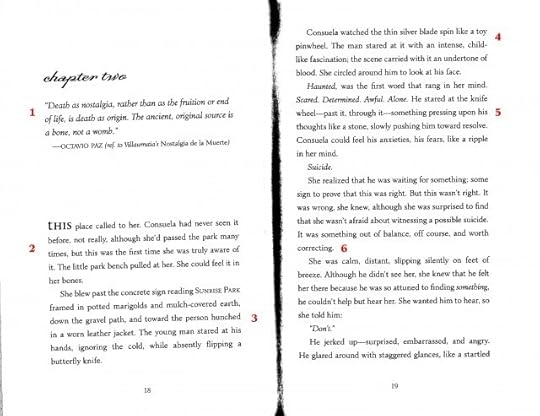
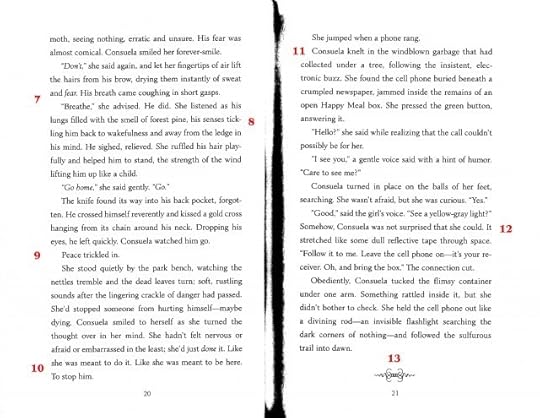
1) In case you didn't know why more people don't put a ton of famous quotes in their books, I learned that not only was it my responsibility to get permission to use these quotes (and these were translations into English, which involved a second party) but it was also my responsibility to purchase them for use in the book. I had no idea what I was getting into, but these Octavio Paz quotes were important to me, so I kept them with my editor's blessing.
2) I ended up tightening-up the first paragraph by shedding some excess details. Many times less is more and "tightening" is a nice-sounding word for "cutting with purpose." It helps move the action forward and picks up the pace.
3) I kept "hunched" but cut some of the other details that delayed me getting there. Less is more and Rodriguez is a "hunched" guy in a "worn leather jacket" holding a "knife" and wearing a "gold cross." That's all he really needs. (Note the cool font they used for Sunrise Park as opposed to my single quotes!)
4) It's a call when to use short, choppy lines and when to string them together to make a long, complete image. This was a good example of how I changed one for the other. The pacing changes so it feels more like Consuela's physical approach in the storyline.
5) Again, less is more. (I cringe when I see how many "like" phrases I'm still using. Blech.)
6) That last sentence? The one where I struggled to find the right words? Gone. Now the paragraph has that clean, almost detached air I want in a proto-guardian-angel on her first time out, going on instinct.
7) I wanted to point out where even in final copy, things can slip through. "fear" shouldn't be italicized, but "Breathe," should. Maybe you didn't notice it, but I do. EVERY time.
8) It was important for me to use natural imagery and sensory words to underscore that Rodriguez is choosing to live life as opposed to death. The words I use for Consuela with him are "ruffled," "playfully" and "child."
9) This line works a lot better now. It uses an action verb--always the better choice!
10) Pacing: short, fast bursts after a longer exposition, circling her reflective thoughts back to herself.
11) Removed the "Looking" and now Consuela is in her new space doing something. Noun, verb, noun. This changes the scene from passive to active and helps establish Consuela as a person who *does things* proactively.
12) By removing the extraneous details, I move the action forward and trust my readers more. By now, I am familiar enough with the story that I don't need to build in such a thick cushion of explanation to justify what I want to say.
13) Nothing says "finished copy" more than a pretty icon for your scene breaks!
And, finally, here we are:
AN ILLUSTRATED SUMMARY FROM FIRST DRAFT TO FINAL PAGE
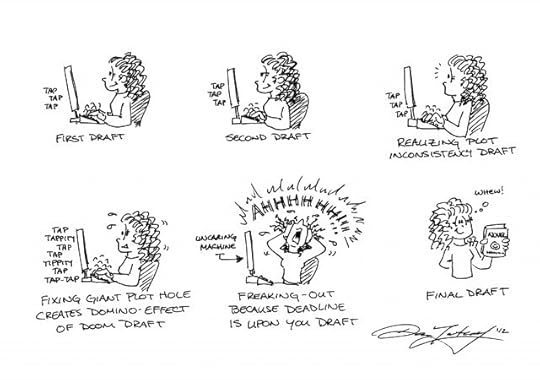
While this might look like a simple a-to-b linear travelogue, I assure you this went through all the alphabet and then some! There was anywhere between five and a dozen drafts of portions of the manuscript to the whole enchilada and much of its gold was thanks to the editors, copy editors, critique partners and supporting cast. The one thing I really learned from this process was that a printed book is truly a work of art.
I hope that this was helpful, or at least amusing, because the #1 thing we can do for one another as writers in the field is Pay It Forward! Thanks, all! If you have any questions, feel free to plunk them in the comments.
Peace and fluffy kittens.
Now, granted, I have little to no technical skill and this post gives thanks to a lot of smart people (mostly my husband, the Ever-Patient One) and due in no small part to the begging/pleading/ranting at the various machines in my office to comply with one another, but herein lies the result: the opening scene of Chapter Two of LUMINOUS, broken down into (appropriately enough) thirteen points to consider at a safe distance, preferably with a hardcover copy handy!
YE OLDE ROUGH DRAFT:
Can you tell I'm a scribbler? I always print draft copies so I can go over them longhand and read them aloud to myself without undo eye-strain. Some of it's even legible!
1) I want to open with where we are, but since it's a place that's only slightly familiar to Consuela, I want to hint at details she might remember. The most important thing for me is the powerful double-message of the last line. I prefer closers to be short cappers with punch.
2) I like to read drafts aloud to see where words might sound more or less natural to the ear. This also helps me balance how many times to use proper names versus pronouns. (This is one of the challenges of using the third person POV as opposed to the more popular first.) This is a long, meandering sentence because she is meandering along and it ends with finding what she's looking for: Rodriguez, the last shorter paragraph like a period at the end of the sentence.
3) There's another person in this scene and I better get to him quickly before it reads like an afterthought! The word that is most important is "hunched" because it shows a lot about the posture and attitude of this person without having to explain a long-winded why. I like the contrasting images of a "hunched" person in a "worn" jacket holding a "cold," "silver" butterfly knife.
4) The butterfly knife is a focal point for the majority of this scene. "Butterfly" is the type of knife, but it has light and airy connotations. Throughout the rest of the text, I'll use the more powerful and dangerous word, "knife." Rodriguez's character evolves from one back to the other.
5) This is the first time the reader will see Consuela interact with someone she's called to save. I want her to be aware of his sensory experience, but this early draft reflects a lot of my need to understand what I want to say. Many of these extraneous words will be cut.
6) I don't want Consuela to read too much into what is happening or might happen, I want her to have a more benevolent POV, but not overdo it. Again, I tend to overwrite, so when I find myself struggling to find the right word to capture exactly what I want to say, I often end up cutting the whole line. If it's too hard, I'm probably fighting with myself to preserve some darling or other. Cut.
7) This is one of those traps I often fall into: action should be attributed to the person, not a part of their body. I do a lot with eyes and hands to express thoughts and feelings...and then I more than often search and "Find" all the "look," "glare," "glance," "stare," etc. and erase/replace them. (I also liked the contrast of having something as solid as "stone" and as delicate as "moth" attributed to the same person.) I want the reader to pay attention to the intense interaction between these two people, not be distracted by their body parts.
8) Strong capper line, but it uses "like." I'd rather say something "is" than say it's "like" something else. That's stronger. I'm also thinking of pacing.
9) After the tension, I wanted to return to the sort of quiet at the beginning of the chapter and have those more human, reflective thoughts trickle in. That easing back reflects moving away from a brush with death back to life. It's good to think of the series: Action, Reaction, Reflection, Decision, then back to the next Action. Lather, rinse, repeat.
10) Short, choppy sentences are the quickest way to show rapid-fire thought patterns, IMO. It also shows Consuela's growing confidence in herself.
11) "Looking" = AHHH! And it slows down the action taking place in a new surrounding, stirring up the first clues of a mystery. Best to hurry it up.
12) Again, how many details do I really need here? Many of them are for me, the writer, and will disappear when I have more confidence in myself and my smart 'n' savvy audience. This is the first time we ever hear of Sissy and I have to capture her "voice" (quite literally) in this one first line.
13) I wanted to drop a hint of what surprises were coming next (the Toy Surprise in the Happy Meal box!) so we're compelled to read on and find out what happens next. I also liked the contrast of the otherworldly/magical along with ordinary objects, the "cell phone" and the Happy Meal box. I tend to write "bookends" where the beginning and end of a scene/chapter/story often reflect one another. Both the beginning and the ending involved smooth, gliding movement.
SHINY, HAPPY FINAL DRAFT:
1) In case you didn't know why more people don't put a ton of famous quotes in their books, I learned that not only was it my responsibility to get permission to use these quotes (and these were translations into English, which involved a second party) but it was also my responsibility to purchase them for use in the book. I had no idea what I was getting into, but these Octavio Paz quotes were important to me, so I kept them with my editor's blessing.
2) I ended up tightening-up the first paragraph by shedding some excess details. Many times less is more and "tightening" is a nice-sounding word for "cutting with purpose." It helps move the action forward and picks up the pace.
3) I kept "hunched" but cut some of the other details that delayed me getting there. Less is more and Rodriguez is a "hunched" guy in a "worn leather jacket" holding a "knife" and wearing a "gold cross." That's all he really needs. (Note the cool font they used for Sunrise Park as opposed to my single quotes!)
4) It's a call when to use short, choppy lines and when to string them together to make a long, complete image. This was a good example of how I changed one for the other. The pacing changes so it feels more like Consuela's physical approach in the storyline.
5) Again, less is more. (I cringe when I see how many "like" phrases I'm still using. Blech.)
6) That last sentence? The one where I struggled to find the right words? Gone. Now the paragraph has that clean, almost detached air I want in a proto-guardian-angel on her first time out, going on instinct.
7) I wanted to point out where even in final copy, things can slip through. "fear" shouldn't be italicized, but "Breathe," should. Maybe you didn't notice it, but I do. EVERY time.
8) It was important for me to use natural imagery and sensory words to underscore that Rodriguez is choosing to live life as opposed to death. The words I use for Consuela with him are "ruffled," "playfully" and "child."
9) This line works a lot better now. It uses an action verb--always the better choice!
10) Pacing: short, fast bursts after a longer exposition, circling her reflective thoughts back to herself.
11) Removed the "Looking" and now Consuela is in her new space doing something. Noun, verb, noun. This changes the scene from passive to active and helps establish Consuela as a person who *does things* proactively.
12) By removing the extraneous details, I move the action forward and trust my readers more. By now, I am familiar enough with the story that I don't need to build in such a thick cushion of explanation to justify what I want to say.
13) Nothing says "finished copy" more than a pretty icon for your scene breaks!
And, finally, here we are:
AN ILLUSTRATED SUMMARY FROM FIRST DRAFT TO FINAL PAGE
While this might look like a simple a-to-b linear travelogue, I assure you this went through all the alphabet and then some! There was anywhere between five and a dozen drafts of portions of the manuscript to the whole enchilada and much of its gold was thanks to the editors, copy editors, critique partners and supporting cast. The one thing I really learned from this process was that a printed book is truly a work of art.
I hope that this was helpful, or at least amusing, because the #1 thing we can do for one another as writers in the field is Pay It Forward! Thanks, all! If you have any questions, feel free to plunk them in the comments.
Peace and fluffy kittens.
January 18, 2012

January 13, 2012
So This Is What It's Like
Yesterday, I got to speak with my editor about finishing touches on Book One and the plans for Book Two. I exchanged emails with two bestselling, award-winning authors on projects and invitations to Pay It Forward. And today, I am getting ready to go to a writer's retreat with two of my old critique partners and a bunch of fellow 2011 debuters.
I feel very writerly.
So I am packing clothes, chocolate, and silly things in preparation to bask in the glory of writing armed with the fresh knowledge of what I'm going to do for Book Two in the Twixt amongst people who understand.
I've been to a couple of retreats and they've always been wonderful. Maybe not productive in word count, but wonderful nonetheless, because I am able to sit in the midst of the typing and the music and the scribbles and it's like you can see the wheels turning. There's an energy snapping and popping in the air and even when it settles, it's the lull of creation taking place; line by line, word by word, bird by bird. And in-between, we eat and we talk and we share dreams and advice, we listen and share, we know and we don't. That is something that cannot be replaced or replicated and that is our community. The writing community's strength is that it understands and reaches out to one another because while writing is solitary, the hearts behind it are open to the world.
I will be open and listening and writing with a smile. More to come soon.
:-)
I feel very writerly.
So I am packing clothes, chocolate, and silly things in preparation to bask in the glory of writing armed with the fresh knowledge of what I'm going to do for Book Two in the Twixt amongst people who understand.
I've been to a couple of retreats and they've always been wonderful. Maybe not productive in word count, but wonderful nonetheless, because I am able to sit in the midst of the typing and the music and the scribbles and it's like you can see the wheels turning. There's an energy snapping and popping in the air and even when it settles, it's the lull of creation taking place; line by line, word by word, bird by bird. And in-between, we eat and we talk and we share dreams and advice, we listen and share, we know and we don't. That is something that cannot be replaced or replicated and that is our community. The writing community's strength is that it understands and reaches out to one another because while writing is solitary, the hearts behind it are open to the world.
I will be open and listening and writing with a smile. More to come soon.
:-)
January 9, 2012
Writing As A Conversation
One of my jobs is "author" and another of my jobs is "Mom." And as a mom, one of my holy responsibilities (besides cooking, cleaning, washing, folding, driving, balancing checkbooks and calendars and making sure everyone's wearing enough layers and clean underwear) is to hound my children mercilessly to do their homework. My daughter is very bright and has become used to finishing her work in ten seconds and, should it take longer than that, she gets easily frustrated and insists it's "too hard" and she "can't do it." To avoid this, she can try to be sneaky and do the bare minimum of an assignment so it'll be done sooner. This illusion works wonders even if it doesn't actually *do* the assignment.
(I know this is a blog about writing. Bear with me.)
The other day, my bright little girl had an essay that was supposed to be 100-300 words. She dutifully sat down with her pencil and paper and wrote steadily while munching on her afternoon snack. Suddenly, she put down the pencil and announced, "One hundred and five words! I'm done!"
This sounded a lot like my daily Word Count goal setting, but I knew that this wasn't achieving some small part of larger picture, to her, this was the whole deal: over and done. My husband checked over the essay topic. "You didn't answer the question," he said and pointed to a bit of her writing. "Why don't you talk about this more?" She rolled her eyes. "But I wrote over 100 words!" she whined. This is when I said a few words of wisdom that came from somewhere in the deep Hivemind of Motherhood (honestly, I blame the Muse for flashes of inspiration like these, which makes me suspect Maggie is a grandmother at the very least):
"Homework isn't a test, it's a conversation on paper. It's asking you for your opinion. We want to know your thoughts and this is a way to tell us what you think by using your words."
Whoa.
And in this silly, Sunday moment, I got a lot of what I feel about education and test-taking as well as a lot about what I feel makes Good Writing. A book is a conversation between the author and the reader as the narrator and the characters, or the narrative character and the reader. The element of "voice" resonates because we, the readers, can hear it, feel it, speaking to us in a way that is believable and breathes the characters and the world into life. We are invested in the main character and her or his journey because we care about what happens and, most importantly, what they have to say about what happens. Through the guise of these conversations, I (the author) get to talk to you (the reader) by having a conversation on paper. I want to hear your voice, too. I want to answer the questions you may have or tell you more about the people or places or ideas you find most interesting. I want us to co-create an experience together: this story coming true for just we two until you can turn and talk about it with your neighbor in a way that makes it true for them, too. It's a shared experience. A larger conversation. And it's one that keeps growing off the page and into the wider world.
Take, for instance, Harry Potter. I love how Jackson Pearce once (quite rightly) pointed out that just about any place in the world, you can have a conversation with anyone about Harry Potter. It has transcended the page and brought such a richness of character and detail that there's an infinite number of conversations to be had. A world of opinions that keeps growing the more voices are added and the more perspectives are shared. It's awesome in its power and, most importantly in my opinion, the inclusiveness--welcoming everyone to come and join the party!
Pick up a pen, turn on the computer, pick up a book, and join the conversation.
(I know this is a blog about writing. Bear with me.)
The other day, my bright little girl had an essay that was supposed to be 100-300 words. She dutifully sat down with her pencil and paper and wrote steadily while munching on her afternoon snack. Suddenly, she put down the pencil and announced, "One hundred and five words! I'm done!"
This sounded a lot like my daily Word Count goal setting, but I knew that this wasn't achieving some small part of larger picture, to her, this was the whole deal: over and done. My husband checked over the essay topic. "You didn't answer the question," he said and pointed to a bit of her writing. "Why don't you talk about this more?" She rolled her eyes. "But I wrote over 100 words!" she whined. This is when I said a few words of wisdom that came from somewhere in the deep Hivemind of Motherhood (honestly, I blame the Muse for flashes of inspiration like these, which makes me suspect Maggie is a grandmother at the very least):
"Homework isn't a test, it's a conversation on paper. It's asking you for your opinion. We want to know your thoughts and this is a way to tell us what you think by using your words."
Whoa.
And in this silly, Sunday moment, I got a lot of what I feel about education and test-taking as well as a lot about what I feel makes Good Writing. A book is a conversation between the author and the reader as the narrator and the characters, or the narrative character and the reader. The element of "voice" resonates because we, the readers, can hear it, feel it, speaking to us in a way that is believable and breathes the characters and the world into life. We are invested in the main character and her or his journey because we care about what happens and, most importantly, what they have to say about what happens. Through the guise of these conversations, I (the author) get to talk to you (the reader) by having a conversation on paper. I want to hear your voice, too. I want to answer the questions you may have or tell you more about the people or places or ideas you find most interesting. I want us to co-create an experience together: this story coming true for just we two until you can turn and talk about it with your neighbor in a way that makes it true for them, too. It's a shared experience. A larger conversation. And it's one that keeps growing off the page and into the wider world.
Take, for instance, Harry Potter. I love how Jackson Pearce once (quite rightly) pointed out that just about any place in the world, you can have a conversation with anyone about Harry Potter. It has transcended the page and brought such a richness of character and detail that there's an infinite number of conversations to be had. A world of opinions that keeps growing the more voices are added and the more perspectives are shared. It's awesome in its power and, most importantly in my opinion, the inclusiveness--welcoming everyone to come and join the party!
Pick up a pen, turn on the computer, pick up a book, and join the conversation.
January 6, 2012
Creative Widdershins
Another thing I've promised to do for myself this year is to go experience more art. Beyond classical Monet, Renoir & Seurat, I like art that twists your head to the left, forcing reconsideration of reality and the automatic "Ooo! What?" That includes anything from Neil Gaiman's writing to movies like Inception or The Game to Bosch's triptych and Blue Man Group's musical pipes. My latest eye candy treat for the noggin is 3D street art.
Check it:

"Cave Painting" by Edgar Müller at the Arts Alive Festival
There is something delightful about changing the ordinary into the extraordinary with the healthy application of art. Edgar Müller's 3D street art speaks to me in ways that are purely Urban Fantasy; the itch I like scratched when I consider the real world with a dollop of "What If?" madness and an offbeat sense of humor and fun. I *love* this stuff! It's always a nice reminder that in order to refuel creatively, it's nice to break out of your medium and go experience something else for a while. And watching the creation of a project from start to finish really gets me ready to take on my own work.
My favorite bits are seeing folks walk along the edges or lean precariously over a drawn precipice!
So this new year, I hope you take the chance to swim in unforeseen waters for a while and zap your brain with some alt-creativity. You never know what you might jar loose!
What are some of your favorite bits of inspiration when you need to refuel? Include them in the comments to share some brain candy with the rest of the class. We could all do with a little creative widdershins!
Check it:
"Cave Painting" by Edgar Müller at the Arts Alive Festival
There is something delightful about changing the ordinary into the extraordinary with the healthy application of art. Edgar Müller's 3D street art speaks to me in ways that are purely Urban Fantasy; the itch I like scratched when I consider the real world with a dollop of "What If?" madness and an offbeat sense of humor and fun. I *love* this stuff! It's always a nice reminder that in order to refuel creatively, it's nice to break out of your medium and go experience something else for a while. And watching the creation of a project from start to finish really gets me ready to take on my own work.
My favorite bits are seeing folks walk along the edges or lean precariously over a drawn precipice!
So this new year, I hope you take the chance to swim in unforeseen waters for a while and zap your brain with some alt-creativity. You never know what you might jar loose!
What are some of your favorite bits of inspiration when you need to refuel? Include them in the comments to share some brain candy with the rest of the class. We could all do with a little creative widdershins!
January 3, 2012
Ninja Your Brain: Dream Big!
I don't make New Year's resolutions. I never got into the habit of making (or breaking) them and don't plan on starting now. Instead, I like to make Big Life Goals and then take the necessary steps to make those dreams happen. Warning: this is not an easy process.
It's so much easier to let dreams and wishes slip into "someday" -- a vague, golden paradise in time and space that exists to coddle us into being content that while we aren't really doing anything about those ideas right now, they will be waiting for us just around the calendar corner when we have the time/energy/brain space to get to them. It is a pretty lure, but don't fall for it: it is a lie. There is no cake.
Here's the secret: Bake your own!
"What meanest thou?!" I hear the cry as the bubble bursts. What meanest me is that I find it far more effective, albeit far more scary and confronting and demanding, to actually plan for Big Things to Happen and then make them happen. But these can't be monthly goals or even yearly goals, those are too close and too immediate. I balk. Rather, it's better to fool the brain with those "someday" impulses by picking a completely ludicrous, far-away date and then logically pacing yourself to meet them, traveling back through time to the more immediate today. (If you ninja your brain quiet enough, it'll never sees this coming.)
For example, my husband and I began our marriage by taking up the challenge to paint our life out as big as we could. We took a fat black notebook and came up with our crazy ideas, marching our Dream Life out to 2025 in areas like Home, Work, Family, Friends & Travel. We made up *huge* stories about what our house would be like, the kinds of parties we'd throw, the countries we'd visit, the careers we would invent for ourselves and wrote them as specifically as possible, with dates. (You can imagine the closer we got to the present how the grumbling and petty fights began. This is what happens when you confront yourself with dreams. You get over it & then eat cookies.) We then listed what steps we'd need to take backwards, allowing that if these Big Goals would be true in 2025, then what would life look like in 2015? 2010? 2005? 2003? 2001? Next year? Six months from now? Three months from now? Next month? Next week? Tomorrow?
This was back in 1999.
Crazy, huh? Well, we didn't get the dog we wanted after we left the apartment (we have two cats) and I didn't make a College Preparatory education program (I got published, an even BIGGER life dream) and my husband didn't expand his business (it's the economy, you know, but he stayed in business that he made himself for over 15 years now!) but it's a little eerie how many of our other life goals came true down to the details including building our dream house, the dates when our children were born, a Paris vacation we promised ourselves, throwing major theme parties for friends we hadn't made yet, and getting to bring my parents to Disney to witness their grandchildren experiencing the magic for the first time.
And, here's the thing: if when we don't make our goals, being "close" is that much closer than not doing anything at all, leaving that hope for "someday", which invariably never comes. Good intentions are great, but having a big, fat, beautiful Plan is *so* much better!
So this week, Better Than Boyfriend & I sat down for our yearly check-in with Ye Olde Black Book of Awesome Lifehood to see how we're doing and being on the cusp of mighty changes that no one could have foreseen, we have some major decisions to make. Luckily, we're making them together, hand in hand, and facing the future with our eyes on the prize(s), but since I barely ever dreamed that I'd *finally* be a published author, I'm keeping Neil Gaiman's advice close to my heart: his wish that we Make Big Mistakes as well as a commitment to pushing my own envelope out of my comfort zone. To that end, I'd like to
- Write the book that I am supposed to write, the one that calls me to step up and do it
- Meet authors who I admire in-person to thank them for their generosity, graciousness, savvy or just because I'm a rabid fangirl at heart and *really* like their books
- Do something for the world, something that can change it for the better in a tangible way
- Stop the roller coaster ride in my head and hug my family more
So while those aren't resolutions per se, these are steps on my way to greatness and a better life than even the one we dreamed up over a decade ago. Life is an adventure: let's dream BIG!
It's so much easier to let dreams and wishes slip into "someday" -- a vague, golden paradise in time and space that exists to coddle us into being content that while we aren't really doing anything about those ideas right now, they will be waiting for us just around the calendar corner when we have the time/energy/brain space to get to them. It is a pretty lure, but don't fall for it: it is a lie. There is no cake.
Here's the secret: Bake your own!
"What meanest thou?!" I hear the cry as the bubble bursts. What meanest me is that I find it far more effective, albeit far more scary and confronting and demanding, to actually plan for Big Things to Happen and then make them happen. But these can't be monthly goals or even yearly goals, those are too close and too immediate. I balk. Rather, it's better to fool the brain with those "someday" impulses by picking a completely ludicrous, far-away date and then logically pacing yourself to meet them, traveling back through time to the more immediate today. (If you ninja your brain quiet enough, it'll never sees this coming.)
For example, my husband and I began our marriage by taking up the challenge to paint our life out as big as we could. We took a fat black notebook and came up with our crazy ideas, marching our Dream Life out to 2025 in areas like Home, Work, Family, Friends & Travel. We made up *huge* stories about what our house would be like, the kinds of parties we'd throw, the countries we'd visit, the careers we would invent for ourselves and wrote them as specifically as possible, with dates. (You can imagine the closer we got to the present how the grumbling and petty fights began. This is what happens when you confront yourself with dreams. You get over it & then eat cookies.) We then listed what steps we'd need to take backwards, allowing that if these Big Goals would be true in 2025, then what would life look like in 2015? 2010? 2005? 2003? 2001? Next year? Six months from now? Three months from now? Next month? Next week? Tomorrow?
This was back in 1999.
Crazy, huh? Well, we didn't get the dog we wanted after we left the apartment (we have two cats) and I didn't make a College Preparatory education program (I got published, an even BIGGER life dream) and my husband didn't expand his business (it's the economy, you know, but he stayed in business that he made himself for over 15 years now!) but it's a little eerie how many of our other life goals came true down to the details including building our dream house, the dates when our children were born, a Paris vacation we promised ourselves, throwing major theme parties for friends we hadn't made yet, and getting to bring my parents to Disney to witness their grandchildren experiencing the magic for the first time.
And, here's the thing: if when we don't make our goals, being "close" is that much closer than not doing anything at all, leaving that hope for "someday", which invariably never comes. Good intentions are great, but having a big, fat, beautiful Plan is *so* much better!
So this week, Better Than Boyfriend & I sat down for our yearly check-in with Ye Olde Black Book of Awesome Lifehood to see how we're doing and being on the cusp of mighty changes that no one could have foreseen, we have some major decisions to make. Luckily, we're making them together, hand in hand, and facing the future with our eyes on the prize(s), but since I barely ever dreamed that I'd *finally* be a published author, I'm keeping Neil Gaiman's advice close to my heart: his wish that we Make Big Mistakes as well as a commitment to pushing my own envelope out of my comfort zone. To that end, I'd like to
- Write the book that I am supposed to write, the one that calls me to step up and do it
- Meet authors who I admire in-person to thank them for their generosity, graciousness, savvy or just because I'm a rabid fangirl at heart and *really* like their books
- Do something for the world, something that can change it for the better in a tangible way
- Stop the roller coaster ride in my head and hug my family more
So while those aren't resolutions per se, these are steps on my way to greatness and a better life than even the one we dreamed up over a decade ago. Life is an adventure: let's dream BIG!
January 1, 2012
Happy 2012!
HAPPY NEW YEAR!!!!!!!
This is YOUR year!
Remember: you are capable of unimaginable brilliance & there is no timeline for awesome. ;-)
This is YOUR year!
Remember: you are capable of unimaginable brilliance & there is no timeline for awesome. ;-)