Norman E. Rosenthal's Blog, page 3
April 1, 2014
Archived Interviews with HER Radio
I have been delighted to be a part of HER Radio with Michelle King Robson and Dr. Pam Peeke. We wanted to provide several links to past shows as a resource for anyone interested. These links are on demand so you can listen to them anytime, anywhere on RadioMD.
 Topics Include:
- Winter Blues: Don’t Let SAD Make you FAT
- How do you Define Emotional Abuse?
- Relationship Growing Pains, Move from Heartache to Happiness
- Adversity: Can Sadness Make you Stronger?
I hope you enjoyed these interviews!
Wishing you Light and Transcendence,
Norman


March 21, 2014
Botox for Depression? You’ve Got to be Kidding
Botox for Depression?
I have always gravitated to research approaches that are off the beaten track, such as the study of Seasonal Affective Disorder (SAD) and light therapy that I spearheaded at the National Institute of Mental Health (NIMH) over 30 years ago. At that time, seasonal affective disorder (SAD) had not yet been identified: we went on to name it and describe its typical symptoms. Light therapy, as it’s used for SAD, was unknown. My colleagues thought I had lost it. Yet now we recognize that millions of people the world over suffer from SAD and countless people have benefited from light therapy.

Dr. Eric Finzi
It was this same out-of-the-box instinct for a winner that went on alert when my colleague, Dr. Eric Finzi, a local dermatologist approached me with a novel idea for treating depression. Some years before, after leaving the NIMH, I had opened up a private clinical research organization in the hope of doing innovative and creative studies. Although that was possible to some extent (for example, I was able to study the effects of Transcendental Meditation on bipolar disorder and post-traumatic stress disorder), the reality of the work revolved mostly around testing new drugs. So, I was always on the lookout for something really different and exciting.
Dr. Finzi had read the work of Charles Darwin and the famous psychologist William James, both of whom had suggested that cues from the body, including the face, had a powerful effect on human emotions. Darwin called the frown muscles between the eyebrows “the grief muscles,” and suggested that they were not just a reflection of sorrow, but also fueled it. An extensive subsequent literature supported this “facial feedback hypothesis,” and numerous experiments showed that facial expressions affect the way we feel. Finzi has described this history in a highly readable book, The Face of Emotion. Now Finzi had an idea as to how these insights could be used to treat depression – by means of botulinum toxin (Botox), which is known to paralyze muscles. How would it be, he wondered, if we paralyzed the frown muscles between the eyebrows in a double-blind study with saline as a control? An encouraging pilot study suggested it might work. But this would now need to be tested in a controlled study. Would I be interested in conducting such a study in my research organization? Well, I loved the idea! And that was the beginning of an enjoyable collaboration.
Another reason why Finzi’s idea appealed to me so much is that over a decade before he approached me, I had written a book about the science of emotion, called The Emotional Revolution. In it I wrote:
 Among the sensory nerves that influence our mood are those that pass directly through the skull and into the brain. These are known as the cranial nerves. Exposure to light stimulates one pair of these nerves, the optic nerves. Another pair, the olfactory nerves, transmits sensations of smell to the brain. The fragrance of lemons lifts the mood of depressed patients with SAD.
It was highly plausible to me that frowning might send signals to the brain via different cranial nerves – the facial and trigeminal nerves. But in this case, it seemed, the signals aggravated a person’s mood rather than relieving it. So it made all the sense in the world to me that blocking these signals might reverse depression.
So Finzi and I embarked on a controlled study of Botox for depression in collaboration with a great team of psychiatrists and administrators at my research organization. We entered 74 depressed people into a double blind, placebo controlled study and when we finally analyzed the data, the results were clear and strong. Botox beat placebo, significantly reducing depression levels, regardless of whether patients were already on antidepressants (to which they had not responded) or were untreated.
The results of the study are due to appear in the Journal of Psychiatric Research in May 2014, but the abstract is already available online:
http://www.ncbi.nlm.nih.gov/pubmed/?term=finzi+e%2C+rosenthal+ne
As a psychiatrist who has treated many people with depression, I am truly excited at this new treatment option. Although there are many available treatments for this very painful affliction, they are often only partially effective and have troublesome side-effects. I am delighted that we now have a new treatment option which can be used safely alongside all other treatments (as the Botox acts only locally in the muscles and is not absorbed). In addition, when properly administered by a trained person, Botox has few if any side-effects. So, what’s the catch? Well, first of all, as with any treatment for depression, some people don’t respond; second, it is expensive – an average treatment costs about $400; and finally, the effects of Botox wear off after about 2 to 3 months, so treatments may need to be repeated. I hope that, with replication of our findings and wider use, insurance coverage may become available. In the meanwhile, for someone suffering from the agonizing pangs of depression, the benefit of Botox may be well worth the cost.
For an additional perspective check out the following link to a New York Times piece on the subject – Don’t Worry, Get Botox.
Wishing you Light & Transcendence,
Norman

March 20, 2014
The First Day of Spring
Spring is an erratic season. When the days are sunny and warm, get out and enjoy them. But remember, there will still be dark and cloudy days. So, for those of us who suffer from the dark weather, don’t pack away your light boxes just yet. Have them on the ready for the variability that Robert Frost so beautifully described in his poem “Two Tramps in Mud Time.”

Robert Frost, circa 1910
The sun was warm but the wind was chill.
You know how it is with an April day
When the sun is out and the wind is still,
You’re one month on in the middle of May.
But if you so much as dare to speak,
A cloud comes over the sunlit arch,
A wind comes off a frozen peak,
And you’re two months back in the middle of March.
Wishing you Light and Transcendence,
Norman
If you want to learn more about the wonders — as well as the fickle nature — of spring you may enjoy these other blog posts:
- Happy Spring! A Note from Norman Rosenthal

March 17, 2014
What is Emotional Intelligence?
Emotional Intelligence (EI) is a concept that has been around for a few decades, but came into popular awareness following the publication of Daniel Goleman’s 1995 best-seller by the same title. While many people intuitively understand that EI represents an important dimension of personality, it is tricky to define and, as yet, there is no good way to measure it. But like pornography, we know it when we see it – and more conspicuously, when it’s lacking.
“My husband has a tin ear for emotions,” one of my patients complained. Another a middle-aged man of high intelligence accurately observed that he never gets along in the workplace, but doesn’t know why. He has therefore chosen to work by himself. “I guess my IQ is much higher than my EQ,” he said. I knew exactly what he meant – and agreed with him. At the same time, as a psychiatrist and researcher, I am aware that while a person’s intelligence quotient (IQ) can be accurately and reliably measured, and has been shown to be a good predictor of certain types of performance, nobody has yet been able to measure Emotional Intelligence in a reliable or valid way.
Despite these caveats here are some basic elements that are generally accepted as part of Emotional Intelligence – and what you can do to improve them.
 1. Self-Awareness
Throughout the day we continuously experience emotions. These may arise mysteriously or in reaction to things that happen, including triggers from the past. These triggers can be as recent as what happened in the traffic on the way to work or as distant as an event from childhood. Something we see or hear may trigger these emotional responses, which often occur outside of our awareness. So, the key question is how do we become more aware of what we are feeling? This is important because our emotions can influence how we are perceived and how we treat others, not to mention the quality of our lives.
A. Simply ask yourself, “How am I feeling today?” That question will help you focus on your emotional brain – a special set of circuits devoted to experiencing, regulating and expressing emotions?” In addition, the question encourages you to view your own emotions as important and valid.
B. Scan your body, which often provides important clues. Are you clenching the steering wheel of the car? If so, maybe you are angry. Do you have a sinking feeling in the pit of your stomach before a work meeting? Perhaps you are anxious. So, every different emotion has its own way of registering in your body – a way that may differ from person to person.
C. Ask somebody else how you are feeling. This may sound rather strange, and I’m certainly not suggesting you should make a daily habit of it – or you may appear rather strange. But at key points in time there may be value to asking this question of someone you trust, as studies show that others are often better judges of how we are feeling than we ourselves are.
2. Reading Emotions in Others and Empathy
One of the principle values of emotion is that it serves as a communication to others. Think of a monkey in a colony who perceives a predator and expresses fear. The monkeys all around will read the signal and run for cover even before they perceive the predator themselves. Their ability to perceive fear in their fellow monkey might just have saved their lives. Now shift to your office when your boss comes in with visible signs of anger. A cartoonist would show him with high color in his face and smoke coming out of his ears. Is this a good time to ask him or her for a raise? I don’t think so. The woman I mentioned above who complained that her husband had a tin ear for emotions was referring to his poor ability to read her. When she was upset he might launch into a description of how well he was doing at work. Such poor reading of her emotions led to endless difficulties. So what can you do about it?
A. Make a more conscious effort to look at the facial or bodily expressions of those around you. You’d be surprised at how much you can detect if you just put your mind to it – a frown, a shrug, a roll of the eyes, a click of the tongue – all of these may seem like minor gestures but may reveal a wealth of information.
B. Check in with the other person – selectively! For example, I wouldn’t recommend that you say to your boss, “You look very angry. What’s the matter?” He’s unlikely to appreciate that. In contrast, the wife of the man with the tin ear would probably very much appreciate it if he said to her, “What’s the matter dear, have you had a hard day?” Especially if that were followed by, “Is there anything I can do to help?”
C. Practice. Like anything else, empathy improves with practice and it’s certainly a strength worth cultivating. For a shining example of its rewards look at Bill Clinton whose trademark comment, “I feel your pain,” showed a key to his success – until the evening stand-ups go ahold of it.

Illustrated by Karen Lauria – www.imagekind.com
3. Emotional Regulation
All of us have our ups and downs, our good times and bad, but we vary as to how well we regulate these fluctuations. In some people – like those with bipolar disorder – moods can swing wildly. In people with anxiety disorders – such as in panic disorder, obsessive compulsive disorder, and social anxiety disorder – anxiety levels can go through the roof. But even apart from these extremes, many people experience fluxes in how they feel that are too extreme for comfort. What can you do about this?
A. Learn to name your feelings, as mentioned above.
B. Watch them come and go – as feelings tend to do. Imagine you are a visitor to an aquarium, watching your feelings swim by through the protective glass panel. Your depression, anxiety, happiness, and relief swim by like stingrays, sharks, minnows, and angel fish. Just realizing that feelings come and go is a great source of comfort in itself.
C. Meditate. There are many studies that show that meditation can reduce anxiety and extreme reactions to stress. Since starting to practice Transcendental Meditation about five years ago, I have been astonished at how much less anxious I feel.
D. Exercise regularly. Studies show that this can reduce levels of anxiety and depression, and many of you may have had that very experience.
E. Talk to a friend. Studies show that a person’s blood pressure is lower when measured in the company of a friend than when that person is alone. Friends can help you to regulate emotions even by such commonplace responses as, “Don’t despair. Things are sure to improve,” or, “Chill out, you’re getting too worked up over nothing.”
4. Expressing Emotions
This skill follows logically from all the other skills mentioned above. If you can perceive emotions in yourself and others, and if you can regulate your own emotions, you are three-quarters the way there. If you express your emotions well, you will be more successful. It’s as simple as that. If the husband with the tin ear becomes a better listener, his relationship with his wife will improve – and so will his relationships with his boss, his colleagues and friends. Regardless of where you are, Emotional Intelligence can be key to your success and well-being.
So good luck in raising your EQ, even if nobody can measure it properly.
Wishing you Light and Transcendence,
Norman


- Emotional Intelligence: 10 Ways to Enhance Yours
- Diagnosing your own Depression: Signs and Symptoms
February 28, 2014
[Photo Blog] NY Town Hall Forum with Dr. Mehmet Oz, Dr. Pam Peeke and Moderated by CNBC’s Andrew Ross Sorkin
I’m delighted to share some photos, which were taken recently at the David Lynch Foundation sponsored New York Town Hall Forum on Meditation, Creativity, Performance and Stress. I was honored to be among the researchers and leaders discussing the benefits of the Transcendental Meditation technique (TM) in business and how TM can be used for promoting creativity, enhancing performance and overcoming stress and stress-related disorders.
I’d like to share some photos with you that highlight the evening and its participants. In addition to Dr. Mehemet Oz and Dr. Pam Peeke, panelists included Media mogul Arianna Huffington, president and editor-in-chief of The Huffington Post; Ray Dalio, founder and CIO of the largest hedge fund, Bridgewater Associates; famous chef and restauranteur Mario Batali; Leslie Seymour, Editor-In-Chief More magazine; and Mary Schmidt Campbell, Dean of NYU’s Tisch School of the Arts. CNBC’s “Squawk Box” host and NY Times columnist Andrew Ross Sorkin moderated the discussions.
I had such a great time at the event that I wanted to share some photos from the evening:
Click on the image below to view it in full resolution
 From left to right: Andrew Ross Sorkin, Dr. Mehemet Oz, Norman E. Rosenthal, M.D., Dr. Pamela Peeke, Bob Roth
 New York Town Hall
 Andrew Ross Sorkin, Dr. Mehemet Oz, Norman E. Rosenthal, M.D.
 Ray Dalio, Norman E. Rosenthal, M.D., Dr. Pam Peeke, Arianna Huffington, Bob Roth, Dr. Mehemet Oz, Andrew Ross Sorkin, Mario Batali
 Norman E. Rosenthal, M.D. & Dr. Pam Peeke
 Norman E. Rosenthal, M.D. & Andrew Ross Sorkin
 Ray Dalio, Dr. Pam Peeke, Norman E. Rosenthal, M.D., Arianna Huffington
 Norman E. Rosenthal, M.D., Dr. Pam Peeke, Arianna Huffington
 Arianna Huffington & Norman E. Rosenthal
If you enjoyed this photo blog please consider sharing it with your network.
Wishing you Light & Transcendence,
Norman
Additional articles about the event:
Huffington Post – The Surprising Success Secret This Hedge Fund Founder Swears By
Bloomberg – Scene Last Night: Ray Dalio, Batali Meditate, Talk Clams
Businessinsider – How Meditation Makes Ray Dalio Feel ‘Like A Ninja In A Fight’
[Photo Blog] New York Town Hall Event
The New York Town Hall event was a great success and a lot of fun!
The event was entitled, “Meditation, Creativity, Performance and Stress,” and was hosted by the David Lynch Foundation. It was a forum for leaders on the research and applications
of the evidence-based Transcendental Meditation technique for promoting creativity, enhancing performance, and overcoming stress and stress-related disorders.
I had such a great time at the event that I wanted to share some photos from the evening:
Feel free to offer any comments in the section below. I look forward to hearing from you.
Wishing you Light & Transcendence,
Norman
Additional articles about the event:
Huffington Post – The Surprising Success Secret This Hedge Fund Founder Swears By
Bloomberg – Scene Last Night: Ray Dalio, Batali Meditate, Talk Clams
Businessinsider – How Meditation Makes Ray Dalio Feel ‘Like A Ninja In A Fight’
February 17, 2014
[Video] SAD & Winter Blues on Huffington Post Live
Today, February 17th 2014, at 11am EST I was interviewed by Nancy Redd (@nancyredd), of Huffington Post Live. The topic was Seasonal Affective Disorder and Winter Blues. It was a lot of fun to do this interview, as it was an interactive experience over a Google hangout.
The interview was entitled, “Seasonal Sadness: Seasonal Affective Disorder In Full Effect.” You can view the entire interview below.
HuffPo Live Description:
As much of the nation grapples with severe winter weather, the cold temperatures & short days can cause depression in some people, known as Seasonal Affective Disorder. We discuss what it is & how you can deal with seasonal depression [below].
[Video 25:31] See the Interview Here:
I hope you enjoyed the interview above. If you found it useful please consider sharing it with your social network(s).
Wishing you Light and Transcendence,
Norm
Additional Resources:
See an inforgraphic on Seasonal Affective Disorder and the Winter Blues
4 Articles: Seasonal Affective Disorder & Winter Blues
February 11, 2014
Alone on Valentine’s Day? 5 Ways to Survive Valentine’s Day Single
As most of us know, February 14th – Valentine’s Day – is around the corner. Those of you who think the tradition was invented by Hallmark and Godiva might be interested to know that it harks all the way back to Chaucer’s England in the middle ages. Since the 18th century, lovers have used the occasion to give flowers, confectionery, and Valentine cards.
 You might also be interested to know that the eponymous Saint Valentine was reportedly imprisoned in Roman times for performing weddings on soldiers who were forbidden to marry. Sounds familiar doesn’t it?
But I digress. For those of us with a beloved our options are limited only by the imagination – though they often involve chocolate, red roses, valentine cards, a fancy dinner and, if you’re lucky . . . . . . . you get the picture.
But what about those of us who, for whatever reason, don’t have a beloved? Maybe we had one last Valentine’s Day but sadly something changed since then. We broke up, grew apart, or maybe lost a loved one through some sad twist of fate. What about those of us who haven’t had a loved one for a long time? What should we do when Valentine’s Day rolls along? Here is some advice from a psychiatrist who has seen hundreds of people who have loved and lost . . . and loved again.
5 Ways to Survive Valentine’s Day Single
1. Don’t give up on love
What this means first and foremost is don’t give up on yourself. The importance of loving oneself has become something of a cliché, but like many clichés it happens to be true. If you don’t feel good about yourself, it is hard to love someone else. So, cherish what is good about you. That will put you in the best position to reach out and connect with someone else. This leads logically to the next suggestion.
2. Take care of yourself
Valentine’s Day is as good a time as any to ask yourself, “What can I do to be my best self?” That could mean becoming fitter, working on your body and your image, and enriching your mind. These are good things to do in and of themselves – and as a side benefit, they will make you more appealing to others as well.

3. Remember, there are millions of other people who don’t have a partner for Valentine’s Day.
Consider trying to find one of them – and remember, you only need one unless your tastes run to the exotic, which goes beyond the scope of this blog. Nowadays, it’s easier than ever to find someone suitable, given the Internet. And I’m not just referring to Internet dating, which is all the rage, but also to Meetups – groups where people with like interests can easily meet one another in congenial non-threatening surroundings.
4. There are lots of forms of love that don’t involve romance
Consider spending Valentine’s Day with a dear friend or family member. Some people have chosen to live without romance but experience and express love every day of their lives in word and in deed.
5. Give yourself permission to take a vacation
Remember, it’s okay not to pursue love. If you don’t feel like it, take a break from love. Do something else – something you enjoy just for itself. And remember, when people are having fun, they are at their most attractive. Love may sneak up on you when you least expect it. And if it doesn’t do so by Valentine’s Day, then the days that follow will bring new opportunities for romance.
So, with no disrespect to St. Valentine and many good memories of Valentine Days past, let me remind you: (1) That it is just a day on the calendar; (2) It is not a sign that you’re a loser if you don’t have a date; and (3) It is not an urgent call to action. Let Valentine’s Day simply be a reminder that love exists, that it is good to find, and sad to lose, and that we humans need it – but not  like oxygen. We can survive very well without it for a long while and certainly get through Valentine’s Day quite nicely, thank you very much.
Wishing you Light and Transcendence,
Norman
Additional Resources:
- The Story Behind Valentines Day
- How to Stop Your Emotions From Controlling You
- 10 Steps: How to Manage My Anger
February 6, 2014
Meditation Creativity, Performance & Stress
Meditation to Boost Business Performance, Morale & Creativity
 I am so looking forward to joining my friends, Drs. Mehmet Oz and Pamela Peeke on February 11th at The New York Town Hall forum in promoting a cause that I believe is going to be really important — getting Transcendental Meditation into business. I believe that doing so will not only help business men and women be more effective in their work but, more important, make them feel less stressed and more fulfilled in their efforts.
 The panel discussion will be moderated by Andrew Ross Sorkin, someone I am really looking forward to meet, based on hearing him on CNBC’s Squawk Box where his opinions are always worth listening to.
The event will be sponsored by the David Lynch Foundation, a non-profit organization that I have long held in high esteem for their work in bringing TM to some of those who need it most — children in disadvantaged schools, wounded warriors, teenage street workers, and the homeless — people who have often been overlooked. In many of these instances DLF has made a huge difference and turned around the lives of those they have helped. Next week’s Town Hall forum will address business leaders on how meditation boosts business performance, morale and creativity.
[Video 3:58] Norman Rosenthal: How Meditation Can Help Your Business
In short, it is an honor to be part of this new enterprise and I look forward to telling you about it and sharing photos with you afterwards. If you want to know more about this event, check out the following link:
Link to Invite: http://townhallny.davidlynchfoundation.org/
If you are interested in this subject, TM for business, I wrote a Huff Post article, Meditation to Boost Morale, Performance and Creativity in Business
Wishing you Light & Transcendence,
Norman
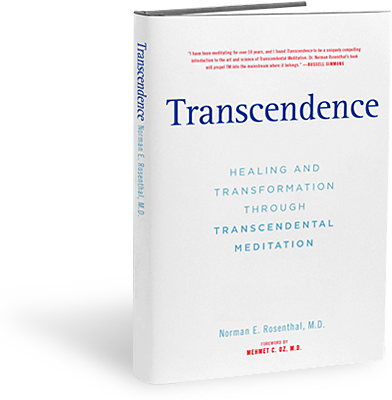
For more information regarding meditation and its benefits you may wish to read my book, “Transcendence: Healing and Transformation Through Transcendental Meditation.”
Related Articles:
- Meditation & Yoga? The Seahawks’ Superbowl Advantage
- From Transcendence to the Gift of Adversity
- Transcendental Meditation: A Promising Remedy for Workplace Stress
February 3, 2014
Superbowl XLVIII: How Did Meditation Effect the Seahawks Dominant Performance?
To all those who’ve been congratulating me for predicting that the Seahawks would win the Superbowl (original article: Meditation & Yoga? The Seahawks’ Superbowl Advantage) because their training included Yoga and meditation, let me put the record straight. I made no such prediction. I simply said that the documented effects of meditation on brain and body could easily  put a team of meditators at a distinct advantage over their non-meditating opponents. Transcendental meditation – which is my particular area of expertise – has been shown to change electrical brain wave patterns in a favorable way and increase the efficiency of fight-or-flight response responses, which are so crucial in the sort of do-or-die situation that champion ballplayers experience.
Such advantages that meditation confers might, I suggested, provide a crucial difference in a closely contested battle. There was, however, nothing close about the way in which, contrary to almost all predictions, the Seahawks demolished their illustrious opponents, led by the legendary Peyton Manning. Broncos’ fans in orange jerseys cleared the bleachers in droves well before the game was over, perhaps to beat the traffic but more likely to distance themselves from the embarrassing trouncing that their team received. The question that arises at this point is, “To what extent might Yoga and meditation have conferred such an overwhelming advantage to the Seahawks as to explain such an unexpected and decisive victory?”
 When Malcolm Smith returned the intercepted pass for a 69-yard touchdown, was there some extra-special brain coherence going on (such has been described to occur with Transcendental Meditation) that might have explained in part the longest interception return in Superbowl history? When Percy Harvin returned the opening second-half kickoff for a touchdown, was this amazing comeback after his concussion in his previous game somehow related to meditation, which is known to speed up recovery to baseline following jarring experiences? And finally, was quarterback Russell Wilson’s flawless game, in which he appeared to be in an invincible zone throughout, somehow related to fluxes in alpha-rhythms across his pre-frontal cortex – the brain’s command and control center – that has also been reported to occur following meditation? Of course, these are all rhetorical questions, and we are not even certain that these guys meditate, yet for each one an affirmative answer is certainly possible.
 In conclusion, this time I will make a prediction: In the year to come the phones in yoga and meditation centers will be ringing off the hook as a result of the astonishing upset that we saw yesterday. Not only will competitive ballplayers take note, but all of us who compete and jostle for advantage in the hurly-burly of our daily lives. And for those of you who wander into the locker rooms of the NFL in the coming season, don’t be surprised to see suited players sitting on the benches, eyes shut, as they quietly contemplate their mantras.
Wishing you Light and Transcendence,
Norman
For more information regarding meditation and its benefits you may wish to read my book, “Transcendence: Healing and Transformation Through Transcendental Meditation.”
Superbowl photo credit (See all photos here): Andrew Mills/The Star-Ledger