
Norman E. Rosenthal's Blog, page 2
June 16, 2016
11 Tips to Greater Happiness
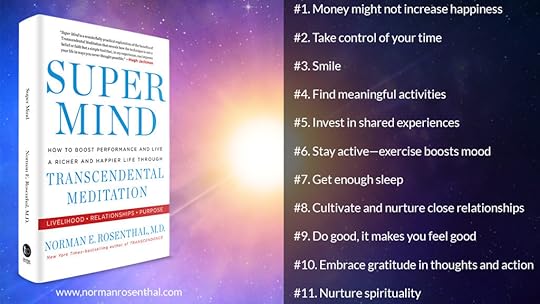
Today we’re going to talk about what you can do to feel happier. Now evidence shows that about a third to a half of our happiness is predetermined; it’s part of the genetic sweepstakes: are we happy or are we unhappy? So, some of it is how we were born, but that leaves a full half to two thirds of things that we can do to make ourselves happier.
In this article I am going to talk about eleven things that we can do in order to feel happier.
First of all, it’s really important to understand one thing that you might think will make you feel happier but that really doesn’t—having more money. Most people think that more money will just automatically make them happier. While it’s true that having more money can help you if you don’t have enough food, shelter, and/or health care. More money in this case can make you feel better but for those of us who’ve got those basic needs covered, extra money does not translate to extra happiness. We look at those people who win the Powerball lottery and think that wow if only we could do that we would be happier but data suggests otherwise. So what can make you happier?
 Point number two, take control of your time. What research shows is that people who are able to take control of their day are much happier than people who are on the clock all the time and have no sense that they can control their time at all. So look around and see what is it in your life which you can control. Obviously none of us can control everything but some elements of being able to control when you take a break, how long your workday is, when you have some leisure time or some vacation time. Those things do make people happier.
Point number three, smile. Evidence shows that acting happy can actually make you feel happy. Let’s try it for a second, let’s smile. I know it seems kind of silly but let’s give it a shot. Try it now, can you stop reading and smile for 10 seconds or so? There you are, did that make you feel happier? Evidence goes all the way back to Charles Darwin who suggested that it’s not only a reflection of our feelings but our facial expressions actually influence our feelings and smiling for happiness is chief among those expressions.
Point number four, find work and activities that you’re good at and that are meaningful to you. It has often been said that if you have a job that you love, you’ll never have to work a day in your life. Trying to do something that you really enjoy, as it does make such a difference. Attempt to feel good about what you do each day during your work as opposed to feeling like you’re just sort of clocking in the time and waiting for the final bell to ring.
Watch the Video, 11 Tips to Experience Greater Happiness
Point number five, investing in shared experiences such as vacations rather than just in things. If you realize that there’s a huge movement nowadays to declutter, you’ll understand that the accumulation of things has been overestimated in terms of how it’s going to make you feel. In fact, a lot of us feel like we’ve got too many things that kind of strangle us, but spending time—especially with meaningful people is good for emotional health. It could be as exciting as a trip around the world or it could be as simple as a walk around the block—even hanging out in front of the TV watching your favorite show can be a great thing to do. Be sure that you invest in shared experiences and don’t just accumulate stuff.
Point six, stay active. Exercise boosts mood, it’s a fact. It doesn’t matter what kind of exercise, do the kind of exercise you enjoy because that’s what you’re likely to stick with.
Point seven, get enough sleep. More and more we’re realizing the power of proper rest. We used to think perhaps that sleep was wasted time and that the more we could cram into our wakeful hours the better off we were. This is not so, what’s going to happen is that not getting enough sleep is going to degrade the quality of our waking time, which may cause us to be less productive.

Point eight, cultivate and nurture close relationships. Our friends and our family are really our treasures, so regard them as such; treasure them, nurture them and you will be repaid in full in terms of the happiness that results from that.
Point nine, do good it makes you feel good. I’m sure this is familiar to all of you but perhaps it’s not something that we focus on often enough. At night when you’re lying in bed and you’re reviewing your day, just pin point one little thing that was good—a kind word that you gave to somebody or something nice that you did for somebody. Check out the warm fuzzies that you’ll feel and realize that if you multiply that throughout the day it’s going to affect the quality of that day. And of course, how we live our days ultimately equates to how we live our lives.
 Point ten, embrace gratitude both in your thoughts and your actions. You might even keep a gratitude journal and express gratitude to others when you feel it. Gratitude is really the opposite of entitlement. If you feel entitled you’ll always feel short changed. I’m entitled to this, why am I not getting it? Why am I not getting a seat at the front of the plane, or that table in the restaurant? Try and avoid placing your attention on whatever it is that you really feel you ought to be having that you’ve been cheated out of, as that is not going to make you feel happy. Instead maybe you can look at the rainbow on a beautiful day? Gosh, I’m feeling so alive today. I can walk, I can breathe—some people can’t do those things very easily so gratitude for the simple things multiplies throughout the day and creates a sense of happiness.
Point eleven, nurture the spiritual side of yourself whatever that happens to be. Whether it’s religion, meditation or something that enriches the internal space in your mind it is a positive thing. This has always been something that I’ve been fascinated by—in fact these eleven tips come from my latest book Super Mind.
So think about these 11 tips and which ones do you use on a regular basis.
If you enjoyed this article please share it with your social community with the buttons on this page. This share count will tell me that the messages I’m putting out are being enjoyed and helping people. This will encourage me to write more articles like this one.
Wishing you light and transcendence,
Norm
Related Posts:
How to Stop Your Emotions from Controlling You
What Is the Super Mind – and How Can You Get It?


May 17, 2016
Super Mind DC Book Launch Talk & Signing
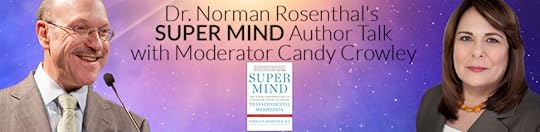
This event will be live right here on this webpage. Simply click through to this page on Thursday, May 19, 2016 from 8:00 PM to 10:00 PM (EDT) to view the event right here.
The award-winning journalist, Candy Crowley, has interviewed every sitting president since Ronald Reagan over her illustrious career as a political news anchor and correspondent in Washington. Thursday, May 19, she will sit with Dr. Norman E. Rosenthal to talk about his latest book, SUPER MIND How to Boost Performance and Live a Richer and Happier Life Through Transcendental Meditation.

Hear world-renowned psychiatrist, public speaker, and best-selling author, known for his innovative research and inspirational writings, introduce his new book to the Washing
ton, DC, audience. In SUPER MIND, Dr. Rosenthal weaves the latest clinical research together with the results of over 600 personal accounts to define the SUPER MIND state, achieved by meditators through their regular practice. He explains the Super Mind phenomenon as, “The blissful transcendent experience that normally begins during one’s meditation practice actually starts to filter into one’s daily life. And all kinds of good things follow. There is a stillness in the presence of activity, an ease of which we do things that help us be more creative, more productive, more available to other people and more available to ourselves.”
Books will be available for purchase from Politics and Prose at the event.
If you will be in Washington DC around on May 19th and wish to attend thgis free event in person, please click here to reserve your seat (limit seating available).
May 12, 2016
Super Mind: Boost Performance with Transcendental Meditation (Infographic)
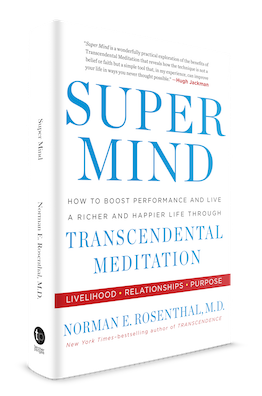
Although the development of consciousness is an ancient concept it has not yet to date been scientifically characterized, so I set out to do just this. The infographic below was derived from a questionnaire—The Consciousness Integration Questionnaire from my book Super Mind. In this survey we gathered and analyzed data from over 600 individuals who regularly practice meditation. Questionnaires of this type have been developed in many areas of behavioral science, so I wondered, “Why not use similar methods to measure the effect of TM on the development of higher consciousness and the lives of meditators—in other words on the Super Mind?” Some of my findings are below…
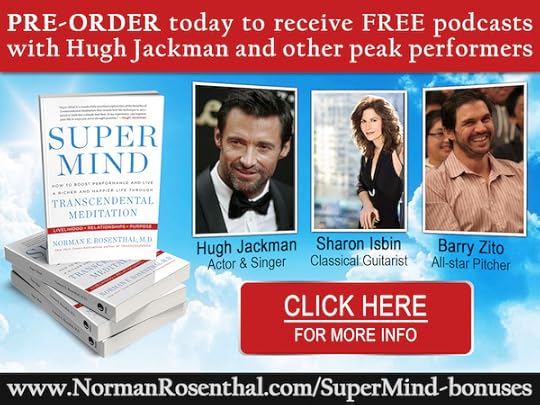
Pre-order your copy of Super Mind today and receive FREE podcasts with Hugh Jackman and other peak performers (Limited Time Offer)




Super Mind: Boost Performance with Transcendental Meditation (Infographic)
If you click directly on the image below two times you can view this infographic in full resolution.
Pre-order your copy of Super Mind today and receive FREE podcasts with Hugh Jackman and other peak performers (Limited Time Offer)
Embed This Image On Your Site (copy code below):
Courtesy of: Norman E. Rosenthal, M.D.
April 1, 2016
What Is the Super Mind – and How Can You Get It?
This is the second of a series of blog posts I will be writing leading up to the publication of my latest book, Super Mind. My hope and intention is to invite conversation around this exciting topic.
The Super Mind is a time-honored concept, though I have given it a new name that speaks to our modern era.
The Upanishads – an ancient text – tells us that through the practice of repeated stillness, you will reach a continuum of silence. Modern practitioners of Transcendental Meditation (TM) have recognized that such changes in consciousness begin to pervade their lives after they have been meditating for a while. This growth in consciousness is associated with many desirable qualities and life circumstances.
Put simply, the Super Mind allows you to live life to the fullest, bringing you profound joy while at the same time boosting your performance and effectiveness.
What is the value of the Super Mind? Will it make me richer, more successful, and happier?
Many have asked me these questions. So, let’s consider them.
Richer and more successful
Although polls show that most people think that having more money will make them happier, evidence suggests this is not usually true – as long as your basic needs are 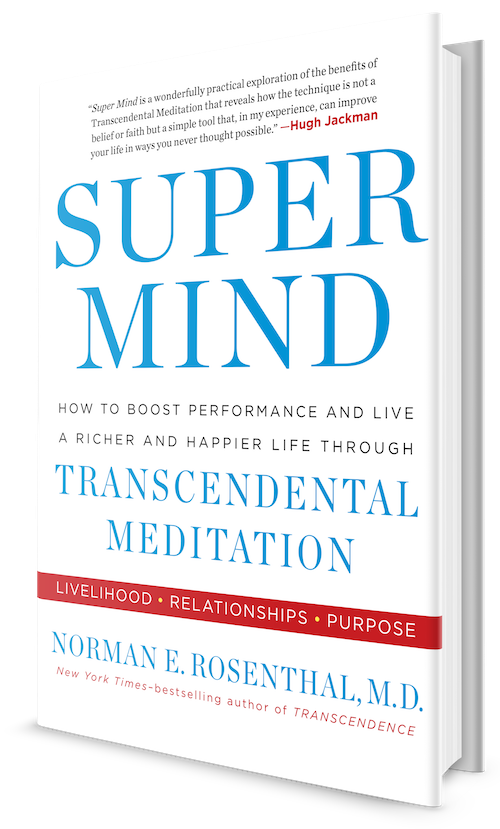 covered. But many people I interviewed – especially in business – say yes, the Super Mind will help you become richer because it will make it easier for you to achieve anything you seek to accomplish, by sharpening your mind and making you more creative and effective.
It follows, therefore, that the Super Mind will make you more successful. The Super Mind may not net you a billion dollars or a Nobel Prize. Instead, it will help you figure out who you really are – your authentic self, who you want to become, and help you get there. In summary, it will help you self-actualize and be the absolute best you can be.
Happier
Scientists have shown that although a significant proportion of our happiness resides in our genes, there is much we can do to make the most of our biological limits. That’s where the Super Mind comes into play. In a survey of over 600 TM practitioners, 94% reported an increased level of well-being since starting to meditate. Factors that predicted how often they would experience this increased sense of well-being were how long they had been meditating (in months or years) and how frequently.
Here are a few examples of Super Mind activity taken from my book:
Actor, singer, and dancer Hugh Jackman credits TM with helping him become more authentic, and live a happier and more rounded life, unspoiled by his legendary success
World famous classical guitarist Sharon Isbin regards TM as key to her creativity, success, and happiness
Former major league baseball player Barry Zito recalls a pivotal game in the 2012 playoffs when he was “completely in the zone” – one of the hallmarks of the Super Mind. His resulting performance in that game was key to the outcome of the 2012 World Series, which went to his team, the San Francisco Giants.
The good news is you don’t need extraordinary talent or abilities to enjoy the benefits of the Super Mind. Anybody can.
[Video 2:44] Norman E. Rosenthal M.D. Introduces Super Mind
So, How Can You Get a Super Mind?
Based on my work with thousands of people who have sought to change their lives, there is not usually one single method for doing so. And that’s how it is with the Super Mind. Throughout history there have been people who achieved aspects of the Super Mind by different methods. Some seem to have stumbled upon it spontaneously. Author Eckhart Tolle may be one such person, to judge from his description in his best-selling “The Power Of Now.” It is also likely that people may attain the Super Mind by many and various practices – religious or meditative.
In my experience, however, the easiest and most powerful way to obtain the benefits of the Super Mind is via TM. Why is that? Because TM is a very simple and effortless procedure. It is taught by a well-studied standardized method that almost anyone can learn. In addition, an essential aspect of TM is the growth of consciousness. During TM sessions, the meditator typically experiences Transcendence – a specific state of consciousness that is different from sleeping, waking, and dreaming. Down the line that state of consciousness enters a person’s daily life.
In the next blog I will describe how the growth of consciousness unfolds and how my colleagues and I have set about trying to measure that growth. In the meanwhile I’d love for you to share your ideas about these issues with me and my readers.

Other Articles in this Super Mind Series:
March 28, 2016
Super Mind: Beyond Transcendence
 This is the first of a series of blog posts I will be writing leading up to the publication of my latest book, Super Mind. My hope and intention is to invite conversation around this exciting topic.
My patients have influenced my research, and my research has influenced my writing. That is how it has always been for me. But there is something else that must always be there for me to pursue a subject whole-heartedly. I must feel powerfully that in the core of my being there is something that cries out to me to pursue this matter – that it is really important. That I must not delay. So it was with seasonal affective disorder (SAD) – that malady of the dark days. I saw patients who suffered in winter, studied them, and found that their spirits flourished under bright light – like tulips bursting into 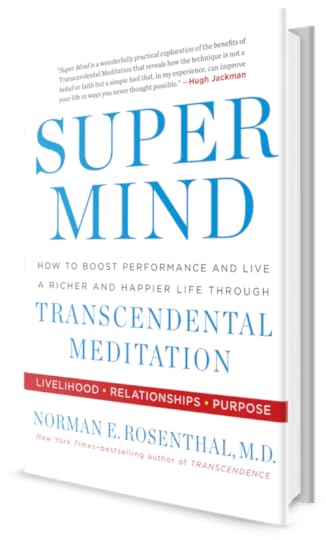 bloom in the spring sunshine. My devotion to the topic was driven in part by realizing that I too suffered from that same malady – and benefited from my own treatment. That led to my book Winter Blues.
So it was with Transcendental Meditation. A young man with bipolar disorder brought to my attention that it was TM – not my medications – that was making him really happy. I had tried TM years before, albeit irregularly, and he urged me to return to my practice. So impressed was I by the power of TM to settle me down in body and mind that I began to recommend it to my patients. They reported similar benefits. I researched TM in veterans of the wars in Iraq and Afghanistan, and to my amazement, I found that TM could soothe even those whose minds had been ravaged by the horrors of war. I felt compelled to write about this gentle yet powerful practice – especially after reviewing hundreds of excellent articles demonstrating the broad scope of TM to alleviate physical and psychological ills. That led to my book Transcendence.
With Transcendence I thought I had written the last useful word I had to say about TM and its benefits. But I was wrong.
As my patients and I continued to meditate, a curious set of developments occurred. First, I noticed a change in consciousness. As I went about my daily activities, a stillness accompanied me so that I felt a realm of constancy and calm dwelling inside me despite the hurly burly of daily life. Second, everything seemed to flow more smoothly. I got along better with people and somehow difficult tasks became easier, even tasks that had previously seemed overwhelming. It was as though unseen forces were conspiring to help me – though I realized, of course, that it was I who must have changed.
Once again, I heard the clarion cry: There is something important going on here, it shouted out to me. Something you must investigate and write about.
So investigate I did – and concluded that the advantages of TM went far beyond the relief of stress and alleviation of distress and disease. What was happening in my own mind – and in the minds of those I observed – was a broad growth of mental faculties, both cognitive and emotional. It was as though the mind itself was expanding and becoming . . . a Super Mind. That then became the name of my latest book, due to be released in mid-May of 2016.
But before my findings and thoughts on the subject are released to the public, I want to give you a jump start on these thoughts and invite you to join me in a conversation about the Super Mind.
In my next blog I will describe the Super Mind more fully. Until then, let me hear from you.
January 8, 2016
New Year’s Resolutions: Keep It Simple
“What’s the point of New Year’s resolutions?” a friend asked me over lunch, “and why should the New Year be better than any other time for making new plans?” I disagreed.
I think anytime is a good time to improve your life. So why not the New Year, when such ideas are in the air and on everybody’s mind?
In my experience, those people whose New Year’s resolutions seem to have the most traction keep them simple – and realistic. For example, one client of mine finally decided to downscale her goal to lose 50 pounds, and try to lose just 5 to 10 pounds instead. Another client, a young gay man decided on just one resolution: to remain HIV negative until the next New Year. He could have put many other things on his list of resolutions, but by keeping it simple he established his priority, and is arguably more likely to succeed in that regard because it won’t be lost in the clutter of many other resolutions.
How to Simplify Your Resolutions
Consider picking at least one resolution from each of the following three categories:
Improve yourself physically or psychologically
Set a specific goal you wish to accomplish
Do something good for someone else
 When you think of doing something to improve yourself, dozen of ideas may crowd your mind. But keep it simple. Start with one thing—whether that be improving a relationship, quitting a bad habit, or cultivating a good one. Often when you focus on one important behavior, others follow, setting in motion a virtuous cycle.
Most of us have something we want to accomplish, along with an unfortunate tendency to put it off. Again, if you keep your goal realistic, you are more likely to achieve it. It may not be the Great American Novel, or a new scientific discovery, but it should be something that is important to you. And once again, one accomplishment often leads to the next.
Finally, do something good for someone. It could be an elderly relative, a friend in need, some random stranger, or a charity that has captured your imagination. Research shows that doing something good for someone else helps you feel good. But that’s not the only reason for doing so. Imagine, if we all did something good, the world would be a better place by next January 1, when it is time once again to look at our new set of resolutions.
If you feel inspired to share your New Year’s resolution(s) with the community you can do so in the comments section below.
Wishing you light and transcendence,
Norman Rosenthal
________________________
Related Articles:
1) Preventing Winter Weight Gain: Breakfast and The Carbohydrate Connection
2) 9 tips for creating – and keeping – New Year’s resolutions
3) Why we make New Year’s resolutions and how to make yours stick
December 1, 2015
Seasonal Affective Disorder: Beating the Winter Blues

Here in the northern hemisphere the days are getting shorter and darker. Not only is that a fact, but many of us feel it viscerally – in body and mind. So what is there to do about it? Quite a lot – and that is good news for the millions of us who suffer from seasonal affective disorder and the winter blues year after year. Based on over 30 years of researching the question – and dealing with it in myself and my patients – here are some simple suggestions:
Recognize the problem. This may seem simpler than it often is. Early signs of seasonal affective disorder (SAD) can be subtle. Decreased energy, fatigue, wanting to sleep more, craving those candies and pastas, slacking off at work – all classical symptoms of SAD or its milder variant, the Winter Blues, can easily be attributed to many other causes. But put them all together – along with feelings of anxiety, sadness or dread – and the likely cause becomes obvious: our old friend (or foe), the Winter Blues or SAD has come to visit us once again. But catch it early, and you’re ahead of the game.
Remember, if you don’t diagnose it, you won’t treat it properly.
 Get more light. You can do this in several ways. Go for a morning walk on a bright winter day (it has been shown that morning is often the most effective time for you to get light). Bring more light into your home. Trim the hedges from around the windows and wipe the grime that has accumulated since last winter off the window panes. Make at least one room in your home the bright room to which you can retreat on a dark winter’s day. Put your bedside lamp on a timer, which turns the lamp on a half hour before you are due to wake up. Better still, get a dawn simulator (they make great holiday gifts), which you can program to turn the light on at your desired time.
If these simple measures don’t work consider getting a light fixture specially geared towards helping people with SAD. Luckily there is a wide range of choices. Here are a few things to remember in choosing a suitable light box. Based on research in this area, the best-tested boxes have fluorescent light bulbs behind a screen that filters out UV light, and have an illuminated surface area of at least one square foot. Most people respond best to light treatment in the morning – the earlier the better. Like all active treatments, light therapy can have side effects including headaches and eye strain, irritability and insomnia (especially when used late at night).
Get up early, keep active, and be sure to plan pleasant events for yourself. Evidence shows that questioning and confronting negative thoughts and doing things that lift your spirits (key elements of cognitive behavior therapy) really do help.
This well known mood booster can work wonders, especially if you combine it with bright light – for example, by taking a brisk stroll in the morning or working out in front of a light fixture.
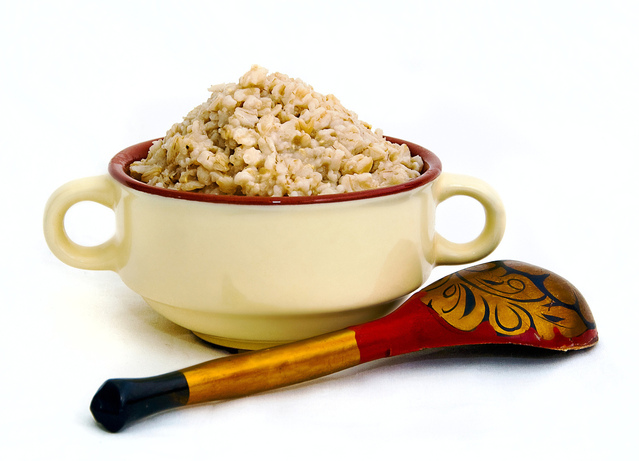 Watch out for those carbs – especially high-impact carbs, by which I mean anything with pure sugars or white starches. Low-impact carbs, such as unprocessed oats or legumes (such as beans, lentils, and chick peas, are much better. So are almonds and walnuts. High protein foods are great for keeping your cravings down while meeting nutritional needs. I avoid processed bars that claim to be nutritious but contain synthetic supplements and lots of sugar in different guises. My favorite snack: a small packet of Trader Joe’s almonds plus a part-skim mozzarella stick. They don’t spoil readily and are perfect for putting in your coat pocket or bag.
Here is a blog post with a recipe for steel cut oats
Whatever form of meditation you do, do it. It’s a great way to reduce excess stress, which is bad in general, and especially bad if you have SAD or the Winter Blues.
Get educated about your condition. For more information on the subject, check out my book Winter Blues: All You Need to Know to Beat Seasonal Affective Disorder, Guilford 2013, or additional blog posts here on my website.
There are limits to self-help. When should you consult a doctor? If your winter symptoms are impairing your functioning to the point that your personal or work life is being disrupted significantly, it makes sense to consult a professional. Don’t jeopardize important relationships or your job. Likewise, if you are despairing and feel like you cannot go on, that’s not a good time to go it alone. Find a caring and knowledgeable professional.
10 . Is there a role for medications? If winter symptoms reach the level described in point #9 above, the professional you consult may recommend medications. The medications most commonly used are the SSRI’s (Prozac, Zoloft, or Lexapro in their generic forms) and buproprion in its various preparations. Since these are all prescription medications, a physician will need to be involved.
Related Posts:
4 Articles: Seasonal Affective Disorder & Winter Blues
How to Beat Seasonal Affective Disorder and The Winter Blues [Infographic]
Summertime: And the Living Aint Easy (summer sad)
Seasonal Affective Disorder: Beating the Winter Blues
Here in the northern hemisphere the days are getting shorter and darker. Not only is that a fact, but many of us feel it viscerally – in body and mind. So what is there to do about it? Quite a lot – and that is good news for the millions of us who suffer from seasonal affective disorder and the winter blues year after year. Based on over 30 years of researching the question – and dealing with it in myself and my patients – here are some simple suggestions:
Recognize the problem. This may seem simpler than it often is. Early signs of seasonal affective disorder (SAD) can be subtle. Decreased energy, fatigue, wanting to sleep more, craving those candies and pastas, slacking off at work – all classical symptoms of SAD or its milder variant, the Winter Blues, can easily be attributed to many other causes. But put them all together – along with feelings of anxiety, sadness or dread – and the likely cause becomes obvious: our old friend (or foe), the Winter Blues or SAD has come to visit us once again. But catch it early, and you’re ahead of the game.
Remember, if you don’t diagnose it, you won’t treat it properly.
Get more light. You can do this in several ways. Go for a morning walk on a bright winter day (it has been shown that morning is often the most effective time for you to get light). Bring more light into your home. Trim the hedges from around the windows and wipe the grime that has accumulated since last winter off the window panes. Make at least one room in your home the bright room to which you can retreat on a dark winter’s day. Put your bedside lamp on a timer, which turns the lamp on a half hour before you are due to wake up. Better still, get a dawn simulator (they make great holiday gifts), which you can program to turn the light on at your desired time.If these simple measures don’t work consider getting a light fixture specially geared towards helping people with SAD. Luckily there is a wide range of choices. Here are a few things to remember in choosing a suitable light box. Based on research in this area, the best-tested boxes have fluorescent light bulbs behind a screen that filters out UV light, and have an illuminated surface area of at least one square foot. Most people respond best to light treatment in the morning – the earlier the better. Like all active treatments, light therapy can have side effects including headaches and eye strain, irritability and insomnia (especially when used late at night).
Get up early, keep active, and be sure to plan pleasant events for yourself. Evidence shows that questioning and confronting negative thoughts and doing things that lift your spirits (key elements of cognitive behavior therapy) really do help.
This well known mood booster can work wonders, especially if you combine it with bright light – for example, by taking a brisk stroll in the morning or working out in front of a light fixture.
Watch out for those carbs – especially high-impact carbs, by which I mean anything with pure sugars or white starches. Low-impact carbs, such as unprocessed oats or legumes (such as beans, lentils, and chick peas, are much better. So are almonds and walnuts. High protein foods are great for keeping your cravings down while meeting nutritional needs. I avoid processed bars that claim to be nutritious but contain synthetic supplements and lots of sugar in different guises. My favorite snack: a small packet of Trader Joe’s almonds plus a part-skim mozzarella stick. They don’t spoil readily and are perfect for putting in your coat pocket or bag.Here is a blog post with a recipe for steel cut oats
Whatever form of meditation you do, do it. It’s a great way to reduce excess stress, which is bad in general, and especially bad if you have SAD or the Winter Blues.
Get educated about your condition. For more information on the subject, check out my book Winter Blues: All You Need to Know to Beat Seasonal Affective Disorder, Guilford 2013, or additional blog posts here on my website.
There are limits to self-help. When should you consult a doctor? If your winter symptoms are impairing your functioning to the point that your personal or work life is being disrupted significantly, it makes sense to consult a professional. Don’t jeopardize important relationships or your job. Likewise, if you are despairing and feel like you cannot go on, that’s not a good time to go it alone. Find a caring and knowledgeable professional.
10 . Is there a role for medications? If winter symptoms reach the level described in point #9 above, the professional you consult may recommend medications. The medications most commonly used are the SSRI’s (Prozac, Zoloft, or Lexapro in their generic forms) and buproprion in its various preparations. Since these are all prescription medications, a physician will need to be involved.
Related Posts:
4 Articles: Seasonal Affective Disorder & Winter Blues
How to Beat Seasonal Affective Disorder and The Winter Blues [Infographic]
Summertime: And the Living Aint Easy (summer sad)
June 10, 2014
Giving Advice: In Memory of My Dad on Father’s Day
—
Giving Advice: In Memory of My Dad on Father’s Day
An article by Dr. Norman Rosethal
—
As a therapist, I generally try to avoid giving advice. I know that psychiatrists are often caricatured for this trait. “What should I do, Doc?” the fictional patient will say. “What do you think you should do?” the caricatured doctor will respond.
Beneath the joke, there is of course a rationale for turning the question back to the client or patient (though hopefully not in the stereotyped way shown above). It’s basically the Socratic method dressed up in clinical garb. A good therapist wants to help the client think through a problem so that when a similar problem arises again, those mental pathways will have already been practiced and the person will be better equipped to answer the problem without help.
 Even when I may have some advice for a patient or client, I might say something like, “You know, I have some ideas about possible directions you may want to take here, but it would be far more useful to hear your thoughts first. Then, later, I might share my own opinion if it seems useful.
All this is a preamble to a story about my Dad, who was not a psychiatrist, but a lawyer. People didn’t come to him to learn how to fix their own problems. They expected him to give them direct advice or fix the problem himself.
The attached excerpt – a chapter from my book The Gift of Adversity (Tarcher Penguin), appropriately called “The Fixer,” because it deals with my father’s skills in this department.
I hope you enjoy it – and happy Father’s Day to all you fathers out there.
Wishing you Light and Transcendence,
Norman
________________________
If you enjoyed this post, you may also like:
From Transcendence to the Gift of Adversity
The Gift of Adversity with Dr. Norman Rosenthal
May 23, 2014
Personal History of Memorial: A Tribute to Veterans
As Memorial Day approaches, it is fitting that we think of those who have fought, suffered and died to keep us safe.
In these troubled times for veterans – and those who care about them – we have been engulfed by stories of physical and mental disability– the horrors of post-traumatic stress disorder and the growing number of veteran suicides. More recently, many of us have looked on in astonishment at scandalous – and sometimes fatal – delays in obtaining health care that too many veterans have endured.
But Memorial Day is also a time for personal reflection on those we have lost, both recently and long ago. The video clip below describes one such personal loss – the death of my uncle and namesake, who died in a tank battle in North Africa at age 21, during World War II. For those of you who want to find out more about him, I have told his story in greater detail in my latest book The Gift of Adversity.
[Video 2:42] Personal Heroes
For me, poetry has always been a source of both joy and consolation, and I would like to share one of my favorite poems for memorial with you – one that seems appropriate for this day of sad and proud reflection.
Do not stand at my grave and weep
I am not there. I do not sleep.
I am a thousand winds that blow.
I am the diamond glints on the snow.
I am the sunlight on ripened grain.
I am the gentle autumn rain.
When you awaken in the morning’s hush
I am the swift uplifting rush
Of quiet birds in circled flight.
I am the soft stars that shine at night.
Do not stand at my grave and cry;
I am not there. I did not die.
Mary Elizabeth Frye
————————
Additional Resources:
Poems for memorial
HOLMES’ 1884 MEMORIAL DAY SPEECH
History of Memorial Day



![[image error]](https://www.normanrosenthal.com/wp-content/uploads/2016/05/SuperMind-Final.png)