Norman E. Rosenthal's Blog, page 5
July 22, 2013
The Thumbs Must Go
Author and psychiatrist Dr. Norman Rosenthal tells a funny story from a childhood art class where he learned (for the first but not last time) that sometimes perfectionism can be your worst enemy.
[Video 1:59] Gift of Adversity: The Thumbs Must Go
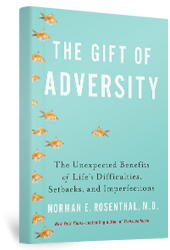


Here’s what the experts are saying about The Gift of Adversity:

“Dr. Rosenthal catalyzes conversations around adversity with tales of wisdom and survival that we can all treasure.” —Mehmet C. Oz, M.D., host of The Dr. OZ Show

“Dr. Norm is a cosmonaut of consciousness, launching into the murky abyss and returning with meteoric treasures for us all. His writing on the value of adversity may come to be regarded by Alien archeologists as a Rosetta Stone in understanding how we advance as individuals and as a culture.” —Russell Brand, Actor

“Dr. Rosenthal presents an intriguing and inspiring work on the endless ‘blessings in disguise’ which shape our lives and our world. He shares frank personal experiences along with stories of others, including historical events on a global scale. He offers suggestions on how to navigate through rough patches in life and celebrates the resilience of the human spirit.” —Laura Dern, Actress

“In this timely and beautifully written work, renowned psychiatrist and best-selling author Norman Rosenthal tells intriguing stories that converge on an important theme–that many of life’s greatest lessons and joys aren’t the products of perfection, but the gifts of adversity. Each short chapter is its own delicious dish in a wonderful feast of a book.”
—Marci Shimoff, #1 NY Times bestselling author, Happy for No Reason, Love For No Reason, and Chicken Soup for the Woman’s Soul

This charming book joins deep insights from psychoanalysis to the humane wisdom of a life fully lived. Rosenthal captures both the complexity of our emotions and the pragmatics needed to harness them, and he does so with humor and grace.
—Andrew Solomon, Author of “Far From the Tree.”

The Gift of Adversity is a wonderful book. Dr Rosenthal, psychiatrist and humanist, vividly describes the pains and setbacks brought about by our actions or circumstance and how we can use them to give substance and meaning to our lives. The Gift of Adversity is an important gift in its own right.
—Kay Redfield Jamison PhD, author of An Unquiet Mind

I really loved Norman’s book—and i agree that adversity can be a great teacher and a great friend. —David Lynch, filmmaker

If you’ve ever wondered what a world-class psychiatrist really thinks when pondering his life journey, then read The Gift of Adversity. You’ll be treated to short and savory stories covering Dr. Norman Rosenthal’s extraordinary roller coaster ride from a young boy in South Africa, to an acclaimed physician and scientist. His wit and wisdom will captivate you as you learn the priceless lessons gifted to you from life’s challenges.
—Pam Peeke MD, MPH, FACP, Assistant Professor of Medicine U of MD, New York Times bestselling author of The Hunger Fix


When All Goes Terribly Wrong: The Gift of Adversity
When we think of adversity, we often imagine the worst kinds of horrors, but we may forget the regular adversities that we navigate every day. No matter what the level of adversity, it provides a common bond between us all — as none of us escapes misadventure and misfortune. We also have the potential to transform these events into an opportunity for change and growth.
In this light-hearted video, a young woman provides an example of this type of thing as she tries to get to a job interview.
[Video 2:26] When all goes terribly wrong: The Gift of Adversity
Here’s what the experts are saying about The Gift of Adversity:
“Dr. Rosenthal catalyzes conversations around adversity with tales of wisdom and survival that we can all treasure.” —Mehmet C. Oz, M.D., host of The Dr. OZ Show
“Dr. Norm is a cosmonaut of consciousness, launching into the murky abyss and returning with meteoric treasures for us all. His writing on the value of adversity may come to be regarded by Alien archeologists as a Rosetta Stone in understanding how we advance as individuals and as a culture.” —Russell Brand, Actor
“Dr. Rosenthal presents an intriguing and inspiring work on the endless ‘blessings in disguise’ which shape our lives and our world. He shares frank personal experiences along with stories of others, including historical events on a global scale. He offers suggestions on how to navigate through rough patches in life and celebrates the resilience of the human spirit.” —Laura Dern, Actress
“In this timely and beautifully written work, renowned psychiatrist and best-selling author Norman Rosenthal tells intriguing stories that converge on an important theme–that many of life’s greatest lessons and joys aren’t the products of perfection, but the gifts of adversity. Each short chapter is its own delicious dish in a wonderful feast of a book.”
—Marci Shimoff, #1 NY Times bestselling author, Happy for No Reason, Love For No Reason, and Chicken Soup for the Woman’s Soul
This charming book joins deep insights from psychoanalysis to the humane wisdom of a life fully lived. Rosenthal captures both the complexity of our emotions and the pragmatics needed to harness them, and he does so with humor and grace.
—Andrew Solomon, Author of “Far From the Tree.”
The Gift of Adversity is a wonderful book. Dr Rosenthal, psychiatrist and humanist, vividly describes the pains and setbacks brought about by our actions or circumstance and how we can use them to give substance and meaning to our lives. The Gift of Adversity is an important gift in its own right.
—Kay Redfield Jamison PhD, author of An Unquiet Mind
I really loved Norman’s book—and i agree that adversity can be a great teacher and a great friend. —David Lynch, filmmaker
If you’ve ever wondered what a world-class psychiatrist really thinks when pondering his life journey, then read The Gift of Adversity. You’ll be treated to short and savory stories covering Dr. Norman Rosenthal’s extraordinary roller coaster ride from a young boy in South Africa, to an acclaimed physician and scientist. His wit and wisdom will captivate you as you learn the priceless lessons gifted to you from life’s challenges.
—Pam Peeke MD, MPH, FACP, Assistant Professor of Medicine U of MD, New York Times bestselling author of The Hunger Fix
June 26, 2013
How to Stop Your Emotions from Controlling You
Writer Mary Wollstonecraft said, “When we feel deeply, we reason profoundly.” These are wise words for those of us trying to understand the intelligence of our emotions. This blog post provides tips and suggestions on how to stop your emotions from controlling you.
Science has now shown that certain parts of our brain specialize in processing emotional information; these parts are somewhat distinct from those responsible for intellect. Further, the different regions may not always work in concert; we may experience feelings and not understand why. Modern neuroscience has validated classical analytic theories about the power of unconscious feelings to drive our actions,  sometimes without ever surfacing into our awareness.
Pascal famously said that “the heart has a reason that reason cannot know,” anticipating both Freud and those modern neuroscientists who have demonstrated the existence of unconscious feelings. But Pascal underestimated the power of the human intellect to comprehend mysterious and elusive things, feelings included. Now that thousands of scientists are focusing their intellect on the mysteries of emotion, reason is finally starting to comprehend the reasons of the heart.
Human beings have highly developed reasoning centers housed in the neocortex (the most recently evolved part of the brain), which offer the ability to experience complex emotions, such as: love, vengeance and anger. But the capacity to experience these complex emotions profoundly act on them rationally and in a measured way is a skill worth developing – one that requires patience, practice, contemplation and reflection.
Nine strategies for helping to stop your emotions from controlling you:
1) Become a good judge of your own mood: Just as you weigh yourself when you begin a diet, then track your weight as you progress, so you should learn to track your mood.
2) Exercise in moderation
3) Take control of those aspects of your life that you can: Just knowing that you have some ability to improve your life can help pacify intense emotions. Even if you choose to stay in difficult situations, such as a bad marriage or job, you have taken some steps to regain control.
 4) Tackle stress by practicing relaxation, meditation and yoga
5) Seek out social support systems
6) Selectively consider appropriate herbs, nutrients and supplements
7) Attend to your sleep and stay rested
8) Alter your environmental light, especially when days are short and dark, which can be conducive to depression.
9) Avoid alcohol and beware of drugs, substances that can give you the illusion of control in the short run, but aggravate the situation down the line.
Finally, enjoy and appreciate your feelings. It is by recognizing and thinking deeply about our emotions that we are able to reach the most important decisions of our lives.
Wishing you Light and Transcendence,
Norman
Additional Articles/resources You Might Enjoy:
Seven Tell-Tale Signs of Depression in a Friend or Loved One
Emotional Intelligence: 10 Ways to Enhance Yours
How to Stop Your Emotions from Controlling You
Writer Mary Wollstonecraft said, “When we feel deeply, we reason profoundly.” These are wise words for those of us trying to understand the intelligence of our emotions. This blog post provides tips and suggestions on how to stop your emotions from controlling you.
Science has now shown that certain parts of our brain specialize in processing emotional information; these parts are somewhat distinct from those responsible for intellect. Further, the different regions may not always work in concert; we may experience feelings and not understand why. Modern neuroscience has validated classical analytic theories about the power of unconscious feelings to drive our actions,  sometimes without ever surfacing into our awareness.
Pascal famously said that “the heart has a reason that reason cannot know,” anticipating both Freud and those modern neuroscientists who have demonstrated the existence of unconscious feelings. But Pascal underestimated the power of the human intellect to comprehend mysterious and elusive things, feelings included. Now that thousands of scientists are focusing their intellect on the mysteries of emotion, reason is finally starting to comprehend the reasons of the heart.
Human beings have highly developed reasoning centers housed in the neocortex (the most recently evolved part of the brain), which offer the ability to experience complex emotions, such as: love, vengeance and anger. But the capacity to experience these complex emotions profoundly act on them rationally and in a measured way is a skill worth developing – one that requires patience, practice, contemplation and reflection.
Nine strategies for helping to stop your emotions from controlling you:
1) Become a good judge of your own mood: Just as you weigh yourself when you begin a diet, then track your weight as you progress, so you should learn to track your mood.
2) Exercise in moderation
3) Take control of those aspects of your life that you can: Just knowing that you have some ability to improve your life can help pacify intense emotions. Even if you choose to stay in difficult situations, such as a bad marriage or job, you have taken some steps to regain control.
 4) Tackle stress by practicing relaxation, meditation and yoga
5) Seek out social support systems
6) Selectively consider appropriate herbs, nutrients and supplements
7) Attend to your sleep and stay rested
8) Alter your environmental light, especially when days are short and dark, which can be conducive to depression.
9) Avoid alcohol and beware of drugs, substances that can give you the illusion of control in the short run, but aggravate the situation down the line.
Finally, enjoy and appreciate your feelings. It is by recognizing and thinking deeply about our emotions that we are able to reach the most important decisions of our lives.
Wishing you Light and Transcendence,
Norman
Additional Articles/resources You Might Enjoy:
Seven Tell-Tale Signs of Depression in a Friend or Loved One
Emotional Intelligence: 10 Ways to Enhance Yours
April 26, 2013
Get Your Questions Answered: Ask Dr. Norm
Whenever I give talks, the part I enjoy most is the Q&A at the end. It is so rewarding to interact directly with my audience! I am excited to report that with today’s tools and technology we can now skip the lecture and go straight to the question and answer portion.
I am inviting you today to engage with me in a new interactive experiment. My hope with this new adventure is that we can rather simply create a direct way of talking to each other — an opportunity that allows us to engage freely — sharing useful and enjoyable content with each other and our online community.
I am looking forward to answering your questions!
Wishing you Light and Transcendence,
Dr. Norm
——————
 Do you have a webcam?
This is the easiest way to get me your questions and share them with the community. Simply click the webcam icon below and press “allow.” This will automatically access the webcam on your computer. When you are ready with your question, click the red record icon. This will start a countdown from 3 to 1. Once the count down has finished, you are live. At the end of your recording you can either save or redo.
Upload Your Question Using the Features Below
My team will review your question and submit it to me to answer. At this point I will answer the question and do some minor editing to tie your question with my answer.
Once your question has been approved and answered it will be seen on my Youtube Channel. You will receive an email with a link to view the video when this happens.
Here is an example of a Q&A that has been finalized:
March 21, 2013
Happy Spring! A Note from Norman Rosenthal
With the change of seasons, it seems like a good time to say hello to old friends and welcome new ones.
From time to time, I send out a note to share with you some of the things that are going on in my world in the hope that they will resonate with what is going on in yours.
In the US and, indeed, all over the world, spring arrives at different times. I spoke to a friend in Arizona the other day, who kept sneezing through the conversation because the flowers there were out in bloom transmitting their pollens along with their colorful signals and fragrances. Cross-pollination, their key to survival has its unfortunate side-effects for those of us who are too busy sneezing to enjoy the spring colors.
For others, spring has not yet arrived. In fact, it is hard to pinpoint exactly when it does arrive – psychologically that is, as opposed to being just a date on the calendar. In that regard, I always return to the lines by Henry David Thoreau, imagining him stepping out of his shack at Walden Pond in New England (just as perhaps we step out of doors each morning to get the newspaper) and writing:
At the end of winter there is a season
in which we are daily expecting spring
and finally a day when it arrives.
A flock of geese
now in the dark flying low over the pond . . .
I stood at my door and could hear their wings.

I hope that day arrives soon for all of you. We are less than a week away from the vernal equinox, which is not only the date when day equals night, but also when the rate of change of daylength is at its highest. For those of us who are especially sensitive to changes in light, it can be an exhilarating time or even a difficult one. If you are one of these people, check out a few blogs I have written on the subject.
To end with a curiosity, can you really balance an egg on its end on the spring equinox?
I remember seeing someone do so once and marveling at the mystical (or at least physical) forces at work on that particular day.
However, I made a cardinal error. As a scientist, I should have known better.
Every experiment requires a control condition.
It turns out that with enough skill and perseverance, you can balance an egg on its end on any day of the year! (see: http://www.snopes.com/science/equinox.asp)
Ah well, we will just have to dispense with that myth and enjoy the other aspects of spring instead: the warm weather, longer days, flowers and . . . . did I forget something? Yes, love! Let us turn to the Tennyson who wrote famously on that subject, “In spring, a young man’s fancy lightly turns to thoughts of love.”
In my experience, that applies to women too.
So, enjoy all that spring has to offer. And, if you run out of things to do, you can always try balancing an egg on its end.
Warm Regards
Norman Rosenthal
Earth’s Equixox inforgarphic
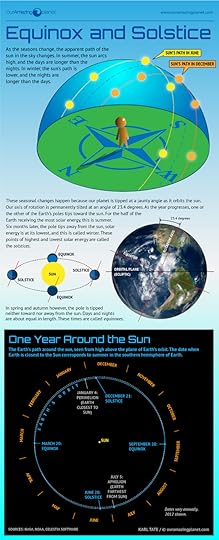
Source:OurAmazingPlanet
March 4, 2013
Between Winter and Spring
What do you call this season, between winter and spring? No Man’s Land, perhaps. I went out for a walk this morning with a friend here in Maryland, and we enjoyed the blue skies and slightly warmer temperatures (though we still needed a scarf and gloves). But now, as afternoon approaches, the clouds have filled in all the blue, and blocked out the sun – and I have just turned on my light box to maintain a decent mood and energy level, and keep the words flowing. (They tend to dry to a trickle in the gloomy weather?)
Shelley, in his Ode to the West Wind, ended on a hopeful note: “If winter comes, can spring be far behind?” We need cheerleaders, and his words were true. But so were Robert Frost’s words when he wrote “Two Tramps in Mud Time.”

Subscribe: Enter to Win Your Free Light Box!
The sun was warm but the wind was chill.
You know how it is with an April day
When the sun is out and the wind is still,
You’re one month on in the middle of May.
But if you so much as dare to speak,
A cloud comes over the sunlit arch,
A wind comes off a frozen peak,
And you’re two months back in the middle of March.
Whether you’re a tramp in New England on an April day or a psychiatrist in Maryland at the beginning of March, you should know that the No Man’s Land between winter and spring – or spring itself for that matter – is a tease. One moment, you’re bathed in heavenly sunlight, and the next . . . well, it’s back to winter’s gloom.
 I had this experience recently in a slightly different form when I returned from a trip to the Caribbean. While I was there, I felt no hint of the Winter Blues that had been troubling me in the preceding weeks. I cavorted and gamboled by the seashore like an expert (though I have never had any formal lessons in either cavorting or gamboling). Somehow it came naturally – a primitive instinct released by the sun.
When I came home, I was feeling so good that I didn’t think much about my mood or the Winter Blues. I neglected my light therapy. The result was . . . not good. Gone were all thoughts of either cavorting or gamboling. What I realized then is that for those of us who struggle through the dark days, we just can’t bank sunlight – not for very long anyway. But at some level, many of us think we can.
Well, I hope I’ve learned my lesson. What we can do is to build on the good mood left by an hour or two of sunlight (or a week in the Caribbean) by not missing a day of light therapy so that we can maintain the momentum.
Bottom line: My light boxes will stay out and ready until I can be sure that the sun has returned consistently. If you’re a fellow SAD sufferer, you may want to do the same.
We are currently putting on a light box giveaway. You can enter to win by simply subscribing to my free newsletter in the sidebar to the right, or by clicking the image below.
Wishing you Light & Transcendence,
Norman

February 26, 2013
Light Box Giveaway: Beat the Winter Blues
As you may know, I am passionate about light – and its power to affect the way we feel. My colleagues and I have done extensive research on light therapy for seasonal affective disorder, depression and the winter blues. Also, I have used and prescribed light therapy for years. I am very happy to be part of this giveaway to help get high-quality light therapy products into the hands of those who may enjoy and benefit from them.
To be considered for the light box giveaway please subscribe to my newsletter in the sidebar to the right.
The winners will be selected at random on March 11th.
Full spectrum light therapy is quite simply light therapy technology that is closest to mimicking the natural light of the suns rays. You can see why it would be most useful in low light conditions.

 The folks over at Verilux have generously offered some of their best products for our giveaway. Verilux specializes in Full Spectrum Lighting, Compact Fluorescent Bulbs and UVC Light Products. They are generously giving away some really great lamps to nine randomly selected individuals who enter to win.
Giveaway: Full Spectrum Light Therapy for Depression
3- HappyLight Deluxe Energy Lamps (value: $189.95 each)
3- HappyLight, Liberty Series, Natural Spectrum Energy Lamp (value: $89.95 each)
3- SmartLight, The Lamp for Learning (value: $39.95 each)
Again, to be considered for the light box giveaway please subscribe to my newsletter in the sidebar above and to the right, or click the image below. The winners will be selected at random in two weeks time.
Please feel free to share any questions, insights or stories about light therapy below with the community.
Wishing you Light and Transcendence,
Norman
Additional resources you might find useful:
Winter Blues, Everything You Need to Know to Beat Seasonal Affective Disorder
Seven Tell-Tale Signs of Depression in a Friend or Loved One
How to Beat Seasonal Affective Disorder and The Winter Blues [Infographic]
January 18, 2013
4 Articles: Seasonal Affective Disorder & Winter Blues
As a long-time resident of the DC Metro area, I have been a regular subscriber to Washingtonian Magazine. I can always depend on them to steer me to the best restaurants for the best prices and, for that matter, to the best of everything. I was delighted therefore to find four articles in the latest copy of Washingtonian that deal with a topic near and dear to my heart — seasonal affective disorder or Winter Blues, and its treatment.
I think the articles are very informative and practically useful, so I am providing a link to each of them below with a brief description of what each covers. I hope you find them useful and that it helps carry you through the next few months. Remember Shelley’s famous words: If winter’s here, can spring be far behind?
Resources for Seasonal Affective Disorder & the Winter Blues:
 9 Tips for Beating the Winter Doldrums
A well written article with 9 helpful tips to keep your dark days bright. From meditation and diet to being more social, the author has some good tips. Read Full Article…
 Sunshine in Winter: Using Light Therapy
As you may or may not know I am a big fan of Light Therapy. This article has information about what size lamp to use, duration of use, good suggestions for purchasing your lamp and a nice success story at the end. Read Full Article…
 Living With Seasonal Affective Disorder
A good story about a man who discovered he had seasonal depression. This man now owns a light box company and helps others combat this disorder. Read Full Article…
 6 Mood-Boosting Foods
It is no secret that our diet has a significant effect on our energy level. This article about “mood-boosting foods” offers up some different options for increasing your energy. Read Full Article…
Please feel free to leave any comments you may have in the section below.
Light and Transcendence,
Norman Rosenthal
Additional Articles you might enjoy:
How to Beat Seasonal Affective Disorder and The Winter Blues [Infographic]
On the Frontiers of SAD: How Much Light is Enough?
Seasonal Affective Disorder and the Holiday Blues: 5 tips to avoid the Holiday Blues
November 21, 2012
10 Steps: How to Manage My Anger
Benjamin Franklin said, “anger is never without a reason, but seldom a good one.”
During rage attacks those parts of the brain that are central to feeling and expressing anger, such as the amygdala and the hypothalamus, commandeer the rest of the brain. In this wholesale takeover, the cerebral cortex is overwhelmed and restraint and reasoning are impossible. In most situations this type of unrestrained anger destroys much more than it accomplishes.
The Value of Anger
 Our anger does have a value. Under normal circumstances, anger has an important communication function. It lets others know that they have encroached upon you or your territory, and it warns them to back off… or else. A mother whose infant is threatened will become angry, and as we all know, it is to get between a mother bear and her cub.
Like all emotions, anger provides important emotional news. When there is not enough to go around, anger lets us know that we had better seize whatever resources we can. Anger can also regulate how we are doing in relation to our goals. In the course of everyday life, we develop expectations of ourselves. Then, if we do not reach them, our frustration-a form of anger-spurs us on.
In stable primate societies, including human ones, communications of anger take place everyday, usually without overt aggression. Sometimes, however, when an individual senses that a threatening gesture is too weak, he attacks. People who suffer from rage attacks have too low a threshold for such outbursts, as well as inadequate mechanisms for controlling the attacks once under way.
Knowing when to attack is a critical life skill for both humans and other animals. It is so important; in fact, that we can assume evolution has programmed such judgment calls into the nervous system.
Anger is a momentary madness, so
control your passion or it will control you.
- Horace
 10 Steps to Help You Manage Your Anger
1) Recognize That Your Anger is a Problem
2) Monitor Your Anger Level
3) Look for a Pattern
a) Be aware of different triggers i.e. bad traffic, slow waiters etc.
4) Take a Time-Out
5) Challenge Perceptions and Thoughts That Fuel Your Anger
a) Seeing hostility where it does not exist
b) The highway does not belong to you
c) Black or white thinking
d) Not having a tantrum doesn’t mean you are giving someone permission to abuse you
e) Even if your anger is justified, it can still cost you
6) Dig Deeper to Understand the Roots of Your Anger
a) Once you recognize a pattern in the types of events that tend to trigger your anger, ask yourself when in your past you have experienced similar reactions.
7) Change the Message You Give Yourself When You Are Angry
8) Use Exposure and Relaxation
a) Upon exposure use relaxation techniques including:
i) Slow, deep abdominal breathing
ii) Contracting and relaxing various muscle groups
iii) Different meditative techniques
9) Use Humor
10) Listen to Your Emotional News – And Act Appropriately
a) Once your anger has calmed down, you will find it possible to think more clearly. Now ask yourself, what is the message from my anger, and what do I want to do about it?
If you would like me to write more on this topic please let me know in the comments section below.
Light and Transcendence,
Norman
This material is taken form The Emotional Revolution: harnessing the Power of Your Emotions for a More Positive Life, Chapter 9.
Additional Resources:
Transcendental Meditation: A Promising Remedy for Workplace Stress
Seven Tell-Tale Signs of Depression in a Friend or Loved One
Manage Anger, Overcome Aggression