
Andrew Bolt's Blog, page 1904
January 14, 2011
Expert claims Wivenhoe was too full to proect Brisbane
More evidence that Wivenhoe - the dam protecting Brisbane from flooding - was kept too full:
As the clean-up in Brisbane began, hydrologist Aron Gingis, formerly of Monash University, criticised the policy of keeping Wivenhoe at maximum capacity, not including the dam's capacity for flood mitigation, in the lead-up to the deluge. He said it meant that the dam's buffer to absorb a huge inflow of water from extreme rainfall had been severely compromised.
The Queensland government-owned dam's operator, Seqwater, did not respond to written questions last night.
Ahead of this week's flooding, the massive volume of water in Wivenhoe rose to 190 per cent of its notional capacity, meaning nine-tenths of its capacity to absorb flooding had been soaked up.
At 200 per cent, authorities would have been faced with an uncontrolled release of water into the Brisbane River. Mr Gingis said Seqwater had "no right prior to the start of the wet season, when the forecasts were all pointing strongly to exceptional rainfall, to keep so much water in the dam"."I tried to warn them about the coming disaster and to urge them before it was too late that they had to release much more water to give themselves more storage room for a big one.
"There is no doubt in my professional opinion that most of the flooding in Brisbane should have been avoided."
Mr Gingis said the dam's levels should have been taken down much more in the months before the extreme rainfall, and that this would have meant its operators would not have been forced to release huge volumes of water that made a significant contribution to the flood in the Brisbane River.
Ms Bligh confirmed yesterday that dam operators came "very close" to losing control of the massive Wivenhoe Dam at the peak of the flood crisis in Brisbane.
Asked late yesterday if she believed the strategy followed by the dam's operators in releasing water had been conducted appropriately, the Premier neither endorsed nor commended the strategy, saying it was a question for technical experts to examine.
This must be the subject of an open inquiry once the emergency has passed. I would be interested to know not just if this allegation is true - that the dam was kept too full - but also to what extent the dam operators relied on assumptions that Queensland rains were declining.
We already know that this assumption, made by global warmists, persuaded the Labor Government to build a desalination plant that has since been mothballed.
How close to an even greater disaster Brisbane came:
It is believed the Wivenhoe Dam came within 90cm of blowing "a fuse plug", which would have crumbled an emergency spill wall and released a wave of water with devastating consequences for Brisbane.
(No comments during break.)
UPDATE
That said, the sheer volume of water that fell is astonishing:
It's estimated that up to 7.5 billion tonnes of water - 15 Sydney Harbours, if that can be imagined - crashed on to southeast Queensland during this week's superstorm.


Save the penguins. Stop global warmists
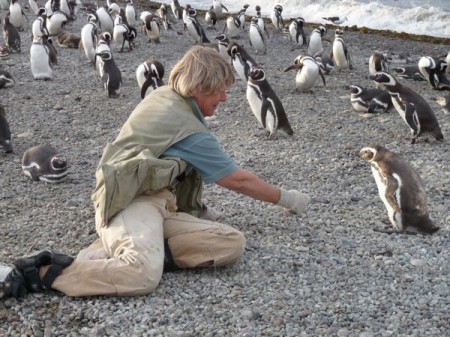
Penguins are more likely to be killed by warmists than by warming:
Tagging penguins with flipper bands harms their chances of survival and breeding, a finding which raises doubts over studies that use these birds as telltales for climate change, biologists said on Wednesday.
More from Anthony Watts.
(No comments during holiday break.)
January 13, 2011
Are these floods really just a warmist's "event"?
Warmists are now claiming they predicted these floods, with The Age - that Bible of the Left - running two we-told-you-so pieces today.
One is from Ian Lowe, head of the Australian Conservation Foundation:
The Queensland floods are another reminder of what climate science has been telling us for 25 years, like the recent long-running drought, the 2009 heatwaves and the dreadful Victorian bushfires. As well as a general warming, increasing sea levels and altered rainfall patterns, climate modellers confidently predicted more frequent extreme events: floods, droughts, heatwaves and severe bushfires.
The other is from young enthusiast Ellen Sandell, head of the Australian Youth Climate Coalition:
Scientists such as Professor Vicky Pope, head of climate change advice at Britain's Met Office, and Dr Kevin Trenberth from the US National Centre for Atmospheric Research have pointed to the evidence showing a warmer world is a wetter world, due to increased water vapour and energy in the atmosphere leading to more frequent and intense storms.
In The Age this week, Professor David Karoly from Melbourne University's school of earth sciences was quoted as saying that the wild weather extremes were in keeping with scientists' forecasts of more flooding and more droughts as a result of high temperatures and more evaporation.
But this self-justification is curious.
First, warmists have insisted for years that the drought - which affected large parts of now-flooded Queensland - was in fact evidence of global warming, and we should expect fewer dam-flling rains:
Example one: Alarmist of the Year Tim Flannery in 2007:
Example 2: Flannery again, in 2007:
We're already seeing the initial impacts and they include a decline in the winter rainfall zone across southern Australia, which is clearly an impact of climate change, but also a decrease in run-off. Although we're getting say a 20 per cent decrease in rainfall in some areas of Australia, that's translating to a 60 per cent decrease in the run-off into the dams and rivers. That's because the soil is warmer because of global warming and the plants are under more stress and therefore using more moisture. So even the rain that falls isn't actually going to fill our dams and our river systems, and that's a real worry for the people in the bush.
Example three, the CSIRO's global warming models in 2007:
5.2.1 Median precipitation change by 2030
Best estimates of annual precipitation change represent little change in the far north and decreases of 2% to 5% elsewhere. Decreases of around 5% prevail in winter and spring, particularly in the south-west where they reach 10%. In summer and autumn decreases are smaller and there are slight increases in the east…
By 2050, under the B1 scenario, the range of annual precipitation change is -15% to +7.5% in central, eastern and northern areas, with a best estimate of little change in the far north grading southwards to a decrease of 5%.
The range of change in southern areas is from a 15% decrease to little change, with best estimate of around a 5% decrease. Under the A1FI scenario changes in precipitation are larger. The range of annual precipitation change is -20% to +10% in central, eastern and northern areas, with a best estimate of little change in the far north grading to around a 7.5% decrease elsewhere.
Example four: Queensland Premier Peter Beattie in 2007:
Given the current uncertainty about the likely impact of climate change on rainfall patterns in (South Eastern Queensland) over coming years, it is only prudent to assume at this stage that lower than usual rainfalls could eventuate.
Example five: warmist scientist David Karoly:
This drought has had a more severe impact than any other drought since at least 1950.... This is the first drought in Australia where the impact of human-induced global warming can be clearly observed.
Example six: Climate Change Minister Penny Wong in September 2008:
There is a great deal of scientific advice about the impact of climate change on rainfall, particularly in southern Australia.
I'll just give you a few examples. We know the IPCC, the Intergovernmental Panel on Climate Change, said by 2050 that Australia should expect around about a 25 per cent reduction in rainfall in the southern part of the Australia.
We also know that in the two years before our election, what we saw were the lowest inflows into the River Murray in history, 43 per cent lower than the previous lows… So there is a very, very sound body of evidence that indicates that climate change is and will have an impact on rainfall in the Murray-Darling Basin and in southern Australia.
As it turns out, almost every big dam in Queensland is now full to overflowing. The drought is gone. Floods have drowned parts of the state for weeks. So how can the warmists still claim to have been vindicated in their predictions and in their theory?
By "events", dear boy.
Yes, say the warmists, we did say global warming will dry up the rains, but it will also cause more extreme weather events that will give us floods in between the longer dries:
Professor Karoly stressed individual events could not be attributed to climate change. However, he said the wild extremes being experienced on the continent were in keeping with scientists' forecasts of more flooding associated with increased heavy rain events and more droughts as a result of high temperatures and more evaporation.
The question then is, are these floods in Queensland caused by a mere extreme weather "event" - most usually described in warmist literature as a storm, heatwave, sudden flood or hurricane. Yes, that definition is also often mischievously stretched to include longer-term droughts, but Isn't an "event" in fact something that is out of the ordinary, temporary, short term?
The problem for the warmists is that these floods are severe because the rains have fallen for so very long, saturating the soil and filling the dams, meaning that the rain from any fresh cloudburst just feeds straight into the flood waters. The amazing downpour that triggered the deadly Toowoomba floods may well be described as an "event", but is that really the way to describe the heavy, almost ceaseless rains that have fallen on the rest of Queensland for many weeks, inundating so much of it?
Indeed, the heavy rains that ended the drought in eastern Australia aren't just a fleeting "event" but a phenomenon of many months - and nor are they unprecedented:
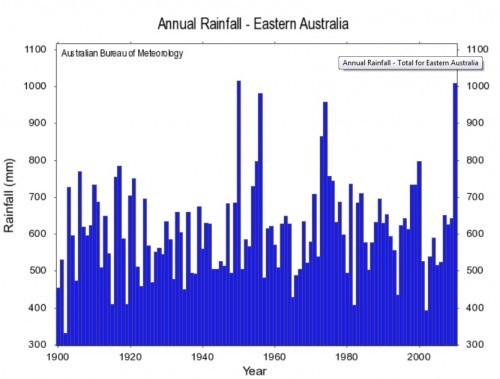
(Incidentally, does that rainfall record above indicate reveal any recent trend that seems to you evidence of "climate change"?)
When warmists start describing these rains which they didn't predict as the "extreme events" which they actually did, we see how a trick of language or definitions makes their theory unfalsifiable. "Extreme events" becomes the label that's stuck on anything that doesn't fit with what was predicted, to make it the exception that was predicted. And so no matter what happens, the warmist is always right.
How prepared was the Wivenhoe dam for this flood?
Yesterday's Courier Mail suggested that the Wivenhoe dam, built in part to protect Brisbane from flooding, had been overwhelmed by the sheer volume of water:
Water releases from Wivenhoe Dam have been reduced from an overnight peak of 645,000 megalitres to 205,000 megalitres per day.
As at 9pm Wednesday Wivenhoe Dam was at 189 per cent, down from 191 per cent overnight, while Somerset Dam was down from 190 per cent to 186 per cent…
Wivenhoe Dam levels dropped just 1 per cent overnight, reflecting the massive volumes of water flowing into the storage from its 7020 sq km catchment.
It also is taking major flows from Somerset Dam, whose Stanley River is in flood. Somerset Dam is at 190 per cent....
"Controlled releases must continue ... to relieve Wivenhoe Dam's swollen flood storage compartment in order to create space for further rainfall and inflows," a spokesman said.
On the morning of 12th January, the day before the flood peak that inundated the Brisbane CBD and much of Ipswich, Brian Williams of Brisbane's Courier Mail, in a masterpiece of misreporting by omission, reported that releases from Wivenhoe Dam were to be reduced from an overnight peak of 645,000 megalitres/day to 205,000 ML/day with the stated aim of "allowing the Bremer River and Lockyer River to subside, thereby easing floods on Brisbane downstream."
Regionalstates Blog has questions:
"Wivenhoe Dam levels had dropped just 1 per cent from the previous night, reflecting the massive volumes of water flowing into the storage from its 7020 km2 catchment." That 1% drop was from a dam capacity of 191% and is an oblique way of saying that the massive flood surge buffer had been pushed close to its limits and they now had no choice but to dump the same amount of water that was flowing into the dam.
What wasn't mentioned was the fact that for more than a week prior to this large release, only 170,000 ML/day was being released as the storage capacity was allowed to rise to 191% from two weeks of heavy rains. And this meant the carefully designed flood buffer, having been taken to its limits, could no longer function as a buffer. The city was entirely at the mercy of the elements and it would only have taken another 37mm of rain in the catchment to hit the limits.
And as it takes 36 hours for water to flow from Wivenhoe to the CBD then it is absolutely clear that the flood peak of Wednesday night and Thursday morning was a direct result of the previous night's forced release of the total inflow from the catchment. And this was only necessary because SEQ Water had spent two weeks releasing much less water than was being captured, into a river that was still well below minor flood level.
(Thanks to reader John McLean. No comments during holiday break.)
UPDATE
Others are asking the same questions, according to The Australian:
Senior engineering and hydrological sources, not authorised to comment on the record, told The Australian that investigations need to be conducted into the operations of Wivenhoe Dam, which had been forced to release massive volumes of water to reduce the risk of a catastrophic collapse.
They said there needed to be a thorough questioning of whether the decision to store as much water as possible leading into the wet season, and the subsequent sudden release of water, had contributed to flooding in Brisbane, and whether flooding could instead have been minimised.
Bligh shines
I agree that Bligh has been excellent in her response to this crisis:
The Brisbane floods are the defining moment of Anna Bligh's premiership. Her polling was at record lows before the rain hit, but when the water subsides, she will have gained some credibility in this "new paradigm" of politics where our elected officials try to please all the people all the time while doing, and feeling, not much most of the time.
After being criticised for briefly returning to her family holidays in Sydney while parts of Queensland were in flood, and then having to take a helicopter view of the damage in several disparate centres, Ms Bligh took control as the southeast was besieged by water this week.
During long days of briefings and media engagements, she was compassionate and resolute, giving reliable information to an anxious public. She did this even as her own electorate was inundated, her mother evacuated to her Highgate Hill home, taking refuge with the Premier's husband and children, and as experts struggled to provide reliable modelling.
He has ways to make you helped
Kevin Rudd helps out:
GEARIN: The cameras captured you today meeting a man who didn't want to leave his house, and he was a veteran of the 1974 floods. Did you come across that a lot, and are you concerned for those people?
Rudd: Yeah, they kind of make you want to pull your hair out sometimes [laughs]. They've got water levels rising and you're having a Socratic dialogue with somebody about why they should be moving out. I mean, strewth. Anyway, I put the coppers on to him, so we'll see what happens.
The Leftist case for a dam, after all
Opposition to dams is being washed away. Leftist Barry York says it's those Greens, not the Left, who actually have an ideological objection to them:
The Green policy is expressed at their website as a principle: "There should be no new large-scale dams on Australian rivers."…
To the Green mentality and ethos, changing nature is destroying nature, dams are an assault on the "delicate balance" in nature, an example of human arrogance going too far…
It is indicative of our strange times that opposition to dams, as a matter of principle, can be seen as left-wing.
What is the traditional practice of left-wing parties in power on this question? What is the left-wing theoretical foundation for a policy on dams?
In practice, revolutionary left-wing parties in power - such as the communists in Russia/Soviet Union in the 20s and 30s and China in the 50s and 60s - were gung-ho in the building of dams.
They did so because making a revolution is about changing things for the better, raising the standards of living and opportunities for liberation from wage slavery.
To borrow from Karl Marx, it's about "unleashing the productive forces" - not forcing them into a sustainable relationship with nature…
In chapter one of The Communist Manifesto, Marx expressed his enthusiasm for the revolutionary consequences of the rise of the new bourgeoisie in transforming nature and extending human horizons.
He said: "It has been the first to show what man's activity can bring about. It has accomplished wonders far surpassing Egyptian pyramids, Roman aqueducts and Gothic cathedrals; it has conducted expeditions that put in the shade all former Exoduses of nations and crusades."
It is unlikely that he would not have been as awe-inspired by the wonders of large-scale dam construction and the range of benefits on such a vast scale arising from dams...
York should try telling the Gillard Government that Leftists likes dams:
Federal Environment Minister Peter Garrett on Wednesday said he made the interim decision to reject the controversial $1.8 billion plan to dam the Mary River because evidence showed it could kill off endangered species…
"The project would have serious and irreversible effects on national listed species such as the Australian lungfish, the Mary River turtle and the Mary River cod - both of those endangered.
York should try telling the Victorian Labor party that Leftists like dams.
Here's the Bracks Government's excuse for not building a dam in Victoria:
Here is the revised excuse of the Brumby Government:
Look at its latest excuse for not building the dam that would have spared Melbourne its insane - and insanely expensive - water restrictions.
"Why aren't we building another dam?" it burbles, shamed at last into defending its Labor masters' failure to build what we needed years ago.
"Unfortunately, we cannot rely on this kind of rainfall like we used to."
Result? Labor banned a proposed dam on the Mitchell River, turning the dam reservation there into a national park.
The Mitchell promptly flooded (in 2007), washing through Bairnsdale and sending more water to waste in the sea than Melbourne uses in a year.
Instead of a building a huge dam for $1.4 billion, the Government instead commissioned a desalination plant for $5.7 billion, even though it would produce just a third of the water.
(No comments during holiday break.)
Assange fears Obama is a killer
Which, of course, means the WikiLeaks chief drama queen, Julian Assange, thinks even Barack Obama might be plotting to kill him:
Julian Assange, the founder of WikiLeaks, could be at "real risk" of the death penalty or detention in Guantánamo Bay if he is extradited to Sweden on accusations of rape and sexual assault, his lawyers claim. In a skeleton summary of their defence against attempts by the Swedish director of public prosecutions to extradite him, Assange's legal team argue that there is a similar likelihood that the US would subsequently seek his extradition "and/or illegal rendition", "where there will be a real risk of him being detained at Guantánamo Bay or elsewhere".
"Indeed, if Assange were rendered to the USA, without assurances that the death penalty would not be carried out, there is a real risk that he could be made subject to the death penalty..."
Or is my boss out to kill Assange? It's so confusing to keep up in Assange's plot-world:
WikiLeaks chief Julian Assange revealed that he has damaging "insurance files" on Rupert Murdoch and his News Corp media empire that he will release if something happens to him or to WikiLeaks.
Oh, by the way, why is Assange entitled to keep some files secret for self-protection but the US not?
Bob Brown is against corporate donations to any party but his own
BOB BROWN ON POLITICAL DONATIONS – 'A CANCER THAT MUST BE CUT OUT'
"There is a stench rising from the whole electoral donations system in Australia. We don't want this to go the way of America and need to stop it now."
(Bob Brown, Press Release, 2 February 2001)
"Australia should seize the moment and ban donations. It is an absolute blight on democracy."
(Bob Brown, The Bulletin, 19 October 2004)
The Greens support a ban on all private donations. "As a matter of democratic principle, elections should give voters fair access to all parties' policies, and public funding is the most even-handed way to ensure this outcome," Senator Bob Brown said.
(The Sydney Morning Herald, 3 February 2009)
"There is a growing wave of corporate largesse that is eating at the fabric of our democracy."
(Bob Brown, Press Release, 14 April 2000)
"Democracy is being eroded by money. The ideal of one person, one vote, one value is eroding under the monetarist epithet that influence is there to be bought. Your power is directly proportional to your purse, and if you are out of the power circle your powerlessness is proportional to your poverty. All democracies in this age of materialism face the same degradation of the pivotal democratic ideal of equality."
(Bob Brown, The Sydney Morning Herald, 14 August 2009)
"The Australian Greens say ending all large political donations would make a tremendous contribution to stamping out corporate influence in politics."
(Bob Brown, Press Release, 30 July 2009)
"Donations should only be allowed from individuals and only up to a limit of $1000."
(Bob Brown, Press Release, 30 July 2009)
"We should, like Canada, put an end to cheque book democracy."
(Bob Brown, Press Release, 1 February 2006)
"I challenge corporate Australia and the big political parties to clean up the system by establishing a Democracy Trust Fund through which corporate donations can be channelled and distributed to all parties and independents in proportion to their vote at elections."
(Bob Brown, Press Release, 1 February 2000)
"This is insidious, it's corrupting, it should be stopped."
(Bob Brown, Lateline, 16 June 2006)
"They (the Coalition and Senator Fielding) voted against fair democratic reform aimed at reducing the influence of wealthy donors. It corrupts politics."
(Bob Brown, The Canberra Times, 12 March 2009)
THE GREENS RECEIVE THE LARGEST SINGLE POLITICAL DONATION IN AUSTRALIAN HISTORY
THE Australian Greens' campaign at the last federal election was largely bankrolled by a businessman, the wotif.com founder Graeme Wood, who made the largest single political donation in Australian history. Mr Wood, whose wealth was estimated at $372 million in last year's BRW Rich 200 list, gave $1.6 million to fund the Greens' TV advertising campaign, helping to significantly increase votes for the party in key states.
(The Sydney Morning Herald, 8 January 2011)
BROWN DEFENDS DONATIONS TO THE GREENS
"We're in the real world . . . so, yes, we do accept donations from individuals, from small businesses, from the union sector."
(Bob Brown, The Age, 19 August 2010)
Senator Brown said he would be "forever grateful" for Mr Wood's donation, which was both selfless and hazardous.
(The Sydney Morning Herald, 8 January 2011)
Small mercy - not as bad as 1974, after all
The devastation could have been even worse:
THE heart of Brisbane won a reprieve this morning, with floodwaters peaking well below expected levels…
The Brisbane City Council in an alert at 5am, said the river was expected to get to about 4.6m, with estimates of 15,268 residential and commercial properties being affected by significant flooding at that level.
The peak well below the 1974 flood level spared numerous homes and high-rise apartment buildings from flooding.
There will be plenty to discuss once the immediate emergency is over, such as the failure to predict this flood, the failure to predict its likelihood, the failure to build dams to mitigate the flooding, and the failure to properly warn residents.
And add this:
A SECRET report by scientific and engineering experts warned of significantly greater risks of vast destruction from Brisbane River flooding - and raised grave concerns with the Queensland government and the city's council a decade ago.
But the recommendations in the report for radical changes in planning strategy, emergency plans and transparency about the true flood levels for Brisbane were rejected and the report was covered up.
The comprehensive 1999 Brisbane River Flood Study made alarming findings about predicted devastation to tens of thousands of flood-prone properties, which were given the green light for residential development since the 1974 flood. The engineers and hydrologists involved in the study warned that the next major flood in Brisbane would be between 1m and 2m higher than anticipated by the Brisbane town plan.
The study highlighted how the council had permitted the development of thousands of properties whose owners were led to believe they would be out of harm's way in a flood on the scale of 1974.
UPDATE
Another problem to discuss:
With some mobile telecommunication services in Queensland currently under siege and mains power shut off to thousands, an expert has warned that basic fixed phone services could have been cut off if the National Broadband Network Company (NBN Co) had deployed the network with its current battery backup technology.
"The Telstra copper network was built to be bulletproof," said Dermot Cox, network professional and networks sales leader at Consulter.
"[In the case of the NBN], if the power goes out and you have battery backup for your fibre-to-the-home (FTTH) service, [basic wired telephony devices] will continue to operate while there is battery charged," he said.
Once the Network Termination Unit (NTU) battery runs out of charge, however, users would be left without access to basic telecommunications services, a potential safety concern for those in the community who require round-the-clock service in the case of emergency.
UPDATE 2
Why was there not more planning to prevent or cope with these floods, other than the building of the Wivenhoe, when the CSIRO report into the (higher) 1974 ones in Brisbane predicted even worse to come:
However,four floods well in excess of the 1974 levels have occurred in the past 133 years and, according to the Professor of Economic Geology at the University of Queensland (Professor Sergent), there is geological evidence of water levels 5.5 m higher than the 1974 flood in the Indooroopilly area of Brisbane. Meteorological studies suggest that rainfalls well in excess of those recorded in the floods of 1893 and 1974 are possible.
Meteorological studies suggest that rainfalls well in excess of those recorded in the floods of 1893 and 1974 are possible. Therefore it seems certain that unless major flood mitigation schemes, such as the proposed Wivenhoe Dam, are implemented, floods even greater than those of 1974 will again be experienced in Brisbane.
UPDATE 3
Reader Brook has an excellent question:
I'd like someone to explain why, if the Wivenhoe is designed for flood mitigation, was it allowed to stay above 93% for over 9 months, and over 100% for more than 3 months?
Same from reader John:
Question,, how could anyone plan to go into the traditional wet season with the main flood mitigation dam "FULL".
UPDATE 4
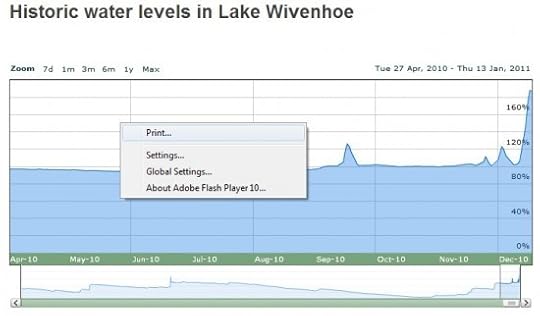
Even at 100 per cent full, the Wivenhoe has saved Brisbane from worse flooding, because of its flooding "shock absorber":
During a flood situation, Wivenhoe Dam is designed to hold back a further 1.45 million megalitres as well as its normal storage capacity of 1.15 million megalitres. Floods may still occur in the Ipswich and Brisbane areas but they will be rarer in occurrence…
It is anticipated that during a large flood similar in magnitude to that experienced in 1974, by using mitigation facility within Wivenhoe Dam, flood levels will be reduced downstream by an estimated 2 metres.
Full supply level or 100 percent capacity (in the water level analysis) is indicative of the optimum level intended for town water supply, and does not take flood mitigation levels into account.
The problem is that the "shock absorber" can't take much more:
Water releases from Wivenhoe Dam have been reduced from an overnight peak of 645,000 megalitres to 205,000 megalitres per day.
As at 9pm Wednesday Wivenhoe Dam was at 189 per cent, down from 191 per cent overnight, while Somerset Dam was down from 190 per cent to 186 per cent…
Wivenhoe Dam levels dropped just 1 per cent overnight, reflecting the massive volumes of water flowing into the storage from its 7020 sq km catchment.
It also is taking major flows from Somerset Dam, whose Stanley River is in flood. Somerset Dam is at 190 per cent....
"Controlled releases must continue ... to relieve Wivenhoe Dam's swollen flood storage compartment in order to create space for further rainfall and inflows," a spokesman said.
(Thanks to readers Victoria 3220 and Peter.)
Andrew Bolt's Blog

- Andrew Bolt's profile
- 5 followers

