
Andrew Bolt's Blog, page 1902
January 16, 2011
The Reichstag fire of the Left
A madman angry about bad grammar and "conscience dreaming" shoots 19 people, which is all the excuse Guardian columnist Simon Jenkins need to demand more curbs on free speech - especially on the speech of those who don't share his Leftist ideology:
Today's culprit is freedom of speech, or at least the speech of the American right and its broadcast cheerleaders. Shock-jock radio presenters feed on biased television news to present a view of the world divided between goodies and baddies. The baddies are always on the brink of victory and must be confronted with virile aggression. Language that might not disturb a balanced mind can clearly stimulate and legitimise an unbalanced one... Free speech cannot exist without chains.
(No comments during break.)


Where's the GG been?
I'm sure the Governor General had pressing business to attend to in the nine days between her two trips to the flooded areas, but her engagements page doesn't list them:
6 January 2011
Visit to the flood-affected towns of Alpha, Jericho and Emerald, Queensland…
7 January 2011
Visit to the flood-affected towns of Condamine and Chinchilla, Queensland…
MEDIA ADVISORY: GOVERNOR-GENERAL TO VISIT FLOOD AFFECTED IPSWICH AND GRANTHAM
In their second visit to flood affected areas of Queensland, the Governor-General, Ms Quentin Bryce AC and Mr Michael Bryce AM AE will visit Ipswich and Grantham to meet local people and volunteers assisting with the recovery effort this Sunday, 16th January 2011.
Google News can't fill in the blanks, either.
The real Julia is needed

Niki Savva:
Comparisons have already been made between Gillard's performance during the floods and John Howard's handling of the Port Arthur massacre and its aftermath.
(No comments during break.)
UPDATE
Other commentators are also complaining about the voice, the hand movements, the lack of passion....
If not this, then something to save Brisbane from the next flood
We cannot have a major city at risk of drowning:
FEDERAL Regional Affairs Minister Simon Crean has called for the construction of flood levees along the Brisbane River to be considered.
If not this, then something to saved Brisbane from the next flood
We cannot have a major city drowned at risk of drowning:
FEDERAL Regional Affairs Minister Simon Crean has called for the construction of flood levees along the Brisbane River to be considered.
But never too soon for Brown to blame a coal miner for the floods
Greens leader Bob Brown thought it was too soon to (correctly) blame soft boat people laws for luring people to their deaths:
Andrew Bolt's call, while bodies were still in the ocean, for Julia Gillard's resignation ... lacked human decency. He should resign.
But Brown did not think it too soon, when the fires were still burning, to blame global warming for the deadly Black Saturday fires in Victoria last year:
Greens leader Bob Brown says bushfires like the ones raging across Victoria and New South Wales this weekend will be more frequent if climate change continues…
"Global warming is predicted to make this sort of event happen 25 per cent, 50 per cent more," he told Sky News. "It's a sobering reminder of the need for this nation and the whole world to act and put at a priority our need to tackle climate change."
And he does not think it now too soon, with bodies still being recovered, to blame coal miners for the Queensland floods, either:
Senator Brown says the coal-mining industry should foot the bill for the Queensland reconstruction efforts, claiming their operations are partly responsible for the floods.
Bob Brown is a hypocrite as well as a fool.
(Thanks to readers Peter, Owen, Simon, Kevin, Anton, John McLean and astonished others.)
UPDATE
Four years ago, Bob Brown claimed global warming could give us a "permanent drought":
From melting polar ice to the spectre of permanent drought in previously productive farmlands, the report makes clear that climate change is not just a future threat, it is damaging Australia now.
He was also warning of possibly no water at all in the Murray-Darling system:
Already, (Ross Garnaut's) daunting data of a 10 per cent chance of no flow at all in the Murray–Darling river system in future years is being overtaken by data indicating that drought is the new norm across Australia's greatest food bowl.
But when drought is replaced by floods, and rivers meant to be empty are overflowing, well, global warming caused that, too.
(Thanks to reader Simon.)
Why was the Wivenboe too full to save Brisbane?
More evidence that the Wivenhoe dam may have been too full to properly protect Brisbane during a La Nina:
MORE serious questions about Wivenhoe Dam were raised yesterday by a senior engineer who claims the Brisbane River flooding was avoidable.
The engineer, Michael O'Brien, said the official data on water flows shows last week's Brisbane River flooding would have been largely avoided if the dam operators had raised their releases of water on the weekend before last Monday's deluge.
Mr O'Brien, and others not directly involved with the dam's operation, told The Australian that the river flood and the devastation of thousands of homes was inevitable after a decision to release relatively low volumes of water on Friday, January 7, and over the ensuing weekend.
The data shows that the dam went from a little over 100 per cent of its capacity on Friday, January 7, meaning it still had capacity for more than one million megalitres in its flood compartment, to about 150 per cent by the morning of Monday, January 10 - before the deluge hit.
Over that weekend and prior to the extreme rainfall event that would flood Toowoomba and the Lockyer Valley on Monday, the dam's operators released a total of about 200,000 megalitres.
Scrutiny of official water-release and dam volume data shows the flood would have been moderate at worst in Brisbane had there been larger releases in the days before the deluge. But it became extreme due to the sudden surge from the release of about 645,000 megalitres from Wivenhoe last Tuesday, which was about 30 per cent of the total capacity of a dam built to protect the city and surrounding suburbs.
This sudden release came because the in-flow of water from the dam's catchment meant its reservoir had risen to alarming levels of about 190 per cent and were closing in on the level that triggers an uncontrolled discharge....But a more conservative approach over that crucial weekend would not have made any difference to the flooding that occurred in the Lockyer Valley and the city of Ipswich, both of which are in separate areas of the Brisbane River catchment.
SEQWater Grid chief executive Barry Dennien insisted last night that although the January 8-9 releases were relatively low compared with what occurred in the days afterwards, this was in accordance with the operating manual to mitigate flooding. He said that nobody had foreseen the extreme rainfall that ensued.
O'Brien's report concludes:
Hindsight is a wonderful thing; but there are really two decisions that were taken which would seem to have little justification at the time they were made. These are: -
o Not increasing releases from Wivenhoe between the 4th and the 10th when the dam levels were rising and there was no downstream flooding, and
o The decision to substantially increase the discharge rate from Wivenhoe to a peak of 645,000ML/d on the afternoon/night Tue 11th.
It is difficult to understand the justification for this increase in the discharge rate, especially as the decision was substantially reversed within about 12 hrs. In addition even if SEQWater had released at the low rate of 215,000ML/d (which is the rate it was reduced to at 07:30 Wed) rather than a maximum rate of 645,000ML/d for the whole time from 14:57 on Tues it would have used only 306,000ML of the available free capacity in both dams of apparently 859,000ML.
Read on for O'Brien's excellent report, giving discharge rates and times:
What went on in Brisbane?
Was this a natural disaster or a manmade disaster?
First a bit of a disclaimer – I am new to some of this river data and may not have interpreted it all
correctly.
First a bit of background: -• Somerset Dam has a Water Storage capacity of 379,849ML with an additional 524,000ML for
flood storage. The dam is rated as 100% full when all the water storage capacity is full.
Therefore when both the water storage capacity and flood storage are fully utilised, the dam
would be at 238%.
• Wivenhoe has a Water Storage capacity of 1,165,238ML with an additional 1,450,000ML for
flood storage. Similarly when both the water storage capacity and flood storage are fully
utilised, the dam would be at 224%.
• Somerset is upstream of Wivenhoe and flood flows from Somerset are discharged into
Wivenhoe.
• There is a river height monitor at Wivenhoe Dam: -Station Number: 540177 Name: Brisbane
R at Wivenhoe Dam Hw # Owner: SEQWCO:143822
SEQWater operate a web site which gives levels in all dams, including Somerset and Wivenhoe;
but interestingly, levels for Wivenhoe and Somerset were not updated between 08:00 11th
January and 09:00 13th January during the peak of the emergency. Historical data now
shown for this period on the SEQWater web site does not show any peak during this period and so
are obviously incorrect.
I have therefore used the Wivenhoe Dam river height monitor as a proxy for the dam level during
this period. There are some interesting disconnects between the river level data and the reported
water levels in Wivenhoe: -
Information from media reports had Wivenhoe at a peak of 191% overnight for the night of
11th/12th; but generally at 190% through most of the emergency period.
The river height shows a height of 73.77m at the time SEQWater were reporting a Wivenhoe
capacity of 175.9%. The river experienced a minor peak of 74.51m commencing at 14:57m
Tue 11th falling substantially (to 74.19m around 17:45 Tue 11th) until peaking again at
74.85m between 18:00 and 19:23 on Wed 12th (compared to a reported peak in Wivenhoe
during the night of 11th/12th). The river level fell gradually, and has continued to fall, from
this peak.
The sequence of events for the current flooding event seems to be: -
• 06:30 Tue 04th, Wivenhoe first went above 100% (i.e. using the flood storage capacity).
• Wivenhoe was at 106.3% at 06:00 on Fri 7th; but there are no reported heights for Sat 8th or
Sun 9th.
• Wivenhoe continued to rise, and at 09:00 on Mon 10th it was at 148.4% and it was reported
that "managers scrambled to increase the release from 116,000ML to 170,000ML per day.
• At 0800/0900 Tue 11th Wivenhoe was at 175.9%, Somerset at 160.8%; total available
capacity for flood storage in both dams stood at 858,642ML. This is the last available data
from SEQWater. At this stage the River height at the dam was 73.77m.
• The river (and by assumption the Wivenhoe dam) continued to rise over the next six hours
and reached an interim peak of 74.51m at 14:57 Tue 11th.
• At this time the river level started to fall quickly to 74.19m around 17:45 Tue 11th
• Media reports indicate that the discharge from Wivenhoe was increased from 344,00ML/d
through 490,000ML/d (both reported by the Courier Mail) to an overnight peak of
645,000ML/d (reported in a media release by the Queensland Police Service).
• SEQWater reported that at 0730 on Wed 12th the releases from Wivenhoe were reduced
temporarily to 215,000ML/d to allow Lockyer Creek peak to enter Brisbane River and would
subsequently be increased to maintain a maximum flow through Moggill of 301,000ML/d.
Some additional data: -
• SEQWater report that there is a delay of approximately 36 hours between a release at
Wivenhoe and a peak at the Brisbane City Gauge.
• It is likely that the rapid drop in the river level at Wivenhoe commencing around 14:57 Tue
11th was due to a substantial increase in the discharge rate from Wivenhoe (645,000ML/d?).
• At around the same time, 16:03 on Tue 11th the Courier Mail reported that Wivenhoe was at
190% and Somerset at 176%, indicating a total capacity for additional flood storage of
636,000ML.
• 36 hours from 14:57 Tue 11th is 02:57 Thu 13th which corresponds almost identically with the
peak of 4.46m experienced at the Brisbane City Gauge.
Now for an attempt at interpretation of this sequence: -
• SEQWater were very slow to respond to the initial increase in levels at Wivenhoe and took 6
days before there was any real increase in rate of release from Wivenhoe to return the dam
to proper flood management levels. Even though there is apparently a legislated
requirement to manage this over 7 days.
• SEQWater then substantially over responded during the afternoon of Tue 11th increasing the
discharge to 645,000ML/d(?). This was at a much higher rate than the current water inflows,
resulting in a substantial drop in the level in Wivenhoe. This was even though there was
approximately 636,000ML of capacity available for additional flood storage in Wivenhoe and
Somerset.
• This substantial increase in the discharge from Wivenhoe was the cause (sole cause?) of the
peak in the Brisbane River.
• Early on Wed 12th (07:30), SEQWater recognised that this discharge rate was excessive and
reduced it substantially to 215,000ML/d. This discharge rate has been sufficient to ensure
that the river level at Wivenhoe (and presumably the dam) did not continue to increase and
indeed has allowed the level to gradually fall.
• Hindsight is a wonderful thing; but there are really two decisions that were taken which
would seem to have little justification at the time they were made. These are: -
o Not increasing releases from Wivenhoe between the 4th and the 10th when the dam
levels were rising and there was no downstream flooding, and
o The decision to substantially increase the discharge rate from Wivenhoe to a peak of
645,000ML/d on the afternoon/night Tue 11th.
• It is difficult to understand the justification for this increase in the discharge rate, especially
as the decision was substantially reversed within about 12 hrs. In addition even if SEQWater
had released at the low rate of 215,000ML/d (which is the rate it was reduced to at 07:30
Wed) rather than a maximum rate of 645,000ML/d for the whole time from 14:57 on Tues it
would have used only 306,000ML of the available free capacity in both dams of apparently
859,000ML.
The serious questions are: -
• Why did SEQWater not allow the total available flood storage capacity of Wivenhoe to be
utilised during this period?
• What justification was there for the substantial increase in discharge from Wivenhoe to
645,000ML/d when a release rate of 215,000ML/d has been demonstrably sufficient to stop
the levels in Wivenhoe rising and while there remained substantial capacity in Wivenhoe for
additional flood storage?
• Was this increase to 645,000ML/d the sole reason for the significant flooding in Brisbane?
• Why did it initially take SEQWater 6 days to respond to the gradually increasing water levels
in Wivenhoe which reduced its flood control capacity?
January 15, 2011
Back for a bit
I'll be back at 8am weekdays on MTR 1377 from tomorrow. Listen here.
My column in the News Ltd papers will resume next week. Comments on the blog will probably resume then, too.
Not alone
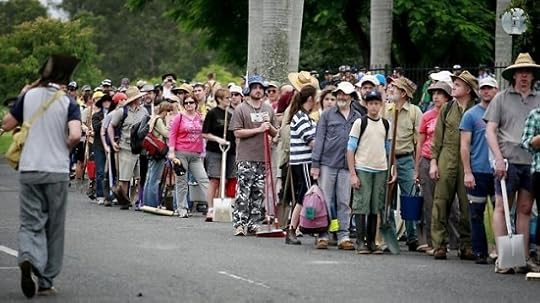
Brilliant:
IT will go down in folklore as Salvation Saturday.
It was the day an army of big-hearted volunteers shouldering brooms, mops and shovels began digging and sweeping Brisbane out of the mud.
In a remarkable display of community spirit, more than 20,000 signed on for duty, ready to bend their backs to help fellow residents reclaim their homes and waterlogged possessions from the stinking sludge left behind by the worst floods in a generation.
UPDATE
Now Victoria's turn:
TWO Victorian towns have been cut off and many more are in danger of being isolated after raging flood waters swamped the state…
Rochester, in Victoria's north, and Charlton, in the state's northwest, were hit by the worst of the disaster but up to a third of the state has been affected.
Fears are also held for Horsham, Echuca, Dadswells Bridge and Glenorchy with flood levels not expected to peak in many areas until this afternoon and, in some cases, as late as Wednesday.
More than 1000 properties were under water in the state's north and west last night, but more than 1200 homes were expected to be inundated by this morning.
About 300 houses were affected in Victoria's floods last September.
Andrew Bolt's Blog

- Andrew Bolt's profile
- 5 followers

