
Andrew Bolt's Blog, page 1899
January 19, 2011
Everyone but Gillard should be grateful to Oprah
Poor Julia Gillard really cannot take a trick. She sacrificed her dignity to capitalise on the publicity that would come from welcoming Oprah Winfrey to Melbourne.
As former Treasurer Peter Costello said at the time:
Julia Gillard is the Prime Minister of Australia. She is the person ultimately responsible for sending troops into battle. She is the one who must stand up and insist our country is treated with respect in international forums. She is not a support act for a visiting US celebrity. She didn't do well. In fact, it was cringe-making.
It also didn't work. Gillard's stilited appearance in the first of the four specials on Australia that Oprah screened yesterday confirmed the Prime Minister has shrunk under the responsibilities of her office. Worse, as every Australian watching would have noted but Channel 10 was too polite to show, Oprah repeatedly got her name wrong, pronouncing it as Gil-LARD, as if she were French.
But the rest of Australia should be pleased. The country looked spectacular, and the enthusiasm of Oprah and her nice audience seemed very genuine.
The one criticism I'd have is the misrepresentation of our history by Malarndirri McCarthy, a NT Labor Government Minister shown telling Oprah that Aborigines weren't counted as citizens of Australia until 1968, which Oprah seems to believe meant they weren't actually citizens then:
In fact, Aborigines have been considered citizens from the start of British colonisation. The difference in 1968 was that the referendum the year before had changed the Constitution to oblige the census to count our Aboriginal population.
In most states of Australia, Aborigines have had the right to vote for some 150 years.


The man who saved Warracknabeal
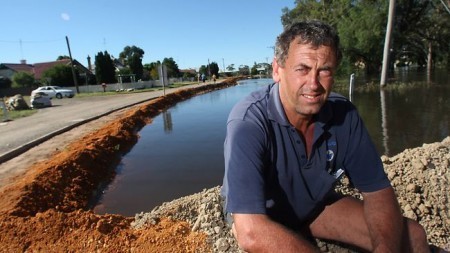
There are some who shout for help, and there are others who just up and organise it themselves. In Victoria's Warracknabeal:
He provided the equipment and co-ordinated dozens of locals who toiled for three days, fending off swarms of mosquitoes as they built the 1m levee with bulldozers and shovels.
Yarriamback Creek peaked about 10.45am but the levee and 55,000 sandbags kept the water away from 170 homes under threat.
Alan Tickner said his house would be underwater if it wasn't for the levee.
"If it wasn't for Richie Wilken, I'd hate to think what position the town would be in," he said.
"None of this would have been done if it wasn't for him. He's saving the town."
A very country kind of thing.
Not criticising, just noting - and not saying
Legal reasons forbid me from mentioning what may be an advantage in the receiving of high honours:
Who will emerge as Australian of the Year 2011? The finalists are:
- Professor Larissa Behrendt, indigenous rights lawyer (NSW)
- Simon McKeon, businessman and former director of World Vision (Victoria)
- Associate professor Noel Hayman, indigenous doctor (Queensland)
- Malcolm McCusker QC, philanthropic barrister (WA)
- Professor Tanya Monro, physicist (SA)
- Deborah De Williams, breast cancer campaigner (Tas)
- Professor Ian Chubb, vice-chancellor of the Australian National University (ACT)
- Professor Michael Christie, indigenous language expert (NT)
What I can say is that. not being a businessman or soldier helps.
Did warmists convince the Wivenhoe dam operators to leave it too full?
Again, it's worth asking whether the Wivenhoe dam was left too full because its operators believed warmist predictions of less rain, rather than this more:
BRISBANE City Council's top flood engineer recommended a decade ago that Wivenhoe Dam be operated differently to ensure a much larger buffer against flooding, documents obtained under Freedom of Information show.
Engineer Ken Morris warned in an internal report, Brisbane River Flooding, that the existing and longstanding Queensland government policy of operating the dam at full supply level meant its capacity to mitigate floods was significantly compromised.
Mr Morris, the council's principal engineer for flood management, also warned a decade ago that the council's development controls meant thousands of residents were unaware they would be severely hit by floods during rainfall events that were much smaller than those predicted to occur once in 100 years, despite assurances that their properties would not be affected.
If warming caused these floods, why didn't warmists predict them?
A word to the global warming extremists who now claim that these floods in south-eastern Queensland are proof of man-made warming.
Two years ago Queensland's warmist Office of Climate Change issued this report on what the state should expect from global warming, and not once did it mention floods. It did predict a slight increase in "extreme" weather events in the north, but not in the south of the state where the worst floods have occurred. Elsewhere it has warned of a slight increase in rainfall during extreme events, but overall it predicted less rain, and not these months of more.
Some excerpts:
A significant decline in the frequency of extreme rainfall events has been observed along Australia's east coast. However, the proportion of total rain falling as extreme events has increased slightly. While these trends are due in part to the natural variability of the global climate system, in particular the fluctuations in the frequency of El Niño and La Niña events, anthropogenic influences are also contributing factors…
As a result of global warming, droughts in Australia are likely to be more severe— not only due to rising temperature, but also due to increased evaporation…
Rainfall has decreased across large areas of Queensland ... Rainfall is projected to decline up to 10 per cent by 2050 under the influence of climate change…
In addition to projected changes to the average rainfall over time, the frequency of wet days will decrease and the frequency of dry days will increase… In the north of the state, extreme rainfall events are projected to increase in all seasons, with the
largest increase in the far north in autumn (six per cent increase). Along the southern Queensland coast, the projected changes in extreme precipitation are small ...
Report: "drought" mentioned 24 times…
Report: "flood" mentioned zero times.
You have to wonder, if the possibility of a flood didn't even get a mention in the official Queensland government's climate change report, how much preparation did they put in to preparing for one?
And, of course, after issuing a report warning repeatedly that global warming would give Queensland more and longer droughts, the heavens promptly opened and gave Queensland two years of good rain, including one of too much:
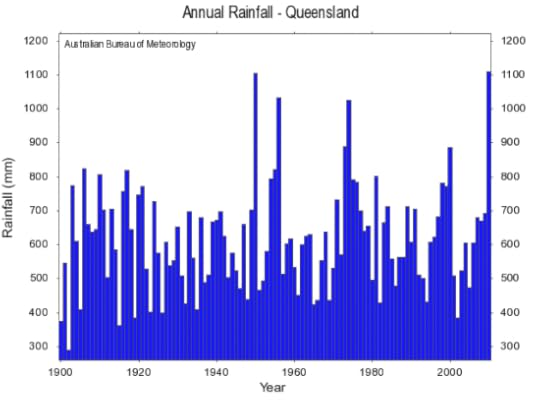
Incidentally, can you detect in that graphic any evidence at all that man's rising emissions have caused the climate to shift?
(Thanks to reader Steve.)
Why couldn't the Bureau predict what private forecasters could?
More than two hours before an "inland tsunami" smashed into Grantham, private weather forecaster Anthony Cornelius posted this warning on Weatherzone:
Concerning for the Gatton-Grantham area right now with very large storm/rain area moving towards it with no doubt, torrential rainfall...I hope they're prepared for it, but sadly I think most won't know until the water starts lapping up at their homes due to our insufficient warning system.
Only four hours later, after Grantham had been submerged and lives lost, did the Bureau of Meteorology issue its own warning.
I repeat: we need to know if more could have been done to prevent this tragedy.
(Thanks to reader Glenis.)
MTR today, January 18
- Victorian Governor David de Kretser abuses his office - and distorts the science - by preaching that the floods are evidence of man-made warming.
- How will we pay for the damage? I doubt Julia Gillard can meet her most solemn promise to return the Budget to surplus by 2013. (Not so, Finance Minister Penny Wong tells The Australian.)
- I'm not convinced Gillard's business round table will make a big difference to the rebuilding of Queensland.
- Nicole Kidman gets another woman to carry her baby to term. Was it by choice or more excusable necessity? We talk to Women's Weekly editor in chief Helen McCabe about Kidman's battered reputation as a mother, and about the method she's chosen to have another child.
- Why has the report to the Government on the Christmas Island drownings not been released? Whatever, I'm betting it won't discuss the role of government policies in luring boat people to their deaths.
- Andre Agassi's offer to let the winning bidder at a charity auction see a picture of his naked wife.
Listen here.
(No comments during break.)
The sceptical meteorologist who laughed last
The fame of Piers Corbyn spreads. He thanks his refusal to believe the climate models that the warmists rely upon.
Corbyn from 8.40 mocks the warmists who predicted endless drought, and now must watch as Queensland is under water.
(Thanks to reader Shane.)
Why bring in more when we need to build for those we have?
Labor MP Kelvin Thomson has had enough:
Yesterday I wrote to Prime Minister Julia Gillard expressing concern about a report in The Economic Times, that Australia intends to 'target' Chandigarh, Punjab and other cities in northern India with a promotional campaign in 2012 looking to attract skilled migrants.
I told the Prime Minister I do not want the number of skilled migrants to increase, and do not support Australia running promotional campaigns to try to attract migrants.
I cannot see how running promotional campaigns to attract skilled migrants is consistent with the Prime Minister's pre-election statements that she does not believe in a 'Big Australia' and that 'we need to stop and take a breath'. I also think this pre-empts the Sustainable Population Strategy for Australia being developed by Population Minister Tony Burke.
I have three objections to the idea of recruiting our workforce from other countries. First, there is nothing humanitarian whatsoever about it. Workers with real skills in developing countries are more valuable where they are, and we should not try to strip these countries of their best and brightest for our own advantage. Surely it is more humanitarian for us to have a more compassionate approach to those in refugee camps who are pleading for us to allow them to come here, than to poach and 'target' people who otherwise have shown no desire to live in Australia.
Secondly, our high skilled migration program comes at the expense of skilling and training young Australians. Broadmeadows, just to the north of my electorate, has unemployment in excess of 15%. These people are entitled to our attention. Our disability pension numbers continue to rise. The Prime Minister said last December that "we'll need to decide that we seriously want to be a high participation economy….where everyone who has the capacity to work has the opportunity to work." "And we'll need to decide we are seriously prepared to change the policies which stop that happening now." She is absolutely right, and a key policy which stops that happening, and which we need to decide we are seriously prepared to change, is the high skilled migration policy.
Third, the extent of the recent floods means we will have our work cut out rebuilding and repairing damaged infrastructure. This is no time to be trying to be trying to meet the additional infrastructure requirements of a rapidly increasing population.
January 18, 2011
How a desperate baker ended the reign of Tunisia's thieving despot
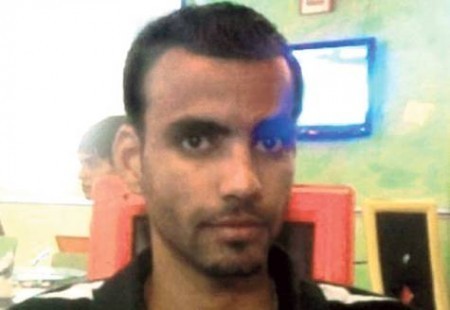
The toppling of the Tunisian despot by a popular revolt, largely from the middle classes, is a heady development in the authoritarian Arab world. And it started with one man's desperate protest:
It all began with the despair of one man, a young graduate unable to get a job, like so many others in his country.
Mohammed Bouazizi turned to selling fruit and veg illegally to earn some money for his family, but when the police confiscated his produce last month because he had no permit, it was all too much. He poured petrol on himself and set it alight in an unusually public protest.
The 26-year-old died earlier this month, but today he is a hero. Not just to his nation, but across the 'gendarmerie' states of north Africa.
For that agonising act of self-immolation sparked something remarkable: a wave of protests that, for the first time in recent memory, felled a leader in the Arab world.
Let the other Arab despots tremble:
Now, reports are coming in from other countries in the region—including Algeria and Mauritania—that other people are turning to self-immolation, even though it is too soon to know how many of the incidents were sparked by political and social grievances.
The writer of the piece I've linked to has the standard contempt for the liberation of Iraq, but I wonder whether the replacement of a tyrant there by an elected government has helped to put democracy on the agenda throughout the Arab Middle East.
(No comments during break.)
Andrew Bolt's Blog

- Andrew Bolt's profile
- 5 followers

