
Small mercy - not as bad as 1974, after all
The devastation could have been even worse:
THE heart of Brisbane won a reprieve this morning, with floodwaters peaking well below expected levels…
The Brisbane City Council in an alert at 5am, said the river was expected to get to about 4.6m, with estimates of 15,268 residential and commercial properties being affected by significant flooding at that level.
The peak well below the 1974 flood level spared numerous homes and high-rise apartment buildings from flooding.
There will be plenty to discuss once the immediate emergency is over, such as the failure to predict this flood, the failure to predict its likelihood, the failure to build dams to mitigate the flooding, and the failure to properly warn residents.
And add this:
A SECRET report by scientific and engineering experts warned of significantly greater risks of vast destruction from Brisbane River flooding - and raised grave concerns with the Queensland government and the city's council a decade ago.
But the recommendations in the report for radical changes in planning strategy, emergency plans and transparency about the true flood levels for Brisbane were rejected and the report was covered up.
The comprehensive 1999 Brisbane River Flood Study made alarming findings about predicted devastation to tens of thousands of flood-prone properties, which were given the green light for residential development since the 1974 flood. The engineers and hydrologists involved in the study warned that the next major flood in Brisbane would be between 1m and 2m higher than anticipated by the Brisbane town plan.
The study highlighted how the council had permitted the development of thousands of properties whose owners were led to believe they would be out of harm's way in a flood on the scale of 1974.
UPDATE
Another problem to discuss:
With some mobile telecommunication services in Queensland currently under siege and mains power shut off to thousands, an expert has warned that basic fixed phone services could have been cut off if the National Broadband Network Company (NBN Co) had deployed the network with its current battery backup technology.
"The Telstra copper network was built to be bulletproof," said Dermot Cox, network professional and networks sales leader at Consulter.
"[In the case of the NBN], if the power goes out and you have battery backup for your fibre-to-the-home (FTTH) service, [basic wired telephony devices] will continue to operate while there is battery charged," he said.
Once the Network Termination Unit (NTU) battery runs out of charge, however, users would be left without access to basic telecommunications services, a potential safety concern for those in the community who require round-the-clock service in the case of emergency.
UPDATE 2
Why was there not more planning to prevent or cope with these floods, other than the building of the Wivenhoe, when the CSIRO report into the (higher) 1974 ones in Brisbane predicted even worse to come:
However,four floods well in excess of the 1974 levels have occurred in the past 133 years and, according to the Professor of Economic Geology at the University of Queensland (Professor Sergent), there is geological evidence of water levels 5.5 m higher than the 1974 flood in the Indooroopilly area of Brisbane. Meteorological studies suggest that rainfalls well in excess of those recorded in the floods of 1893 and 1974 are possible.
Meteorological studies suggest that rainfalls well in excess of those recorded in the floods of 1893 and 1974 are possible. Therefore it seems certain that unless major flood mitigation schemes, such as the proposed Wivenhoe Dam, are implemented, floods even greater than those of 1974 will again be experienced in Brisbane.
UPDATE 3
Reader Brook has an excellent question:
I'd like someone to explain why, if the Wivenhoe is designed for flood mitigation, was it allowed to stay above 93% for over 9 months, and over 100% for more than 3 months?
Same from reader John:
Question,, how could anyone plan to go into the traditional wet season with the main flood mitigation dam "FULL".
UPDATE 4
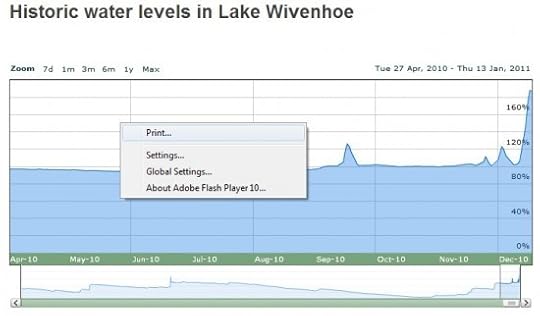
Even at 100 per cent full, the Wivenhoe has saved Brisbane from worse flooding, because of its flooding "shock absorber":
During a flood situation, Wivenhoe Dam is designed to hold back a further 1.45 million megalitres as well as its normal storage capacity of 1.15 million megalitres. Floods may still occur in the Ipswich and Brisbane areas but they will be rarer in occurrence…
It is anticipated that during a large flood similar in magnitude to that experienced in 1974, by using mitigation facility within Wivenhoe Dam, flood levels will be reduced downstream by an estimated 2 metres.
Full supply level or 100 percent capacity (in the water level analysis) is indicative of the optimum level intended for town water supply, and does not take flood mitigation levels into account.
The problem is that the "shock absorber" can't take much more:
Water releases from Wivenhoe Dam have been reduced from an overnight peak of 645,000 megalitres to 205,000 megalitres per day.
As at 9pm Wednesday Wivenhoe Dam was at 189 per cent, down from 191 per cent overnight, while Somerset Dam was down from 190 per cent to 186 per cent…
Wivenhoe Dam levels dropped just 1 per cent overnight, reflecting the massive volumes of water flowing into the storage from its 7020 sq km catchment.
It also is taking major flows from Somerset Dam, whose Stanley River is in flood. Somerset Dam is at 190 per cent....
"Controlled releases must continue ... to relieve Wivenhoe Dam's swollen flood storage compartment in order to create space for further rainfall and inflows," a spokesman said.
(Thanks to readers Victoria 3220 and Peter.)


Andrew Bolt's Blog

- Andrew Bolt's profile
- 5 followers

