
Jared C. Wilson's Blog, page 37
May 5, 2015
The One Source of Total Salvation
 From his fullness we have all received grace upon grace.
— John 1:16
There is no end to the cascading blessings of grace flowing from our Savior Jesus Christ.
The finished work of Christ is that beautiful spring from which flows our forgiveness from sins, our justification before God, our receipt of Christ’s righteousness, our adoption as sons, our reconciliation with the Father, our reconciliation with our brothers and sisters in the Body of Christ, our sure sanctification, our grounds for the Spirit’s fruit, our position as a royal priesthood, our serving as Christ’s ambassadors in the advancing kingdom of God, our resurrection from the dead, our eternal reward, our enjoyment of the new heavens and the new earth, and our participatory witnesses of God’s restoration of all things.
The gospel of first importance produces a myriad of blessings I suppose that were every one of them to be written the world itself could not contain the books. Grand thing, then, that God is remaking the world to broadcast them best.
The large tree of salvation, with branches enough for bird of every kind and from every place, grows from the mighty mustard seed of the gospel of Jesus Christ.


May 1, 2015
No Little Disturbances!
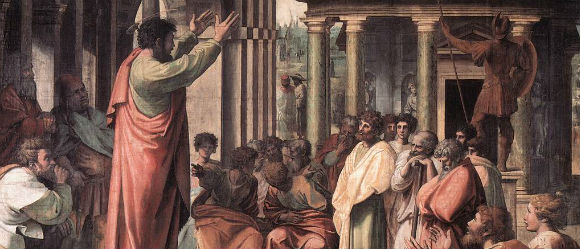
About that time there arose no little disturbance concerning the Way. — Acts 19:23
These men who have turned the world upside down . . . — Acts 17:6
We desperately need to change the subject in our cities. The Church has become wallpaper in too many of them. We recede into the background, staying indoors, safe and avoidable in our religious cubbyhole.
The Ephesian idolmakers rioted because they were put out of business, not by Christians protesting their industry in the parking lot, but by the pervasive spread of the gospel in the city.
We are not responsible for fruit. We are responsible for faithfulness.
God, no little disturbances, please. Please send big ones. Come down, disrupt, break things. Make us dust to breathe new life into us again. So that the Way may create no little disturbance for your glory again.
Help us to want what your servant Spurgeon calls “a glorious disorder.” Make us want to be bowled over. Cultivate astonishment in us.
Teach us how to and empower us to change the subject.
Declare these things; exhort and rebuke with all authority. Let no one disregard you. — Titus 2:15
April 30, 2015
Only Christ Counts for Anything
 “. . . neither circumcision nor uncircumcision counts for anything . . .” – Galatians 5:6
Most people assume there are really two categories: good people and bad people. There are people who are trying and people who aren’t. Most religions, including some identifying as Christian, operate according to these two categories. There are religious people and irreligious people.
There’s a local cult group in Rutland, Vermont called the Twelve Tribes that teaches that in the afterlife, bad people go to hell, people in the Twelve Tribes go to heaven with Jesus, and good people who don’t know Jesus occupy a renewed earth. (It’s somewhat like the Jehovah’s Witnesses that way.) They want to accommodate the two categories in their creation of three categories, because they know “good people” and “bad people” are the categories that “work.”
But the Bible puts a red x on this categorization. All people are born condemned. We all know apathetic licentiousness won’t rectify that. But the Scriptures tell us being good won’t either. Good works don’t get us in any more than doing “whatever” will. There is only one category for us.
We don’t need a “good people” category. We need a whole new category. Christ supercedes our plausibility. The gospel is the other category, because only Christ counts for anything.
If We Are Lost, It is God’s Loss
“A young minister, w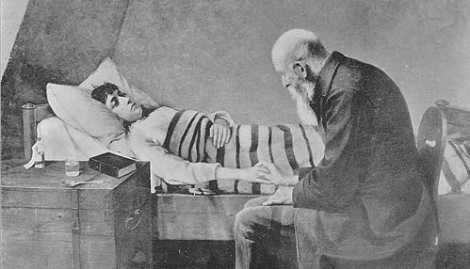 hile visiting the cabin of a veteran Scotch woman who had grown ripe in experience, said to her, ‘Nannie, what if, after all your prayers and watching and waiting, God should allow your soul to be eternally lost?’
“Looking at the youthful novice in divinity, she replied, ‘Ah, let me tell you, that God would have the greatest loss. Poor me would lose her soul, and that would be a great loss; but God would lose his honor and his character. If he broke his word, he would make himself a liar, and the universe would go to ruin.’
“The veteran believer was right. Our only real ground of salvation lies in God’s everlasting word.”
– Theodore Cuyler, “Wayside Springs”
April 29, 2015
“I Couldn’t Worship a God Like That”
 “The ancient man approached God (or even the gods) as the accused person approaches his judge. For the modern man the roles are reversed. He is the judge: God is in the dock. He is quite a kindly judge: if God should have a reasonable defence for being the god who permits war, poverty and disease, he is ready to listen to it.”
– C.S. Lewis, “God in the Dock”
“I could not worship a God like that.”
It is one of God’s eternal blessings that he is a good God, a loving God, a merciful God, a beautiful God. And we ought to worship him for these attributes and more. But we also ought to worship him because he is God, and we are not.
This imperative is no time more crucial than when God reveals himself in ways inscrutable and uncomfortable, when God is being seeker-insensitive.
When God is like that, we are inclined to put him in the hot seat. To say things like “I couldn’t worship a God who allowed this” or “I couldn’t love a God who did that” is in essence to say, “I will worship the God that meets my demands.” But God doesn’t fill out job applications. You can try to, as C.S. Lewis says, put “God in the Dock,” but he neither belongs nor fits there. He does not have to justify himself to us. It is a boon that he reveals himself to us.
God will meet our needs, and while he may answer our cries, he will not answer our demands. Because he is God.
And the LORD said to Job: “Shall a faultfinder contend with the Almighty? He who argues with God, let him answer it.” – Job 40:1-2
Listen for the Gentle Clatter of Hooves
 from Russell D. Moore, Tempted and Tried: Temptation and the Triumph of Christ (Crossway, 2011):
“Forces are afoot right now, negotiating how to get you fat enough for consumption and how to get you calmly and without struggle to the cosmic slaughterhouse floor. The easiest life for you will be one in which you don’t question these things, a life in which you simply do what seems natural. The ease of it all will seem to be further confirmation that this is the way things ought to be. It might even seem as though everything is happening exactly as you always hoped it would. You might feel as though your life situation is like progressing up a stairway so perfect it’s as though it was designed just for you. And it is.
“In many ways the more tranquil you feel, the more endangered you are. As you find yourself curving around the soft corners of your life, maybe you should question the quietness of it all. Perhaps you should listen, beneath your feet, for the gentle clatter of hooves.” (p.59)
April 28, 2015
To Trust Our Striving is to be Ever Striving
 Martin Luther in his Commentary on Galatians:
“The monks imagined the world was crucified unto them when they entered the monastery. Not the world, but Christ, is crucified in the monasteries.”
How so?
To trust in our religious devotion for justification is to be ever-striving, because we are ever-sinning. This theoretical recycling of salvation assumes Christ’s original work did not justify us “once for all” but must continue to be accessed through our efforts, treating justification like a spiritual game of Whack-a-Mole.
To taste of the heavenly gift and fall away from the gospel of justification by grace through faith is to “crucify once again the Son of God to our own harm” (Heb. 6:6).
April 27, 2015
Making Our Church “Miss-able” To Our City
 Darrin Patrick asks a really good question in his book with Matt Carter and Joel Lindsey, For the City:
“If our churches shut their doors tomorrow, would our cities even know we were gone?”
The truth is, though, that churches don’t tend to shut their doors “tomorrow.” Apart from some uncommon catastrophic collapse, churches don’t go from growing/thriving to dead in a day. This doesn’t nullify the question, of course. It helps apply it.
For instance, in New England, churches have been closing down “every day” for a few decades. New England evangelicalism once thrived. But that was a long time ago. The churches shutting down left and right didn’t die in a day. They gave up ground over time. They died an inch at a time, a day at a time.
So. We can’t let up on mission. We can’t lose focus on the gospel. Not for a second. Because one second leads to a minute to an hour to a day to a month to a year to a decade to “tomorrow” you’re shutting the doors. And if we do let up, we’ve got to repent and circle back.
The best way to become miss-able to our cities is be churches that keep repenting and keep returning to the gospel. Every day counts.
When the preferences of the church members are greater than their passion for the gospel, the church is dying. – Thom Rainer
April 25, 2015
What the Greatest Preachers Recognize
 “Throughout the history of the church the greatest preachers have been those who have recognized that they have no authority in themselves and have seen their task as being to explain the words of Scripture and apply them clearly to the lives of their hearers. Their preaching has drawn its power not from the proclamation of their own Christian experiences or the experiences of others, nor from their own opinions, creative ideas, or rhetorical skills, but from God’s powerful word. Essentially they stood in the pulpit, pointed to the biblical text, and said in effect to the congregation, “This is what this verse means. Do you see that meaning here as well? Then you must believe it and obey it with all your heart, for God himself, your Creator and your Lord, is saying this to you today!” Only the written words of Scripture can give this kind of authority to preaching.”
— Wayne Grudem, Systematic Theology (p. 82).
April 24, 2015
Heaven Lies Flat in Thee
 Had to find my copy of George Herbert’s poems today to check a citation in a manuscript, and as often happens when I open up this collection of beauties, I couldn’t put it down without reading beyond my duty. Here’s one of my favorites called “The Holy Scriptures”:
I.OH Book! infinite sweetnesse! let my heart
Suck ev’ry letter, and a hony gain,
Precious for any grief in any part;
To cleare the breast, to mollifie all pain.Thou art all health, health thriving till it make
A full eternitie: thou art a masse
Of strange delights, where we may wish & take.
Ladies, look here; this is the thankfull glasse,That mends the lookers eyes: this is the well
That washes what it shows. Who can indeare
Thy praise too much? thou art heav’ns Lidger here,
Working against the states of death and hell.Thou art joyes handsell: heav’n lies flat in thee,
Subject to ev’ry mounters bended knee.I I.
OH that I knew how all thy lights combine,
And the configurations of their glorie!
Seeing not onely how each verse doth shine,
But all the constellations of the storie.This verse marks that, and both do make a motion
Unto a third, that ten leaves off doth lie:
Then as dispersed herbs do watch a potion,
These three make up some Christians destinie:Such are thy secrets, which my life makes good,
And comments on thee: for in ev’ry thing
Thy words do finde me out, & parallels bring,
And in another make me understood.Starres are poore books, & oftentimes do misse:
This book of starres lights to eternall blisse.


