Cora Buhlert's Blog, page 49
December 29, 2020
Indie Crime Fiction of the Month for December 2020

Welcome to the latest edition of “Indie Crime Fiction of the Month”.
So what is “Indie Crime Fiction of the Month”? It’s a round-up of crime fiction by indie authors newly published this month, though some November books I missed the last time around snuck in as well. The books are arranged in alphabetical order by author. So far, most links only go to Amazon.com, though I may add other retailers for future editions.
Our new releases cover the broad spectrum of crime fiction. We have cozy mysteries, holiday mysteries, historical mysteries, Victorian mysteries, Jazz Age mysteries, paranormal mysteries, hardboiled mysteries, police procedurals, crime thrillers, legal thrillers, psychological thrillers, science fiction thrillers, police officers, amateur sleuths, private investigators, ex-cops, lawyers, drug-dealers, assassins, organised crime, missing persons, crime-busting witches, crime-busting socialites, crime-busting seamstresses, crime-busting ghosts, crime-busting bakers, murder and mayhem in Florida, Minnesota, New Orleans, London, Australia, South America and outer space and much more.
Don’t forget that Indie Crime Fiction of the Month is also crossposted to the Indie Crime Scene, a group blog which features new release spotlights, guest posts, interviews and link round-ups regarding all things crime fiction several times per week.
As always, I know the authors at least vaguely, but I haven’t read all of the books, so Caveat emptor.
And now on to the books without further ado:
 Murder at the Mayfair Hotel by C.J. Archer:
It was the most fashionable place to stay in London, until murder made a reservation.
December 1899. After the death of her beloved grandmother, Cleopatra Fox moves into the luxury hotel owned by her estranged uncle in the hopes of putting hardship and loneliness behind her. But the poisoning of a guest on Christmas Eve throws her new life, and the hotel, into chaos.
Cleo quickly realizes no one can be trusted, not Scotland Yard and especially not the hotel’s charming assistant manager. With the New Year’s Eve ball approaching fast and the hotel’s reputation hanging by a thread, Cleo must find the killer before the ball, and the hotel itself, are ruined. But catching a murderer proves just as difficult as navigating the hotel’s hierarchy and the peculiarities of her family.
Can Cleo find the killer before the new century begins? Or will someone get away with murder?
 A Tangle of Secrets by Blythe Baker:
Lily Dickinson’s discovery of a dead gamekeeper in a cottage near a country lane leads to a search for his killer. Suspects range from employees of the nearby Grangehurst estate to a number of dangerous characters much closer to home.
Before Lily can face the murderer, she needs to enlist the aid of her younger sister Iris. But with Lily still refusing to share the secret of the trunk in the attic, will Iris be willing to help when Lily needs her most?
 The Lurid Possibility of Murder by Beth Byers:
December 1925
Severine DuNoir has discovered who has been hunting her. Now she needs to discover why. As the foes circle each other, their friends and family get drawn into the conflict.
Just who can Severine trust? How can she stop the rogue? And what will happen to those she loves if she fails? She’s all too afraid the answer is one she won’t be able to live with.
 Baking Magic by Melinda Craig:
Starry Valley has been anything but calm since Lindsey moved in. She’s tackled thieves walking through walls, and just last month, she faced down a killer. Not to mention, she had a short romance with one of the handsome police officers and an unusual friendship is blossoming with a maybe detective…she’s still trying to figure that one out. It’s all Lindsey can do to stay sane, yet these people, this town, is more home to her than any place she’s ever been.
She’s still getting used to being open with people about her ability. After all, reading memories is no cakewalk, and it’s definitely not conversation for dinner. But Starry Valley isn’t like other places. She can be real with a select few others, and that is heaven…to finally not hide.
So when Felmira asks for Lindsey’s help in finding a friend’s husband, it’s no surprise she says yes. Helping is a given; delivering is another thing. Lindsey promised Sarah she’d find her husband before Christmas…she only hopes he’s still alive.
 The Happy Widow by David Crosby:
MARRIED AND MURDERED—
WHAM, BAM, SCAM YOU, MA’AM…
In his sixth hard boiled action thriller, reporter Will Harper attempts to balance the beginnings of new love with a treacherous fraud investigation. While trying to unmask scammers who target vulnerable elderly Floridians, Will risks angering homicidal con artists who will stop at nothing to extort their hapless victims.
The mystery opens with an exhilarating honeymoon at sea: philanderer Alain Duvalier has whisked his new—wealthy—wife away on a honeymoon cruise. There’s trouble in paradise, though: Duvalier pushes his giddy wife off the cruise ship, then claims the death was a tragic accident. The remorseless widower packs his bags and moves into his late wife’s ritzy Florida condo, with immediate plans to sell off all her assets.
Enter semi-retired journalist Will Harper, who’s just started researching a hard-hitting series on black widows and widowers who seduce aging, wealthy single folks. This project is personal: Will’s newly exclusive girlfriend Bonnie has an elderly uncle who’s being isolated and financially controlled by a new, monstrously villainous wife—the infamous Millie Potts.
While brainstorming story ideas aboard his live-in yacht, The Wanderlust, Will gets wind of the honeymoon cruise death and immediately begins tracking Duvalier. Will attempts to juggle his dangerous investigation into Millie’s murky past with an equally risky inquiry into Duvalier’s whereabouts. These scammers are so morally bereft that they’ll swiftly, thoughtlessly kill anyone who stands between them and a bundle of cash. Which is unfortunate, considering that Will, Bonnie, and Callie—Will’s ex girlfriend and current coworker—are all standing in the way.
 The Contract Lawyer by John Ellsworth:
He went into the jungle to find his family. He came back out to find himself…
Thaddeus Murfee is an attorney in San Diego whose nephew is kidnapped to South America. The traffickers just didn’t know all the rules, but he did.
This is Thaddeus at his best, pulled away from his normal life and cast into a cruel world where the cartels run rife and anything goes. This time, they rang the wrong doorbell, took the wrong kid, and ran in the wrong direction. Because this seasoned lawyer will stop at nothing to bring back his sister’s son. And in the end, there will be a trial, inside a California courtroom, where justice is sought and crimes are punished.
But will they even be there? Or will they no longer walk the earth, buried in a South American jungle where no one cares?

Dev Haskell is running late for dinner at his girlfriends house when he rear ends a car in the parking lot. Small world, the car is driven by a Dev’s former high school English teacher. . In lieu of paying for damages Dev agrees to work Tuesday and Thursday evenings helping kids with homework. From there he ends up searching for an art forger with ties to local crime lord, Tubby Gustafson.
Along the way he’s beat up by a petit woman in a thong, searches for a missing boy… Oh, and he sets a homeless kid on a career path.
Another hilariously delightful Dev Haskell tale.
A wonderful read to remind you that, actually, your life is pretty good!
As always, Morton, Dev’s Golden Retriever, provides a dose of sanity.
 Witch Is the New Black by Lily Harper Hart:
Ofelia Archer has faced demons, evil witches, and freaky zombies, but nothing could prepare her for the horror of meeting her boyfriend’s mother, Madeline Sully. She thinks she’s ready and able, but she’s really not.
For his part, Zacharias “Zach” Sully isn’t any more thrilled by his mother’s visit than his girlfriend. He’s simply better at dealing with Madeline’s brand of madness.
After one meal, a magical barrage of fire rains down on the group as they’re walking down Bourbon Street. When the flames clear, a young woman is left for dead, and the only thing they know about her is that she was part of a multi-level marketing scheme called Hexential Oils.
Before they realize what’s happening, Sully and Ofelia find themselves knee-deep in an odd world that neither of them really understand … and it leads straight to trouble, as usual. It seems New Orleans is teeming with suspects, and they have no idea which one to focus on.
Ofelia and Sully have a bond that can’t be broken. That won’t stop outsiders from trying. When the hierarchy of Hexential Oils leads to long-forgotten magic and a creature of mythical proportions, they realize they’re in over their heads.
They’ll die to protect one another … and someone desperately wants to make that a reality. It will take both of them working together to make sure that doesn’t happen.
 Ghostly Graves by Lily Harper Hart:
Maddie and Nick Winters are embarking on the biggest adventure of their lives: parenthood. They’re nervous, excited, and prepared to go shopping. That leads them to a special baby boutique in Whisper Cove, where they just happen to participate in a cemetery tour run by Michigan’s most famous ghost hunter.
Maddie and the tour guide Harper Harlow recognize each other for what they are right off the bat, although they don’t initially say anything. Everything spills out in the open, though, when a ghost leads Maddie to the body of a local plastic surgeon.
The dead doctor has an interesting reputation with the women around town, and Maddie recognizes him from her days of nursing. Before anybody realizes what’s happening, the two women have formed a crime-fighting team and they’re determined to uncover answers.
Nick would prefer Maddie shop and embrace their incoming baby but he knows when her inner detective can’t be silenced. While the men bond – and discuss loving a magical woman – the women (and Zander, of course) dig deep and uncover exactly how sordid the tale of an unethical doctor can be.
Get ready for some fun. Maddie, Harper, and Zander are ready for adventure … and they’re dragging absolutely everybody along for the ride.
 Church of the Assassin by Ross Harrison:
KILL ONE TO SAVE A HUNDRED
Alexiares spends her time killing, tinkering with a car she never drives, and wondering if she’s a sociopath. This simple life is complicated by a deadly purge of her sect and she finds herself on the run, trying to make sense of the slaughter. She’s not alone: the broken-minded assassin has inherited a baby girl. But how can hands that know only how to squeeze necks and strip engines ever nurture a child? When painful revelations, betrayals, and secrets show Alexiares that her life can only cause Baby pain and suffering, she’ll have to make a difficult choice.
Across the galaxy, one seemingly natural death puts rookie Intelligence officer Ryan Blake on a collision course with Alexiares. His journey into desperation and madness will reveal a world he’ll wish had stayed hidden. One full of mysteries and death. As his mentor says, there are cases to make your career and there are cases to make you look over your shoulder for the rest of your life, right up until it ends abruptly and violently.
KILL A HUNDRED TO SAVE ONE
Relentless hunters want both her and Baby, and they will tear worlds apart to get them. They are bigger, stronger, and more resourceful. But Baby is more than a newfound vulnerability to Alexiares: she is a reason to live. A reason to kill.
When you take a shot at an apex predator, do not miss.
 Foxtrot Hotel by Simon Haynes:
First a dead body shows up on Harriet’s favourite beach.
Then she discovers the whole place is going to be bulldozed for an apartment complex.
She’s convinced the two are connected, but she’ll have to untangle a web of lies and corruption to reach the truth.
Meanwhile, someone has decided that the best way to avoid discovery is to silence Harriet… for good!

While attending a gala at Prescott University’s lavish new campus, Hester Thursby and fellow guest, Detective Angela White, are called to the home of the college’s owners, Tucker and Jennifer Matson. Jennifer claims that someone broke into Pinebank, their secluded mansion on the banks of Jamaica Pond. The more Hester and Angela investigate, the less they believe Jennifer’s story, leaving Hester to wonder why she would lie.
When Hester is asked by the college’s general manager to locate some missing alumni, she employs her research skills on the family and their for-profit university. Between financial transgressions, a long-ago tragedy, and rumors of infidelity, it’s clear that the Matsons aren’t immune to scandal or mishap. But when one of the missing students turns up dead, the mystery takes on new urgency.
Hester is edging closer to the truth, but as a decades-old secret collides with new lies, a killer grows more determined to keep the past buried with the dead…
 The Banshee Brouhaha by Amanda M. Lee:
Charlie Rhodes has spent her entire life wondering who her birth parents were, why they abandoned her, and where the magic she’s been learning to hone came from.
She’s finally going to get some answers.
With proof that the new member of the Legacy Foundation is really her brother, Charlie sets off to visit Salem with him and her boyfriend Jack Hanson. She’s never been to the city before and finds that the history swirling is only one of the things that has her excited.
Not long after landing, a body is strung up in Salem Common, and witnesses say it was ghosts doing the dirty work. Jack is intrigued enough to call in the rest of the team. Since Charlie’s parents are supposedly taking refuge within the city limits, the investigation makes for a nice cover.
It’s not long before Charlie realizes that there’s more going on in Salem than witches and white magic. Something dark is festering under the surface, and whatever it is seems to be taking aim at her.
Charlie wants answers. She’s also afraid to get them. During the search for what she’s lost, though, she becomes more determined than ever to hold onto what she has.
There’s evil afoot, and a woman who looks like an older version of Charlie is stalking the group. Could the two things be connected? Charlie won’t leave until she knows for certain.
Salem’s history might be coming back to haunt those who venture into the city and it’s up to the Legacy Foundation to figure out why … that is if they survive long enough to uncover the answers.
Hold onto your broomsticks, because it’s going to be a witchy ride.
 The Lost Letters of Playfair Street by Michelle Montebello:
A lover’s game. A chest of clues.
Come find me. I’ll be waiting…
1929: On the night of her engagement to austere banker Floyd Clark, Charlotte Greene meets enigmatic Sydney Harbour Bridge engineer, Alexander Young. Their encounter is brief, but their attraction instant.
Alex invites Charlotte to play a game with him, one of daring clues and secret meeting places. She accepts and they embark on a thrilling lover’s chase across the city.
But with her arranged marriage to Floyd looming, will she have the strength to let Alex go?
Present Day: Paige Westwood is helping her boss establish a publishing company in his newly-purchased Playfair Street house in The Rocks, Sydney. In the attic, she discovers a chest of old clues that lead the reader on a journey across the city.
Paige contacts the former owner, Ryan Greene, who explains the clues belonged to his great-aunt Charlotte, who once lived in the house, but who mysteriously disappeared in 1929.
Together, they follow Charlotte and Alex’s clues to unravel a fascinating tale of lies and intrigue, of two lovers bound by hope, but also by deceit. Can they solve the mystery of Charlotte’s disappearance or has all hope been lost to the past?
 Should Grace Fail by Priscilla Paton:
When a disgraced policeman who rescues addicts and trafficking victims is murdered, Detectives Erik Jansson and Deb Metzger have their skills put to the test as killers target a vulnerable girl, an empathetic pianist, and a man generous to a fault.
 Better To Be Lucky by Ben Rehder:
The trouble at the Conlees’ lakeside estate begins when vandals topple and destroy an expensive Italian fountain. Then they slash the tires and damage the paint job on a Jaguar. That’s when Roy Ballard’s client, the insurance company, asks him to catch the vandal in the act and prevent future claims. Surprisingly, the homeowner, Norman Conlee, opposes the idea. He intends to address the problem himself by fencing the property and keeping his revolver handy. Eventually, though, he gives in, and Roy goes to work. It’s not long before the case escalates in a way nobody saw coming. Roy will need some luck to close this case before he winds up a victim himself.
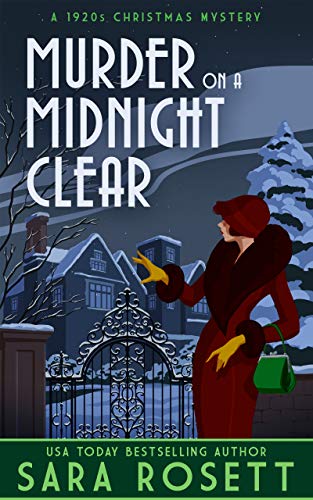 Murder on a Midnight Clear by Sara Rosett:
A snowbound country mansion, a missing butler, and a Christmas case…
Olive and Jasper have never been closer—except in one area. Jasper is still reticent about his frequent disappearances from polite society. With the holidays approaching and no paying client on the books, Olive decides to shadow Jasper when he’s unexpectedly called away. Her search brings her to Holly Hill Lodge where an eclectic group has gathered to celebrate an old-fashioned English Christmas.
The guest list includes a celebrated lawn tennis champion, a fussy scientist studying snowflakes, a persuasive luggage salesman, a famous lady explorer, and the family’s eccentric aunt who has a fondness for the newfangled drinks called cocktails.
When the butler goes missing, Olive and Jasper must work together to solve the Christmas crime—as well as the secret Jasper hides.
 Rising Moon by Wayne Stinnett:
On Grassy Key, things aren’t as idyllic as they seem. The quiet, sleepy community has been awakened. A young woman with strong ties to the community is missing.
A local craftsman, the last person to see the girl, is questioned and released. The girl’s friends are interviewed. Nobody knows what happened to Cobie, except that she left for work one day and didn’t arrive. The only lead is the girl’s car, parked where she worked. But it provides no clues and nobody saw anything.
Days go by. Then weeks. The case grows cold.
The employer of the girl’s mother knows Jesse McDermitt, a retired Marine and reputed government spook. Jesse leans on people the way only he can and soon finds there is a lot more to the abduction than anyone knew.
Does he find the missing girl? Does he survive what he uncovers? Find out in this 19th novel in Wayne Stinnett’s wildly popular Jesse McDermitt Caribbean Adventure Series.
 Murder in Hyde Park by Lee Strauss:
Murder’s a fashion faux pas. . .
The summer of 1926 brings high fashion to Hyde Park. Ginger’s Regent Street dress shop, Feathers & Flair, is a major sponsor, and when top designer Coco Chanel makes an appearance, the London fashion scene lights up.
Until a model drops dead and Miss Chanel is suspected of murder. The fashion icon hires Lady Gold Investigations to clear her name, but can Ginger discover the murderer before becoming a lifeless mannequin herself?
 Send to Kindle


December 25, 2020
Star Trek Discovery mounts a rescue mission and meets “Su’Kal”
Because the powers that be at US streaming services apparently believe that all their viewers are bored slackers sitting on the sofa with nothing else to do and that no one has such a thing as a family or a life that does not involve watching TV, CBS All Access in its infinite wisdom decided to stream the latest episode of Star Trek Discovery on Christmas Eve. So here is the latest installment in my ongoing episode by episode reviews of season 3 of Star Trek Discovery. Reviews of previous episodes may be found here.
Warning: Spoilers behind the cut!
After a two part pointless detour to the mirror universe, Star Trek Discovery is back in the prime universe as well as back on track.
“Su’Kal” starts of literally where part II of “Terra Firma” ended, at the “wake” for Philippa Georgiou. Adira stands around, looking a bit lost, since they don’t really feel like part of the crew yet. Stamets goes over to them and tells them to interact a bit more with people, when Gray – who’d been missing for a few episodes – decides to put in an appearance again. Stamets decides to play along and tells off Gray, even though it looks as if he’s talking to thin air, because no one except for Adira can see Gray. As for why Gray has been absent, he is bothered that Adira can talk to people and interact with them, while Gray can only interact with Adira.
The wake is interrupted, when the program Stamets and Adira rigged up with Book’s help to hack into the systems of the crashed Federation ship inside the Verubin nebula that’s the source of the Burn finally gets a result. It has found a lifesign on board the crashed research Kelpian vessel, even though the vessel has been lost 125 years ago. Stamets, Tilly and Michael wonder how it’s even possible that the Kelpian scientist whose distress signal they intercepted is still alive after 125 years, especially considering the intense radiation inside the nebula. Saru replies that it’s not the scientist whose lifesign they detected, but her child. Because the forehead markings of the Kelpian scientist, which Stamets and Tilly took for radiation burns, indicate that the woman was pregnant. This also explains why Saru was so fascinated by the distress signal.
So the Discovery sets off for the Verubin nebula. However, the attempt to enter the nebula to rescue the person whose lifesigns they detected go wrong almost immediately, when the Discovery is battered by turbulences and radiation. So the Discovery has to pull out. Book offers to fly into the nebula in his own ship, since it’s smaller and can morph, treating us to some nice special effects scenes. In fact, this whole episodes features some very cool space action and effects. I guess they spent whatever money they saved on the largely studio-bound and low on special effects “Terra Firma” two-parter on this episode.
Book (and Grudge, the cat) suffer some radiation damage (which is easily cured via 32nd century miracle medicine), but he does manage to fly in far enough to scan the planet, where the Kelpian ship crashed, and find a stable pocket inside the nebula for Discovery to jump into. The scan of the planet at the heart of the Verubin nebula reveals something remarkable. For it turns out that the entire planet is basically one huge dilithium deposit. Considering how rare dilithium has become after the Burn (and supplies were running low even before), this discovery has the potential to be a gamechanger.
As a result, Admiral Vance is as excited as we’ve ever seen him, when Saru makes his report. However, Admiral Vance is considerably less thrilled when Saru announces that he will lead the away team himself. Of course, Saru is from the era and Kirk and Pike, where the captain frequently beamed down with the away team. And besides, his knowledge of Kelpian culture may come in handy, when dealing with a Kelpian who has been alone for a very long time. Finally, Saru points out that Tilly is more than capable of handling the Discovery in his absence, whereupon Vance shoots Tilly an “And who are you again?” look.
Vance also has bad news for Saru, because the Emerald Chain has chosen the Kelpian homeworld Kaminar as the site of its latest “training exercises”. Saru immediately offers to have the Discovery jump to Kaminar and help out, but Vance tells him to focus on his own mission and leave the defence of Kaminar to Starfleet. He also points out that the location of the Emerald Chain’s latest training exercises, first Book’s homeworld and then Saru’s, is no accident. The Emerald Chain is trying to deliberately draw out Discovery to get hold of their spore drive and their dilithium stores. For some reason, this does not worry the Discovery crew nearly as much as it should.
Tilly is understandably nervous about her first mission as acting captain, so Michael tries to calm her down by telling her a story about a knob underneath the armrest of the captain’s chair on multiple Starfleet vessels that captains tend to touch in times of stress. Michael also tells Tilly that she has to beam down to the planet, because Saru needs her more than Tilly does, because Michael isn’t sure that Saru is entirely objective about the whole mission.
Meanwhile, Stamets is not at all happy that Dr. Culber wants to join the away team, because he worries about his husband. After all, the radiation on the planet is intense and lethal within a few days at most. However, Culber insists that he must go. Not just because he’s a doctor and the survivor might need help, but also because he knows what it feels like to be lost and alone. And besides, the away team will be taking anti-radiation drugs along, so they should be fine. We get treated to another kiss between Stamets and Culber, which demonstrates once again why they’re one of the best – if not the best – Star Trek couples of all time. I also love that Stamets and Culber have basically adopted Adira (and Gray, since they come as a package deal, even though only Adira can see Gray). It’s just great seeing a non-traditional LGBTQ family in a mainstream SFF show.
So Saru, Michael and Culber beam down into the crashed ship and promptly get a surprise, for instead of a ship, they find themselves inside a wintery forest (considering the many wintery sceneries we’ve seen this season, I guess it snowed a lot in Canada last winter). They also find that their clothes and appearance has been altered. Michael is now a Trill, Culber is a Bajoran (which makes me wonder if the Federation even knew about Bajorans in the 23rd century, since they only show up from The Next Generation on) and Saru is human, giving Doug Jones the chance to show off his acting skills without ten kilograms of latex make-up for once. Worse, their badges/transporters and supplies, including the vital radiation drugs, are gone. There is an explanation for all this, that doesn’t really make a whole lot of sense, though the lack of the lifesaving drugs does add a sense of urgency and I imagine Doug Jones was happy not to have to wear the Saru make-up for an episode or two. Besides, Michael’s red riding hood type cloak and cape nicely hide Sonequa Martin-Green’s pregnancy bump.
After some trudging through the snowy forest, Saru, Michael and Culber come across a glitchy hologram demonstrating maintenance procedures (in a forest? Yes, a lot about this episode makes no sense). Our trio now realises that they are in a – quote – “sophisticated holographic environment”. They obviously can’t say “holodeck”, because holodecks would only become a thing in the Next Generation era. When they introduce themselves, the hologram unglitches long enough to tell them that information on Starfleet and the Federation may be found in the politics and history section. Since Saru, Michael and Culber can’t figure out how to stop the program, they decide to head for the politics and history section.
Yes, “Su’Kal” is Discovery‘s take on one of the staples of Star Trek from The Next Generation onwards, the holodeck episode. Of course, holodeck episodes are normally about as welcome as mirror universe episodes. There are a handful of good ones, but most of them are inconsequential fluff. As holodeck episodes go, “Su’Kal” is certainly one of the better ones. Furthermore, since Discovery hasn’t really had a holodeck episode yet (the closest thing were the magic mushroom world scenes in season 1 and 2), since season 1 and 2 were set before holodecks were a thing, holodeck stories haven’t won out their welcome yet.
It also helps that while most holodeck episodes look like random studio backlot sets, “Su’Kal” really pulls out all the stops with gorgeous CGI environments such as a very M.C. Escher-esque stairwell and a dark fortress straight out of a fantasy cover, accessed only via floating rock islands.
Saru, Michael and Culber eventually come across a group of holograms reenacting the acceptance of Kaminar as a member of the Federation over and over again. As before, the holograms are glitchy, but the hologram of a Vulcan admiral manages to unglitch long enough to ask our trio, if they are here to rescue the child. By now, it’s pretty obvious what the holographic environment is, namely a learning and training program for the Kelpian child survivor, created – as we later learn – by the child’s mother. As for why the appearances of the Discovery away team were altered, that’s part of the program to avoid spooking the child. Of course, it makes no sense that a Kelpian child would be spooked by two humans and a Kelpian showing up to rescue them, but would not be spooked by a Bajoran, a Trill and a human. But then, a lot about this episode makes little sense, when you think about it.
Considering that the team is stuck in a holographic fantasy world – and now I am reminded of the many Alice in Wonderland references back in season 1 – there is of course also a monster, which resides behind a padlocked door, but tends to bang against it. Strange piles of stone are set up outside that door, which begins to buckle alarmingly. The piles of stone look vaguely familiar to Saru, but before he can remember why, the away team finally encounters “the child”. Only that “the child” is no child at all but an adult Kelpian, played by veteran character actor Bill Irwin, as Keith R.A. DeCandido points out in his review at Tor.com.
Though “child” is not such a bad description after all, because after spending decades alone with only glitchy holograms for company, the Kelpian survivor is still very much a traumatised child mentally. And so, the survivor initially asks the newcomers which program they are from. And then, when Saru mentions the word “outside”, the survivor runs away in fear. At the same time, the monster becomes more active behind its locked and barred door. I guess I wasn’t the only person who was immediately reminded of Forbidden Planet (which is often viewed as a precursor to Star Trek) and its monster from the Id.
The team now splits up. Saru and Culber go after the survivor, while Michael will hold the monster – a creepy CGI horror that looks like a Kelpian zombie made from smoke – at bay. Though in the end, Michael is the one who finds the survivor and manages to get him to talk by pretending that she is a program intended to teach him social interaction. She even gets a brief memory of the survivor harvesting kelp with his family, before he runs off again. It’s also becomes increasingly clear that the survivor has no idea that there he is aboard a ship and that there is such a thing as an outside world.
Meanwhile, Culber and Saru find what appears to be the survivor’s quarters, complete with a Kelpian elder dozing in a rocking chair. Saru is fascinated by this elder, because he has never seen a Kelpian become so old before, since they experienced the vaharai and were killed long before then. Culber and Saru also find out the name of the survivor. He’s called Sa’Kul, which means “blessed gift” in Kelpian and is traditionally the name given to the first child born after a great disaster.
When Saru finally manages to wake the elder, they get some more information out of him. The elder confirms that the entire holo environment was created and programmed by Sa’Kul’s mother to keep him alive until rescue could arrive. However, rescue took far longer than expected to arrive and the holograms were forced to provide emotional support they weren’t really equipped for. The purpose of the holographic elder is basically to dispense stories and lullabies, which he does for Saru in a very sweet scene. Now we can actually see his face, it becomes even clearer what an excellent actor Doug Jones is. But then, I’m still outraged that everybody in The Shape of Water got an Oscar nomination except for Doug Jones, since the Academy apparently thought that he really was a swamp monster.
The holographic elder also explains that the stone piles the away team saw earlier are totems supposed to ward off the monster, a creature from Kelpian legend that represents their greatest fear that every Kelpian has to face (after all, Kelpians were originally a race of permanently afraid prey creatures). So yes, it is the monster from the Id. Until Sa’Kul will face the monster, he – and the away team – will never be free. This is a huge problem, because Saru, Michael and Culber are already beginning to exhibit radiation burns.
Things come to a head, when the away team come face to face with Sa’Kul and the monster. Sa’Kul freaks out and has a breakdown that sends shockwaves through the holo environment. Meanwhile, both the Discovery and Book’s ship are experiencing problems that are very similar to what happened during the Burn. Book manages to hail the away team (Discovery is otherwise occupied) and tell them to stop whatever they’re doing, cause they’re about to cause another Burn. Saru finally manages to calm down Sa’Kul by singing the lullaby the elder sang to him.
So we finally know what caused the Burn, namely a terrified Kelpian child with psychic powers induced by radiation exposure in utero. And people thought that a scared Baby Grogu tossing Stormtroopers about was a bad temper tantrum. As explanations go, this one is certainly unexpected, though not without precedent. After all, Star Trek has featured (usually malicious) superpowered kids before all the way back to the original series. Trelane from “The Squire of Gothos” and particularly “Charlie X” come to mind. However, Star Trek didn’t invent this trope. Indeed, children with psychic powers causing havoc was a common science fiction trope during the golden and silver ages. “It’s a Good Life” by Jerome Bixby and “When the Bough Breaks” by Henry Kuttner and C.L. Moore come to mind, as do The Midwich Cuckoos by John Wyndham. It seems to me as if science fiction has deep-seated issues with children.
Though none of the above mentioned super-children have managed to wreck quite as much havoc as poor Sa’Kul, whose temper tantrum killed millions, possible billions of people and brought galactic civilisation to its knees. Of course, none of this is in any way Sa’Kul’s fault, since he has no idea what he’s done and doesn’t even know that the outside world exists. Nonetheless, I don’t think that anybody at Starfleet – or anywhere else in the galaxy, for that matter – will be happy to see him. Not to mention the impact it will have on Sa’Kul’s already fragile mental health, when he learns that he is personally responsible for the deaths of millions, if not billions of people and the destruction of the Federation.
Book has flown his ship close enough to the planet to beam out the away team, but Michael, Culber and Saru realise that they cannot leave Sa’Kul alone, because it’s only a matter of time before he causes another Burn. Saru wants Michael to stay, because she’s the empathic one, but Michael points out that Saru was the one who managed to calm down Sa’Kul. So Saru and Culber stay behind, while Book beams out Michael just in time, before she faints from radiation sickness. Meanwhile, Saru and Culber know that they’re doomed if Discovery doesn’t return within a day or so. But luckily, help is on the way in the form of Adira who stowed away on board of Book’s ship and beams down with a supply of radiation drugs.
However, the odds of Discovery returning within a day or so are slim to none, because Discovery has been experiencing some dramatic issues of its own. For of course, Tilly was not granted a quiet first time in the captain’s chair. And so Discovery suddenly detects another Starfleet vessel approaching and hailing them, even though there isn’t supposed to be any Starfleet vessel in the vicinity. At first, the Discovery bridge crew thinks it’s a Starfleet vessel stranded by the Burn. But why would it stay near the inhospitable Verubin nebula instead of doing a Voyager and trying to get somewhere the slow way? The answer is of course – and I figured this out about a minute before the bridge crew did – that the supposed Starfleet vessel is no Starfleet vessel at all, but the Viridian, flagship of Emerald Chain boss Osyra herself. After all, Admiral Vance did note that Osyra appears to be after Discovery‘s spore drive and dilithium supplies.
What follows is a neat stand-off between Tilly and Osyra. Osyra tries to trigger Tilly’s imposter syndrome, while Tilly unleashes her inner Killy and first goes all Freudian on Osyra and then threatens to self-destruct the Discovery rather than let her fall into Osyra’s hands. There is an exchange of torpedoes and the Discovery tries out its brand-new cloaking device. However, Discovery is hampered by the fact that her shields are not at full capacity. And while jumping out would be the best course of action, that would mean abandoning the away team to certain death.
Book finally offers to get the away team out with his own ship, so Discovery can escape. But once the shields are down, some creepy masked Emerald Chain goons, who look like they should be in Star Wars rather than Star Trek, beam right into the engine room and seize Stamets to keep him from starting up the spore drive. Meanwhile on the bridge, no one has any idea what is happening and why Tilly shouting “Black alert” doesn’t result in any reaction. Methinks the Discovery desperately needs an intruder alarm.
Stamets tells the Emerald Chain goons that he’s not helping them and that they cannot operate the spore drive without him. However, the Emerald Chain are prepared for all eventualities and so they fit Stamets with some kind of mind control device. More and more Emerald Chain goons beam aboard Discovery, while tentacles shoot out of the Viridian to wrap around Discovery. Osyra herself beams onto the bridge, forces Tilly out of the captain’s chair and sits down. Then she orders the ship to jump to Federation headquarters, the location of which is secret, but programmed into Discovery‘s computers. Book and Michael emerge from the nebula just in time to see the Discovery and Viridian jump away. Cue cliffhanger.
I suspect this will be the first and last time that we’ve seen Tilly in the captain’s chair for a long time, because she’s simply not yet ready for the job. Though I hope Federation justice has become more lenient since the 23rd century or poor Tilly will spend the rest of her life slaving away in a prison mine. After all, she not just lost Starfleet’s most powerful ship to the enemy, but gave away the location of the secret HQ as well. And yes, it was an accident, but then it’s not as if Michael intended to trigger the war with the Klingons either.
“Su’Kal” is certainly an action-packed episode. And in fact, it’s so action-packed that you don’t notice that a lot of it doesn’t make any sense until afterwards. Zack Handlen calls it “messy” in his review at The AV-Club and it certainly is. It also has too much rather than too little plot, which makes the decision to waste the previous two episodes on a pointless detour to the mirror universe even more puzzling. Though I do understand why they sent Georgiou away before the endgame. Because Osyra wouldn’t stand a chance against the original tough woman in black leather.
Furthermore, as James Whitbrook points out in his review at io9, Discovery is clearly heading towards the season finale. James Whitbrook also thinks that there is rather too much plot and too many revelations packed into this episode, though he still feels that it works better than the season 1 and 2 finales. Though “better than the season 1 finale of Discovery” is a low bar to clear.
All this probably sounds, as if I didn’t enjoy this episode. That would be wrong, because I did. But enjoyable or not, “Su’Kal” is still something of a mess and the plot and revelations should have been streteched over two episodes, while cutting down the whole mirror universe sidetrip to one episode or even a B-plot. After all, “Su’Kal” relegated the hijacking of the Discovery to a B-plot.
So far, season 3 of Star Trek Discovery has alternated between telling very typical Star Trek stories and exploring common space opera tropes that Star Trek has rarely done to date. “Su’Kal” combines these two approaches and tells a very typical Star Trek story, namely a holodeck adventure combined with an emotionally unstable child with psychic powers, while also borrowing from the works that inspired Star Trek in the first place, namely golden age science fiction and Forbidden Planet.
Next week, the penultimate episode of the season will air on New Year’s Eve, which is an even worse day for any new TV than Christmas Eve. Honestly, CBS All Access, next year just do a two week holiday break.
Send to Kindle
December 23, 2020
A Holiday Story Bonanza
It’s time for the last new release announcement of the year. As the title indicates, this will be a big announcement, because I have three new holiday stories plus a collection to announce.
Unfortunately, some of the buy links are still missing, because several distributors and vendors are slow to get new e-books up in the run-up to the holidays.
Furthermore, the good folks at Smashwords are having their annual end of the year sale. You can get lots of e-books at reduced prices, including several of mine.
Back in 2013, I decided to write a Christmas story for the holiday season. This story was Christmas Gifts and it did quite well, so I decided to write another holiday story the next year. And then the year after. Some years, I ever wrote more than one holiday story. And so I’ve thirteen Christmas stories (as well as two Valentine’s Day stories and one Easter story) in various genres over the past seven years.
I haven’t been feeling particularly festive this year, but nonetheless inspiration struck and so I published not one or two but three very different holiday stories.
The first new story is a sweet holiday romance novelette called Driving Home for Christmas. The inspiration for this story happened last year just before Christmas, when I had to make a phonecall and therefore pulled into the parking lot of an outlet mall. The mall was closed, but the Christmas lights were still on and so the entire parking lot was lit up by electric stars. It looked very pretty – a lot prettier than an outlet mall deserves – and so I thought, “You know, this place would make a nice romantic setting for a holiday romance. Especially when it’s snowing.”
So I wondered what might bring two people to the parking lot of a closed outlet mall late at night just before Christmas. That particular outlet mall is right next to the Autobahn A1, one of the main North South routes for all of Europe. So I thought, “What if someone’s car broke down and they had to leave the Autobahn and wound up on the mall parking lot? And what if they meet a good Samaritan who’s willing to help them?” The story grew from there.
I used the real Autobahn exit and the outlet mall as a setting, though I did rearrange the shops a little. I also borrowed the details of a car breakdown I had a few years ago – though at a different Autobahn exit (because it would be too easy, if my car broke down some seven kilometres from home) and not at Christmas.
So follow college student Laura, whose car breaks down after midnight on Christmas Eve, and Danish truck drive Jonas, who comes to her aid, as they are…
Driving Home for Christmas When her car breaks down after midnight on Christmas Eve, Laura thinks she’ll never make it home for the holidays.
But then fate sends Laura her very own Christmas angel in the form of hunky truck driver Jonas…
This is a short and sweet holiday romance of 8400 words or approximately 30 print pages.
More information.
Length: 8400 words
List price: 0.99 USD, EUR or GBP
Buy it at Amazon US, Amazon UK, Amazon Germany, Amazon France, Amazon Netherlands, Amazon Spain, Amazon Italy, Amazon Canada, Amazon Australia, Amazon Brazil, Amazon Japan, Amazon India, Amazon Mexico, Kobo, Barnes & Noble, Apple Books, Google Play, Scribd, Smashwords, Thalia, Weltbild, Hugendubel, Buecher.de, DriveThruFiction, Casa del Libro, Vivlio, 24symbols and XinXii.
The second holiday story is another romance novelette. This one is part of Christmas at Hickory Ridge Mall series of loosely interconnected holiday romances. The connecting thread in this series is that all three stories to date take place at the same mall just before Christmas and that all characters eventually end up at the same coffee shop, where they are served by the same barista.
This latest story takes us outside the mall to the Christmas tree lot, where Jessica is trying to buy a tree one day before Christmas. However, she gets more than she bargained for, when she meets biology graduate student and seasonal Christmas tree vendor Matt in…
The Crappiest Christmas Ever Jessica is having the worst Christmas ever, when her parents announce that they are getting a divorce two days before the holidays.
Stuck on her own with no home to go to, Jessica heads for the mall to buy a Christmas tree for herself. Here she meets Matt, who sells Christmas trees and is having a really awful Christmas himself.
Matt and Jessica bond over their shared pain and also manage to make each other laugh. So maybe, this won’t be the worst Christmas ever after all…
This is a short and sweet holiday romance of 12000 words or approximately 40 print pages.
More information.
Length: 12000 words
List price: 2.99 USD, EUR or 1.99 GBP
Buy it at Amazon US, Amazon UK, Amazon Germany, Amazon France, Amazon Netherlands, Amazon Spain, Amazon Italy, Amazon Canada, Amazon Australia, Amazon Brazil, Amazon Japan, Amazon India, Amazon Mexico, Kobo, Barnes & Noble, Apple Books, Google Play, Scribd, Smashwords, Thalia, Weltbild, Hugendubel, Buecher.de, DriveThruFiction, Casa del Libro, Vivlio, 24symbols and XinXii.
The third holiday story of 2020 is something completely different. For starters, it’s not romance, but horror comedy (since I’m still unable to write straight horror – it either comes out as urban fantasy or comedy).
The initial inspiration for this story was coming across this piece of fantasy artwork by artist Jakub Rozalski on Twitter. In the image, Krampus has just gutted Santa, while a few kids look on. Since Krampus, who also appears in The Bakery on Gloomland Street, another of my holiday stories, is actually supposed to be Santa’s helper, I have course wondered what might have led to Krampus turning on Santa. So I thought, “What if Krampus isn’t Santa’s pal at all, but actually hates him?”
As I looked through Jakub Rozalki’s portfolio at Art Station, I also came across another holiday related horror image of a reindeer with bloody antlers facing down Santa, while a gutted elf lies on the ground. So I thought, “Maybe it’s not just Krampus who hates Santa? What if the elves and the reindeer hate Santa as well?” The story grew from there.
To be fair, this Santa is a very bad Santa. He exploits his workers, cheats of Mrs. Claus with two attractive young women and he takes drugs, too. So don’t feel too sorry for him. And besides, Christmas still happens as normal, though with someone else manning the sleigh.
I may also have done something nasty to Donald Trump. But to quote a character in the story, “Ain’t no one gonna miss him.”
So watch as elves, reindeer, Krampus and Black Piet take on Santa and stage a…
Revolt at the North Pole Rebellion is brewing at Santa’s compound at the North Pole. The elves and the reindeer both are overworked, underpaid and angry, so they unite to take down Santa. However, there’s still Santa’s most fearsome enforcer, the horned, clawed and fanged holiday monster known only as Krampus…
This is a short holiday horror story of 3900 words or approx. 14 print pages by Hugo finalist Cora Buhlert.
More information.
List price: 0.99 USD, EUR or GBP
Length: 3900 words
Buy it at Amazon US, Amazon UK, Amazon Germany, Amazon France, Amazon Netherlands, Amazon Spain, Amazon Italy, Amazon Canada, Amazon Australia, Amazon Brazil, Amazon Japan, Amazon India, Amazon Mexico, Kobo, Barnes & Noble, Apple Books, Google Play, Scribd, Smashwords, Thalia, Weltbild, Hugendubel, Buecher.de, DriveThruFiction, Casa del Libro, Vivlio, 24symbols and XinXii.
Since I now had thirteen holiday stories in six different genres – romance, mystery, thriller, science fiction, fantasy and horror – I also decided to offer all of my holiday stories to date in one handy mega-collection. This one is a real bargain, because you get almost 400 pages worth of holiday stories at a much lower price than if you were to buy them individually.
So check out the…
The Christmas Collection
 Thirteen tales of Christmas by Hugo finalist Cora Buhlert.
Romance, cozy fantasy, murder mysteries, pulp thrillers, science fiction, horror and humor – we have all that and more.
Watch young people find love in the pre-holiday shopping rush at Hickory Ridge Mall, at a Christmas tree lot, on the parking lot of a shuttered outlet mall and at the one bar in town that’s open on Christmas Eve.
Experience Christmas in Hallowind Cove, the permanently fog-shrouded seaside town, where strange things keep happening.
Watch as Santa’s various helpers unite to depose him.
Follow Detective Inspector Helen Shepherd and her team as they investigate the death of a robber dressed as Santa Claus as well as a wave of thefts at a Christmas market.
Meet Richard Blakemore, hardworking pulp author by day and the masked crimefighter known only as the Silencer by night, as he fights to save an orphanage from demolition in Depression era New York City.
Watch Alfred and Bertha, an ordinary married couple, as they decorate the Christmas tree and live their marvellous twenty-first century life.
Experience Christmas on the space colony of Iago Prime as well as after the end of the world.
Enjoy thirteen novellas, novelettes and short stories in six genres.
This is a collection of 118000 words or approx. 390 print pages.
Contains the following stories:
Christmas Gifts
Christmas Shopping with a Broken Heart
The Crappiest Christmas Ever
Christmas Eve at the Purple Owl Café
Driving Home for Christmas
The Bakery on Gloomland Street
Revolt at the North Pole
A Bullet for Father Christmas
Santa’s Sticky Fingers
Nicholas of Hell’s Kitchen
The Tinsel-Free Christmas Tree
Christmas on Iago Prime
Christmas after the End of the World
Length: 118 000 words
List price: 4.99 USD, EUR or 3.99 GBP
Buy it at Amazon US, Amazon UK, Amazon Germany, Amazon France, Amazon Netherlands, Amazon Spain, Amazon Italy, Amazon Canada, Amazon Australia, Amazon Brazil, Amazon Japan, Amazon India, Amazon Mexico, Kobo, Barnes & Noble, Apple Books, Google Play, Scribd, Smashwords, Thalia, Weltbild, Hugendubel, Buecher.de, DriveThruFiction, Casa del Libro, Vivlio, 24symbols and XinXii.
***
So what can you expect from Pegasus Pulp next year? There will be more In Love and War space opera, more sword and sorcery in both the Thurvok and Kurval series, more Two-Fisted Todd adventures, more Helen Shepherd Mysteries, more Alfred and Bertha and lots of other stories.
But for now, I wish you a Merry Christmas or other seasonal holiday, whichever one you may celebrate, as well as a happy, healthy and hopefully better 2021.
Send to Kindle
December 19, 2020
The Mandalorian Comes to “The Rescue” of Baby Grogu
It’s time for the last of my episode by episode reviews of season 2 of The Mandalorian again. Previous installments may be found here.
Also, since Star Wars is a Disney property now, may I remind you once again that Disney is not paying the royalties due to Alan Dean Foster and others as well. Andrew Liptak has more, including the names of some other authors affected, in this in-depth article at Polygon.
Warning: Spoilers under the cut!
Honestly, I mean it. Don’t read on, unless you have watched the season 2 finale of The Mandalorian.
“The Rescue” begins with an Imperial shuttle carrying cloning specialist Doctor Pershing under attack by Slave-1. A shot by Slave-1 disables their systems and a voice tells the pilots (who look as if they stepped straight out of a Nazi recruiting poster) and Doctor Pershing to stand by for boarding. And indeed, Doctor Pershing and the pilots raise their hands, when Mando, Cara Dune and Fennec Shand board the shuttle. “Is the child still alive?” Mando asks Doctor Pershing. The Doctor confirms this, but before he can say any more, one of the pilots draws his blaster, shoots the other pilot, when he insists that he has nothing to do with any of this, and then puts his blaster to the head of Doctor Pershing.
The pilot taunts Cara Dune about the destruction of Alderaan – it turns out that the rebel crest as a tear tattoo Cara wears is a symbol worn by the survivors of Alderaan – and informs that he was serving aboard the Death Star and has a front row seat, when Alderaan was destroyed. He also declares that millions of Imperial soldiers died aboard the two Death Stars and that the destruction of Alderaan was a small price to pay to stamp out “those terrorists”. Before he can rant any more, Cara shoots him and I for one can’t even blame her.
Though it’s interesting that for the second time in a row, The Mandalorian has attempted to give us however briefly the Imperial perspective on the Star Wars universe. Of course, the destruction of the Death Star(s) and the deaths of millions of Imperial personnel, some of them probably coerced into service, and the fact that this would be viewed as a terrorist act by the Empire nor would they be wrong to view it that way have been discussed in Star Wars fandom for a long time now and even spilled out into popular culture – see the Death Star contractors scene from Clerks. However, this is the first time this has actually been spelled out in a Star Wars series itself.
Doctor Pershing has a scorched ear from Cara’s blast, but otherwise he’s little worse for wear. He’s positively eager to spill his guts and tell Mando and his friends everything about Moff Gideon’s cruiser, its crew, where Grogu is being held and that Moff Gideon has a squad of Dark Troopers, nigh indestructible robotic soldiers (“The human element was the weak spot”, Doctor Pershing explains). Those Dark Troopers are kept in cold storage, because they draw a lot of energy, and require a few minutes to power up. Once they do, they’re nigh unstoppable.
Against odds like this, Mando needs more help and so he returns to Trask to enlist the help of someone he knows bears a grudge against Gideon, namely Bo-Katan Kryze, would-be heiress to the throne of Mandalore. There is something of a stand-off in the bar, where Mando and Boba Fett track down Bo-Katan Kryze and her associate Koska Reeves (Bo-Katan’s other associate is notable by his absence). Because it turns out that Bo-Katan and Koska really, really don’t like Boba Fett and insists that he is not a proper Mandalorian, because he’s a clone (and because his father helped to bring about the rise of the Empire), albeit accidentally. So I was correct that the other Mandalorians frown on the Fetts.
Nonetheless – and I can’t believe I’m siding with Boby Fett here – Bo-Katan’s and Koska’s “You’re not a real Mandalorian” attitude towards Boba Fett irked me. After all, it’s not his fault that he’s a clone. And the fact that Boba Fett is a clone is probably the least objectionable thing about him – his chosen professsion as a bounty hunter and the fact that he worked for Jabby the Hutt and even the Empire itself are a lot more objectionable than whether Boba Fett popped out of a human womb or a glass tank. And besides, Boba was raised as a Mandalorian by Jango, so he has at least as much right to call himself a Mandalorian as Din Djarin, who was a foundling after all. Also, considering that Din Djarin fully accepted Boba Fett’s right to wear the armour and call himself a Mandalorian, I really wonder who is the religious fanatic here, Din Djarin or Bo-Katan and her group. Not to mention that Bo-Katan still wants to reconquer Mandalore, while both Boba Fett and Din Djarin insist that the planet was “turned to glass by the Empire”.
Before Boba and Koska can come to blows, Bo-Katan and Din Djarin interrupt them. Din asks Bo-Katan for help, but she has her own mission (reconquering Mandalore). Then Din mentions that he’s going up against Moff Gideon and that he happens to know where to find the man’s cruiser and Bo-Katan is in. After all, Moff Gideon has something she wants and – it turns out – desperately needs, namely the darksabre.
So Din and his team are off the rescue little Grogu. In order to get aboard Moff Gideon’s cruiser, Din, Cara, Fennec, Bo-Katan and Koska board the captured Imperial shuttle and Boba Fett pretends to fire at them with Slave-1. The beleaguered Imperial shuttle now requests an immediate landing permit aboard the cruiser. Though considering how highly recognisable Slave-1 is, I wonder whether it’s on any Imperial watchlists.
Moff Gideon – who after all knows that Mando is coming for him, because he unwisely told him – grants the landing permit, but orders some TIE fighters launched. The cruiser bridge crew inform the shuttle to leave the launch and landing tube clear for the TIE fighters. This was not at all planned and the shuttle ignores this request, claiming that this is a dire emergency. Nonetheless, we are treated to some footage of TIE fighters being launched, which made my geeky heart very happy. The TIE fighter launch scenes reminded me a bit of the fighter launch scenes in the original Battlestar Galactica (whose special effects were done by John Dykstra, who also worked on A New Hope), only that TIE fighters are stored hanging.
The TIE fighter launch is stopped, when the shuttle enters the launch tube to land. Slave-1 plays cat and mouse with some TIE fighters and then jumps to hyperspace. A squad of Stormtroopers rushes towards the errant shuttle, only to be promptly met by fatal blaster fire dispensed by Cara Dune, Fennec Shand, Bo-Katan and Koska. The plan is that the four women distract the Stormtroopers and fight their way to the bridge, where Bo-Katan can take out Moff Gideon. Meanwhile, Din Djarin will sneak aboard the cruiser, disable the Dark Troopers, free Grogu and then heads for the bridge himself.
Most reviewers enjoyed the scenes of four awesome women kicking arse. See Germain Lussier’s review at io9 or Emmett Asher-Perrin’s at Tor.com. I enjoyed those scenes as well, because hey, sometimes I just like watching awesome women kick butt. Season 1 of The Mandalorian wasn’t all that great on the gender front – during the first three episodes, the Mandalorian armourer played by actress was the only woman with a speaking part and we never even saw her face. Season 2 has improved greatly and we have female characters with speaking parts in every single episode, often more than one, culminating in the four women assault team in the season finale.
However, The Mandalorian has been playing with gender roles in general. After all, this is a show whose protagonist is a man who – though a great warrior – is mainly shown caring for a young child. Din Djarin still gets involved in plenty of fights, but his main priority, as illustrated repeatedly in this episode and throughout the whole season, is keeping Grogu safe. So we have a male character placed in a nurturing role. Meanwhile, none of the many female characters we meet during this season are mothers with the exception of the unnamed frog lady (who very much feels as if she wandered in from a completely different movie). And all of the women are not just tough, they also work in masculine coded professions. Cara Dune is an ex-soldier turned marshal, Fennec Shand is an ex-soldier turned outlaw, Bo-Katan is a warrior and the aspiring queen of Mandalore, Koska Reeves is another warrior, Peli Motto is a mechanic who hangs out in the Mos Eisley cantina, Ahsoka Tano is a Jedi knight (and remember that until the prequels we never saw a single female Jedi nor any hints that women could become Jedi knights), Morgan Espbeth is a crime boss and villainous dictator who is good at fighting with lances. Now Star Wars has given us strong women from the very beginning on, but until well into the Disney era, the strong women of Star Wars were solitaires with usually only one notable woman character per trilogy or movie. The season 2 finale of The Mandalorian, however, gave us four women fighting together, even if it was to help a man recover his kidnapped child.
I also find it interesting that “The Rescue” is already the second time this season after that Din Djarin goes sneaking about, rescuing prisoners and quietly sabotaging the enemy, while one or more women go in guns or lightsabres blazing to keep the enemy busy.
Since Stormtroopers have never been much of an obstacle, our four tough ladies quickly make it to the bridge, only to find that Moff Gideon is not there. And since they unfortunately shot the bridge crew, there’s no one left alive to answer questions either.
Meanwhile, things don’t go nearly as well for Din Djarin. For starters, the Dark Troopers have already been activated by the time Din makes it to the storage area. Din does manage to close the blast doors on the Dark Troopers just in time, but one Trooper got out and this one Trooper is more than a match for our favourite Mandalorian. It’s only his trusty beskar armour and helmet that saves Din Djarin’s life, until he gets lucky and manages to take out the lone Dark Trooper with his beskar lance. Meanwhile, his comrades or punching against the doors and about to break through, but Din opens an airlock. The Dark Troopers are sucked out into space and taken care of… for now.
Unlike Stormtroopers and the goofy battle droids from the prequel trilogy, the Dark Troopers are genuinely frightening with their glowing red eyes, their lockstep and particularly the way their fists relentlessly punch at anything – whether it’s a blast door or a Mandalorian helmet – like steam hammers. And indeed, the episode did a great job building up the Dark Troopers as a genuine menace – particularly in the light of what happens later.
After tangling with the Dark Trooper, Din Djarin heads for the cell where Grogu is being held, only to find another unpleasant surprise waiting for him. For it turns out that Grogu, who’s in handcuffs and clearly still groggy from having so much of his blood taken, is not alone. Moff Gideon is with him and threatening the kid with the darksabre. Din Djarin tells Moff Gideon that he doesn’t care about the darksabre or Bo-Katan’s quest, he just wants Grogu back. Moff Gideon appears to agree, but then he attacks Din anyway. Grogu manages to warn his Dad and we are treated to the second instance of Din Djarin fighting a duel with an impressive opponent. And once again, his trusty beskar armour saves him, because beskar is the one substance through which the darksabre cannot cut. Though Din’s beskar lance glows red hot, when he uses it to block Moff Gideon’s strikes.
In the end, Din Djarin prevails and manages to disarm Moff Gideon. Rather than kill him, he takes Moff Gideon prisoner (Cara Dune did want him alive, because the New Republic wants to question him) and struts onto the bridge with the darksabre in one hand, Grogu in the other and Moff Gideon in handcuffs. Cara and Fennec are happy to see him and Cara promises him double the bounty on Moff Gideon, because he brought him in alive. Bo-Katan, meanwhile, seems not at all happy, even though Din Djarin has recovered the darksabre for her.
Moff Gideon – who is still a manipulative bastard even when beaten and in handcuffs – reveals what exactly Bo-Katan’s problem is. For in order to cement Bo-Katan’s claim to the throne of Mandalore, she needs to win the darksabre in battle. Just being handed the sabre is not enough – she needs to fight for it. After two nearly fatal duels, Din doesn’t want another fight, least of all against one of his own comrades and so he deactivates the darksabre and offers it to Bo-Katan with the words, “I yield.” But Bo-Katan still isn’t satisfied (and note how Cara Dune shifts her aim from Moff Gideon to Bo-Katan). “It’s not the weapon itself that’s important, it’s the legend,” Moff Gideon taunts.
Now I’ve said before that the Star Wars universe in general is dysfunctional, though not quite as dysfunctional as the Terran Empire from Star Trek, which truly raises dysfunctionality to an art form. But up to now, the Mandalorians had seemed like one of the more functional of the many fractions of the Star Wars universe. Yes, they’re weapons toting religious fanatics who worship their armour, but they’re remarkably honourable for people who earn their living as bounty hunters and they have at least a semblance of a functioning social system that makes sure that orphaned kids are taken care of, which is more than you can say for most other groups. Of course, we have seen the toxic elements of their religious beliefs before – at the end of season 1, Din was willing to die rather than remove his helmet – but this moment really brought home how toxic the Mandalorian way can be, if driven to extremes. After all, Bo-Katan was fully willing to fight and potentially kill someone who’s one of her own people and an ally besides, all for the sake of her pie in the sky dream of ruling Mandalore and because her own beliefs don’t allow her to just accept Din’s offer, take the darksabre and simply pretend that she won it in combat. Never mind that Din Djarin doesn’t even want the darksabre and neither seems to realise nor care that he is theoretically king of Mandalore now, even though it’s likely just a radioactive lump of glass floating in space. There is a Mandalorian fanatic in this scene and it’s not Din Djarin.
In the end, Bo-Katan and Din Djarin don’t fight after all, because they have another massive problem to deal with. For the Dark Troopers that Din flushed out into space have come back – they are not organic, after all, and have jets in their feet, as we’ve seen in “The Tragedy” – and are heading for the bridge. And considering that Din Djarin barely managed to beat one of them, even five excellent warriors are no match for a whole platoon of Dark Troopers, as Moff Gideon gloatingly points out. Honestly, by this point I wondered why no one has gagged him or just knocked him out yet.
For now, our heroes close the blast doors to the bridge, but we know that blast doors don’t stop Dark Troopers, but only slow them down. And so the blast doors soon begin to buckle, as the Dark Troopers hammer against them relentlessly. At this point, the system on the bridge report the arrival of a single X-wing. “Oh great, now that’s going to help”, Cara Dune says. And indeed, I initially assumed that the pilot of the X-Wing was one of the X-Wing pilots we’ve seen before during this season, neither of whom would be much help against the Dark Troopers. However, then Grogu’s ears suddenly prick up and we realise that something quite different is going on. The look on Moff Gideon’s face, which gradually changes from smugness to fear, tells us the rest.
Soon our heroes on the bridge – and we at home – watch via the bridge monitors as a cloaked and hooded figure emerges from the X-Wing. A lightsabre ignites, though we can’t see the colour, because the bridge monitors are unfortunately in black and white. “It’s a Jedi”, someone says. Meanwhile, Grogu is very excited about this development.
Moff Gideon makes one more attempt to break free. He fires at Bo-Katan, whose beskar armour saves her, and then at Grogu, but Din throws himself in front of his kid and both are saved by his beskar armour. Amazingly, Moff Gideon survives not just that attempt, but the episode. The New Republic must really be desperate to apprehend him.
Our heroes – and we – now watch breathlessly as the cloaked and hooded Jedi proceeds to turn the Dark Troopers into scrap metal. We still only see the battle in black and white, though the Jedi only has one lightsabre, which rules out Ahsoka, since she has two. Eventually, the scene cuts from the bridge camera view to the location of the fight. We still don’t see the face of the Jedi, but we see the colour of the lightsabre – green – and that the hand that wields it wears a black glove. By which point, every Star Wars fan yelled excitedly, “Could it really be… Luke Skywalker?”
I had this surprise semi-spoiled for me, because when I opened up Twitter after lunch, The Mandalorian, Boba Fett, Luke and Lauterbach were the top trends on Twitter in Germany. I joked at the time that I was certain that Karl Lauterbach, a terrible German politicion whom I intensely dislike, was definitely not in The Mandalorian. Boba Fett clearly was in The Mandalorian and as for Luke, the Twitter trend might either have been referring to German comedian Luke Mockridge or to Luke Skywalker. In the end, it turned out to be the latter.
Cause to cut to the chase, yes, the mystery Jedi is Luke and he’s as impressive as he’s ever been. And so we watch him chopping and cutting his way through the Dark Troopers and even force-crushing one Trooper, just because he can. The scene is very reminiscent of a similar scene towards the end of Rogue One, where Darth Vader cuts and chops his way through a whole squad of rebel soldiers. Over the course of the past two seasons, The Mandalorian has paid homage to many of the works that inspired the original trilogy, from samurai movies via westerns to war movies. For the season 2 finale, it does pay homage to Star Wars itself and offers several scenes that are a direct callback to similar moments on Star Wars. And so Luke Skywalker cuts his way through swathes of enemies just like his father before him, we have our heroes sneaking into an Imperial stronghold aboard a stolen shuttle as in Return of the Jedi and we have a cellblock scene like in A New Hope.
Luke finally makes it to the bridge, introduces himself and removes his hood to reveal a bad case of creepy de-aging CGI. Now Star Wars has used CGI de-aging effects before in Rogue One and The Rise of Skywalker, as did other movies from Guardians of the Galaxy, Vol. 2 to The Irishman. But while CGI de-aging is pretty impressive, it still has an uncanny valley quality about it. And so Luke looks more like an ethereal force ghost than himself. And since Din Djarin and everybody else looks crumpled and battered by their experiences, the contrast is even greater. To be fair, I have no idea how else they should have handled the appearance of Luke Skywalker. At 68, Mark Hamill is much too old to play Luke Skywalker at about age 30. And recasting as iconic as Luke doesn’t work, as the experiences with Solo have shown.
Luke is here to take Grogu away for Jedi training, because as he tells Din Djarin, “talent without training is dangerous”. He’s not even wrong, because Grogu clearly is strong in the Force and he can be dangerous and not just to random Stormtroopers either. After all, towards the end of season 1, Grogu force-choked Cara Dune, when he mistook a friendly arm-wrestling match for an attack on his Dad. However, given what we saw during the sequel trilogy, I don’t think Luke Skywalker should be entrusted with anybody’s kid, considering that he turned out to be a terrible Jedi master (sorry, Luke) who tried to kill his own nephew and drove him to the dark side of the Force. Add to that that I’m pretty sure that Luke has never changed a diaper in his life nor even that he even knows that diapers are a thing (I know imagine Leia rolling her eyes, when a desperate Luke calls her to tell her that his newest student has wet himself again). Luke is simply as woefully underequipped to deal with a young child as Obi-Wan was, when he inherited Anakin from Qui-Gon.
And so Din Djarin, who spent most of this season trying to find a Jedi to offload Grogu upon tells Luke quite bluntly, “He doesn’t want to go with you.” “He just wants your permission”, Luke replies. And so we come to the sweetest and most heartbreaking scene in all two seasons of The Mandalorian, namely Din Djarin and Grogu saying good-bye to each other.
Din is trying to be very brave and tells Grogu he must go with the nice Jedi now and learn how to use the Force. Grogu, meanwhile, reaches out and touches Din’s helmet. We know what he wants and Din knows it, too, and so he does what had seemed unthinkable until two episodes ago. He takes off his helmet, even though there are seven other people looking on, at least two of whom don’t like him. It’s powerful moment, simply because the show has shown us over and over again what a huge deal removing his helmet is for Din. The previous two times he took off his helmet, the first time was to save his life (and he had to be talked into it) and the second time was to save Grogu’s. This time around, no one’s life is in accute danger, though Din still takes off his helmet for Grogu, to allow him to look at the face of the man who has become his father in every way that matters. And Grogu strokes his cheek in a tender good-bye. The scene intentionally echoes the moment towards the end of Return of the Jedi, where a mortally wounded Darth Vader begs Luke to remove his helmet, so he can look upon his son with his own eyes.
I’m not someone who cries at movies and I managed to sit stone-faced through such infamous tearjerkers like Love Story, The Champ, Gone with the Wind, Out of Africa and Doctor Zhivago (as well as Terms of Endearment and/or Ordinary People, except that I keep getting them mixed up and don’t recall which one I saw), while wondering what on Earth all the fuzz was about and thinking that the saddest thing about those movies was that they had won Oscars and accolades. However, when I do cry at movies, I cry at genre movies. All three movies of the original trilogy have moments that infallibly make me cry and some of the other Star Wars movies have managed that rare feat as well.
However, I cried when Din handed Grogu over to Luke. And so does Din, even though we’re not sure if he notices or if he even knows what tears are, since he clearly has no idea that smiles are a thing, considering he can’t even manage one for Grogu. Come to think of it, I take it back. The way of the Mandalorians is as dysfunctional as everything else in the Star Wars universe. Because Din Djarin is clearly unable to even admit that he has emotions, let alone deal with them.
After the tender moment they shared, Din sets Grogu down on the floor. Grogu hugs his legs once more – he is very small after all – and then toddles over to Luke and R2-D2 (because where Luke goes, R2 goes). R2 wasn’t a fan of the adult Yoda, but he clearly likes the toddler version and Grogu likes R2 as well. Luke scoops up the little one and the door closes behind them. The screen fades to black and the credits roll.
But wait, there’s more. Because this episode of The Mandalorian has something we rarely see in the Star Wars universe, namely a post-credits scene. The binary stars show us that we’re back on Tatooine and then Jabba’s palace comes into view. Except that we know that Jabba is dead in this timeline, so why exactly are we here? The scene shifts to the interior and we see Jabba’s former mayor domo Bib Fortuna sitting on a throne on Jabba’s deis. Now I wasn’t even aware that Bib Fortuna had survived the excursion to the sarlacc pit, though come to think of it, we never see him die nor do we see his body. And as Jabba’s mayor domo and second in command, he is clearly perfectly situated to take over Jabba’s criminal operations – because we knew that someone would. Bib Fortuna also seems to be determined to become Jabba in other ways. He has gained a lot of weight since we last saw him and he also has a chained up Twilek slave girl, though at least she is the right species for Bib Fortuna, cause I for one never knew what exactly Jabba wanted with human and Twilek slave girls, since they’re compatible with his species.
However, Bib Fortuna’s reign is about to come to an end, when shots are fired and Gamorrean guards fall down the stairs, quite dead. Fennec Shand appears a little later. She shoots some more Gamorreans and Weequay and also shoots through the chain of the slave girl, freeing her. And where Fennec goes, Boba Fett is not far behind. So we soon see Boba Fett descend the staircase. “Boba, I didn’t know you were still alive,” Bib Fortuna begins. Boba doesn’t answer. He shoots Bib Fortuna, throws his body off the throne and sits down in a pose that recalls Conan and Kull during their times of King of Aquilonia or respectively Valusia (and it’s notable that George Lucas and John Milius, director of the Conan movies of the 1980s) were classmates at university), while Fennec finds something to drink for herself. Cue a text overlay, which promises us that we can expect The Book of Boba Fett in December 2021.
Now Disney just announced a shit ton of Star Wars series and movies, but one thing they did not announce was a Boba Fett series. Of course, they may have held back that announcement so to not spoil the ending of The Mandalorian. Nonetheless, there is some debate whether the Boba Fett series is an all-new series or season 3 of The Mandalorian, which had previously been announced for December 2021.
Personally, I would prefer the former. I like Fennec and I even like Boba Fett now, which surprises no one more than me, since I never much cared for Boba Fett beyond the fact that he was a cool looking villain who worked best as a mystery antagonist. However, as James Whitbrook points out in this article at io9, The Mandalorian has turned Boba Fett from a cool looking suit of armour into a character. And surpising as it may be, Boba Fett and Fennec Shand are not the worst thing that could happen to Tatooine. Just as Din Djarin, who is now theoretically King of Mandalore, though he neither wants the job nor even seems to be aware that he has it, is not the worst thing that could happen to the Mandalorians, whether they still have a habitable planet or not. Though I really hope that someone in the Star Wars universe will eventually invent that revolutionary concept called democracy.
However, while season 2 of The Mandalorian was extremely good and an improvement upon season 1, which already was very good, the ending – though cracking good – very much feels like the downer cliffhanger at the end of The Empire Strikes Back, as the AV-Club‘s Mike Vanderbilt and the Guardian‘s Paul MacInnes point out. Because it’s really not clear where the show will go from here.
For me, the main attraction about The Mandalorian – apart from the fact that the show managed to capture the magic and beautiful absurdity of the Star Wars universe better than anything else since 1983 – was the relationship between Din Djarin, a man so emotionally damaged and numbed that he is literally encased in a suit of impenetrable armour he never takes off, and a small and seemingly helpless alien child, who turns out to be not just extremely powerful but also very special and the way these two damaged souls managed to become a family. I’m a sucker for found family stories and it was this aspect of Star Wars that I always liked most, even though I loved the aliens and lightsabre duels and space dogfights, too, because everything is better with lightsabres and spaceships.
But with Grogu off to become a Jedi, where will Din Djarin go next? Will we even see him again or will the focus now shift to the adventures of Boba Fett and Fennec Shand, King and Queen of Tatooine? Of course, I expect that Grogu and Din will eventually be reunited – with Grogu sporting a few new Jedi skills and maybe even being able to talk – if only because Disney won’t let go off its breakout sensation and moneymaker Baby Grogu. Also, considering that Kylo Ren will destroy Luke’s Jedi Aacademy and murder all the students in approx. fifteen years or so, I fervently hope that Grogu gets out of there before that massacre happens (though Grogu has already survived one Jedi purge).
Talking of which, how exactly did Luke where how to find Grogu? Of course, the logical explanation is that Luke sensed Grogu through the seeing stone in temple. But it’s also possible that Grogu used the Force to call for help from aboard Moff Gideon’s ship and that Luke heard him. After all, Grogu was scared and he cannot contact Din Djarin, since Din is not Force-sensitive.
Another question is why did Grogu agree to go with Luke, when he wouldn’t go with Ahsoka, but made it clear to her that he wants to stay with Daddy? Now we know that Grogu, though physically a toddler, is a lot older and more intelligent than a looks. We also know that Din had his entire life upended and was pretty non-stop in danger, ever since he picked up Grogu. Mere minutes before Luke arrives, Grogu has witnessed his adoptive father engaged in a duel to the death with the man who hurt Grogu and about to face another duel with someone who is supposedly on his side. It’s quite possible that Grogu decided to leave Din Djarin behind to keep him safe from the danger that seems to follow in Grogu’s wake. After all, Grogu already saw everybody he ever cared for murdered once and then spent more than twenty years alone and scared. It makes sense that he would want to keep the one person in the universe he cares about safe. After all, he’s on the Light Side of the Force, even though he occasionally steals cookies and eats frog eggs.
Anyway, I do hope that Grogu will eventually grow up to be an awesome if tiny Mandalorian Jedi who uses the force, the darksabre and a suit of beskar to fight the minions of the Dark Side and protect the powerless, because “The Way This Is”.
I guess we’ll find out… in December 2021.
Send to Kindle
December 18, 2020
Star Trek Discovery a.k.a. the Adventures of Empress Philippa the No Longer Quite So Merciless on “Terra Firma, Part II”
It’s time for the latest installment in my ongoing episode by episode reviews of season 3 of Star Trek Discovery. Reviews of previous episodes may be found here.
Warning: Spoilers behind the cut!
Part II of “Terra Firma” continues where Part I left off. Philippa Georgiou is back in the mirror universe (even the title credits are upside down and in a different colour this time around, which is a nice touch), only to find that she no longer fits in, because her time aboard Discovery has changed her irrevocably. And so, once she gets wind of Mirror Michael conspiring with Lorca to depose the Empress, she does not execute Michael, but has her taken to an agonizer booth instead.
When Mirror Tilly a.k.a. Captain Killy asks why the traitor Michael Burnham is still wasting oxygen on her ship, Georgiou responds that she intends to break Michael as an example to the other conspirators among the ranks. Not that those conspirators will have much time to learn whatever lesson Georgiou decides to impart, because Georgiou is fully confident that Michael will give up her con-conspirators, so they can be executed.
And so almost half of the episode consists solely of scenes of Michael in a cell and Michael getting tortured over and over again, while Georgiou watches regretfully from her private chambers. However, Michael has been naughty and therefore must be taught a lesson for her own good.
Those who’ve read my fiction will be surprised to learn that I’m not a fan of extended torture scenes. I have no issue with the torture scenes I write myself, but I don’t really like watching or reading most torture scenes written by others. And for some reason, I really, really dislike it when Star Trek does torture scenes, because that’s not what I watch Star Trek for. For example, I intensely dislike the famous Next Generation episode “Chain of Command” a.ka. the one where Picard gets tortured a lot. And the first half of part II of “Terra Firma” basically is “Chain of Command” all over again, except that we don’t particularly care what happens to Mirror Michael, because Mirror Michael is fucking evil. Never mind that, as Camestros Felapton points out in his review, brutally torturing someone to break them and turn them into a loyal supporter is completely fucked up, even if it doesn’t work out in the end.
Eventually, Mirror Michael gives in or at least pretends to. She falls to her knees infront of the Empress and begs her forgiveness. And Georgiou grants her forgiveness, though she does insists that Michael execute all her co-conspirators aboard the Mirror Discovery by her own hand. Mirror Michael does get to keep Mirror Dettmer, though. And for that matter, am I the only one who was getting some lesbian vibes from Mirror Michael and Mirror Dettmer? After all, we know that everybody in the Mirror Universe is apparently bisexual. Though I don’t like the implications of equating bisexuality with evil at all.
We are now treated to one of the few satisfying scenes in this episode, as Mirror Michael and Mirror Dettmer proceed to take out Commander Landry, former security chief of the Discovery, whose equally unpleasant prime universe counterpart was eaten by the tardigrade. Though considering how awful Prime Landry was, maybe Mirror Universe Landry was actually not evil or at least slightly less evil.
Meanwhile, Philippa is turning out to be slightly less evil herself. For starters, she deals with an alliance of non-human races against the Terran Empire by intrigue rather than brute force. Furthermore, she has banned the eating of Kelpian meat, supposedly because it’s unhealthy. She’s also made Mirror Saru, probably the only Mirror Universe character who is not evil, her personal servant and actually takes an interest in him. When Mirror Saru experiences the first symptoms of the vaharai, Georgiou informs him that no, he is not dying, but will emerge stronger than before. She also tells him that she saw another Kelpian go through the vaharai and survive to become the captain of a starship. Saru, who’s smart in any universe, figures out that Georgiou is not from around here and tells her to go back to where she came from, lest she be killed. However, Georgiou is confident that she has everything in hand and that she will yet triumph. She’s wrong.
Once Michael has taken out all her former co-conspirators, including the faithful Dettmer, whom she stabs, while at the dinner table with Georgiou, only Lorca remains still at large. And if you thought that we’d actually see Lorca, well, then you thought wrong. Because we don’t get to see Lorca, but only one of his associates, a never before seen or mentioned character. The Discovery tracks this associate to Riesa, that infamous pleasure planet from several Next Generation episodes, and beams him straight into the brig.
Now Mirror Michael shows her true colours. For you see, she only pretended to come around to Georgiou’s point of view to give the Empress a false sense of security. And the co-conspirators Michael killed were not all of them. For Michael has been conspiring with Mirror Culber, Mirror Rhys, Mirror Nielsen and Mirror Airiam (who is not a cyborg) to depose Georgiou. When Georgiou heads to the brig to oversee the interrogation of Lorca’s associate herself, Michael’s co-conspirators attack. Georgiou is defended by Mirror Tilly a.k.a. Killy and Mirror Owosegun, who appear to be the only people aboard the Mirror Discovery who are actually loyal to Georgiou. They are joined by the unexpected arrival of Saru and some of the other Kelpian slaves. It turns out when you treat people semi-decently, they’re actually willing to support you.
In fact, this is one of the many problems I have with the Mirror Universe as it has been depicted in Star Trek since 1967. The fact that everybody is constantly backstabbing everybody else makes no sense, as Zack Handlen points out in his review at the AV-Club. Cause a society where everybody is constantly backstabbing everybody else would have zero cohesion and simply not be functional. It would descend into chaos and civil war within a short matter of time. Even in authoritarian regimes where power is backed up by fear, there is always a sizeable number of true believers who support the regime no matter what. Without those true believers, the regime would quickly collapse, even if everybody was afraid of the people in charge.
Viewed in this light, the Empire from Star Wars makes at least modicum of sense, because there are plenty of true believers, whether the brainwashed and conditioned Stormtroopers or those who joined the Empire of their own free will like Captain/Admiral Piett, Moff Gideon, Werner Herzog’s unnamed character or Commander Hess from last week’s episode of The Mandalorian. Sure, the main way to get promoted in the Imperial military is because Darth Vader just Force-choked your superior and the main reward for joining the Imperial forces seems to be getting to hang out in bases and aboard ships with utilitarian grey corridors. But apparently, enough people genuinely believe in the Empire and think that joining up is worth the risk, though I can’t for the life of me see why. However, a position in the Terran Empire from Star Trek is not worth the risk, because someone will always try to kill you and stab you in the back and chances are very good it’s a lover, sibling or child. It is possible to survive the Empire in Star Wars – just ask Admiral Piett, who survives several “He’ll get force-choked now for sure” moments. It’s not possible to survive the Terran Empire, cause someone is always trying to kill you and will eventually succeed. Even the Empress herself is not safe from plots and assassination attempts.
In the end, Lorca’s and Michael’s attempted coup comes down to Georgiou and Mirror Michael having a one on one duel in the brig of the Discovery. It ends on what is basically a draw, when Mirror Michael stabs Georgiou in the jugular, while Georgiou runs her through with her sword. The fact that Sonequa Martin-Green very likely was already pregnant in real life, when she was forced to shoot a scene where she is stabbed in the stomach (and she receives several kicks in the abdomen earlier in the episode), makes the whole thing even more disturbing. Sadly, as I argued in this old post, pregnant actresses being forced to shoot torture scenes and specifically scenes that involve violence against their abdomen, is depressingly common. It’s almost as if filmmakers were trying to punish actresses for daring to get pregnant.
Empress Philippa the Merciless ends her reign by expiring in the arms of Mirror Saru. We don’t know what will happen to the Mirror Universe now (Ruled by Lorca? Ruled by Tilly – pardon – Killy? Ruled by Mirror Saru? Ruled by Owosegun?), because suddenly, Philippa Georgiou opens her eyes and is back on the snow-covered planet we saw last episode, with Michael – the real Michael – looking down at her with a worried look on her face.
It turns out that even though Philippa spent three months in the Mirror Universe, only a minute or so has passed in the Prime Universe. The bowler-hatted gentleman named Carl (delightfully played by Paul Guilfoyle, whose character I never much liked on CSI) explains that Philippa’s sojourn in the Mirror Universe was a test to see if she has changed sufficiently to give her another chance and let her loose on the Prime Universe of the past. Okay, so Philippa’s attempts to save Mirror Michael and prevent the coup against her failed – who would have guessed that torturing people into submission doesn’t actually make them love you? But nonetheless, Carl tells Philippa that she passed his test and can now travel back to the 23rd century and the Section 31 spin-off show.
Carl also reveals his true identity. And no, he’s not Q, as many had assumed. Instead, Carl is the Guardian of Forever from the legendary original series episode “The City on the Edge of Forever” (somewhere, the ghost of Harlan Ellison is preparing to sue the Discovery producers), though for reasons best known to himself, the Guardian has decided to appear not as a booming voice, like in the originsel series, but in the form of Paul Guilfoyle. Though once the Guardian reveals himself (time portals have no gender, but since the Guardian of Forever appears in male form and uses a male voice, I am using male pronouns), the time portal reverts from the doorway we saw earlier to the familiar torus-shaped form from “The City on the Edge of Forever”. Though the Guardian has switched planets, upset that the portal was being abused during the temporal wars. Because as we know, the Guardian is strictly opposed to changing history.
Too bad that the Guardian did change the history of the Mirror Universe and the Prime Universe as well by sending Georgiou back to the day of the attempted coup against her. Because as a result of Georgiou’s action, a lot of people died who were still alive in the Mirror Universe episodes of season 1 (and the Kelpians figured out the truth about the vaharai). And while the premature deaths of Mirror Landry or Mirror Dettmer probably don’t impact the timeline all that much, Mirror Stamets was instrumental in letting our Stamets know how to escape from the Mirror Universe. Also, with the timeline of the Mirror Universe altered, will Lorca ever travel to the Prime Universe and will the Mirror Discovery under the command of Captain Killy ever switch places with her Prime Universe counterpart? It’s quite possible that the Guardian of Forever just undid most of season 1 (not that I’d blame him, because season 1 was a mess) and completely messed up the timeline.
Though the show never addresses these questions, because it’s too busy with staging a tearful farewell between Michael and Georgiou. And it is a great scene with both Sonequa Martin-Green and Michelle Yeoh giving their all. Philippa once more tells Michael that she was like a daughter to her (a daughter she had brutally tortured only minutes before), while Michelle tells Philippa that she is her Georgiou now (Uhm no, Michael, this Georgiou may be slightly less evil than before, but she’s still a nasty person who had your counterpart brutally tortured). However, as io9 reviewer James Whitbrook points out, the show never really earns the tearful goodbye.
Not to mention that it’s painfully obvious that the entire point of the “Terra Firma” two-parter was to take Philippa Georgiou back into the past to the Section 31 spin-off. As a result, there is never any real tension, because we know that Georgiou will survive. Besides, as Tor.com reviewer Keith R.A. DeCandido points out, the presence of Empress Philippa the Merciless in the show was only due to the showrunners desperately trying to undo the mistake of killing off one of their best characters in the second episode. Just as a lot of season 2 and season 3 were clearly attempts to undo the many mistakes of season 1. Keith R.A. DeCandido also remarks that he’d much rather have watched the adventures of Captain Philippa Georgiou, first officer Michael Burnham and science officer Saru aboard the Shenzhou than the actual season 1 we got.
But even though the departure of Philippa Georgiou was necessitated by the Section 31 spin-off, I still don’t see why we needed to waste two episodes on this necessity, most of which are set in a horrible universe full of horrible people and feature events that don’t impact the overall storyline at all. If you cut out the entire Mirror Universe plot, everything that happens in these two episode could have been inserted into another episode as a B-plot. As storytelling choices go, spending so much time on an ultimately inconsequential Mirror Universe plot is just bizarre.
Once Michael is beamed back aboard sans Georgiou, she has issues explaining to Saru what exactly happened, though she assures him that Georgiou will not be coming back. Saru knows that Michael isn’t telling him the full truth, but decides to list Georgiou as “deceased” in his report.
The episode ends with everybody drinking to Philippa Georgiou at some kind of wake, while Jett Reno (cause this episode also marks the welcome return of Tig Notaro’s ascerbic engineer) looking very much, as if she wouldn’t have minded some woman on woman action with Georgiou at all.
The B-plot – yes, there is one – concerns Stamets and Adira still trying to hack into the systems of the Kelpian vessel whose distress signal may or may not be connected to the origin of the Burn. Unfortunately, they’re not making any headway. Jett Reno, who has spent the past few episodes updating the Discovery‘s systems with 32nd century technology and eating black licorice, isn’t able to help either. Unexpected help finally comes from Book, who is still trying to prove himself as a valuable addition to the Discovery crew. The problem is that the signal is too weak, so Book hands Stamets and Adira a signal boosting device that’s unfortunately Emerald Chain technology. No one is all that happy with using Emerald Chain technology, even if it is safe according to Booker, but they finally agree. Admiral Vance isn’t happy about all that either and also can’t help but notice that Michael’s marverick tendencies seem to have rubbed off on Saru. But since the Discovery and her crew get the job done, he’ll let it slide – for now.
So far, I largely enjoyed season 3 of Star Trek Discovery. However, much as I like Michelle Yeoh, the “Terra Firma” two-parter was inconsequential, overlong and just dull. Let’s hope that the next episode – which will apparently be airing on Christmas Eve, since obviously no one at CBS All Access has any family – is back on track.
Send to Kindle
December 12, 2020
The Mandalorian Pays the Wages of Fear in “The Believer”
It’s time for my episode by episode reviews of season 2 of The Mandalorian again. Previous installments may be found here.
Also, since Star Wars is a Disney property now, may I remind you once again that Disney is not paying the royalties due to Alan Dean Foster and others as well. For more on the #DisneyMustPay issue, also watch this interview with Alan Dean Foster and SFWA president Mary Robinette Kowal.
Warning: Spoilers under the cut!
When we last saw our favourite clan of two, they were in deep shit, for Baby Grogu has been captured by Moff Gideon. Din Djarin is rushing to the rescue with some friends, but first he needs to locate Moff Gideon and his cruiser. And in order to do that, he needs the help of ex-Imperial sharpshooter turned mercenary Migs Mayfeld. There’s only one problem. Migs Mayfeld is currently in prison and Din Djarin helped to put him there.
Luckily, Din Djarin has a good friend (though she’d like to be more) in Cara Dune, who also happens to be a marshal of the New Republic. And so Cara uses her badge and her newfound authority to have Migs Mayfeld a.k.a. inmate 34667 remanded to her custody. I have to admit that I expected this episode to be a big prison break, but instead Cara just flashes her badge to the guard droid and walks off with a very confused Mayfeld. But then, this episode’s big mission is another caper.
Though only seen for a few minutes, the depiction of the New Republic prison is another interesting example of cultural assumptions, specifically US cultural assumptions around prisons and prisoners, seeping into science fiction. For of course, the prisoners are used for forced labour, though it makes more sense here than in Star Trek Discovery (or Voyager, for that matter), because unlike the Federation in its prime, the Star Wars universe is not and has never been a post-scarcity society. And so the work the prisoners are forced to do is to scavenge a huge pile of spaceship wrecks and other assorted trash that covers the prison planet in question. Which begets the questios: “Just why every second world in the Star Wars universe covered in wrecked spaceships and other assorted trash?” and “Why is everybody scavenging rather than manufacturing new stuff?” Is the Star Wars universe poor in natural resources and therefore has to scavenge and recycle almost everything? And while wars, particularly when lost, tend to generate a lot of trash and military equipment simply left lying around (leftover ammunition and military equipment from WWII is still causing problems in many parts of Europe), the wreck strewn worlds of the Star Wars universe are still an extreme example.
As in Star Trek Discovery and Guardians of the Galaxy, the prisoners on the unnamed prison planet wear brightly coloured overalls (well, brightly coloured by Star Wars standards, where all colours are kind of muted) in mustard yellow with theie prisoner numbers printed on the overall. Even though prisoners wearing brightly coloured overalls is not just a very American convention (cause in other countries, prisoners wear different clothes), but also one that only came in in the past twenty-five years or so, cause if you look at pre-1990s prison movies or documentaries, inmates wear denim shirts and pants or even the traditional striped prisoner garb.
For that matter, while Mayfeld is undoubtedly not a very good person, a fifty-year sentence does strike me as extreme, considering that he did not actually kill the New Republic officer – Mando’s crazy Twilek ex-girlfriend did. But then, very long prison sentences are another US convention that keeps popping up in SFF, regardless whether it makes sense in the context or not. And in fact, overly long prison sentences make more sense in the Star Wars universe than in the Star Trek universe, because the Star Wars universe never pretended to be a progressive utopia, unlike Star Trek.
Mayfeld is eager to get out of prison, but also has no idea what Cara wants with him. He gets even more nervous when he sees Fennec Shand and Boba Fett in his newly repainted armour. “For a moment, I thought you were this other guy”, he says to Boba, before Din Djarin comes strolling down the ramp of Slave-1. Now Mayfeld comes close to peeing his mustard yellow overall, for he and Din Djarin didn’t exactly part amicably the last time around. “You’ve come a long way to kill me”, Mayfeld says, though if Mando had really wanted to kill him, he could have done so aboard the prison ship back in season 1.
Din Djarin tells Mayfeld that unfortunately they need him, because he’s Imperial. “That was a long time ago”, Mayfeld says, but Din Djarin insists that he still knows the relevant codes and procedures. Mayfeld starts to hedge, but then Cara says, “They’ve got his kid.” You can all but see the wheels turning in Mayfeld’s head, as he realises for the first time just what the relationship between Grogu and Din Djarin is.
Now Mayfeld is willing to help. However, he insists that he can’t locate Moff Gideon’s cruiser without accessing a physical Imperial terminal. Luckily, there should be such a terminal on the planet of Morak, where the Empire is operating a secret rhydonium refinery. So everybody sets off to Morak aboard Slave-1. To the joy of every Star Wars geek in the audience, we also finally get to see the interior of Slave-1 beyond the cockpit and what exactly happens, when the ship swivels (it swivels around a fixed core, it turns out). Tor.com reviewer Emmet Asher-Perrin and io9 reviewer Germain Lussier are as thrilled as I am to see Slave 1 in action, by the way.
Once our heroes make it to Morak, the next question is how to get into the refinery and access the terminal. The most obvious solution would be to hijack one of the armoured transporters transporting the rhydonium to the refinery. However, there’s a problem, because the Empire will be doing a routine DNA scan of everybody entering the refinery and that scan would immediately flag everybody who’s a known enemy of the Empire (This begets the question why they’re not using the DNA scan to only let verified personnel enter the refinery. On the other hand, the turnover is probably quite high). That leaves out former rebel shocktrooper Cara Dune as well as Fennec Shand, since she was apparently wanted by the Empire (odd, since I thought she was a former Imperial assassin). Boba Fett can’t go in either, because – as he says – they might recognise his face (which begets the question of what became of the clone troopers after the rise of the Empire? Were they phased out or even killed off?). And since no one trusts Mayfeld to go in alone, that leaves Din Djarin as the only person who can go with him.
However, there’s another dilemma, because Mayfeld and Din Djarin obviously can’t go in as they are. In good old Star Wars tradition, they need to appropriate Stormtrooper uniforms along with the armoured transport. And this required Din Djarin to take off his armour, which we know he is extremely reluctant. And it’s a testament to how much he cares about Grogu that he is immediately willing to put on the Stormtrooper armour to get the information, though he does change out of sight of everybody else and hands his armour to Cara for safekeeping.
“Can you not take off your helmet or can you just not show your face to anybody?” Mayfeld asks en route, “Because there is a difference.” Not that I know what “the way” actually is, but Din Djarin clearly interprets it as “As long as no one sees my face, I’ll be fine”, though he’s clearly uncomfortable throughout. That Mayfeld keeps poking him doesn’t help either, especially considering that Mayfeld and his comrades were eager to violate Din Djarin’s privacy in their first appearance as well. Indeed, it’s interesting who in the series respects that Din Djarin simply won’t take off his helmet and armour, because “this is the way” and who won’t stop harrassing him about it.
On their trip to the refinery, Mayfeld and Mando pass through a village with human and not very friendly inhabitants. At this moment, Mayfeld offers us the clearest in-universe assessment of the Star Wars universe I’ve ever seen, when he points out that to the people in the village, it doesn’t matter whether the Empire or the New Republic is in charge, because to them either regime are just invaders on their lands. Now I’ve said before that the Star Wars universe is a terrible place for the vast majority of its inhabitants regardless of which regime is in charge. If anything, The Mandalorian is clearer about what a crapsack place the Star Wars universe is, because it focusses more on the ordinary people that rarely appear in the Star Wars movies. However, while the viewer can see that the Star Wars universe is a crappy place and that the regime changes don’t actually improve life for the people on the ground, I never expected to hear it from the mouth of a character living in that universe.
However, Mayfeld isn’t finished yet. “If you’re born on Mandalore, you believe one thing; if you’re born on Alderaan, you believe something else. But guess what? Neither one of them exist any more,” he says and continues, “We’re all the same. Imperials, Rebels, the New Republic, Mandalorians—does it really matter to their families what they died for? They’re dead.”
Now Star Wars has always been just as political as Star Trek. However, while Star Trek wears its progressive politics on its sleeve and is not afraid to let the characters express them openly, maybe even a little too bluntly at times (“Let That Be Your Last Battlefield”, anyone?), Star Wars camouflages its politics between the lightsaber duels, space dog fights and explosions and only rarely has its characters speak them out loud (Padme’s “So this is how liberty dies… with thundrous applause” is one of the rare exceptions). As a result, a lot of people miss the politics behind Star Wars and deny that it has any at all (but then, certain people even manage to miss the politics of Star Trek, even though they’re delivered with all the subtlety of a hammer to the head). And so, I was both surprised and very pleased to hear Mayfeld of all people, a character I didn’t even particularly like, to deliver the most clear-eyed political assessment of the Star Wars universe ever.
Talking of Star Wars and Star Trek, it’s fascinating that even though Gene Roddenberry and George Lucas are/were very much on the same page politically, namely progressive and left of center by US standards, they both used the medium of science fiction to express their political views in very different ways. Roddenberry created a (flawed) utopia, the world he thought it should be. George Lucas created a dystopia to have its character fight it.
The underlying emotion that vibrates through all of Star Wars is anger. Anger at a world that’s not as it should be and was advertised to be. Anger at everything that’s wrong with the world and the desire to do something about it, even if you are just a farmboy/scavenger/outlaw/street kid/droid. It’s this anger that always made Star Wars resonate more with me than Star Trek (though I love both of them). Because it was an anger I understood and shared.
However, even though that anger at the state of the world permeates all of Star Wars, we almost never hear it expressed out loud by the characters. However, you can hear that anger in Migs Mayfeld’s words and can see it in his face, which gave me a new appreciation both for the not very likeable character of Migs Mayfeld as well as for Bill Burr, the actor and comedian, who plays him.
But unlike Star Trek, Star Wars doesn’t do grand political statements without action and so the trip through the jungle in a stolen Imperial transport turns out to be a lot more eventful than it initially seems. For starters, the rhydonium is highly volatile. Then, the local population is hostile and finally, two other transports following the same route suddenly explode. The deadly trip through the jungle in a truck full of explosive cargo is very much an homage to the 1953 classic adventure movie Le Salaire de la Peur a.k.a. The Wages of Fear as well as William Friedkin’s 1977 remake Sorcerer, which debuted shortly after the original Star Wars and was trounced by it at the box office. Guardian reviewer Paul MacInnes also draws the Wages of Fear comparison, while Germain Lussier points out the influence of Sorcerer and the Fast and Furious movies and AV-Club reviewer Katie Rife also detects an Indiana Jones influence. Though the truck scenes of the various Indiana Jones movies may well have been influenced by Wages of Fear, considering that it is very much the kind of arthouse adventure classic a young George Lucas probably watched during his film school days.
For Mando and Mayfeld soon learn just what caused the other two transporters to explode, when they are attacked by what Mayfeld calls “pirates”, aliens on floating skiffs armed with spears and detonators. It’s pretty clear that those aliens are not pirates, because they don’t want to steal the rhydonium, they want to blow it up. Most likely, they’re local freedom fighters trying to get the Empire off their planet. The attack gives Din Djarin the chance to show off his mad fighting skills as he fights off the attackers to keep them from blowing the transport to Kingdom Come, but – as Emmet Asher-Perrin points out – Mando is essentially fighting and killing the good guys here. And what saves Mando and Mayfeld is the timely appearance of the cavalry in the form of two TIE-fighters.
I do think that the fact that the attackers are the sort of freedom fighters we would normally sympathise with in Star Wars and that the ones who save our heroes are the Empire is deliberate and intended to mess with our heads a little and demonstrate that good and evil is also a matter of persepctive. The scenes of indigenous people fighting and nearly overcoming a high tech opponent with their comparatively primitive weapons in a jungle is of course a callback to the Vietnam War and the original trilogy is full of Vietnam war analogies, most notably the battle of Endor. However, the basic idea of aliens fighting against humans who exploit their worlds goes back much further and indeed shows up in several of Leigh Brackett’s classic space operas of the 1940s. And Leigh Brackett of course wrote the first draft of the screenplay to The Empire Strikes Back.
When Mando and Mayfeld finally make it to the refinery, they are hailed as heroes by the assembled Stormtroopers, tech personnel and miners, driving the point home once again that the various Imperials are people, too, and the good guys in their own minds. Not to mention that at least the miners and many of the Stormtroopers may well have been coerced into service.
Mando and Mayfeld are clearly uncomfortable with all the backslapping and congratulations, so they decide to seek out the terminal, get the necessary information and escape as soon as possible. However, there are yet more obstacles waiting for them. For starters, the terminal is in the officers’ mess and Mayfeld can’t go in, because one of the officers lounging there is none other than his old commander Valin Hess, who might recognise him. Mando offers to go in, but unfortunately the terminal requires a facial scan in order to work. Of course, this makes no real sense, since the terminal doesn’t scan faces to determine whether the person using the terminal is authorised to do so, it just scans faces to determine whether the person using the terminal is human. Is the Empire afraid of infiltration by droids, Wookies or three Ewoks stuffed into a Stormtrooper uniform? We never learn and indeed, the tech level of the Star Wars universe makes less sense the longer the franchise last. And besides, the facial scan only serves one purpose, to get Din Djarin to remove his helmet. That he is willing to do this at all once again demonstrates how much Grogu means to him. After all, he was still willing to die rather than take off his helmet in season 1.
The scenes with the helmet-less Din Djarin show how good an actor Pedro Pascal really is. Because you can see how painful baring his face is to Din Djarin. He’s literally hurting. Furthermore, as Emmet Asher-Perrin points out, after spending most of his life wearing a helmet and living around other people wearing helmets, Din Djarin clearly is no longer fully aware how facial expressions work or how to control them. As a result, he looks shellshocked the entire time he isn’t wearing his helmet, which becomes a problem when none other than Valin Hess, Mayfeld’s former commanding officer, decides to question him.
Since Din Djarin is clearly unable to answer or react appropriately, Mayfeld does come to his aid and tells Hess (who thankfully doesn’t recognise him) that the reason Din Djarin doesn’t answer is because he lost his hearing during an explosion. Mayfeld tries to quickly extricate both of them, but once Hess realises that they are the drivers of the only transport to reach the refinery, he insists on buying them a drink and displaying his slimy villainy.
For starters, Hess is certain that the Empire will soon be back in charge, because – as he puts it – “the people only think they want freedom, but what they really want is order.” Those words are chillingly prescient in a time of resurgent authoritarianism from the right, but also the left, since even otherwise leftwing politicians are calling for curfews, the curtailing of civil liberties and police brutality against protesters they don’t like now. Not to mention that the sequel trilogy will prove Hess right with the rise of the First Order.
But things get worse. For when Hess asks what to toast to, Mayfeld suggests toasting to “Operation Cinder”. According to Emmet Asher-Perrin, “Operation Cinder” was Palpatine’s posthumous final order to basically turn the Star Wars galaxy into scorched Earth and killing millions of civilians and Imperial soldiers in futile doomed operations, just so those worlds, bases, etc… won’t fall into Rebel hands. Mayfeld mentions one world in particular affected by Operation Cinder, namely Burnin Konn. From the tone of his voice and the look on his face, it’s amply clear that Mayfeld was there and only narrowly escaped.
The Operation Cinder approach to warfare is chillingly familiar from what happened in the last days of World War II, where many Nazi generals were still insisting on winning a war that was already lost, needlessly sacrificing the lives of their own soldiers and the civilians caught in the crossfire and blowing up what infrastructure allied bombers had not yet managed to destroy. Most German bridges destroyed in WWII were actually destroyed by retreating Nazi forces, so the Allies could not use them. It’s certainly no accident that Hess shares a surname with Rudolf Hess, Hitler’s deputy and the longest serving Nazi prisoner, until he died of alleged suicide at the age of 93 in 1987.
Throughout the mess hall scene, it’s obvious how deeply uncomfortable Din Djarin is, so uncomfortable that he can barely speak. But in the end, Mayfeld is the one who loses control and shoots Hess in the middle of the mess hall, literally shooting the Empire in the face. It’s a moment that’s both shocking – because I honestly didn’t expect Mayfeld to do it – and cheerworthy, because Hess was just that awful.
Of course, even by the standards of the Empire, shooting a superior officer in the mess hall is just not done and so Mayfeld and Mando are forced to shoot their way out of there. Mayfeld tosses Din Djarin his helmet and tells him he’ll simply pretend he never saw his face and that everybody else who saw it is dead anyway.
They escape through a window via a narrow ridge high above a damm. The Stormtroopers are hot in pursuit, but luckily Cara Dune and Fennec Shand use their impressive sniper skills to pick them off. Cara and Fennec are both awesome, though I wish this episode would have given them (and Boba Fett) more to do. Though we do get a nice Bechdel-test passing conversation between the two. I also like it that pop culture increasingly portrays snipers as female, because snipers in fully integrated militaries or guerilla forces are often women.
Mando and Mayfeld make it to the roof of the refinery, where Boba Fett picks them up with Slave 1. While in retreat, Mayfeld fires at the rhydonium filled transporters, blowing the entire refinery to smithereens. We know that the Empire will rise again as the First Order, but courtesy of rhydonium mined on Morak. The moment is ambiguous – after all, the episode had previously done its best to humanise the Imperial forces a little. However, Hess only too clearly shows how awful the Empire was and is and always will be, so my sympathies for the miners, Stormtroopers and maintenance staff blown up along with the refinery are limited. But unlike with the two Death Stars we see blowing up on screen, “The Believer” at least reminds us that Stormtroopers are human, too.
There is some more trouble, when Slave 1 finds itself pursued by two TIE-fighters. However, Boba Fett repeats the manoeuvre his Dad used back in Attack of the Clones and blows them up via a sonic charge and our heroes are home free. Cara is impressed by Mayfeld’s shooting skills and his taking out an Imperial refinery and Din Djarin knows that Mayfeld saved his arse and that he hates the Empire as much as everybody else. Therefore, Din and Cara decide to just let Mayfeld go and pretend he died in the explosion.
In the final scene, Moff Gideon gets a message from Din Djarin. “You have something that I want,” Din tells Moff Gideon, pretty much throwing his own words from the season 1 finale back at him, “You may think you have some idea what you are in possession of, but you do not. Soon he will be back with me. He means more to me than you will ever know.”
But even though the words Din uses are the exact same words Moff Gideon used in the season 1 finale, the context is completely different. Because to Moff Gideon, Grogu is nothing but an asset, a living and toddling supply of supersoldier serum. To Din Djarin, Grogu is his child whom he loves. And you don’t want to deal with an angry Mandalorian Dad, as Moff Gideon will undoubtedly learn next week.
Season 2 of The Mandalorian has been going from strength to strength and every week I think, “Okay, this is the episode that will go on my Hugo ballot. No, this one.” But while “The Believer” may not be as mythology heavy as or “The Tragedy”, what made “The Believer” special to me was its clear-eyed look at the state of the Star Wars universe and the way the episode managed to put the anger at a world that’s not as it should be that lies at the heart of Star Wars into words and puts them in the mouth of a character we don’t even particularly like, nor are we supposed to like him. And it manages to be entertaining as hell, while doing it, too.
The Mandalorian is probably the best Star Wars has been since the original trilogy (and I like the prequels and the sequel trilogy, too). The series is clearly made by people who love and understand Star Wars and it shows in every moment and every scene.
What makes the fact that The Mandalorian is so good even more remarkable is that it’s very much a side story, which only occasionally intersects the main storyline of the battle between the Empire and the Rebellion, the Jedi and the Sith, the dark and the light side. However, I do think that Din Djarin and Baby Grogu have a better shot at happiness than most other Star Wars characters, if only because these two seem determined to make as good a life as possible for themselves in a shitty universe.
Send to Kindle
December 11, 2020
Star Trek Discovery lands on “Terra Firma, Part I”
It’s time for the latest installment in my ongoing episode by episode reviews of season 3 of Star Trek Discovery. Reviews of previous episodes may be found here.
Warning: Spoilers behind the cut!
Of all the places I would have expected Star Trek Discovery to go this season, a return to the mirror universe was pretty far down the list. Nonetheless, that’s what we get in part I of “Terra Firma”.
But first things first. Georgiou’s condition is deteriorating noticeably, as she keeps literally phasing out of reality at times. Though otherwise, she still seems largely unchanged. And so she calls Tilly “Saru’s command blunder” who’ll just get the whole crew killed, which is frankly a mean thing to say to someone who just wants to help. She also attacks Michael and tries to goad her into killing her, but Michael won’t have any of that. She, too, is only trying to help.
Dr. Culber also just wants to help, even though Georgiou is the worst patient ever, as we’ve seen last episode. And so he goes to see David Cronenberg’s character – apparently his name is Kovich. Kovich has bad news. Because it turns out that bodies can only tolerate either time or transdimensional travel, but not both. Should someone travel both from one universe to another as well as through time, they will die horribly. Of course, there was only one precedent, an alien soldier who fought in the time wars, but the data Dr. Culber gathered shows that Georgiou is on the same path. “Well, why didn’t you send that time soldier back either to his own universe or his own time?” Dr. Culber asks. Kovich points out that both time and interdimensional travel are forbidden by the time accords. Letting people die horribly is apparently not forbidden, but that’s the Federation for you.
But even though Kovich knows no solution to Georgiou’s dilemma, the infodump sphere does. And so it points the Discovery to the planet Dannus V. If they take Georgiou there, she has a five percent chance of survival rather than zero percent. It’s not a lot, but five percent is better than nothing and so Michael, Culber and Saru petition Admiral Vance to allow them to take Georgiou to Dannus V. However, the Emerald Chain is holding “training exercises” again (which Book points out are anything but) and so all Starfleet ships are on alert. Saru agrees to stay and sacrifice Georgiou (well, she did want to eat him), but Admiral Vance surprises everybody by allowing Discovery to go anyway. He also encourages Saru to be a bit more maverick in the future. I honestly like Vance and not just because Oded Fehr is easy on the eyes.
And so the Discovery is off the Dannus V. There is an awkward good-bye, as Georgiou and Saru shake hands and address each other as “Captain” and “Emperor”, which is quite a development, considering that Saru was initially just a tasty snack for Georgiou. Tilly, meanwhile, hugs Georgiou, much to the latter’s confusion.
Finally, Michael and Georgiou beam down and find themselves strutting through some kind of snowy winter wonderland landscape, Georgiou bitching all the way. She wants her own Michael back, she tells our Michael, because Mirror Michael would already have found a solution.
Eventually, Michael detects something that is “not exactly a lifesign” and then things get weird. For suddenly, Michael and Georgiou comes across a door in the snow and a cigar-smoking man in roughly 1940s clothing who’s wearing a bowler hat and reading a newspaper. The man introduces himself as Carl and is played by Paul Guilfoyle, best known for playing Captain Jim Brass in the original CSI. My first reaction upon seeing Carl was “Okay, he’s obviously a Time Lord, except that that’s the wrong franchise and wrong universe.” Tor.com reviewer Keith R.A. DeCandido and io9 reviewer James Whitbrook both believe that Carl is a member of the Q Continuum and that theory has a lot of merit. Never mind that the Q Continuum is Gallifrey by another name to avoid legal issues.
Carl shows Georgiou a newspaper headline that announces her horrible death and tells her that she can avoid that fate if she steps through the door in the snow. Though he also warns her that even if she won’t die of molecular degeneration, she may still die on the other side of that door. Not know what else to do, Georgiou goes through the door and finds herself back in in the 23rd century in the mirror universe, aboard the mirror Discovery, faced by Captain “Killy” and her command crew.
The rest of the episode now takes place entirely in the mirror universe back in the 23rd century. Georgiou is Empress Philippa the Merciless again, ruler of the universe. She also realises that she has arrived on exactly the same day that mirror Michael and Lorca (not mirror Lorca, since we only ever met one of him) tried to kill her. Georgiou decides to take this as an invitation to change history and bring mirror Michael back into the fold, so she won’t have to execute her. This goes about as well as you’d imagine.
The second half of the episode consists basically Empress Philippa the No Longer Quite So Merciless (and the viewer) being reminded that the mirror universe is a really awful place full of really awful people. And so Philippa the No Longer Quite So Merciless realises that her time with Starfleet has changed her. She saves mirror Saru from being turned into sushi, reveals that she knows more about his species and their lifecycle than Saru expected and then pumps Saru for information. She also repeatedly gives mirror Michael the chance to confess that she has been plotting with Lorca, a chance that mirror Michael steadfastly refuses to take.
Things come to a head at the dedication ceremony of the Charon, Philippa’s huge flagship we saw back in season 1. Since the mirror universe is a whole parallel universe full of drama queens that makes Romulans look reasonable by comparison, the dedication ceremony comes with a Cirque de Soleil type stage production of the greatest deeds of Empress Philippa the Merciless narrated by none other than mirror Stamets himself. The climax of the production is supposed to be Stamets stabbing Philippa, but Philippa turns the tables on him and stabs him in the neck. Since mirror Stamets was still alive in season 1 of Discovery, which is set after “Terra Firma, Part I”, Philippa did success in changing history, though not exactly in the way she wanted.
Cause even when Philippa confronts Michael point blank about her conspiring with Lorca, mirror Michael is utterly unrepentant. She tells Philippa that she resents her and always has, for even though Philippa thinks that she saved Michael from a life of poverty atop a trash heap, mirror Michael would rather be the queen of the trash heap than crown princess of the Terran Empire. Yes, mirror Michael is an ungrateful little bitch. Philippa makes a great show of beheading mirror Michael, but then stops after drawing blood, but short of doing any real damage. Instead of executing Michael, she orders her taken to an agony booth. Cue credits.
Yes, this is a two-part episode, which is part of the problem with it. True, the mirror universe was fun in season 1 and the set and costume design are gorgeous to look at (and Philippa gave me tiara envy, cause I really want a tiara like hers now). Camestros Felapton calls it “the universe in which every shot looks like a Baen book cover”, though personally I find the mirror universe designs more reminiscent of Flash Gordon comics and the covers of the more disreputable science fiction pulps like Planet Stories or Startling Stories. The prime universe in Star Trek tends to have a bit of a sterile office park look, so I’m always happy to see mirror universe go full Art Deco gothic. Cause whatever else you can say about the mirror universe, they sure have style.
It was also fun seeing alternate versions of regular characters past and present. We finally get to see the real mirror Michael and the real Captain Killy rather than our Michael and our Tilly posing as them. We also get a glimpse of mirror Culber (whom we didn’t see in the season 1 mirror universe episodes, probably because his prime counterpart was dead at that point) in a blood red uniform. It was also nice seeing a version of Dettmer sans cybernetic implant, a fully human Airiam (played by Hannah Cheeseman, the actress who played Airiam in season 2) and the horrible woman security chief from season 1 (apparently that character’s name was Commander Landry) who was eaten by the tardigrade. Considering how deadly the mirror universe is, at least the core cast seems to live longer and healthier lives there.
The regular cast, particularly Sonequa Martin-Green and Mary Wiseman, clearly have a lot of fun playing their evil counterparts. However, a large part of the problem I had with this episode is that the mirror universe counterparts of the Discovery crew are simply horrible people with really heavy eyeshadow and dark lipstick (goth make-up seems to be the female equivalent of Spock’s goatee of evil in the original “Mirror, Mirror” episode). And indeed what makes the mirror universe work is the juxtaposition between our favourite characters and their evil twins and how the prime characters have to pretend to be evil to fit in,. However, “Terra Firma” has none of that. All we get is a bunch of horrible people played by actors we like and Philippa Georgiou of all people serving as the moral linchpin. And much as I like Michelle Yeoh, watching a bunch of evil people and one not quite so evil person running about is not all that thrilling. To quote AV-Club reviewer Zack Handlen:
The Terrans are boring. They don’t even have the novelty of Klingon face ridges. They’re comically selfish and comically sadistic, like if the legions of Cobra (or S.P.H.I.N.X.) suddenly went live action and flew space missions.
One person we don’t get to see is Gabriel Lorca, even though his name is mentioned more often in this episode than it has been mentioned in all of season 2 and 3 to date. I do hope we get to see Jason Isaacs reprising his role as Lorca in part II, if only because full on evil Lorca is a lot of fun. Though even he was changed by his time in the prime universe, just like Philippa. After all, Lorca did seem to care about various crewmembers, even as he manipulated them. Besides, even though Lorca was a lying psychopath from the mirror universe, he was a fascinating character and he’s not at the bottom of my personal ranking of Star Trek captains. Lorca my have been evil, but at least he wasn’t dull or bland.
Another problem I had with this episode was that I don’t quite see the point of it all. Okay, so I understand that the main purpose of this episode is to get Philippa Georgiou from the 32nd century back into the 23rd, where she’s supposed to star in the Section 31 spin-off show. However, they could have accomplished this by just sending Philippa through the magical doorway into the Section 31 headquarters and having her announce, “Hell, I’m back and ready to take over the place. No, Mr. Tyler, Michael does not send her regards. She’s found someone else, someone who hasn’t yet killed anybody, is not a Klingon in a human body and does not have a Klingon secret baby either.” There’s absolutely no need to spend two episodes in the mirror universe, watching Philippa dodge horrible people with familiar faces, only to end up where we know she’ll end up anyway, back with Section 31. Especially since the mystery of the Burn and the danger posed by the Emerald Chain are rather more pressing issues at the moment.
Talking of which, Stamets and Adira have managed to decode the Starfleet distress signal that Michael and Tilly found emanating from a nebula that was also the source of the Burn. They show Saru and Tilly the decoded signal and find that it is a distress message from a female Kelpian scientist. Saru is fascinated by that signal and not just because he’s thrilled to have finally found another Kelpian in the future.
The scene between Stamets and Adira is brief, but I still love the relationship that’s developing between these two. Grumpy men suddenly finding themselves thrust into the parent role for a very special young person seems to be something of a pop culture trend right now and Stamets, Din Djarin, Geralt of Rivia and Jean-Luc Picard could form an “Unexpected fatherhood” support group.
There’s another mini B-plot in which Book seeks out Saru and basically applies for a job aboard Discovery. Saru still isn’t all that certain about Book, not to mention jealous, because Saru has been nursing a crush of sorts on Michael since the very first episode, though it took me a few episodes to catch on (and Michael still hasn’t caught on yet), so he blows him off with “Wait for your turn.”
And that’s it. Next week, it looks as if we’ll spend yet more time in the mirror universe and maybe get a few breadcrumbs regarding the mystery of the Burn and the nefarious plans of the Emerald Chain.
Send to Kindle
December 5, 2020
The Mandalorian and Baby Grogu walk right into “The Tragedy”
Now I have this week’s Star Trek Discovery review out of the way, it’s time for my episode by episode reviews of season 2 of The Mandalorian again. Previous installments may be found here.
Also, since Star Wars is a Disney property now, may I remind you once again that Disney is not paying the royalties due to Alan Dean Foster and possibly others as well.
Warning: Spoilers under the cut!
Before the titular tragedy can occur, the episode starts with an incredibly sweet moment aboard the Razor Crest en route to Tython, as Mando is playing force-catch the ball with little Grogu. Communication between the two is improving, even though Grogu promptly drops the silver knob he loves so much, when Mando swears with joy that his kid is honing his Force abilities. “I’m not mad at you,” Mando quickly reassures the little one, before telling Grogu that he must use the seeing stone in the Jedi temple on Tython to call a Jedi and said he must go with said Jedi, because Mando can’t train him. I’m not sure whether Mando is trying to convince himself or Grogu here. Especially since it’s becoming increasingly clear that the one person in the Star Wars universe who cares more about Grogu that anybody else is Din Djarin and that the kid is exactly where he needs to be. And yes, he may never become a Jedi, but he’ll be an awesome pint-sized Mandalorian with Force powers (and maybe wielding the darksabre) one day.
Tython belongs to those 30 percent of planets in the known universe that look like the California desert. Mando quickly located the Jedi temple, which looks a bit like Stonehenge, but he cannot land anywhere near it. And yes, Tython is yet another example of a Star Wars planet that’s seemingly the size of an average small town (try locating a random place on Earth from space, without knowing where it is), but then Star Wars is hardly alone in forgetting that planets are big places. Star Trek regularly does it, too, including this week’s episode of Star Trek Discovery.
Because Mando can’t land the Razor Crest directly at the temple, we are treated to another sweet moment of Mando jetpacking up to the temple, much to Grogu’s delight. Mando sets Grogu down on the seeing stone and tells the kid to do his thing, but Grogu doesn’t do anything for the time being and Mando can’t figure out how to make the stone work either. They are interrupted by the arrival of a very familiar ship, which we haven’t seen in a long time (nineteen years, to be exact). Yes, it’s none other than good old Slave 1, the ship owned first by Jango and then Boba Fett and still one of the stranger looking ships in the Star Wars universe.
Unlike the viewer, I don’t think that Mando recognises the ship at once. However, he realises that an unknown spaceship in the middle of nowhere means trouble. And so he decides to grab Grogu and get the hell out of there. However, there is a problem. Because Grogu has started meditating on the stone and communing with the Force, which causes either Grogu or the stone or both to build up an inpenetrable forcefield (or rather a Force-field) around Grogu and the stone. So when Mando tries to grab Grogu and get the hell out of there, he is repelled by the forcefield. And since Grogu is in a trance, he can’t hear Mando either.
Mando tells Grogu he’ll buy them both some time and goes to face the occupants of the ship. And this is when Mando – and the viewer – meets Boba Fett for the first time in nineteen years and an adult Boba Fett for the first time in thirty-seven years. He’s gained a few new scars courtesy of his time being digested inside the Sarlacc’s stomach and as well a few pounds.
Temuera Morrison reprises his role from the prequel trilogy. That is, he doesn’t exactly reprise his role, because in the prequels, Temuera Morrison played Boba’s father Jango Fett, while young Boba Fett was played by , who also voiced the character in the Clone Wars series. Meanwhile, the actor who wore the armour in The Empire Strikes Back and Return of the Jedi was Jeremy Bulloch. However, since Boba is a clone of Jango and we’ve never seen Bulloch’s face in the role anyway, Temuera Morrison is the logical choice to play the adult Boba Fett. Not to mention that Temuera Morrison’s turn as Jango Fett was one of the best things about the prequel trilogy. So like everybody else, I was happy to see him back for good – after his cameo in the first episode of season 2.
Boba Fett has followed Din Djarin, because he’d really like his armour back, which Din repossessed from Cobb Vanth in the season 2 premiere. And since Din Djarin was planning to return the armour either to his fellow Mandalorians or its rightful owner anyway, you wouldn’t think there’d be much of a problem. However, we’re dealing with two macho warrior types here, so of course there’s conflict.
And so, Din Djarin first wants to see Boba’s Mandalorian credentials, before he hands over the armour. Boba tells Din that he’s just a simple man trying to make his way in the universe (quoting the exact words his father said to Obi-Wan, when he first met him in Attack of the Clones) and that the armour is his and used to belong to his father before him, but that’s not enough for Din Djarin, who belongs to a sect of fundamentalist Mandalorian fanatics after all. And so he demands to know, if Boba has taken the creed and if he is a proper Mandalorian.
Not that the stand-off isn’t fun – and Din Djarin’s total lack of diplomacy, when dealing with Mandalorians who are not part of his particular sect, is certainly striking – but it’s also completely unnecessary, because we later see that Mandalorian armour comes with an integrated hologram detailing the family tree of the owner, so Boba can actually prove his credentials without any problems. It’s also weird to hear Boba Fett address Din Djarin as “Mandalorian”. For while it makes sense for outsiders to call him that, since all Mandalorians probably look alike to the unskilled eye and besides, Din hardly ever gives anybody his name, Boba is Mandalorian himsel, so wouldn’t Mandalorians have some other way of addressing each other such as “Comrade”, “Brother” or whatever?
But even though the armour unquestionably belongs to Boba, it’s not certain, if he ever took the oath Din mentioned, since Boba Fett was orphaned as a kid and basically stripped the armour from the headless body of his father, after Mace Windu beheaded him. Did other Mandalorians take him in after that? Or was Boba basically left to fend for himself? At any rate, it’s interesting that Boba says that he owes no allegiance to anybody, even though we know that he worked for both Jabba the Hutt and the Empire, while Jango worked for Darth Sidious. Yes, the Fetts are mercenaries, but they’re not particularly discerning in their choice of employer. And how well exactly did Jango get along with his fellow Mandalorians, especially since Boba mentions that his father fought in the Mandalorian civil war? How much do you want to bet it was on the losing side?
At any rate, Boba Fett is sick of having his credentials questioned and tells Din Djarin to hand over the armour or the friend he brought along, a friend who just happens to be an excellent sniper, will shoot. Oh yes, and that friend just happens to be Fennec Shand, the Imperial assassin played by Ming-Na Wen, whom we first met in the season 1 episode “The Gunslinger”. Din Djarin is surprised to find Fennec Shand alive, since the last time he saw her she was apparently dead with a gutshot in the desert of Tatoorine. It turns out that Boba found her half-dead and healed her with some kind of cyborg parts, which begets the question where he got that medical knowledge?
However, Din is not afraid of Fennec, because beskar is impervious to blaster fire, which – so Din Djarin implies – Boba would know, if he were a proper Mandalorian. Boba counters that Fennec is not aiming at Din Djarin, but at Grogu. Threatening the one person in the galaxy that Din Djarin truly loves (and he does) is not a good idea, though it does make Din agree to hand over the armour in exchange for Grogu’s safety. But before it can come to that more uninvited guests arrive in the form of a transport full of Stormtroopers.
Since no one likes Stormtroopers, Boba, Fennec and Din now form an impromptu alliance. And so Boba and Fennec hold off the Stormtroopers, while Din tries to get Grogu. However, Grogu is still meditating and Din still can’t get to him, though he’s certainly trying and bangs his head against the forcefield twice. Emmet Asher-Perrin points out at Tor.com that it doesn’t make any sense that the seeing stone creates a forcefield that repeals everybody, including adoptive fathers (and for that matter, wouldn’t the forcefield have repealed Fennc’s shot, too?), and he’s right. It doesn’t make a lot of sense, though it does create an obstacle that makes it impossible for Din to just grab Grogu and leg it. And so Din Djarin has to fight it out with the Stormtrooper alongside Boba and Fennec.
What follows is an impressive extended action sequence courtesy of director Robert Rodriguez, who specialises in impressive action scenes (and really neat action comedies for kids), where Fennec uses her sniper skills and a very big rock to take out Stormtroopers, while Boba bashes their heads in with a stick he clearly borrowed from a tusken raider. What makes this scene ever so slightly disturbing is that the Stormtroopers Boba take out may well be his genetic identical twins, since Jango was the person from whose genetic material the original batch of Stormtroopers was cloned.
Since he can’t get to Grogu, Din Djarin joins the fight, deploying his “singing birds” mini-rockets. But even though Stormtroopers aren’t particularly competent, there sure are a lot of them and so Din and Fennec are eventually outnumbered. Luckily, Boba Fett has grabbed his old armour from the Razor Crest and uses it to make mincemeat out of the Stormtroopers and blow up both of their retreating transports with a single shot, too.
Our heroes have won. Or have they? For a sudden laserblast, courtesy of Moff Gideon’s Imperial cruiser, blows up the Razor Crest. Yes, Mando’s faithful ship and home is no more. Even worse, Moff Gideon dispatches some Dark Troopers – creepy cyborg-like warriors with integrated rockets – to nab Grogu who has picked just this moment to fall asleep from exhaustion. And even though Fennec and Din Djarin immediately set off to rescue the kid before the Dark Troopers can get to him, Din unfortunately took off his jetpack during the initial confrontation with Boba and Fennec and can’t rocket to the rescue. And so Baby Grogu is abducted by the bad guys.
Boba Fett immediately goes after the Dark Troopers with Slave 1, but Mando implores him not to shot, because he would endanger the kid. So Boba just follows and sees that Dark Troopers vanish aboard an Imperial cruiser. “The Empire is back”, he says in a tone that makes it only too clear that as far as Boba is concerned, this is very bad news. Uhm, Boba, may we remind you that you used to work for the Empire and that your father helped to bring it about, albeit unwittingly?
Unlike io9 reviewer Germain Lussier, I’ve never been a huge Boba Fett fan. Yes, Boba Fett looked really cool, but I never found him all that impressive in the comparatively little screentime he has in The Empire Strikes Back and Return of the Jedi. Not to mention that Boba Fett was one of the bad guys. And unlike the various Imperial troopers and officers we see, who are there for ideological reasons or because they’re terrified that Darth Vader will force-choke them, if they don’t cooperate, Boba is purely in it for the money. So I didn’t exactly find him sympathetic. Though I do recall writing some long-lost fanfiction, where Boba takes off his helmet and turns out to be Leia’s ex-boyfriend, which makes the conflict a lot more personal.
The prequels did a lot to rehabilitate Boba Fett for me, cause we finally see where he came from and that he was yet another of the many traumatised kids the Star Wars universe has produced. After all, his father was beheaded in front of his eyes – by one of the supposed good guys, no less. And yes, Jango worked for the bad guys, but I don’t think he deserved to be beheaded in front of his kid. Especially since Jango was actually a decent father (Mandalorians in general seem to make good parents) who cared about his kid.
However, “The Tragedy” was the first time I actually liked Boba Fett. For starters, Boba is actually as awesome as his reputation for once. Cause who wasn’t whooping with delight, when Boba Fett dismantled the Stormtroopers? And besides, Boba Fett is actually behaves like a decent person in this episode, even though we’ve only ever seen adult Boba as a villain and he starts out as an antagonist in this episode, too.
That said, a lot of questions we have about Boba Fett – How did he escape the Sarlacc pit? How did he lose his armour? How did he manage to reunite with Slave-1? How the hell did he manage to rebuild Fennc? Why didn’t he just take the armour from Cobb Vanth? – remain open, because The Mandalorian is not interested in answering them. We may eventually get answers in the last two episodes of the season. On the other hand, we might not.
Someone on Twitter pointed out this post by a tumblr user named sassyresacon1990, in which they point out that The Mandalorian is at its heart a show about someone who would normally be a supporting character. Cause while Din Djarin’s story occasionally crosses with those of more major figures with bigger missions such as Bo-Katan, who wants to regain the throne of Mandalore and get back the darksabre from Moff Gideon, or Ahsoka tano, who is searching for Grand Admiral Thrawn, or Boba Fett, a character who has been fascinating generations of fans, Din Djarin steadfastly fulfills his own small mission, which is to keep Grogu safe and find a suitable home for him, even though everybody else knows that Grogu already found that home. Star Wars usually deals in big stories where the fate of the whole galaxy hangs in the balance, which is why it is so refreshing to see a story with smaller, more personal stakes told in this universe. Not that I would mind seeing all of those other, bigger stories told eventually. But that’s not the story The Mandalorian is interested in telling and that’s okay.
After the fight, a despairing Din Djarin sifting through the charred remnants of the Razor Crest, but all he can recover are and the shiny knob that is Grogu’s favourite toy. Din also accepts that the armour rightfully belongs to Boba and that they are even now. However, Boba insists that he and Fennec promised to protect Grogu in exchange for the armour and they will honour their end of the bargain.
And so Boba and Fennec give the now rideless Din Djarin a lift to Nevarro, where Din goes to see Cara Dune who is now officially a marshall of the New Republic, ever since a New Republic trooper gave her a badge at the end of “The Siege”. Din asks Cara, if she’ll help him bust out a prisoner – Migs Mayfield, sniper and double-crossing mercenary, whom Din himself helped to put behind bars in season 1. Cara would love to help, but she does have a badge and responsibilites now. So Mando reveals that Grogu is in danger and Cara is in.
Meanwhile, aboard Moff Gideon’s cruiser, Grogu has woken up in a cell and he’s very lonely, very angry and very scared. However, little Grogu is also powerful in the Force and so he tosses some Stormtroopers around like rag dolls and also force-chokes them, much to Moff Gideon’s delight. Because this demonstration of Grogu’s abilities not only proves to Moff Gideon that Grogu or rather his blood is exactly what Moff Gideon needs for his nefarious plans. No, he also knows that Grogu isn’t really a danger to anybody except for a few Stormtroopers, because there’s no way to little one can escape. Especially since using the Force always makes Grogu extremely tired – he’s still a baby, after all. Moff Gideon even taunts Grogu with the darksabre, which Grogu tries to grab, because he knows exactly what it is. But the little one has exhausted himself and so Moff Gideon orders him sedated and put in handcuffs for good measure.
Now several reviewers were bothered by Grogu’s cavalier use of the Force, since using the Force to toss people around and choke them is not what good Jedi do, it’s what Sith Lords do. However, Grogu is also a terrified small kid forcibly separated from his caregiver and facing the terrible fate of being used as a bloodbank for Moff Gideon’t super-soldier program. So pardon me, if I don’t exactly feel sorry for the Stormtroopers.
Is Grogu on the path to the dark side? Well, if you frighten and abuse children, they don’t usually turn into well-adjusted adults. However, the Jedi’s mantra of “fear and anger are the path to to Dark Side” isn’t at all helpful as long as they don’t also make sure that the padawans have no reason to be afraid and angry. And let’s face it, the Jedi failed Anakin (since it would have been possible to save Anakin until well past the halfway point of Revenge of the Sith, if someone had just bothered to talk to him) and they failed Ben Solo/Kylo Ren. They’d probably fail Grogu, too, so Grogu is really better off with Din Djarin, the one person in the universe who’d literally move heaven and Earth to save him and who very likely will do so in the season finale.
I for one can’t wait.
Send to Kindle
December 4, 2020
Star Trek Discovery visits “The Sanctuary”
It’s time for the latest installment in my ongoing episode by episode reviews of season 3 of Star Trek Discovery. Reviews of previous episodes may be found here.
Warning: Spoilers behind the cut!
“The Sanctuary” is a busy episode, partly because Star Trek Discovery finally remembers that it is an ensemble show, so we have several B-plots and even C-plots in addition to the A-plot. Camestros Felapton calls it “not 100% B-plots, but it feeels like it”. Furthermore, “The Sanctuary” also provides answers to several open questions and raises new ones.
Let’s get to the C-plots first: Linus is moulting, which is rather unpleasant both for him and the crew. Saru is looking for a Picard-like catchphrase to give commands and tries out several catchphrases, before finally settling on “Carry on”. Tilly is first officer now and gets to come up with one good idea to save the day, but otherwise her actual role doesn’t seem to have changed much, which begets the question why they did the whole first officer switcheroo in the first place.
Moving on to the B-plots, Dr. Culber and Dr. Pollard try to determine what the hell is wrong with Philippa Georgiou, which is complicated by the fact that Georgiou is about the worst patient imaginable. Honestly, I thought I was a bad patient, because I don’t much care for doctors. But so far I have never threatened to kill a doctor to their face, whereas Georgiou threatens to gruesomely murder poor Dr. Culber repeatedly. Culber is remarkably sanguine about that. After all, he’s been dead before, murdered by a patient. Georgiou also experiences another of her weird flashbacks/flashforwards/flash-sideways. The Georgiou scenes don’t really tell us anything new, but Michelle Yeoh is always fun to watch and Wilson Cruz manages to hold his own against her.
A somewhat more important B-plot is that Stamets and Adira have used the SB-19 data and the flight recorder data to determine the source of the Burn. That source is located inside a nebula, which makes it somewhat hard to reach. However, Stamets and Adira have discovered a distorted audio signal emanating from the nebula. When remastered, that signal turns out to be none other than the lullaby that the family on the seed ship hummed and that Adira and Gray were playing on their cello. Further remastered, the signal turns out to be a Starfleet distress signal. So Starfleet somehow managed to cause its own destruction, though likely unwillingly.
Furthermore, Adira also informa Stamets that they don’t want to be addressed by the pronouns “she” and “her”, but prefer “they” and “them”, which Stamets takes in stride and promptly switches to the correct pronouns. Adira also confesses that they didn’t tell anybody about their preferred pronouns other than Gray and now Stamets. Oh yes, and Adira cannot see and hear Gray anymore, which is bothering them.
io9 reviewer Zack Handlen praises Discovery for the relatively low-key handling of Adira’s preferred pronouns, as does Emmet Asher-Perrin at Tor.com. However, I felt that the pronoun scene was clumsy in the well-meaning progressive way that Star Trek can sometimes be clumsy. Because at least in some area such as Twitter bios, convention badges, Zoom conferences and meetings, etc… we are rapidly moving towards normalising people stating their preferred pronouns. So by the 24th century, let alone by the 32nd, I would assume that the universal translator automatically recognises pronoun preferences or that they have something along the lines of the Betan earring code from Lois McMaster Bujold’s Vorkosigan novels to indicate pronouns.
Not to mention that the fact that non-binary people exist isn’t exactly new to Star Trek. Way back in 1992, The Next Generation had a whole episode, “The Outcast”, featuring a planet where being non-binary was the norm and binary folks were considered abnormal. And yes, it’s a crappy and offensive episode by modern standards (and frankly, I found it crappy and offensive even back in the 1990s), but it still happened, so non-binary people are not a new concept in the Star Trek universe. As Jonathan Frakes, director of “The Sanctuary”, should well remember, because he starred in “The Outcast”, where Riker falls in love with a rare binary non-binary alien played by Melinda Culea, before she is brainwashed into non-binariness again. And yes, the episode is exactly as bad as it sounds.
But even though the whole pronoun things was handled a tad clumsily, I really love the relationship that’s developing between Stamets, Culber and Adira with Stamets and Culber basically acting as surrogate parents to Adira. So Adira has two daddies now and since Culber mentioned to Georgiou, that he would have children, if he had more time, there might even be siblings on the horizon.
So let’s get to the actual A-plot of the episode, which is that Book receives a message from his never before mentioned estranged brother Kyheem (Book and Spock really would get along, considering both never mention relatives, unless forced to do so) asking him to return to his home planet Kwejian.
Since Kwejian doesn’t have warp travel, the Burn did not affect them directly. However, they were affected indirectly, because whatever caused the Burn (the mystery distress signal/lullaby?) caused a species of glowing blue insects named the sea locusts to swarm the planet and destroy the harvest. We never learn what this harvest might be, since Kwejian belongs to the approx. 30 percent of planets in the galaxy that look like British Columbia, so all we see is forest. Maybe the people of Kwejian export timber (though who in the Star Trek universe uses wood except for Jean-Luc Picard?) or maybe they eat trees?
At any rate, the people of Kwejian were starving until rescue arrived… – no, not in the form of Starfleet, because they’re bloody useless these days, but in the form of the Emerald Chain syndicate (who have turned violations of the Prime Directive into an artform according to Admiral Vance) who offered Kwejian a sea locust repellant for a price. That price was that the people of Kwejian hunt down transworms and hand them over to the Emerald Chain (And has it ever been explained why transworms are so sought after? Do they shit dilithium crystals? Is there slime the best drug against erectile dysfunction ever?). Kyheem was willing to pay that price and cooperate with the Emerald Chain. Book was not and left to become a courier cum transworm rescuer.
And now the repellant has stopped working, Kwejian is in trouble and Kyheem sends Book a message after more than ten years. It’s very obviously a trap, especially since Book (and Michael) seriously annoyed the Emerald Chain only two episodes ago. However, Book is determined to go. And Michael is determined to not let him go alone. Now we could get a repeat of “Scavengers”, with Michael going rogue to help Book. However, it seems as if someone (the characters? the writers?) has learned from that particular disaster and so Saru, Michael and Book go to see Admiral Vance together. And Vance listens to them and then allows Discovery to travel to Kwejian, but only as observers. They are not allowed to engage with the Emerald Chain.
So the Discovery is off to Kwejian. Book and Michael beam to the surface and are immediately cut off from the Discovery, because Kwejian’s defence systems block transporter and communication signals. Book and Michael wander through the woods, while Michael assures Book that his homeplanet is beautiful, cause he was a bit nervous whether she would like it. They encounter the sea locusts, which don’t look like a dangerous pest at all, and Book demonstrates his “talk to the animals” abilities to driving a few of them away. When Michael asks whether he couldn’t just tell all of the sea locusts to go away, Book says that he’s not strong enough for that.
Book and Michael are quickly found by Kyheem’s people, held at gunpoint and taken to Kyheem’s surprisingly cozy headquarters. Book and Kyheem also yell at each other – a lot. We learn that Book and Kyheem are not biological brothers, but found family. Oh yes, and Book isn’t really called Book. He had another name once, though I didn’t catch what it was.
Meanwhile, the Discovery detects something alarming. A massive armed ship is on its way to Kwejian. The Emerald Chain are coming and they’re not happy. The ship turns out to be the Viridian, flagship of Emerald Chain leader Osyra (played by Janet Kidder, niece of Margot Kidder, who was Lois Lane in the 1970s and 1980s). Osyra is your typical vampy villainess in black leather, only that she’s green (and I hope we’ll get a Georgiou versus Osyra catfight). And she’s not at all pleased about the events in “Scavengers”, so displeased in fact that she feeds her nephew and representative of the scavenger planet Tolor to a transworm.
Once the Viridian reaches Kwejian, Osyra demands that the Discovery hand over the antennaless Andorian Ryn whom Book and Michael had rescued back in “Scavengers”. Now Ryn clearly doesn’t want to be aboard Discovery either and pretty much demands to be beamed down to Kwejian to be with Book (he blunders into Saru’s ready room and promptly asks “Which of you is the captain?”). But Ryn is also terrified of Osyra and frankly terrified of everything. Saru, meanwhile, won’t hand over anybody who is under his protection and makes that very clear to Osyra.
Meanwhile, Osyra gives Kyheem a holographic call. Unsurprisingly, we learn that she was the one who ordered Kyheem to contact Book. And even though Kyheem has gotten Book to come to Kwejian, Osyra still isn’t satisfied. Because what she really wants is Ryn. She also threatens Kyheem with the destruction of the harvest and starvation for his kid (cause that is why Kyheem is so willing to cooperate with Osyra, because he’s afraid for his kid), if he doesn’t produce Ryn.
Since no one is willing or able to give up Ryn, Osyra decides to tighten the thumb screws and begins bombing Kwejian, targetting the defence systems. Book and Michael use the ensuing chaos to escape, though they still can’t hail Discovery.
Saru is not just going to sit by and watch as a helpless planet is bombed. However, he’s also not going to hand over Ryn to Osyra’s tender mercies, because he has principles. But his hands are bound, because Admiral Vance ordered Discovery not to engage. Saru is about to grasp the virtues of being a maverick and doing what you know is right, orders be damned (and I was applauding at this point), when Tilly comes up with a brilliant idea. Discovery cannot fire on the Viridian without violating Vance’s orders and risking a direct conflict, but Book’s ship can. And so Dettmer and Ryn attack the Viridian with Book’s ship, while the Discovery continues to observe.
We are now treated to the kind of space dogfight you normally only find in Star Wars, not Star Trek, as Dettmer unleashes her inner Han Solo and attacks the Viridian, while a terrified Ryn clutches Grudge and points out the weak spots. Dettmer eventually succeeds in chasing off the Viridian, but Osyra promises that she’ll be back. Which she likely will. However, the whole adventure has done wonders for Dettmer’s self-confidence and her PTSD. It has also done wonders for Ryn, who finally realises that the Federation is not evil. He also tells Tilly just why Osyra is so keen to have him back (especially since he’s “about as useful as the cat” in a fight). For the Emerald Chain is running out of dilithium, which puts Osyra’s little empire at risk. And Ryn is the only other person who knows.
Book’s reaction to seeing his ship attacking the Viridian in orbit is priceless, by the way. Though we don’t get to see a lot of it, because Kyheem and his people catch up with Book and Michael. A fight ensues that leaves Book and Kyheem literally at each other’s throats, until Michael gets them to stop by pointing a gun at Kyheem. Book confesses that he doesn’t want to fight Kyheem. Kyheem confesses that he doesn’t particularly want to fight Book either, but that he has no choice, because his planet and his son are in danger. And once the two brothers talk to each other, Michael comes up with a solution. Since Book and Kyheem are both empaths, why don’t they link together to drive the sea locusts back to sea? However, even two empaths are still not strong enough, so the Discovery boosts their signal and sends the locusts away.
It’s a very typically Star Trek solution – talking and working together solves the problem that no party could solve alone. However, even though “Let’s talk about it and work together” is the Star Trek way, it’s also much more satisfying to see characters actually talking to each other to find a solution than the past two episodes of characters not talking to each other but doing their own thing to generate artificial drama. James Whitbrook also notes in his review at io9 that the characters seem to have returned to the pre-future-trip status quo of talking to each other and trusting each other. Honestly, what was the point of the whole “Michael goes rogue – again – and gets demoted – again” excercise except generating artificial drama? And if the producers wanted to make Tilly first officer, they should just have had Michael decline and Saru offer Tilly the job. So less artificial drama, please.
The episode ends with Michael and Book giving Kyheem and his son a tour of the Discovery. Kyheem Jr. is fascinated by Linus, while Kyheem hopes Book will remain on Kwejian. However, Book declines, because he has decided that he wants to join Starfleet, now he’s seen that they’re genuinely helping people. Michael is naturally happy about this, but I wonder just why Starfleet and the Federation have such a bad rap in the 32nd century to the point that even founding members like Earth and Vulcan a.k.a. Ni’Var want nothing to do with them and Ryn (and the Andorians were another founding member of the Federation) is literally terrified of Starfleet, until they save his bacon. I mean, the Federation and Starfleet can be annoying and overly preachy and they do tend to believe a little too much in their own propaganda, but they’re not actively evil (with a few “wartime requires desperate measures” exceptions). And the current incarnation of Starfleet as represented by Admiral Vance seems fairly benign. So why are the Federation and Starfleet so disliked? Emerald Chain propaganda?
All in all, this was a solid, if unremarkable episode of Star Trek Discovery. My main criticism would be that the many B and C-plots are drowning out the supposed A-plot and that Book’s homeworld and its people remain vague as a result. Star Trek worlds are rarely well defined and often consists only of some countryside and a single city, but Kwejian basically seems to be a forest in Canada inhabited by maybe ten people in leather jackets who have a massive problem with cute floating blue things for reasons that never become quite clear. Similarly, the relationship between Book and Kyheem remains vague, especially since they spend most of their screentime together shouting at each other. Also, are the people of Kwejian even human or are they humanoid aliens? Cause Book’s and Kyheem’s abilities suggest that they’re not fully human. For a while, I wondered whether they were Betazoids, but Lwaxana and Deanna Troi never mumbled and has glowing foreheads, when they deployed their empathic abilities.
The Orions are another massively underdeveloped Star Trek race. In the original series, they were basically sexy green women and they were rarely seen in subsequent series. Meanwhile, Discovery seems to be turning them into Ferengi Mark 2 (and why are we never seeing any Ferengi anymore? Rights issues?), only with fewer unique quirks, so they’re basically space gangsters in black leather spraypainted green.
We will certainly be seeing Osyra again – after all, she announced that she’ll be back. But I still hope that we’ll eventually learn more about Orions and about Book and Kwejian, for that matter.
Send to Kindle
December 2, 2020
Cora is considering starting a Patreon and wants your input
I’m considering starting a Patreon in 2021.
Don’t worry, I will still be keeping up this blog, because I don’t believe in putting everything behind a pay wall. But some posts will go up earlier on Patreon than on the general blog and there may be the occasional bit of exclusive content. You’ll probably also be able to get my e-books via Patreon.
However, I need your help. What sort of content would you like to see me offer on Patreon? And what would you be willing to pay for it?
Therefore, I have created a survey to gauge interest, which you can find here. It would be really helpful, if you could fill out the survey, even if you don’t necessarily want to become a patron.
Thanks a lot for your help.
Send to Kindle
Cora Buhlert's Blog

- Cora Buhlert's profile
- 14 followers