
Cora Buhlert's Blog, page 106
June 11, 2015
Too Many Deaths – Sir Christopher Lee, Wolfgang Jeschke, James Last and a couple of others
We only just lost Pierre Brice, but it seems the universe is conspiring to take away even more of our best and brightest, because the wave of deaths of much beloved celebrities continues unabated.
The most discussed death today is of course that of Sir Christopher Lee after a long and full life at age 93. Christopher Lee was just as ubiquitous as Pierre Brice. But unlike Brice, who was only known for a single role, Christopher Lee was known for many, many different parts.
He was Dracula and the Mummy and Frankenstein’s Monster and Fu-Manchu and Lord Summerisle and both Sherlock and Mycroft Holmes. He was both the Bond villain Scaramanga and the real-life cousin of Ian Fleming as well as an actual spy during WWII. He was Count Dooku and Saruman the Grey and duelled on screen with three Jedi knights as well as Galdalf, while in his eighties. He was in a Dr. Mabuse movie (sort of – it’s complicated) and in two Edgar Wallace movies, playing a police officer who turns out to be the killer in one and the obvious villain, who turns out to be innocent, while Eddi Arent is the real killer, in the other. He lent his voice to the animated adaptation of Peter S. Beagle’s The Last Unicorn. He was a trained singer, recorded several Heavy Metal albums and spoke nine languages. He was, in a word, amazing and he will be sorely missed.
The second death of the day is a particular blow to German science fiction, because noted German science fiction writer and editor Wolfgang Jeschke died on Wednesday, aged 78. The state of German language science fiction has never been particularly happy and that we have something approaching a science fiction genre at all is largely due to Wolfgang Jeschke’s tireless work on behalf of the genre at the publisher Heyne. Dietmar Dath, himself an SF writer as well as one of my favourite German critics, puts it very well in his obituary for Wolfgang Jeschke at the Frankfurter Allgemeine Zeitung: He was the one who made German language SF possible.
Since Wolfgang Jeschke was not all that well known outside Germany, there are no English language obituaries yet. Though his novel The Cusanus Game was translated into English and published by Social Justice Cabal Central – pardon, Tor Books – a few years ago. Here is a review by Gary K. Wolfe from the Chicago Tribune.
What is more, we also lost James Last, musician, composer, bandleader and king of easy listening this Wednesday, when he died in Florida aged 86. In his own way, James Last was as ubiquitous as Pierre Brice and Sir Christopher Lee. If you grew up in 1970s and 1980s Germany, you knew his music and your parents or grandparents probably had one or more of his records. Mine certainly did. When they were recently remodelling their living room, I came across a stack of old records of bad German pop music from the 1970s and asked, “Can we throw those out or at least hide them where the handimen won’t see them?”, they vehemently answered “No”. One of those records was a James Last record. It’s the one I would have rescued, along with the Johnny Cash in Folsom Prison record and the “Musikalische USA-Reise” (A musical trip through the US), a compilation of country songs named after US cities.
Because – in spite or because of what this kind of mean obituary in the Guardian claims – James Last was one damn good musician, even if his music was not quite to your taste. His songs were sung by various international stars including Elvis Presley, Frank Sinatra and Luciano Pavarotti, he wrote the scores for many movies and the title songs for several popular TV series. His piece “Einsamer Hirte” (The lonely shepherd), originally written for an album called “Film scores without films” (which is a bloody brilliant title), wound up becoming a film score not once but thrice, most famously in Quentin Tarantino’s (who, whatever else you think about him, knows a thing or two about music) Kill Bill, Vol. 1.
Since James Last was born in Bremen as Hans Last, started his career here and remained connected to the city of his birth throughout his life, his death received a lot of coverage in the local media. Radio Bremen, where his career began, has a lot of background material about James Last, including some rare photos and early clips.
His most famous work was probably the wonderfully evocative tune “Biscaya”:
But my favourite of his is probably the Herz Schmerz Polka (Heartache polka). James Last didn’t actually write it – that honour goes to Czech composer Václav Bláha – but his orchestra sure played it wonderfully. The Herz Schmerz Polka starts at 1:10 BTW:
However, Sir Christopher Lee, Wolfgang Jeschke and James Last were not the only great people who left us in these past few days. Here, mentioned in brief, are a few others.
Ernst Waldemar Bauer, German nature documentary filmer and TV host, died aged 89. If you’re German and were into nature and animal documentaries (which I never was, not even as a child), he was probably as ubiquitous to you as Pierre Brice, Sir Christopher Lee and James Last.
British actor, singer and writer Ron Moody, best remembered for portraying Fagin in the musical Oliver! on stage and screen, died aged 91. He almost became the Third Doctor instead of Jon Pertwee.
Margueritte Patten, British author of cooking cooks, including one about war-time ration cooking, as well as one of the first TV-chefs, died aged 99. Even the New York Times has an obituary for her.
Ornette Coleman, revolutionary jazz saxophonist and composer, died aged 85. The New York Times shares some of his greatest hits.
Wrestler Dusty Rhodes a.k.a. “The American Dream” also died, aged only 69. I’ve never really been a wrestling fan and considered US-style pro-wrestling mostly as this really curious phenomenon that I sometimes saw on the original Sky Channel in the 1980s in Rotterdam, where my Dad worked and where we had that most marvelous miracle of the modern age, cable TV. Dusty Rhodes would have been active in those years and he was recognisable enough that I knew who he was as soon as I saw a photo.
Please, universe, just make it stop.
 Send to Kindle


June 8, 2015
Winnetou Redux, German SF and Two Audio Links
My post about the passing of Pierre Brice, the actor best known for portraying the noble Apache chief Winnetou in the Karl May adaptations of the 1960s, attracted some unexpected attention, because it led to me being interviewed by Carol Off on the program As It Happens by CBC Radio today. You can listen to the interview here.
As for how that interview came about, I was just sitting down to watch the evening news, when I was handed the telephone with the words “Someone speaking English.”
Now English language phonecalls in this house are usually for me and even when they’re not, I’m usually the one who ends up answering them. Most of those English language calls are work-related, but since I wasn’t expecting anything along those lines, I was naturally a bit curious.
So I answered the phone and found myself talking to a very nice lady who works as a producer for CBC Radio in Toronto. Turned out that they wanted to do a piece about the late Pierre Brice and my blogpost was one of the very few English language articles about him. So she asked me a few questions, I tried to explain why Pierre Brice and Winnetou were so important for many Germans and then she asked if she could call me back for the interview with Carol Off.
They called me back an hour later, we did the interview and this is how I ended up getting interviewed on Canadian radio, which impressed my parents mightily. when I told them.
If you’re not all audioed out yet, I’d also like to point you to this recent episode of the Skiffy and Fanty Show podcast about German science fiction. I wasn’t interviewed for this one, since it’s a recording of a panel about German SF at Loncon, the 2014 WorldCon. But I did help out the Skiffy and Fanty team by decyphering the German names and tracking down the relevant links, for which they kindly thanked me in the subsequent episode dedicated to Mad Max: Fury Road.
Send to Kindle
June 7, 2015
Thoughts on the 2014 Nebula Awards
The debate about the Hugo Awards is still going on and reaching ever more ridiculous proportions. If you feel like wading into all that, the tireless Mike Glyer at File 770 offers daily summaries of the latest entries in the debate. And if you’re in need of a laugh, check out “Sad Puppies Review Books” by Alexandra Erin, parody reviews of popular (American) children’s books written Sad Puppy style.
With all the controversy surrounding the Hugos, it’s easy to forget the other important SFF award, which would be a pity, because the winners of the 2014 Nebula Awards have been announced this weekend.
As I said in my Nebula nominations reaction post from February, this year offered a worthy and pleasantly diverse group of Nebula nominees and the winners reflect this.
Jeff Vandermeer wins in the Best Novel category for Annihilation, the first book in his Southern Reach trilogy. It’s certainly a worthy winner, though personally I prefer both Ancillary Sword and The Goblin Emperor (and it’s going to be very hard to decide which one to give the top spot on my Hugo ballot). What is more, Jeff Vandermeer’s Southern Reach trilogy very likely lost a Hugo nomination due to puppy shenanigans, so I’m happy to see him win the Nebula.
I loved Ursula Vernon’s “Jackalope Wives”, which won in the short story category, and indeed the story was on my Hugo nomination ballot. Alaya Dawn Johnson took home two well-deserved Nebulas, one in the novelette category as well as the Andre Norton Award for the best YA book. Nancy Kress in the novella category is another worthy winner, though I haven’t read the work in question.
Guardians of the Galaxy won in the dramatic presentation category, proving that at least this year, colourful and fun science fiction won out over dull and earnest entries like Interstellar. But then I feel that Guardians of the Galaxy is really the SFF movie to beat this year, even though puppy shenanigans may have harmed its chances at the Hugo due to several voters having vowed to place all slate nominees (and Guardians was on the puppy slate, because even crying canines occasionally have taste) under “No Award”.
The recipients of the Grand Master and Solstice Awards are all very worthy choices as well, though it’s a pity that Joanna Russ couldn’t receive this honour in her lifetime. I also agree with some of the commenters at File 770 that deserving as Larry Niven is, it would be great to see more Grand Master Awards go to the many great women writers in the genre.
Send to Kindle
June 6, 2015
Rest in Peace, Pierre Brice a.k.a. Winnetou
French actor Pierre Brice died today at age 86.
If you grew up in (West) Germany between 1962 and approx. 2001, this news will come as a shock to you, because Pierre Brice in his star role as the noble Apache chief Winnetou was very much part of your childhood. Barbara Moeller’s obituary from Die Welt expresses it perfectly: The hero of our collective childhood is dead.
Winnetou and his white blood brother Old Shatterhand were created in the 1870s by Karl May, one of the most popular German language writers. Karl May’s Wild West adventures starring Winnetou and Old Shatterhand as well as his Middle Eastern adventures starring Kara Ben Nemsi and Hadschi Halef Omar Ben Hadschi Abul Abbas Ibn Hadschi Dawud al Gossarah (I could once recite the whole name without looking it up) were read by generations of young Germans and the classic Karl May editions in their iconic dark green jacket, unchanged since the late 19th century, were a common sight on German bookshelves. Albert Einstein was a fan, as was Adolf Hitler. Too bad he did not take May’s lessons about pacifism and tolerance to heart.
When I was a kid in the 1980s, Karl May was still a childhood reading staple, even though those novels were more than a hundred years old by that point. My then best friend was a hardcore Karl May fan and was planning to marry Winnetou someday. I was not quite that huge a fan, but I still read the novels – in slightly mouldy editions inherited from my Dad, because my Mom had lost her set – and besides, I was going to marry Old Shatterhand. And then we’d live happily ever after in the American West.
By the time I read Karl May’s novels, the face of Winnetou was already irrevocably that of Pierre Brice, the actor who played the character in a series of highly successful film adaptations between 1962 and 1968. The face of Old Shatterhand and Kara Ben Nemsi for that matter (but then, it was always pretty obvious that they were the same person) was irrevocably that of Lex Barker. The Winnetou movies were true blockbusters and later television staples. Der Schatz im Silbersee (The Treasure of the Silver Lake), the first film in the series, was watched by more than 3 million people and grossing a then stunning 6.4 million Deutschmarks. The subsequent movies were similarly successful and when Winnetou died in Old Shatterhand’s arms at the end of Winnetou III in 1965, there was not a dry eye in the movie theatre. Sadly, the death scene is no longer on YouTube, where all of the Winnetou films could be found until fairly recently. Coincidentally, Rik Battaglia, the Italian actor who played Winnetou’s killer, died earlier this year. Supposedly, he never lived that particular role down and kept getting snarls and ugly remarks even year’s later.
I belonged to the last generation of German kids for whom Karl May’s novels and their film adaptations were a childhood staple. For soon after I grew up, kids simply stopped reading Karl May and the Winnetou movies were no longer event programming in the vastly expanded TV landscape of the 1990s and beyond.
In retrospect, it’s not difficult to see why Karl May eventually fell out of favour. His novels are massive Victorian tomes, heavy on the description and Christian lecturing and low on the accuracy, since Karl May had never actually visited all the places he wrote about, a fact that was becoming increasingly notable as time went on. What is more, the chronology is an unholy mess. Come to think of it, the books were sometimes tough going even by the time I read them and I totally understand why modern teens wouldn’t want to read them.
The books are problematic in other ways as well. Winnetou is very much a “noble savage” stereotype, while Old Shatterhand is a complete Mary Sue to the point that Old Shatterhand (and Kara Ben Nemsi for that matter) share notable features of Karl May’s own biography such as the fact that they hail from Saxony (which shocked me as a kid, for how could someone as cool as Old Shatterhand possibly be East German) and spent some time in jail, May for fraud and theft and Old Shatterhand, because the cruel world misunderstood him, as he puts it. The novels are very male focussed as well. Women play only minor roles and often get fridged for their troubles. And though the movies expanded the roles of the female characters and cast roles such as Ribanna, Apanatschi, Ellen Patterson and Winnetou’s sister Nscho-tschi with big female stars of the period, the women’s roles were still limited to damsel-in-distress. Their final fate was inevitably either death (Nscho-tschi most notably) or getting married off to someone who was neither Winnetou nor Old Shatterhand (Ribanna and Apanatschi, though the latter at least nabbed a young Götz George). For no woman could ever disturb the sheer and overwhelming slashiness of the Winnetou/Old Shatterhand relationship.
Rewatching the Winnetou movies today, the slashiness is so striking that it’s stunning that 1960s audiences apparently didn’t notice the homoerotic undertones at all. And indeed the currently highest grossing German movie of all time (all time meaning since 1968, since calculations for earlier movies were made differently), Der Schuh des Manitu (The shoe of Manitou) is a Winnetou parody, which is basically Winnetou/Old Shatterhand slash, proving that even in 2001, Winnetou and Old Shatterhand were still iconic enough that a parody of the 1960s movies could break box office records.
The (apparently unintentional) slashiness isn’t the only issue with the 1960s Winnetou movies. For starters, it’s kind of obvious that the Croatian landscape where the movies were shot – though beautiful – bears zero resemblance to the American West. The fact that all Native Americans in the film are played by white actors is another huge issue, though the practice of casting white actors as Native American continues in the Karl May Festivals in Bad Segeberg, Elspe and Radebeul, actual Native Americans being kind of rare in Germany.
Nonetheless, the Winnetou movies still make for surprisingly entertaining viewing on a lazy Saturday night in summer. What is more, early exposure to Winnetou completely ruined Hollywood westerns for me, because after the focus on brotherhood, cooperation and pacifism of the Winnetou stories, the macho antics of US western heroes were hard to take, as was the fact that Native Americans were inevitably villains. I still remember watching a random Hollywood western as a kid and being outraged at the white heroes fighting the Apaches, because to me the Apaches were Winnetou’s tribe and therefore the good guys. Not too mention that the stars of Hollywood westerns were inevitably craggy-faced old men, whereas Pierre Brice and Lex Barker were both strikingly handsome. Coincidentally, I can watch Italian westerns just fine – even though they are more violent and cynical than Hollywood westerns. But then, nobody in an Italian western is under the illusion that they are the good guys and their macho bullshit is usually revealed exactly for what it is. And once again, the actors are a lot more handsome than their US counterparts.
As an adult, it is obvious to me that the “noble savage” stereotype promoted by Winnetou is just as problematic as the “red devil” stereotype pushed by Hollywood westerns. Nonetheless, it is notable that Native Americans have always been viewed positively in Germany, largely due to the lingering influence of Winnetou and his spiritual heirs like Zeerookah, the Native American FBI agent from the long-running German pulp series G-Man Jerry Cotton. When playing “Cowboys and Indians”, every German kid always wanted to be the Indian.
As for Pierre Brice, he never quite lived down the Winnetou role and returned to the part several times, for the last time in 1998 for a TV two-parter entitled Winnetou’s Rückkehr (Winnetou’s Return). He also continued to remain a lot more popular in Germany than in his native France.
Coincidentally, Pierre Brice did make one foray into the science fiction genre in the execrable TV series Star Maidens in 1976, where he plays one of the poor widdle white men who escape the matriarchical tyranny of a planet ruled by women. It’s just as offensive as it sounds, though Pierre Brice was certainly one of the better looking domestic slaves.
So rest in peace, Pierre Brice, hero of my childhood. My you forever ride through those great hunting grounds in the sky side by side with Lex Barker and the rest of the Winnetou cast who has gone before you.
Send to Kindle
May 30, 2015
Indie Speculative Fiction of the Month for May 2015
 It’s that time of the month again, time for “Indie Speculative Fiction of the Month”.
So what is “Indie Speculative Fiction of the Month”? It’s a round-up of speculative fiction by indie authors newly published this month, though some April books I missed the last time around snuck in as well. The books are arranged in alphabetical order by author. So far, most links only go to Amazon.com, though I may add other retailers for future editions.
Once again, we have new releases covering the whole broad spectrum of speculative fiction. We have science fiction, space opera, paranormal romance, post-apocalyptic fiction, epic fantasy, YA fantasy, time travel romance, Steampunk, Cyberpunk, horror, werewolves, wizards, fairytale princesses, monkey queens, pearl divers, heroic thieves, dwarves in love, alien invasions, conspiracies, ghosts, lots of LGBT characters and much more.
Don’t forget that Indie Speculative Fiction of the Month is also crossposted to the Speculative Fiction Showcase, a group blog run by Jessica Rydill and myself, which features new release spotlights, guest posts, interviews and link round-ups regarding all things speculative fiction several times per week.
As always, I know the authors at least vaguely, but I haven’t read all of the books, so Caveat emptor.
And now on to the books without further ado:
 The Time Slip Girl by Elizabeth Andre
What if the woman you loved was more than a century away? Dara, a computer programmer from Chicago, is visiting London when she opens a door in an Edwardian house and slips into Edwardian England. Agnes, a beautiful London shop girl, takes in the bewildered 21st century American lesbian, but, as Dara begins to accept that she is stuck in 1908, she also begins to accept that she has feelings for Agnes that go beyond gratitude. And the longer Dara stays, the harder Agnes finds it to hide her growing love for the accidental time traveller from the future. Will they overcome grief and prejudice to acknowledge their true feelings for one another? Or will Dara be snatched back to the 21st century before they can express their love?
 The Pearl Diver by S. Elliot Brandis
I’m Elsie, from the planet Caelum.
It’s 96% ocean, but that’s okay. Out of all six planets (or seven, if you believe the myths), we’re the only people with gills. I can breathe underwater for minutes at a time, discovering the secrets of the deep-sea. Diving is my first love.
But not everybody understands.
Each year they run a competition—a single black pearl is dropped into the ocean, and graduating students dive to find it. It sounds easy, but it’s not. The ocean is a dark and dangerous place, with caves, crevices, and flesh-eating creatures. Some years, not everybody survives.
It’s how my brother died.
My parents won’t let me compete. At times it seems like the whole island is against me. I don’t care. I will enroll, win, and gain the ultimate prize—a job diving on the head planet of the entire system. I’ll do whatever it takes. I’ll fight for a better life, out there in the stars.
I will be the Pearl Diver.
Or die trying.
 A Tiding of Magpies by Robert Dahlen
“One for sorrow, two for joy.”
When Jiao, a princess from Faerie’s Far Lands, comes to the Wonderland Diner and Tavern looking for help, it’s showtime for the Monkey Queen! Michiko and her best friend, Beth McGill, have to rescue the princess’ boyfriend from the minions of a scheming warlord, and then race against time and fend off goblins, ogres and monsters to fulfill a prophecy.
But Michiko has been hiding something from everyone, even Beth, and no secret is forever. And when that secret is revealed…
Everything will change for Michiko and Beth.
This is book 4 of the Monkey Queen series.
 Inoculated by Scott Michael Decker
Orphaned on a muddy planet and reared by giant paramecia, Lydia observes with inoculated indifference as the nearby Gaean Empire crowns its new, ugly Empress. Suddenly, her life goes haywire. Pursued across the galaxy, she tries to discover why her fellow Homo sapiens have taken such a sudden dislike to her, and why her adoptive Paramecia are going to such lengths to protect her.
 The Initiative: In Harm’s Way by Bruce Fottler
Sam Maxwell hates his bland, dead-end job at a company that’s little more than a labyrinth of cubicles. Seeking a better position, the Blanchard Corporation quickly extends him a surprisingly generous job offer. But something mysterious is lurking beneath the prestigious veneer of this multi-billion dollar technology giant. After accepting the offer, Sam’s life is surreptitiously evaluated by a board of directors who are anxious to recruit candidates for their clandestine consortium. To those already part of this consortium, it’s simply known as The Initiative. To Sam, it’s the start of a perilous venture to help protect one of the most closely guarded secrets in modern history.
 The Lady in Blue by Kimberly G. Giarrantano
The Lady in Blue stole a car and fled Ash.
Out on Devlin Road she emerged from a crash.
She wandered the woods with her head dripping blood.
Then drowned in the river in water and mud.
All her life criminology student Liz Bloom has heard this rhyme, meant to scare young campers. When she’s about to take on her first cold case, Liz learns the eerie song is about her great aunt Lana. Liz isn’t big on studying, but she does have one advantage most criminologists don’t — she can speak to the dead.
In 1955, Lana Bloom was an eighteen-year-old beauty with Hollywood dreams who fell in love with a stranger. When Lana died in a bloody car crash, all signs pointed to the mysterious man who was never seen again.
As Lana unravels the details surrounding her last week of life, the tale she weaves for Liz is one of desire, betrayal, and murder. If Lana can’t identify her killer, not only will a murderer escape punishment, but her ghostly form will cease to exist. And Liz will have failed the most important assignment of all – family.
 Twisted Cogs by Malcolm Hemmings
It is the turn of the 16th Century, and the world has entered a golden age of art, invention, and architecture. This renaissance of literature and learning in Europa is suddenly thrown into overdrive when a chosen few “Stormtouched” begin displaying supernatural abilities. Torn between the age’s burgeoning love of science and the dark promises of magic, Europa has become a powder-keg of clockwork and sorcery.
Elena Lucciano doesn’t care about increasing mankind’s knowledge or exploring the mysterious workings of magic. Even though she herself is Stormtouched, Elena doesn’t have high ambitions. All she wants is for her mother to be proud of her, for her teacher to accept her, and to become one of the best artists in all of Italoza, content to ignore all thoughts of science and magic.
Unfortunately for Elena, the tides of invention and magic are sometimes not content to ignore those who ignore them…
 Emergence by Michael Patrick Hicks
Still recovering from the events that befell her in Los Angeles, Mesa Everitt is learning how to rebuild her life.
The murder of a memorialist enclave changes all of that and sets into motion a series of violence that forces her into hiding. Hunted by a squad of corporate mercenaries, with the lives of her friends and family in danger, Mesa has no one to turn to, but she holds a dark secret inside her skull. She has no knowledge of that secret, but it is worth killing for.
The ghosts of her haunted, forgotten past are about to emerge.
The thrilling sequel to Convergence!
 The Sentience Sentence by Ian Jaymes
What if your housemate was trying to take over the world?
Chris Kelton decides to stick it out one last summer in his college town after graduating, and takes on a housemate for few months to help with the rent. Why? He’s not sure. His new boarder, faculty at the university, wasn’t what Chris was looking for, but he takes him in anyway. Before Chris knows it, he’s helping with research, neglecting his cat, making big lifestyle changes and ignoring his friends. Even though he knows his summer guest is strange, Chris doesn’t seem to mind the mystery. Yet true intentions can only stay hidden for so long, and Chris soon discovers that his guest is not who he says he is. Has Chris inadvertently hastened the end of the world as he knows it? What will Chris do next? What can he do?
The Sentience Sentence is approximately 13,500 words in length.

Does true love really conquer all? The old fairy tales say yes.
Thea doesn’t believe in magic, witches, or fairy tales. They are merely stories for children. She’s not even sure about love, until she meets – again – the man of her dreams. When he tells her, “We do not see one another as we are. Love changes us, and we see one another through the eyes of love”, she’s lost. There’s no one else for her. All that remains is for him to speak to her father, and they will be able to live happily ever after.
Except Thea discovers that’s not quite how things work. Her father has his own agenda. There are handsome suitors vying for her hand. And her crown. Being next in line to the throne also means she’s got enemies. One is a powerful witch who places a curse upon her. Unfortunately, it’s doesn’t affect only Thea.
With many forces conspiring against them, the question is no longer will Thea and her love live happily ever after. It’s will they live at all?
The Sisters of the Curse series follows the twelve dancing princesses who found themselves cursed, and what happens afterwards. Thea’s Tale is the story of the eldest.

Falling for a human wasn’t part of the plan.
A Stand Alone Story
#29831 a.k.a. Naya is a fierce commander of the quiet alien invasion. Her tasks were minimal. Remain invisible. Direct the invasion. Reach the quota of humans. See how the other humans react.
Falling for a human wasn’t part of the plan.
Will Naya be loyal to her heart or her family?
Second story in the “Fallen Invasion” Series, following Fallen.
 The Outsiders, edited by Joe Mynhardt
A Suspense Thriller / Horror featuring the gated community of Priory, with its cult leader Charles Erich and his followers, including those who want to overthrow him, and those who’ll do anything for him. Is that which they worship the true evil, or does evil reside in them?
Inside Priory awaits a lot more than meets the eye. The people might seem friendly, but only because their enigmatic leader Charles Erich accepts nothing less.
The cottages within this gated community seem simple enough, and even though what lurks beneath them is more ancient than mankind itself, can anything be more evil than the people worshipping it?
If you dare follow this UK invasion of five prime authors as they each tell their own story of the people living behind Priory’s steel gates and high walls, you’ll quickly find yourself an outsider, as well.
Featuring stories by Stephen Bacon, James Everington, Gary Fry, V.H. Leslie, and Rosanne Rabinowitz.
 Nightfall by Shiriluna Nott and SaJa H.
Gibben Nemesio thought his life was over the day he received a conscription notice demanding he train to be a soldier. When he left his home for Silver City, he never expected he’d thwart a terrible plot to murder the King and become an overnight hero—and he definitely hadn’t expected to find love in the form of a handsome mage trainee named Joel.
Three years later, Gib has fought his way from lowborn farmer to hold the coveted position as understudy to the seneschal. Despite heightening tensions between the King and High Council and the rumors of impending war still terrorizing the people of Arden, Gib finds solace in the company of his wise mentor, loyal friends, and beloved companion.
But with the arrival of an ominous message from a powerful enemy in the north, Gib quickly realizes peace is fleeting in a world where chaos lurks in every shadow, and treacherous forces—from both outside the country and within—threaten to destroy everything he holds dear.
This is book 2 in the Chronicles of Arden series, following A Call to Arms.
 Forging Change by Alix Novarra
Ostracized and shunned, due to a mysterious illness that has left him in constant pain and with a limp, Elin, crown prince of the dwarven kingdom Quatnu doesn’t believe he has much of a future left.
When he’s ordered to attend a celebration for the safe return of the Diamond Warband, all he wants to do is catch a glimpse of Valodym, Captain of the warband and the dwarf he still loves. Just to make sure that Valodym has returned safely from the mission that many considered suicidal.
Valodym though? Is not the kind of dwarf who gives up so easily, especially not when there’s something worth fighting for. Like Elin, their happiness, and their future.

If you slept one day and woke up in a grand palace – to which you had never been before – only to find yourself lying in a coffin, what would you do? What if you woke up in the body of someone else than yourself, or even worse yet if that person, of whom you supposedly took the body, had been long dead? Jadia, Secret of Sagebrush, steep in paranormal adventure and speculative mystery, is a middle grade fantasy about a girl, who embarks on a quest to find out the truth behind her impaired memory, which will trap her within a mazelike riddle.
 As the Ash Fell by A.J. Powers
Life in the frozen wastelands of Texas is anything but easy, but for Clay Whitaker there is always more at stake than mere survival.
Yellowstone, along with two other Super Volcanoes, exploded with a tremendous fury following months of heightened seismic activity worldwide. The devastating eruptions released unmeasurable quantities of ash into the atmosphere. Coastlines were changed. New canyons were formed. Temperatures plummeted, dragging economies down, too. With no real way to sustain order, governments around the world began to fold, societies collapsed.
It’s been seven years since the ash rained down from the sky. Populations are thinning. Food is scarce. Despair overwhelming. Clay and his sister Megan have taken a handful of orphaned children into their home—a home soaring 16 stories into the sky. Providing for his adopted family is a 24/7 job for Clay. And with roughly six short months a year to gather enough food and supplies to last the long, brutal winter, Clay is forced to spend much of his time away from home—scavenging, hunting, and bartering.
Despite the vicious, unforgiving world he lives in, Clay has grown accustomed to his new life. That is, until he meets Kelsey Lambert.
Now, with winter rolling in earlier than ever, Clay must swiftly adapt to the changes in his life to ensure the safety of those he cares about.
 The Wizard and the Wood by Becca Price
“I’m dying.” Only a special kind of wizard could hear the cry that was carried by the whispery winds. Only a special kind of wizard could answer it.
He followed the cry to the Wide Wild Wood, a place that should have been filled with magic and wonder. But the dryad, the guardian of the Wide Wild Wood, was gone. Without its Guardian, The Wood had sunk into sadness. Its waters sat dark and stagnate, its creatures hid, its plants grew unhealthy. Not even a very special wizard could dispel the sadness by himself. But if the wildfolk came to his aid, he might just have a chance.
 The Mages of Bennamore by Pauline M. Ross
A fragile peace. A clash of magic. A woman with secrets.
The war between Bennamore and the coastal region was over almost before it began. But the uniquely powerful mage who forged the alliance is dead, and the coastal folk are restless. Now the victors are bringing their spellcraft to the Port Holdings, unaware that the locals have their own less conspicuous magical ability.
Fen’s new job with the mages of Bennamore seems pleasant enough, but their powers threaten to expose her shady little habits. And then she can’t shake off the attentions of the flirtatious and uneducated guard, Mal. Nothing, it seems, will deter him.
The mysterious disappearance of a mage uncovers a dragon’s nest of deceit. Mal needs Fen’s help to figure it out, but she has divided loyalties and her past drags everyone into the middle of a violent conspiracy. Yet she may be the only one who can stand between the two countries, and stop them plunging back into a war which, this time, would destroy all of them.
 The Sea Calls My Name by Hollis Shiloh
He lost his magic. How?
Returning to the bookstore by the sea, Daniel worries about how to tell his father that the money he saved to send his gifted son to magic school was a waste.
Daniel buries his secret under the pretense of coming home for a vacation. Then he meets Leaf Springfield, a beautiful young man who’s been systematically beaten down by his uncle.
Irresistibly drawn to one another, they learn they share more than a love for raw fish and the ocean—both have lost a mother, and their ties to the ocean may be more fantastic than they can imagine.
Passion explodes between the two. It terrifies Daniel how quickly his feelings for Leaf grow. There may be more here than meets the eye—about both of them.

Grant Ralstead has loved Sahil Singh for years, working with him and being his friend but knowing all the time that the angry, fierce human is his mate.
Singh doesn’t believe in mates or love, and doesn’t trust anyone. But he worries every time Grant has to go away on a mission, endangering himself. Even though he pushes Ralstead away, his feelings about the wolf shifter are clearly complicated.
Is there any hope for a happily-ever-after between a wounded human and the wolf shifter who loves him?
A Ralstead and Singh short novella. Fits in the Shifters and Partners universe.
Relationship-centered, very low heat, some angst.
Approx. 19,000 words
 Thief of Pailtar by Robyn Wideman
Kiana is a thief.
But to be a thief in Pailtar you either join the Thieves’ Guild or pay them to work in the city. Kiana wants to join the Guild.
Kiana’s adventures take her to places she never dreamed of. Deadly animals, vicious monsters, and angry armies all stand between her and survival…Nobody said being a thief was easy!
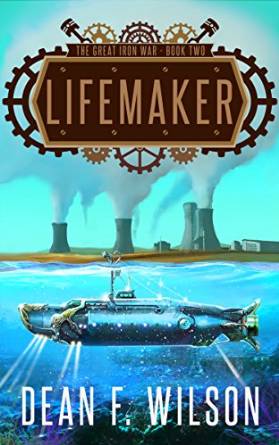
The Regime is on the hunt, forcing the Resistance to take refuge aboard the Lifemaker, an advanced submarine that houses a special cargo: a handful of women who can still give birth to human children.
To evade the Regime’s own submersibles, all parties must work together, but tensions are high, and not everyone on board is looking out for the greater good.
As they descend into the deeps, they quickly learn that not all monsters work for the Regime.
Send to Kindle
May 29, 2015
New Story Available: The Revenant of Wrecker’s Dock
May has not been a good month for me writing-wise. Nonetheless, I did manage to publish a new story, a nice little sailor’s yarn with a dash of zombies or rather revenants.
So what are you waiting for? Make yourself a good hot mug of grog, our it into a Tiki mug if you have one (and I totally want a Tiki mug now), though any other mug will do as well, and settle down to visit the seaside town of Hallowind Cove, Harbour of the Weird, and meet one of the local tourist attractions, The Revenant of Wrecker’s Dock.
 Strange things keep happening in the permanently fog-shrouded seaside town of Hallowind Cove, earning it the nickname “Harbour of the Weird”.
When Paul comes Hallowind Cove, after inheriting an old house from an uncle he barely knew, he doesn’t put much stock in those stories. But then he finds himself hunted by an angry zombie, who is looking to avenge a century-old crime…
List price: 0.99 USD, EUR or GBP
Buy it at Amazon US, Amazon UK, Amazon Germany, Amazon France, Amazon Netherlands, Amazon Spain, Amazon Italy, Amazon Canada, Amazon Australia, Amazon Brazil, Amazon Japan, Amazon India, Amazon Mexico, Kobo, Barnes & Noble, Apple iTunes, Scribd, Oyster, Smashwords, Inktera, txtr, Thalia, Weltbild, Hugendubel, Der Club, Libiro, Nook UK, DriveThruFiction, OmniLit/AllRomance e-books, Casa del Libro, Flipkart, e-Sentral, You Heart Books and XinXii.
Send to Kindle
May 25, 2015
Sirens in the Night
Yesterday at shortly after midnight, I was sitting at my PC trying to write, when suddenly the fire sirens went off. Since I live in a semi-rural suburb, we still have a volunteer fire brigade that is assembled via sirens installed on various rooftops around town (though they also have pagers and probably other alarm systems as well). These sirens are really, really loud, but not exactly uncommon and most of the time they don’t announce anything more dramatic than a burning trashcan.
A few minutes later I heard more sirens, this time of the fire trucks. Again, this was only to be expected. Though the trucks did pass fairly close by my house. Then, barely a minute later, there were more sirens and more fire trucks, suggesting that the volunteer fire brigades of neighbouring villages had been alerted as well. So whatever was going on, it was clearly a bigger fire.
By now I got curious and looked out of every first floor window, trying to find out what was going on. But though I could make out the approximate direction in which the fire trucks were moving (there were steadily more of them, too, at least several villages worth), there were no first floor windows in that direction. So I unlocked the front door and went outside to take a look. I wasn’t the only one who had that idea either, since the lights came on in several neighbour houses.
Outside, I could still hear the sirens and – more worryingly – something that sounded like distant explosions. I could also make out what looked like a smoke plume in the otherwise clear nightsky, which worried me a tad.
Since I couldn’t make out anything more, I went back indoors to check the websites and Twitter feeds of various local news organisations. Alas, it was half past midnight on a holiday weekend, so pretty much everybody was asleep. Nobody else seemed to know anything either.
Meanwhile, there were still more fire engines arriving. The sirens went off twice more to rouse even the last firefighter from their sleep.
I went downstairs again and this time I could make out a distinct fireglow as well as a smoke plume in the nightsky. I also heard more distant explosions and I could smell smoke.
By now I was pretty worried, so I checked Twitter again. At 1 AM I finally found this message on the stream of a news agency specializing in disaster footage.
+++ AKTUELL +++ Großbrand in Brinkum
Zur Stunde steht das Gelände eines Recyclinghofes in Brinkum lichterloh in… http://t.co/XjJIDOfvoV
— NonstopNews (@NonstopNewsTeam) May 24, 2015
Turned out that a recycling facility approx. three kilometres from my home was on fire. More than two hundred fifty firefighters from the entire region did their best to stop the fire – they even drafted one of the big airfield fire engines from Bremen Airport (which was closed for the night anyway, so it’s not as if they will miss it). The fireglow and smoke plume could allegedly still be seen from twenty kilometres away. Luckily, the recycling facility is located inside an industrial park, so there were no homes in danger, though a nearby animal shelter had to be evacuated. No casualties either, thank goodness, even a cat that had been on the premises managed to get away. The fire is still burning, too, and the smoke hindered traffic on the adjacent highway throughout the day.
Here is a report from the news agency that first reported about the fire and here is the report with lots of photos from the local fire brigade.
There is a video, too:
I actually know the recycling facility, since I’ve been in the industrial park before, e.g. to buy screws at a hardware wholesaler right next door. The company has a good reputation as far as I know.
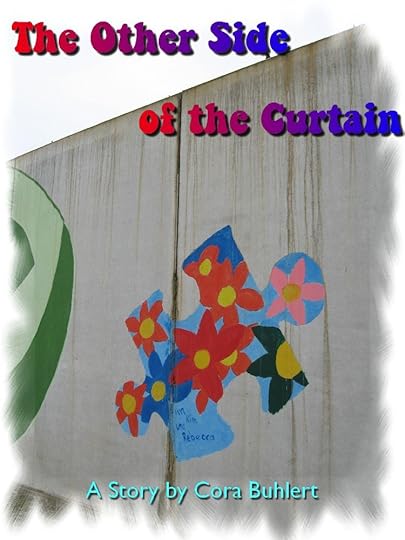
What is more, the massive concrete walls around the facility, which likely saved adjacent buildings and businesses from the fire last night, actually featured on the original cover for The Other Side of the Curtain, standing in for the Berlin Wall.
Send to Kindle
May 23, 2015
Eurovision 2015 – Blandness wins and blandness loses
This weekend is not just a long weekend in both Germany and several other European countries (Pentecost/Whitsun) as well as the US (Memorial Day), it also happens to host one of the biggest global TV events in the world, the 60th annual Eurovision Song Contest. For my impressions of previous contests, please click on the Eurovision tag.
This year’s contest was hosted in Vienna for the second time since 1967, following last year’s win by the fabulous non-binary singer Conchita Wurst. Conchita was co-hosting this year and also presented two new songs as part of Austria’s attempt to present itself as a diverse and inclusive country. And at least on stage, Austria certainly managed to make itself look diverse. The three-women (plus Conchita) hosting trio of television personalities Alice Tumler and Arabella Kiesbauer (who hosted a popular chat show in the 1990s) and actress Mirjam Weiselbraun included two women of colour and the orchestra that played during the break consisted of musicians from many European and non-European countries. What is more, in the run-up to the contest, Vienna installed traffic lights featuring same-sex couples all over the city.
It’s all very well intended and glosses over the fact that Austria still doesn’t have full marriage equality, that same-sex couples are banned from adopting children except in rare circumstances, that earlier this year, a lesbian couple was kicked out of a famous coffeehouse for daring to – gasp – kiss in public and that one of Austria’s most popular singers, Andreas Gabalier, has been making headlines complaining about what he calls “gender madness” by rewriting the Austrian national anthem to remove the line “brothers and sisters” and generally whining about his fate as a poor, put-upon heterosexual man. So in short, the backlash against a bit more diversity is in full swing.
However, this conservative backlash didn’t change the fact that Austria put on a great show yesterday evening. The Eurovision Song Contest isn’t the Hugo Awards after all. Everything was very slick and very professional, but the most recent contests have been, regardless of the host country. I also liked the homage in the opening minutes to Austria’s first winner Udo Jürgens, who won the Eurovision Song Contest in 1966 with “Merci Cherie” (Doesn’t he look like a Vulcan in that clip?) and went on to have a distinguished career in the German speaking world before dying earlier this year.
The standard of music was once again surprisingly high this year. There were no real WTF? entries in the finale – the ones that made it through were likely weeded out during the semi-finales. A few performances were a tad weird, such as the Azerbaijani werewolf, the Spanish Little Red Riding Hood and the Georgian lady whose costume made her look like an extra from Flash Gordon, but even those performances had a very high standard in general and Azerbaijan was actually in my personal top five this year. In general, the worst you could say about most songs was that they were kind of bland and samey. Several songs still seemed to copy the 2012 winner Euphoria by Loreen, a song I never particularly liked in the first place. There also were a couple of earnest songs about world peace – apparently, it’s 1982 all over again.
The winner this year was Sweden with a cute guy named Måns Zelmerlöw and a song that was so forgettable I spent most of the voting period trying to remember what the song had been. When Zelmerlöw performed his song again at the end, I realised that it actually wasn’t bad at all. The performance was nice as well and had Zelmerlöw dancing with CGI stick figures and turning into a butterfly. Nonetheless, I still couldn’t hum the song or tell you much about it beyond the fact that it was something about heroes.
Russia finished in second place with the usual sacrificial virgin in white. At least, the virgin could sing and she wasn’t booed on stage (which is just a mean thing to do, regardless what you think of Russian politics), though the German commentator got pretty snarky about the fact that sacrificial virgin was singing about world peace. What is more, the Russian entry was also pretty bland in my opinion and didn’t stand out at all.
Italy, which finished third, was a personal favourite along with Norway, Latvia and Romania. Australia, which has apparently joined Eurovision by now, finished fifth for their debut with a pretty good song.
Meanwhile, the German contestant Ann Sophie and her song “Black Smoke” tied for last place with the Austrian contestant The Makemakes, both managing to win a stunning zero points. And to make matters worse, the German commentator even got her name wrong and called her Ann Marie.
This is really rather unfair, for Ann Sophie wasn’t bad at all (and did seem to channel Modesty Blaise on stage) and the Makemakes were actually pretty good. Okay, so Ann Sophie’s song “Black Smoke” was pretty bland, but so were many other contestants. In fact, I don’t see much of a quality difference between Ann Sophie and the Russian singer who finished in second place.
Ann Sophie’s participation was somewhat controversial, since she did not actually win the German primaries. A singer named Andreas Kümmert did and promptly withdrew. Personally, I think Andreas Kümmert’s song was better and also would have stood out more in a sea of women singing dance numbers and power ballads. However, Kümmert himself is also apparently somewhat unstable and recently made headlines by making a tasteless joke about paying a hitman to take out his former manager.
This article from Die Welt argues that Ann Sophie’s zero point debacle is part of the larger issue that Germany simply cannot put forward promising candidates unless Stefan Raab is involved. I’m inclined to agree, especially since Ann Sophie had very little backing in Germany as well. I didn’t even hear her song on the radio until a few days before the contest.
So where do we go from here? I don’t know. It’s certain that Germany will be back next year, since we have an automatic place in the final (along with the UK, Italy, Spain and France) due to paying for a huge chunk of the spectacle. Let’s just hope that whoever sings for Germany in 2016 at least manages to win a point or two.
Send to Kindle
May 20, 2015
Of Outlander, Sex and the Female Gaze
I finally got around to watching the first few episodes of the TV adaptation of Diana Gabaldon’s Outlander series.
I was rather sceptical, when the series was first announced, partly because I’m not the world’s biggest Outlander fan and partly because I’m still angry at Ron D. Moore for what he did to my childhood favourite Battlestar Galactica.
Ron D. Moore has allegedly promised to remain more faithful to the source material with Outlander than with Battlestar Galactica (well, it’s hardly possible to be less faithful to the source material), since his wife is apparently a fan of the books. And at least based on the first few episodes, he kept that promise (with one notable exception), because the Outlander TV series follows the novel quite closely so far.
Talking of which, I was surprised how much I still remembered about the novel, considering I read the book more than ten years ago under the UK title Cross-Stitch and didn’t even like it all that much. But even though I didn’t particularly care about the book or at least don’t love it as much as many others do, it was clearly memorable enough for me to remember details about the plot after more than ten years.
Outlander, the TV series, is clearly the sort of well-made production we have come to expect from US “quality” TV drama. Catriona Balfe, Sam Heughan and Tobias Menzies are all fine actors and fitting for their respective roles. The Scottish landscape, shot on location in the highlands, is lovely. The historical anachronisms aren’t too bad – never mind that the novel has its share of those as well. The Gaelic dialogue snippets are supposedly quite accurate – not that I could tell.
However, Outlander is broadcast on an American cable channel, a HBO wannabe named Starz, which seems to be mainly known for historical dramas low on the history and high on blood, guts and bare skin. They broadcast the Spartacus TV show, the pirate show Black Sails, of which I couldn’t watch more than ten minutes, a Mad Men wannabe named Magic City that I found equally unwatchable and a Camelot series that I’ve never seen, but that looks pretty dreadful. Coincidentally, Starz also resurrected Torchwood for its final, Americanized season, which managed to surpass even the low points of the previous two seasons (since I actually liked season 1).
In this company, Outlander actually looks pretty good, plus it fits in with the historical drama focus of the broadcaster. However, we’re still talking about an American subscription cable channel here. And that means we’re getting what I’ve once jokingly dubbed HBO sex, since US pay-TV cable channels like HBO inevitably seem to use more or less gratuitous sex scenes as a means to lure in new subscribers. For even though the public image of HBO is that of a haven for high quality TV drama, the sex scenes are actually a large part of the appeal for many viewers, as the fact attests that the above-linked post is frequently found by people typing variations of “HBO shows with lots of sex” into Google.
Starz is no HBO, so they probably have to resort to the “sex sells” ploy more than its more highbrow rival. And so, barely ten minutes into episode 1, we get a scene of Claire Randall receiving oral sex from her 20th century husband Frank on a random table while exploring a ruined castle. It’s a scene that’s not in the book (or at least I don’t remember it being inside the book, since I don’t remember any explicit sex scenes between Claire and Frank in the first book) and that doesn’t make a whole lot of sense either. At any rate, I’ve never felt the desire to have sex while exploring ruined castles – and trust me, I’ve visited my share. There’s another sex scene between Claire and Frank later in the first episode, though this time at least they choose a comfortable looking brass bed in an B&B in Inverness over a hard table in a drafty castle ruin.
Now as anyone who’s read the novel can attest, there’s actually quite a lot of sex in Outlander, but it only occurs well into the novel from about the halfway point on. The TV show, on the other hand, dumps two sex scenes into the first thirty minutes or so.
It’s pretty much the same tactic used for True Blood, the TV adaptation of Charlaine Harris’ Sookie Stackhouse novels (and True Blood actually was on HBO). Frontload the first half hour or so of the first episode with sex to grab those viewers. At least, the sex in Outlander looks more pleasant than the usual joyless, furniture bumping HBO sex, though both I and the friend I watched with rolled our eyes at the oral sex scene and the absurd setting for it.
Once Claire travels back into the 18th century, the sex takes a backseat (for now, at least) and the plot begins in earnest. We do get a brief scene of Claire undressing and several scenes (which actually do fit into the plot) of the camera lingering on Jamie’s impressive physique.
“He’s handsome”, my friend, who hasn’t read the books, said.
“Well, that’s the point”, I replied.
In the US media, there’s been quite a bit of discussion about the sex scenes in Outlander, especially compared to the sex scenes in other pay-TV cable shows such as Game of Thrones, Masters of Sex, Girls, etc… Jenny Trout points out that the sex scenes in Outlander are largely rendered from and for the female gaze, hence also the camera lingering on Jamie’s impressive body. Jodi McAllister calls Outlander a show featuring a female gaze that’s both romantic and radical, while Maureen Ryan views Outlander as part of a whole wave of shows featuring sexually unapologetic women that according to her also includes Girls (which I dislike), Masters of Sex (ditto), Transparent (which I haven’t seen) and Orange is the New Black (which I have zero desire to see, because we’ve already had ten seasons of a women’s prison TV show in Germany, so I’ve literally been there, watched that).
I agree that Outlander caters to the female gaze a lot more than the usual US “quality” drama. For comparison, view the fact that Game of Thrones features a lot more random boobs in the back- and foreground than random abs, let alone the by now infamous sexposition scenes where people talk about worldbuilding details while having sex, usually focussing almost exclusively on female bodies. And Mad Men often deliberately shoots scenes so that the viewer never gets the chance to admire the rather handsome form of Don Draper, which may be due to the fact that actor Jon Hamm was allegedly uncomfortable with such scenes.
We’re also seeing more filmic catering to the female gaze in general of late, though the examples I’d name aren’t Girls or Masters of Sex (both of which make sex look singularily unpleasant) but the current superhero movie and TV boom. Now women make up a huge part of the audience for Marvel’s and DC’s superhero movies and TV shows and IMO a large part of the reason for that is that for all their issues, today’s filmic superhero offerings are a lot more female-gazy than similar works in the past. Witness how often Thor or Steve Rogers or Oliver Queen or Tony Stark find excuses to take off their shirts, whereas in Tim Burton’s 1989 Batman Michael Keaton’s only shirtless scene takes place in the semi-dark. The female gaze in superhero films is quite blatant, too, at times. Thor literally blinds Jane and Darcy with his muscles, our first glimpse of post-transformation Steve’s impressive chest is from Peggy’s POV (and don’t forget the lengthy butt shot that’s our first glimpse of Steve in The Avengers) and we often watch Oliver training from Felicity’s POV. Another really blatant example of the female gaze in film happens in Pacific Rim, where Mako Mori’s first encounter with Charlie Hunman’s character (it’s probably telling that I can’t remember his name) has Mako clandestinely watching “Charlie” undressing and training with the camera taking Mako’s POV.
So I’d argue that the female gazy scenes in Outlander are not quite as revolutionary as some of the commentators I linked to above claim, but rather part of a larger trend, though given the male-centric world of US pay-TV cable drama, Outlander is still a step forwards.
I also wonder at whom the two sex scenes between Claire and Frank in the first episode were really aimed. Because no one who’s read the books was all that keen on watching Claire and Frank have sex – indeed, there is a reason why the books don’t go into a lot of detail regarding Claire’s and Frank’s sex life. Plus, frontloading the first episode with sex to hook viewers also strikes me as a tactic more aimed at male than female viewers. As for that oral sex scene on the table in the castle, maybe there actually are viewers who have this fantasy, but my friend and I, both of us heterosexual women, found it rather eye-rolling and uncomfortable looking, though at least it was tastefully shot.
If anything, it seems to me as if Outlander is trying to hook both male and female viewers – not that there’s anything wrong with that. And one thing I have noticed is that a lot of men, who’ve never read the books and likely won’t ever read them, seem to be watching and enjoying Outlander, which is a good thing IMO, because Diana Gabaldon is one of those hugely successful female SFF authors who don’t seem to be on the radar of the largely male-dominated SFF sphere at all.
Send to Kindle
May 10, 2015
New story available: The Four and a Half Minute Boiled Egg
Regular readers of this blog as well as the Pegasus Pulp blog may recall that I occasionally enjoy doing writing challenges such as the eight hour fiction challenge.
The story I want to announce today (which I actually should have announced two weeks ago, except that life got in the way) is the result of another writing challenges, namely the “Not Really SF Short Story Challenge” issued by writer E.P. Beaumont.
As anybody who has not been living under a rock this past month may have noticed, the SFF sphere is currently embroiled in a huge controversy due to some rightwing US fans and writers unable to cope with the fact that the genre is shifting away from their particular preferences.
One of the complaints raised is that SFF has been invaded by literary fiction and that awards and other accolades increasingly go to works that are “literary” rather than good old proper SF.
The “Not Really SF Short Story Challenge” is a response to these complaints and proposes a counter-invasion of literary fiction by SF. The idea behind the challenge is to write a perfectly mundane short story, the sort you might find in any literary fiction mag, but write it in the clunky style of Golden Age science fiction complete with “As you know, Bob…” dialogue and overexplanation of every single bit of technology the characters interact with, no matter how mundane.
I really liked the idea of the challenge, so the next thing I needed was a story. And the first idea that popped into my mind was, “Why not write a story about a couple arguing at the breakfast table, something like Loriot‘s ‘Breakfast Egg’ skid, only with extensive explanations of everyday household technology?” And then I thought, “Why the hell don’t I simply take ‘The Breakfast Egg’ and do an SF-nal parody of the skid?”
Das Frühstücksei (The Breakfast Egg) is a short skid by the brilliant German comedian Vicco von Bülow a.k.a. Loriot. If you’ve lived in Germany for any extended time in the past forty years, you’ll have come across The Breakfast Egg at some point. It frequently shows up on TV in compilation of Loriot skids and it’s a staple of German textbooks along with another Loriot skid, Die Bundestagsrede (The parliamentary speech).
Personally, I don’t think either of these skids are particularly good choices for highschool textbooks, for while many Loriot skids are suitable for all ages, “The Breakfast Egg” is not one of them. And “The Parliamentary Speech” requires more insight into politics than teens usually have. Never mind that broadcasts of parliamentary debates are no longer as ubiquitous as they used to be in the three TV channel era of the 1970s and 1980s and have largely been relegated to niche channels no one watches, so many teens will never have seen more than very brief clips.
However, while “The Breakfast Egg” may not the best text for highschool students, it’s still a brilliant bit of comedy and also the ideal basis for a mundane story (for what could be more mundane than a long married couple arguing at the breakfast table) told in the style of Golden Age science fiction.
The result is The Four and a Half Minute Egg (because that is how long the breakfast egg from the skid was supposed to be boiled), 3500 words of prime technobabble embellishing 379 words of plot (I checked).
The story required quite a bit of research, because it turned out that I didn’t know what Formica actually is, how the heat resistant glass from which coffee pots are made works and a lot of other stuff about common household technology. For maximum alienation, any biological specimen mentioned (cows, chickens, coffee beans, wheat) are referred to exclusively by their scientific name. And BTW, it’s depressing that the top ten search results for “wheat” (I needed the official Latin name) are all for books and articles of highly dubious scientific merit explaining why wheat is totally evil and bad for us and will kill us all.
So I give you:
The Four and a Half Minute Boiled Egg Bertha and Alfred, married for twenty years, enjoy all a truly science fictional life in the twenty-first century. But in spite of all the technological marvels surrounding them, an argument at the breakfast table about egg boiling times escalates and threatens to end their marriage.
This parodistic piece is a mundane short story of 3500 words, written in the style of science fiction’s “golden age” of the 1940s and 1950s.
More information.
Length: 3500 words
List price: 0.99 USD, EUR or GBP
Buy it at Amazon US, Amazon UK, Amazon Germany, Amazon France, Amazon Netherlands, Amazon Spain, Amazon Italy, Amazon Canada, Amazon Australia, Amazon Brazil, Amazon Japan, Amazon India, Amazon Mexico, Kobo, Barnes & Noble, Apple iTunes, Scribd, Oyster, Smashwords, Inktera, txtr, Thalia, Weltbild, Hugendubel, Der Club, Libiro, Nook UK, DriveThruFiction, OmniLit/AllRomance e-books, Casa del Libro, Flipkart, e-Sentral, You Heart Books and XinXii.
Send to Kindle
Cora Buhlert's Blog

- Cora Buhlert's profile
- 14 followers

