Phil Simon's Blog, page 25
May 18, 2021
Episode 30: HR and Hygge With Zendesk’s Danielle Newton
[image error]Danielle Newton is the Global Director, Workplace Experience at Zendesk. She joins me for an illuminating chat about remote work, Hygge, location designations, and how her company has handled this vastly new work environment.
The post Episode 30: HR and Hygge With Zendesk’s Danielle Newton appeared first on Phil Simon.


May 17, 2021
Does using collaboration hubs correlate with better outcomes?
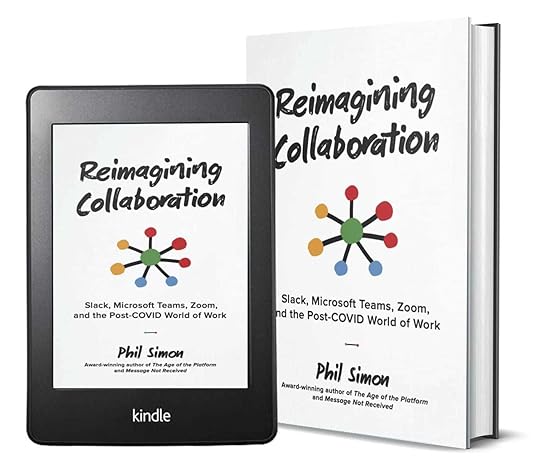 One of the key tenets of Reimagining Collaboration is that the use of internal collaboration hubs correlates with better outcomes. That is, all things being equal, projects in which participants routinely use Microsoft Teams, Slack, Zoom, and Google Workspace will yield superior results than their email-based counterparts.
Since the book’s publication earlier this year, both Microsoft and Slack’s Future Forum have released interesting research on the future of work. Among their findings, internal collaboration hubs will play critical roles as organizations build digital headquarters and manage hybrid workforces.1
I like to think that my books connect dots that others miss. Analysis and synthesis are powerful arrows in the quiver for non-fiction writers. Yep, I do my homework in the form of reviewing existing academic and industry research. Although my books contain original case studies, I simply don’t possess the access, data, and resources required to do anything remotely resembling an industry-wide analysis all by my lonesome. My focus is on original ideas and qualitative research, not quantitative research. Gartner or Forrester I am not.
That doesn’t mean, however, that I my books represent the sole outlet for my contributions, thinking, and analysis.
Specifically, I was curious about two things:
How my own projects and partnerships have gone over the past few years.The extent to which my clients and partners use the very collaboration tools that I espouse—at least with me.In this post, I go down the rabbit hole and answer a modest question: In my little universe, does others’ use of new collaboration tools ultimately correlate with better project outcomes?
MethodologyI began by exporting the last two years of data from my accounting application. Two years seemed reasonable given the recent rise of new collaborative tools. If a project didn’t go well in 2012, it’s hard to cite a stubborn resistance to using Slack because, you know, it didn’t exist yet.2
I then ranked my interactions with partners and clients across these two dimensions: outcomes and the use of new collaboration tools. I placed outcomes into three simple buckets:
Unsuccessful: Worlds collide.Moderately successful: The project met its objectives, but there’s a low probability that we’ll undertake another.Successful: The client or partner was pleased. In all likelihood, we’ll work together again.To minimize the chance of pesky survivorship bias, I included prospects and potential partners. I kept them in my dataset even if we ultimately didn’t wind up walking down the aisle together.
Now, on to the second dimension. I ranked others’ use of new collaboration tools as follows:
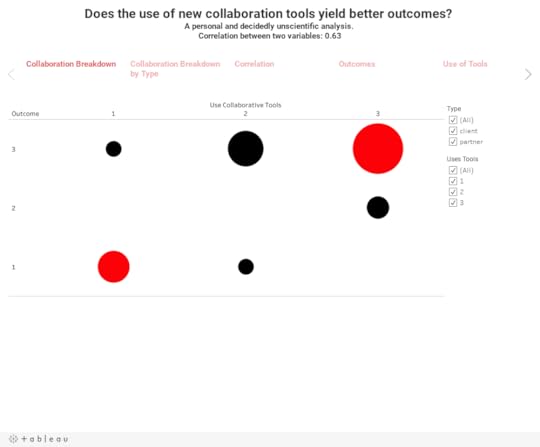
Refused to use them and instead relied upon the scourge that is email. Get in your time machine, grab your PalmPilot, and fire up Netscape and AOL because we’re returning to 1999. If I’d suggest using an online calendar link to book time with me, they’d balk.3 To be fair, however, sometimes they were willing but not able to use new tools due to corporate policies and rigid IT departments.Displayed a willingness to use collaboration tools, but only to a limited degree. For example, individuals would fire up Slack, Zoom, or Teams, but only after I suggested them or prodded them. Sometimes they’d send me emails in lieu of direct messages (DMs). Baby steps…Gleefully—and permanently—swap out email for internal collaboration hubs. What’s more, many of them would send me their own Calendy links before I had the chance to send them mine. At a high level, these saints not only understood the Hub-Spoke Model of Collaboration, they embraced it.DataBased on my analysis, I created five interactive data visualizations in Tableau:
 var divElement = document.getElementById('viz1621174439353'); var vizElement = divElement.getElementsByTagName('object')[0]; vizElement.style.width='1000px';vizElement.style.minHeight='827px';vizElement.style.maxHeight='1026px';vizElement.style.height=(divElement.offsetWidth*0.75)+'px'; var scriptElement = document.createElement('script'); scriptElement.src = 'https://public.tableau.com/javascript... vizElement.parentNode.insertBefore(scriptElement, vizElement);
 View the dataviz on Tableau Public.
Results and FindingsFirst and as expected, the use of collaborative tools correlates positively with successful outcomes. (See the red circles in first dataviz.) Only once did an engagement go well when the individuals demanded that our interactions take place exclusively via email. Conversely, when we used proper collaboration hubs, the outcome was unsuccessful exactly zero times. 
I’ll cop to playing a major role here. I nudge people in my orbit to embrace these hubs—sometimes not all that subtly either. I’m usually able to read the room and, on occasion, dial things down when necessary. At the same time, though, I won’t pretend that Slack and its ilk don’t exist. Without question, my hub-oriented mind-set affects the outcomes.
Better collaboration tools tend to yield better collaborations and better outcomes.
Second, the opposite holds true: I look back on recent projects that went well and, almost without exception, most of our communications took place in Zoom, Slack, or Microsoft Teams. Google Docs, Asana, Canva, and Docusign also make regular appearances. Put bluntly, we all realize that email is not a Swiss Army Knife.
Case in point: A new webinar client. In total, over the past three weeks, I have received a grand total of two emails from company personnel:
An initial services inquiry via my website.An invitation to join the company’s instance of Microsoft Teams as a guest.That’s it.
Next and as you can see on the fourth tab, real and prospective partners scored about 20 percent higher on the outcome scale. Finally, when it comes to the use of collaborative tools, my clients scored almost as well my partners did. I’m still processing both of these findings.
LimitationsAt the risk of stating the obvious, my analysis wouldn’t withstand peer review for a bevy of reasons. (Cue Dirty Harry quote.) Although instructive, it suffers from a number of limitations.
Small Sample SizeEnough said.
Selection BiasIt doesn’t take a rocket surgeon to see the elephant in the room: selection bias. Specifically, I get to choose the people with whom I work. Should prospective partners vehemently oppose adopting new tools, then I can cut bait. As an aside, it would be interesting to see what happens at large consulting firms. As I know from personal experience, rarely do you get to choose your projects.4
Measurement BiasI’m the one doing the categorizing. That is, I alone decided if an outcome was moderately or highly successful. I cannot claim to be entirely objective. #self-awareness
What I’m MeasuringI’m measuring outcomes, not effort. It’s not a trivial distinction. In a few instances, the gigs turned out well, but individuals’ refusal to use collaboration tools made things more difficult. I can think of a few instances in which a five-minute Zoom call would have obviated six emails. Ditto for sharing a Google Doc vs. emailing attachments back and forth.
Lack of Random AssignmentIt’s not like I decided to run an experiment on my clients and partners. Some people on the list have worked with me for years in different capacities.
Correlation <> CausationAre projects successful because people use collaboration hubs? Or does the arrow go in the either direction? Oh, and I can’t rule out any confounding variables.
Simon Says: Better collaboration + better outcomes.The answer to the question that I posed at the start of this post is yes. Despite the limitations of my analysis, the use of new collaboration tools correlates with successful outcomes.
FeedbackWhat say you?
The post Does using collaboration hubs correlate with better outcomes? appeared first on Phil Simon.
May 12, 2021
In Which I Stitch Together Booleans, Books, and Influence
Regardless of the specific language, in computer programming you’ll quickly encounter Booleans. I’m hardly a proper software developer, and I’ve known as much for more than 30 years.1
As you can see below, the and statement connotes exclusivity.
[image error]Image from lotame.com
I often think about Boolean logic in the context of books and the coaching work that I do. Specifically, the power of exclusivity and the and statement.
Let me take a step back. Since the advent of the Web, it’s only become easier to express your views. Let’s say that you feel a certain way about a particularly relevant topic like the future of work.
Scenario AYou’ve got a mainstream opinion on the subject and you post it on Facebook, LinkedIn, or Twitter.
Great. So does just about everyone else. That doesn’t distinguish you from anyone.
Scenario BExtra ands matter.
You’ve got a unique perspective on the future of work.
All things considered, you’re in a better spot compared to the previous scenario.
Scenario CYou’ve got a unique perspective on the future of work and you’ve crystallized your thoughts in the form of a book.
That extra and is a big deal. You’ve just put yourself in a elite company: Amazon currently lists nearly 1,000 books on the future of work.
Scenario DTo recap, you’ve got a unique opinion on the future of work and you’ve written a book on the topic. Time for two more ands:
and your book is well-written and -researchedand you’ve nailed the title and subtitleAll of those Amazon books don’t’ meet these criteria.
Simon Says: Extra ands matter.Again, there are no guarantees, but this last scenario yields the best chance to turn your idea into multiple revenue streams —speaking, consulting, writing, and training most readily come to mind.
FeedbackWhat say you?
The post In Which I Stitch Together Booleans, Books, and Influence appeared first on Phil Simon.
May 11, 2021
Episode 29: Psychological Safety With Author Leo Bottary
 Leo Bottary joins me for a multifaceted discussion on management, collaboration, and communication. He’s the author of three books, most recently Peernovation: What Peer Advisory Groups Can Teach Us About Building High Performing Teams. We talk about servant leadership, golf, basketball, and organizational learning.
The post Episode 29: Psychological Safety With Author Leo Bottary appeared first on Phil Simon.
May 4, 2021
Episode 28: Workplace Transformation With Nellie Hayat of VergeSense
 Nellie Hayat, head of Workplace Transformation at VergeSense, pops by. We discuss HSBC’s decision to abandon offices for its top brass, performance management, trust, changes in real estate, transparency, and Stripe. WANT EARLY ACCESS TO PODCAST EPISODES?
 The post Episode 28: Workplace Transformation With Nellie Hayat of VergeSense appeared first on Phil Simon.
May 3, 2021
Nailing Your Book’s Title and Subtitle Is Really Hard—and Essential.
It always happens.
At some point when I coach first-time and even experienced authors, the topic turns to their book’s title and subtitle. It’s a matter of when, not if. Often authors suspect that these key words will just magically fall into place.
It’s not an unreasonable belief. After all, some of them have already written meaty manuscripts and detailed outlines. How hard can it be to pick a few of them?
While kismet can happen, it tends to be the exception that proves the rule. In my experience, it’s far easier to write a chapter or even entire section than to scribe the critical ten or so words that do each of the following:
Succinctly capture the essence of your idea.Distinguish your book from the dozens, hundreds, or even thousands of others on the subject.Make people want to know more about it.Convert as many of those curious folks as possible into buyers.Turn buyers into fans.Turn fans into clients.Yes, the combination of a good book title and subtitle accomplishes these lofty objectives.
In this post, I’ll explain the process by which I arrived at the title and subtitle for my new book. It was neither simple nor easy.
BackgroundBy way of background, for this one I had to invoke my contingency plan. As a result, the previous cover, title, and subtitle went by the wayside.
After dozens of iterations and plenty of conversations with friends,1I had finally landed on Reimagining Collaboration—a short and evocative title. By itself, however, those two words are incomplete and devoid of context:
Collaboration with whom?For what purpose?To be fair, though, just about all business book titles make little sense absent their subtitles as a general rule. The Long Tail? Huh? The Long Tail: Why the Future of Business is Selling Less of More? Oh, now I get it.
Exceptions to this rule include classic texts such as How to Win Friends and Influence People and business-related For Dummies guides.(Yeah, I got off easy on titling my previous two books, but I digress.)
Weighing the Risks of an SEO-Friendly SubtitleAt a high level, Reimagining Collaboration focuses on the unrealized power of internal collaboration hubs. I’m talking about Slack, Microsoft Teams, Zoom, and others. Putting the names of these three tools in the subtitle increases the odds that buyers will stumble upon it. For example, perhaps a CEO thinks that employees at her firm are using Teams as E-Mail 2.0 when it can do much more. (She’s right.) As a result, she starts looking for a solution in the form of a book. (More on that later.)
Think of a title and subtitle as complements.
At the same time, though, this move entails a good deal of risk. Flashback to 2014. You are considering buying a social-media book with Myspace in its subtitle like this one. I’ll bet that you passed on it and opted for one that didn’t feel as dated. Brass tacks: Rare is the software application or vendor with extended staying power. Want to bet that people will be still buying books on Clubhouse in two years?
In fact, as Reimagining Collaboration was going to print, Salesforce acquired Slack for nearly $28 billion. (Salesforce is wisely keeping the Slack brand, just as it did when it gobbled up Tableau.) Here’s another complicating factor: Product names change. Google recently rebranded G Suite as Google Workspace. (At least I hadn’t put Google’s G Suite in the book’s subtitle.)
As of early November of last year, the complete name of my book was Reimagining Collaboration: Slack, Microsoft Teams, Zoom, and the New World of Work. Here’s that version of the cover:
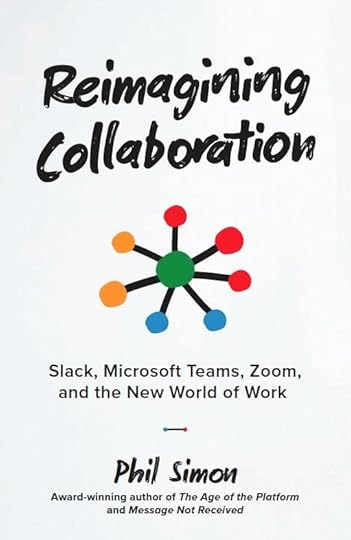
Listing today’s most popular collaboration tools in the subtitle only got me halfway home, though. I hadn’t quite nailed it—and I innately knew it. I needed to properly mark this book in time without using a verbose subtitle.
A One Last Small but Critical TweakThink about it. People have been writing books about the future of work for decades. Here is one from 1992, but that year is arbitrary. What about 1997? Back then, the Web was starting to explode. Ditto in 2007 when the iPhone arrived—followed shortly with Android-based smartphones. Didn’t those events portend massive changes in the mechanics of work? What made my effort about the future of work different from the hundreds of others already out—with scores of others on the way?
Even a single word replacement can yield massive benefits.
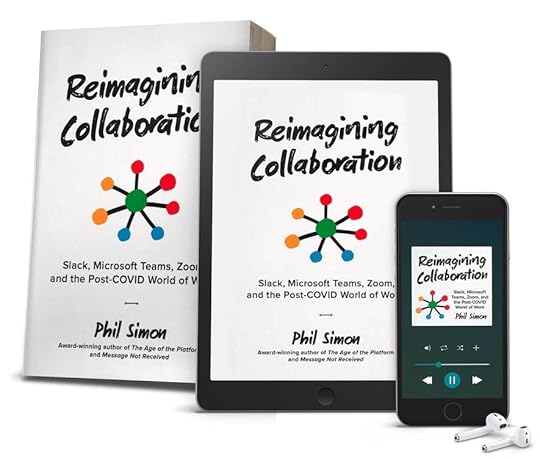
Along these lines and after much wordsmithing, I swapped out the New World of Work with the Post-COVID World of Work. This minor change did two essential things.
First, it clearly indicated to prospective buyers that I wrote this book after the pandemic began—although the very tools in the subtitle suggest as much.2 Second and just as important, it accentuates the fact that many if not most knowledge workers will not return to their pre-COVID work routines. (This New York Times piece details what Google is doing to prepare as its employees return to the office. TL;DR: The changes are significant.)
Here’s the final cover:
If all of this obsessing over adjectives, verbs, nouns, and word orders seems like a great deal of effort, trust your instincts. (As an aside, I drove a few of my friends crazy asking for their opinions. I will be picking up some dinner checks.) When launching a book, you only get one bite at the apple, at least until a second edition arrives. Beyond that, last week provided several reminders of why spending all of this time and effort is so valuable.
First, I signed up a new client for an upcoming webinar. When I asked him how he had found me, he said that he had searched Amazon for post-COVID books about collaboration. Based on my book’s gestalt, he was intrigued and contacted me. (I’m talking about its cover, title, subtitle, book description, endorsements, and reviews.) He’s also purchasing 100 copies. Second, entrepreneur.com listed Reimagining Collaboration as one of 10 New Books for Leading in a Hybrid Work Environment.
I know that the book is resonating with potential readers and finding its audience. A recent and thoughtful Amazon reviewer underscored the benefits that a descriptive, eye-catching, and SEO-friendly title and subtitle that fastidious authors strive to attain:
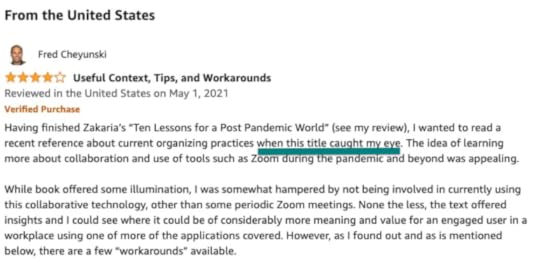
Take away the words in my subtitle, and it’s likely that Fred doesn’t find my book at all, much less buy it, read it, and review it. If a tree falls in a forrest…
Simon Says: Intelligently titling your book can pay off in spades.The naming process can be time-consuming and downright frustrating, even for repeat authors. Fight through it. The juice is worth the squeeze.
FeedbackWhat say you?
The post Nailing Your Book’s Title and Subtitle Is Really Hard—and Essential. appeared first on Phil Simon.
April 27, 2021
Episode 27: Organizational Rock Stars With Dr. Rebecca Kehoe of Cornell University
 Dr. Rebecca Kehoe joins me. She is an Associate Professor of Human Resource Studies at Cornell University. We talk about her research into stars, whether the pandemic has given them more or less power, and companies such as Uber, Google, and Amazon.
The post Episode 27: Organizational Rock Stars With Dr. Rebecca Kehoe of Cornell University appeared first on Phil Simon.
April 20, 2021
Episode 26: Teams and Roosters With Microsoft’s Shiraz Cupala
 Shiraz Cupala of Microsoft joins me. Cupala is the Product Leader for Microsoft Teams Meetings. We talk about AI, machine learning, the power of hubs and spokes, and roosters. 🐓
The post Episode 26: Teams and Roosters With Microsoft’s Shiraz Cupala appeared first on Phil Simon.
April 18, 2021
Custom Editions of Reimagining Collaboration Available
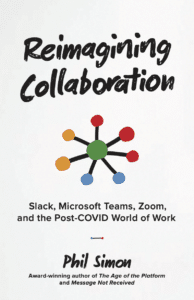 It’s finally happening: Employees are returning to the office. Workers are looking for clarity, flexibility, and, in many instances, a reason to leave their homes.
Brass tacks: It’s no understatement to say that these are unprecedented and disruptive times. Foolish is the soul who thinks that we’re going to return to pre-pandemic work schedules.
Against this backdrop, I’m making custom editions of Reimagining Collaboration available. Here’s how it would work.
Executives agree with the general message of the book. Still, they want to put their own spin on it and give to their employees and/or customers. They’ll do this by writing four- to five-page forewords with their individual takes on the fascinating future of work and what their organization is doing to prepare. Ideally, their takes align nicely with the core themes of Reimagining Collaboration. What’s more, the execs’ names and titles would adorn the cover of this version of the book.1 Finally, we could put the organization’s logo on the cover, probably in the upper right-hand corner.
Here’s a laughably crude mock-up. Final versions will look much better.
 Target Audiences
I can envision a number of different homes for bespoke versions of my book. In no particular order:
Upscale furniture outlets such as Steelcase, Haworth, ELEMENTS, HNI Corporation, Inscape, Officescapes, and Herman Miller. For the most part, these companies are smartly leaning in to the WFH phenomenon. With respect to my book, the opportunity here is two-fold. Employees could receive books as gifts.2 As for consumers, I could also see them as throw-ins with qualified purchases or salable products with SKUs.FedexKinko’s, UPS Stores, Staples, OfficeDepot, and their ilk.Co-working spaces.Hotels.Conferences, even if I’m not speaking at them.HR think tanks such as SHRM. Members could receive as physical copies as part of their annual dues.Universities, especially for exec-education programs.HR consulting outfits such as Mercer and Deloitte.Prefab office manufacturers.Other LogisticsI can envision a number of different homes for bespoke versions of this book.
At the risk of stating the obvious, paperback versions will cost far less than their hardcover counterparts—although both are on the table. To make the per-unit price cost-effective, an organization will need to purchase no fewer than 200 copies. Larger orders will drop the per-unit price considerably. If we hit 1,000, then the number really plummets. Oh, and copies—no matter how many—do not include rights to the book’s intellectual property. That stays with me.
.rv_button.closed:after {content:"\47";}.rv_button.opened:after{content:"\46";} jQuery(document).ready(function() {// Hide the divjQuery('#reveal').hide();jQuery('.rv_button').click(function(e){e.preventDefault();jQuery("#reveal").slideToggle();jQuery('.rv_button').toggleClass('opened closed');});});Please fill out this form and hit submit.
[contact-form-7]
The post Custom Editions of Reimagining Collaboration Available appeared first on Phil Simon.
April 13, 2021
Episode 25: Personas and Executive Alignment With Tamara Adlin
 Author and UX expert Tamara Adlin joins me for a rocking chat. We talk about personas, collaboration, shiny new things, the four stages of competence, and the classic album Pink Floyd Dark Side of the Moon.
The post Episode 25: Personas and Executive Alignment With Tamara Adlin appeared first on Phil Simon.