Phil Simon's Blog, page 23
July 27, 2021
Reimagining Collaboration Wins Indie B.R.A.G. Medallion
 Reimagining Collaboration has won an Indie BRAG Medallion. In this case, BRAG is an acronym for Book Readers Appreciation Group. (I had to look it up.)
This is the book’s second award and my fourth overall. In June, Reimagining Collaboration took home an International Book Award.

Reimagining Collaboration has won an Indie BRAG Medallion. In this case, BRAG is an acronym for Book Readers Appreciation Group. (I had to look it up.)
This is the book’s second award and my fourth overall. In June, Reimagining Collaboration took home an International Book Award.

|
AMAZONBAM!B&NBOOKSHOPBULK ORDERSCUSTOM VERSIONINDIE BOUNDSIGNED COPY AppleAudibleAudiobooks.comChirpGoogle PlayKoboNookThe post Reimagining Collaboration Wins Indie B.R.A.G. Medallion appeared first on Phil Simon.


Episode 40: The Future Office With Chris Good
 Chris Good joins me. He’s the Creative Director at One Workplace. We talk about reimagining the office, going to work to get away from home, and the massive opportunity for companies to differentiate themselves via design.
The post Episode 40: The Future Office With Chris Good appeared first on Phil Simon.
July 21, 2021
Why I Don’t Offer Turnkey Consulting Arrangements
 Six months ago, major questions lingered about the return to work. Even when that happened, how it would play out was anything but certain. (Make no mistake: That doubt still exists today.)
Against this backdrop, an executive at a mid-sized healthcare company contacted me about the role that collaboration technology will play in its future. Specifically, Sophia (a pseudonym) wanted me to create a project plan that detailed each of the following:
The steps that her organization should take to become more collaborative.When it should take them.The criteria by which we could gauge success.Seems reasonable, right?
The Importance of Gathering Essential DataI told Sophia that providing such a plan without any type of discovery phase was an exercise in futility.1 In short, the number of critical variables made such an exercise impossible. Specifically and in no particular order, I wanted to know:
The current collaboration tools that her organization currently used.The tools that it tried to adopt in the past.The results of those efforts.The level of technical sophistication of its employees.Basic but anonymized data on its workforce. (Average tenure is particularly important.)I know the definition of bad business.
No, I’m not nosy, but I wanted to conduct a confidential and comprehensive employee survey before proposing any solutions. I just know the definition of bad business. In this case, an example will illustrate my concern.
A six-month engagement for a small startup already using the rudiments of Slack or Microsoft Teams may be overkill. Conversely, consider a vastly different example: A hidebound organization with risk-averse employees and antiquated business processes. In all likelihood, the latter won’t be able to transform itself in the same time period. Any productivity or efficiency gains are unlikely to stick.
Simon Says: Successful change management eschews a cookie-cutter approach.Ultimately, Sophia didn’t hire me—and I didn’t lose any sleep over it. Even under ideal circumstances, change management is tricky. Tossing in massive uncertainty all but guarantees failure.
FeedbackWhat say you?
The post Why I Don’t Offer Turnkey Consulting Arrangements appeared first on Phil Simon.
July 20, 2021
Episode 39: Organizational Improv With Coonoor Behal
 Coonoor Behal is my guest today. She runs Mindhatch—a firm that using creativity to help companies get better results. She is also the author of I Quit! The Life-Affirming Joy of Giving Up. We talk about the Great Resignation, improv comedy, saying no, and the choices that employees make.
The post Episode 39: Organizational Improv With Coonoor Behal appeared first on Phil Simon.
July 13, 2021
Episode 38: Amazon Unbound With Brad Stone
 Brad Stone is a Senior Executive Editor at Bloomberg News. He joins me this week to talk about his excellent book Amazon Unbound: Jeff Bezos and the Invention of a Global Empire. We talk about automation, HQ2, Prime Studios, fake reviews, Seinfeld, and the tension between creativity and analytics at the world’s largest e-tailer.
The post Episode 38: Amazon Unbound With Brad Stone appeared first on Phil Simon.
July 12, 2021
The Great Resignation Will Hurt Some Firms More Than Others
A frequent topic of Conversations About Collaboration over the last month or so has been the Great Resignation. TL;DR: Millions of Americans are poised to leave their jobs as soon as their employers formalize return-to-work plans. In fact, it’s already happening:
From The Wall Street Journal:
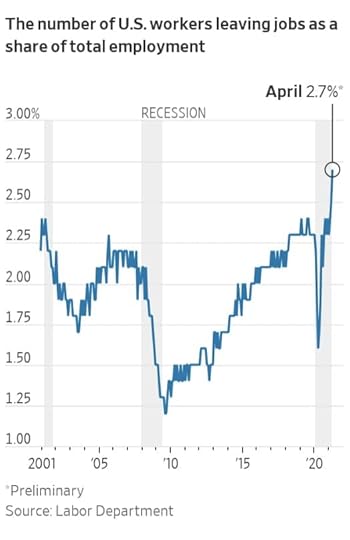
In a word, ouch.
Still, some organizations are poised to weather the employee-turnover storm better than others—and yes, I’ve got a strong opinion on the matter: Companies that have embraced the Hub-Spoke Model of Collaboration will fare far better than those clinging to 90s-style “collaboration” methods.
Here’s why.
A Central Knowledge RepositoryWhat happens to an employee’s inbox when she leaves her company?
IT deactivates her email address and effectively deletes the employee’s valuable correspondence, documents, and decisions. All of it. Poof.
Whoops.
What if those same emails lived on in Slack, Zoom, Microsoft Teams, or another internal collaboration hub? Then they’d remain for all relevant parties to see.
A More Transparent CultureWhen used properly, internal collaboration hubs can promote greater transparency. Employees are more likely to know what their colleagues are doing, when they are doing it, and why. (See previous point.) As a result, it stands to reason that, when an employee leaves, there’ll be less confusion about the following:
Who was responsible for what.How Employee X ran a process or completed a vital task.I can only speak from personal experience here.1 If you think that increased transparency makes an organization more resilient and better equipped to deal with key departures, trust your instincts.
Automated ProcessesWhat happens to an employee’s inbox when she leaves her company?
Automation lies at the heart of the Hub-Spoke Model of Collaboration. Manually entering data into two systems or apps invites errors, takes longer, and generally sucks. Coupled with the transparency angle mentioned above, organizations that have gone all-in on hubs and spokes rely less upon the clandestine, mysterious, and manual actions of an essential employee to make the magic happen.
Increased Ability to Handle ChangeFinally, the Hub-Spoke Model of Collaboration almost always requires change. Researching Reimagining Collaboration, I found very few organizations that have adopted hubs and spokes from day one. (Data startup Tartle is the exception that proves the rule.) I’ll put these companies in Group A.
Next, There’s Group B. Faced with the pandemic, these organizations rolled out new collaboration technologies in a largely reactive way. (It’s no coincidence that the use of Microsoft Teams exploded as we started working from home. Ditto for Zoom.) To be sure, some companies in this group were already using internal collaboration hubs. Still, I’d wager that relatively few of them have gone beyond the basics:
Simplifying antiquated business processes.Automating manual ones.Put differently, only a minority has really reimagined collaboration.
Against this backdrop, I’ll bet that Group A does much better when a few employees—or a few dozen—give notice.
FeedbackWhat say you?
The post The Great Resignation Will Hurt Some Firms More Than Others appeared first on Phil Simon.
July 6, 2021
Episode 37: Making Work More Fun With Corporate Rebel Pim de Morree
 Pim de Morree joins me. He’s the co-founder of Corporate Rebels and co-author of
Corporate Rebels: Make work more fun
. We talk about self-management, employee trust, Spotify, hybrid work, e-commerce, and the world coming around to his line of thinking.
Pim de Morree joins me. He’s the co-founder of Corporate Rebels and co-author of
Corporate Rebels: Make work more fun
. We talk about self-management, employee trust, Spotify, hybrid work, e-commerce, and the world coming around to his line of thinking. The post Episode 37: Making Work More Fun With Corporate Rebel Pim de Morree appeared first on Phil Simon.
June 29, 2021
Episode 36: Trust, Culture, and Teams With Larry English of Centric Consulting
 Larry English joins me. He’s the president of Centric Consulting and the author of
Office Optional: How to Build a Connected Culture with Virtual Teams
. We talk about trust, teams, culture, change management, and hybrid work.
Larry English joins me. He’s the president of Centric Consulting and the author of
Office Optional: How to Build a Connected Culture with Virtual Teams
. We talk about trust, teams, culture, change management, and hybrid work. The post Episode 36: Trust, Culture, and Teams With Larry English of Centric Consulting appeared first on Phil Simon.
June 22, 2021
Should you use e-mail for internal communication?
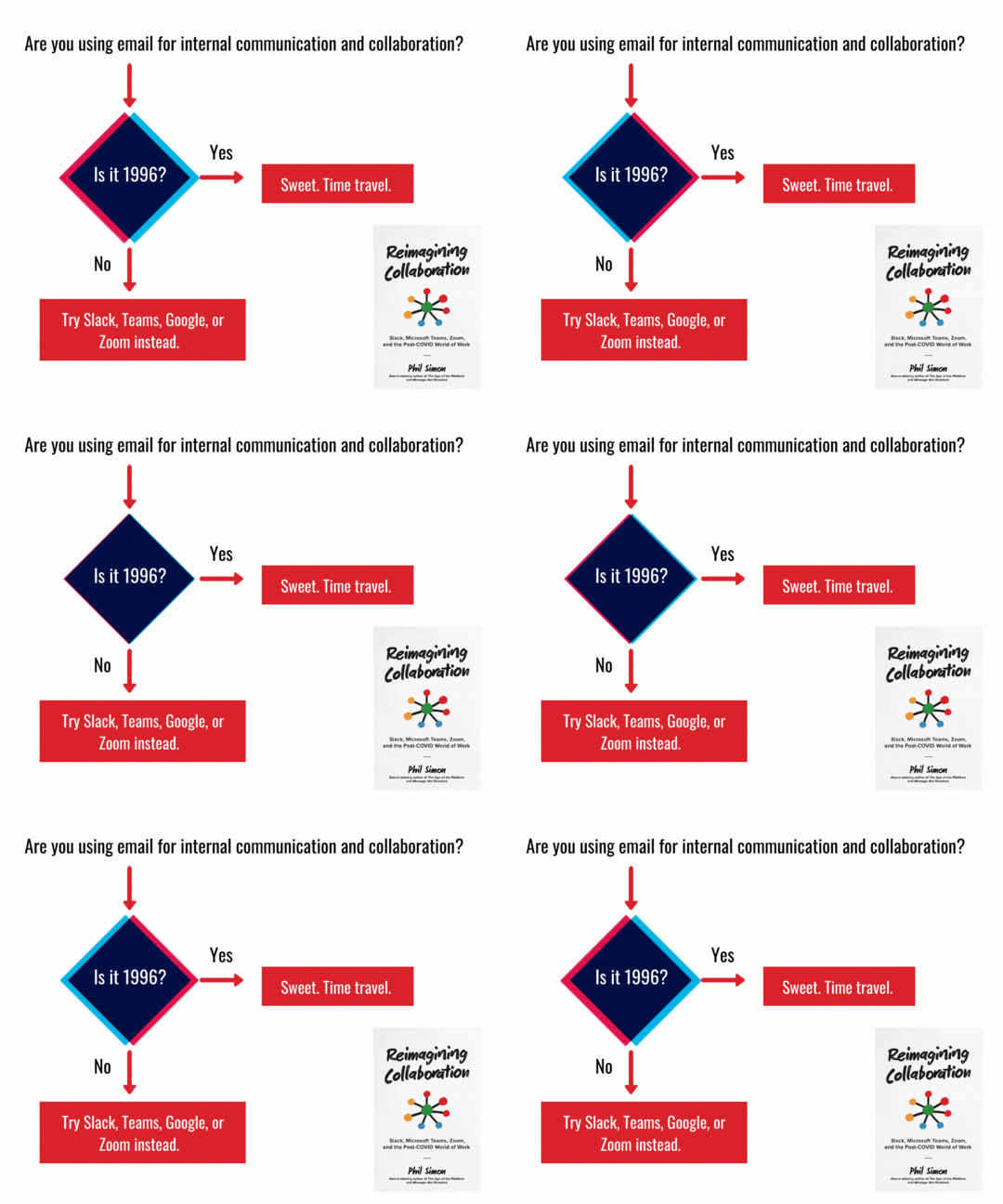
Any questions?
The post Should you use e-mail for internal communication? appeared first on Phil Simon.
Episode 35: Automation, Businesses Processes, and Economics With AirSlate CEO Borya Shakhnovich
 AirSlate CEO Borya Shakhnovich and I discuss the obstacles that inhibit organizations from automating manual business processes. We also talk about small businesses, change management, and the economics of automation.
The post Episode 35: Automation, Businesses Processes, and Economics With AirSlate CEO Borya Shakhnovich appeared first on Phil Simon.