Angela Slatter's Blog, page 57
July 5, 2016
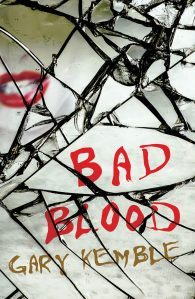
Bad Blood: Gary Kemble
 Gary Kemble’s award-winning short fiction has been published in Australia and overseas. His debut novel Skin Deep was published in 2015 by Echo Publishing. The follow-up, Bad Blood, is out now. When he’s not writing or being a dad, he works as a digital journalism specialist. You can find him on Twitter: @garykemble and Bad Blood will be launched at Avid Reader on Thursday 21 July, 2016.
1. First of all, what do new readers need to know about Gary Kemble?
I’m a Brisbane-based writer and journalist, and I’m drawn to the dark side.
2. How did your first novel, Skin Deep, come about?
I had this concept kicking about in my head for a long time, about tattoos spontaneously appearing on someone’s body. I’ve always wanted to write a series of books about a journalist investigating paranormal events. The two ideas clicked. And then I was extremely fortunate to get an Australia Council grant, which allowed me to take time off work to research and write Skin Deep.
3. When did you first start writing and can you remember the first thing you finished?
I remember in primary school we used to write and illustrate stories and then our teachers would help us turn them into books (in other words staple the pages together). The two I remember most are ‘Back from the Grave’ (about a ‘Master of Weapons’ with a black Trans-Am, battling an evil ghoul) and ‘Lost in Space’ (about a space explorer coming to a grisly end).
4. How did you come into contact with Echo Publishing? 
My wonderful agent Alex Adsett was trying to find a home for Skin Deep. She contacted me and told me she had a publisher interested, but they were a new publisher — so new they didn’t even have a name yet! Skin Deep was Echo’s first Australian fiction title.
5. Who were/are your literary heroes/influences?
Stephen King is a huge influence and inspiration to me. The Shining was the first book that made me genuinely scared. I love Kurt Vonnegut’s books because he breaks the rules and it works. Over the years I’ve read lots of Harry Harrison, Tom Clancy and John Birmingham. Nick Earls also holds a special place in my heart — Zigzag St was the first Brisbane-set book I read that really resonated with me.
6. How did your second Harry Hendrick novel, Bad Blood, come into being?
I’d always envisaged a series of Harry Hendrick books, and I wrote the first draft of Bad Blood before Skin Deep was published. (And I am so glad I did, because I don’t know how I would have gone trying to write the second HH book after Skin Deep was published). Skin Deep was looking like it was doing okay sales-wise so I pitched Bad Blood and Echo, Gods bless them, picked it up.
7. When you’re in the mood to read, who is your first choice?
If I’m after a comfort read I’ll generally pick up a Stephen King classic, like Salem’s Lot or The Stand (not necessarily to read the whole thing). Generally though I’m quite gregarious. I save up a stockpile of books and have a big reading session over the summer holidays.
8. Which book, either fictional or otherwise, would you say taught you the most about writing ?
On Writing by Stephen King. I really appreciated his no-bullshit approach to writing, which boils down to: ‘just write, and never give up’. He also provides an insight into his own development as a writer and a person. I often find myself remembering the anecdote about the rail spike he had in his room as a teenager, which he would use to spike short story rejections.
 9. You invite five fictional characters for dinner and shenanigans: who makes the guest list?
Kilgore Trout, Roland of Gilead, Elizabeth Bennett, Arya Stark and Ash Williams.
10. What’s next for Gary Kemble?
We’re currently in the process of moving back to Brisbane after two years in Scotland. I’m working on book three of the Harry Hendrick series, tentatively titled Stone Cold.


July 4, 2016
Meanwhile, over at Kaaron Warren’s place …
 … I take part in her “Refreshing the Wells” series.
Angela Slatter is an astonishingly good writer. Her story in In Your Face is one of my faves of the year so far, and that’s only one of her excellent stories. I asked her how she refreshed her well.
“As I’m a writer who always has multiple projects (read: deadlines) on the go, I’m also a writer who needs to refill the well regularly. Unfortunately, I’m also a writer who doesn’t always remember to refill the well.
The rest is here.
July 1, 2016
Despatches from KSP – Day 7
Art by Kathleen Jennings
I’ve written before about rejections and how to handle the dent they make in your self-esteem, and I think it’s advice that bears revisiting from time to time. One thing any writer needs to develop (apart from mad writing skills and the ability to respect the deadline) is a thick skin. Not everyone is going to like your writing. Some folk will love it, some will loathe it, some will feel neither here nor there about your hard-won wordage – the only thing you can control is yourself and your reaction.
The thick skin doesn’t mean that you listen to no one – after all, if someone’s correcting your spelling (and they’re correct), it’s not a matter of your artistic integrity being attacked. Be grateful and gracious, say “thank you”; don’t be embarrassed even if the person is a bit of a douche and is trying to make you feel embarrassed – that’s their damage, not yours, their insecurity, not yours.
The thick means that you keep on writing even after you receive a rejection. I do know people who’ve given up after their first rejection. Don’t be one of those people. Write in spite of the rejections because you should always be writing your story – your first draft – for you. You are your first reader, your first audience member. We never learn anything without trying and failing – the greatest teacher in the world is failure. Writing is hard, submitting it to another’s gaze is hard, suffering the slings and arrows of outrageous editors is hard; but the important next step is to work out what went wrong. One of the ways you can do this is to read your rejections. Now some writers will laugh and call this “rejectomancy” a form of scrying as dodgy as peering at the entrails of pigeons, but really there are genuine lessons to be taken away.
So I give you, the Hierarchy of Rejections.
The Bad Rejection
The bad rejection can be a sign of a few things. You’ve sent your sexy nurse story to a gardening magazine. This is also a lesson to research markets and read submission guidelines very carefully. Chances are you may well get a bad rejection from an overworked, underpaid, very tired and impatient editor.
Or it is possible the editor is simply not accepting any more submissions, or stories of a particular type. You might have missed the deadline. There’s also the possibility that your story sucked. It might be a mostly invitation-only anthology with just a few open sub spots, which means you’re competing against a lot of other writers (please note: this is not a reason not to try – by all means submit, it’s good practice and editors may well start to remember your name in a positive fashion).
No rejection should ever say “Please hand in your pencil/pen/quill/stylus/laptop at the door and never, ever write again”, but the sad fact is that sometimes the bad rejection may well be rude or mean. Maybe you got someone on a bad day – you didn’t do anything wrong, you just got caught in the jet stream of an editor’s bad mood (donut shipment didn’t arrive; failure of a project; pet death, etc – you don’t know what’s happening in other people’s lives, so keep a little perspective); or the intern who’s doing the slush reading has an agenda. I once got a rejection letter from the editor of a leading spec-fic magazine that did not mention my story at all, but did offer quite a lot of personal abuse because I had provided an email address for notification of rejection/acceptance in order to save trees. This editor was so moved/offended/drunk that he typed this rejection letter personally, used his own envelope, schlepped to the post office, paid for the stamps himself, and roundly abused me for forcing him to do this. Have I ever submitted to that magazine again? Will I ever submit there again? If asked/begged for a story by that magazine will I ever say “Yes”? The answer to all three questions starts with an N.
The Fair to Middling Rejection
This is your standard “thanks but no thanks” letter. It doesn’t say you’re a bad writer. It just says not this story, not now. Maybe not ever. Maybe you’ve chosen the wrong market. Maybe you need to revisit the story and do a bit of flensing. And once again, some of the reasons listed in the bad rejection section may apply. But do not be downhearted, do not vow never to submit that magazine again. Keep trying.
The Hopeful Rejection
This is the letter that is almost the same as the fair to middling rejection, except it an editor asking if you’ll consider re-working the story, with no guarantee of acceptance. Depending on the extent of the re-writes, give it some thought. Work out if the time investment is worth it for the pay day, and for the time it will take away from working on other stories. And consider whether this re-working can be a good learning experience for you in terms of craft and editing.
The Best Rejection of All
This is the gold standard of rejection letters, the one that says “Okay, not this story, but please send another.” What this means is “This particular story is not for us, but we like your style and ability so much that we want to see something else from you – yes, you! Yes, this is an invitation to YOU. And you know what? This shows we have noticed your work; we will remember your name and, with any luck, you will now get out of the slush pile a little faster.” These are all good things, dear reader-writer; these are not cause for depression.
In Conclusion
Don’t just accept one rejection and assume that’s it for your writing career – your skin cannot be that thin, your ego that fragile. How many rejections is too many? How long is a piece of string? If a tree falls in the forest does anyone hear it? Questions with either no answer or an infinite variety of answers, all of which may be right, wrong or a little of both. How much persistence do you have? Because the best friend of talent is persistence. Personally, I give a story twenty rejections – it’s an arbitrarily chosen number. It gives me time to get a story across a variety of markets. If it gets the boot from all twenty then I look at re-writing or re-purposing the story. Sometimes the rejection letters help with this because sometimes you get that rarest of things: the rejection letter with feedback telling you why the story was not right for them. These are rare because editors of magazines, journals, anthologies, etc, don’t generally have time to provide feedback on every story they get. Nor should they have to do so. You want feedback? Join a writing group.
The main thing to remember is this: your writing is not you. At the beginning of your career especially, a rejection feels like someone saying your baby is ugly. You may well be tempted to wander around the house doing an Agnes Skinner impersonation: “A dagger! A dagger through my heart!” The greatest danger is reading a rejection letter and only picking out the negative bits and then translating that negative part into self-loathing – “I’m a bad writer! My stories suck! I’ll never make it! Waaaaaaaaaaaaaaaah!” Okay, you get to do this for fifteen minutes – time yourself, then move on. Go back to writing. Send the story straight back out.
And a golden rule? Do not reply to a rejection unless it is to say “Thank you for taking the time to consider my work”. “Thank you” goes a long, long way. Don’t argue with the rejection. Don’t try to get the editor to reconsider. Don’t write back rejecting the rejection. Don’t blog about the rejection, naming and vilifying the editor – if you’re going to do that, then just save some time and shoot yourself in the foot right now (off you go, we’ll wait). Take Neil Gaiman’s advice. My favourite part is “The best reaction to a rejection slip is a sort of wild-eyed madness, an evil grin, and sitting yourself in front of the keyboard muttering “Okay, you bastards. Try rejecting this!” and then writing something so unbelievably brilliant that all other writers will disembowel themselves with their pens upon reading it, because there’s nothing left to write.”
Remember that every writer at some point suffers rejection – you’re not alone.
June 30, 2016
Reviews and Stuff
 Hello, lovely readers.
Angela here with a small request (and I’ll not bother you again, I promise).
If you love Vigil (or any of my books), would you mind leaving reviews on Amazon and Goodreads? Obviously as well as telling friends and family and anyone else you can corner without actually infringing their personal liberties.
And if you are already one of those delights who leave reviews on Goodreads, would you mind cross-posting to Amazon?
A writer lives and dies by Amazon reviews apparently, so if you could help out that would be ace.
If you don’t like Vigil, that is absolutely your privilege, but if you do like/love it then any assistance would be most appreciated.
Thank you!
A
xx
What Makes You Weyrd?
 Over at the JFB blog a competition is being run – tweet @JoFletcherBooks and let the lovely folk there know what makes you Weyrd.
So far, we’ve had psychics and goblin secretaries. Can you top that?
Also, there’s a Loki gif.
June 28, 2016
Top Ten Tuesday!
 Coz it’s still Tuesday in the UK!
Over at the JFB blog I give my Top Ten Tip for Curing Writer’s Block.
Because I am full of opinions and bright (and sometimes not so bright) ideas.
Chatting about Vigil
And here’s the link to the interview I did with Sarah Howells at ABC Radio National yesterday about Vigil.
Colouring Outside the Lines: Fran Wilde

Photo Credit Dan Magus
Fran Wilde’s work includes the Andre Norton-, and Compton Crook Award-winning, and Nebula-nominated novel Updraft and its sequel Cloudbound, publishing from Tor in September 2016. Her short stories appear in Asimov’s, Tor.com, Beneath Ceaseless Skies, and Nature. Her novella The Jewel and Her Lapidary is available from Tor.com Publishing. She writes for publications including The Washington Post, Tor.com, Clarkesworld, iO9.com, and GeekMom.com. You can find her on twitter @fran_wilde.
1. First of all, what do new readers need to know about Fran Wilde?
My tendency is to color outside the lines – I write all over the genres, occasionally drop a poem, and sometimes draw cartoons when I should be writing.
My favorite topics to mess with recently include social class, disruptive technology, engineering, artisan culture, birds, flight, monsters, military optics, very bad gemstones, and the ghost of Tallulah Bankhead.
I’m funnier on twitter.
2. What inspired your Tor.com novella “The Jewel and Her Lapidary”? 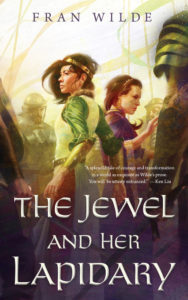
Years ago, I worked as a jeweler’s assistant. I learned how to manipulate metals, solder, and stones (and how not to). The craft and science that goes into that process has always fascinated me. At the same time, I got a firsthand look at how people respond — from facial expressions to the ways their eyes light up — in the presence of different kinds of gemstones. That made me want to explore the kind of control gemstones might exert in a secondary world, and the trouble they could get up to.
“The Jewel and Her Lapidary” is a facet of a larger set of stories that range in length. The short story “The Topaz Marquise” is available for free at Beneath Ceaseless Skies.
3. What can you tell us about your new novel Cloudbound?
Cloudbound is a companion novel to Updraft. Same world – a city of living bone rising high above the clouds -, different narrator… which I am very excited about! Within you’ll find monsters, politics, wings and wind, and a whole lot of… well. We’re heading down into the clouds, so you’ll be discovering a lot of things alongside the characters.
4. Can you remember the first story you read that made you think “I want to be a writer”?
As an adult, Genevieve Valentine’s short story “Bespoke” (Strange Horizons) reminded me that I could be a writer. “A Bead of Jasper and Four Small Stones” (Clarkesworld) drove the point home.
As a child, probably both The Phantom Tollbooth, because I was fascinated by how playful it was, and Tuck Everlasting.
 5. Do you prefer long form to short?
I like both equally. Depends on what form fits the story. I’ve written stories as short as 250 words (“You are Two Point Three Meters from Your Destination” – Uncanny Magazine) all the way up to novel-length.
6/7. You get to invite five fictional characters to dinner – who do you choose and why?
Cent, from Steven Gould’s Exo; Agnesika from Naomi Novik’s Uprooted; A through L the wyvern from Cat Valente’s The Girl Who Circumnavigated Fairyland in a Ship of Her Own Making; Helva from Anne McCaffrey’s The Ship Who Sang; Yeine from N.K. Jemisin’s The Hundred Thousand Kingdoms, and Karen Memery from Elizabeth Bear’s Karen Memory because I think that would be an incredibly badass girl (& wyvern) gang and who cares about dinner when you’re a badass girl gang that can teleport, do tree magic, roll with gods, sail the universe, and generally overthrow standard assumptions while riding a modified steampunk sewing machine?
8. Name your five favourite books (yes, I know that’s mean).
Right now? I’ve recently enjoyed:
Jane Steele, by Lindsay Faye
The Radch Series (aka Ancillary Justice & etc) by Anne Leckie
Luna by Ian Macdonald
Everfair by Nisi Shawl (out in September)
Karen Memory by Elizabeth Bear
The Fifth Season / Obelisk Gate series by N.K. Jemisin
Absolutely anything by Aliette de Boddard
All Time (yes, totally cheating & also I can’t count)?
Annals of the Former World by John McPhee (nonfiction – a geological history of the United States as told through roadcuts.)
The Phantom Tollbooth, by Norm Juster
The Penguin Book of Modern Fantasy By Women (1995, Penguin) because of the scope within, because there’s SF hiding among the fantasy… So many reasons.
First Light, by Richard Preston (nonfiction, space telescopes)
The short story collections Burning Chrome by William Gibson & Looking for Jake by China Miéville
Synners by Pat Cadigan
The Book of Sand, Borges
What? … that’s five. Plus a few.
9. If you could recommend one book that everyone should read, what would it be? 
I would suggest everyone read (aloud if possible) at least one book of poetry in their lifetime – purely for the sound mechanics. It doesn’t matter what kind of poetry – the most important thing is that it’s something you can return to and learn about in layers. But if pressed, I’d probably hand out poets like Wislawa Szymborska, Lynda Hull, Wordsworth, Ai, Rita Dove, Gerard Manley Hopkins, H.D., Elizabeth Bishop, Seamus Heaney, Keats, Chinua Achebe, Pablo Neruda, Ossip Mandelstam, Tracy K. Smith, or Eavan Boaland, depending on the person.
Or, barring that, The Watchmen by Alan Moore.
10. What’s next for Fran Wilde?
Cloudbound launches September 27, and I can’t wait. I’m finishing the third book in that group, which is currently called Title TBD. I have a short story coming out in Shimmer in August, and a few other projects that haven’t been announced yet. Plus more gemworld stories.
It’s safe to assume online shenanigans will continue.
The Doctor in the TARDIS

So darned happy. I literally got to be the Doctor in the TARDIS this afternoon.
Pre-recording a segment at ABC Radio National Perth for ABC Radio National Brisbane! I’ll be talking about Vigil and general writerly things this eve on Evenings with David Curnow (7pm-10pm – not three hours of me, though, that would be nuts)… with Sarah Howells!
From the freaking TARDIS.
One happy nerd here.
June 26, 2016
Despatches from KSP: Day One

Welcome basket from KSP. Contains chocolate!
Travel is the great discombobulator.
We are taken out of our normal environment, sundered from our daily routines. Our habits, we find, are no longer easy. This can make us grumpy: we go to put our coffee cup in its usual place but the usual place isn’t there. Not to mention that our favourite coffee mug isn’t there either. Cue: disgruntlement.
When you’re a writer it can be even worse because our writing routines – our creative processes – are often synched with our habits to the point where we think they are utterly entwined and meant to stay that way. We sit in the same spot; we have our desk set up in a certain way, facing a special direction; yes, we put our favourite coffee cup (and all the other coffee cups in the grand hierarchy of coffee cups) on the same coaster at a particular point on said desk for maximum grabability and minimum chance of spillage on the keyboard. Habits are comforting, reliable, but they can also become guards in a prison of our own making.
“I cannot write unless I’ve got my: favourite cup, coffee, tea blend, am facing nor-nor-east, wearing my lucky undies, my blue sweater, a hat made from the wings of angels, using this specific pen or pencil on this particular kind of paper/in this especial notebook, after turning widdershins around my desk.”
Sound familiar? Your habits have become rules, obstacles, fetishes. Those of you of the right vintage will recall an episode of The Young Ones (young people, go to the Tube of You), where Neil is sitting an exam, but spends all of his time setting up the things he “needs”: lucky pens and pencils, secondary lucky pens and pencils, favourite notepad, packet of lollies, back-up packet of lollies, lucky gonk, spare lucky gonk … he spends so much time doing this that he runs out of exam time. When you’re indulging in that kind of ritual behaviour with your writing, you’re committing a Neil.
Moreover, you’re giving yourself excuses not to write. You’re able to claim that “circumstances beyond your control” derailed you. It’s not your fault.
It is, you know.
Jeff VanderMeer in Booklife says that we must free ourselves from writing fetishes. You must be able to write anywhere, anytime, using anything. Don’t make your ability to write depend on such silly obstacles: that particular pen doesn’t make your writing better. You and your skill and talent, you stubborn determination, you willingness to commit to starting AND finishing are what make you better. Not using the Mont Blanc pen that cost so much you could have purchased a jet ski for the same amount of money.

Comfy chair, not fetish.
My point? When you travel you can be grumpy about the loss of habit or you can embrace it and learn from it. You can choose to view everything that happens on your trip through a filter of irritation or you can look at everything as a useful opportunity. You can choose to ruin an adventure or look around at the new space and realise it’s something new for you to play with, to adapt to your needs. It’s your new space, you can make it work for you, it is a tabula rasa untainted by all your old habits.
I woke this morning and moved a few things around in my KSP cottage (nothing major, don’t panic!): but the microwave is now on top of the wheelie-shelf-unit-thingy, and the printer is on top of the fridge. As a result my desk has more space (I have more space than I have at home!) and I can spread out my paperwork. I’ve created new habits – those habits are temporary because they are a reaction to a new workspace, but they don’t affect whether I write or not. If I hadn’t been able to move things it wouldn’t have changed whether I wrote or not. I’m able to fit in with a changed environment and work with it. In managements terms I guess I’m “agile” despite my tendency to fall over my own feet.
Habits are hard to break, whether on our home ground or out in the big wide world. The important thing is not to let them break you. Don’t let them stop you from writing. Your creative process depends on you, your motivation, your determination, not the location of your lucky gonk.