
Jonathan Harnum's Blog, page 37
October 23, 2016
What’s Better: Practice or Performance?
Something I learned when researching The Practice of Practice is that many of the best musicians don’t make a distinction between “practice” and “performance,” and if they do, most strive to have more performance in their playing. This was driven home most by Rex Martin, who got the words from Chicago Symphony’s legendary principal trumpeter Bud Herseth (55 years with CSO), who said, “We have to be careful about practice, because we start to practice practicing. We need to practice performance.”
Here’s the same words of wisdom, but from jazz trumpeter Woody Shaw, in a 1983 Downbeat interview:
LR: Your sound on trumpet is big, with considerable flexibility. Do you still practice various exercises, particularly the more difficult ones, or do you find that your practicing is done when you perform on-stage with your band?
WS: The latter is more suited to me. I’ve seen some musicians who practice all day, but when they get on the bandstand, they can’t play a thing. Practice is essential definitely, in developing any particular craft, but I find that it’s best for me to play with my band as much as possible. Even when we’re off, I try to rehearse this band at least twice a week, to keep in good shape. If the need arises where I’m unable to execute a phrase on-stage, I’ll go home and practice it, but I don’t want to practice to the point where I sound mechanical. Playing with my band is like roadwork – it keeps me in shape. My thing is being able to take what I’ve learned through observing and practicing, and apply it to my role as performer and bandleader.
Check out Woody Shaw below. Click the video and let the playlist play. Nice way to while away the day:
and as a bonus, check out one of the members of WS’s quintet, trombonist Steve Turre, who also plays….wait for it….conch shells. Check him out playing the Miles Davis tune All Blues:



October 20, 2016
How to Listen When You Practice: Ted Nash
One of many JLCO’s Jazz Academy videos that I’ll be posting here over the coming months. Great stuff from modern masters.
Here, Ted Nash talks about using the piano as a practice tool. Super advice. What Mr. Nash is talking about is covered in The Practice of Practice, in the chapter titled: Drone Power, all about using your ears to play in tune.


October 17, 2016
Going Mental (Mental Practice, that is)
A nice primer on mental practice from The Open Score, a new, useful YouTube channel. Check out her other material.
There’s a whole chapter on mental practice in The Practice of Practice with more information, but this is a great way to get started.


October 13, 2016
Free Kindle Book: Practice Like This
Free Kindle Edition of Practice Like This: 35 Effective Ways to Get Better Faster
note: to get your free copy, click the cover below or here.
Then click the “buy” button, and you’ll be “charged” $0.00 when you check out.
If you don’t have a Kindle Reader, you can get the free app here.
Or, get a Kindle. They’re pretty handy (pun intended).


October 4, 2016
Work On Your Rhythm: Learn to Play Guiro
Small percussion instruments don’t take less practice for you to become really good, but you can grasp the basics quickly, and then be able to play along. It’s also nice to be able to add something rhythmically to tune you’re playing, like Lee Morgan Wayne Shorter do on Night in Tunisia. Plus, learning a small percussion instrument will help your rhythm.
In The Practice of Practice, I recommend learning the tumbao and clave patterns on conga, or learning any rhythm instrument. Here’s a lesson on playing the guiro, from Bobby Sanabria. He teaches not only how to play it, but where the patterns go in the clave pattern.


October 1, 2016
A Lick a Day: Soundslice Serves it Up!
Learning licks from someone on an instrument different from yours is a great idea, because is exposes limitations of your instrument, but also exposes patterns on your instrument that can be changed or broken, in a good way. Say, learn Ella Fitzgerald and Billie Holiday melodies on your instrument, or check out these short licks from the amazing site, Soundslice, mentioned in The Practice of Practice.
The great thing is that both TAB and standard notation are included, and you can vary the playback speed when you practice. I’ve posted the whole video below, but at Soundslice, there is just one sweet lick pulled to focus on. A new one every weekday. Check it out at https://www.soundslice.com/licks/
Here are a couple examples. If you play a non-harmony instrument like I do (trumpet), how might you “translate” some of these to a single-line melody? Sounds like fun practice to me:


September 30, 2016
How to Use the Piano to Explore Harmony
Ted Nash of the JLCO gives some superb advice on using the piano to explore harmony.
“Part of practicing is putting yourself in a position where you’re going to discover something new.” – Ted Nash
Check it out.


September 29, 2016
Top 7 Practice Tips for Absolute Beginners (and everyone else, too)
We all want to get better, which means we’re all on the same path. When you see someone whose music blows you away, the tips below are part of what they did to get there. No matter how impossible it seems, you can do it, too. Follow these 7 guidelines:
 Practice Is More Than You Think: world-class musicians from jazz to symphonic to singer-songwriters to African kora masters know that almost everything is practice: listening, just messing about, reading, talking, warming up, watching others…. If it has something to do with music, it’s practice. Or it can be with the right focus. Warming up before rehearsal? Make it a mini practice session. Use this simple secret and you’ll get better a lot faster. The key is focused attention.
 The KISS principle: Keep It Super Simple: when you spend time with your instrument, pick only one thing to focus on. For best results, extend this single focus over several practice sessions.
Practice to Your Weakness: you have limited time so you want to make the most of it. Warm up with a simplified version of what you struggle with, then go directly to that spot in the music or skill or whatever it is. Remember the KISS principle. Playing what you know is super fun and feels good, but it’s not making you better. Save the “play” part til the end, like dessert. Tackle the tough stuff first. Always.
How Often and How Long: short, frequent, high quality practice is the very best. Daily if you can. Start small, even 5 minutes, and let the time grow longer naturally. Three or four times a week for 10 minutes is way better than an hour once a week.

Feed Your Motivation: without this secret sauce you won’t put in much time. Work on music that interests you, or focus on skills you think are cool, no matter what they are. Also, cruise YouTube, see live music, listen to recordings, browse the Net. Find ways to keep interested. Playing scales and technique exudes day after day isn’t going to work. Whether it’s Mudhoney, Marilyn Manson, Mussorgsky, or Mariachi, work on what interests you.

Where You Practice and Who’s Around You Makes a Big Difference: find a private space, out of earshot if you can. You want space to explore sound and to discover the ways you suck without fear of judgment or the anxiety of bugging others with your experiments. Also, hang with like-minded peeps,preferably who are better than you. You can even do this online. See #1. Do this and you’ll get better faster.

Seek Out More Information: nobody can be aware of what they don’t know. The best players strive to open their eyes and ears and brain wider. The best are always hungry to learn more. Humility is necessary to make the most if this. If you’re a know-it-all, you’re not going to learn much. One way is to find a good teacher, but talking to others and scouring the Web works, too. Keep learning. I’ve talked to many world-class musicians and they all have this curiosity about them.
______________________________
These tips are the tip of the iceberg. To learn more and get better faster, check out these books:


September 27, 2016
How to Practice Trumpet: Trumpet How-To 4th Edition Is #1 New Release on Amazon (+free video lessons)
I’m super excited to announce a new edition of Sound the Trumpet: How to Blow Your Own Horn. The book is frequently a #1 best-seller in its category, and 2 days after publication it’s the #1 New Release in Trumpets and Cornets on Amazon.com.
The book has been completely overhauled, updated with new content, way better graphics and a cleaner design. But the big update is the accompanying web site with free video lessons and lots of extra content. Check it out at www.AllAboutTrumpet.com
“Every new trumpet should be sold with this book.”
JR Torres, RI USA
 Click the cover for the best price and free shipping.
Packed with information no trumpet player should be without. The style is always friendly and often funny. Its 25 lessons are short, well-paced and enjoyable. It’s like having your own private teacher for a fraction of the cost of lessons.
Take advantage of the Bonus Material, including video lessons, recordings and lots of online content.
The book has 236 pages divided into 4 sections and 25 lessons, each of which is packed with information, from basic to advanced skills. Read the overview chapter and see the table of contents and the rest of the supporting material here.
Whether you’re new to the world of trumpet or an experienced player who needs to bone up on your rusty skills, or whether you need a fun way to teach trumpet, you’ll find this book valuable. Music educators have found this book to be very helpful in their college methods classes and as a practicing teacher.
Learn more below, or read the book overview, check out the other samples, and read reviews of the book.
“This book will be useful to both the beginner and the more experienced player, is an excellent value, and I give it my highest recommendation,
but do so wish that it had been in print 30 years ago!
David Hutchins: Kent, UK
Here are a few pages from the new edition (note that the forthcoming eBook will be in color, but the print book is in black and white to keep costs down)
Part One
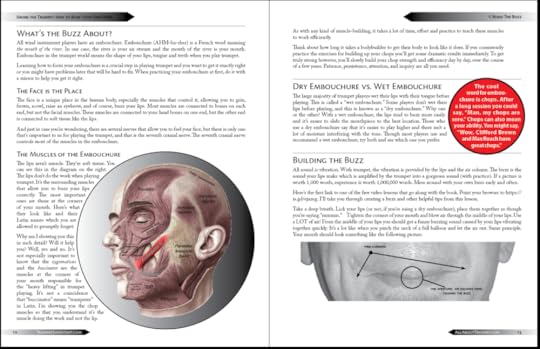
From Lesson 1 – Build the Buzz: The Secrets to Getting a Great Sound (buy)
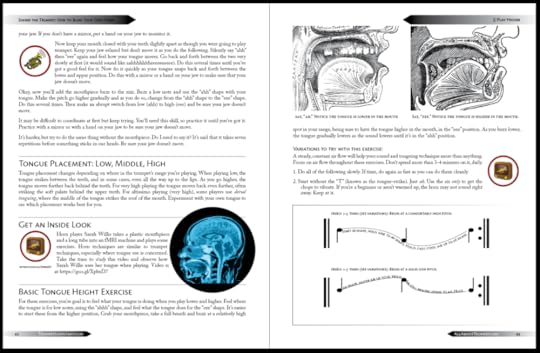
From Lesson 5 – Play Higher with Proper Tongue Use (buy)
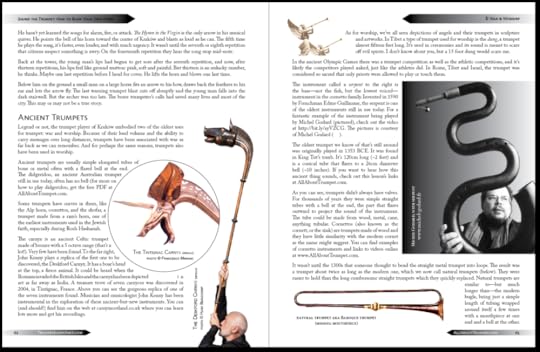
From Lesson 8 – War and Worship: A Brief Trumpet History (buy)
This book is the most thorough treatment of the various aspects of trumpet playing that I have seen. Very informative and helpful. Even my current teacher, who has played with the Metropolitan Opera (NYC), was impressed.
Don Young, Cranston, NJ USA
Part Two
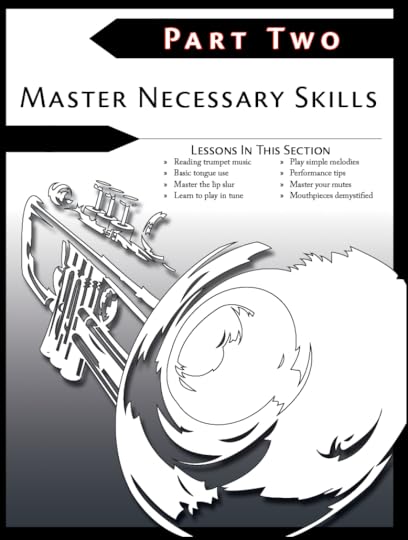
From Lesson 10 – Tune Like a Pro: Learn How to Make the Horn Play In Tune (buy)
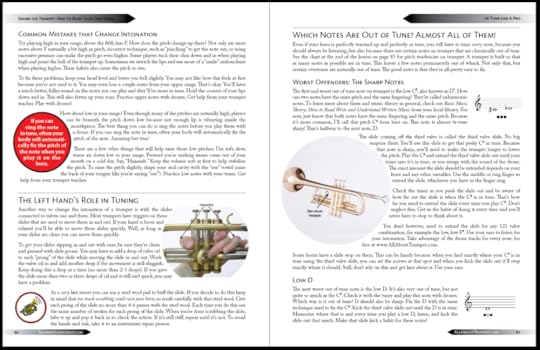
From Lesson 11 – Simple Songs: Great Melodies to Improve Your Reading Skills (buy)
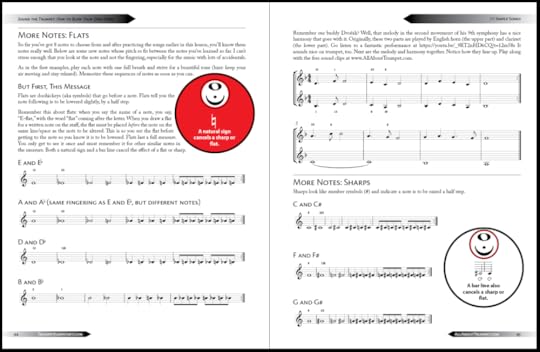
From Lesson 12 – Master the Lip Slur: Improve Your Flexibility (buy)
“This book is not only enjoyable and info-packed it will remain in my music library as a great reference book. I have been buying a lot of trumpet books lately and, thanks to Amazon reviews, have been very fortunate in my selections.
“This one,though, is a standout. One of the threads through a number of the books I have read is that,as in this book, the writer really projects a love for the instrument.”
Stephen T. Terhune, MD USA
Part 3
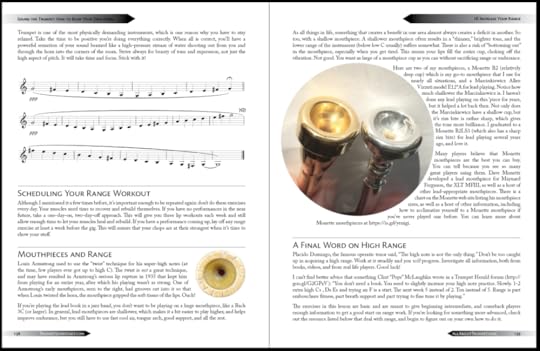
From Lesson 16 – Increase Your Range: How to Play Higher (buy)
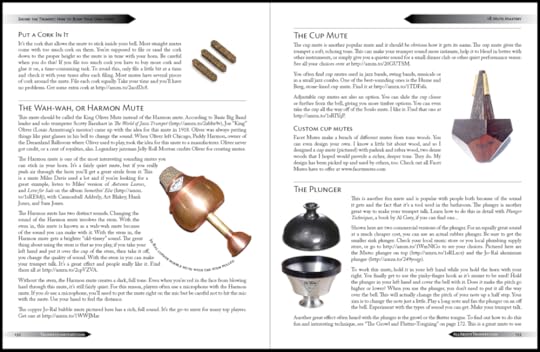
From Lesson 18 – Mute Mastery: Give Your Sound Shape and Color (buy)
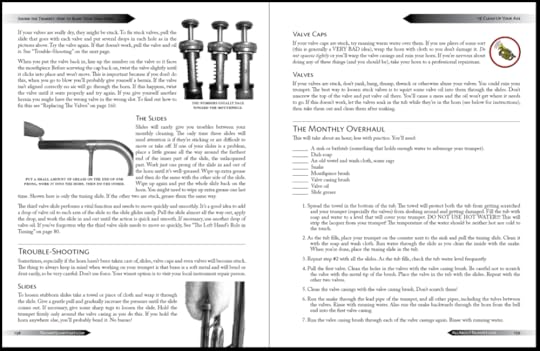
From Lesson 19 – Clean Up Your Axe: Fast Valves and Slick Slides (buy)
“I played trumpet in high school, rock guitar professionally for ten years and studied piano for as long. After reacquainting myself with some CD’s from my youth I was inspired to pick up the trumpet again. Looking for a guide to get me off on the right foot I came across this book. It covers about every topic you can think of concerning the trumpet. It’s an easy enjoyable read packed with trumpet history, instruction, recommended CD listening and much more. He deals with classical music as well as jazz. The examples in the book have mp3 files that can be accessed on the author’s website. I think any level of player can find something of interest in here.”
Revvvdup
Part 4
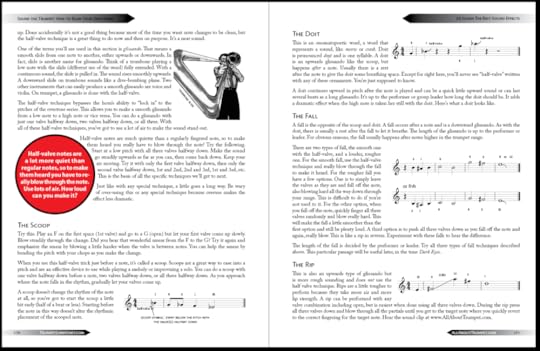
From Lesson 20: Learn the Best Sound Effects: From Vibrato to the Horse Whinny (buy)
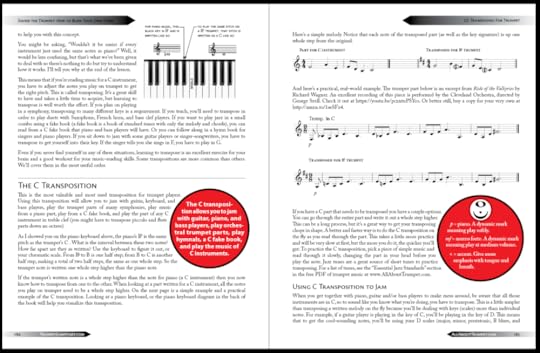
From Lesson 22 – Transposing for Trumpeters: Play Orchestra Music, Hymns, and Lead Sheets (buy)
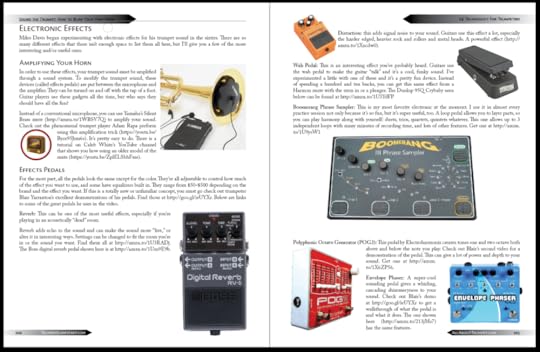
From Lesson 24 – Technology for Trumpeters: Make Practice More Fun and Productive (buy)
“Love the book for the quick and easy ability to teach and reference countless points. I’m a 62 year old beginner and this is
the only Trumpet tutorial that doesn’t put me to sleep.
It has the vibrance of the trumpet itself. Thanks also to Amazon for the quick delivery.”
kozmo 18
Index and Extras
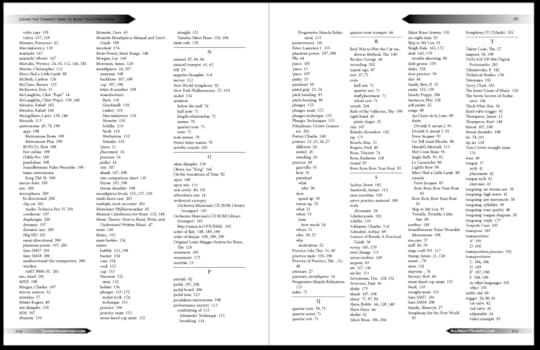
Index
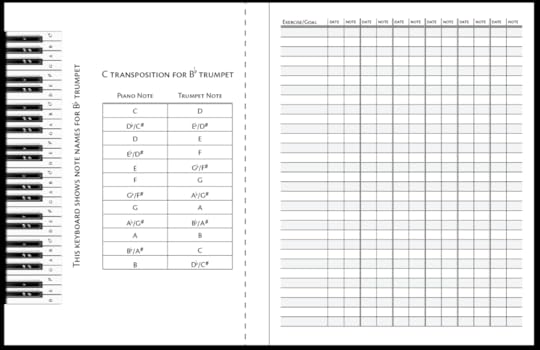
Appendix: Keyboard with trumpet notes transposed and exercise tracking form (also available as free PDF at www.AllAboutTrumpet.com) (buy)
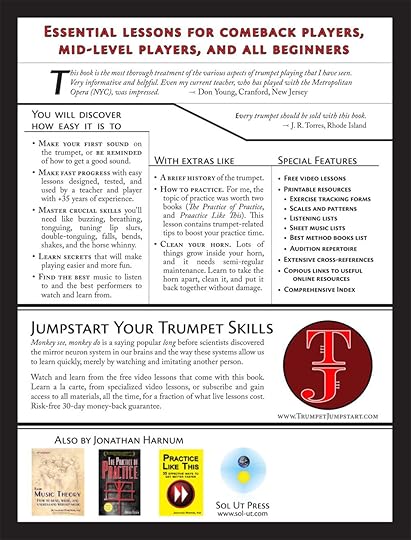
Back Cover (buy)


September 22, 2016
Get Hip to Jazz Slang, Dig?
The great Christian McBride riffs on jazz slang. Dig it.



