Malcolm Blair-Robinson's Blog, page 154
August 18, 2015
Printing Money: Download for .99p
An idea to stimulate economic growth without further government borrowing. Written in plain English and very easy to follow, this is the only really fresh approach out there to the intractable problems of the UK economy, and it is just beginning to be noticed in important places. Buy! Download only .99p Paperback £2.99


August 17, 2015
Armed Forces Malaria Drug: Withdraw It
When respected ex-service officers like Johnny Mercer MP say something is not right, it is good to pay attention. If what he says is backed by other experts and people who have personal experience, the weight of argument grows for the withdrawal of the controversial Malaria drug given to Army personnel serving in at risk postings overseas. Apparently the side effects are widespread and unpleasant and can be life changing. Other, safer drugs are now available.
The British Army has a bad record for selling its troops short with poor equipment, unsuitable vehicles, and a lack of helicopters; all eventually remedied but not in timely fashion. Changing pills is easy and it should happen without delay. Medical authorities do much good but if they have a fault it is they can be hierarchical, set in their ways and stubborn. Military medics can act with greater urgency and they should do so now.
The Reward Of The Boss
The news that a clutch of overpaid executives earn over 180 times the average pay of everybody else comes as no surprise but it still deeply shocking. One of the reasons our economy is so out of balance and our society is so unequal is that many rules and principles are being bent or broken. One of these is the foundation principle of capitalism; with high reward comes high risk and failure is a key ingredient of nurturing renewal.
It therefore follows that if you earn massively more than the people below you, it is because you shoulder risks which they do not. By this we mean that should the enterprise fail you lose your all including you home and your shirt, because you risked all to found or buy the business which you own. But if you are just an employee and you shoulder no personal risk (other than losing your job and share options) there should be an absolute limit on what you can be paid. Twenty times average would seem fair.
If you want more you must become an aspirational entrepreneur then, if you succeed, having taken the risk, you get the reward. That is what capitalism is. It is not what we have now. This is greed, exploitation and selfishness. Time is up.
Gordon Brown: Right and Wrong
Gordon Brown is quite right to warn that Labour cannot win without a credible economic policy. Where he is wrong is to imply that the remnants of New Labour (and the candidates who lean towards the centre) has one. The reason Jeremy Corbyn has become a phenomenon is because voters have for years been unable to distinguish between New Labour and the Tories when it comes to economic policy, because both follow what might be described as a Thatcherite agenda. There is a difference of emphasis here and there, but there is no real difference. The house price driven economy based on debt at every level and consumption of imported goods, with manufacturing and exports accounting for historically low GDP, is as much a creation of New Labour as it is of the Tories.
New Labour introduced tuition fees. The Tory led Coalition put them up. New Labour introduced Academies; the Coalition increased their numbers and the new Cameron government wants even more of them. Thatcher and Major privatised everything and created a network of regulatory quangos; New Labour left almost all of it in place. New Labour introduced Tax Credits to subsidise low wages, when it should have expanded the economy to pay wages which the state did not need to subsidise. The Tories have kept them going whilst increasing the minimum wage in the hope of reducing them. Labour allowed house prices to spiral out of control and did little to build social housing. The Tories have been no better. New Labour backs austerity, but with a lighter touch.
Gordon Brown echoes the cry that unless there is barely a cigarette paper between Labour and Conservative economics, Labour will not win power. This is nonsense. If voters want to continue in the Thatcherite tradition they will vote Tory. Labour is not about power at any price. It is about principle and people. New Labour set power as its goal and abandoned the working class in the process. It was re-elected on ever reducing votes because the Tories were off in the woods and unelectable. But the Tories are back now smartly dressed in new clothes very like those worn by New Labour. Without regaining the 4 million plus working class votes it has lost, Labour cannot win, ever. And those will not return until Labour returns to them.
Labour will get not them back without a credible economic policy, but credibility in this context means a radical departure from both Thatcherism and New Labour’s version of it. History will see Blair and Brown’s New Labour as a failure, which abandoned its mission in order to gain and retain power, which it then wasted with a lot of tinkering at the margin, while leaving the imbalances of social and economic injustice unrestrained. It followed an interventionist foreign policy which was founded on illegality and lies, and when free market excesses overheated and blew up, it was asleep at the wheel. Its finest hours were saving the banking system from collapse at less than 200 hundred minutes notice, the Good Friday Agreement and devolution for Scotland and Wales.
The real story is in the voting figures, which fell away from New Labour in every election it fought. It succeeded not because of what it offered but because the Tories had lost their way. Now the Tories have found their place again, which is that they are the natural party of power who can be relied upon to govern quite well. The Labour movement was founded to be a game changer and power for it lies in changing the game.
We now have a society in which lawyers, estate agents, loan sharks, gangmasters, unscrupulous private landlords, the sharp elbowed aspirational and celebrities prosper and are happy. But there is a huge mass of disenchanted voters who have to work all hours to keep the fundamentals of a civilised nation running, who feel abandoned and let down. Labour’s mission, its purpose and its priority is to rally to their cause. If you have a vote in the contest vote for a candidate who understands that. There appears to be only one who has a radical agenda to make a difference to a society which has now synchronized the creation of billionaires and foodbanks. That is why the grandees of New Labour are in a panic. They know deep down in their hearts that they share in the responsibility for the most unequal society since the nineteen thirties and that for them the game is over.
August 15, 2015
DQE: Now In The News
An idea to stimulate economic growth without further government borrowing. Written in plain English and very easy to follow, this is the only really fresh approach out there to the intractable problems of the UK economy, and it is just beginning to be noticed in important places. Buy! Download only .99p Paperback £2.99
New Greek Bailout: Old Greek Crisis
News comes that the terms of a new Greek bailout have been agreed. Sadly this is once again kicking the can down the road. Because setting the terms of new loans which are mostly used to pay old loans, is the classic error which has been repeatedly made over the past five years by a split and confused currency union dominated by Germany. The key question which has to be settled first and upon which the viability, both economically and politically, of any new financing package depends, is the extent and effectiveness of the write down of Greece’s unsustainable debt mountain. All that has happened over the last five years is that new loans have merely kept afloat the idea that Greece is solvent when it is not and that big money has not been lost when it has.
There is a hint that the issue of debt relief will be discussed in the autumn. Let us hope so. At the moment we have the classic picture of the cart being put before the horse because the horse is too weak to pull the cart. But sooner or later the cart has to move forward and that will only happen when its weight is adjusted to the capability of the horse. If Euroland does not see this, the next Greek bailout crisis will not be about Greece surviving in the euro; it will be about the survival of the euro itself.
August 14, 2015
China And Its Currency
China has recently been devaluing its currency to boost its exports. Some think it will go on doing so bit by bit until it settles ten per cent lower than its peak. The fact that it is happening at all causes word wide consternation, because since globalisation it is the currency markets, not governments, which set the level. But not in China, whose government has retained close control of the currency during its meteoric rise to become the second largest ( by some measures the largest) economy in the world. This fact alone demonstrates the disadvantage of market valuation, because China’s control of its own valuation a key to its rise to economic mega power.
One of the reasons for the world’s fluster is that it is unclear how to react. If China reduces the prices of its goods by devaluing, it will make western goods more expensive in China and reduce trade. But if China slows and its own consumption goes down, that will also reduce trade expressed in western exports into China. So the West faces not a win win, but a lose lose. Broadly this blog takes the view that the stronger the Chinese economy the better, even if in the short term we are disadvantaged.
The particular problem Britain faces is that its attempt to rebalance its economy in favour of exports and manufacturing has failed and will continue to do so because sterling is valued much too high. The only way a government can influence the value of its floating currency is with interest rates. Reduce the rate and you devalue the currency. But with interest rates at .25% there is nowhere down to go. So if the pound rises, there is nothing the government can do about it. That is another reason why this blog believes rates should have risen long ago, because we are headed to a point where they might need to fall.
August 12, 2015
Labour And The Left: Some Warnings
It is clear that the centre of western politics generally and those in the UK in particular has shifted left after thirty years on the right. There is a lot of angst about big business, bankers, globalisation, poverty,vulgar riches, wars, social inequality et al. In Greece and Spain new left wing movements have been the response to the euro crisis and in France the response to the ineffectual socialist regime of Hollande has been Marine La Pen, technically far to the right but actually appealing to the left. In this context the rise and rise of Jeremy Corbyn is easily understood. So is the rise of the SNP which in the view of this blog has surged not because of its nationalism but because of its left wing agenda.
There are dangers here and two warnings are timely. The first is that this is not a signal that the mass of voters would support a return to looney left policies and pointless gesture politics. The left agenda has to be financially viable, delivering efficiency, value and fairness in equal measure. Public ownership of railways and utilities would be popular if they deliver greater efficiency for less cost, but a return to loss making monoliths and loss making corporations making obsolete products propped up with public money are an absolute no no.
Equally all of Labour needs to understand that New Labour is a busted flush and the circumstances which gave it three victories is a row are gone. They were challenged by a right wing Tory party which had lost its way post Thatcher, which moderate voters turned their backs on. This gave success to both the Liberals and the Blair regime. The Tories are now back in the centre and on the left of it. Yes there were cuts in the budget, but there were some harsh tax increases on the better off as well. Labour’s response has been to argue for a little less of this and a little more of that. But most voters can see barely a cigarette paper between the old guards of New Labour and the new Tories.
It was indeed the case post Thatcher that Labour could only win on the centre ground. That no longer applies. Wilson won four elections and Attlee won two. They both won from the left. The SNP was left of Labour in Scotland and won almost every seat. Labour can win only from the left in future, but it must be a savvy financially creative left which unifies, not one of endless strikes and nuclear free zones, which fosters both division and derision. The public will never vote for that.
August 11, 2015
Greece: Bailout Agreement Near?
There are reliable reports from Athens that Greece as agreed terms for a further bailout. It is not possible to comment sensibly until the details are known. However three conditions have to be met in order that it will succeed. First there must be very substantial debt relief because everyone agrees the current debt level can never be repaid. Second there must be recapitalizing of Greek banks. Third there must be a programme to kick-start the Greek economy so that growth becomes an embedded feature.
If those three conditions are met it is feasible for the lenders to impose some domestic reforms, so long as the majority in the Greek parliament backs them. These reforms have to be supported by consensus and not overturned at an upcoming election, so extreme demands are counter productive. If the debt haircut is merely cosmetic and reforms further shrink the Greek economy, then the bailout will only benefit the creditors by keeping alive the notion that they have not lost a large part of their money. That will signal that the Greek crisis remains with full potency, even if temporarily repressed by what amounts to fraudulent accounting. It will return again as it has before.
August 10, 2015
Downfall In Downing Street: A Must Read!
Set in the mid nineteen nineties, this fast moving 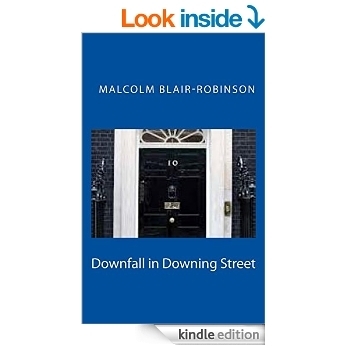 thriller lifts the curtain on sex, sleaze and corruption in high places as the long reign of the government totters to an end, following the ousting of the iconic Margaret Thatcher. The novel catches the mood of those times with a host of fictional characters who engage in political intrigue, sex, money laundering and murder, pursued by an Irish investigative journalist and his girlfriend, the daughter of a cabinet minister found dead in a hotel room after bondage sex.