
S. Kay Murphy's Blog, page 10
September 6, 2020
Blessed
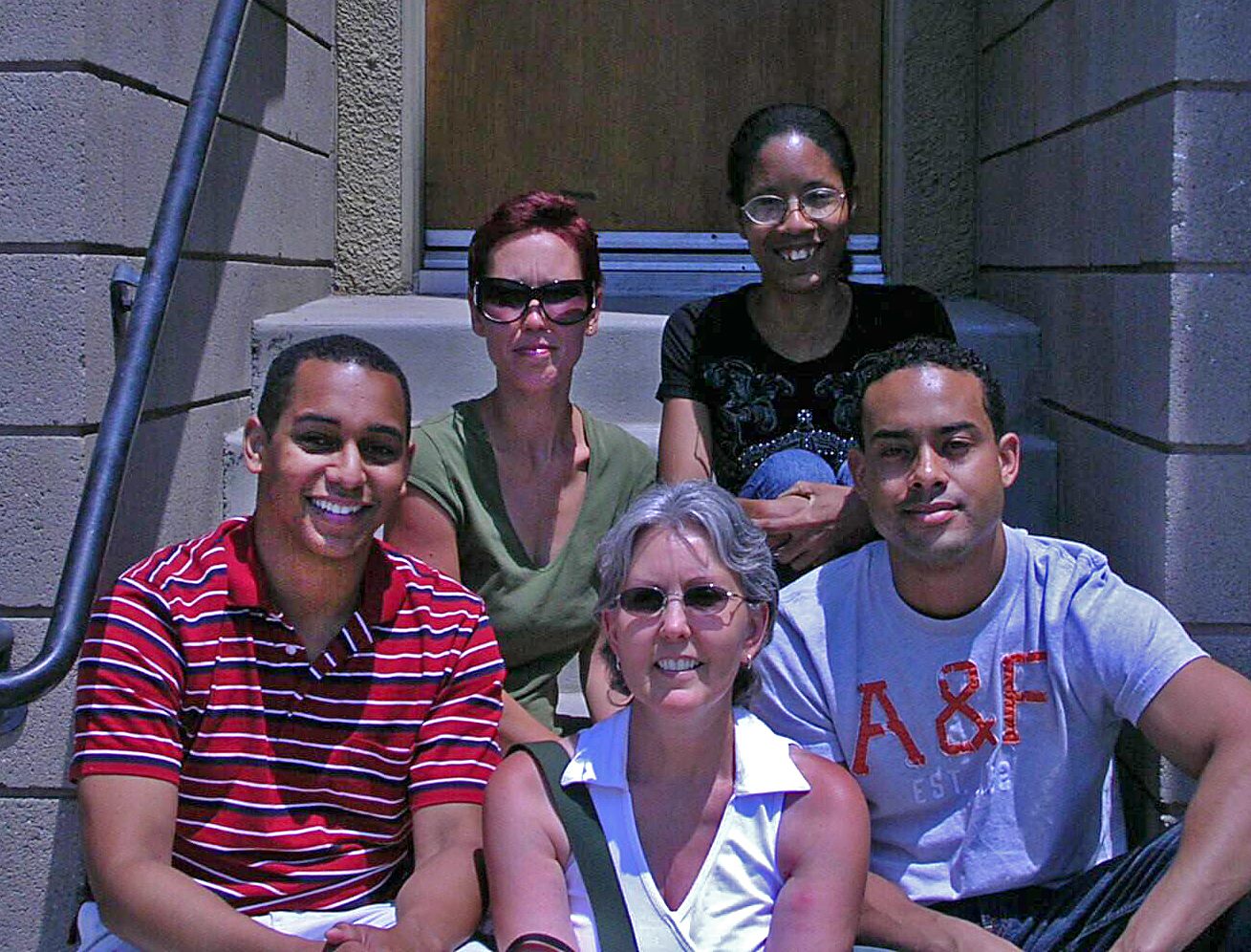
Yesterday was one of those very rare days in which I hear from all four of my kids in the same day. That usually only happens on Mother's Day and my birthday (and sometimes not even then). My kids are busy living their best lives, and I can appreciate that. I didn't call my mom very often when I was their age. Then again, my mother and I had an entirely different relationship than I do with these amazing people.
It was my youngest grandson's birthday yesterday. Jordan turned eight. Or, as he put it, "I'm becoming eight today." Yes, sweet boy, I hope we are all "becoming" our best selves. His mother (Younger Daughter) and I chatted for an hour about life and her plans for the future, near and far. When I walked out of my den and looked out the kitchen window, I saw a gigantic plume of smoke--another out-of-control wildfire is burning in the next town over. Here we go again....
An hour or so later, I received a text from Younger Son (who currently lives in Ohio): "Hey Mom, are you doing okay?" Checking in, because he heard about the fire. Then Older Daughter did the same, concerned about the air quality down here. She and Hubby live and teach in Lake Arrowhead. They were getting ash drifting down on their deck. Several hours after that, Older Son called from the Bay Area. "So, you have another fire down there?"
My kids will not know (unless they read this blog post, and they seldom read my blog posts, because they are busy living their best lives) that I went to sleep last night with a bit of a happy glow about me.
I am blessed. All of my children lived to adulthood. (Dang, tho, with my boys, it was dicey at times, I'm not gonna lie. You see that gray hair in the photo above? My girls didn't give me that. My boys did. Whew.) All four were employed--until the pandemic, when two were laid off, but Younger Daughter has just been offered a new job, so she'll be working soon, and Younger Son has a nice cushion of savings, and he will resume work after the pandemic--when he returns to California permanently. (Yay!)
Most important, though, they are good, kind people. No, we do not always agree on everything. (Boy howdy!) No, they do not parrot back my own belief systems. (If only!) But dang... in spite of the haphazard parenting I did at way, way too young an age, these guys turned out to be stellar human beings, and sometimes I'm just in awe of that. They are all ethical people of sound integrity who think for themselves and are not afraid to voice their opinions and stand up for what is right and justice. Damn, I am so proud of them. (Sorry, can't help it. Shameless Mom boast. Hang on--it gets worse.)
My happy glow rekindled this morning when my junior-in-college granddaughter sent me a text: "Hey Nana, how is it over there?? Are you doing okay?? Do you need anything??"
So yeah, my grandkids--all six of them--are also stellar human beings. Well, okay, Jordan is just now "becoming eight," so maybe he'll turn out to be a thief or a thug, but he's already an animal lover, and his best friend is his black cat, "Lucky," and he loves to read, so I think his mama is on the right track with him.
All that is just to say this:
Parenting is hard. Damn hard. We struggle blindly, wishing for a crystal ball so we can really determine what is "best" for them through any given crisis or major decision or, lord help us, meting out of consequences, but there is no instruction book, and each one is absolutely different than his/her/their siblings. We just do the best we can, often throwing up Hail Mary passes, and we pray, we pray really hard, that they will "turn out all right." And when they do, we are amazed. And blessed. Really and truly blessed.


August 23, 2020
B: P4 Longmire
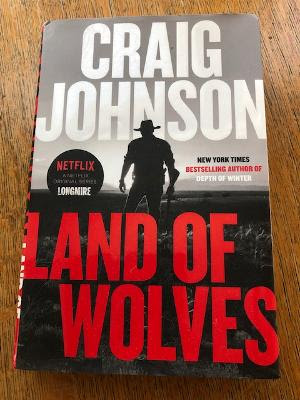
Land of Wolves, the most recent offering in Craig Johnson’s engaging Longmire series, came out last fall. Although I have been following the series since 2018, and I was pleased to know that a new episode in the saga of Sheriff Walt Longmire had been released, I didn’t order it right away. And when I did, it remained stacked on top of my to-read list for weeks, then months. I couldn’t bring myself to crack it open, and I didn’t understand why. Until last month. And now I know.
My buddy John introduced me to the Longmire series when we met for a lunch date in 2018 that was anything but casual. John and his wife Lisa wanted to break the news to me that John had been diagnosed with IPF—Idiopathic Pulmonary Fibrosis. In layman’s terms, his lungs were hardening, and doctors could point to no specific cause. Like my bronchiectasis, IPF is progressive and irreversible, but its progression is much more rapid. Day by day, John was slowly running out of oxygen as the disease robbed him of more and more lung capacity.
But let me tell you about John. I met him in my first full year of teaching, and we bonded over crazy pants, those crazy-patterned, ballooning trousers with elastic ankles and waistbands and way too much room in the crotch. Remember those? Lordy, I am deeply grateful no photographs exist of me wearing them. John was a body builder back in the early 90’s—a serious body builder—and I was somewhat of a gym rat, and we’d both wear our crazy pants to work sometimes. I never saw a guy smile so much. Even when John began the tumultuous journey through a tough divorce, he kept his sense of humor, his smile in place. We talked a lot in those days, because he knew that I had just gone through the same, and when you’re navigating hell, it’s always nice to shout out to the guy that’s on the boat just ahead of you, just to be reassured you still might make it through.
When he finally did make it through to the other side, Lisa was right there waiting for him. She was also a friend made through teaching and shared experiences, and we are so alike we are sisters in spirit. Like John, Lisa has a smile that never quits, no matter what trauma she’s working her way through. She has been friend, confidante and counselor to me, and when the two of them got together, it was a match made in heaven, no doubt about it.
Years after their marriage, on the day the two met with me to give me an education on IPF and explain John’s limited chances of survival, there they both were, sitting side by side, still as deeply in love, still smiling. And after we finished our serious talk of lung disease, John asked what I was reading, and when we discussed books, he told me how much he’d enjoyed the Longmire series. A sheriff in Wyoming who, like John, is one of the true good guys? I’m in. And I was really in after I read The Cold Dish, the first in the series.
So why, when I finally had the most recent book in my hands, couldn’t I bring myself to crack it open and read it?
Because the last time I saw John and Lisa in person, at dinner with a group of friends, John was not doing well at all. He was thin and weak and had to carry portable oxygen with him at all times. Lisa explained that they would be heading to UCLA Medical Center soon to consult with doctors about a lung transplant.
A lung transplant. Damn.
That dinner was the last social engagement I have participated in to date. Immediately after it, we were locked down due to the pandemic, and my worry for John—what with COVID-19 drifting about, plus the delay in medical procedures and appointments, increased a thousand fold.
And then, suddenly, in the midst of a pandemic, when all the world seemed to be imploding, John was approved for a transplant. Shortly thereafter, some other family somewhere—strangers to us—incurred some tragedy that robbed them of a loved one, but did not strip them of their humanity; a lung was donated, and John went into surgery, and I got busy calling, texting, and messaging friends to please pray, light candles, chant, think positive thoughts or whatever they could conjure up that would help John make it through.
And he did. Boy howdy, he did. Within days after his surgery, he was back on Facebook, posting positive messages, participating in discussions on the Longmire page, and joking about being ready to spike his orange juice with something that had a bit more kick to it.
That was in June. By July, John was back home with Lisa, taking daily walks (early in the morning, wearing a mask, of course), making his great, creative videos, and spending a good portion of each day encouraging others who are battling IPF.
One night in mid-July, when I went looking for my next book to read, I saw Land of Wolves. I smiled and picked it up, settling in for the good read I knew was ahead of me, and I realized why I hadn’t read it before. I had to know that John was going to be okay. Of course I know that, as a transplant recipient, life will never be the same “normal” for John that it was before his IPF diagnosis. He will face challenges in the years to come—but that’s the miracle of all this; he has years now, with Lisa, to face all the challenges ahead of him, and he’ll be doing so with that great smile of his, let me tell you.
August 13, 2020
B:P3 Early Departure
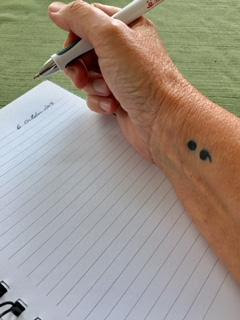 In Memoriam: Scott, you left way too early, honey. There was still so much good stuff....
 Some time ago a friend mentioned the book A Confederacy of Dunces, by John Kennedy Toole, in a way that made me feel as if I'd been missing something without knowing it because I hadn't read it. Instead of buying the book or at least putting it on my to-read list, I started reading about the book instead. I quickly learned of Toole's suicide--prior to the book being published. Sigh.... The mythology within the literary community is that Toole was so despondent over his failure to find a publisher for his book, he killed himself, at which point his mother took up the cause, eventually finding a publisher who agreed to take it on--to great success. Toole was awarded a Pulitzer Prize posthumously for the book. It was first published in 1980 but today is still an Amazon best seller.
The truth about Toole is far more complex, of course. I have yet to read A Confederacy of Dunces. But I did read Butterfly in the Typewriter by Cory MacLauchlin, which details the life and death of Toole. (The title comes from writing by Toole himself, who described himself at one point as a butterfly being smashed to death by a typewriter key, an accurate reference, I suppose, to the fragility of many creative minds.) I'm not here to recommend MacLauchlin's book. (Sorry, fellow author.) It's far too long and rambling for its purpose, a bit repetitious and not well edited. (Sorry again. Truly.) Something happened, though, just as I was getting to the part of the book I'd wanted to read, the part about Toole's suicide, the part that explained what he did and what led up to it. Just about the time I read about Toole's mental collapse and subsequent suicide, a cousin called to tell me that our youngest cousin had killed himself. He had a wife and kids and grandkids, but his mental anguish, his degree of depression, his "psychache," as Edwin Shneidman, founder of the American Association of Suicidology, would put it, had become unbearable, so he took it upon himself to end it. I cried for days. At his loss (at Toole's as well), at the grief his wife and children will bear for the rest of their lives, at our inability to find an effective treatment for debilitating sadness, at the agony he must have endured in the weeks, months, years before he felt he could no longer go on. The "if onlys" come hard and fast during these times. If only I'd been aware. If only I had reached out to him. If only someone had been there to say, "Wait! Just wait! One more day. It gets better. I promise you, it will get better." Because it always does. Ask anyone who has contemplated an early departure but decided against it, and they will say the same: "I'm glad I lived to see/to hear/to experience/until...." "I'm glad I lived." I'm glad I lived. If I had taken my life at 15, I never would have experienced the ineffable joy of watching my children grow up... then my grandchildren. I would never have known how powerful and heady it can feel to set a difficult and far-off goal--publish a book, earn a degree--and keep slogging forward until it has been reached. I would not have experienced the humbling yet noble and rewarding duty of guiding young people toward their own goals and aspirations. Yes, sadness still haunts me at times. I still struggle to shrug off that heavy coat of my heart-crushing childhood. (Butterfly... typewriter....) But this is what I know: As stormy as the night may be, the morning always comes. The sun will rise, the light will shine, spring emerges after winter and brings warmth, relief, and new growth. I have a thousand things to look forward to, still. I'm glad I lived. If you have come upon this post in a state of deep sadness and you have considered or are considering making an early departure, please, please, I beg of of you, talk to someone first. Just... talk. No, there are no easy answers, there is no magic pill. It's hard. Damn hard. But it will be so worth it if you can just hang on another day. There are people out here who care. I promise. Suicide Prevention Lifeline: 1-800-273-8255
July 26, 2020
Books, Part Two: Finding the Shadow of the Wind
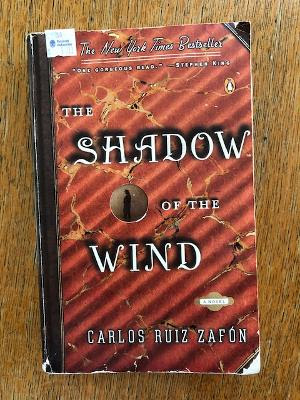
Back in December, before Christmas, before the pandemic shut-down, in those chilly, blissful days when Dark Time came early, and I would hustle the cats inside to cuddle up and read with me, my book club made a donation of books—some new, some used—to a local group home that serves children who have been separated from their parents due to abuse. The residential facility, located on beautiful, sprawling acreage, was just getting its library reorganized after some renovation, so the books were greatly appreciated. Most of the books were purchased new from money we’d collected in a bake sale, but we did have several boxes of books donated. A small group of members went through these donations, checking to be sure they were appropriate for children and teens, and also making sure the books adhered to the guidelines we’d been given by the group home: No dark subject matter, no gratuitous violence, no themes of death or dying or separation from parents. We ended up with a small box of rejected books that sat on my kitchen floor, just inside the door, until well after Christmas, New Year’s, and maybe even Easter, if I’m being honest. My intent was to donate those books, a few at a time, to the Little Free Library I mentioned in my previous post. And I did. Every time I took a drive up to drop something off for Harry or his cat, Asher, I took another few books. Finally, there was one book left in the bottom of the box. I pulled it out when I was getting ready to head up to Harry’s again, intending to put Sophie Quire in the library as well. But you know how that goes if you’re a bibliophile; we’re always curious. I flipped it over and read this on the back of the book: Barcelona, 1945: A city slowly heals from its war wounds, and Daniel, an antiquarian book dealer’s son who mourns the loss of his mother, finds solace in a mysterious book entitled The Shadow of the Wind, by one Julian Carax. But when he sets out to find the author’s other works, he makes a shocking discovery: someone has been systematically destroying every copy of every book Carax has written. In fact, Daniel may have the last of Carax’s books in existence. Soon Daniel’s seemingly innocent quest opens a door into one of Barcelona’s darkest secrets—an epic story of murder, madness, and doomed love. Intrigued (who wouldn’t be?) I opened the cover and read the first paragraphs: I still remember the day my father took me to the Cemetery of Forgotten Books for the first time. It was the early summer of 1945, and we walked through the streets of a Barcelona trapped beneath ashen skies as dawn poured over Rambla de Santa Monica in a wreath of liquid copper. “Daniel, you mustn’t tell anyone what you’re about to see today,” my father warned. “Not even your friend Tomas. No one.” “Not even Mommy?” My father sighed, hiding behind the sad smile that followed him like a shadow through life. “Of course you can tell her,” he answered, heavyhearted. “We keep no secrets from her. You can tell her everything.” Shortly after the Civil War, an outbreak of cholera had taken my mother away. We buried her on my fourth birthday. I can only recall that it rained all day and all night, and that when I asked my father whether heaven was crying, he couldn’t bring himself to reply. And then, as the saying goes, I was hooked. My desire to read the huge tome (of 487 pages in very small font) created a bit of a dilemma. If you are an avid reader who loves nothing more than to spend an afternoon browsing through a used book shop, please take a moment here to close your eyes and take a nice deep breath. As you exhale, thank the Universe (or whomever you would like) that you do not have a lung disease. Because if you were me, you wouldn’t be able to have that joy, that luxury, of walking through the aisles with row upon row of titles, pulling first this one, then that one off the shelf, loading up your arm or basket or bag with 5 or 6 or 10 because they’re priced at a dollar a book. I can’t do that. Dust will kill me. Dust in books is really, really bad. And this book in particular was very, very old and very, very dusty. Just reading the first page started me coughing. So I did what I’ve learned to do in that situation. I put on the N95 mask I use for cleaning the house, took the book in the bathroom, plugged in my blow dryer, and blew the dust out while flipping through the pages. Works like a charm. I’m so glad I did. Because when I finally started reading it, I needed it desperately. I needed its rich, dense prose, so carefully crafted, to lose myself in. I needed the twists and surprises of the plot to keep me turning pages. (I didn’t really need to be staying up past my usual bedtime every night, but that’s okay; I’m a grown-up. I have choices.) I needed to have that story to look forward to as cases of the virus continued to climb and the country went into lockdown and I couldn’t go to my book club meetings or have tea with friends or see my kids or grandchildren. In the days that I slowly made my way through it, savoring every page, that one author’s craftsmanship kept me from despair. It's amazing how powerful books can be, isn’t it?
July 19, 2020
Books, Part One: Rescuing Sophie Quire
So in the next few posts, I want to talk about some of the books I've been reading. This is my favorite story about the stories, but I can't wait, so I'm sharing it first.
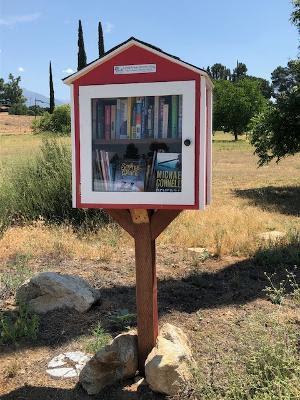 In the town directly north of mine, on a winding back road, there is a "Little Free Library." If you don't know about the Little Free Library project, click here for the back story. It's pretty amazing. The "library" pictured above is the one I mentioned. It's been erected at the side of the road I drive to get to my friend Harry's house in Cherry Valley.
Some weeks ago, while driving back from dropping off a few groceries for Harry, I came around the corner and saw a book lying in the middle of the road a few feet from the Little Free Library. Of course I pulled over and got out to pick it up; my bibliophile friends would be scandalized to see a book tossed out like that, like so much trash. I know I was. But I'm sure it was there by accident. Or was it?
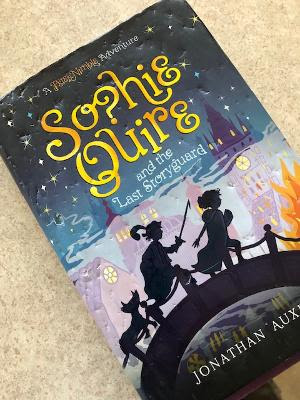 The title was Sophie Quire and the Last Storyguard. "Storyguard"? From the font and the whimsical picture on the book jacket, I could tell the book was children's literature. Of course I did what all book lovers do: I flipped it over and read the back cover. Not wanting to stand in the road and examine it further, but definitely wanting to read it, I tossed it on the floor of the car and drove off.
Upon my return home, I promptly forgot about it, and it remained in the car for quite a number of days (because, you know, the pandemic and all; no one's going anywhere much). Finally, I remembered it and brought it into the house.
Mystery #1: When I rescued it, the book had been lying in the southbound lane of traffic. The Little Free Library is on the opposite side of the road, and it has been sturdily built, with a door that closes tightly. I mean, it's not like the book fell out. And the paper book jacket wasn't torn or dirty, as it might have been if it had fallen from a car and slid along the pavement. It was as if someone had intentionally dropped the book smack dab in the middle of the road.
Mystery #2: There was, however, damage to the jacket--and not the unintentional sort. The jacket was riddled with holes. When I pulled it off to examine the actual cover of the book, I could see many, many punctures.
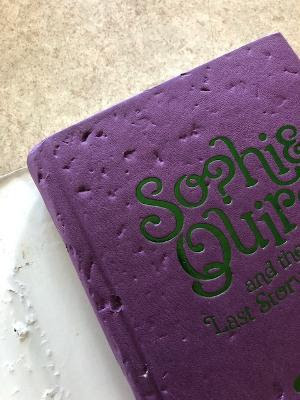 It looked as if someone had gone after the book with an instrument such as a pen, jabbing it over and over and over on the front, on the back, and even along the spine.
What the heck?? Who does this to a book?? What's the opposite of bibliophilia? (Let me know if you discover an antonym; I did not in my quick search just now.) Did this book's attacker dislike the main character? Or the ending? Or the fact that he/she/they had been forced to read a book?
I'm struggling to live with my unsatisfied curiosity, but alas, chances are I will never be able to solve those two mysteries.
What I can tell you, though, is that the book was delightful. Here's part of the description from Amazon.com:
"Sophie knows little beyond the four walls of her father's bookshop, where she repairs old books and dreams of escaping the confines of her dull life. But when a strange boy and his talking cat/horse companion show up with a rare and mysterious book, she finds herself pulled into an adventure beyond anything she has ever read."
Cool, huh? And yes, that does say "cat/horse companion." I don't want to give any spoilers away, but the book is filled with fantasy and whimsy and adventure--and a few very tense scenes. Oh, and a very strong female protagonist.
I loved it, loved the premise, the solid storytelling, the narrator's at times snarky voice, and I loved that the heroes were children.
I know you want to read it now, and I would loan you my copy, but as soon as I finished it, I dropped it off at the Little Free Library in Cherry Valley. I hope it's not languishing there. I hope some young person, intrigued by the brightly painted red and white stand, pulled it out, read the back cover and maybe the first page, and decided to take it home.
June 27, 2020
Ex Concessis

Evenings have been beautiful lately, so I’ve been riding my bike at dusk when the temperature is dropping quickly and there aren’t many people out and about. Earlier this week I coasted onto my street to find my neighbors, a married couple, out walking.
I see them often, walking down to our community mailboxes every day to get their mail, chatting amiably with each other, always holding hands. She had hip replacement surgery a while back, and he told me at the time how hard it was for him to be separated from her while she was hospitalized. They were cordial to me three years ago when I moved in, showing me their home (same model as mine) and welcoming me.
When I saw them the other night, they were just heading out, and I was returning home. I was masked. They were not. I stopped about ten feet from them and said hello.
“Kay? Is that you? We don’t recognize people with their masks on.”
“Yep, it’s Kay. How are you two tonight?”
We chatted about the gorgeous sunset, the weather, then the virus. They said they’d be going on vacation in July, flying to Minnesota to visit family.
“We ordered face shields off the internet,” he said. “I hope Southwest lets us wear them.”
I commented that the face shields would be a great extra precaution, but He explained that they wanted to wear them instead of masks. Because masks are “uncomfortable,” and they didn’t want to wear them for the entire six-hour flight.
“So we’re hoping Southwest will allow it,” he went on. “I talked to my son about it today, and he said, Well, if they insist on you wearing the masks, just tell them ‘I can’t breathe.’”
He laughed.
She laughed.………
“I’ll let you two get on with your walk,” I said. I pulled my bike up onto the porch and slipped quietly into the house.
This is what I want to stop doing.
Because, make no mistake, my dear white friends, when we are faced with racial discrimination on any level and we choose to say nothing, we are complicit.
When we say nothing, we are complicit.
Many of my white friends are earnestly, sincerely, genuinely wanting to “do things differently,” wanting to “be an ally,” and I am deeply grateful for that. If that’s you, then okay, here’s the deal:
Let’s agree to stop being complicit.
As the privileged majority in this country, this is what we know: That white folks will say things to other white folks with this assumption: ‘We all agree on this, right?’
No. No, we certainly do not.
Look, I’m not trying to say my sweet neighbors are racists. I am saying that, at the very least, his remark—which mocks a dying man’s last words—was racially insensitive, and my point is, I should have said something. Not to be confrontational or combative or an angry ass about it, but just to gently make them aware that making a joke out of a man’s tragic death says something about them and that something is not flattering.
In my younger years, I was angry and abrasive all the time, and I had zero tolerance for racist chatter. Back then, I thought nothing of getting in someone’s face and expressing exactly what I thought. But I’ve softened in my older years as I try harder to be a kinder, gentler version of my early self. And that has caused me to silence myself in situations such as the one described above.
I don’t want to do that anymore. My friends, we can’t do that anymore. Giving others a free pass to mock or demean persons of color makes us complicit in their racism. Those who do so have been emboldened by our silence—because we didn’t want to make a conversation tense or awkward or uncomfortable.
Let’s not allow those folks to be comfortable anymore. We do not all have to carry signs and march in protest (although if you’ve never done it, I highly recommend it, as it is an excellent curative for the soul, to say nothing of its power to spark a fire). Our voices have power. The more we speak up and speak out, the more uncomfortable certain folks will become. Maybe it won’t change them, but it will certainly put them on notice that such talk will be tolerated no longer.
June 12, 2020
The Voices in My Head
“Please… I can’t breathe, sir.”“… Mama….”(The final words of George Floyd.)
“Black lives matter.”
“All lives matter.”
“Then Jesus told them this parable: ‘Suppose one of you has a hundred sheep and loses one of them. Doesn’t he leave the ninety and nine and go after the lost sheep until he finds it?’ We are the ‘ninety and nine,’ and we must focus on the black community right now until they are safe. That doesn’t mean other lives don’t matter. It means black lives matter, too.”(From a friend’s Facebook post. I have paraphrased somewhat. Thank you, Donna.)
“I pray that you might be shielded from the ignorance and stupidity of racists. And they are racist idiots as well. When a person tries to make every single issue about race they reveal their true nature. Sorry these folks are allowed to breed.”(From a comment to a Facebook post. The man who wrote this was not addressing me, he was addressing his pastor, who had posted the notion that the family of George Floyd should not be allowed a large funeral, since churches in California are not being allowed to hold large funerals. The man who wrote this ‘prayer’ for his pastor is white. He was referencing me as the ‘racist idiot’ who should not be ‘allowed to breed.’ Oh, and, he thought I was black. So maybe go back and read his ‘prayer’ again and imagine you are reading it as a black woman, knowing that it is targeting you.)
“Burn. it. all. down.”(In a text from someone I love dearly.)
“But why? Why are they marching? I don’t get it. George Floyd didn’t doanything. Except die. Accidently. He’s not a hero.”(In a phone call with someone else I love dearly.)
“But I’ve seen black people at my job. I’ve seen black men in business suits. Do you really think they are oppressed?”(My neighbor, in a conversation in my driveway. I responded with a few anecdotes about my sons being pulled over for Driving While Black. He replied with the following.)
“Your son, the one that comes to visit you here? I’ve met him. He seems like a nice young man.”(There is profound but very subtle subtext here that black people will recognize right away but may be more difficult for some white people to pick up on. Maybe you’d have to hear my neighbor’s tone to catch it, but let me clarify what he is actually saying: ‘Wow, that’s outrageous that the cops would do that’ [given that your son is a nice young man]. If I had told him that my son was wearing a hoodie and sitting in his car at night, listening to rap music, and he was confronted by police and handcuffed with no probable cause (which is what actually happened), he would not have found it so outrageous. Because there is this history of black people—including my sons—being told they “fit the description…” and white people saying or thinking things like, ‘If you don’t want to be taken for a thug, don’t act/dress/behave like one.’
“The presence of the confederate flag at NASCAR events runs contrary to our commitment to providing a welcoming and inclusive environment for all fans, our competitors and our industry…The display of the confederate flag will be prohibited from all NASCAR events and properties.”(From the official NASCAR Twitter account.)
“But I bet people can fly their rainbow flags all day.”(A tweet in reply to the NASCAR announcement. Well, it is Pride month, after all.)
“NASCAR is a sport born in the south if you ban my flag you are stepping on my second Amendment right you also will never make another dime from me I will call all of the products I Buy and tell them Ian will no longer buy their products because of this you can kiss my southern ass”(A tweet [copied verbatim] in reply to NASCAR—by a guy named George. I don’t know who Ian is. Also not sure how the right to bear arms got caught up in this—unless this guy is arming himself with a confederate flag. I want to say there were more articulate responses than this one in opposition to NASCAR. I want to say that. I did not find any, but then again, I did not read all of the 11.6 thousand tweets in response.)
“This is AMAZING! As a southerner with ancestors who fought for the confederacy, I think that stupid flag belongs in a history book/museum, not being waved around or hung in public as a sign of “pride.” Everyone KNOWS it’s a racist symbol at this point. Good job, @NASCAR!”(Another tweet in reply to NASCAR’s announcement. There were many, many more like it. I had intended to include some of the more severely racist (you don’t really want to know anyway) tweets in response to NASCAR’s announcement, but with a new feature, Twitter users can “hide” replies. Which, in this case, is a really good thing, and someone whose job it is to hide them is working overtime at the NASCAR social media office right now.)
“Where is the outrage?”(My friend Kelli posted this on her Facebook page in the first days after George Floyd was killed. This is not the first time she has felt like the lone voice crying out for justice for the black community in the wilderness of social media.)
“This is why I’m not on social media/Facebook.”“I saw his racist comment but I choose not to engage with people like that.”“I don’t know what to say, so I don’t say anything. I’m afraid of offending someone.”“I’ll just be happy when all this is over and we can get back to normal.”(These are remarks made to me by dear friends—all of them white—in recent weeks. I’ll be happy when “this” is “over,” too—and I pray that comes within the lifetime of my children. Also: I interpret “normal” as “status quo.”)
“You have to be willing to make mistakes. You have to be willing to put your foot in your mouth. Lord knows I put my foot in my mouth enough times when I first became involved in social activism, but that’s how we learn, from our mistakes, and we become better at articulating our message to others.”(From a really cool gentleman giving an interview on NPR, and I’m sorry I didn’t catch his name but I was driving and listening and crying and hoping. But if somebody else heard it and knows who he is, let me know so I can credit him.)
“white people. do something.”(On a sign created by Temple University’s Tyler School of Art graduate student Kara Springer. Her work was photographed and published widely online in the days following the death of George Floyd—and she has endured repeated ugly racist comments regarding it. Sigh….)
“We need a break in the action, Kay.”(My favorite neighbor, after I remarked to him, “Things seem a bit calmer today.” My first response when he said this was to agree. I was worn out and worn down and had been doing my utmost to guide my own race toward love, acceptance and mutual understanding for weeks. But no. A break is exactly what we don’t need right now. We need momentum, and we need it to keep building. Please, for the love of all that is sacred in this “land of the free,” please, I beg of you, my white friends, do not allow us to return to status quo, to “get back to normal.” Because our normal is not everyone’s normal. Please do not turn away this time and return to the life you enjoy without first doing all you can to ensure that everyone has the opportunity to enjoy that same level of safety, security and happiness.
“Injustice anywhere is a threat to justice everywhere. We are caught in an inescapable network of mutuality, tied in a single garment of destiny. Whatever affects one directly, affects all indirectly.”(Dr. Martin Luther King, Jr. in his “Letter from Birmingham Jail.” Thank you, Jennette, for reminding me of the beauty of his words.)
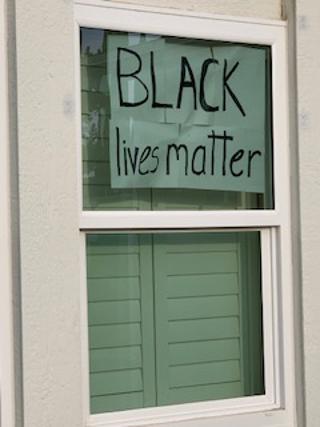
Black Lives Matter(Written in black marker on white paper and taped in a window in my senior community. There are 554 occupied homes here and close to a thousand residents. It is the only sign in the entire community in support of Black Lives Matter.)

May 30, 2020
How I Slept
Eric Garner. Michael Brown. Freddie Gray. Philando Castile. Alton Sterling. Breonna Taylor. Ahmaud Arbery. Christian Cooper. George Floyd.
This keeps happening.
This has been happening all my life.
I was 11 years old during the Watts riots of 1965. We lived 12 miles away.
I was 15 and a student at Rubidoux High School on September 24, 1969, the day of the race riot on campus there.
Last night I had the news on for hours and hours, just like I used to in the good old days. That’s not like me anymore. My psyche can’t take the overload of sadness, so I limit myself in the evening—usually—to 30 minutes of national news.
But last night was extraordinary. So I kept it on, watching, sometimes with the volume up, sometimes with it muted as I talked to friends and my son for hours and hours, watching, and at times, crying.
I wanted to turn it off.
I couldn’t turn it off.
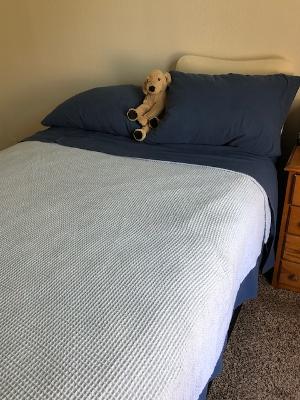
I finally turned it off and laid on the floor with my good, good dog, stroking his head, massaging his back, telling him why I loved him so very, very much. Then I crawled into bed, cocooning myself between the pillows and clutching Charlie, the plush pup my cousin gave me.
My friends tease me at times about my evening routine, how I go to bed so early, no TV or movies or internet or phone. Just me and a book for an hour in another world before I turn off the light, and I am asleep in less than 60 seconds.
Not last night.
Last night I kept watching, even with the house dark and everything turned off. I closed my eyes, but I saw the violence and destruction that I had just been watching on the news… and the violence and destruction of 2015… and 2014… and 1992… and 1969… and 1965.
Lying there in the dark, it was reminiscent of 9/11/2001, when my kids—my caring, adult children—finally convinced me to turn off the television and go to bed, and they came in my room and sat around me and talked to me until I finally fell asleep.
Last night I had my dog. And I had Charlie. And a headful of memories I wish I didn’t have.
May 29, 2020
Understanding Amy
This post is not about that altercation, essentially; it is about my post on Facebook about that altercation. Because I need to clarify (or justify, if you would have it so) something I said about that.
But to summarize (and forgive me for the lack of journalistic form as I use their first rather than last names for obvious reasons): While Christian was bird-watching in a section of the park called “the Ramblings,” where dogs are not allowed off leash, he noticed Amy’s dog diving into the foliage and whatnot (as dogs will do). When he asked her to leash her dog, she refused, so he began to record their interaction on his phone, at which point she demanded he stop, and when he didn’t, she called 9-1-1 and shouted to the dispatcher that she needed help because a black man was threatening her and her dog.
The video taken by Christian has been posted repeatedly by multiple news outlets on Youtube, so go take a look if you need to see “exactly” what happened. You’ll note that Christian is courteous (“Please do”) when she threatens to call the cops—even when she threatens him with “I’m going to call the cops and tell them a black man is threatening my life,” which clearly has not happened, and he remains courteous even after her hysterical plea to the dispatcher of “Help me! I’m being threatened by a black man in the Ramblings!” (He tells her “Thank you” after she ends the call.) I’m not going to post a link here, for multiple reasons that aren’t important; you can find it easily enough.
Initially, I simply posted a link to the video on my Facebook page. Why? I want to be very clear with my answer: I did not do so to vilify Amy. I resent that people are calling her “Central Park Karen” and other names. I am horrified that she has received death threats. I didn’t post that video to pile on. Not at all.
I posted the video because, of my 793 “friends” on Facebook, the vast majority are white. And, sadly, in that group, there are a few folks who still don’t “get” what “white privilege” is, a few folks who still claim that, yes, there are “a few bad apples,” but overall, racism died out long ago. Try as I might, no matter how many blog posts and Facebook comments I make, I can’t seem to convince this small handful of people that, in fact, racism remains a very powerful threat in America. How powerful? Powerful enough that black men like Ahmaud Arbery and George Floyd are still losing their lives in modern-day lynchings in this country.
But again, that is not what this post is about, and full disclosure here in case you came upon this page after doing a search for one of the topics or names I’ve tagged in it: I am a white woman with a white daughter and a black daughter and two bi-racial (black and white) sons. This post is about what happened after I posted Christian’s video on Facebook. Sean, a good friend and fabulous teacher with whom I have discussed race issues in the past, commented on the post regarding how discouraged he had become in trying to teach young people about racism. I replied with this:
“Getting people of privilege to ‘get it’ is so, so daunting. And always keep in mind, love, that people like this woman are reacting out of fear… because she has been taught to fear.”
My comment was not well received. A couple of friends—good friends, great people—commented, “She was NOT reacting out of fear….”
Well, but… she was. Yes, folks, I’m right there with you in terms of how horribly she behaved, how his very life could have been at stake by her false accusation. Trust me, I get that. It is something I fear for my own sons all the time as they try to navigate through a world populated by a privileged majority. And yes, yes, I agree! Of course! Racism is still out there (only now it’s filmed), and we should expose it whenever possible. I’m right there with ya. You only need to read my blog (keep scrolling after this post) to see that.
But I feel—agree with me or not—that it is imperative we find a way other than shouting and name-calling to help racists see themselves as they are. I’m pretty sure calling Amy Cooper names and threatening her life is not going to encourage self-examination or self-awareness on her part.
Quick side note here: Yes, Amy Cooper is a racist (despite Christian Cooper stating graciously in an interview that ‘only she knows whether that is true’). Simplest definition I could find online: “Racists discriminate against other races.” Did she? Yes—immediately, without even thinking twice.
You’ll have to trust me on this next bit: I’ve confronted a lot of racists in my day. This is how I used to do it in my youth:
At age 16, I was sitting at the dinner table in a friend’s home when the father of the family made some reference to “niggers.” I responded with this gem: “Ahem. My dad was a nigger.” Not my proudest moment, and I have rarely shared that, for obvious reasons. What a jerk! (Me, I mean. Well, the dad was a jerk, too, and a racist.) Most folks knew my dad had died when I was young. No one knew what he looked like. My skin was dark enough that kids in my neighborhood when I was small called me “nigger baby,” so I just responded in that way to shock the guy. Because I was profoundly offended by what he said, and I wanted to profoundly offend him in turn.
Would that have helped Mr. So-and-so to an epiphany wherein he became open and accepting of all races? Um… no.
We have been shocked and offended by Amy Cooper. Will offending or threatening her in return help her to a similar epiphany? No. No, it will not.
Can we please just try to take a breath and realize that the majority of racists don’t even realize that they are? Yes, I know, blatant white supremacists have become emboldened by persons in power who turn a blind eye to their hatred. I get that. Amy Cooper is not one of those people. She is a white woman with a nasty temper who lashed out from a place of deep-seated fear. Let me clarify: She was not fearful of Christian Cooper or anything he did. She is fearful of black people in general—whether she is aware of it or not.
Case in point: Just before the publication of The Tainted Legacy of Bertha Gifford, I went back through the book, deleting all the parts I thought might hurt my mother. Mom was 91. I wanted the book to bring her closure about her beloved grandmother. I didn’t want it to hurt her or cause yet another rift between us. So I took out the part where she barked at me, “Keep your eyes on your purse!” when she saw that our shuttle driver from the airport in St. Louis was a black man. I also took out the part in which I described her reaction when I got us lost in the rental car one day and we ended up in a predominantly black suburb… and how she literally slid down in her seat to hide, fumbling for the door lock, screaming at me in near-hysterics to “Turn around!” and “Get out of here!” Amy Cooper’s tone in her brief exchange with the 9-1-1 dispatcher was reminiscent of that.
This was my mom, though. Grandma to my children, who loved her, and whom she loved in return.
But… Mom was taught from a young age not to trust black people, to be fearful of them. I was not. Thank all the gods and the Universe that, in my childhood, I never once heard my parents speak ill of anyone of another race. I knew people were “different.” I was never taught that “different” meant “inferior or “dangerous.” Mom and Dad knew what was right and just, and we saw them, as our role models, practice that at home. But taking Mom back to the location of her childhood after she’d been gone for decades triggered that latent, sub-conscious fear in her.
In the decades since being an ass to Mr. So-and-so, I have had a lot of heartfelt conversations with racists. With the exception of my former father-in-law, who told me when my son was an infant that he would never be as smart as my daughter because he was black, the vast majority of racists I have known will eventually (with enough patience and careful listening on my part) admit to some incident in their childhood when they learned to fear black people. Or Mexicans. Or Japanese people because of the racist propaganda distributed by so many (including the U.S. government) during WWII. (Ever done a Google image search of WWII propaganda posters? Take a deep breath first.)
I could write an entire blog post (or book, really) about how fear is the most powerful weapon in controlling people. When fear of certain things, certain people, becomes ingrained in our psyche at a very young age, it is very, very difficult to root out—because, while we may mature and begin to think of ourselves as nice, grown-up people with good manners who treat everyone with decency and respect, it remains there, on a sub-conscious level, until something happens to trigger that fear.
I don’t advocate that you feel sorry for Amy Cooper. I just ask that you attempt to understand what motivated her to do what she did.
As for me, I was a nerdy kid who grew up fascinated by TV and newspaper coverage of current events, so I watched the Civil Rights Movement unfold before my very eyes, and it left a huge impression on the very strong sense of justice I inherited from my father. Thus my intense anger toward Mr. So-and-so or anyone else who crossed my path who referred to others by racial or xenophobic slurs. I’ve never been able to tolerate that sort of thing. Only now, instead of shocking and offending, I really try to consider the source and engage in a conversation that leans more toward enlightenment than further anger and hatred.
May 17, 2020
Ipso facto
I have a point to make here, dear Reader, and I have to tell a couple of stories to get to those points, so I hope you will bear with me if this post seems a bit lengthy. I would say, “I’ll try to keep it short,” but doing so would be a disservice to the man whose untimely death I am mourning.
In 1994, I bought my first home in Rancho Cucamonga, and before your brain tells you, “Ooooh, nice,” it was a repo that had been sitting vacant for a year and had been vandalized multiple times. Definitely a fixer, but it was mine. The boys and I moved into our own home, the married daughter lived just up the road, and from my bedroom window, I could see all the way to I-10 and beyond the freeway to watch planes take off from Ontario Airport.
Between my home and those planes, there was nothing but vineyards and long lines of towering eucalyptus trees, planted as windbreaks, as far as the eye could see. We quickly collected a few geriatric dogs in the years after we moved in, and every weekend I would take them for long, early morning walks over there.
Then the property was sold, the new owners tore out all the grape vines, yanked out all the trees, and began leveling those acres for a huge housing development with large, two-story homes—as far as the eye could see.
While they were building them, there was no fence around the property, so I still walked across the road of an evening to stroll along the unpaved streets with the dogs, hating the fact that the homes were going up but curious about the process, the floor plans, etc. On occasion, I would follow the dogs up onto one of the pads and poke my head in the framed doorway, or walk in a few feet to determine where the kitchen would be or how big the living room was. I did this with no malice, no ill intent. I just walked in, looked around, and left.
Fast forward to a few years later when the completed development loomed just yards from my bedroom window. It was now a gated community, and my then teenage son made the acquaintance of a young lady who lived there. I have to state here that my boys are bi-racial. That shouldn’t matter to anyone at any time, but it does, which is why this story must be told.
One warm summer night, he drove across the way in his newly acquired car, a buddy in the passenger seat, to visit this young woman. She’d given him an access code for the gate, so he drove in, but didn’t go straight to her house. He doesn’t remember now why they pulled over; he thinks maybe to listen to a favorite rap song. But minutes later there was a spotlight shining through the windshield of his car, blinding them, and they were given commands through a loudspeaker to step out of the car. They assumed it was police; they couldn’t see anything beyond the glare of the spotlight. The two were placed in handcuffs and made to sit on the curb—for all the world to see. His car was searched (with his permission), his license run for warrants, while they sat, saying no more than “Yes sir” or “No sir” in answer to most of their questions, except when they were asked why they were in this neighborhood, one officer remarking that they didn’t look like they belonged there.
Finally, when they had detained them long enough to publicly humiliate them and make them wonder if they would actually end up in jail for some unknown reason or someone else’s crime, they were let go with the explanation that they “fit the description” of someone who had “recently committed a burglary in that area.”
All of the aforementioned that happened long ago in my life has to do with this story that happened three months ago:
On February 23, 2020, Ahmaud Arbery, a young black man, left his home to go for a run. Along the way, he stopped at a construction site where a home was being built and stepped inside for a few minutes. Conjecture now is that he was stopping to get a drink of water from a functioning sink in the building. He is seen on a security camera walking out of sight, then back into view, wiping his mouth. He leaves then, having disturbed nothing.
Several minutes later he is shot dead after being confronted by two white men who chased him down in a pick-up truck and tried to stop him. When he resisted, they killed him.
When I say to people, “This could have been my son,” I feel those words all the way down to my heart and soul. I wish I could say that what happened to my own son was an isolated incident. Sadly, both my boys in their younger years had to endure similar fear and humiliation after being pulled over for contrived reasons. “You fit the description….” “You were weaving….” “You failed to stop completely.” I know how these things go. I was a police chaplain once, and I rode with an officer who told me that if a person “looked suspicious,” all he had to do was follow him long enough to make him nervous, get him to make the slightest error, and then he “had cause,” and he delighted in that. He was a white officer working in a primarily Latinx community.
I digress.
I stopped writing here for a moment because I couldn’t think of a gentle way to express what I need to say next, and that is this:
If you find yourself feeling even slightly less horrified by the modern-day lynching of Ahmaud Arbery because you found out that, ‘Oh look! He was snooping around at that construction site first!’ then you’re part of the problem. Because it doesn’t matter if he did. People do that sort of thing all the time. I keep telling my own story of doing the same thing, and those who hear it keep saying, “So have I!”
Ahmaud Arbery wasn’t guilty of any wrongdoing. But let me just say this: Even if he was, even if he took a piss on the dirt floor or picked up a power tool and shoved it in his cargo pants on the way out, those two men are not excused from chasing him down and killing him.
Because this is not about what Ahmaud Arbery did or did not do. This is about what Gregory McMichael and his son, Travis McMichael did. They chased a man down, confronted him, and when he refused to comply with what they demanded and he attempted to defend himself, Travis McMichael shot him multiple times point blank with a shotgun. Arbery didn’t even have a fighting chance of survival.
I don’t care what Ahmaud Arbery did in the moments before his execution. I don’t care that the autopsy report shows he had “no drugs or alcohol in his system” when he was murdered. None of that matters, because that’s not what this case should be about, but that’s all I keep hearing about in the news. We seem to be focusing primarily on the victim here, instead of on the man who committed the heinous crime.
The same was true in the case of Emmett Till, a young black teenager who, in 1955, was dragged out of his uncle’s home in the middle of the night by several white men, beaten, tortured, and finally drowned. They did unspeakable things to him. He was 14 years old. The men who lynched him were acquitted of their crimes by an all-white jury. One year later, in an interview for Look magazine, two of the men admitted to killing Till, and they felt justified in doing so because he had allegedly flirted with a married white woman.
The entire focus of the case in 1955 was on what Emmett Till may or may not have done, not on what was done to him, nor on the individuals who perpetrated those acts.
Do you see my point here? I pray that you see my point here. In the case of an unarmed black man who is clearly chased down by two white men and then killed, it is not necessary to “wait until we have all the facts” before we make a judgment. A gross and tragic injustice has been done here. Nothing we learn about what Arbery did or did not do in the moments or days or weeks before it happened is going to justify what was done to him.


