
Lawrence R. Spencer's Blog, page 550
August 4, 2013
TOURISTS AT A CRUCIFICXION

Crucifixion was often performed to terrorize and dissuade its witnesses from perpetrating particularly heinous crimes. Victims were left on display after death as warnings to others who might attempt dissent. Crucifixion was usually intended to provide a death that was particularly slow, painful (hence the term excruciating, literally "out of crucifying"), gruesome, humiliating, and public, using whatever means were most expedient for that goal. Crucifixion methods varied considerably with location and time period.
The Greek and Latin words corresponding to "crucifixion" applied to many different forms of painful execution, from impaling on a stake to affixing to a tree, to an upright pole (a crux simplex) or to a combination of an upright (in Latin, stipes) and a crossbeam (in Latin,patibulum).
In some cases, the condemned was forced to carry the crossbeam on his shoulders to the place of execution. A whole cross would weigh well over 300 pounds (135 kg), but the crossbeam would not be quite as burdensome, weighing around 100 pounds. The Roman historian Tacitus records that the city of Rome had a specific place for carrying out executions, situated outside the Esquiline Gate, and had a specific area reserved for the execution of slaves by crucifixion. Upright posts would presumably be fixed permanently in that place, and the crossbeam, with the condemned person perhaps already nailed to it, would then be attached to the post.
While a crucifixion was an execution, it was also a humiliation, by making the condemned as vulnerable as possible. Although artists have depicted the figure on a cross with a loin cloth or a covering of the genitals, writings by Seneca the Younger suggest that victims were crucified completely naked. When the victim had to urinate or defecate, they had to do so in the open, in view of passers-by, resulting in discomfort and the attraction of insects. Despite its frequent use by the Romans, the horrors of crucifixion did not escape mention by some of their eminent orators. Cicero for example, described crucifixion as "a most cruel and disgusting punishment", and suggested that "the very mention of the cross should be far removed not only from a Roman citizen's body, but from his mind, his eyes, his ears."
Frequently, the legs of the person executed were broken or shattered with an iron club, an act called crurifragium, which was also frequently applied without crucifixion to slaves. This act hastened the death of the person but was also meant to deter those who observed the crucifixion from committing offenses. -- REFERENCE SOURCE: Wikipedia.org



August 2, 2013

MOURNING FOOL HAIKU

MOURNING FOOL HAIKU
Fools Mourn Romantic Flowers
Delusions Dreamed Are Never Real
Love Dissolves Like Misty Clouds.
_________________
Lawrence R. Spencer. 2013.
August 1, 2013

July 31, 2013
BELIEVE

SEEING IS BELIEVING
Definition of Believe: to have confidence in the truth, the existence, or the reliability of something, although without absolute proof that one is right.


July 30, 2013
LIFE’S ILLUSIONS
Discovering that we do NOT know makes it possible to understand Life, Illusions, Delusions and other Universes.
BOTH SIDES NOW, by Joni Mitchell
"Bows and flows of angel hair
And ice cream castles in the air
And feather canyons everywhere
I've looked at clouds that way
But now they only block the sun
They rain and snow on everyone
So many things I would have done
But clouds got in my way
I've looked at clouds from both sides now
From up and down, and still somehow
It's cloud illusions I recall
I really don't know clouds at all
Moons and Junes and Ferris wheels
The dizzy dancing way you feel
As every fairy tale comes real
I've looked at love that way
But now it's just another show
You leave 'em laughing when you go
And if you care, don't let them know
Don't give yourself away
I've looked at love from both sides now
From give and take, and still somehow
It's love's illusions I recall
I really don't know love at all
Tears and fears and feeling proud
To say "I love you" right out loud
Dreams and schemes and circus crowds
I've looked at life that way
Oh but now old friends are acting strange
They shake their heads, they say I've changed
Well something's lost but something's gained
In living every day
I've looked at life from both sides now
From WIN and LOSE and still somehow
It's life's illusions I recall
I really don't know life at all
I've looked at life from both sides now
From up and down and still somehow
It's life's illusions I recall
I really don't know life at all"
BURNING BOOKS
 I recently re-read a book from my personal library about the destruction of the greatest library of antiquity in Alexandria, Egypt, The Vanished Library, by Luciano Canfora. Because I write books, I also read books. Books are a gateway to intellectual and spiritual freedom.
Although my personal library shelves contain only several hundred volumes, it is estimated by various sources that the Library at Alexandria housed tens of thousands of scrolls amassed by Ptolemy that were added to the sacred library of Ramses II, Pharaoh of Egypt! (c. 1300 BCE) At the time of it's destruction there were reported to be more than 45,000 hand-written books, gathered from all of the civilized word -- translated into Greek -- and housed in a single building.
In 640 AD, this priceless library was burned at the order of Muslim Caliph Omar. When the general of his army asked the Caliph what to do with the books of the library, the Caliph responded:
"If their content is in accordance with the book of Allah, we may do without them. If they contain matter not in accordance with the book of Allah, there can be no need to preserve them. Proceed then, to destroy them."
At that time the city of Alexandria had 4,000 public baths. The water for the baths was heated by underground stoves or furnaces. "The books were distributed to the public baths of Alexandria, where they were used to fuel the stove which kept the baths comfortably warm. ....It took six months to burn all that mass of material." Only the writings of Aristotle were spared from the flames.
As has so often been the case in the history of Earth, religious fanaticism -- the enemy of knowledge and freedom -- was the cause of destruction of precious accumulated knowledge, technology and wisdom recorded by literate scientists, mathematicians, artists, philosophers and scholars. The modern destruction by the United States of the priceless Library of Baghdad, the burning of books and burying of scholars under China's Qin Dynasty, the destruction of Aztec codices by Itzcoatl, the Nazi book burnings, the Spanish Inquisition, and many others psychotic episodes serve to keep humanity stupid, superstition and enslaved by ignorance.
However, in 2013 we live in an age of unprecedented information access. There are thousands of libraries all around the world. The internet is a vast library of information that contains nearly every book that has ever been written! (Of course there are huge numbers of "heretical" books that have been burned by Caliphs or Nazis or hidden in the Vatican library or the Smithsonian Institute.) However, in spite of intellectual terrorism, superstition, religious fanaticism, and government mind-control agendas, we are living in an unprecedented age when books are freely available in abundance! All we need to do is read them.
http://www.beautiful-libraries.com/index.html
July 29, 2013
THE AQUARIUM CLUB
 I am a great admirer of Mark Twain (Samuel Clemens). After reading his Autobiography I discovered that Mark Twain became increasingly cynical, depressed and disillusioned by the behavior of the human race. His revolutionary books, Huckleberry Finn and Tom Sawyer were protests against the institution of human slavery in a time when "owning people" for commonplace. Toward the end of his life, in his 70s, Mark Twain became reclusive and bitter about the pain and suffering he witnessed on his extensive travels around the world during lecture tours. This was compounded by the agony and personal responsibility he felt for the death of his infant son, the death of his daughters and his beloved wife. The accumulated tragedy of his his observations and experience as a human being overwhelmed him in the end. He died defeated by the pain of his own compassion for humanity and from the loss of the people he loved the most-- his family.
Many men who are "dreamers" and "visionaries", like Twain, are highly empathetic. They FEEL the pain of other beings as a personal, subjective pain. Some beings find relief from this chronic agony in drugs or alcohol. Or, they just stop looking and caring. Mark Twain found a temporary relief from his own pain in tobacco, humor, and a "collection" of young girls....
This article is re-posted from the Blog "Today I Found Out":
Samuel Clemens (aka, Mark Twain) used to “collect” girls between the ages of 10-16 years old.
On February 12, 1908, Clemens said, “I suppose we are all collectors… As for me, I collect pets: young girls — girls from ten to sixteen years old; girls who are pretty and sweet and naive and innocent — dear young creatures to whom life is a perfect joy and to whom it has brought no wounds, no bitterness, and few tears.”
Okay, so it isn’t actually as creepy as it initially sounds and in some ways is kind of sweet, but Samuel Clemens did love to entertain young girls. Towards the end of Clemens life, he suffered quite a lot of hardship. His daughter Susy died in 1896 and his wife Olivia passed away in 1904, followed by a second daughter, Jean, in 1909. Clemens fell into a depression in the early 1900s and noted that while he had reached the grandfather stage of life, he had no grandchildren to keep him company. He therefore went about befriending young girls who he treated as surrogate granddaughters.
The girls in question were the daughters of couples who ran in his same social circle. He often met them on boats carting him back and forth to England or Bermuda, as was the case with Helen Allen. Allen was just twelve years old when Clemens stayed with her family in Bermuda. Her father was the American Vice-Council in Bermuda; her grandmother had known Clemens’ wife as a child. Clemens said Allen was “perfect in character, lovely in disposition, and a captivator at sight,” everything that Clemens wanted in his collection of young girls.
The group of girls were called “Angel Fish” or “the Aquarium Club.” The name is derived from the fish that Clemens first saw in Bermuda. He decided on that name because the angelfish “is the most beautiful fish that swims.” Clemens would buy angelfish pins in Bermuda and present them to each of his girls. Out of a dozen or so original pins, at least one is still in existence. It currently resides in the Mark Twain Library in Redding, Connecticut.
So what exactly did a man in his late seventies do with a bunch of teenaged girls? All manner of innocent, grandfatherly things. Clemens invited the girls to concerts, the theatre, and to his own house for card games, billiards, and reading. While in Bermuda, several of his Angel Fish had fun riding in a donkey-pulled cart with him. Clemens initially called his estate “Innocence at Home” in honour of “his girls.” He kept in touch with them by exchanging letters when they couldn’t visit, but always kept a room available and hoped to have an Angel Fish “in it as often as Providence will permit.” Before you get too much of a “Michael Jackson” vibe, it should be noted that the girls were always accompanied by a chaperone; the room for the Angel Fish even had two beds to accommodate a mother or guardian along with a girl.
Besides the room, Clemens’ house also had a billiard room which was refashioned into a sort of shrine to the Angel Fish. Above the door was a sign that said “the Aquarium” and inside the walls were lined with framed photos of each of the Aquarium Club’s members.
As innocent as it all was, if some celebrity tried to do that today, the press would have a field day with it, insinuating all manner of disgusting things, whether there was any evidence of such acts or not. In his day, it wasn’t really much of a scandal, though Clemens’ remaining daughter, Clara, didn’t appreciate the behavior, perhaps being a tad jealous. When she returned to her father’s home from a stint in Europe to find that her father had collected a group of young girls to entertain, she made her father change the name of his house to “Stormfield” and stopped the household staff from saving letters from the Angel Fish. (Today the full collection of every surviving letter can be read in Mark Twain’s Aquarium: The Samuel Clemens-Angelfish Correspondence.)
The presence of chaperones probably should have put Clara’s mind at ease, but the letters Clemens wrote to his girls would definitely raise some eyebrows today. Shortly after Dorothy Harvey’s fourteenth birthday, he wrote to tell her “I wish I could have those free-gratis-for-nothing-voyages-&-nothing-to-do-but-look-at-you every day.” To Dorothy Quick, just eleven years old, he wrote after one of her visits, “I went to bed as soon as you departed, there being nothing left to live for after that, & all the sunshine gone. How do you suppose I am going to get along without you?” The letters showed his love and devotion to his girls and the enjoyment he experienced in spending time with them, but today parents would likely have used these letters as evidence in civil lawsuits.
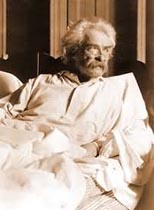 Despite this, only one relationship ever looked to be somewhat improper, and that wasn’t with one of his Angel Fish; further, the inappropriate overtures didn’t come from Clemens. The girl was Gertrude Natkin. He met her when she was fifteen and he was 70 in 1905. The two exchanged letters and Natkin developed a “school girl crush” on Clemens and went somewhat overboard in expressing her affection for him through her letters. Clemens became concerned about this and distanced himself from her- his letters growing more and more infrequent, because he didn’t want to gain a reputation for impropriety nor encourage her affections, perhaps proving that he saw his Angel Fish as nothing more than granddaughters. Certainly, at the time, an adult male courting a 15 year old girl wouldn’t have raised eyebrows, particularly if the suitor was well-to-do and not too old. But at 70, it would have been a scandal even in that time period.
Clemens died on April 21, 1910 of a heart attack, just a few years after establishing the Aquarium Club for his Angel Fish. All in all, there were around a dozen members of the club who visited Clemens regularly until his death, but his enthusiasm for the club waned in the last year of his life; he complained that his girls were growing up too fast, complained about their boyfriends, and cut off one girl when she turned sixteen. In the end, his fondness for them primarily lying in their innocence, as something of a breath of fresh air in a cynical world, waned as they gradually lost that defining feature of children."


