Lawrence R. Spencer's Blog, page 546
August 30, 2013


August 29, 2013
OUROBOROS: MY END IS MY BEGINNING

Excerpt from the book MORTALITY MECHANICS MANUAL by Lawrence R. Spencer
( Listen to Five Minute Selection from the Audiobook version )
"The Ouroboros Serpent
A variety of renderings of the Ouroboros Serpent from various cultures, religions and philosophical disciplines are featured as illustrative decoration on many pages of this book. (Mortality Mechanics Manual)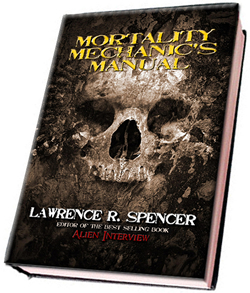
I have included this symbol, as it has been used almost universally on Earth throughout the ages, beginning in the Egyptian period, and possible as early as the Veda which dates back as far as 10,000 years. This symbol has been used to represent a variety of existential interpretations of the spiritual and physical condition of humankind and the universe.
“The Ouroboros is an ancient symbol depicting a serpent or dragon eating its own tail. The name originates from within Greek language; (oura) meaning "tail" and (boros) meaning "eating", thus "he who eats the tail".
The Ouroboros represents the perpetual cyclic renewal of life and infinity, the concept of eternity and the eternal return, and represents the cycle of life, death and rebirth, leading to immortality, as in the Phoenix. The current mathematical symbol for infinity - may be derived from a variant on the classic Ouroboros with the snake looped once before eating its own tail, and such depictions of the double loop as a snake eating its own tail are common today in fantasy art and fantasy literature, though other conjectures also exist.
It can also represent the idea of primordial unity related to something existing in or persisting before any beginning with such force or qualities it cannot be extinguished. The ouroboros has been important in religious and mythological symbolism, but has also been frequently used in alchemical illustrations, where it symbolizes the circular nature of the alchemist's opus. It is also often associated with Gnosticism and Hermeticism.

The serpent or dragon eating its own tail has survived from antiquity and can be traced back to Ancient Egypt, circa 1600 B.C.E. It is contained in the Egyptian Book of the Netherworld. The Ouroboros was popular after the Amarna period. In the Book of the Dead, which was still current in the Graeco-Roman period,
the self-begetting sun god Atun is said to have ascended from chaos-waters with the appearance of a snake, the animal renewing itself every morning, and the deceased wishes to turn into the shape of the snake Sato ("son of the earth"), the embodiment of Atun.
The famous Ouroboros drawing from the early alchemical text The Chrysopoeia of Cleopatra dating to 2nd century Alexandria encloses the words hen to pan, "one is the all". Its black and white halves represent the Gnostic duality of existence. As such, the Ouroboros could be interpreted as the Western equivalent of the Taoist Yin-Yang symbol. The Chrysopoeia Ouroboros of Cleopatra is one of the oldest images of the Ouroboros to be linked with the legendary opus of the Alchemists, the Philosopher's Stone.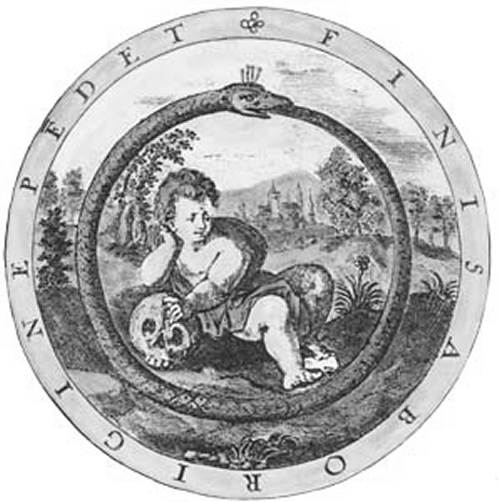
Plato described a self-eating, circular being as the first living thing in the universe - an immortal, mythologically constructed beast. The living being had no need of eyes when there was nothing remaining outside him to be seen; nor of ears when there was nothing to be heard; and there was no surrounding atmosphere to be breathed; nor would there have been any use of organs by the help of which he might receive his food or get rid of what he had already digested, since there was nothing which went from him or came into him: for there was nothing beside him.
All the other six motions were taken away from him, and he was made not to partake of their deviations. And as this circular movement required no feet, the universe was created without legs and without feet. In Gnosticism, this serpent symbolized eternity and the soul of the world. The universe was early divided into Earth below and Heaven above. These, two as one, gave the idea of opposites but forming a unity. Each opposite was assumed to be powerful and so was their final unity. For creation of the universe they projected reproduction to conceive creation. Now reproduction results in the union of two opposites as male and female.
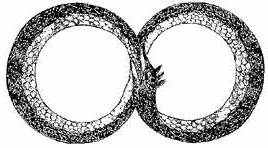
Correspondingly, the Chinese believed Light and Darkness, as the ideal opposites, when united, yielded creative energy. The two opposites were further conceived as matter and energy which became dual-natured but as one. The two opposites were yin-yang and their unity was called Chhi. Yin-Yang was treated separately in Chinese cosmology which consisted of five cosmic elements.
Since Chinese alchemy did reach Alexandria probably the symbol Yin-Yang, as dual-natured, responsible for creation, was transformed into a symbol called Ouroboros. It is a snake and as such as symbol of soul. Its head and anterior portion is red, being the color of blood as soul; its tail and posterior half is dark, representing body.
Ouroboros here is depicted white and black, as soul and body, the two as "one which is all." It is cosmic soul, the source of all creation. Ouroboros is normally depicted with its anterior half as black but it should be the reverse as shown here. With the name Chemeia taken to Kim-Iya, the last word would take Ouroboros to Yin-Yang.
In Mesoamerica the serpent god Quetzalcoatl is sometimes portrayed biting his tail on Aztec and Toltec ruins. A looping Quetzalcoatl is carved into the base of the Pyramid of the Feathered Serpent, at Xochicalco, Mexico, 700-900 AD.
In Norse mythology, it appears as the serpent Jormungandr, one of the three children of Loki and Angrboda, who grew so large that it could encircle the world and grasp its tail in its teeth. In the legends of Ragnar Lodbrok, such as Ragnarssona patter, the Geatish king Herraud gives a small lindworm as a gift to his daughter Pora Town-Hart after which it grows into a large serpent which encircles the girl's bower and bites itself in the tail. The serpent is slain by Ragnar Lodbrok who marries Pora. Ragnar later has a son with another woman named Kraka and this son is born with the image of a white snake in one eye. This snake encircled the iris and bit itself in the tail, and the son was named Sigurd Snake-in-the-Eye.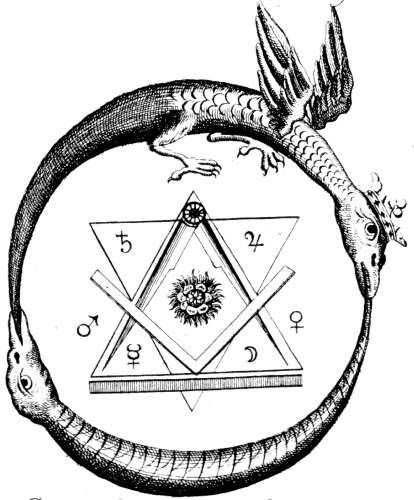
Christians adopted the Ouroboros as a symbol of the limited confines of this world (that there is an "outside" being implied by the demarcation of an inside), and the self-consuming transitory nature of a mere this-worldly existence following in the footsteps of the Preacher in Ecclesiastes.
It could very well be used to symbolize the closed-system model of the universe of some physicists even today.'
In Freemasonry the Ouroboros is displayed on numerous Masonic seals, frontispieces and other imagery, especially during the 17th century.
The Ouroboros is featured in the seal of the Theosophical Society along with other traditional symbols.
Alchemically, the ouroboros is also used as a purifying glyph. Ouroboros was and is the name for the Great World Serpent, encircling the Earth.
Ouroboros represents the conflict of life as well in that life comes out of life and death. 'My end is my beginning.' In a sense life feeds off itself, thus there are good and bad connotations which can be drawn. It is a single image with the entire actions of a life cycle - it begets, weds, impregnates, and slays itself, but in a cyclical sense, rather than linear.
Thus, it fashions our lives to a totality more towards what it may really be - a series of movements which repeat. "As Above, So Below" - we are born from nature, and we mirror it, because it is what man wholly is a part of. It is this symbolic rendition of the eternal principles that are presented in the Emerald Tablets of Thoth, (cited earlier)."

HUMAN ANATOMY IN 80 SECONDS
THIS 80 SECOND VIDEO SHOWS YOU THE ESSENTIAL INFORMATION YOU NEED TO KNOW ABOUT THE ANATOMICAL COMPONENTS OF A HUMAN BIOLOGICAL ENTITY. ANY QUESTIONS? Consult Greys Anatomy for further details....
IMPORTANT NOTE: THE SPIRITUAL ENTITY THAT ANIMATES THE BODY IS NOT SHOWN because Spirits are INVISIBLE, except to other Spirits....
The Human Body (stop-motion!) from kellianderson on Vimeo.

August 28, 2013
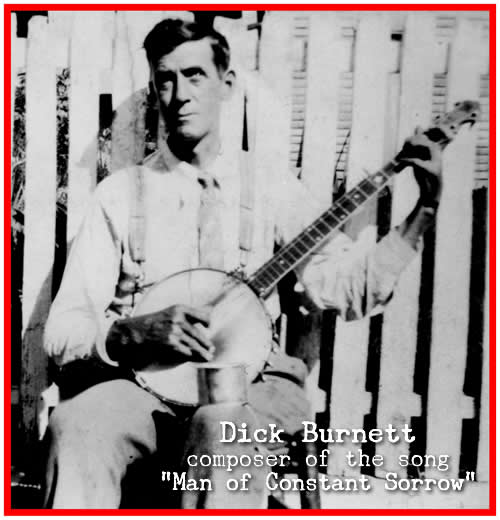
MAN OF CONSTANT SORROW
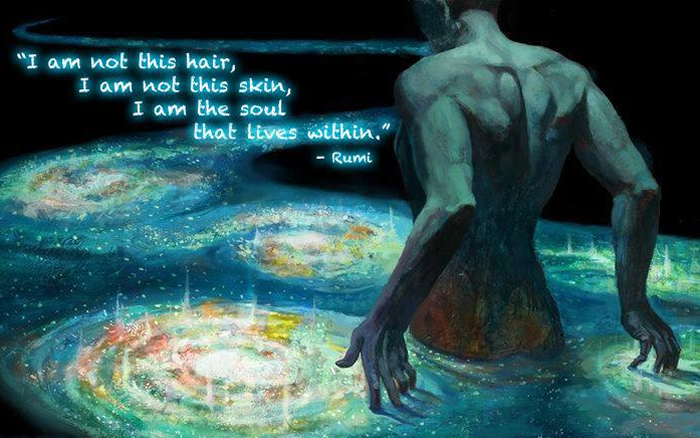
MAN OF CONSTANT SORROW is one of my favorite songs. It communicates the very real pain that all of the citizens of our Earthly prison experience, to a greater or lesser degree. The song was originally recorded by Burnett as "Farewell Song" printed in a Richard Burnett songbook, c. 1913.
Written by Richard (Dick) Burnett (October 8, 1883 – January 23, 1977) was an American folk songwriter from Kentucky. Burnett was born near Monticello, Kentucky. He was known to play the banjo and guitar and was blind in one eye. Burnett allegedly wrote the traditional American folk song, Man of Constant Sorrow, which was later to be covered by Bob Dylan. He recorded with fiddler Leon Rutherford for Columbia Records. An early version was recorded by Emry Arthur in 1928.
Here is the link to listen to this version of the song on YouTube:
http://www.youtube.com/watch?v=d70uxe9FCls&feature=share&list=TLhR46lYtLp_E
The following are subsequent “covers” of the song:
Roscoe Holcomb (cover) -- http://youtu.be/1cJRRc8FToQ
Roscoe Holcomb, (born as Roscoe Halcomb[1] September 5, 1912 – died February 1, 1981) was an American singer, banjo player, and guitarist from Daisy, Kentucky. A prominent figure in Appalachian folk music
BOB DYLAN (cover) -- http://youtu.be/xCipKmyngLY
JOAN BAEZ (cover) -- http://youtu.be/nQQjBjwe3-s
Ralph Stanley (Solo version (cover)) http://youtu.be/fLKltv26-00
Stanley Brothers (cover) http://youtu.be/ldnZnjGBGXw
BLUEBERRY SMOKE (cover) -- http://youtu.be/SFhFiLmzIpk
Soggy Bottom Boys (from the film “Oh, Brother Where Art Thou” http://youtu.be/YZtgZ5fHOuU
Original Lyrics to “Farewell Song” (Man of Constant Sorrow)
I am a man of constant sorrow,
I've seen trouble all of my days;
I'll bid farewell to old Kentucky,
The place where I was born and raised.
Oh, six long year [sic] I've been blind, friends.
My pleasures here on earth are done,
In this world I have to ramble,
For I have no parents to help me now.
So fare you well my own true lover,
I fear I never see you again,
For I'm bound to ride the Northern railroad,
Perhaps I'll die upon the train.
Oh, you may bury me in some deep valley,
For many year [sic] there I may lay.
Oh, when you're dreaming while you're slumbering
While I am sleeping in the clay.
Oh, fare you well to my native country,
The place where I have loved so well,
For I have all kinds of trouble,
In this vain world no tongue can tell.
Dear friends, although I may be a stranger,
My face you may never see no more;
But there's a promise that is given,
Where we can meet on that beautiful shore.
________________________________________________
Dick Burnett Biography on Wikipedia.org
Burnett was born near Monticello, Kentucky. He was known to play the banjo and guitar and was blind in one eye. Burnett was born near the end of the nineteenth century on October 8, 1883, in the area around the head of Elk Springs, about seven miles north of Monticello. He remembered little of his farming parents. His father died when he was only four and his mother died when he was twelve. Burnett did say that his mother told him how his father would carry him in his arms when he was only four years old and he would help his dad sing. It is notable that Burnett's grandparents were of German and English descent and that particular ancestral influence would be instrumental in forming Burnett's musical career. At seven-years-old, Burnett was playing the dulcimer; at nine he was playing the banjo, and at thirteen he had learned to play the fiddle.
Richard Burnett's life took a drastic turn in early adulthood when he was attacked by a robber, shot in the face, and lost his eyesight. He was working in the oil field of central Kentucky, married with a young child, and now faced an uncertain future. Almost prophetically, his boss made the following statement to Burnett: "Well, you can still make it; you can make it with your music."
In time, Burnett joined forces with a young fourteen-year-old orphaned boy from Somerset. That young boy, Leonard Rutherford, would become Burnett's student and became one of the "smoothest" fiddle players known to come from Kentucky.
Richard Burnett, "blind minstrel of Monticello" and Leonard Rutherford, "one of the smoothest fiddlers ever to take a bow," soon were singing at every opportunity. They appeared on courthouse lawns and on the street playing and singing their music. In order to earn some money, Richard would strap a tin cup to his knee to collect the contributions from a satisfied crowd.
They traveled by bus, Model A, and on foot to any place they could and sing. From about 1914 until 1950, the pair became so popular that they found themselves in the company of most all the popular mountain musicians of the time. They were "at home" in the presence of greats like the Carter Family, Charlie Oaks, Arthur Smith, and many others. They appeared at the Renfro Valley Barn Dance, on radio stations in Cincinnati, and finally, they would be some of the first old-time musicians to enter the recording studios.
Burnett and Rutherford made their first commercial recording in 1926 for Columbia Records in Atlanta, Georgia. "They gave us sixty dollars a record and paid all our expenses from here to Atlanta and back, hotel bills and everything," Burnett reminisced. This unique banjo-fiddle-playing team, at times joined by banjoist W.L. Gregory and his fiddle-playing brother Jim, also of Monticello, continued to record for Columbia (and Gennett as well), through 1930.
Many of the songs Burnett and Rutherford used in their performances were songs they had learned from others in the past. When Burnett was asked where he learned some the old songs he recorded, he indicated some of them came from "Negroes around playing old time music" in Wayne County. He mentioned "Bled Coffey here in town, he was a fiddler during the Civil War, and the Bertram boys here, Cooge Bertram was a good fiddler…..Yes sir, there were a lot of black men playing old-time music. Bled Coffey was the best fiddler in the country."
Burnett was a prolific songwriter as well as an instrumentalist. Possibly his most well known song is the popular "Man Of Constant Sorrow" that found notoriety in the movie, "O Brother, Where Art Thou." On one occasion when asked if he wrote the song, Burnett replied: "No, I think I got that ballet from somebody—I dunno. It may be my song….."
It has been correctly observed about Richard Burnett: "He was a valuable link to country music's folk past and was a repository of material which he had both preserved and rewritten: "Pearl Bryan," "Short Life of Trouble," "Weeping Willow Tree," "Little Stream of Whisky," and many other ballads known to all folk revivalists." The team certainly deserves the title of "one of the most colorful and rewarding groups of the 1920s."
Richard Burnett died in Somerset, Kentucky on January 23, 1977, probably without ever realizing the great influence he had in the field of old-time Appalachian music.
August 26, 2013
IS-BE
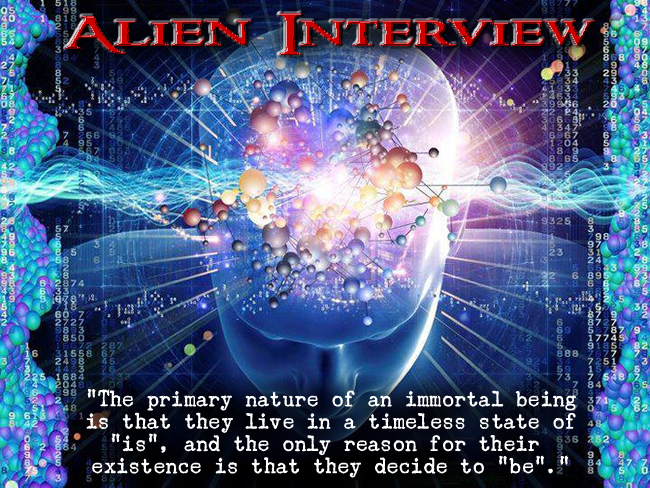
"Personally, it is my conviction that all sentient beings are immortal spiritual beings. This includes human beings. For the sake of accuracy and simplicity I will use a made-up word: "IS-BE". Because the primary nature of an immortal being is that they live in a timeless state of "is", and the only reason for their existence is that they decide to "be".
No matter how lowly their station in a society, every IS-BE deserves the respect and treatment that I myself would like to receive from others. Each person on Earth continues to be an IS-BE whether they are aware of the fact or not."
-- Airl (Officer, Pilot and Engineer of The Domain Expeditionary Force). Excerpted from the book ALIEN INTERVIEW
August 25, 2013
DON’T TOUCH MY STUFF!
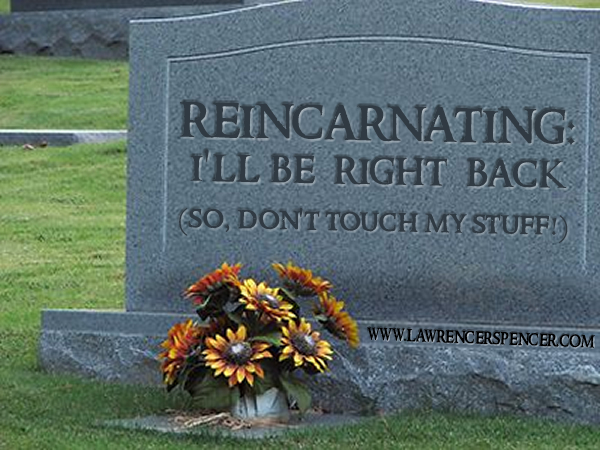
(Excerpt from the book 1,001 THINGS TO DO WHILE YOU'RE DEAD: A Dead Person's Guide To Living )
"VISIT A MATERNITY WARD.
If you finally change your mind and decide to go back to being a baby again, your best chances of getting a new baby body are at a maternity ward. Find a hospital building. Locate the newborn baby section. You may have to wait for a body that is not already occupied, or one that isn’t quite ready to hatch yet. This could take a while.
Or, you may be able to get one sooner by fighting off all the other disembodies beings who are hanging around the hospital trying to get a body for themselves. Why do you think babies cry and sleep so some much when they’re born? They had to kick a lot of disembodied asses to get a body. That’s why they are usually tired and cranky and have bruises, messy hair and blotchy skin!

REINCARNATE YOURSELF AS AN ANIMAL.
Theoretically, you can go back to Earth and inhabit the body of a human being. And, just as theoretically, you can go back to Earth an inhabit the body of a different kind of life form. This could be an interesting interlude.
Many small animals don’t live a long time, like rats and small birds. So, you might enjoy a short excursion as a creature of some kind. There are millions of species to choose from on land, in the air and in the oceans.
For convenience, here is a list of the Top 10 longest lived animals: rabbits – 28 years, bird-eating spiders – 28 years, dog – 29 years, cats – 38 years, goldfish – 43 years, horses – 62 years, birds – 60 to 118 years, elephants – 86 years, Koi fish – 226 years, Tortoise – 255 years!
If you decide to inhabit the body of a different life form you might want to consider their life style and eating habits before you choose.
For example, cats eat rats and mice. That could take some getting used to…. Some birds eat seeds, raw fish, frogs, bugs, garbage and road kill.
Silverback gorillas eat vegetation and they are strong enough to tear a man’s arms and legs off easily. Whales eat plankton, krill, squid, octopus and jellyfish. Dolphins are a fun species. They eat whole, raw fish – guts and all.
Anyway, there are a lot of options. Of course, human beings have been known to eat just about everything under the sun – including ALL of the items AND the animals listed above."
PREVIEW and BUY THE BOOK ...BEFORE IT'S TOO LATE! 
![1001 Things to Do While You're Dead | [Lawrence Spencer]](https://i.gr-assets.com/images/S/compressed.photo.goodreads.com/hostedimages/1381985472i/5512720.jpg)
AUDIOBOOK -- (UNABRIDGED) by Lawrence Spencer, Narrated by Kendra Hoffman