Lawrence R. Spencer's Blog, page 544
September 10, 2013
POINT OF VIEW HAIKU
We live on a planet controlled by psychopaths. It may be wise to change our point of view in order to avoid the contagion of their insanity.

transcendent view above
peaceful contemplation state
serene clouds below
__________
Lawrence R. Spencer
2013



September 9, 2013
THE LOGIC OF HOMO SAPIENS

Do you ever wonder about the "logic" of homo sapiens? Do we really understand what motivates the "thinking" of the "average" human life form creeping around on the Earth killing and eating everything they can catch or shoot? Did you know that during the entire history of human beings on planet Earth there have been only 12 DAYS during which a war was NOT being fought somewhere on the planet! (this is probably due to incompetent record keeping, or illiteracy, or both).
Did you know that more than 2/3rds of the taxes collected from American residents --- just like you and me --- is spent to fund MILITARY activities? Most of this money is spent by "contractors" who build weapons and other gadgets that are used for murder, mayhem, pain, destruction, mutilation and to create social, economic and environmental chaos. But, what is the REAL "logic" for this perpetual slaughter?
The FACT is that every single war in human history (without ANY exceptions) was FUNDED BY PRIVATE BANKERS FOR PERSONAL FINANCIAL GAIN. Do your TAXES pay for waging war? NO. It is "money" that is created by and loaned by private banks at interest to BOTH combatants. When all the dead bodies have been cleared from the fields, the "spoils" or "profits" are collected by the Private Bankers. Don't take my word for it, folks. Do your own research. The Private Bankers are PARASITES that are fed on the blood and flesh of the dead human bodies that litter the perpetual war zone called EARTH.
Do you have a "healthy" lust and zeal for killing your fellow human beings, and other creatures? Why not take some of the guns from you personal arsenal and go hunting for private bankers? This will solve TWO problems at once: 1) satisfy your "normal" human desire to kill something, and 2) rid the Earth of parasites!
What could be more "logical" ?
September 8, 2013

PREDATORS AND PARASITES
 Symbiosis (from Ancient Greek σύν "together" and βίωσις "living") is close and often long-term interaction between two or more different biological species.
Some of the most common and frequent symbiotic relationships examples are prey-predator and parasitism.
Parasitism is yet anther example of symbiotic relationship. The concept is fairly simple and it can be seen throughout nature. Mosquitoes for example, represent one form of parasitism. Other kinds can be seen in animals who have fleas and ticks.
Symbiosis can be a vital process for some species. A great example is Prey-Predator in which only one species can win the other being killed and annihilated.
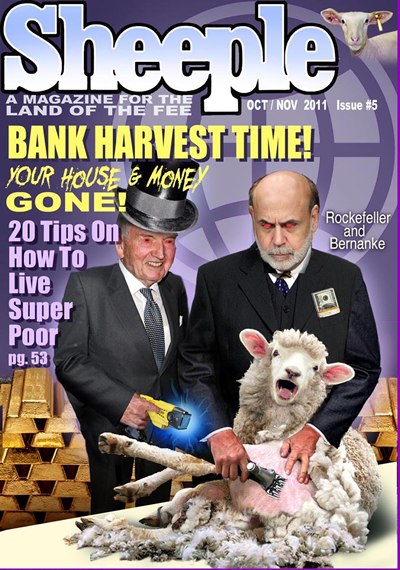
Do not make the mistake of thinking that International BANKERS are anything more or less than Predators and Parasites. These "creatures" are NOT the same species of animal as human beings. When a BANKER looks at you, he sees FOOD. You are very carefully fed with "CREDIT" lies, false aspirations and false values to entice you into becoming a victim of the false economic institutions that literally CREDIT MONEY FROM NOTHING, and convince that it has "real value". Factually, what we call "money" is created from thin air by PARASITES AND PREDATORS who produce NOTHING of value and STEAL all of your possessions, your work and your future from you.
The common-sense approach to preventing yourself from becoming "food" in the mouths of bankers is to AVOID them, or EXTERMINATE them!
September 7, 2013
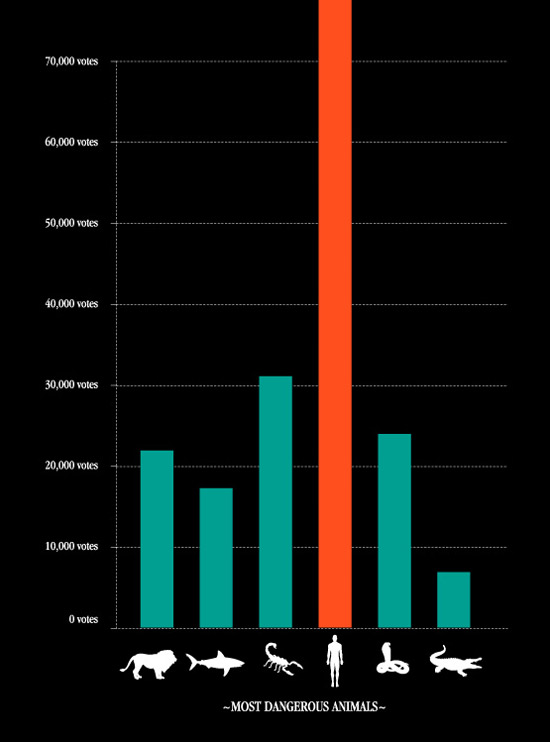
MOST DANGEROUS ANIMALS
Humans get MY vote for "Most Dangerous Animal"
September 6, 2013
WISE WATTERSON WORDS
This graphic and the following article are reposted from ZenPencils.com (http://zenpencils.com/comic/128-bill-...)
Bill Watterson is the artist and creator of (in my humble opinion) the greatest comic strip of all time, Calvin and Hobbes. I was a bit too young to appreciate it while it was originally published from 1985-1995, but I started devouring the book collections soon after. I think my brother had a few of the treasury collections and I must have read those dozens of times. I was hooked, and I remember copying Watterson’s drawings relentlessly as a kid (Calvin’s hair was always the hardest to get right).
To me, Calvin and Hobbes is cartooning perfection – that rare strip that has both exquisite writing AND gorgeous artwork. A strip that managed to convey the joy of childhood, absurdity of humanity and power of imagination all through the relationship between a boy and his stuffed tiger. And most importantly, a strip that was consistently laugh-out-loud funny. I flick through my Calvin and Hobbes books a few times a year, not to read them cover to cover anymore, but just to get lost in Calvin’s world for awhile and to remind myself what comics are capable of.
Besides the fact that Calvin and Hobbes is the comic I cherish above all others, Bill Watterson is my biggest creative influence and someone I admire greatly as an artist. Here’s why:
• After getting fired as a political cartoonist at the Cincinnati Post, Watterson decided to instead focus on comic strips. Broke, he was forced to move back in with his parents and worked an advertising layout job he hated while he drew comics in his spare time. He stayed at this miserable job and submitted strips to comic syndicates for four years before Calvin and Hobbes was accepted. About this period Watterson wrote: “The only way to learn how to write and draw is by writing and drawing … to persist in the face of continual rejection requires a deep love of the work itself, and learning that lesson kept me from ever taking Calvin and Hobbes for granted when the strip took off years later.”(Also see the Advice for Beginners comic.)
• Watterson sacrificed millions (probably hundreds of millions) of dollars by never licensing and merchandising Calvin and Hobbes. He went through a long and traumatic fight with his syndicate over the licensing rights, and although he eventually prevailed, Watterson was so disillusioned with the industry he almost quit cartooning. “I worked too long to get this job, and worked too hard once I got it, to let other people run away with my creation once it became successful. If I could not control what my own work was about and stood for, then cartooning meant very little to me.”
• Luckily Watterson didn’t quit and took a sabbatical instead. Eager to reinvigorate his creative mojo on his return, Watteron proposed a radical new layout for his colour Sunday strips. For those not familiar with comic strip lingo, each week a newspaper comic will have six ‘daily’ strips (usually black and white, one tier, 3-4 panels) and one ‘Sunday’ strip which is larger and in colour. Previously, the Sunday strip was comprised of three tiers of panels and looked like this. The layout was restrictive and the top tier had to be completely disposable because a lot of newspapers would cut it and only run the bottom two tiers in order to save space so they could cram in as many comics (or puzzles, or ads) as they could.
Watterson was sick of the format restraints and wanted more space to experiment and push his storytelling ability so he (with his syndicate’s support) gave newspaper editors a ballsy proposition. They would have to publish his Sunday comics at a half-page size with no editing, or not publish it at all. By this time Calvin and Hobbes had been running for over five years and was extremely successful so Watterson had the clout needed to pull this move off. Despite fearing many cancellations, he was pleasantly surprised that most newspapers supported the change. Free of the shackles of tiers and panel restrictions, Watterson gave us visually exciting and beautiful strips that hadn’t been since the glory days of newspaper comics in the 1920s and 30s. He was free to create strips like this, and this andthis. “The last few years of the strip, and especially the Sundays, are the work I am the most proud of. This was close as I could get to my vision of what a comic strip should be.”
• After working on the strip for 10 years, when Calvin and Hobbes was at the height of its popularity and was being published in over 2,000 newspapers, Watterson stopped. He had given his heart and soul to one project for 10 years, had said all he wanted to say and wanted to go out on top. “I did not want Calvin and Hobbes to coast into half-hearted repetition, as so many long-running strips do. I was ready to pursue different artistic challenges, work at a less frantic pace with fewer business conflicts, and … start restoring some balance to my life.”Since retiring the strip, Watterson has pursued his interest in painting and music.
It’s pretty incredible when you think about. Could you say ‘no’ to millions, I repeat, MILLIONS of dollars of merchandise money? I don’t know if I could. Would you stop creating your art if millions of people admired your work and kept wanting more? I don’t know if I would.
Reprints of Calvin and Hobbes are still published in over 50 countries and the strips are as fresh and funny as they were 20-25 years ago. It has a timeless quality and will continue to entertain comic fans for generations to come. Great art does that.
- The quote used in the comic is taken from a graduation speech Watterson gave at his alma mater, Kenyon College, in 1990. Brain Pickings has a nice article about it. The comic is basically the story of my life, except I’m a stay-at-home-dad to two dogs. My ex-boss even asked me if I wanted to return to my old job.
- My original dream was to become a successful newspaper comic strip artist and create the next Calvin and Hobbes. That job almost doesn’t exist anymore as newspapers continue to disappear and the comics section gets smaller and smaller, often getting squeezed out of newspapers entirely. I spent years sending submissions to syndicates in my early 20s and still have the rejection letters somewhere. I eventually realised it was a fool’s dream (also, my work was nowhere near good enough) and decided webcomics was the place to be. It’s mouth-watering to imagine what Watterson could achieve with webcomics, given the infinite possibilities of the online medium.
- My style is already influenced by Watterson, but this is the first time I’ve intentionally tried to mimic his work. It’s been fun poring through Calvin and Hobbes strips the past week while working on this comic and it was a humbling reminder that I still have a long way to go.
- The quotes I’ve used in the write-up above are taken from the introduction to The Complete Calvin and Hobbes collection, which sits proudly on my desk.
- Thanks to Marlyn, Emily, Joseph, and Suchismita for submitting this speech.
September 5, 2013
EXISTENCE
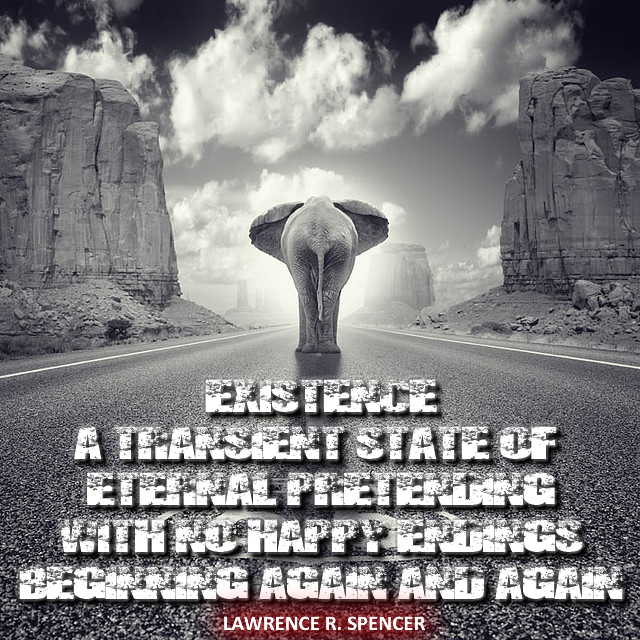
EXISTENCE:
A TRANSIENT STATE OF
ETERNAL PRETENDING
WITH NO HAPPY ENDINGS
BEGINNING AGAIN AND AGAIN