
Christine Valters Paintner's Blog, page 86
November 20, 2018
Monk in the World Guest Post: Brenda Buckwell
I am delighted to share another beautiful submission to the Monk in the World guest post series from the community. Read on for Brenda Buckwell's reflection "No Greater Love!"
I remember from high school one particular girl. At the time no one called her mean. She was kind on the outside and everyone admired her. All wanted to be her friend. And yet, there was within her a streak of jealousy that was deeply device and manipulative. This mean girl told her friend at the time that she was plain and boring; no one, especially the boy the other girl had a crush on would ever like her. The friend, the mean girl said was not good enough, not pretty enough, just plain old not enough for anyone to like her.
The mean girl’s jealousy ran so deep, that she vowed to herself that if that the boy didn’t like her, then she would do all in her power to make sure her best friend didn’t get the boy either. The mean girl went so far even to tell the boy untrue things about the nice girl. She destroyed the love of two people, simply by her jealousy. And all the while the mean girl professed love of God, offered prayers and appeared to live the life of one who believed in Jesus’ love.
This story remains in my mind through these many years, because it typifies human jealousy, pride, arrogance, competition and the drive that so many folks chase after; that being to place our self as number one. With self being number one, our feelings, attitudes, and our perspective on situations of life become the driving force and motivation for all words and actions at all cost. It doesn’t matter, like with the mean girl’s line of thought how behavior born out of selfishness impact the lives of others. This narcissistic style of life infects folks in all walks of life, from the smallest of personal relationships to the grandest of leaders.
So, what is a believer to do about this infliction of ego and jealous selfishness? How are we able to burst forth in love of others placing the other’s best interest ahead of our own self-interest without feeling less than? These questions are scary to the ones that struggle with self-worth, those that live from a me-first perspective in relationships. To the defender of self at all cost, even entertaining these ideas beyond the surface level of mental consent may feel devastating and so the narcissistic life style deepens, hoping beyond hope no one will notice. If lived long and hard enough this line of thought leads to deep racism, nationalism, clannism and device plotting to remain in control of the other.
The words of Jesus which echo in my mind and heart this day come from John 15. This is my commandment, that you love one another as I have loved you. No one has greater love than this, to lay down one’s life for one’s friends. You are my friends if you do what I command you. (John 15: 12-14, NRSV) The complete scripture can be found here >>
One of the ways I live being a Monk in the world is by leading groups through the prayer practice Lectio Divina. That is Latin for Divine reading. It is an ancient way of praying the scripture that can revolutionize one’s interior attitudes, love and action within the world. Do you think I am exaggerating about the power of reformation that can be lived through praying scripture in this manner? One time I led a small congregation through this process for six months which resulted in the council unanimously, passionately affirming a direction of ministry which resulted in outreaching love to 10,000 neighbors’ in the first year.
(To check out this complete story see Dwight Judy’s book A Quiet Pentecost .For our purposes this day, we seek to listen personally and discern to the best of our ability how to live as a force of God’s love within our circle of influence.)
There are five steps today for Lectio Divina*
First read the full text John 15:12-17 to become familiar with the story.
When reading the same text, the second time, ask yourself “What word or phrase sticks out to my heart?” This is a word or phrase directly from the text, not something it reminds you of.
After a time of contemplative silence praying with the word you heard from God from scripture, read the text a third time. This time ask yourself, “How does this text intersect your current life situations?”
Again, after extended time for contemplative silence praying with the intersection of your life and this scripture, read the story a fourth time. Since God is alive and speaking to your heart through this scripture, consider: “What is God inviting you to be or do through this text?”
Once you have discerned the invitation from God for your daily living, then remain in silence with that invitation for at least ten minutes. Conclude your time of praying with a spoken prayer of thanksgiving as you express deep gratitude for God’s living Word shaping your prayer and heart’s desire. May you be empowered by God’s Holy Spirit to live as Jesus loves from this time of prayer.If praying Lectio Divina can transform community, I wonder, what might have been possible if the mean girl from high school had prayed Lectio Divina? Would her jealousy have subsided? Could the foundation of her life have shifted so that she would have sought to speak honesty and love to others rather than living deviceively? What if everyone reading this blog post shared Lectio Divina in community? I wonder how that could possibly influence relationships, neighborhoods, and nations?
I look forward to hearing your wisdom as to how to live Jesus love in relationship with others. Talk to you in the blog comments.
Brenda
*This process is modified by Living Streams Flowing Water which is originally found in the Companions in Christ book by Upper Room publishers.
 The Rev. Dr. Brenda Buckwell is an author, (The Advent of God's Word and weekly blog posts), an United Methodist She is an endorsed spiritual director, life coach, and educator who opens interior space for the power and presence of Christ to shape individual and community life to fullest potential for authentic living. She is also a national retreat leader and founder of Living Streams Flowing Water spiritual formation ministry.
As a United Methodist ordained elder, who trained as spiritual director and supervisor of spiritual directors at Mercy Center in Burlingame, California, Brenda holds the United Methodist Certification in Spiritual Formation and lives a deep passion for spiritual formation within the church. With an online teaching certification, she is adjunct at Ashland Seminary and teaches for Garrett-Evangelical Theological Seminary and CenterQuest.
In addition to spiritual direction, two of Brenda’s favorite spiritual disciplines are swimming and ballroom dancing. The delight of life is her children and grandchildren for whom she strives to be Amma.


November 18, 2018
Celtic Conversations with Deirdre Ni Chinneide
 I am delighted to introduce a new podcast series, Celtic Conversations, inspired by my new book – The Soul's Slow Ripening: 12 Celtic Practices for Seeking the Sacred – and my time living in Ireland. I am hosting a series of conversations with authors, artists, and guides about Celtic spirituality. So find a cozy space and pour yourself a cup of tea.
My guest today is Deirdre Ni Chinneide and we had a delightful conversation about her background and how she came to live on Inismor, the stories of the island, the marriage between the Celtic and the Christian, the gifts solitude, connecting to a lineage of pilgrims, seasons of living on the island, creating a retreat space for healing, the music she is currently creating, and we close by playing her song "Surrender" from our album The Soul's Slow Ripening: Songs for Celtic Seekers.

Deirdre Ni Chinneide is trained as a psychotherapist / spiritual director and workshop facilitator. She has worked all over Ireland, the U.S.A. and Europe including Bosnia and Kosovo. The Aran Islands with its unique history, culture and natural beauty provides a special setting for the retreat work, and was the place of inspiration for Celtic Passage, a journey of the heart which she leads through music, reflection and prayer.
Deirdre divides her time between the Aran Islands and the mainland offering retreats, workshops and performances of spiritual music and also works part time with Partners in Faith, a Catholic adult faith education programme working in marginalised areas in Ireland. Her website is Celtic Passage.
Deirdre has three beautiful songs on our newest album from the Abbey, The Soul's Slow Ripening: Songs for Celtic Seekers.
Deirdre shared this beautiful blessing she wrote to begin our time together:
At each new land, there is a cross, a place to stop and scan direction. It is here you will be tempted to remain the same old story of a self that was cornered by its frame. Take my hand little one, let you walk on the inside, saved from that which blocks your journey home to this good house of hope.
*Opening music track is an excerpt from Simon DeVoil's song "Water" on his album Heart Medicine (used with kind permission)
November 17, 2018
Gratitude and Thanksgiving ~ A Love Note from Your Online Abbess
 Dearest Monks, artists, and pilgrims,
The United States celebrates the feast of Thanksgiving this week. I have always loved this time of gratefulness and sharing with loved ones. My heart overflows with gratitude for this beautiful community we have created together. I delight daily in knowing there are dancing monks all over the world.
The 5th century monk and mystic Benedict of Nursia counsels in his Rule for monastic life an attitude of contentment among his community. Whatever the circumstances they find themselves in, they are to find some satisfaction with what is in the moment. In a world of self-entitlement and inflated sense of need, learning to be content with what we have has the potential to be quite revolutionary. It means craving less and being more satisfied with what one has.
One way to encourage this posture of contentment in our lives is gratitude. Gratitude is a way of being in the world that does not assume we are owed anything, and the fact that we have something at all, whether our lives, our breath, families, friends, shelter, laughter, or other simple pleasures, are all causes for celebration. We can cultivate a way of being in the world that treats all these things as gifts, knowing none of us “deserves” particular graces.
We might begin each day simply with an expression of gratitude for the most basic of gifts, life itself. Awakening each morning for another day to live and love, grateful for our breath and a body that allows us to move through our day. Then we can offer gratitude for a home and all the things that are important to us about this place of shelter.
Environmental activist and author Joanna Macy describes gratitude as a revolutionary act “because it counters the thrust of the industrial growth society, or the consumer society, which breeds dissatisfaction. You have to make people dissatisfied with what they have and who they are in order that they keep buying.” Gratitude is a way for us to cultivate a healthy asceticism and reject consumerism.
Gratitude is a practice that can begin with the smallest acknowledgement and be expanded out to every facet of our existence. A simple way to nurture this awareness in our lives is to end each day with a gratitude list. You might write 5-10 things for which you feel grateful each day, lifting up both the large and small moments of grace. It is a way to end the day by honoring the gifts we have received rather than dwelling on where life came up short for us. Consider saving these grateful noticings together somewhere, and after a season of time reading back over the things that made your heart expand and notice what patterns you find there.
Gratitude has a way of transforming our approach to life into one that is more open-hearted, generous, and joyful. Rather than moving through our day feeling cynical or burdened, we can consciously choose our thoughts. This doesn’t mean that we have to offer gratitude for injustices or abuse, we are always called to resist those. But it does mean we might be able to tap into greater joy to replenish us for those moments when we do need to fight for dignity and kindness. Gratitude overflows into joy and makes us feel connected to something bigger than ourselves.
With great and growing love,
Christine
Christine Valters Paintner, PhD, REACE
Photo © Christine Valters Paintner
November 16, 2018
Christine Interviewed at Encountering Silence

"I believe in the revolutionary power of stillness and spaciousness, and of practicing presence to life’s unfolding. I believe this commitment can change the world." — Christine Valters Paintner
Christine joins Carl McColman at Encountering Silence to explore the intersections of silence, spirituality, contemplation, creativity, and living as a monk in the real world. She also offers a special treat at the end of the conversation — she reads a never-before-published poem of hers, “Saint Francis and the Grasshopper.”
November 13, 2018
Monk in the World Guest Post: Debby Bellingham
I am delighted to share another beautiful submission to the Monk in the World guest post series from the community. Read on for Debby Bellingham's reflection on trusting that God will speak.
I recently moved to the Hudson River Valley of New York and I am awed and beguiled by the beauty of the seasons, each with it’s unique wonder. In California seasons were days on a calendar, not events to be experienced. My home in San Francisco had variations on one season: cool, windy and foggy.
It is autumn in New York. I look west over the Hudson River at the trees blazing with color illuminated by the setting sun, and I have a burning-bush type encounter with God. God spoke to Moses at the site of that burning bush, giving him a role to play in the great story of God’s love for humankind; a new direction for his life, one he felt inadequate to fulfill, but compelled to attempt. Moses’ experience is my own.
Left behind in San Francisco is my psychotherapy practice, my work with people as their spiritual director and some significant but taxing relationships. Waiting for me in New York is the question that has nagged me every few years during my entire adult life, “What are you going to be when you grow up?” Translation: What is in store for me during this next season in my life? How am I to spend my time? What is my new role in unfolding God’s great story of love for humankind?
These questions are not heavy or oppressive, demanding an immediate answer; they are just there, hanging around my consciousness, ever present and patient.
Within a week of moving to New York I found a beautiful state park for my weekly runs. Open and vast, I can run there every day and never run the same trail twice. Great varieties of trees, still lakes with lily pads and swans, squirrels and chipmunks scampering and chirping, all welcome and accompany me on my run. There was no such experience in urban San Francisco. At times, I just stop and breathe in the wonder. My spirit seems to expand with each passing run. The glory of nature, the freedom of having no set agenda (at least for now) the newness of the setting hydrate my dried out soul.
A new energy emerges, one that opens doors to creativity. I enroll in an art class and a writing class. I set aside time each morning to pursue these more right brain activities. I feel life and enthusiasm return. Mary Oliver writes in one of her poems: “The vivacity of what was is married to the vitality of what will be.” The questions remain unanswered, but I am approaching the burning bush and trust God will speak.
 Debby Bellingham lives in the Hudson Valley of New York, with her husband and her two dogs. She is a spiritual director, a psychotherapist, an author, pastor and retreat director, and friend. She blogs at www.thementoredlife.com and offers a daily prayer to subscribers. Contact her at debbybellingham@gmail.com
November 11, 2018
Celtic Conversations with Edward Sellner
I am delighted to introduce a new podcast series, Celtic Conversations, inspired by my new book – The Soul's Slow Ripening: 12 Celtic Practices for Seeking the Sacred – and my time living in Ireland. I am hosting a series of conversations with authors, artists, and guides about Celtic spirituality. So find a cozy space and pour yourself a cup of tea.
My guest today is Ed Sellner and we had a delightful conversation about the rebirth of interest in Celtic spirituality, his upcoming book on saints and animals, does resurrection apply to animals, the story of St. Cuthbert and the otters, crows bearing witness, the importance of pilgrimage, the Celtic roots of European churches, Glendalough, and his work on a book about Merton and Jack Kerouac.
Edward Sellner is professor emeritus in theology and spirituality at St. Catherine University in St. Paul, MN and a Fellow at the Oxford Centre of Animal Ethics, in Oxford, England. A graduate of the University of Notre Dame, he is the author of 13 books on Celtic spirituality, mentoring, the history of Western monasticism, men's issues, Buddhism and other Asian religions. His latest book, Celtic Saints and Animals: A New Spirituality of Holiness, will be published by Paulist Press next year (2019).
On a personal note I first encountered Ed’s books several years ago, the first of his I read is Finding the Monk Within: Great Monastic Values for Today, which is still one of my favorite on the subject of bringing monastic spirituality to contemporary life. Then I discovered The Wisdom of the Celtic Saints which is a treasure and I also love Stories of the Celtic Soul Friends which dives deeply into the practice of soul friendship, so much at the heart of Celtic wisdom
Ed shared this beautiful blessing to begin our time together:
Let us go forth
In the goodness of our merciful Father,
In the gentleness of our brother Jesus,
In the radiance of his Holy Spirit,
In the faith of the apostles,
In the joyful praise of the angels,
In the holiness of the saints,
In the courage of the martyrs.
Let us go forth,
In the wisdom of our all-seeing Father,
In the patience of our all-loving brother,
In the truth of the all-knowing Spirit,
In the learning of the apostles,
In the gracious guidance of the angels,
In the patience of the saints,
In the self-control of the martyrs.
Such is the path for all servants of Christ,
The path from death to eternal life.
from Celtic Prayers by Robert Van De Weyer (Dublin: Gill & Macmillan,1997).
*Opening music track is an excerpt from Simon DeVoil's song "Water" on his album Heart Medicine (used with kind permission)
November 10, 2018
Join Us for an Advent Online Retreat ~ A Love Note from Your Online Abbess
 Dearest monks, artists, and pilgrims,
This is my favorite time of year, these months of autumn’s arrival, then this time of remembrance in the church of those who have passed away, and finally the season of Advent which asks us to quiet ourselves and listen to the holy birthing happening within each one of us. It can be a rich contemplative time if we give ourselves the gift of space.
Each year we create an online retreat offering for Advent to support you in creating a space dedicated to retreat in daily life so that you might be even more open to the gifts the season brings. This Advent the title of our retreat – Signs in the Sun, Moon, and Stars– comes from the first Sunday’s gospel passage. I love to imagine the awe that ancient peoples must have felt from observing the rhythms of the sky. Here in Ireland, the sun is getting lower and lower in the sky and her arc each day gets smaller. I love that low angle of golden light as well as the long hours of darkness each night to light candles and spend time simply being and breathing. When I take our dog Sourney out at night before bed I stand under the night sky for a few moments, especially when we are blessed with clear vision and I can see the moon and stars still beckoning to us.
This winter I am working on a book version of the Earth as Original Monastery material I have shared in this community in both online and live retreats. The Advent retreat is an extension of that, new materials to invite you into a sense of kinship and wonder with the natural world. Each week will have reflections from me, stories of saints and their animal companions, guided meditations, writing prompts, scripture reflections from John on the Sunday gospels, song and embodied prayer with Betsey Beckman, and we are delighted to welcome a new guest teacher for this season, Jan Blencowe. Jan will be introducing the beautiful and simple practice of nature journaling as a way to attend to the world around you. Through handouts and videos, she makes the practice really accessible and a beautiful way to drop into the contemplative spirit of this season. No fancy materials are necessary.
We will also have our vibrant community forum where you can share the fruits of your reflection and prayer, lovingly facilitated by Melissa Layer and Amber Andreasen, two gifted guides. You are always free to choose how much or how little you want to participate, but know there is a supportive community there if you do choose to dive into that aspect of the retreat.
Wouldn’t it be wonderful to arrive to Christmas, that feast of holy birth, feeling deeply nourished and grounded rather than rushed and depleted? Make a commitment to yourself, anywhere from 10 minutes to a half hour each day to dive deep into a contemplative journey with creation. We would love to have you join us.
As always, if you are having financial challenges in this season of life and would really value some retreat time, please get in touch about the possibility of some scholarship assistance. We strive to make our programs accessible to all.
With great and growing love,
Christine
Christine Valters Paintner, PhD, REACE
Photo © Christine Valters Paintner
November 6, 2018
Monk in the World Guest Post: Lorraine Roy
I am delighted to share another beautiful submission to the Monk in the World guest post series from the community. Read on for Lorraine Roy's reflection "Thinking in Circles: A Journey Through the Rings."
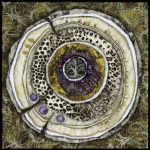
Heartwood – Oak Framed textile, 12×12”
At the moment I’m shutting down my textile studio after a long day. The chaos of my work surface recedes. My thoughts take a quiet stroll through the day’s creative journey, where my eyes and hands led me outward from the warm heart of a tree, and back in again.
I have been a professional artist working with textiles for over 30 years. I also hold a BSc in Horticultural Science. Not surprisingly, my work is inspired by trees and the many ways they connect with each other, other organisms and humans. The biology, mythology, culture and symbolism of trees have given me an infinite source of material to draw upon, gracefully guiding me from one absorbing subject to the next. Lately my generous muse has led me to circles.
The circular motif perfectly mirrors the inter-dependence of forest trees in their natural setting, and reinforces a spiritual interpretation of this remarkable phenomenon. Recently, I finished producing a collection of twelve round wall hangings called Woven Woods, which highlights the science of tree communication. Circles took hold of my imagination and, in my wish to delve deeper into their mystery, I came upon the idea of working with tree rings. Tree rings are a living journal of a tree’s history: its growth, development and endurance. They record events in the life of a tree by building layer upon layer of fresh cells, leaving the marks of events forever preserved within.I’m intrigued. My new task is to explore a question: what can tree rings teach me?
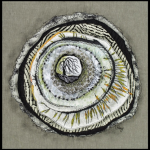
Wind in the Willow #2 Framed textile, 12×12″
Taking this challenge to the studio, I begin by layering circle upon circle of plain and printed fabrics, and stitch them down. Each new layer represents a fresh phase of the tree’s life. In my mind I situate myself at the heart’s core, and, like a tree, build outward, letting stitches and colours guide me.
Through the rings I imagine tracing my own life path, from youth, to jaded young adult, to my long break from my Roman Catholic roots. I lose myself among the layers, through the various bumps and spots, the tortuous side trips, the dark tunnels, each step leading me further from the heart. Eventually I finish the rounds, and find myself outside the circle, past the bark layer, surrounded by empty space.
I look down at my work, surprised. How did I get here, so far from the heart?
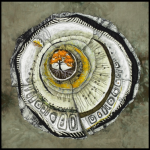
Mother Oak Framed textile, 16×16″
As I examine my emotions, I am suddenly reminded of my many failed attempts at communing with real trees. I’ve studied various techniques on how to approach them, imagining the power of their radiating energy, hoping to experience a warm response. Nothing works. I am always on the outside, cold, rejected. Perhaps I am taking the wrong approach. I wonder – instead of expecting energy to radiate outward from the tree, why don’t I allow it to draw me in? Is it possible to follow the rings back in as I have come?
Curious and excited, I seek out a grand white oak and press my arms around her fragrant being. I let go of expectations and allow myself to fall. The difference is magical. In this moment I stand at a labyrinth’s entrance, sensing the power of her heartwood. I am guided inside, drawn up into the branches, and pulled downward into the roots. At last, the right way to approach a tree. And perhaps this is the finest message of all: she has always been there for me.
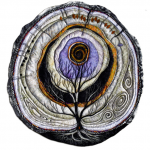
Call of the Heart Fabric wall hanging 36”
We move through our lives unconsciously collecting, storing and sometimes burying our own memories. We add layer upon layer of life experience and distraction, moving around and away from our center. We need to be vigilant because at any moment, we can be offered the gift of return. I examine my own life trajectory – one that took me far from my roots, physically and spiritually. The centre is slowly, miraculously, calling me back, and I am listening. It will likely take a few more curves and tunnels to recover, uncover, the span of my life, but a true strong heart awaits. All I need to do is let myself go.
 Lorraine Roy has a BSc in Agriculture, majoring in Horticulture. She has been a full time professional artist working with textiles for over 30 years. In her work she focuses on trees and the myriad connections they have with each other and with other organisms and humans. She lives and works in Dundas, Ontario, Canada. Connect with her online at www.LroyArt.com
November 4, 2018
Celtic Conversations with Kayce Stevens Hughlett
I am delighted to introduce a new podcast series, Celtic Conversations, inspired by my new book The Soul's Slow Ripening: 12 Celtic Practices for Seeking the Sacred and my time living in Ireland. I am hosting a series of conversations with authors, artists, and guides about Celtic spirituality. So find a cozy space and pour yourself a cup of tea. (Also available at Soundcloud, Stitcher and iTunes).
My guest today is Kayce Stevens Hughlett and we had a delightful conversation about discovering oneself through travel, how it is never too late to journey, the divine presence in the elements, the wildness of Ireland, the land as container and threshold place, ancestral healing, and her new memoir.
 Kayce Stevens Hughlett is a tender, a healer, an author, and an artist of being alive who believes in everyday magic and that complex issues often call for simple practices. Breath. Body. A single step. She began her working life as an accountant for a multi-national firm and later transitioned into the more apt fit of healer when life’s harsh circumstances sent her searching for answers and solace on a less-linear path. Kayce’s official titles include: Licensed Mental Health Counselor, Spiritual Director, Life Coach, Speaker/Facilitator, and co-creator of SoulStrolling® ~ a movement for mindfulness in motion, at home or abroad. She is the author of three books, including her new body-mind-spirit travel memoir, SoulStroller: experiencing the weight, whispers, & wings of the world.
Kayce shared this blessing to begin our time together:
I see a time of seven generations when all the colors of mankind will gather under the sacred Tree of Life and the whole Earth will become one circle again. –Crazy Horse
*Opening music track is an excerpt from Simon DeVoil's song "Water" on his album Heart Medicine (used with kind permission)
November 3, 2018
Orchard and Forest ~ A Love Note from Your Online Abbess
 Dearest Monks, artists, and pilgrims,
I have been going back through the Abbey archives and found this sweet post written almost six years ago when John and I were living in Vienna and making plans to move to Ireland. It was a very sweet and vulnerable time of our lives. So I am offering these words to you once again, several years on, from a different place in my life:
John and I have made the discernment to move to the west coast of Ireland at the end of December and so this threshold time left here in Vienna has become a profound opportunity for retreat, turning inward, savoring our experience of these days, and sharing with one another the dreams being birthed within us.
We have taken on a shared rhythm of life that has become deeply nourishing and such a gift. Part of that rhythm is a time of praying lectio divina together each morning. We are praying texts from the prophet Isaiah, letting them work on us, and then having a conversation about what we are discovering.
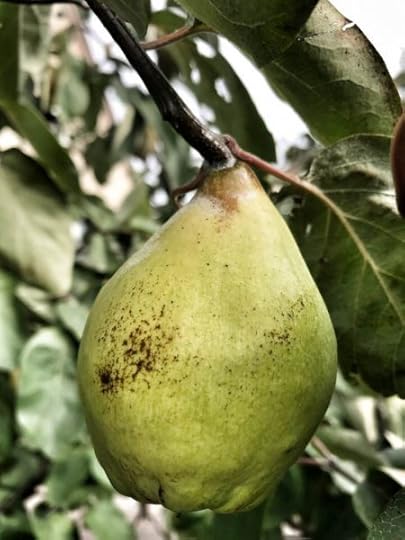
Last Friday the phrase "the orchard (shall) be regarded as a forest" (Isaiah 29:17-24) shimmered for me. Pears and woods have been calling to me this autumn season. In my recent rereading the story of the Handless Maiden, I was so touched by her solitary journey through the forest to come upon the pear orchard and imagining those pears heavy with sweetness bending down to nourish her. Here in the scriptures orchards and forests were again dwelling together in the poetry of the text. Images rose up in my prayer: ripeness, lush, sweet, fruitfulness, greenness, savoring, the beautiful vineyards of Vienna which nestle against the woods, the cultivation of orchards and vineyards to bear fruit, the wildness of forests as a space beyond the confines of cultural expectations.
As I listened for the invitation, I saw how orchard and forest together form a symbol for the monastic life. They invite us into the balance between creating rhythm and structure through the cultivation of fruit and the orderliness of orchards, and the freedom and instinctual power we find in the heart of the woods. In east Indian culture, the forest was considered "beyond the pale," which means beyond the rules that normally restrict us. The ancient monks fled to the desert and off to the wilderness to find this place "beyond the pale" of established society. But they brought with them scriptures and shared wisdom which offered the trellis of support for their practice. The two together is what allowed them to flourish.
I am called to the wild edge of the sea in Ireland because it shimmers for me as a place to explore what being a monk "beyond the pale" might mean. I want to live in this holy landscape and see what it teaches me about the dance between rhythm, Rule, wildness, and dancing freedom.
I am reflecting on the incredibly rich movements I have experienced, both inner and outer, and how these are calling me to move into the coming year. To think that a year ago our "plan" was to come to Austria for only the summer to study German and explore the possibilities for a future move.
I am listening for a word to guide me in the coming year. Clearly pears and viriditas are shimmering for me. My word this past year was "savor" which has been very meaningful. The root of the word savor is the same as the root of wisdom. I have been reminded again and again to slow down and linger over these incredible moments I have been given. To savor life's moments.
So much of my life I have lived with the subtle fear of not having enough – enough food, enough money, enough love, and the fear of not being enough.
I think these fears for many of us are at the root of the compulsions we grasp at to fill ourselves, to seek satisfaction.
But of course, we are only left hungering again, or numb to life's grace. The achievements, the feasting, the toys, the seeking after love, all leave us empty.
It is only when we remember that the branch of the pear tree is already bending herself to us so no reaching is necessary that we are satisfied.
But even more than that.
When we realize that everything, everywhere, including ourselves, is already suffused with the greening life force of the one who sustains us. And all we have to do is breathe that in and know ourselves sustained, suffused, spread through with the love we so desperately seek. This has been the gift of this first leg on my pilgrimage. To know this not just with the mind, or even the heart, but a fully embodied knowing so there is no gap between knowing and the truth of it.
And even more than that, this heavy ripening fruit which exceeds all measure, must be given away, offered freely with no fear of depletion. Not in a self-sacrificing kind of way, but one which honors my own gifts and real physical and emotional limits, and makes no apologies for radical self-care of my body vessel, time when I dip back into this suffusion of love and grace which of course is already there. It is our forgetting that exhausts us. The monk in the world practices remembering this sacred rhythm of inward and outward extension again and again.
What the pear is offering to me is a deep trust that I am suffused already with what the poet Rilke called "a paradise of light" and through cultivating my own growing sweetness, I bear fruit which must be offered to others.
Each of us has a particular kind of heavy sweetness to give to the world. The kind that overflows naturally when we experience ourselves as nourished.
May you cultivate sweet fruit and sweeter wildness and offer it freely, no holding back.
With great and growing love,
Christine
Christine Valters Paintner, PhD, REACE
Photo © Christine Valters Paintner


