
Christine Valters Paintner's Blog, page 85
December 9, 2018
Writing on the Wild Edges: Participant Poem from Linda Courage
At the end of August, 17 creative souls gathered with us for our retreat on Inismor – Writing on the Wild Edges of the World. We had a wonderful group with participants from all over the U.S., Canada, Singapore, and Australia. I am delighted to share some of their poems over these next few weeks. Pour a cup of tea, imagine yourself on a windswept limestone island in the Atlantic, and savor for a while.
From Linda Courage:
Back yard spaces
With buckets and overturned containers
Diggers and trailers
Useful and necessary at certain moments
But left to befriend passing creatures
And the backwater of gardens
Until they come into their own.
And so it is with us, well me at least
I have all sorts of tools that I’ve laid to rest
Some have become so overgrown and rusted
Never to be used in that form again.
Once I could drive an electron microscope
Now I know there is beauty in the unseen
Once I functioned as a well oiled machine
Now I know that seasons of life ask different things of us
Once I researched and taught
Now I know that confidence is built by walking alongside
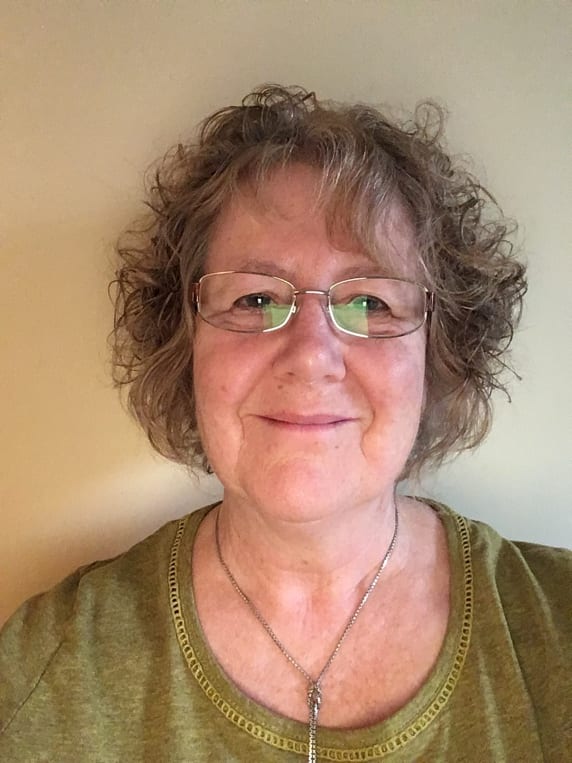 Linda Susan Courage is a Nurse and an Expressive Artist. She is coming to the end of a rich and varied career in nursing. She has used the Arts as a means of self expression and exploration for nearly 30 years, and was delighted to discover Abbey of the Arts, which is now her primary spiritual home.
She is a member of Living Spirituality Connections, which resources and connects people asking questions that are not easily addressed in mainstream churches. Here she coordinates The Arts and Spirituality Special Interest Area.
She lives in Selby, a market town in North Yorkshire, England, with her son, Joel, and cat, Millie. She is a novice Fell walker, helps to run contemplative activities locally, and runs occasional expressive art workshops. She loves reading, and poetry.
This poem was written while on pilgrimage with Abbey of the Arts, to Inis Mor off the West coast of Ireland, with wonderful people from all over the earth, who were also Writing on the Wild Edges.


December 8, 2018
Give Me a Word 2019: Celebrating 10 Years!
In ancient times, wise men and women fled out into the desert to find a place where they could be fully present to God and to their own inner struggles at work within them. The desert became a place to enter into the refiner's fire and be stripped down to one's holy essence. The desert was a threshold place where you emerged different than when you entered.
Many people followed these ammas and abbas, seeking their wisdom and guidance for a meaningful life. One tradition was to ask for a word – this word or phrase would be something on which to ponder for many days, weeks, months, sometimes a whole lifetime. This practice is connected to lectio divina, where we approach the sacred texts with the same request – "give me a word" we ask – something to nourish me, challenge me, a word I can wrestle with and grow into. The word which chooses us has the potential to transform us.
What is your word for the year ahead? A word which contains within it a seed of invitation to cross a new threshold in your life?
Share your word in the comments section below by January 4, 2019 and you are automatically entered for the prize drawing (prizes listed below).
A FREE 12-DAY ONLINE MINI-RETREAT TO HELP YOUR WORD CHOOSE YOU. . .
As in past years, I am offering all Abbey newsletter subscribers a gift: a free 12-day online mini-retreat with a suggested practice for each day to help your word choose you and to deepen into your word once it has found you. Even if you participated last year, you are more than welcome to register again.
Subscribe to our email newsletter and you will receive a link to start your mini-retreat today. Your information will never be shared or sold. (If you are already subscribed to the newsletter, look for the link in the Sunday email).
WIN A PRIZE – RANDOM DRAWING GIVEAWAY ENTER BY JANUARY 4TH!
4 people will win their choice of our self-study online retreats
So please share your word (and it would be wonderful to include a sentence about what it means for you) with us in the comments below.
Subscribe to the Abbey newsletter to receive ongoing inspiration in your in-box. Share the love with others and invite them to participate. Then stay tuned – on January 6th we will announce the prize winners!
December 6, 2018
Order Dancing Monk Icon Prints by December 15th
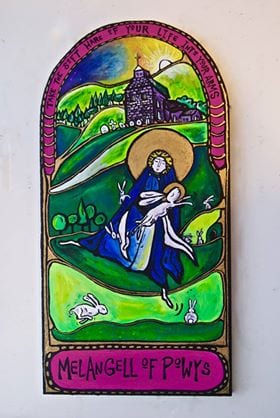 Did you know that you can order high-quality print reproductions of all the dancing monks in our icon series by artist Marcy Hall? The prints are 5×10 inches mounted on an 11×14 matte ready for framing. Imagine inviting St. Hildegard, St. Benedict, St. Brigid, St. Francis, Mary, or one of the 20 other monks and mystics we have images for into your sacred space or as a wonderful gift for a loved one.
Plus we'd like to introduce the newest addition to the dancing monk series, St. Melangell from Powys in Wales, the patron saint of hares. I have recently fallen in love with her story:
St. Melangell was originally from Ireland and wanted to flee an impending marriage and so went to Wales to live as a hermit. She lived there for many years when one day a group of hunters with their dogs are chasing a rabbit across the fields. The rabbit leaps and bounds and arrives to where St. Melangell is living and jumps into her cloak for protection. The hunters and dogs are unable to approach and the prince who is with them is so impressed by this woman’s presence that he gifts her all the land surrounding her hermitage. She says that she will receive it only if it can be a place of sanctuary for any animal in danger.
There is still to this day a chapel in that valley in remembrance of Melangell and the place is still considered a sanctuary. We are called to seek the wild spaces of our lives, to break free from the places that feel confining, but also to find places of sanctuary where we are offered the gift of rest and safety. From there we can find nourishment to return again and again to the wild edges. Click this link to order an icon of Melangell>>
December 4, 2018
Monk in the World Guest Post: Tara Shepersky
I am delighted to share another beautiful submission to the Monk in the World guest post series from the community. Read on for Tara Shepersky's reflection "Anxiety & Radical Hospitality."
I'm alone this weekend, on retreat above the Pacific. Sitting beneath a fuchsia hedge, the loudest sound is the vrzzzzz! of the bright-green hummingbirds, who've grown used to my presence. I heard something very faint half a minute ago, and it took me these thirty seconds to parse it as the musical approach of geese.
If you value silence, as I do – cultivating it within, and breathing relief at its outward manifestation – this probably sounds wonderful. I find it so – and also, it's a frightening challenge. Silence is not easy. But something else tests me harder.
***
The sun this noon is warm, the slight breeze cool. There's a bank of fog lolling about the headland. I am deeply content. And also, I'm afraid.
I struggle with aloneness. Although I enjoy being alone, I hate to live that way. Anxiety is my unshakeable companion. It wanders near or far, but when I am long alone, it sits close. It reminds me that my husband is on a plane to a far-off city. That airplanes fill me with terror. That I am, since first I fell in love, inhabited by waking dreams of my dear one's death.
I've tried all my adult life not to dwell on these fears. Not to give them strength – or admit weakness. I've pursued distraction, barred the inner gate. Of course, that's exhausting. And no, it hasn't worked.
This weekend is only the fourth time in my 35 years I have not just traveled alone, but lodged and lived that way, to a purpose. What's opened me to this new beginning is another: the disciplined study of writing. I realized I wanted to schedule blocks of time in which to think and write uninterrupted, to wander the natural tides of body and mind. To do this, I needed to remove from other voices. I needed to retreat – alone.
I've done this three times now, and guess what? My solitude is haunted. Once open to what is, in David Whyte's beautiful phrase, "just beyond [my]self," I am even more closely accompanied by unbanishable fear. It's happened every time.
This weekend's encounter is new, though, because I've started recently trying to welcome my difficult emotions as guests.
***
Celtic spirituality drew me strongly in my teens. I've heard its resonance echo in my adult life, but I haven't sought it. I've paused to listen, as to a distant bell. Recently, something – my Lutheran upbringing suggests grace – has changed that occasional attendance to a passionate yes.
Choosing this path, I've known I would encounter a principle my privileged introvert self reels away from: hospitality to the stranger. I thought the hardest part would be people, though. In fact, what's challenged me most is inner hospitality: the way hospitality entwines with silence, and opens it further.
The practice of Welcoming Prayer asks us: what if you took time to identify what you feel when fear strikes? What if you name it, know where it sits in your body? Then what if you welcome it – not because you're happy it's there, but because it is there? And sit with it, listening?
In my anxiety this solitary weekend, I have done this three times. I spoke aloud, envisioning my terrors as physical strangers, gesturing them closer, inviting them to draw up a chair and talk with me. As I listened, they didn't leave. They did lean back in their chairs. Their postures eased.
***
Contemplative practices lead me toward graceful acceptance that sometimes being human is just hard. Acknowledgement has not empowered my anxiety. An open heart may not conquer fear, but it seems to offer a wide, forgiving context.
I can't say if my embrace of inner hospitality is "working." The word implies finality, solutions. And there is no "fix" for the beauty, difficulty, and uncertainty of life.
I'm a little easier, though, more of the time. This weekend I am still living with anxiety, but I notice that verb: living. Not existing, not denying, not hiding. I do not get over my fears, but I get used to them. Consistent welcome is a radical way to do that – but it's either that, or they'll pound on the door all night, so that none of us sleep.
Another Celtic practice I love is blessing. Calling down, is how I think of it: summoning the powers of all good things in life upon another.
I write blessings mostly as gifts. I wrote one recently for the birth of a niece I have yet to meet, but already treasure. Yesterday I composed one for myself, as I motored down the freeway, fizzing with anxiety. And I felt it settle.
Blessing for the Anxious Traveller
May your fears and your anxieties
walk easily beside you.
May they point out
what you need to know
and rest
when their wisdom is no longer required.
May you breathe freely,
wonder fully,
and wander well in your travels.
***
Perhaps you know someone who needs a blessing? Maybe it's you. It feels odd, formally addressing yourself or another. But it eases something. It opens some door of kindness or understanding or just witness. To bless is to be present in a way we so rarely embrace. It's another act of radical hospitality.
May you be present. May you accept even anxieties with soul-deep compassion. May you receive with grace, bless with love, and live with radical welcome.
 Tara K. Shepersky is an Oregon-based taxonomist, poet, walker, & essayist. Her work has appeared in Cascadia Rising Review, Empty Mirror, Mojave Heart Review, and Sky Island Journal, among others. Find her on the trail, or at pdxpersky.com, and on Twitter @pdxpersky.
December 2, 2018
Writing on the Wild Edges: Participant Poem from Francine E. Walls
At the end of August, 17 creative souls gathered with us for our retreat on Inismor – Writing on the Wild Edges of the World. We had a wonderful group with participants from all over the U.S., Canada, Singapore, and Australia. I am delighted to share some of their poems over these next few weeks. Pour a cup of tea, imagine yourself on a windswept limestone island in the Atlantic, and savor for a while.
From Francine E. Walls:
The Abbot of Inis Mor turns to his Flock
 Pow! Waves stomp on sand, a fringe
of lace spreads out,
rooted kelp lets down its green hair.
How long must the sea speak its liquid song before you listen?
A currach bobs at anchor on this bay.
Steal away to Iceland or beyond, or,
throw away rudder, oars, sails,
drift to a place of beginnings.
Though hunger growls in your belly,
cold slices like a blade, pirates beset you,
dive into cockles, fish, whales;
cry like a gull, swim into froth.
Your way may be barely discernible,
gray against gray, blue against blue.
Closer, see a cleft in the wall, a slender harbor.
Be certain of your desire.
What you release can never be retrieved.
Then, call yourself Bold.
Say, Fare thee well,
Say, Welcome.
—Francine E. Walls
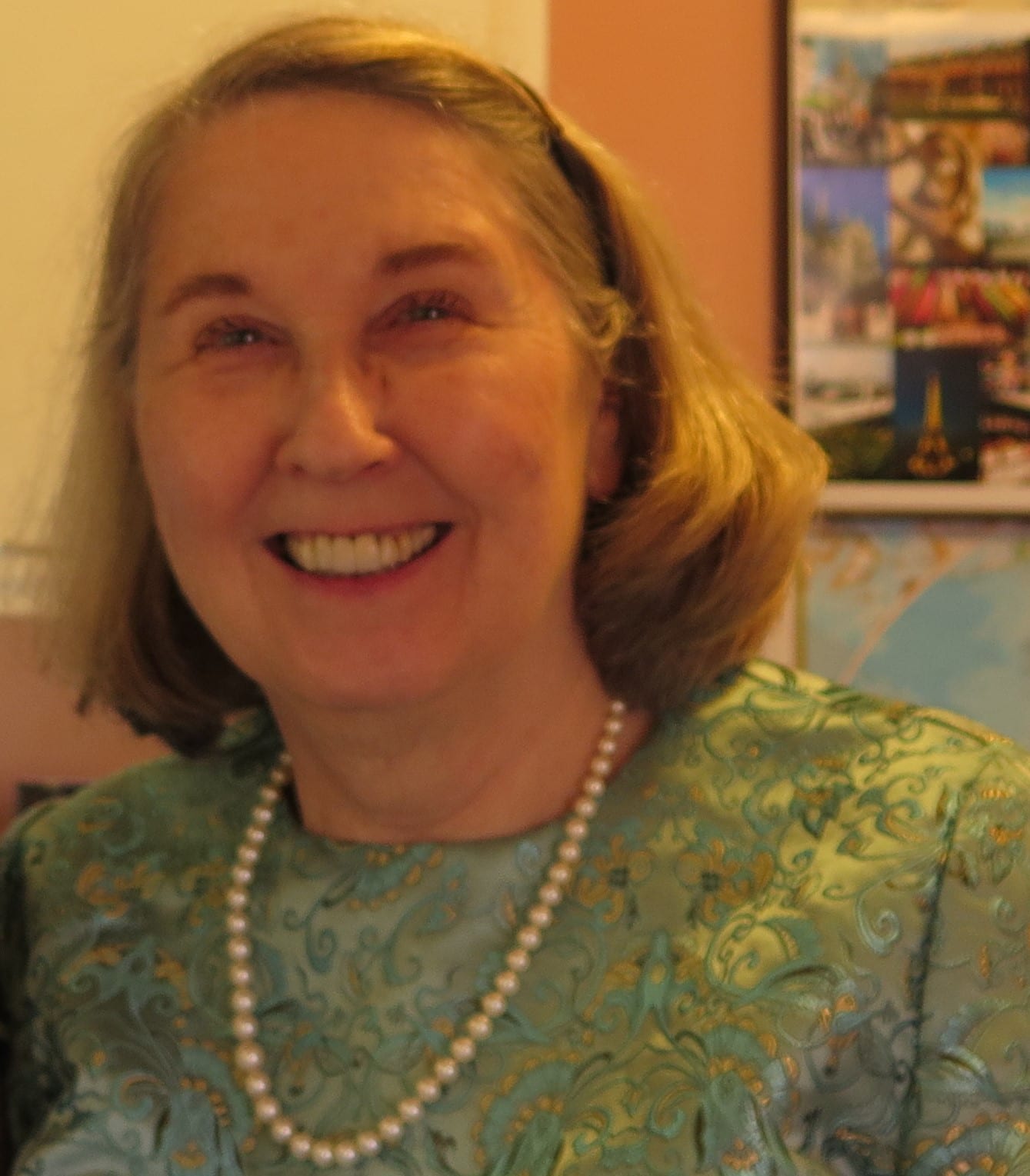 Poems by Francine E. Walls appear in the writing text, Writing Across Cultures: A Handbook on Writing Poetry and Lyrical Prose, the anthology, Peace Poets v. 2 & journals such as Pontoon, Passager, Ekphrasis, damselfly press, Avocet & Strange Poetry. Born & raised in the Pacific Northwest, she worked for years as a college librarian and teacher. Her blog of poems & photographs is at A Long Perspective.
Writing on the Wild Edges: Participant Poem from Francine E. Wells
At the end of August, 17 creative souls gathered with us for our retreat on Inismor – Writing on the Wild Edges of the World. We had a wonderful group with participants from all over the U.S., Canada, Singapore, and Australia. I am delighted to share some of their poems over these next few weeks. Pour a cup of tea, imagine yourself on a windswept limestone island in the Atlantic, and savor for a while.
From Francine E. Wells:
The Abbot of Inis Mor turns to his Flock
Pow! Waves stomp on sand, a fringe
of lace spreads out,
rooted kelp lets down its green hair.
How long must the sea speak its liquid song before you listen?
A currach bobs at anchor on this bay.
Steal away to Iceland or beyond, or,
throw away rudder, oars, sails,
drift to a place of beginnings.
Though hunger growls in your belly,
cold slices like a blade, pirates beset you,
dive into cockles, fish, whales;
cry like a gull, swim into froth.
Your way may be barely discernible,
gray against gray, blue against blue.
Closer, see a cleft in the wall, a slender harbor.
Be certain of your desire.
What you release can never be retrieved.
Then, call yourself Bold.
Say, Fare thee well,
Say, Welcome.
—Francine E. Walls
Poems by Francine E. Walls appear in the writing text, Writing Across Cultures: A Handbook on Writing Poetry and Lyrical Prose, the anthology, Peace Poets v. 2 & journals such as Pontoon, Passager, Ekphrasis, damselfly press, Avocet & Strange Poetry. Born & raised in the Pacific Northwest, she worked for years as a college librarian and teacher. Her blog of poems & photographs is at A Long Perspective.
December 1, 2018
Join us for our online Advent retreat (starts today!) ~ A Love Note from Your Online Abbess
 Dearest Monks, artists, and pilgrims,
Today the season of Advent begins and I offer you a brief excerpt from our online retreat Signs in the Sun, Moon, and Stars:
In the Celtic tradition, one of the central teachings is the idea that there are two books of revelation – one is the written scriptures and the other is the book of Creation. Both reveal the face of the divine to us, both have profound gifts to offer.
The gospel reading for today talks about looking for the “signs in the sun, moon, and stars” which forms the title of this Advent retreat. Advent is a time for slowing down, even while the rest of the world around us is rushing toward Christmas with endless shopping and preparations, Advent invites us into a different way of being. One that makes time to notice the sun’s journey across the sky each day, one that steps outside in the evening to gaze at the stars and the moon in wonder. To imagine what life was like for the ancient peoples, when sun, moon, and stars were guiding lights and navigational tools.
I invite you for this season ahead to give yourself the gift of time and slowness. To ask yourself if you really need to buy one more gift or attend one more party. To nourish yourself with time spent in nature and savouring moments of silence. To awaken to the possibility of unexpected gifts awaiting you.
What is your intention for this time? What is your heart’s deep desire as we prepare for the holy birthing in our midst?
The Practices of Wonder, Mutuality, and Presence
The ancient monks used to practice a kind of inner and outer watchfulness. The desert mothers and fathers write about this frequently, a central part of their spiritual discipline was to show up for life and pay attention. This kind of presence can be challenging in our modern world when our attention is pulled in so many different directions. Presence is a gift we offer to another.
Cultivating contemplative presence to the natural world means growing in intimacy with creation into a way of mutuality, where we recognize that nature is not just there for our benefit but has existence and intrinsic value apart from us and our needs. Mutuality means that we listen to what nature has to say to us, we allow our hearts to be opened by our encounters there.
Walking the path of wonder is a radical act in a world numbed by cynicism and despair. Trusting that holy surprises await us each moment if we only pay attention is a practice worth cultivating. In the coming days, notice when your thoughts start to tell a story of predictability, of knowing how things will turn out, or of trying to control the outcome. Practice wonder and presence to the world, listen deeply to her whispers.
Please join us for a contemplative journey with creation through Advent (we start today!)>>
With great and growing love,
Christine
Christine Valters Paintner, PhD, REACE
Photo © Christine Valters Paintner
November 27, 2018
Monk in the World Guest Post: Michele Chung
I am delighted to share another beautiful submission to the Monk in the World guest post series from the community. Read on for Michele Chung's reflection "Finding New Friends In My Journey."
Being a Monk in the World has been quite an exciting adventure. However, what I didn’t expect was that when I went on my journey, I had to leave my friends and old support groups behind. It didn’t happen right away, but in the span of a year, my small inner circle of friends had mostly moved out of town for personal reasons. Over the next few years, my theology would change so much that I stopped sharing my spiritual life with friends from my old circles because our paths have diverged so far from one another.
Honestly, I didn’t expect them to understand the path I was following. After all, the journey God has for each of us is immensely personal. The shock for me was leaving the support system I had leaned on for most of my adult life. Who or what will take their place? To be fair, I wasn’t alone. My husband was a great encouragement to me. God took him also on a similar journey. One night, after a disappointing talk with an old friend, I turned to my husband and said, “I have no friends left.” He replied wisely, “You will always have three friends: the Father, Jesus, and the Holy Spirit.”
Dear friends, if your contemplative journey has also led you to a place where you seem to be traveling alone, I hope you will find comfort in knowing that you’re not the only one. For I too am going through a similar season.
I’ve always felt closer to the Holy Spirit, and tended to pray to the Spirit for comfort and guidance. However, it’s different this time around. During my solitude practice, I laid bare my longing for companionship, and was reminded of how Jesus called us friends. Rather than focusing on the Holy Spirit as my source of comfort, I sensed the Lord wanted to teach me about the friendship of Jesus. Not only was my earthly support being shifted, God was also shifting me away from my old spiritual habits.
It’s never comfortable when God tears down the old in our lives to make way for the new. But unless I let go of my old ways and habits, I could not grow. Recently, I’ve finally made new friends. However, these new friends are very different than the ones I had before. My new friends are from a variety of age groups, ethnic backgrounds, and have very different spiritual outlooks than my old ones. I didn’t go out of my way to build this new group of friends. They’re simply kindred spirits whom I met along the way. Our paths crossed so often that we’ve started to lean on one another for support. They have become my new neighbors in life.
I’m also learning what it means to let Jesus be my friend. He has called me friend, but I did not understand the significance and depth of that friendship. Through this experience, I’m slowly learning to trust him as my source of comfort and provision.
I’ll be honest, a part of me still misses the familiar closeness I had with my old friends. We’ve known one another for so long that we’re like family. However, just as new wine needs new wineskin, so I need new friendships to help me grow in the new journey. I’m grateful for Christine’s website as a channel where I can process my thoughts and interact with others on a similar journey. I’m also grateful to many bloggers and artists online who bravely share their insights and challenges. Looking at their works have inspired me to keep writing and sharing. As I continue, I hope I can also be an encouraging friend to others along the way.
 Michele loves reading and learning about everything contemplative. She lives in Silicon Valley with her husband and a house full of books. You can find her writings at mzchele.wordpress.com or Facebook: @SabbathCafeBlog. She also shares her art on Instagram: @imagochele.
November 25, 2018
Writing on the Wild Edges: Participant Poems from Michael Philley
At the end of August, 17 creative souls gathered with us for our retreat on Inismor – Writing on the Wild Edges of the World. We had a wonderful group with participants from all over the U.S., Canada, Singapore, and Australia. I am delighted to share some of their poems over these next few weeks. Pour a cup of tea, imagine yourself on a windswept limestone island in the Atlantic, and savor for a while.
These haiku were written by Mike Philley:
ancient beehive hut—
grayed stones etched with gold
prayers of lichen
winged peregrine
soaring above the sea cliff
the wind its muse
at the holy well—
a gnarled rag tree, steadfast
altar of blessings
wild blackberries
ripen on fences of stone
teaching patience
gravestones of ancestors—
names lost, weathered away
all facing the sea
the labyrinth twists
through a field of rabbit holes
ever opening
the currach’s thin ribs—
canvassed, coated black with tar
buoy an oarsman’s faith
pillars of sharp stone
guard the walls of Dun Aengus—
now only silence
abandoned abbey—
shadows fleeting in sunlight
like dancing monks
two women talking
in Irish, their Gaelic tongue—
one stirring the soup
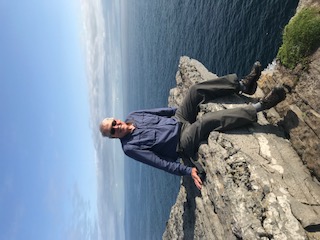 Michael Philley, retired from government service, now lives with his wife, Sue, in Boise, Idaho. Several of his short stories appear in Writers in the Attic, a literary anthology. To spur his imagination, he also reads and writes haiku poetry. On a recent pilgrimage to Inismor with Abbey of the Arts, he wrote haiku expressing the island’s ancient rhythms and still abundant traditions of Celtic spirituality.
November 24, 2018
Feast of Dorothy Day ~ A Love Note from Your Online Abbess
 Dearest Monks, artists, and pilgrims,
On Thursday is the feast of Dorothy Day, so I share with you this excerpt from my book Illuminating the Way: Embracing the Wisdom of Monks and Mystics about her:
In an editorial, she described the mission of the Catholic Worker she helped to found: “For those who are sitting on park benches in the warm spring sunlight. For those who are huddling in shelters trying to escape the rain. For those who are walking the streets in the all but futile search for work. For those who think that there is no hope for the future, no recognition of their plight—this little paper is addressed.”
She would describe the writing of her regular column as a letter to friends and “an act of community,” a reaching out to others who shared the same values and principles. She eventually called her column “On Pilgrimage” to reflect her sense of always journeying.
Dorothy Day was very much committed to those who were “outcasts” and on the fringes of society. She loved the widow and the orphan. She was passionate about the corporal works of mercy: feeding the hungry, sheltering those without homes, providing clothes for the naked. She was always trying to see Christ in “the poor lost ones, the abandoned ones, the sick, the crazed, the solitary human beings whom Christ so loved, in whom I see, with a terrible anguish, the body of this death.”
Soon after the newspaper began Peter and Dorothy opened a soup kitchen and homeless shelter, and Peter Maurin challenged bishops to open “houses of hospitality” in every diocese, to live out the message of the gospel. As the number of houses grew they were open to everyone. Dorothy resisted creating a formal rule of life, she saw it as more of a family, often with the chaos that comes from many people in great need living together.
To sustain herself, she attended daily mass and prayed the monastic Hours. She was also a Benedictine Oblate at St. Procopius Abbey in Lisle, IL and often went there on retreat. Dorothy Day’s spirituality was very earthy, finding the sacred in the most ordinary of moments and encounters. She saw the sacraments as sustaining her in this life she chose so freely. Her faith is rooted in reaching out to the needs of others and she was sustained by regular prayer and worship. Yet, she often came into conflict with the Church over her activities.
Dorothy’s favorite saint was Therese of Lisieux, the “Little Flower” who died the same year Dorothy was born. Dorothy was very drawn to Therese’s “little way” of infusing all daily activities with a prayerful awareness and intention, and a spirit of love. She loved the phrase “duty of delight” which comes from nineteenth century critic John Ruskin. She repeated it often as a reminder to herself to find beauty in the midst of every moment.
Dorothy Day died on November 29, 1980. Although she famously said, “Don't call me a saint. I don't want to be dismissed so easily,” the Church has begun the canonization process.
With great and growing love,
Christine
Christine Valters Paintner, PhD, REACE
Dancing Monk Icon © Marcy Hall at Rabbit Room Art (click link to order print)


