
Christine Valters Paintner's Blog, page 39
September 13, 2022
Monk in the World Guest Post: Sharon Johnson
I am delighted to share another beautiful submission to the Monk in the World guest post series. Read on for Sharon Dawn Johnson’s reflection, “The Green-Beaded Branch.”
‘Mary as the greenest branch.’
At the moment of reading this startling phrase, an image of a green-beaded branch appears in my mind’s eye – and issues an invitation, “Bring me to life.”
I’m intrigued by this new-to-me name for Mary, even though I’m already rooting in the green power of viriditas, the term coined by Hildegard of Bingen. The V-word constantly alerts me to the life-greening sap flowing in my body and in the world. So, when the beaded image shimmers in the visio divina way of sacred seeing, I sense my artist-self being summoned. I say yes to the invitation.

The calling to creative service as a bead and fibre artist enriches my monk-artist practices. The process proves to be a different matter, however. I struggle with the push-pull transition from the completeness of a mind’s eye image to seeking a suitable branch and starting the branch-encircling bead work. What kind of branch? Where to find it?
Months pass as other losses and responsibilities press in. I grieve the front garden loss of a long-established shrub, a hibiscus syriacus (also named Rose of Sharon). All summer long, I resist uprooting its woody remains. Then, one September morning – Hildegard’s feast day – I discover fresh shoots sprouting from under the soil. Surprise!
The unseen roots generate new life. I accept the hidden gift that long-grieved loss contains the green viriditas power to become the place of new life for me too. This natural cycle gives evidence and meaning to my own spiritual growth and composting seasons.
For thirty-five years, the hibiscus syriacus has shown climatic resilience and adaptability because of its microclimate location. Winter snow insulates the shrub and the sun’s heat on the nearby brick wall regulates its life, winter and summer. Six weeks of large rose-mauve flowers in mid-summer proclaim the shrub’s hardy nature.
The new growth allows me to cull the dead wood, repurposing it for an artwork. I choose one small branch to bear the beading. The front garden’s shrubby gift inscribes in me a heart-etched lesson about yearning – contemplative and artistic. What I long for dwells closer to home than I ever imagined possible!
Thanks to a retort stand with adjustable test tube holder, I have a ‘third hand’ to grip the velvet-wrapped base of the branch. Using that hand, I can twist and turn the beading. Easier said than done! The artwork’s experimental nature twists and turns me out of my comfort zone. My trial-and-error methods offer a way to grow the work and myself as monk and artist. My studio becomes a sacred space, the creative work a new way of praying.
I make several unanticipated discoveries. Though I can wrap threads on certain twiggy branches, I can’t directly bead onto the main ones. The twigs add overall form and three-dimensional space, yet their dry fragility means they’re likely to break if accidentally pressured. While the third hand holds steady, my own hands must be mindful to maneuver without doing damage.
Some bead shapes prove too big or awkward to snug around a limb; the workable ones still slither around so I can’t position them. They too twist and turn, just like me and my third hand.
I devise new methods to bead the main branch sections using small, freeform sections fitted to particular spots, and add armholes or straps where necessary. Bead, fit, bead, fit again, repeat. I attach one straight section stitched in RAW (right angle weave) using invisible lacing. I’m pleased with the results, but feel raw, so I seek balm in Hildegard’s choral tonics.
Even though her viriditas themes bring fullness to my life, I don’t yet know that Hildegard originated the Mary as greenest branch phrase and set it to music. O, viridissima virga, ave… (O, greenest branch, hail…)
The slow-ripening months fill with many viriditas dreams that keep me energized, like a Camino pilgrim walking step-by-step. I’m puzzled, though, by one that I have no time to digest. The dream pictures a well-tailored emerald green jacket – no comments, no feelings, no associations. A month later, I remember my mother’s stories of my dressmaker grandmother who could cut out garments freeform without paper patterns. I gasp to realize – I’m tailoring a made-to-measure garment of praise for Mary!
But the greatest surprise still awaits me, a further month along the Epiphany road.
I intend to mount the Mary branch on mottled green fabric stretched over a 6-inch x 12-inch frame, but size doubts prompt me to consult an art teacher/ fibre friend. I’m stunned when my friend suggests re-orienting the work. She is right.
I find myself floating, suddenly, like Hildegard’s feather on the breath of God. When we shift the vertical format I’d first envisioned to the horizontal, Mary As The Greenest Branch comes alive!

Sharon Johnson, a writer and bead/ fibre artist living in Ottawa, Canada, created Mary As The Greenest Branch during 2018 and 2019. Currently, she is beading the fourth in a series of green artworks. She belongs to Out of the Box, a local group of artists exploring diverse fibre-related media.
The post Monk in the World Guest Post: Sharon Johnson appeared first on Abbey of the Arts.


September 10, 2022
Join Us For The Mystical Heart and Hildegard ~ A Love Note from Your Online Abbess
St. Hildegard Strolls Through the Garden
Luminous morning, Hildegard gazes at
the array of blooms, holding in her heart
the young boy with a mysterious rash, the woman
reaching menopause, the newly minted widower,
and the black Abbey cat with digestive issues who wandered
in one night and stayed. New complaints arrive each day.
She gathers bunches of dandelions, their yellow
profusion a welcome sight in the monastery garden,
red clover, nettle, fennel, sprigs of parsley to boil later in wine.
She glances to make sure none of her sisters are
peering around pillars, slips off her worn leather shoes
to relish the freshness between her toes,
face upturned to the rising sun, she sings lucida materia,
matrix of light, words to the Virgin, makes a mental
note to return to the scriptorium to write that image down.
When the church bells ring for Lauds, she hesitates just a
moment, knowing her morning praise has already begun,
wanting to linger in this space where the dew still clings.
At the end of her life, she met with a terrible obstinacy,
from the hierarchy came a ban on receiving
bread and wine and her cherished singing.
She now clips a single rose, medicine for a broken heart,
which she will sip slowly in tea, along with her favorite spelt
biscuits, and offer some to the widower
grieving for his own lost beloved,
they smile together softly at this act of holy communion
and the music rising among blades of grass.
~ Christine Valters Paintner, Dreaming of Stones: Poems
Dearest monks, artists, and pilgrims,
Next Saturday, September 17th is the Feast of Holy Hildegard, one of the patron saints of our work here at Abbey of the Arts because of her roots as a Benedictine monk and Abbess, and her incredible commitment to creative expression and nurturing aliveness.
Like last year Betsey Beckman and I are offering an online mini-retreat to celebrate her wisdom. This year’s theme will be on her vision of Divine Love and is part of our brand new 10-month series The Mystical Heart: Love as a Creative Force. (You can register for each retreat individually or the full series with an additional facilitated forum for sharing between retreats. There is also a facilitated small group option you can add on.)
In her antiphon Caritas Abundat, Hildegard writes: “Love lives in everything, from the deepest depths to the highest stars.”
This is the inspiration behind the series we are leading – the conviction that Love indeed is the foundation of everything and also the highest reaches of the heavens. We live and breathe in Love, surrounded, held, uplifted, and guided when we open our heart and listen to Love’s pulsing in the world around us.
Hildegard of Bingen was a 12th century German Benedictine Abbess and mystic known for her powerful visions. In the third book of her theology, the Book of Divine Works, several of the illustrations presents us with her Vision of Divine Love or Caritas. Love appears as the soul of the world, the Creatrix of all that is, the living fountain that offers replenishment, and as existing in the center of the wheel of eternity. Hildegard of Bingen was a theologian, visionary, musical composer, spiritual director, preacher, and healer who held Love at the center of everything she did.
There is a story from the desert fathers where an Abba says to a seeker, “Do not feed your heart what does not nourish it.” This can be easier said than done, since we are inclined to so many “comforts” which only serve to numb and distract us from life. How often do we try to satisfy ourselves with that which depletes us?
What if your fundamental commitment was to only offer your body, heart, and soul that which is nourishing and to listen to what depletes you and say no to those things? What if you fed your heart with the wisdom of the mystics and their guidance on the holy path of loving the world?
Join us on September 17th, Hildegard’s feast day for an online retreat experience. Together we will explore her visions of Love through a variety of contemplative practices including visio divina, writing explorations with her symbols, and praying with her music. We will contemplate what it means for Love to be the “supreme and fiery force” that both sparked and sustains creation and take this into an embodied exploration through gentle movement where we might discover new dimensions of Love living within our hearts. There will also be an opportunity for sharing in small groups and name your emerging vision of Love inspired by Hildegard’s work.
Or better yet, join us for the whole series and make a commitment to nourishing Love in your heart and life throughout the coming months.
I was also featured on Sharon Blackie’s podcast Hagitude where we talk about the wisdom of women mystics for midlife and beyond including Hildegard of Bingen.
I am also offering a free one-hour workshop through the Rowe Center tomorrow on Writing with the Celtic Seasons as an introduction to the four-week series in October on Writing with the Ancestors. Everyone is welcome.
To read an extra reflection on thresholds and thin times, visit this link for an article I wrote for the Rowe Center.
With great and growing love,
ChristineChristine Valters Paintner, PhD, REACE
Image credit: Hildegard icon by Marcy Hall
The post Join Us For The Mystical Heart and Hildegard ~ A Love Note from Your Online Abbess appeared first on Abbey of the Arts.
September 6, 2022
Monk in the World Guest Post: Jean Wise
I am delighted to share another beautiful submission to the Monk in the World guest post series from the community. Read on for Jean Wise’s reflection “Travel Light.”
“Travel light,” was our tour guide’s instruction. We were soon heading to Germany with a group of fellow pilgrims to visit historic sites and cathedrals and would complete our journey by seeing the Passion Play in Oberammergau. Excited, I was ready to pack.
I chuckled thinking about her advice about packing. I have tended to overpack on most of our vacations and dreaded facing this challenge once again. I stuffed my suitcases with “just in case I might need this” and “how can I get by without…” covering all the possible scenarios. What if I forgot something important?
My hubby and I have a contest each time we pack: whose bag will weigh the lightest? I always lose.
But once home I began to pack with a new determination to travel lighter this time. Over the years I have learned a few tricks, but knew I still carried too much. I began to consider: What do I need to leave behind before my journey? What is essential to bring as we travel?
We are all pilgrims on life’s journey too. And like in regular travels, many of us tend to overpack in life. Our burdens weigh us down, ruin the trip, and add to exhaustion and stress.
Especially these last two years. This trip to Germany was originally scheduled for May 2020 and we all know what happened that spring, cancelling many events including the Passion Plan in Oberammergau.
Covid upended our lives. We began taking on the extra luggage we may not have gathered into our hearts in an earlier year. We packed our souls with heavy loads of insecurity, fear, anger, and anxiety. Disappointment and discouragement filled my emotional suitcase.
In these times of uncertainty and political upheaval, all sorts of emotions surround us. I gathered them up like a starving child seeking some type of comfort in whatever I conveniently find. I don’t want to be left without and vulnerable by not having what I needed. I overpacked.
Our culture doesn’t make this practice of traveling light easier either. The world tells us that life would be better and even perfect if we had more, did more, were more. Home improvement shows highlight perfect homes styled in 60 minutes while stirring up desires within us for new gadgets and just the right appearance for others to see. Advertisements to buy, buy, buy because we don’t have or are not enough scream at us on every device.
How do we learn to travel light? I have started this year as a monk in the world to ask two basic questions: What is overloading my heart? What is essential to carry with me?
I begin with silence and stillness, listening to what is present, presently within me. I pay attention to all the emotions, especially those that like to control and be bossy, like fear. I have learned that “not being good enough” likes to hide in the dark crevices out of the light of love. Worries and disappointment sneak in, hindering my walk. Becoming aware and attentive to what I have picked up and packed is the first step in setting those heavy burdens aside.
I name the emotions. Welcome them. Then bid them goodbye. I intentionally choose not to carry them in my life’s luggage. I find writing them out in my journal and spending time in prayer strengthens my resolve to set them aside.
The next key questions become: what are my essentials? What are most important items to carry my soul’s suitcase?
Rest. Peace. Love. Gratitude. Kindness.
I assure I have the sense of my mission/calling in life tucked in. I add my deep desire to learn and continue to grow. Don’t forget the spiritual rhythms that draw us closer to God.
I save space to hear God’s voice and my own, too. I have the choice and have chosen to trust God and live without the things that I don’t really need. This is not always easy and I find I need the reminder every day to travel light.
If we pack our hearts with our essentials, we really won’t have room for other less important things, especially the burdens we aren’t supposed to carry.
What is overloading your heart right now? Take the time to assess how heavy your heart is, what your essentials are and remember to travel light.
Jean Wise is a writer and speaker at retreats, gatherings, and seminars. She is a spiritual director and Deacon for her local church. Find out more at her blog: www.healthyspirituality.org and connect with her on Facebook, Instagram, and Pinterest.
The post Monk in the World Guest Post: Jean Wise appeared first on Abbey of the Arts.
September 5, 2022
Christine Interviewed on “The Hagitude Sessions”
Christine Valters Paintner was this week’s guest on Sharon Blackie’s ‘The Hagitude Sessions’ podcast which helps to celebrate Sharon’s wonderful new book. In this episode we talk about Hildegard of Bingen, one of the inspiring elder women featured in ‘Hagitude’, other elders in the Christian tradition, and the transformative effects of chronic illness.
See all the episodes here:https://hagitude.org/podcast/
Find Christine’s episode here.
The post Christine Interviewed on “The Hagitude Sessions” appeared first on Abbey of the Arts.
September 3, 2022
The Sacred Art of Doll Making + New Dancing Monk Icon ~ A Love Note from Your Online Abbess
Dearest monks, artists, and pilgrims,
This Saturday, September 10th, Wisdom Council Member Polly Paton-Brown is leading a retreat on Praying with Poppets: Rediscovering the Sacred Art of Doll Making. Polly worked for many years as a psychotherapist and trainer in the field of trauma. More recently, her focus has been on helping people explore their spirituality and prayer using creativity and connection with nature. Polly has a particular passion for creating healing dolls as a portal to transformation. Read on for Polly’s reflection on the art of doll making.
Creativity, nature and spirituality have always been interwoven for me. As a child I loved the Anne of Green Gables books and remember very clearly reading the part where tight laced spinster Marilla Cuthbert instructed Anne on how she should say kneel to say her prayers. Anne replies:
“Anne knelt at Marilla’s knee and looked up gravely.
‘Why must people kneel down to pray? If I really wanted to pray I’ll tell you what I’d do. I’d go out into a great big field all alone or into the deep, deep, woods, and I’d look up into the sky–up–up–up–into that lovely blue sky that looks as if there was no end to its blueness. And then I’d just feel a prayer. Well, I’m ready. What am I to say?’”
What am I to say? The emphasis on verbal prayer has always been a stumbling block for me. A late diagnosis of various forms of neurodiversity explained the struggle but for much of my life I didn’t know this. I just felt a failure at prayer in church settings. I was blessed to find dance when in the Catholic Church during my teens and experienced the freedom of being set free from the need to use words. This freedom was taken away when I became part of an extreme Evangelical fellowship. Years of masking neurodiversity and dissociation caused by trauma meant that my inner life was chaotic. The certainty offered by the fellowship made me feel safe, but it came at a cost. Dance was forbidden and the rigid forms of verbal prayer meant that I continually felt there was something wrong with me. Why couldn’t I manage the ‘quiet time’ they insisted was the right way to pray?
It has been a long journey to heal from that particular wound. A journey that took me into training as an Integrative and Expressive arts therapist, becoming a member of the Iona Community where the arts were welcomed in worship and of course here in the Abbey. Mime clowning, puppetry, clay, collage and dance became part of prayer and worship. The journey also took me out of the institutional church and into a more earth based spirituality where I began to explore the ways of my ancestors. I discovered that activities I was drawn to such as weaving, spinning and the use of herbs would have been enough to get me burned as a witch during the burning times.
And the dolls. The dolls broke into my life totally unexpectedly in the autumn of 2019. Grieving climate change and how human beings were such a part of it, I was out in the field where my horses graze. ‘Make an offering and leave it in the hedgerow.’ The words were whispered in my heart. I didn’t know where they came from but they were very clear and were accompanied by images of small felted figures. I had no idea as I needle-felted those small figures that I was partaking in the ancient craft of Poppet making, something that would have been familiar to my ancestors and has been used across many cultures.
The word Poppet comes from the Middle English word pupet, meaning a doll or small child. People are often put off because they connect such figures with images of effigies with pins stuck into them, made popular in horror films and books. Of course it is a fact that such figures have been used for cursing. But they were also used for healing. My own experience has been that the dolls not only provide a way of expressing prayers but that the actual making of the poppet can reveal hidden wisdom and messages for our lives. When making a doll I don’t begin with a set idea of what I want it to look like. The process starts with an intention or prayer and then I allow my hands and the material to lead. It includes listening deeply, allowing the Spirit to speak through the making. Materials can be as simple as some sticks and found objects. The doll making becomes both an act of devotion and prayer as well as a physical reminder of the grace they bring.
Join us September 10th for this creative retreat and make your own poppet.
Harriet Tubman – New Dancing Monk Icon
God set the North Star in the heavens and meant I should be free. -Harriet Tubman
Harriet Tubman (1822-1913) was born into slavery just south of the Mason-Dixon Line in Maryland. She was brought up in the Methodist church. Harriet eventually escaped north to Pennsylvania. But she soon joined the Underground Railroad, making thirteen rescue mission that freed 70 people. Harriet worked as an abolitionist up to and through the American Civil War. Later in life, Harriet became very involved with the African Methodist Episcopal Zion Church and her visions and vivid dreams have become part of her enduring legacy.
On September 17th we begin our monthly series on The Mystical Heart: Love as a Creative Force. I’ll be joined by Betsey Beckman as we explore the wisdom of St. Hildegard. There will be a session on Harriet Tubman led by Therese Taylor-Stinson in February 2023.
With great and growing love,
ChristineChristine Valters Paintner, PhD, REACE
Dancing Monk Icon by Marcy Hall (You can order a print at the link)
The post The Sacred Art of Doll Making + New Dancing Monk Icon ~ A Love Note from Your Online Abbess appeared first on Abbey of the Arts.
September 1, 2022
Lift Every Voice: Contemplative Writers of Color – September Video Discussion and Book Group Materials Now Available
Join Abbey of the Arts for a monthly conversation on how increasing our diversity of perspectives on contemplative practice can enrich our understanding and experience of the Christian mystical tradition.
Christine Valters Paintner is joined by author Claudia Love Mair for a series of video conversations. Each month they take up a new book by or about a voice of color. The community is invited to purchase and read the books in advance and participate actively in this journey of deepening, discovery, and transformation.
Click here to view or listen to the full conversation along with questions for reflection.
This month’s selection is Art + Faith: A Theology of Making by Makoto Fujimura.
Conceived over thirty years of painting and creating in his studio, this book is Makoto Fujimura’s broad and deep exploration of creativity and the spiritual aspects of “making.” What he does in the studio is theological work as much as it is aesthetic work. In between pouring precious, pulverized minerals onto handmade paper to create the prismatic, refractive surfaces of his art, he comes into the quiet space in the studio, in a discipline of awareness, waiting, prayer, and praise. Ranging from the Bible to T. S. Eliot, and from Mark Rothko to Japanese Kintsugi technique, he shows how unless we are making something, we cannot know the depth of God’s being and God’s grace permeating our lives. This poignant and beautiful book offers the perspective of, in Christian Wiman’s words, “an accidental theologian,” one who comes to spiritual questions always through the prism of art.
Join our Lift Every Voice Facebook Group for more engagement and discussion.
The post Lift Every Voice: Contemplative Writers of Color – September Video Discussion and Book Group Materials Now Available appeared first on Abbey of the Arts.
August 30, 2022
Monk in the World Guest Post: CJ Shelton
I am delighted to share another beautiful submission to the Monk in the World guest post series from the community. Read on for CJ Shelton’s reflection Reclaiming Our Sense of the Sacred.
On summer mornings I often wake to the sound of birds singing their first tentative greetings to the dawn’s early light, the soft beams of which filter through the curtains swaying in a gentle breeze.
My cat, happily ensconced on a thick pile of blankets, yawns deeply, and stretches right out to the very tips of each toe. I envy that stretch and try to mimic it although, I admit, not very successfully. No matter … it is still wonderful to feel my own bones and muscles flex, even if they can’t quite match her suppleness.
As a small gust of wind billows out the curtains, I glimpse the peachy glow of the morning sky and know if I were to get up, I would probably see the neighbourhood bunnies out enjoying an early breakfast of greens on the fragrant, dew-covered lawn.
It is simple moments like these that delight. That inspire. That are sacred.
I do my best to find such moments whenever I can … backlit leaves against a blue-drenched sky. Fiddleheads unfurling in the forest. A joyous burst of evensong from a cardinal. A heron gliding on long, graceful wings.
And of course, there is always the continuous enchantment of living with a feline. My beautiful girl is sixteen now and sleeps most of the time, but still has completely spontaneous moments of the “cat-crazies”, those sudden bursts of tearing around like some invisible spirit is in hot pursuit.
Although I’m not nearly as old as her cat-years yet, I too seem to need a little more rest between playtimes than I used to. I also find myself envying that she doesn’t have a care in the world beyond where dinner and the next comfortable sitting spot is, while I am faced with the challenges of living in an increasingly complicated world.
We are all reeling from what has been multiples year of collective trauma: Covid, war, corrupt leadership, constant fear. We’re tired. Focusing on anything for more than a few minutes is hard work, sometimes even impossible. Our vigilance these days is spread across the environment as our brains do the cat-crazies and our attention spans last about as long as the skittish bunny’s out on the lawn.
And yet … we still want to make things. To create things. To express ourselves. To show up and contribute to this fragile world with all that is best in us.
While it can be overwhelming, I take the cue from my cat – to consciously choose what I focus on and be someone who shares a bit of light when things are looking dark. I may not always succeed but, like my less-than-perfect morning stretches, at least I am reclaiming a wee bit of the sacred for myself.
Theologian Matthew Fox says, “there is nothing wrong with the human species today except one thing – you have forgotten the sense of the Sacred”. His words underscore Thomas Berry’s sobering observation that, “if we have lost a sense of the Sacred, we are set up for despair, for depression, for apathy”.
In medieval times there was a name for this, acidia. Thomas Aquinas described acidia as “the lack of energy to begin new things”. It is often misinterpreted as being the result of sloth or laziness, a sin of the spirit. But acidia is much bigger than that. Aquinas says it comes from a “shrinking of the Mind”.
Many modern mystics believe we are experiencing acidia right now and suffering severely from anthropocentrism, the misguided conviction that human beings are the most important entity in the universe. Even Pope Francis says humanity is undergoing “a narcissism of our species”. This “shrinking of the Mind” is the natural result of an anthropocentric culture, a culture more invested in “what’s in it for me” rather than “what is in the highest and best interest of us all?”
So, what are we to do – and do right now – in the face of all this existential exhaustion?
For myself, reclaiming the sacred is essential … challenging as that is while living embedded in a society that insists on burying its head in the sand. But I look to the mystics, indigenous elders, poets, artists, and other wise folk for inspiration, to those who know how to walk lightly on our good Earth, who sing her praises and show her respect. Who know how to appreciate life’s simple moments as echoes of the Divine … like birdsong at dawn’s first light and a contented cat enjoying a comfortable resting place.
Appreciation of the beauty-in-the-moment is simple but sage advice for any of us trying to find our way back to a sense of the Sacred. To Source. To energy. And joy.
The storms of these last few years have been humbling. But I keep reminding myself that “to be humble is to befriend one’s earthiness” and all the great mystical traditions tell us that when we are humble, we create a bridge between the Earth, our psyches, and the cosmos where the sacred can flow unimpeded into every facet of our lives.
So, I will continue to strive and reclaim the sacred in the small everyday things. And to acknowledge others as sacred echoes of nature and the Divine. Because these are the things that are fully within my control; the simple things that delight. That inspire. That reconnect me to my Source.

CJ Shelton is a Visual Artist and Educator who inspires and guides others on their creative and spiritual journeys. Through her art, teaching and shamanic practices, she reveals the meaning, magic and mystery of the Great Wheel of Life. To learn more about CJ and view her work visit www.dancingmoondesigns.ca.
The post Monk in the World Guest Post: CJ Shelton appeared first on Abbey of the Arts.
August 27, 2022
Hildy Tails: Jesus Curses the Fig Tree + New Dancing Monk Icon ~ A Love Note from Your Online Abbess & Prior
Dearest monks, artists, and pilgrims,
This week we are featuring one of our Hildy Tails. This series of essays were composed last year for our Sustainers Circle. They were dictated to John by the Abbey’s mascot, Hildy the Monk-ey. Hildy is a bit of a free spirit who likes to entertain and doesn’t normally feel constrained by conventional story structure . . . or grammar, in general. She lives by the motto that “all stories are true; some actually happened.” We wanted to share them with you, our wider Abbey community, to give you a small monkey-sized, humorous perspective on some biblical passages and stories of the saints.
Jesus & the Fig Tree (Mark 11:12-14 & 20-25)
Why does Jesus hate figs so much?!?
Oh . . . sorry. John says I need to back up and introduce myself before I get too far into the story.
Hello everyone, it’s me . . . HILDY the Abbey of the Arts mascot. I’m an Irish monkey (I bet most of ye didn’t know we were a thing) who met John and Christine a few years ago on my feast day, the birthday of Saint Hildegard of Bingen. I was working in a charity shop in Galway City’s uber-fashionable West End, contemplating what I *really* wanted to do with my life, when they walked by. I waved. They waved. I waved, again. They popped in and we had a wee chat and before I knew it, I’d quit my part-time job as a store clerk to become a full-time virtual monastery mascot . . . just like my guidance counsellor never said I would.
Now where was I? Oh, yeah . . . Jesus has this weird obsession about a fig tree that he . . . What? Why am I even telling this story? John, you were the one who asked . . . Oh. Tell the people reading why I’m doing this whole series of weird Biblical stories. Great idea. Thanks.
This all started back during John and Christine’s Jubilee Year when I wrote a series of stories about my life and life in Galway. Not to sound like I’ve got what we Irish refer to as “Notions” (i.e. – thinkin’ too highly of yerself), but I did such a BRILLIANT job that John and Christine asked me to write some more stories. (I was really chuffed by the invitation. I mean . . . how could I say ‘no’ to an opportunity like this?) At first I was gonna write about some weird saints, like St. Giles, a man who’s the patron saint of breastfeeding (don’t get me started), but then I realised that I’d have to do a bunch of research about the lives of saints and . . . homework was never my favourite part of school, like. But I’m cheeky and realised that if I decided to write about some odd Biblical figures and strange Biblical stories, then I could just ask John a bunch of questions and get HIM to do my homework for me. (By the way, he’s the one typing while I dictate, on account of my small paws. That explains what John refers to as the less-than-formal writing style you see before you . . . and the grumpy expression on John’s face as he’s just now learning about being my research assistant, as well as my stenographer. Thanks John!)
Anywhoos . . . now that you know a bit about who I am and why I’m telling these stories, let’s actually get back to the first story before John interrupts me again.
But where was I? Oh, yeah . . . Jesus hating figs. (I don’t mean figs that hate Jesus, but that Jesus doesn’t seem to like figs. Or at least he doesn’t appear to like this one fig tree in particular.) Like much of the Bible, there’s more than one version of this story. The Gospel of Matthew has (in this humble monkey’s opinion) a far less interesting interpretation of events and it’s written as a parable in Luke’s Gospel. You see, in Mark’s Gospel, the fig tree story is divided up over a couple days where a bunch of seemingly unrelated and important stuff happens. (But I’ll get to that in a minute; I promise.)
It must have been Mark’s version that I heard first, because I distinctly remember thinking “What’s the deal with cursing the poor fig tree?” and then thinking “The fig tree is back AND IT’S DEAD!” I remember leaving church that day and saying to my siblings, “why would anyone hate something that’s fun to climb on?” But you’re not here to listen to me reminisce about my childhood. Let’s look at the whole chapter and see if we can understand what’s really going on here.
Chapter 11 of Mark’s Gospel starts off with Jesus preparing to enter Jerusalem. He sends two disciples ahead to get a colt for him to ride into town on, to fulfil the old prophecies about the Messiah. (John and I went around and around about whether the prophets knew in advance that Jesus would do this or that or if Jesus knew what the prophets wrote about the Messiah and so picked the colt as a result. I’m still not sure, so I’ll let ye decide for yerselves.) Long-story-short: the crowds come out to greet Jesus and sing his praises and . . . This isn’t a story about Palm Sunday.
It’s really the next day that we’re interested in (or at least I am; I hope you are too). Jesus spots a fig tree and goes up to it to see if it’s got any figs on it. But it doesn’t, only leaves. So Jesus says to the tree, “May no one ever eat fruit from you again.”
Harsh, right? But this is just before Jesus goes into the Temple and drives out the money changes taking advantage of the people coming to worship. All in all, not a very calm Jesus in this chapter.
The day after all of that, Jesus and the disciple pass the fig tree again . . . and it’s completely withered!
The disciples are completely amazed and want to know what happened to the tree. But Jesus uses this as an important lesson about the power of faith (with a nice mini-lesson about forgiveness, giving, and receiving). He even says that faith can literally move mountains, flinging them into the sea!
Or *is* Jesus speaking literally here? Is this story, presented here in Mark and in Matthew as an actual event, but in Luke as a parable, something that really happened? Is that important?
We Irish like to say that “all stories are true . . . and some of them actually happened.” Or (if you’re feeling a bit cheeky) “we never let facts get in the way of a good story.”
What does any of that have to do with this cursed fig tree (I hear ye asking)? Well . . . I think it means that the cursed fig tree (whether it actually existed or not) is symbolic of something else. In the context of Matthew’s Gospel, the fig tree seems to represent the lack of faith of the religious authorities in Jerusalem at the time.
That kinda lets the rest of us off the hook. We don’t have to think about ourselves as the fig tree that lacks faith and/or isn’t bearing spiritual fruit. Trust me, as a creature who loves to climb ON trees, I don’t spend a lot of time thinkin’ about what it means to BE a tree. Yet . . . here I am, askin’ myself not only “how am I like a tree?” but “what kind of tree am I?” Or (to tie it all back into this month’s theme of Harvest) “what kind of spiritual harvest am I producing?”
Guinefort the Greyhound ~ Newest Dancing Monk Icon
Did you know there was a greyhound saint? When we discovered the story of Guinefort, a greyhound who had been canonized by popular devotion, we knew we had to include her in our dancing monk icon series.
Guinefort is a folk saint from the 13th century and a canine who was the companion of a French knight near Lyon. Due to a tragic rush to judgement, the knight killed Guinefort because he thought she had eaten his child. But Guinefort had actually saved the child’s life by killing the snake that was about to attack the infant. The knight buried Guinefort in a well, but when locals learned of the greyhound’s sacrifice they began to venerate the tree that grew up near the well.
In my book Earth, Our Original Monastery I write about animals as our original saints, taking inspiration from Thomas Merton who wrote in New Seeds of Contemplation:
“The pale flowers of the dogwood outside this window are saints. . . the bass and trout hiding in the deep pools of the river are canonized by their beauty and their strength. The lakes hidden among the hills are saints, and the sea too is a saint who praises God without interruption in her majestic dance.”
With great and growing love,
Christine, John, and HildyChristine Valters Paintner, PhD, John Valters Paintner, MTS
Dancing Monk Icon © Marcy Hall (you can order a print at the link)
The post Hildy Tails: Jesus Curses the Fig Tree + New Dancing Monk Icon ~ A Love Note from Your Online Abbess & Prior appeared first on Abbey of the Arts.
August 23, 2022
Monk in the World Guest Post: Elaine Breckenridge
I am delighted to share another beautiful submission to the Monk in the World guest post series from the community. Read on for Elaine Breckenridge’s reflection “Spiritual Guidance in and Through Creation.”
In the summer of 2020 I had the opportunity to read the book Earth, Our Original Monastery by Christine Valters Paintner and participate in an Abbey of the Arts community retreat by the same name. The retreat helped me out of my pandemic lethargy and into the great outdoors. There I experienced, as Christine has written in the book, spiritual guidance in and through God’s creation.
My journey began by began worshiping in a Washington state park. There I had a pew beneath a madrone tree cross overlooking the sea. The light shimmering through the trees was as beautiful as any stain glass window. Birds were my choir. A baptismal font disguised as a stream made me feel born anew.
Worshiping in nature led me to the practice of paying attention to nature. I began following the tides. I had always favored visiting a local nature preserve when it was near high tide, preferring to watch the waves and sky. But one day I visited the beach when the tide was at its lowest point. “Pay attention” the elements said to me. “So many gifts, so many messages are below you and within you.” I looked down to the ground and in between the rocks. What the outgoing tide had left behind was magnificent.
God was speaking to me through this experience. As I began paying attention to my own inner landscape, I realized how much I crave excitement like the rolling high tide. Now I was being invited to observe and enjoy my energy when it is at its ebb. Afterall, what might be hidden and then revealed between the rocky points in my life?
Paying attention to creation led me to the practice of speaking directly to and with creation. One day, I encountered a grove of madrone trees whom I had never met before. As I grew closer, I was shocked to see the number of signatures people had carved into their lovely limbs. I spent quite some time with the trees. Sitting below them on the ground I wrote in my journal, recounting my experience:
 Madrone Tree, Iverson Preserve, Camano Island, WashingtonA community of madrones welcomes me into their midst.
Even as they hold the sunlight, they hold me,
allowing me to be close to touch limbs which each tell a story.
I see scars made by human initials carved
into their skin. It makes me angry.
The Wise One speaks, “Come here my dear,
lay an ear against my arm.
Listen and feel the pulse of veriditis
greening new skin while peeling
back another layer, shedding my cares below.
You too must practice letting go.”
I study her complex designs and textures.
“You are beautiful” I whisper.
She whispers back “And so are you.”
I tilt my head up and back and see them dancing with the sky.
“How are you so fluid and flexible?” I ask.
“We never stop moving!” the chorus replies.
“We follow the light. We search for love and joy
even on the darkest days. We look east and
know that the sun will rise.
You should do likewise.”
I step back to get a broader view.
“How intertwined you all are!”
“Of course! We grow by needing one another.”
“Find and stick to your tribe” the Wise One said.
I bow to my new friends. “Thank you for showing me the way.”
“Come back and see us anytime! they say.
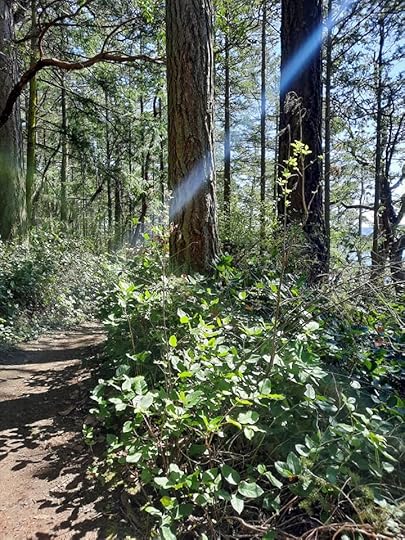 Light on the path, Camano State Island Park, Washington
 Letting go. Embrace your beauty. Never stop moving. Look for the light and joy. Find and stick to your tribe. What wonderful spiritual guidance.
The guidance continues. In the early spring, I had a terrible chest cold. I found myself slipping into self-pity and depression. I prayed and hit a wall of silence. The sun was out and beckoned me to come outdoors. The wind was wild so I wrapped myself in a blanket and sat in a chair on my deck and tried praying again. I asked the Spirit, who rides on the breath of the wind, to sweep me out and heal me.
Suddenly, I was presented with healing images of Mary, the mother of Jesus. Mary was holding an image of Christ– me as an infant. Then the image changed and she was holding me as a toddler. And then a child. A teenager. All through my lifecycle, I was presented with images of being held in the arms of the divine feminine. When the vision faded, love, peace and joy flooded my being. The next morning, I awoke in much better health. There is no question that God used the elements of the wind and the Spirit’s love to heal me in body, mind and heart.
God is revealed in creation. The more time I have spent being in God’s magnificent creation; the more I have become aware of God’s love, guidance and healing. I am being made whole. As Christine says in her book, “We are called to live the life of the new creation in which right relationship in all of creation is restored.” God, working through creation is offering us this guidance. We can all be a part of this great restoration.
The Rev. Elaine H. Breckenridge is a retired Episcopal priest residing on Camano Island, Washington. She enjoys serving as a substitute priest on Sundays, caring for two grandsons, exploring nature, and writing.
The post Monk in the World Guest Post: Elaine Breckenridge appeared first on Abbey of the Arts.
August 20, 2022
The Mystical Heart: Love as a Creative Force ~ A Love Note from Your Online Abbess
The soul is made of love and must ever strive to return to love. Therefore, it can never find rest nor happiness in other things. By its very nature it must seek God, who is love. –Mechthild of Magdeburg (1208-1282)
Dearest monks, artists, and pilgrims,
I’ve been thinking a lot about love lately. About how I believe it is at the foundation of everything. This deep knowing is what helps sustain me in dark times. Even as we are bombarded by news of violence and destruction daily, Love also helps me to remember the tremendous beauty to be found in the world. Kindness, presence, loving attention, speaking truth, witnessing beauty, resting in wonder – these are all acts of love in a world that desperately needs reminders.
On September 17th we are starting a ten-month journey through some of the Christian mystics exploring the theme of love as a creative force in the world. I will be leading several of these retreats myself – launching us with Hildegard of Bingen, then later in the series Anthony the Great and the desert tradition, Benedict of Nursia, and Kevin of Glendalough (the first and last of those will be co-led with Betsey Beckman) – and we have a wonderful array of guest teachers as well.
I am also starting to dream into a future book project I am contracted to write. Some of you might remember the Women on the Threshold program I co-led back in fall of 2012 when I first moved to Vienna. Inspired by that series I will be writing a book about seven medieval women mystics who offer some wisdom to those of us at the threshold of midlife and beyond.
As part of this writing journey, I am hoping and planning (health and Covid-allowing) to make a series of pilgrimages to visit the sites of these holy women in Europe. One of these women is Mecthtild of Magdeburg who was a Beguine in Germany in the 13th century. Beguines were a remarkable movement of lay women who chose to live together without formal vows and work together to serve the most vulnerable of their communities. The dancing monk icon above was created by Marcy Hall for our series. (I am delighted that Sister Laura Swan who wrote a wonderful book on the Beguines will be leading one of our retreats).
For my part, I am excited to be dreaming into a series of personal retreats to visit the places connected to Brigid, Hildegard, Mechtild, Teresa, Julian, Clare, and Angela of Foligno over the next year or two. I will, of course, be sharing some of my discoveries along the way in these newsletters as well as in the book I am writing. They all preached Love at the core of their message and cultivated that deep trust through a commitment to contemplative practice.
My next poetry collection due out in spring 2023 is titled Love Holds You: Poems and Devotions for Times of Uncertainty. I am also working right now on finishing up my manuscript The Love of Thousands: Honoring Angels, Saints and Ancestors which will be published in fall 2023. I loved offering that material for the Lent retreat this past spring and inspired by the conversations there I have now added in several chapters so it will be an even richer resource. So you can see Love really is threading its way through everything I am focusing on these days!
What a gift, as always, to be perched here on the edge of the Atlantic Ocean writing about the contemplative life from the many different perspectives the monastic tradition offers. There are so many treasures waiting to be uncovered or beheld in new ways. Thank you for being such willing and enthusiastic recipients of this work! Your commitment to cultivating Love in the world does make a difference!
With great and growing love,
ChristineChristine Valters Paintner, PhD, REACE
Dancing Monk Icon © Artist Marcy Hall
The post The Mystical Heart: Love as a Creative Force ~ A Love Note from Your Online Abbess appeared first on Abbey of the Arts.


