
Christine Valters Paintner's Blog, page 37
November 1, 2022
Monk in the World Guest Post: Kate Kennington Steer
I am delighted to share another beautiful submission to the Monk in the World guest post series from the community. Read on for Kate Kennington Steer’s reflection “following feelings . . . “
 “the greenwood tree” © Kate Kennington Steer
I have always felt that, for a photographer obsessed with ways of seeing, I am particularly poor at discernment. Having studied English at university, I know intellectual techniques for picking apart intertextual meanings, and I have been trained how to read nuance, tone and voice. I am fascinated by how people tell their own stories, in whatever form or language. Yet cajoling my heart into a listening openness, when years of chronic illness and depression have disconnected heart from head, too often feels like an immense task which is beyond me.
Over the past ten years this Abbey has played a crucial part in my emotional, spiritual and creative reconnection, and led me deep into the wonders of Lectio- and Visio-Divina. I created a sabbath practice of making what I called a ‘lectio soul collage’, which then provided the basis for a Visio-Divina reflection during the following week. Often this cycle of weaving prayer and silence, reflection and construction, has produced startling, clear, ‘words’ for me, which I heard God speak into my specific circumstances. So yes, my soul can recognise when it is being beckoned; my heart can answer the ever-present invitation to belonging; my bodymindheartsoul can be opened to receive that divine nourishment which it so desperately needs.
And yet. It is a standing (not-quite-funny) joke between my therapist and I, that if she asks me the direct question, ‘how are you feeling?’, all that follows is an excruciatingly long silence. And for a wordsmith, (a.k.a. one who normally has something to say on pretty much any subject) this inability to dig down, to listen, to verbalise what I hear within, shows up my emotional poverty and creative stumbling-blocks. It is a major indicator of what still needs healing in me.
So I am in search of developing my own emotional vocabulary. This could be dismissed as mere navel-gazing by many, who know nothing of the treasures stored within each precious one of us. All I know is that without this reconnection of mind and heart and spirit and body I am nothing: I will have no offering to give to others, no blessing to pass on to fellow pilgrims, I will have no peace, no solace, no health or wholeness.
So, how to begin on such a grand project of (re)discovery? Although, I have a daily negotiation with myself about how to use the tiny amount of energy available to me, when I do get to paint, I love to paint expansively big. Knowing this, my therapist suggested that when it comes to developing a personalised emotional vocabulary, I needed to start small. We came up with the idea of ‘following feelings’ postcards: to be scribbled on a windowsill on my way between bed and bathroom, making visible what was stuck in my throat or clenching my belly in that moment. The aim was to focus on expression rather than production (always a tricky prospect for a recovering perfectionist), to bypass the brain and go for the gut. Each postcard didn’t need to be finished but it did need to be truth, which would serve as the basis for the following week’s therapy discussion.
I could write a book about my relationship with the word small, about how depression shrinks your perspective, how chronic pain shrinks your interactions with worldspace, how mobility problems seem to grow in direct proportion to the dwindling of expectations. One day I will tell the full story of how I came to discover the truth that God dwells in my details, by looking at the ground below my window through a camera’s viewfinder. I will testify to how, eventually, a sense of vocation has begun to emerge: staying vulnerable, sharing my vulnerability, telling my story of how God meets my desolation and isolation and shows me presence and healing in return. All this is to say: I will simply describe the miraculous.
 “one eye of one storm” © Kate Kennington Steer
For even out of the most difficult, restrictive and agonising of physical symptoms, I have discovered a way to express some of the accompanying emotional turmoil. Since August 2021, I have been making digital ‘finger paintings’ whilst experiencing FND seizures (Functional Neurological Disorder). With the aid of the app Art Set 4, one clawed and shaking finger swipe at a time, colour, texture, shape and form transfigure into expressions of pain, of frustration, of anger, of longing, of release; and a ‘creative episode’ is born at the very same moment I have a seizure. Once my world shrivelled and darkened into a state of not-being but merely existing, where there was no prayer, no poetry, no painting, no photography within me. Since then, with a lot of different kinds of support, my regular soul-work practices are deliberately designed to open up my perspectives and keep them open. My vocabulary is developing – slowly. Through the discipline of sabbath ‘lectio-soul collages’; by trusting the process of ‘following feelings’ postcards; by playing with fingerpainting on an iPad screen, I now find myself about to open a solo exhibition of these ‘creative episodes’ which, thanks to the wonders of digital technology, translate seizure experiences into large canvases.
I might still have a puny view of a mighty God, but I say: God is in my details; God is in all the details – all our details. Selah.
Kate Kennington Steer is a writer, photographer and visual artist. Visit imageintoikon.com or ‘acts of daily seeing’ on Facebook or her YouTube channel or katekenningtonsteer on Instagram.
The post Monk in the World Guest Post: Kate Kennington Steer appeared first on Abbey of the Arts.


October 31, 2022
Lift Every Voice: Contemplative Writers of Color – November Video Discussion and Book Group Materials Now Available
Join Abbey of the Arts for a monthly conversation on how increasing our diversity of perspectives on contemplative practice can enrich our understanding and experience of the Christian mystical tradition.
Christine Valters Paintner is joined by author Claudia Love Mair for a series of video conversations. Each month they take up a new book by or about a voice of color. The community is invited to purchase and read the books in advance and participate actively in this journey of deepening, discovery, and transformation.
Click here to view or listen to the full conversation along with questions for reflection.
This month’s selection is Abuelita Faith: What Women on the Margins Teach Us about Wisdom, Persistence, and Strength by Kat Armas.
What if some of our greatest theologians wouldn’t be considered theologians at all? Kat Armas, a second-generation Cuban-American, grew up on the outskirts of Little Havana, Miami’s famed Cuban neighborhood. Her earliest theological formation came from her grandmother, her abuelita, who fled Cuba during the height of political unrest and raised three children alone after her husband passed away. Combining personal storytelling with biblical reflection, Armas shows us how voices on the margins–those often dismissed, isolated, and oppressed because of their gender, socioeconomic status, or lack of education–have more to tell us about Christian faith than we realize. Abuelita Faith tells the story of unnamed and overlooked theologians in society and in the Bible–mothers, grandmothers, sisters, and daughters–whose survival, strength, resistance, and persistence teach us the true power of faith and love. The author’s exploration of abuelita theology will help people of all cultural and ethnic backgrounds reflect on the abuelitas in their own lives and ministries and on ways they can live out abuelita faith in their day-to-day lives.
Join our Lift Every Voice Facebook Group for more engagement and discussion.
The post Lift Every Voice: Contemplative Writers of Color – November Video Discussion and Book Group Materials Now Available appeared first on Abbey of the Arts.
Sister Death and Samhain Pilgrimage
Blessings on this All Hallow’s Eve!
I love this time of year as the darkness of the world grows, inviting me into more contemplative space, more rest, more dreamtime, more mystery.
This time of the thinning of the veil also invites me to reflect on death as a spiritual practice. As the world turns inward and things outwardly appear to release and die, inwardly there is a profound nourishment happening and preparation for the bursting forth of seeds in the spring. The rest and darkness of this womb space is essential.
Giving honor to our ancestors, those who have traveled through this tender, painful, exquisite, beautiful world before us, is an act of honoring the reality of death as well. If we have a cyclical view of the world, as we find in nature, death and birth are always intimately intertwined. It is only in our modern linear view that death feels like the very end.
The ancient monks all counseled meditating on death as a way to live life more vibrantly. When we come close to endings, we are able to see what is most essential and precious.
We resist death, we try to numb ourselves from life’s inevitable stripping away of our “secure” frameworks. We spend so much energy and money on staying young. But when we turn to face death wide-eyed and fully present, when we feel the fullness of the grief it brings, we also slowly begin to discover the new life awaiting us.
St. Benedict wrote in his Rule: “Keep death daily before your eyes.” (RB 4:47)
St Francis of Assisi referred to death as “Sister” in his famous poem Canticle of Creation. Rather than the presence at the end of our lives, death can become a companion along each step, heightening our awareness of life’s beauty and calling us toward living more fully. Living with Sister Death calls us to greater freedom and responsibility.
As we approach the Christian Feasts of All Saints and All Souls and the Celtic Feast of Samhain, let us call on the beloved well dead to support us in our own journeys of welcoming Sister Death as a friend and wise teacher. Let us ask for their blessings on the things we are letting go of and the things we are hoping to be born.
(This is the newest dancing monk icon of Sister Death from artist Marcy Hall)
TODAY Simon de Voil and I (and many wonderful guest teachers from Ireland) begin a Virtual Celtic Pilgrimage at this threshold time of Samhain. Join us for nine days of journeying in community, a gathering of kindred spirits, fellow pilgrims, and the spirits and ancestors who are there to guide our way.
The post Sister Death and Samhain Pilgrimage appeared first on Abbey of the Arts.
October 29, 2022
Does Your Heart Long to Journey to Celtic Lands? ~ A Love Note from Your Online Abbess
Dearest monks, artists, and pilgrims,
These northern hemisphere days when the nights grow longer and the sun lower in the sky is my favorite time of year. I especially love that the sun rises later and later so I am able to get up on calm mornings and stand at the threshold of sea and shoreline to witness the beauty that unfolds. (The photo above is from a recent October morning walk).
This is the time of year when the ancient ones honored the growing darkness as the season of mystery, rest, and incubation. It is the time when the veil between worlds is especially thin and the saints and ancestors reach toward us, offering love and wisdom and guidance. Are you listening?
The pilgrim archetype is one I hold so dear. I have always been a wanderer, even as I love the coziness of home. I know the transformative power of stepping into new landscapes and letting my vision be expanded. When we journey as a pilgrim we come open to holy disruption asking to be changed, to be drawn more nearly to who we are called to be. A tourist wants everything to happen according to plan. The pilgrim knows that when Spirit guides us, we open to possibilities we were never able to imagine for ourselves.
Pilgrimage was a core practice of the Irish monks and even the wise ones who came before them. The Imram was a journey of letting wind and current carry them to new horizons. Living on a land surrounded by the sea, the ocean carried depth of meaning and promise of adventure.
The Irish monks stepped into their boats pushing off from shore without oar or rudder praying to be carried to their place of resurrection. They sought out the wild edges in imitation of the desert mothers and fathers before them. They knew a radical encounter with a wild and holy One could be found at the edge places.
These last few years have brough so many challenges on the global front. The pandemic still spreads and replicates, but we have to navigate it in new ways. Some of us might not yet be comfortable with travel, some might not have the opportunity right now due to responsibilities or finances.
What if you could make a pilgrimage in your daily life? What if you could show up with a community of kindred souls gathering from across this beautiful globe to say yes to the holy call to step across the threshold. Perhaps you are in a place of transition, maybe you have recently experienced loss, or maybe you simply long to immerse yourself in Celtic wisdom for a few days and see what the saints and ancestors want to whisper to you.
We led two Novenas during the height of the pandemic which were such meaningful times to gather together as a community in prayer. Last February at the turning point of Imbolc and the feast of St. Brigid we offered our first virtual pilgrimage and it was a joyful, vibrant time of opening our hearts to new possibilities.
I am delighted to be joined by my dear friend Simon de Voil again. Simon is an interfaith minister and gifted musician. He is a joy to work with and together we will be creating sacred space and entering into ritual every day for nine days. Nine was a sacred number in the Irish tradition, three times three. It is said that over the nine waves of the sea is paradise.
For this Samhain season we are inviting in the wisdom of Saints Kevin, Ita, and Enda to especially guide us. Kevin was the founder of the community at Glendalough and is known especially for his profound kinship with creatures. Ita was a powerful woman and leader who educated many of the monks of her time, including St. Brendan who often returned to her during his life for spiritual direction. Enda was the founder of a community on the island of Inismor (one of the places we will visit on this pilgrimage) and considered to be one of the early founders of Irish monasticism.
We have a wonderful community of pilgrims gathering and a terrific team of guides offering their wisdom. We have spent several months filming and preparing for this journey together at this sacred season. We’d love for you to join us. We know times are difficult right now so if the lowest amount on our sliding scale is still too much get in touch with us. If you are unable to join us due to other commitments, we ask for your prayers that our pilgrims be nourished in ways that support our healing journeys and our discernment of the best ways to serve a wounded world in this season.
You can find all the details of the Virtual Celtic Pilgrimage here. October 31-November 8 with daily pilgrimage sessions and the option for breakout groups at the end each day, two additional sessions with poetry and keening, recordings of everything with lifetime access, and being a part of a community of seekers who love Celtic wisdom.
With great and growing love,
ChristineChristine Valters Paintner, PhD, REACE
Image credit: October Sunrise over Galway Bay © Christine Valters Paintner
The post Does Your Heart Long to Journey to Celtic Lands? ~ A Love Note from Your Online Abbess appeared first on Abbey of the Arts.
October 25, 2022
Monk in the World Guest Post: John Spiesman
I am delighted to share another beautiful submission to the Monk in the World guest post series from the community. Read on for John Spiesman’s reflection “Dream, Dream, Dream.”
As noted by Christine Valters Paintner in The Soul’s Slow Ripening (Sorin, 2018), dreams were respected as signs and invitations from God to a calling bigger than our human mind could possibly imagine (p. 13). Dreams, as Christine notes, give us insight into the soul’s longings – and call us to say yes to gifts and calls which can only be born through us.
This is echoed by the Rev. Bob Haden in Unopened Letters from God (Haden Institute Publishing, 2010), who notes that Hebrews and early Christians believed that dreams are the primary way in which God speaks. Haden reminds us of the third century Babylonian sage Rabbi Hisda’s teaching – “A dream uninterpreted is like a letter (from God) unopened.” (p. 1)
Dreams come to us as metaphors, which Haden reminds us of is the primary language of the Divine. Haden notes that “Dreams tell it like it is.” Dreams alert us when we have taken a path in life that may not be right at this time, and they provide many clues about life’s path, and how we can re-center. Even nightmares, says Haden, come in the service of healing and wholeness (just like all dreams).
Christine reminds us that all the Celtic harvest festivals begin with a celebration the night before (p. 14). The night celebrations remind us that everything begins in darkness and emerges into light – even from the great womb of our birth (p. 14). We are invited through scripture to embrace the night for in the darkness our dreams come as gifts. The darkness, notes Christine, brings forth our dream wisdom.
Angeles Arrien, cross cultural anthropologist, educator and author, invites us to understand dreams ad gifts of preparation – an invitation to deepen our soul journey (Eliason, 2016). Arrien, as noted by Eliason, describes discernment as “being open without scrutiny, judgement or suspicion” (p.45). Discernment invites us to assess with curiosity, rather than critically. Arrien suggests that in discernment we are called to ask ourselves
Is my response in the realm of my comfort zone, or a growth experience?Do I have a gut feeling about the situation?Do I have clarity of mind, openness of heart, and is my gut aligned with my mind and heart? (p. 46)And so it is with our dreams, which come for our health and wholeness – every time. As Jeremy Taylor reminds us – A dream never comes to tell us something we already know, and the dreamer is the only one who can say with certainty what meanings a dream holds (p. 3).
Around this beautiful time of Samhain, which coincides with the celebration of All Saint’s Day, I find the veil to be very thin. Christine notes that in ancient Celtic wisdom, this thin time is one in which the wisdom of our ancestors is closer to us – we are reminded that we are not alone, and are together with the cloud of witnessesjust through the veil (p. 120). As we enter the Celtic new year, and into a time of darkness, we are invited to a time of listening for voices we may not hear at other times of the year – these as Christine notes, may by the sounds of our own inner wisdom or even the voices of those who came before us – our ancestors (p. 120). This is truly a time of our soul’s descent, and a time to pay very close attention to our dreams as they come in health and wholeness, and to reveal many divine mysteries.
A couple years ago around Samhain, I received this beautiful dream.
I am in my backyard cleaning up the fall leaves, and I come across a path that I had never noticed before. I follow the short path and come to an enclosed artesian spring well. The well is enclosed with stone all around, and yet there was no door. I enter and the water draws me to place my hands in it. The water is cool and crystal clear. As I return to the path to take me back to my yardwork, an old man hands me a folder paper saying “this is for you.” I open the paper to find this text: “ I will show you the path of life. In my presence is fullness of Joy.”
What a gift this dream has offered for discernment – a path, a direct message, water, and an ancient well! What more could a dreamer desire?
As I thought about this path, it is a journey that I and my ancestors take together. It leads me to something new and invites me to freely move. Since this is a path, I had yet to discover, I knew that there was a new and perhaps uncharted journey with which I might be unfamiliar. This path led me straight to a well of cool, clear water – an invitation to increased life depth and knowledge that in doing so I will be sustained and nourished. Deep water invites me to explore my unconscious self – and the possibility of fertility, growth, creative potential, new life or healing contained therein. And finally, the old man – that symbol of wisdom, and a man of few words – invites me to connect with my inner guidance and highest thought and offers a gift. I am invited to explore life’s path perhaps on a deeper, broader, and even more mysterious level, and I am assured that this is indeed for my own health and wholeness.
Recalling dreams can be a challenge. Some tips I have found helpful are first setting and keeping a consistent sleep schedule. The more consistent I am, the more I can recall my dreams. In addition, I set an intention each night when I ask the Dream maker for a dream, to write the dream in my dream journal and to work with the dream. I need to be sure to be ready and willing to receive the message of the dream and equipped to work with that dream message through the lens of my health and wholeness. In the morning, and especially when I begin to awaken, I make sure I never jump out of bed. Lying in bed and slowly allowing myself to awaken helps recall both dreams and their symbols and images. I make sure to have a journal close by so that I can write down everything I remember – even if it is just a symbol, a word, or an image. Finally, I give gratitude to the Dream maker for the dream I have received.
Jeremy Taylor (2009) reminds me that it is important to affirm each dream as a gift, and to recognize that there are multiple meanings of a dream – there are layers, and the dreamer is invited to explore all kinds of possibilities. This is a journey of discovery! Taylor reminds me that dreams bring things to my consciousness which to this point have been unconscious inviting me to new insight. This is my opportunity to embrace and honor my dreams, and to use them as tools for my discernment, for my health, wholeness and evolution of consciousness.
May this Samhain be a beautiful time of awareness of our ancestors and those we love who have gone before. May we be blessed by the Dream maker with many dream gifts – and, above all, may we never leave these gifts unopened.
Holy Dream Maker,Creator of all,Be with us as we open our hearts and mindsto the divine wisdom in our dreams.We thank you and honor you.As you guide us in the way tohealth and wholeness,may we be open to the blessings of your message. Haden Institute Dream PrayerSelected Bibliography:
Ackroyd, E. (2007). A dictionary of dream symbols. Sterling Publishing, NY.
Eliason, M. (2016). Reflecting on the teaching of Angeles Arrien. Createspace Independent Publishing, SC.
Haden, R.L. (2010). Unopened letters from God: A workbook for individuals and groups. Haden Institute Publishing, NC.
Hoss, R. J. (2005). Dream language: Self understanding through imagery and color. Innersource, Ashland, OR.
Taylor, J. (2009). The wisdom of your dreams. Warner Books, NY.
Valters-Paintner, C. (2018). The soul’s slow ripening: 12 Celtic practices for seeking the sacred. Sorin, Notre Dame, IN.

John has journeyed in formation as a spiritual director, and in dream work through The Haden Institute. Formed in the Jungian Mystical Christian tradition, he welcomes and accompanies journeyers who long for a deeper relationship with the Divine. John’s interests include spiritual symbols and ritual, church wounds, vocational calls, the Celtic Anam Cara and Celtic Spirituality, the sacred masculine journey, the empath’s journey, as well as intuitive dream work, and dream work in psychotherapy. John has been a career educator, and currently serves as a Licensed Independent Social Worker, pastoral counselor, spiritual companion and dream worker in Ohio, USA. He can be reached through his website: www.spsj.care.
The post Monk in the World Guest Post: John Spiesman appeared first on Abbey of the Arts.
October 22, 2022
Join Us On a Virtual Pilgrimage to Ireland ~ A Love Note from Your Online Abbess
Dearest monks, artists, and pilgrims,
We are thrilled to be offering a second virtual Celtic pilgrimage starting a week from tomorrow which will be the eve of Samhain and the Feast of All Hallows. Journey with us over nine days as we deepen into Celtic wisdom and hear the stories of Kevin, Ita, and Enda. Each day’s live session (via Zoom) also includes film footage from various sacred sites in Ireland including Glendalough and two of the Aran Islands as well as our wonderful guides Dara Molloy, Deirdre Ní Chinnéide, Pius Murray, Fr. Michael Rodgers, Pádraigín Clancy, and Órla Mc Govern. (All sessions will be recorded if you can’t join us live). Simon de Voil will be joining me to hold our sacred space through music. In addition, for this journey we have added two extra sessions – a poetry reading with Mícheál ‘Moley’ Ó Súilleabháin and a session on the Irish practice of keening with Mary McLaughlin. It will be a rich banquet to nourish us for the journey!
The Feast of Samhain is one of the great Celtic feasts which begins the new year. This threshold time is when the veil between worlds is said to be especially thin and the ancestors and saints are especially close. We will be listening across the veil for wisdom from those who have walked before us.
This is an excerpt from my book The Soul’s Slow Ripening: 12 Celtic Practices for Seeking the Sacred:
The ancient Christian monastic traditions, especially desert, Celtic, and Benedictine, offer great wisdom for the journey of unfolding. They understood that the soul’s ripening is never to be rushed and takes a lifetime of work. The gift of the contemplative path is a profound honoring of the grace of slowness.
We can grow impatient when life doesn’t offer us instant insights or gratification. We call on the wisdom of these monks to accompany us, to teach us what it means to honor the beauty of waiting and attending and witnessing what it is that wants to emerge, rather than what our rational minds want to make happen. The soul always offers us more richness than we can imagine, if we only make space and listen.
In 2007 my husband John and I traveled to Ireland and I began to fall in love with the path of Irish monasticism. I discovered stories and a way of moving through the world that felt more spiral and less linear, more organic and less structured. The early period of Irish monasticism is quite unique in that it was less influenced by the Roman church and desire for uniformity of practice. The Irish monks integrated Christian teachings with the Druidic wisdom of their ancestors and created a spirituality that was much more earth-honoring and indigenous to the place they lived.
We have found in Ireland an even richer immersion in Irish culture and ways of being in the world, which are decidedly less controlled, structured, and planned than the American ways we are used to. We have learned to embrace an Irish understanding of time with more fluidity. This is challenging at times, but ultimately invites us into a way of being that is more relaxed and spontaneous. Even the lack of street signs invites us sometimes to get lost and disoriented and find our way anew.
Discernment is essentially a way of listening to our lives and the world around us and responding to the invitations that call us into deeper alignment with our soul’s deep desires and the desires God has for us. When I work in spiritual direction, often people come at a time of discernment and transition. They have been thrust onto a threshold, often not of their own choosing, such as loss of a job or relationship. But sometimes it is born of a sense of needing a change.
Sometimes they are seeking a clear answer, they want to know the path God is calling them to, as if we had to figure out the one right thing. My sense is that God is much more expansive than this, and calls us to what is most life-giving, but this might take several forms, many opportunities and possibilities. Often directees want to know their life’s call, but more often than not, we can only discern what is appropriate for this particular season of our lives.
Through this journey of the last several years, I have come to embrace words like ripening, organic, yielding, and unfolding as ways of understanding how my soul moves in a holy direction. There hopefully comes a time in our lives when we have to admit that our own plans for our lives are not nearly as interesting as how our lives long to unfold. That these plans are as the poet David Whyte writes “too small for me to live.” That when we follow the threads of synchronicity, dreams, and serendipity we are led to a life that is rich and honoring of our soul’s rhythms, which I have discovered is a slow ripening rather than a fast track to discernment.
The rhythms of the seasons play a significant role in my own discernment. Honoring the flowering of spring and the fruitfulness of summer, alongside the release of autumn and the stillness of winter, cultivates a way of being in the world that feels deeply reverential of my body and soul’s own natural cycles. We live in a culture that glorifies spring and summer energies, but autumn and winter are just as essential for rhythms of release, rest, and incubation. When we allow the soul’s slow ripening, we honor that we need to come into the fullness of our own sweetness before we pluck the fruit. This takes time and patience.
The Irish tradition is deeply rooted in the landscape and the seasonal rhythms of the year. The year begins in November, as we descend into the womb of darkness. It honors wandering “for the sake of Christ” where a person may take years of journeys before settling into the “place of their resurrection.” Another significant practice is walking the rounds at holy sites. Instead of a linear path straight to blessing oneself at a well, first one must walk the rounds in a “sunwise” direction, in harmony with cosmic forces. Walking the rounds helps us to arrive, to ask permission to be there, and to slowly receive the gifts that come. Dreams show up again and again in the stories of the Irish monks as guidance for the path ahead.
If the Celtic way calls to you, please join us. We begin in a week! There are live daily sessions on Zoom for nine days which will be recorded and posted the same day for those unable to join us at the scheduled time. This year we have also added a daily opportunity for people to meet in small groups at the end of each session for sharing from the heart’s journey.
Virtual Pilgrimage starting October 31st!
With great and growing love,
ChristineChristine Valters Paintner, PhD, REACE
Dancing Monk icons by Marcy Hall (Prints Available for Purchase on )
The post Join Us On a Virtual Pilgrimage to Ireland ~ A Love Note from Your Online Abbess appeared first on Abbey of the Arts.
October 21, 2022
Hildy Tail ~Balaam & the Talking Ass
This week we are featuring one of our Hildy Tails. This series of essays were composed last year for our Sustainers Circle. They were dictated to John by the Abbey’s mascot, Hildy the Monk-ey. Hildy is a bit of a free spirit who likes to entertain and doesn’t normally feel constrained by conventional story structure . . . or grammar, in general. She lives by the motto that “all stories are true; some actually happened.” We wanted to share them with you, our wider Abbey community, to give you a small monkey-sized, humorous perspective on some biblical passages and stories of the saints.
Balaam & the Talking Ass (Numbers 22:22-40)
Hello and welcome back!
(Don’t panic. This reflection isn’t late. After an Abbey of the Arts staff meeting, it was agreed that the front end of the month was kinda crowded with a lot of content and I volunteered to post my stories later. So, here we are.)
Now before I get into today’s odd Biblical story (it’s a doozy), I need to talk about animal classifications and the ever-changing nature of language (it’s a bit long, but please bear with me . . . and pardon the pun.)
A mule is the barren offspring of a horse and a donkey (I think the gender of each matters, but I can’t remember which . . . and it doesn’t really matter here). But not all donkeys are the same. Not only are there different breeds, but there are different names for donkeys that have changed overtime. Up until last century, donkeys were called “asses” (it has to do with their Latin name . . . but don’t worry about that; there won’t be a test later). And for a while, a distinction was made between a donkey (a wild animal) and an ass (a domesticated animal). But that wild/domesticated version isn’t consistent, depending on region and era. (Dictionaries don’t always agree. I know! I’m as shocked as you are.)
Long story short, in not-so-older English translations of the Bible (this passage from the Book of Numbers in particular), the word “ass” was used instead of the term “donkey” that one finds in more modern translations. It was changed to cut down on the number of giggles in Bible classes, as the term “ass” now also refers to stupid/foolish people . . . and butts.
It’s a reasonable change, as the terms are basically interchangeable now. But it means that instead of the older English name for this story of “Balaam and the Talking Ass” one gets “Balaam, the Donkey, and the Angel.” But why take all the fun out of the story? As you’re about to see, changing the name doesn’t make the story any less weird.
John’s right. I should just tell you the story and get back to the commentary after.
The story begins some forty years after the Exodus from Egypt, as the Israelites are returning to the Promised Land. As it’s already occupied and the new locals aren’t so keen on new neighbours, fighting breaks out. At this point in the story, the Israelites are on quite the winning streak and the local tribes are starting to get worried. In particular, the king of the Moabites felt that something drastic had to be done if he was to defeat the Israelites in the inevitable battle (I guess sharing wasn’t an option, but that’s a discussion for another time.)
Now the Moabite king knew of a guy named Balaam who had the power to tell the future and that whoever Balaam blessed would be blessed (and whoever he cursed would be cursed). Balaam was ordered to go to the king and curse the Israelites and bless the Moabites. Balaam was reluctant to go and tried to explain that it wasn’t his words that changed the future, but that he spoke what was to be. The Moabite king wasn’t having any of that and ordered Balaam to come to him to curse the Israelites. He even threatened Balaam’s life, if he did not do as he was told.
So, reluctantly (and under instructions from God in a dream), Balaam saddled his ass (or “donkey,” if you’re reading this to small children . . . who I’d think would enjoy the story all the more for the use of the term . . . Okay, John. I’ll get back to the story.)
But as Balaam progressed on his journey, God got angry that Balaam was going to curse the Israelites and so sent an angel (with a sword) to stop Balaam. The angel, sword in hand, stood on the road, blocking Balaam’s path. But Balaam could not see the angel (or the sword). The ass could see it though and so took a detour into a field . . . saving Balaam’s life.
And what did the ass get for this heroic deed? A pat on the head? A scratch behind the ears? A tasty treat?
Nope.
Balaam struck the ass for not staying on the road!
Balaam got the ass back on the road, but the angel (still holding the sword) just went a bit further up the road and waited . . . this time in a spot between two walls. Again, only the ass could see the angel (did I mention it had a sword?) The ass was able to swerve out of the way of the sword-wielding angel, but Balaam scraped his foot on the wall . . . and so beat the ass, again.
Next the angel (sword still dangerously in hand) went a bit farther down the road to a narrow gap where the ass wouldn’t be able to get out of the way. When the ass saw this (and Balaam couldn’t), the ass lay down to avoid being stabbed by a sword. And again, for the third time (as another translation of this text states) “Balaam beat his ass a third time.”
(You’re beginning to see why John’s teenage male students loved this story when he taught high school. But that’s just the silly modern English translation issues. We’re only just now getting to the really weird bit.)
It’s at this point (after the ass has saved Balaam’s life three times and gotten beaten for it each time) that the Lord opens the mouth of the ass (. . . I’ll wait for the giggling to stop . . .) and says to Balaam, “Why are you beating me?” Balaam replies that the ass is making a fool of him and he might just kill the ass. The ass then points out that it’s been a loyal and faithful mount for Balaam for years and has never done anything like this before today and maybe (just maybe) it deserves the benefit of the doubt and has VERY good reasons for doing what it’s been doing. Balaam agrees to this excellent point by the ass and his eyes are suddenly open to seeing the angel (the one with the sword sent to kill him) and he understands what just happened.
Balaam, properly humbled bows before the angel and asks God’s forgiveness. God relents and instructs Balaam to only repeat the blessings that God tells him. The Moabite king isn’t happy to hear the Israelites blessed by Balaam, but there is nothing he can do about it at that point.
Now in case you missed it, the weird bit isn’t that the ass suddenly can speak (although that is weird). It’s not even that the ass and Balaam get into a bit of an argument. It’s that Balaam doesn’t seem all too surprised that the ass is now talking to him (maybe this isn’t an unusual thing for Balaam, maybe this is how he gets all his curses and blessings . . . from animals talking to him). On top of THAT . . . and perhaps my personal favourite bit in the whole story . . . Balaam loses the argument with the ass. The ass makes several good points and Balaam, as murderously mad as he is at this particular point, can’t help but be persuaded.
There’s all sorts of messages and lessons we can take from this story: God speaks through ALL of creation/ALL creatures; staying on the straight and narrow path isn’t always the best option; follow God’s instructions; even a talking ass can utter words of wisdom, so listen carefully to everyone and don’t let your emotions/ego keep you from hearing the truth; the Bible is a lot more fun that most people think.
I could go on, but I think this talking monkey has made her point.
How can you get out of your own way and learn more from the larger world around you?
The post Hildy Tail ~Balaam & the Talking Ass appeared first on Abbey of the Arts.
October 18, 2022
Monk in the World Guest Post: Laurel Pepin
I am delighted to share another beautiful submission to the Monk in the World guest post series from the community. Read on for Laure Pepin’s reflection, “My spiritual practice of receiving light.”
In the beginning was light. The light of the universe, brought into being in an unimaginably short moment. Light and energy, energy and mass, in the beginning interchangeable. For me it’s all about the light. Light, the energy that holds together the particles, that hold together atoms, that holds together me. Light energy from supernovae, possibly the single source of matter that makes up stones, cardinals, seaweed, bone.
Light is a wave. Light is a particle. Nothing can travel faster than light. Nothing. Telescopes measure the distance to a cosmic body by its light, its wavelength, its red shift.
Light is a spectrum, a continuum. There is light that we can see and light that we can’t. The visible light is just a slice of all the light that is. On the spectrum of light – from radio wave, microwave, infrared, visible, through ultraviolet, x ray, gamma ray – visible light is .0035 percent.
Thought of another way: My eyes have evolved to see only visible light. All the other light is invisible to me. This light that reveals depth, meaning, differentiation to my existence is but a small slice of all the possible light. This understanding of my vision is profound to me. It is magnificent mystery, inspiring, and guides my spiritual practice of photography.
A covid year sheltering at home, photographing creation in my back yard – my pandemic sanctuary – gave time and space for my practice grow. My teachers: photographers who encourage me to trust my unique vision, scientists who peer deeper into the quantum realm revealing profound mystery, poets who elevate the power of a word to evoke emotion. My guides: Sophia, wisdom who comes to me in silence. My practice: walking, looking, receiving.

My practice of receiving light from creation, both cosmic and terrestrial light, combined with a Visio Divina practice of receiving a word speaking to me from this light, connects me to this mystery and miracle of being present to Spirit.
And along my journey of exploring light, something amazing happened. Sophia whispered to me: “Your eyes can only see visible light, but your camera can receive infrared light. What might you find there?”
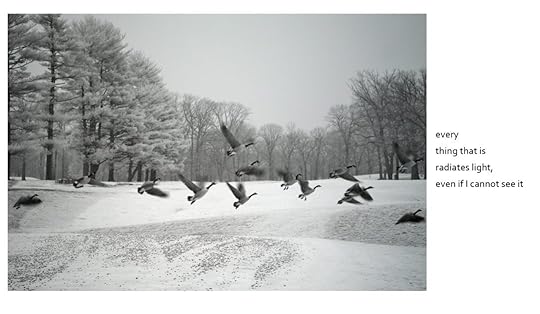
With a full spectrum converted camera, modified to receive infrared, visible and ultraviolet light, and an expansive learning curve, I explore the same open spaces in a new light. Receiving only infrared light from the ground and a wider spectrum from the cosmos, I ask spirit to teach me what this means and what else this means. My exploration of ‘another light’, another slice of the spectrum, is teaching me to look deeper both within creation and within myself.

This spiritual practice of mine is sacred gift.
Being able to share what I learn from creation is so important to me and I was able to self-publish my collection of photos and poems from my covid confinement: 227 Paces, My Pandemic Sanctuary. I’m working on my second collection, roughly titled In Another Light. I am inspired by the photographers, scientists, and poets whose shared works have guided me. The only way I know to thank them is to do the same.

Laurel Pepin, a lifelong resident of Windsor, Connecticut; studied fine art photography in school, although her management skills brought her on a different path. She has since returned to her artistic roots designing liturgical art installations for her church and writing and photographing creation in every spare moment. Visit Laurel online at SharedLightWorks.com
The post Monk in the World Guest Post: Laurel Pepin appeared first on Abbey of the Arts.
October 15, 2022
This Here Flesh ~ A Love Note from Your Online Abbess
Dearest monks, artists, and pilgrims,
Next Saturday, October 22nd I will be leading a retreat for Spirituality & Practice on The Wisdom of the Body: Contemplative Practices for Deep Listening.
Buddhist teacher Reginald Ray describes the body as “the last unexplored wilderness.” For the desert monks of the Christian tradition, the wilderness is the place where we can have a radical and intimate encounter with the divine.
What does it mean to take the incarnation seriously? To live as if our flesh is holy? St. Hildegard of Bingen, the 12th century Benedictine Abbess believed there was a greening life force, very similar to the eastern concepts of chi or prana, which animates us and brings us fully alive. To tend to the greening of our body and soul is an act of devotion.
We live so disconnected from the tremendous wisdom our bodies have to offer to us. Ancient practices like breath prayer, allowing our senses to become doorways to the holy, living in alignment with the slow rhythms of nature, and sacred movement to drop in and listen for how our bodies long to move and express themselves can all be ways to nourish ourselves. Contemplative ways of deep listening help us to come into a loving relationship with our bodies and find the pulse of the divine presence in our blood and bone.
Our featured book for this month’s Lift Every Voice book club is This Here Flesh by Cole Arthur Riley. Cole has written a beautiful book of stories and reflections on embodiment inspired by conversations with her grandmother.
She describes contemplative spirituality as “a fidelity to beholding the divine in all things. In the field, on the walk home, sitting under an oak tree that hugs my house. A sacred attention.” When we bring this sacred attention to our bodies and to our physical experience of the world, we encounter the sacred presence in all things.
This disconnection from our bodies goes hand-in-hand with capitalism’s relentless demands on us and the worship of productivity and busyness. This impacts who we see as valuable. Cole writes:
“We cannot help but entwine our concept of dignity with how much a person can do. The sick, the elderly, the disabled, the neurodivergent, my sweet cousin on the autism spectrum—we tend to assign a lesser social value to those whose ‘doing’ cannot be enslaved in a given output. We should look to them as sacred guides out of the bondage of productivity. Instead we withhold social status and capital, we neglect to acknowledge that theirs is a liberation we can learn from.”
I love this image of looking to those who are unable to “do” in the way our culture expects as “sacred guides out of the bondage of productivity.” Having lived with an auto-immune illness my entire adult life, it has been a profound teacher on the gift of rest and honoring my being, rather than doing.
Cole ties this relentless working and filling our calendars to a loss of wonder:
“We have found ourselves too busy for beauty. We spin our bodies into chaos with the habits and expectations of the dominating culture, giving and doing and working. . . We live depleted of that rest which is the only reliable gateway to wonder.”
The practice of Sabbath, of the delight and restoration of deep rest, of celebrating our bodies through slowness and pleasure, all help us to cultivate that essential practice of wonder which sustains us through difficult days and connects us to the beauty of the world.
We encourage you to purchase and read Cole Arthur Riley’s beautiful book This Here Flesh and to listen to our conversation with her.
If you want more support in slowing down and attuning to your body’s wisdom, please join us next Saturday for an online retreat on The Wisdom of the Body.
New dancing monk icon: Maya Angelou
This force that makes leaves and fleas and stars and rivers and you, loves me. -Maya Angelou
Maya (1928-2014) grew up in the United States during the Great Depression. She moved often between family members because of a chaotic home life. Maya even stopped speaking for a few years, but through the help of a teach and her love of poetry she once again found her voice. Maya had several jobs, including in music and the arts. She was an active participant in the Civil Rights Movement and her writing have inspired new generations of activists and artists.
Tomorrow, October 17th we are offering our new Taize-inspired sacred chant with Simon!
With great and growing love,
ChristineChristine Valters Paintner, PhD, REACE
Dancing Monk icon by Marcy Hall (Icon available for purchase on Etsy)
The post This Here Flesh ~ A Love Note from Your Online Abbess appeared first on Abbey of the Arts.
October 11, 2022
Monk in the World Guest Post: Emily Lasinsky, PhD
I am delighted to share another beautiful submission to the Monk in the World guest post series from the community. Read on for Emily Lasinsky’s reflection “Being a Teacher-Monk in the World.”
My identity is deeply rooted in being a creator. Integrated within this identity are the roles of artist, writer, and teacher. At the time of writing this, I am starting to prepare my undergraduate psychology classes for the fall semester. For this post, I will share how I practice being a monk in the world as a teacher.

My philosophy of teaching, greatly influenced by Parker Palmer, Brené Brown, and Saint Francis of Assisi, is rooted in contemplative and social justice pedagogies. I currently work at two Catholic universities, which encourage the integration of contemplation and service. I consider the classroom a sacred space where students, as well as myself, can enter the depths of the transformational learning process. This space also serves as a container for ambiguity and a safe environment where difficult topics can be discussed. Creating this space requires modeling intentionality, presence, and inclusivity. To help students transition into this space, I often start class with a brief mindfulness activity. For example, around mid-term when students may feel particularly overwhelmed, I start class with a mantra card activity. I pass out index cards and markers and instruct students to think about an uplifting phrase that may reinforce their personal and career goals. Students are invited to write down the phrase, as well as draw anything that comes up for them. Afterwards, students are invited to share their mantra cards with the class. To model that I am still a work in progress, I also make one and share it with students. Finally, I encourage students to place their cards in a location where they will see it often.
By using reflective and experiential activities, I invite students to reflect on their personal sense of meaning and consider the various ways of being in the world. My assignments and classroom activities are designed to encourage students to increase their awareness of self, others, and larger systemic concerns; think critically; and demonstrate ethical practice and cultural sensitivity. For example, I ask students to complete a wellness inventory as part of the Health Psychology unit in General Psychology. Students complete the inventory and then write a reflection about what they noticed while completing it, what surprised them, what areas of wellness they would like to work on, and how the inventory may be adapted for others from diverse backgrounds. In addition to asking students to apply class material to case studies that represent individuals from diverse walks of life, I also frequently use art in the classroom. For example, I arrange the room in a half circle and sit in the center holding a piece of art. I ask students to share what they see from their perspective in the room. This often starts a discussion about the role of context and positionality in how people experience the world.
I not only want students to think about the material; I want them to live it. I regularly include community engagement projects in the courses I teach. Students are part of the projects from the very start. For example, I ask students to complete an assessment of what is needed in the university or local community. From there, we have group discussions about possible projects. This process is deliberate—not rushed. By providing students with opportunities to take ownership and direction of their learning, I hope to convey that they are co-creators of the class and I value their unique contributions. I also invite guest speakers into class to provide students with a broader picture of how course topics are perceived and practiced from diverse viewpoints. Overall, such reflective and experiential activities can foster the development of self-awareness, empathy, compassion, and critical thinking skills needed in today’s world.

Finally, as a teacher, I am aware that I am still a student of life and have much to learn. I engage in my own contemplative practices (e.g., art, walks in nature) that help me be centered and present. While I spend much time preparing for classes, I also allow for flexibility based on what students need and how classes naturally evolve. Career experts suggest looking back to your career interests as a child to determine possible career directions. My first career day was in preschool, where I dressed up as a teacher. While I have explored many professions since then, I circled back and feel authentic in the teacher role.
To conclude, I want to share three quotes that capture how I endeavor to be a teacher-monk in the world by practicing authenticity, humility, contemplation, and action. I invite everyone to consider what these quotes mean to you.
“Good teaching cannot be reduced to technique; good teaching comes from the identity and integrity of the teacher.” –Parker Palmer
“What we know matters but who we are matters more.” –Brené Brown
“It is no use walking anywhere to preach unless our walking is our preaching.” – Saint Francis of Assisi
Emily Lasinsky, PhD, is an artist, writer, and teacher from Pennsylvania. She currently serves as an adjunct professor at two universities. Her current scholarly interests include expressive arts and healing, spirituality and mental health, and the mind-body connection. In her free time, she enjoys hiking in nature and creating art.
The post Monk in the World Guest Post: Emily Lasinsky, PhD appeared first on Abbey of the Arts.


