
Christine Valters Paintner's Blog, page 43
May 3, 2022
Sacred Time Webinar with Christine Valters Paintner and Veriditas
Hosted by Veriditas
Monday, May 23, 2022
10-11am Pacific | 1-2pm EST | 3-4pm Ireland
I am delighted to join Veriditas founder the Reverend Dr. Lauren Artress to engage with sacred time in your life and with the labyrinth.
I will discuss how by becoming in tune with the rhythms of the natural world, we can live more intentionally and experience a conversion toward a more expansive way of being. In my recent book, Sacred Time: Embracing an Intentional Way of Life, I invite readers to embrace a world that urges us toward rest, reflection, and growth.
In this webinar you will learn more about the concept of sacred time and how it can deepen your labyrinth practice. Whether you are new to the labyrinth or a facilitator looking for a theme for your next event, you will be inspired by the concepts in this webinar.
Learn more and register for the webinar here.
The post Sacred Time Webinar with Christine Valters Paintner and Veriditas appeared first on Abbey of the Arts.


May 2, 2022
Lift Every Voice: Contemplative Writers of Color – May Video Discussion and Book Group Materials Now Available
Join Abbey of the Arts for a monthly conversation on how increasing our diversity of perspectives on contemplative practice can enrich our understanding and experience of the Christian mystical tradition.
Christine Valters Paintner is joined by author Claudia Love Mair for a series of video conversations. Each month they take up a new book by or about a voice of color. The community is invited to purchase and read the books in advance and participate actively in this journey of deepening, discovery, and transformation.
Click here to view this month’s video discussion along with questions for reflection.
This month’s selection is Becoming Rooted: One Hundred Days of Reconnecting with Sacred Earth by Randy Woodley. Becoming Rooted invites us to live out a deeply spiritual relationship with the whole community of creation and with Creator.
Through meditations and ideas for reflection and action, Randy Woodley, an activist, author, scholar, and Cherokee descendant, recognized by the Keetoowah Band, guides us on a one-hundred-day journey to reconnect with the Earth. Woodley invites us to come away from the American dream–otherwise known as an Indigenous nightmare–and get in touch with the water, land, plants, and creatures around us, with the people who lived on that land for thousands of years prior to Europeans’ arrival, and with ourselves. In walking toward the harmony way, we honor balance, wholeness, and connection.
Creation is always teaching us. Our task is to look, and to listen, and to live well. She is teaching us now.
Join our Lift Every Voice Facebook Group for more engagement and discussion.
The post Lift Every Voice: Contemplative Writers of Color – May Video Discussion and Book Group Materials Now Available appeared first on Abbey of the Arts.
April 30, 2022
Embrace the Wisdom of the Sacred Feminine ~ A Love Note from Your Online Abbess
Dearest monks, artists, and pilgrims,
I am back home in Ireland now after my six weeks away for surgery and recovery in Vienna. I am really grateful to be back with sweet Sourney and the quiet rhythms and comforts of home. My body still needs more healing time so I will keep going slowly in the weeks to come. I continue to be enormously grateful for your prayers.
This time away has been so many things. A welcome return to an ancestral city I love so much after two years of pandemic-restricted travel. A season of grieving the loss of my dear aunt Nancy who died two days before I left. A liminal space where I could release the demands of work and truly just rest into the day to day. A span of recovery when I could truly witness the daily marvel and miracle of my body’s healing journey, from the first waking up after surgery to my first foray out of my hospital bed to my oh-so-slow walks around the block when I was first released to the longer walks and more capacity to enjoy the treasures Vienna offers as days progressed.
I return to Galway in need of continued slowness, of still lots of rest, and so these next few weeks I have only committed to a few things that feel manageable to me. My body craves this slow rhythm of life and my spirit longs to integrate some of the gifts that came through as I released my need to produce or do and simply showed up to my meditation and prayer. My monk’s path, and certainly my hermit’s calling, has deepened during this time. I am listening for what that means. I called on the presence of angels, saints, and ancestors even more keenly than I have before and I wrapped myself in your love and care for me. This community is such a beautiful thing we create together.
All I am certain of right now is that the contemplative way continues to be a powerful resistance and antidote to a world that demands our relentless doing and exhaustion. Our choices for slowness where and when we can point to a different way of being, to another world that exists just below the surface of this one.
I have three invitations for you to embrace the wisdom of Mary and the sacred feminine:
The song video above is of the traditional Latin Hail Mary prayer sung by Simon de Voil and Mia Kelley. It is one of the songs on our newest compilation of songs. We invite you to play the video as a prayer of opening to the sacred feminine in the midst of your life right now and see what she wants to say to you. The video was created by our filmmaker friends in Galway at Morgan Creative and features a local actress and friend Johanne Webb holding the space for Mary. We hope you enjoy!
I have an article on the Black Madonna in the May issue of US Catholic magazine. You can read the article here. As you read, you might want to call to mind and heart any griefs you carry and imagine that Mary as fierce dark mother is holding you in your sorrow.
Tomorrow we celebrate my new book, our new music album, and the newest week of the Prayer Cycle! Please join us for our monthly contemplative prayer service which will be 90 minutes instead of the usual 60 and I am joined by wonderful friends Betsey Beckman, Soyinka Rahim, Simon de Voil, and Richard Bruxvoort Colligan. Help us to celebrate these works which bring the sacred feminine more fully into the world. Mary has been a tremendous healing presence to me in these days of recovery, especially in her guise as Life-Giving Spring. The audio podcasts will be published over seven weeks starting next Sunday and we will be sharing those links here.
With great and growing love,
ChristineChristine Valters Paintner, PhD, REACE
Video © Abbey of the Arts and Morgan Creative
The post Embrace the Wisdom of the Sacred Feminine ~ A Love Note from Your Online Abbess appeared first on Abbey of the Arts.
April 26, 2022
Monk in the World Guest Post: Kathryn Coneway
I am delighted to share another beautiful submission to the Monk in the World guest post series form the community. Read on for Kathryn Coneway’s reflection “Sanctuary at Home and Deepening Relationship with Neighbors.”
There’s a tall straight oak tree growing behind our house; its thick trunk stretches straight up and then branches open like an umbrella at the top above other trees. I can walk around the base of the tree, stepping on thick roots that anchor it to the earth. In some places, a smaller root wraps over the larger main root; I imagine this as a glimpse of the vast network in the ground below.
My favorite side of this tree faces away from our house, hidden from view by the thick stem. I look out toward a creek in the distance. This side of the tree gets the most sun; it feels warm against my back. As the seasons change, I delight in the call and response of bird song in the mornings and marvel at the noise of the wind through branches. In a light spring rain, I notice the canopy keeps the large trunk mostly dry even as the roots and ground around become soaked. The tree shelters a pool created by an uprooted tree that fell nearby.
I’ve lived in my house nearly 14 years, but it is only in the last 2 years that I’ve begun to venture regularly to this spot, finding sanctuary through monthly, weekly, and daily pilgrimages to the base of this tree; over time my visits have grown more frequent. When I visit, I sit on a root or stand and lean against its broad trunk. In the privacy of the forest, I pray aloud, words of thanksgiving, concern, questioning. I feel seen and heard.
Previously, I saw the forest behind our house as a nice backdrop. I vaguely remember the fall of the tree that made the pool years earlier, we noticed the opening in the leaves and a bit more view of the creek in the distance. Six years ago my work shifted to working at home and I began to pay more attention to the afternoon light and sunsets behind our house. Even then, I observed from my deck, seeing the forest in the distance as a landscape, a pretty view. It was only when I began a regular visit to one spot, that my relationship began to deepen with this sanctuary and the living beings within it.
In a podcast this winter, theologian and naturalist, Mary DeJong, suggested a shift in wording from “shelter at home” to “sanctuary at home.” This idea resonated for me as an artist and writer working from home and seeking to deepen my relationship to the natural world. She went on to suggest how when feeling isolated, one could seek presence in nature. She encouraged listeners to see what they notice outside as an interaction with natural elements rather than a one-sided observation. This description aligned well with my own sense of feeling seen and heard with this tree in the forest. It also reminded me of what I have learned as a monk in the world practicing contemplative photography. With a posture of receiving images rather than taking pictures, presence is about relationship.
I am not the only visitor to this spot; one day as I sat with my eyes closed, I heard a low growl and opened my eyes just in time to see the busy tail of a fox walking away. Other times I hear deer splashing through the reeds along the creek. This spring I celebrated the return of a large snapping turtle who visits the pool, staying close to the tangle of roots from the upturned tree and likely feeding on large bullfrog tadpoles darting about.
I am learning the names of plant neighbors too, beginning to recognize different stages of growth. In April, mayapple pop up on the forest floor; last spring I lost track of them before getting to see any blooms. Now, with more frequent visits, I check daily to see their growth and hope to see a bloom. This spring as the trees began to bud sprout leaves, I felt like they were saying their names as the signature leaf shapes became clear. I’ve been noting the date that each one bursts with new leaves. Initially, I was surprised that so many saplings were sweet gum, but then remembered the bright red and purple shapes of the autumn leaves. The tall oak was the last to bloom, its new leaves were only visible in silhouette along the high branches. Eager to see the leaf shapes, I was delighted to find a few small bundles of yellow pollen and new baby leaves on the ground; it felt like a gift from the tree.
As a monk in the world, this natural sanctuary helps me practice stability and also encourages me to grow and deepen. I delight in the return of seasons as well as invitations to new discovery. The more I visit this space, the more it sparks my curiosity and invites presence and wonder.
I think of the scene in The Little Prince by Antoine de Saint-Exupéry where the fox and the prince speak about what it means to tame something. At one point, the fox describes to tame something as “to establish ties.” Their discussion mentions the relationship between the prince and a rose he cares for as an example of taming. It seems self-important to imagine taming a tree, particularly such a large and independent one that asks nothing in the form of care from me. Instead, I can imagine that this tree is taming me, deepening my ties to the forest and living things around it through my visits to this sanctuary in my own backyard.
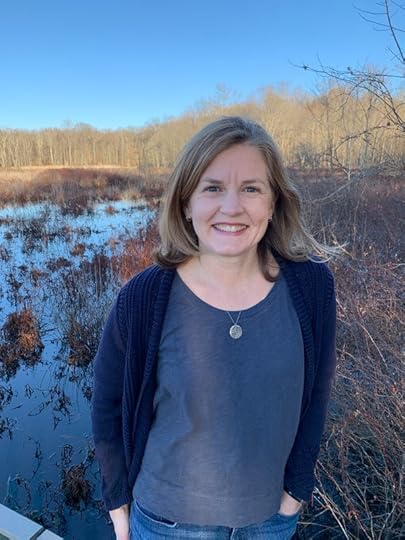
Kathryn Coneway is a mixed media visual artist, author, and educator; view more of her work KathrynConeway.com She provides workshops to foster connections between creative and spiritual practice. Kathryn is the author and illustrator of two children’s books, COLLETTE A Collage Adventure and Oops Paint. Kathryn lives in Alexandria, Virginia with her family.
The post Monk in the World Guest Post: Kathryn Coneway appeared first on Abbey of the Arts.
April 23, 2022
Cause of Our Joy: She Who is the Source of Delight ~ A Love Note from Your Online Abbess
Dearest monks, artists, and pilgrims,
On Monday, May 2nd we will be hosting a contemplative prayer service that will also serve as a launch of my new book, the companion album, and our wonderful new prayer cycle on Mary and the Wisdom of the Sacred Feminine.
In celebration of these resources being birthed into the world, I offer you an excerpt from my book Birthing the Holy on one of my favorite of Mary’s titles – Cause of Our Joy:
When the angel Gabriel visits Mary, he tells her to “Rejoice!” When Mary and Elizabeth meet while they are both pregnant, John the Baptist leaps with rejoicing in his mother’s womb at the encounter of the two women. When Mary prays the Magnificat, she says her soul rejoices in God. Mary says yes so that Jesus could come into the world to also bring freedom, homecoming, and joy. We describe Mary as “full of grace.” Grace is a gift offered freely that helps us to return to alignment with our Self and the divine. This causes us to experience joy.
There is a devotion called the seven comforts of Mary which consists of saying seven Hail Mary prayers to share the joys Mary experienced on earth: the Annunciation, the Visitation, the Nativity, the Epiphany, finding Jesus in the Temple, the Resurrection, and the Ascension (these actually vary in different time periods as sometimes other events are included instead). Mary is not just the keeper of sorrows, but also a celebrator of life’s joys and delights as well.
The Hebrew bible brings us strong themes of slavery and exile throughout its stories which lead to both freedom and homecoming. David Richo describes these both as archetypal experiences – bondage is when we are trapped in fear, attachment, or an overwhelming need to control events or people. Exile is what happens to us when we forget our profound communion with others and with the earth, when we get stuck in selfishness and self-directed desires. Mary guides us to both freedom and homecoming through her own modelling of choice and surrender. She leads us into joy.
Here at Abbey of the Arts one of our core commitments is shaped by words from St. Benedict in his Rule: “What is more delightful than this voice of the Holy One calling to us?” And then this invitation to continue on the spiritual journey with “our heart overflowing with the inexpressible delight of love.” (Prologue) The commitment we make is to dance with creative joy.
Thomas Merton, at the end of his book New Seeds of Contemplation, concludes with a wondrous passage inviting us to follow in God’s “mysterious cosmic dance.” He says that we can take ourselves so seriously and forget the meaning of it all which is really to live in this state of wonder. We must make space for our grieving, but we must also enter into the dance of joy that beckons to us from the heavenly spheres.
Whether we dance literally or metaphorically, the dance is a symbol for forgetting our self-consciousness and letting ourselves be overcome with the joy and love that beat at the heart of everything. Our whole purpose in following a spiritual path and nurturing these practices in our lives is to expand our inner freedom which expands our capacity for loving the world. As we release the hold of expectations and disappointments, as we stop trying to live into the imagined life and live the one we have been given, we discover a profound inner freedom to make choices out of love, rather than obligation or resentment.
Join us next Monday, May 2nd to celebrate our joy at birthing these new creations!
With great and growing love,
ChristineChristine Valters Paintner, PhD, REACE
Image credit ©
The post Cause of Our Joy: She Who is the Source of Delight ~ A Love Note from Your Online Abbess appeared first on Abbey of the Arts.
April 19, 2022
Monk in the World Guest Post: Becky Rische
I am delighted to share another beautiful submission to the Monk in the World guest post series from the community. Read on for Becky Rische’s reflection on creating a community labyrinth.
It’s a strange feeling to follow a calling and then watch it take shape in ways you hadn’t imagined. As the pandemic wore on and I sought safe ways to practice my faith, a labyrinth’s blend of faith and nature appealed to me more and more. That’s how building a neighborhood prayer labyrinth looped around my mind, and eventually materialized along the local hike and bike trail that runs in front of our home.
I sat on rock piles at local stone supply stores selecting materials, and thought of how this would give the many walkers on our street another way to keep moving and add a prayer to their outdoor time. I had hoped to look out my front window and see people walk through and away in a more peaceful mood. I had hoped it would provide some community prayer with my literal neighbors in the absence of in-person church services. And I had sought to meet others who treasured this ancient balm in the midst of a modern pandemic.
Very little of that happened.
First, what initially appeared to be a simple mowing job as land prep, became a major land-clearing project. A couple of girlfriends with temporarily-shuttered house cleaning businesses needed a new income source, and I felt grateful to get on their work schedule. When the digging and dragging of brush was finished, it became clear we still needed some heavy equipment to smooth the area enough for less-abled walkers. Turns out one girlfriend’s husband had access to a Bobcat to do the job. With their children unable to get regular nutrition at school, they were so grateful for the help with grocery bills, and I was so grateful to find a way to help them while honoring the dignity of work, as well as maintain the unrelenting isolation our family’s co-morbidities required.
As the prayer circle took shape, I serendipitously reconnected with a fellow contemplative who recognized the labyrinth under construction, and enthusiastically pitched in with the final placement of rocks. She now uses it regularly. She also has long served on the local parks and recreation board and has had several opportunities to support it among curious officials. Without her intervention, the labyrinth may have just as mysteriously disappeared as it appeared.
Unlike my original vision, few regular walkers use the labyrinth. They initially stopped and read its description, but their intent is to exercise, not be distracted from the serious task of physical training.
Instead, children and families find it magnetizing. Grandparents, newly-charged with entertaining toddlers as a result of the pandemic, arrive daily with young ones who squeal and run through the pattern. Pre-teens are just as pleased with themselves when they complete it. Since I had hoped to offer a source of peace during the pandemic, I interpret this as an unexpected blessing for families struggling to school energetic children at home while continuing to manage their professional work load. Now several times a week, small bikes park in front of the labyrinth while their owners make a quick stop for a twirl around the rock pattern. It’s an unforeseen delight to watch them. Once I went to visit with a child and his grandmother staring at the pattern. “Jesus is in my heart,” he said, in an apparent reaction to what his grandmother had described of the labyrinth. So it seems a deeper message leaves with children as well.
A description of the seven-circuit labyrinth’s meaning and use lives in a clear box next to it, along with words from the physically-distanced blessing ceremony our Pastor Drew conducted when it was first finished. Those disappear at a rate of about 8-10 a week, about the number of weekly new visitors to the prayer circle. Altogether, it seems 30 souls swing through every seven days or so.
Painted rocks appear in the labyrinth with some regularity now. First it was one with a cross painted on it, now three of those live there. A lady-bug-painted rock soon joined them, and then rocks of abstract designs and one with plastic googly eyes arrived. I’ve never witnessed the rock artists leaving their work, but when I have moved them to make more space in the center, the artwork soon returns to its original position.
Books and websites abound on how to pray the labyrinth. Nowhere have I seen how to interpret the heart-shaped pipe cleaners or old baseball that have appeared in this one.
Last week when my husband gave our dog his final outing before bed, four teenagers were peacefully walking the labyrinth. (For fun we added solar twinkle lights outlining the exterior circle.). After praying, they skateboarded away.
One neighbor recently mentioned how surprised he was that the labyrinth has remained unscathed by vandalism. After all, it’s just 650 rocks perched on top of the ground. I have to admit, I share his surprise. Especially since it was finished just before Halloween when one neighborhood social media network labeled it a Blair Witch project and a city councilman jokingly responded it looked more like a pet cemetery. The only vandals seem to be the deer and peacock who travel through and bump the rocks out of place. Their hoof/claw prints give them away.
But yesterday, a little bit of my original intention was realized when a neighbor I’ve never met, but seen unwaveringly walking on our street for 25 years stopped briefly. Her bright red cowboy hat and intensely orange athletic shoes keep her top of mind. She interrupted another streetside conversation about the labyrinth. She asked if I was the builder, and thanked me three times for creating it. Her church has one, she said, but it’s not as convenient. And she loved this one. At that moment at least, I felt both of our labyrinth prayers answered.

Becky Rische is retired from a long professional career in writing ranging from city lifestyle magazines to business journals to public relations at major universities. It took a few years to warm up to labyrinth prayers, but it’s now clear that moving her feet opens her heart and she tries to practice it daily.
The post Monk in the World Guest Post: Becky Rische appeared first on Abbey of the Arts.
April 16, 2022
Easter and the Elements ~ A Love Note from Your Online Abbess
Dearest monks, artists, and pilgrims,
Happy Easter and Feast of the Resurrection! I am delighted to share that my assistant Melinda, whom you may know from our online programs and yoga practices, is leading a mini-retreat on Saturday, April 23rd themed around yoga and the elements. Read on for her reflection on Easter and the 5 great elements.
When I asked my eight year old son if he knew what Easter was about he said, “God coming back.” After nearly two years away from church and Sunday School I thought this was pretty on the mark. We briefly talked about love never leaving and the miracle of Jesus’s resurrection before he lost interest.
One thing I appreciate about Easter is the way it is a continuation of the Incarnation celebrated at Christmas. Without incarnation there can be no resurrection. And without resurrection incarnation seems a little finite. Astonishing in its generosity, but finite.
We see this miraculous cycle of incarnation and resurrection in the wheel of the year and the interaction of the elements that form the building blocks of our world. In the yoga tradition there are 5 great elements – or Mahabhutas.
Earth – the element of physical being and sustenance Fire – the element of energy and transformationWater – the element of flowing and yieldingAir – the element of breath and communicationSpace – the subtle element of vastness in which all the other elements existAs in the Celtic tradition, engaging with these elements invites us into a deeper connection with the matrix of creation. When we recognize that the elements do not simply exist in the “natural world” beyond our humanity, we enter into an enriching relationship with creation and the Creator. There’s a sense of mutuality and aliveness to our collective lived experience.
From a yoga perspective, the Mahabhutas are part of the way creation is danced into being. This cosmic dance is not a one and done deal; incarnation is not finite. It’s an unending, moment to moment dance of love and bliss. It’s the Divine manifesting creative delight.
When we pay attention, this dance of delight is revealed in a myriad of ways including the interplay of elements in the cycle of seasons both liturgical and literal. In Lent – which happens in late winter-to-early spring in the Northern Hemisphere – we experience the subtlety of air inviting us to breathe and turn inward to attune oneself to the subtle movements of spirit.
At Easter, air breathes new life as the earth is reborn. Water flows, flowers bloom, and light returns. We celebrate resurrection, the rebirth of the spirit, and the promise that death is not the final word. God comes back because God never left. The elements shimmer in new ways.
In yoga practice we are invited to play with the elements in their physical and thematic actions.
During our mini-retreat on April 23rd we will explore the Mahabhutas through contemplation, meditation, breath work, and asana (the postures or shapes we make with the body). No yoga experience is necessary and all bodies are welcome.
Melinda will also be leading a yoga nidra on Thursday, April 21st themed around Earth Day and the elements. Yoga nidra – or “yogic sleep” – is a restorative practice done entirely in Savasana. (Lying down under cozy blankets.) Please consider joining her for either or both of these yoga practices to enrich and broaden your engagement with the elements.
With great and growing love,
ChristineChristine Valters Paintner, PhD, REACE
PS I am doing quite well with my recovery from surgery two and a half weeks ago now. Read my full update here >>
Image paid license by Canva
The post Easter and the Elements ~ A Love Note from Your Online Abbess appeared first on Abbey of the Arts.
April 15, 2022
Health Update from Your Online Abbess
Dearest monks, artists, and pilgrims,
I am doing quite well with my recovery from surgery two and a half weeks ago now. My incision has healed up well. My pain has transitioned more to discomfort and I can walk about 10-15 blocks. I am still going very gently but the doctor highly recommended walking along with resting. So thankfully since the weather has been lovely here we walk each day to an outdoor spot for lunch. This time of healing is a gift and I continue to be so grateful for all of your prayers. I feel the presence of my Austrian ancestors too lifting me up and celebrating the miracle that is my body.
My histology report came back negative and no malignant cancer cells were found so I can return home to Ireland on the 25th. I will need to keep going gently for a while after my return too.
In the meantime, quiet mornings for reflection and coffee, a sweet stroll to a leisurely lunch outside, an afternoon nap, a light dinner at our apartment, streaming a movie (I’d highly recommend Coda, Summer of Soul, and Belfast), and early to bed are the healing rhythms of my days. John has of course been great company. Wonderful to get to spend time with my dear friend Katharina too and her husband Wolfgang. With continued gratitude for each of your prayers and blessings.  (I am a couple of days early for wishing you a “Frohe Ostern”, but here is some bunny love from Vienna’s shop windows for you.)
With great and growing love,
ChristineChristine Valters Paintner, PhD, REACE
Images © Christine Valters Paintner


 Easter in Vienna
The post Health Update from Your Online Abbess appeared first on Abbey of the Arts.
April 12, 2022
Monk in the World Guest Post: Therese Pekala
I am delighted to share another beautiful submission to the Monk in the World guest post series from the community. Read on for Therese Pekala’s reflection “Hospitality: A Graceful Art.”
On the exterior of my front door reads a sign, “My dog is my door bell.” It may appear to be a warning and unhospitable until you realize the dog is a friendly fifteen year old golden retriever named Maisy. She is the official greeter. If dogs are like their master, then Maisy and I are symbiotic souls when it comes to welcoming those who appear at our door.
I open my home with greetings of: “Come in; Have a seat; Would you like something to drink?” and more importantly, I open my listening heart. A shared word of comfort or gratitude, a hardy laugh, an empathetic smile, and an enveloping hug, these are the gestures of hospitality. It is soul touching soul, however, short or small the greeting. Leaving a human connection that presence is indeed a gift from the heart. There is an expansion of joy with each encounter.
How did I learn to be welcoming to others? It began with observing my parents who opened their home and hearts to those in need of a welcomed space. It was not uncommon for my mother to invite strangers to our holiday dinners, those without family near, like a military soldier or someone disconnected from family, an elder who lived alone. It was an adventure not knowing who would be at our table; a welcomed blessing with many a story to be told. Truly a Christ like exchange between souls.
I realized as time went by that the first person I had to learn to welcome was Me! This is not an easy task to welcome my failures, my shadows, and the years of falsely believing I am not enough. As I ground in Spirit, and treat myself with kindness and generosity, it becomes the key to unlocking the flow of acceptance, love, and openness to another.
However, there are times when it is a challenge to demonstrate hospitality when the person is someone who has hurt me or is unleashing unresolved anger. Then being welcoming requires an extra dose of Divine intervention: “Dear God help me to be kind.” With these encounters, though my blood may be rushing to my head, and my body wants to run away, I take a deep breath and invite the calming presence of Spirit.
I step back and choose to act from a place of grace. I quiet the voices that whisper, “Don’t give them the time of day. Tell them to take a hike”. I speak to those inner childlike defenses, “I can handle this. Greet them, and be cordial, I got this.” I will not be baited into responding with like aggressive feelings. I look for the Divine spark, the piece of humanity that has somehow been buried alive in this person, and I respond with an understanding heart. It is not easy to maintain my integrity in the midst of another’s chaos. Welcoming another’s pain into my essence is a sacrifice of love and mercy.
As the years pass, I now realize that the degree of my hospitability, is the degree of the inner work that I do. Prayer, meditation, journaling, mindfulness are all instruments that allow me to stay connected with my Divine Essence. Being grounded to the Source of One is the gift that keeps on giving; this is where my spiritual energy maintains my ability to live with open hands and heart. A beautiful cycle of unconditional love from the Divine, to me, to you, to us, to all. Hospitality is a grace filled art, and one that is part of my daily living, prayer practice; my calling as a Monk in this beautiful, messy world. And of course, I do have my dog, Maisy, to remind me of the joy of welcoming!

Therese Pekala, is a retired social worker and educator, residing in Eugene, Oregon. She loves walking her dog, Maisy, in the tree lined hills where the wild turkeys and deer live. Therese enjoys the company of friends and family both near and far. Her creative activities are writing poetry and stories, and gardening. Also, she thrives on reading spiritual works from the mystics.
The post Monk in the World Guest Post: Therese Pekala appeared first on Abbey of the Arts.
April 9, 2022
The Space Between ~ A Love Note from Your Online Abbess
Dearest monks, artists, and pilgrims,
Today we enter Holy Week. This week ahead in the Christian scriptures invites us into a world full of betrayal, abandonment, mockery, violence, and ultimately death. The Triduum, those three sacred days which constitute one unfolding liturgy, call us to experience communion, loss, and the border spaces of unknowing. Holy Saturday is an invitation to make a conscious passage through the liminal realm of in-between.
I love the wide space of Holy Saturday that lingers between the suffering and death of Jesus on Friday and the vigil Saturday night proclaiming the return of the Easter fire. For me, Holy Saturday evokes much about the human condition—the ways we are called to let go of things or people, identities or securities and then wonder what will rise up out of the ashes of our lives. The suffering that we experience because of pain or grief or great sorrow and we don’t know if we will ever grasp joy again. Much of our lives rest in that space between loss and hope. Our lives are full of Holy Saturday experiences.
In their book The Last Week: What the Gospels Really Teach About Jesus’s Final Days in Jerusalem, Marcus Borg and John Dominic Crossan write:
“Easter completes the archetypal pattern at the center of the Christian life: death and resurrection, crucifixion and vindication. Both parts of this pattern are essential: death and resurrection, crucifixion and vindication. When one is emphasized over the other distortion is the result. The two must be affirmed equally.”
Before we rush to resurrection we must dwell fully in the space of unknowing, of holding death and life in tension with each other, to experience that liminal place so that we become familiar with its landscape and one day might accompany others who find themselves there and similarly disoriented. The wisdom of the Triduum is that we must be fully present to both the starkness of Friday and to the Saturday space between, before we can really experience the resurrection. We must know the terrible experience of loss wrought again and again in our world so that when the promise of new life dawns we can let it enter into us fully in the space carved by loss. As the great poet of Hafiz reminds us, we must let our loneliness “cut more deep” and “season” us, so that we are reminded of our absolute dependence on the Source of all.
When I first moved to the Pacific Northwest United States in 2003 I fell in love with trails that run along the border spaces between forest and ocean. Walking these paths is like walking along the edges where two wild places meet, and in that space I encounter the wilderness within me. This landscape of earth and sea pressed against each other, wild against wild, speaks to something deep within me—that place where God’s voice often whispers and sometimes roars. It reflects the landscape of my soul in a way that no other place had until I moved to Ireland and found a new landscape of wild edges. I somehow feel very much at home in this place of borders. We often try to domesticate God and to make spirituality about happiness or feeling good. We try and tie things up in neat packages. The spiritual journey is about none of these. It demands something of us and calls us to stand in uncomfortable places while the deserts of our lives strip away ego and power and identity. It calls us to embrace the God of wild borderlands.
Lent, for me, is always about dwelling in the border spaces of my life and recognizing those places and experiences that do not offer me easy answers, those fierce edges of life where things are not as clear-cut as I hope for them to be. There is beauty in the border spaces, those places of ambiguity and mystery. In Esther de Waal’s rich little book To Pause at the Threshold: Reflections on Living on the Border, she writes that the ability to live with uncertainty requires courage and the need to ask questions over finding answers. I am called to hold the space for mystery within me.
In Living on the Border of the Holy: Renewing the Priesthood of All, William Countryman writes that this border country is one we all carry within us. There is a fault line running down the middle of our lives that connects our ordinary reality with its deeper roots. The border country, he argues, is what gives our lives meaning:
“This border country is a place of intense vitality. It does not so much draw us away from the everyday world as it plunges us deeper into a reality of which the everyday world is like the surface . . . To live there for a while is like having the veils pulled away.”
Threshold space opens us up to life that is vital, intense, and filled with unknowns. Borders and edges are the places of transformation, transformation that makes demands of us. Jesus’ journey in the desert was a willingness to dwell in the border space of that landscape and the walk toward Holy Week often fills me with more questions than answers.
Much of our lives are spent in Holy Saturday places but we spend so much energy resisting, longing for resolution and closure. Our practice this day is to really enter into the liminal zone, to be present to it with every cell of our being.
Make some time on Holy Saturday to sit with all of the paradoxes of life. Bring yourself as fully present as you can to the discomfort of the experience. Rest in the space of waiting and unknowing and resist trying to come up with neat answers or resolutions. Imagine yourself on a wild border or standing on a threshold, knowing that you cannot fully embrace what is on the other side until you have let this place shape and form your heart. When you notice your attention drifting or your mind starting to analyze, return to your breath and the present moment. Allow yourself to feel whatever arises in this space. Honor the mystery.
With great and growing love,
ChristineChristine Valters Paintner, PhD, REACE
Image © Christine Valters Paintner
The post The Space Between ~ A Love Note from Your Online Abbess appeared first on Abbey of the Arts.


