James Maxey's Blog, page 4
March 11, 2019
Week 10: 9098 Words
I'd hoped to get in a little writing Friday and Saturday of last week to get me over the 10k mark for week 10. Friday we were driving to Greenville for the SC Comicon. I'd planned to write on my laptop for a few hours while my wife drove, but we were driving through rain and started hitting construction zones and I decided to take over driving, not because I'm in any way a better driver than Cheryl, but I just felt guilty about having her be stressed by bad driving conditions while we were heading to one of my events. Anyway, the drive took two hours more than we planned, then load in took a while since we had a hard time finding the loading dock at the convention center. Then, during load it, the light drizzle shifted to pouring rain. I was having to drape boxes in with trash bags and other makeshift umbrellas to make sure no rain snuck through gaps and ruined books. So, my back up plan to write when we got back to the hotel was shot by not getting to the room until nearly 10pm.
But, gripe gripe gripe… wow! What an amazing weekend! I would do a dozen rainy drives and crappy load ins in order to have another con like SC Comicon. It was my biggest total revenue from a two day con ever. I got within $100 of what I did last year at Raleigh Supercon and that was a three day show. At Supercon, I didn't have any hardback available. Now I have both dragon collections in hardcover, plus Bad Wizard, and There is No Wheel, and the revenue boost from selling those at a higher price point really made a difference. Thank you, South Carolina public school system, for producing readers with a taste for fine books!
The next con I do (this weekend, Oak City Comicon) I'll print order forms and make some laminated covers to stand in for sold out titles. At SC Comicon I sold out of Nobody Gets the Girl, Burn Baby Burn, and paperback There is No Wheel. Sadly, a box with more copies of Nobody and Wheel was sitting on my porch back home, delivered after we'd left town. Oh well.
Anyway, by the time I finished Saturday at the con I was completely brain dead, and couldn't sneak in the last 1000 words I needed to get to my goal for the week.
Still, 9098 brings me to just over 98,000 words for the year. I'm on track for my total word count goal for the year. Continuing to pile words into Dragonsgate. Chomping at the bit to crank out the rest of Nobody Nowhere. Doing a lot of second guessing on Squire and Smash. I'm excited about both projects, but wondering if I should spend any more time on them this year. A growing folder full of notes and excerpt for The Stuff. Right now, if I had to predict the three books I'll actually finish this year, I'd say Dragonsgate, Nowhere, and the Stuff.
Now, off to finish the current chapter of Dragonsgate!
But, gripe gripe gripe… wow! What an amazing weekend! I would do a dozen rainy drives and crappy load ins in order to have another con like SC Comicon. It was my biggest total revenue from a two day con ever. I got within $100 of what I did last year at Raleigh Supercon and that was a three day show. At Supercon, I didn't have any hardback available. Now I have both dragon collections in hardcover, plus Bad Wizard, and There is No Wheel, and the revenue boost from selling those at a higher price point really made a difference. Thank you, South Carolina public school system, for producing readers with a taste for fine books!
The next con I do (this weekend, Oak City Comicon) I'll print order forms and make some laminated covers to stand in for sold out titles. At SC Comicon I sold out of Nobody Gets the Girl, Burn Baby Burn, and paperback There is No Wheel. Sadly, a box with more copies of Nobody and Wheel was sitting on my porch back home, delivered after we'd left town. Oh well.
Anyway, by the time I finished Saturday at the con I was completely brain dead, and couldn't sneak in the last 1000 words I needed to get to my goal for the week.
Still, 9098 brings me to just over 98,000 words for the year. I'm on track for my total word count goal for the year. Continuing to pile words into Dragonsgate. Chomping at the bit to crank out the rest of Nobody Nowhere. Doing a lot of second guessing on Squire and Smash. I'm excited about both projects, but wondering if I should spend any more time on them this year. A growing folder full of notes and excerpt for The Stuff. Right now, if I had to predict the three books I'll actually finish this year, I'd say Dragonsgate, Nowhere, and the Stuff.
Now, off to finish the current chapter of Dragonsgate!


March 3, 2019
Week 9: 7738 words
Meh. Missed 10k for the week. I'll again blame good weather. Yesterday I did a 55 mile bike ride yesterday for my 55th birthday, and felt like I couldn't pass up good weather earlier in the week for rides to make sure I was ready for it. In the summer, a 55 mile ride is usually no big deal. I mean, any ride over 30 miles eventually turns into a slog, but, though it doesn't seem obvious, it's a lot easier to ride in 90 degree heat than in 50 degree mildness. When it's hot, I'm usually just in a tank top and shorts and sweat evaporates off my quickly, keeping me cool and comfortable. In 50 degree weather, riding at a modest 10 miles an hour creates a wind chill effect that makes it feel much colder, so you have to bundle up. But, bundling up means you're trapping sweat next to your skin, no matter how much your clothes claim they wick sweat. So, the further you ride, the damper you get. Part of training for a winter wide isn't boosting your lung capacity or keeping your leg muscles toned. It's training yourself to put up with being both cold and hot at the same time. You're core is hot because of the exercise, but your skin is cold because it's wet. When I got home last night and started peeling off clothes, it looked like I'd fallen into a swimming pool.
This week, no rides! Plenty of butt in chair time, though, alas/yay, next weekend I'll be at the SC Comicon, so I really need to hit my goals by Thursday night. Still, counting today, that's just 2k words a day, a relatively achievable goal.
This week, no rides! Plenty of butt in chair time, though, alas/yay, next weekend I'll be at the SC Comicon, so I really need to hit my goals by Thursday night. Still, counting today, that's just 2k words a day, a relatively achievable goal.
March 1, 2019
How Much Science Do You Need to Know to Write Science Fiction? Part One: Science!
Later this year, I've agreed to teach a workshop called "How Much Science Do You Need to Know to Write Science Fiction?" The class isn't until July, but it's never too early to start fleshing out the ideas I'll be covering.
I intend to cover some common strategies authors use when writing science fiction. The genre covers a lot of ground and can refer to stories built around very specific and mostly accurate science fiction facts to outright fantasies that are sprinkled with "science" jargon. Utterly debunked pseudoscience like telekinesis or precognition still gets treated as plausible. There's also a lot of faith that some science facts we are currently quite sure of will one day be overturned. No one is going to mock you for writing science fiction where faster than light travel is taken as a fact. It's respectable to pretend that we will one day travel to alien words where we can safely breathe the air. And, at least on screen, having humans and aliens interbreed is no big deal.
The sheer scope of science fiction means I should probably start my workshop by first defining the term. What is science fiction? I think there's a more important question that creates some of the problems with defining the genre. What is science?
It doesn't take a lot of research to realize that the definition of science means one thing in a dictionary and another in general usage.
Going to the old Miriam Webster, science has a topline definition of, "knowledge as distinguished from ignorance or misunderstanding." This speaks to the authoritative weight of science, but feels a bit broad. For instance, I probably have more knowledge of English Literature than the average person. Or, in another area where I have some quantitative data, there was a headline popping up on news sites not long ago about how most US citizens would fail a US Citizenship test. Fewer than 50% could name the three branches of government or explain the difference between the Declaration of Independence and the Bill of Rights. I took the sample citizenship test used for this survey online and scored 100%. I wouldn't describe myself as an expert, but think my knowledge of basic American civics would in no way be described as "ignorance and misunderstanding." Yet, I also think that very few people would call extensive knowledge of civics or literature or comic books (where I'm also pretty well educated) "scientific" knowledge.
Digging deeper into the dictionary, we arrive at this definition: "knowledge or a system of knowledge covering general truths or the operation of general laws especially as obtained and tested through scientific method." The scientific method isn't explained within the definition, and a lot of the definitions of this term online are somewhat wordy, so my condensed version is that the scientific method is a way of testing factual claims about the physical world that involves careful observation, the formulation of an explanation for these observations, the repeated testing of that explanation, and the willingness to toss out or modify explanations that are contradicted by new observations.
The transformative power of the scientific method when it comes to understanding the world around is profound. Before this was adopted as a standard of knowledge, the world was mostly comprehended via myth, superstition, and dogma. Dogma is knowledge handed down by an unquestionable authority. A king or a priest would declare something to be true and, for anyone subject to their authority, it had to be treated as true. In most of Europe for over a thousand years it was true that man had been created by God, that kings ruled via divine will, and that the Earth was stationary with the sun, moon, and stars moving around it. Men were mortal and women experienced pain in childbirth due to punishment for the sins of the first man and woman. People who had fits or suffered from mental illnesses were plagued by demons.
And, whatever it's connection to mental illness may be, the ultimate appeal to authority was to claim that you got your information firsthand from God. This was such a successful tactic that it shaped human history with far more reach and far more force than any king or empire of kings could match.
Of course, even before the scientific method arose, dogma had competition: Reason. The Greeks gave the world a method of deciding truth via argument, with premise after premise leading to inevitable conclusions. Reality was an extension of the mind, since the mind was ultimately the only tool we had for knowing the world. If the world existed primarily in our thoughts, it must be possible to arrive at truth purely by thinking about it, and reason provided an excellent canvas on which men could paint the image of reality. Unfortunately, a beautiful as a reality of pure reason might seem, time and again it led men to believe in things that had no true underpinning in the real world. As it happens, reality is under no obligation to be reasonable.
The important difference between knowledge handed down as dogma, or built upon a foundation of pure reason, and knowledge arrived at via the scientific method, is that dogma and reason have no need to put their "facts" built upon any sort of evidence. Who told you the facts, or the beautiful logic behind the facts, was more important than the facts being, you know, factual.
Science as understood by popular culture looks very much like a list of facts handed down by authorities. And, of course, science does have authorities. But, when Darwin proposed the theory of natural selection people didn't accept it because he was an expert. They paid attention because he had evidence. His evidence was documented in meticulous, even tedious detail, and was available for anyone to study for themselves. His theory wasn't presented with the hope that no one would challenge his evidence or conclusions. Instead, it was put forward into an scientific culture where every aspect of his theory and his evidence would be examined. People who found his ideas suspect were free to do their best to refute both his premises and his conclusions.
This is still the heart of good science. Every claim gets examined, all evidence is publicly available. Sometimes, theories are so firmly established that they seem like dogma. I've had arguments with people who think that the theory of evolution is just an alternative religion, taken as faith and impervious to evidence that refutes it. In reality, elements of evolution are modified continuously as new evidence gets uncovered. Many alternatives to natural selection have been proposed, and all come up short when tested by the real world. The Soviets rejected natural selection for an evolutionary theory known a Lysenkoism and based their agriculture around it. This bad evolutionary theory wound up contributing to famines that killed tens of millions.
At least Lysenkoism was put to a brutal, real world test, and eventually rejected. The current popular competing "theory" of "intelligent design" fails as science because it makes no predictions that can be tested. You couldn't build an agricultural program around it, because it has no theory about how organisms change other than that some higher intelligence tweaks things from time to time. When this designer makes changes, why he makes changes, how he makes changes, where he makes changes... unknown. Unknowable. And thus--even if it was absolutely true--completely useless as a tool for understanding life.
In contrast, natural selection makes predictions about what will happen to bacteria exposed to antibiotics. It gives us ideas of how insects might respond if we keep using the same pesticides on crops year after year. It makes large scale predictions about how flora and fauna will change over time as their environment changes. Importantly, if these predictions turned out to be wrong, scientists would change their theories. Even if the predictions were confirmed, if new theory came along that made better predictions, the old theory would be abandoned or modified. Dogma, authority, and beautiful arguments all get ground to dust beneath the wheels of actual, repeatable, verifiable observations.
Don't believe this? Every advance in science starts with an admission that the best previous explanation wasn't quite right. There would be no science at all without scientists ability to utter the words, "We were wrong." If a politician or priest says, "We were wrong," it's normally with a great deal of embarrassment. When scientists say, "We were wrong," it's often in a tone of celebration and awe. Newton's laws of gravity reigned until they were replaced by Einstein's theories. A "tree of life" derived from the study of bones reigned until it was redrawn by genetic evidence. There was a time people reported spotting a planet closer to the sun that Mercury, known as Vulcan. Multiple lines of evidence "proved" its existence. Then, thanks to Einstein's equations explaining Mercury's orbit better than Newton's had, the Vulcan required by the old physics vanished.
While you won't find this in any dictionary, I think that the best, short, definition of science is this: Science is the intellectual knife we use to carve reality free from the thicket of the unreal. Science isn't the only tool in mankind's toolbox when it comes to understanding the world. Art, religion, emotion and pure animal instinct all have roles to play in defining who we are as humans. But science explains our existence in both galactic scales and microscopic scales. It explains our ancient and recent past and hints at possible and probable futures. It helps us understand where we came from, who we are, and who we might hope to be.
Still, sometimes the other tools in the toolbox we use to describe the world are better at describing the human experience than pure science. As a novelist, I think there are truths both grand and subtle that are better examined in works of fiction, things that no telescope or microscope will help us understand. Science fiction is where the tools of science and the tools of art come together to create something wondrous.
Fairy tales have enduring power, existing in every culture in the world, and so beloved by children that it's possible that we've somehow evolved to need these stories to comprehend the world. Fairy tales explain morals and ethics and human character all why evoking a sense of wonder and magic.
Now take these fairy tales and, instead of building upon a foundation of magic, reimagine them on the foundation of wondrous reality. As a child, this to me always seemed like the true appeal of science fiction. I knew that stories of fairy kingdoms and gingerbread men and flying carpets were pure myth. But stories of spaceships and intelligent robots and distant planets--these things could plausibly exist. For me, it was an important distinction. It was entertaining to read about things that could never be. But to read about things that might be true, or that might one day become true, was more than entertaining. It was thrilling; it was inspirational. I still get that reaction from good science fiction, a feeling that I'm catching a glimpse of a something that's a perfect blend of imagination and fact. And while I'm capable of enjoying stories that are works of pure fantasy, I still experience a degree of awe when I find myself immersed in good science fiction.
So, how much science fiction do you need to know to write science fiction? All of it! Well, quite a bit of it. Okay, some. At least a little. Hardly any at all, if you're brazen or bold enough. I believe the better you understand science, the better you'll write science fiction, but, more importantly, the better you understand fiction, the better you'll write science fiction. Sometimes, you'll need to trade away good science in order to grab the prize of a good story. But, even when you're bending science to your will, you can do so in a way that is respectful to the underlying truth. Explaining how to do this is going to take some time. I'll be expanding on this topic in future posts in this series. Stay tuned.
I intend to cover some common strategies authors use when writing science fiction. The genre covers a lot of ground and can refer to stories built around very specific and mostly accurate science fiction facts to outright fantasies that are sprinkled with "science" jargon. Utterly debunked pseudoscience like telekinesis or precognition still gets treated as plausible. There's also a lot of faith that some science facts we are currently quite sure of will one day be overturned. No one is going to mock you for writing science fiction where faster than light travel is taken as a fact. It's respectable to pretend that we will one day travel to alien words where we can safely breathe the air. And, at least on screen, having humans and aliens interbreed is no big deal.
The sheer scope of science fiction means I should probably start my workshop by first defining the term. What is science fiction? I think there's a more important question that creates some of the problems with defining the genre. What is science?
It doesn't take a lot of research to realize that the definition of science means one thing in a dictionary and another in general usage.
Going to the old Miriam Webster, science has a topline definition of, "knowledge as distinguished from ignorance or misunderstanding." This speaks to the authoritative weight of science, but feels a bit broad. For instance, I probably have more knowledge of English Literature than the average person. Or, in another area where I have some quantitative data, there was a headline popping up on news sites not long ago about how most US citizens would fail a US Citizenship test. Fewer than 50% could name the three branches of government or explain the difference between the Declaration of Independence and the Bill of Rights. I took the sample citizenship test used for this survey online and scored 100%. I wouldn't describe myself as an expert, but think my knowledge of basic American civics would in no way be described as "ignorance and misunderstanding." Yet, I also think that very few people would call extensive knowledge of civics or literature or comic books (where I'm also pretty well educated) "scientific" knowledge.
Digging deeper into the dictionary, we arrive at this definition: "knowledge or a system of knowledge covering general truths or the operation of general laws especially as obtained and tested through scientific method." The scientific method isn't explained within the definition, and a lot of the definitions of this term online are somewhat wordy, so my condensed version is that the scientific method is a way of testing factual claims about the physical world that involves careful observation, the formulation of an explanation for these observations, the repeated testing of that explanation, and the willingness to toss out or modify explanations that are contradicted by new observations.
The transformative power of the scientific method when it comes to understanding the world around is profound. Before this was adopted as a standard of knowledge, the world was mostly comprehended via myth, superstition, and dogma. Dogma is knowledge handed down by an unquestionable authority. A king or a priest would declare something to be true and, for anyone subject to their authority, it had to be treated as true. In most of Europe for over a thousand years it was true that man had been created by God, that kings ruled via divine will, and that the Earth was stationary with the sun, moon, and stars moving around it. Men were mortal and women experienced pain in childbirth due to punishment for the sins of the first man and woman. People who had fits or suffered from mental illnesses were plagued by demons.
And, whatever it's connection to mental illness may be, the ultimate appeal to authority was to claim that you got your information firsthand from God. This was such a successful tactic that it shaped human history with far more reach and far more force than any king or empire of kings could match.
Of course, even before the scientific method arose, dogma had competition: Reason. The Greeks gave the world a method of deciding truth via argument, with premise after premise leading to inevitable conclusions. Reality was an extension of the mind, since the mind was ultimately the only tool we had for knowing the world. If the world existed primarily in our thoughts, it must be possible to arrive at truth purely by thinking about it, and reason provided an excellent canvas on which men could paint the image of reality. Unfortunately, a beautiful as a reality of pure reason might seem, time and again it led men to believe in things that had no true underpinning in the real world. As it happens, reality is under no obligation to be reasonable.
The important difference between knowledge handed down as dogma, or built upon a foundation of pure reason, and knowledge arrived at via the scientific method, is that dogma and reason have no need to put their "facts" built upon any sort of evidence. Who told you the facts, or the beautiful logic behind the facts, was more important than the facts being, you know, factual.
Science as understood by popular culture looks very much like a list of facts handed down by authorities. And, of course, science does have authorities. But, when Darwin proposed the theory of natural selection people didn't accept it because he was an expert. They paid attention because he had evidence. His evidence was documented in meticulous, even tedious detail, and was available for anyone to study for themselves. His theory wasn't presented with the hope that no one would challenge his evidence or conclusions. Instead, it was put forward into an scientific culture where every aspect of his theory and his evidence would be examined. People who found his ideas suspect were free to do their best to refute both his premises and his conclusions.
This is still the heart of good science. Every claim gets examined, all evidence is publicly available. Sometimes, theories are so firmly established that they seem like dogma. I've had arguments with people who think that the theory of evolution is just an alternative religion, taken as faith and impervious to evidence that refutes it. In reality, elements of evolution are modified continuously as new evidence gets uncovered. Many alternatives to natural selection have been proposed, and all come up short when tested by the real world. The Soviets rejected natural selection for an evolutionary theory known a Lysenkoism and based their agriculture around it. This bad evolutionary theory wound up contributing to famines that killed tens of millions.
At least Lysenkoism was put to a brutal, real world test, and eventually rejected. The current popular competing "theory" of "intelligent design" fails as science because it makes no predictions that can be tested. You couldn't build an agricultural program around it, because it has no theory about how organisms change other than that some higher intelligence tweaks things from time to time. When this designer makes changes, why he makes changes, how he makes changes, where he makes changes... unknown. Unknowable. And thus--even if it was absolutely true--completely useless as a tool for understanding life.
In contrast, natural selection makes predictions about what will happen to bacteria exposed to antibiotics. It gives us ideas of how insects might respond if we keep using the same pesticides on crops year after year. It makes large scale predictions about how flora and fauna will change over time as their environment changes. Importantly, if these predictions turned out to be wrong, scientists would change their theories. Even if the predictions were confirmed, if new theory came along that made better predictions, the old theory would be abandoned or modified. Dogma, authority, and beautiful arguments all get ground to dust beneath the wheels of actual, repeatable, verifiable observations.
Don't believe this? Every advance in science starts with an admission that the best previous explanation wasn't quite right. There would be no science at all without scientists ability to utter the words, "We were wrong." If a politician or priest says, "We were wrong," it's normally with a great deal of embarrassment. When scientists say, "We were wrong," it's often in a tone of celebration and awe. Newton's laws of gravity reigned until they were replaced by Einstein's theories. A "tree of life" derived from the study of bones reigned until it was redrawn by genetic evidence. There was a time people reported spotting a planet closer to the sun that Mercury, known as Vulcan. Multiple lines of evidence "proved" its existence. Then, thanks to Einstein's equations explaining Mercury's orbit better than Newton's had, the Vulcan required by the old physics vanished.
While you won't find this in any dictionary, I think that the best, short, definition of science is this: Science is the intellectual knife we use to carve reality free from the thicket of the unreal. Science isn't the only tool in mankind's toolbox when it comes to understanding the world. Art, religion, emotion and pure animal instinct all have roles to play in defining who we are as humans. But science explains our existence in both galactic scales and microscopic scales. It explains our ancient and recent past and hints at possible and probable futures. It helps us understand where we came from, who we are, and who we might hope to be.
Still, sometimes the other tools in the toolbox we use to describe the world are better at describing the human experience than pure science. As a novelist, I think there are truths both grand and subtle that are better examined in works of fiction, things that no telescope or microscope will help us understand. Science fiction is where the tools of science and the tools of art come together to create something wondrous.
Fairy tales have enduring power, existing in every culture in the world, and so beloved by children that it's possible that we've somehow evolved to need these stories to comprehend the world. Fairy tales explain morals and ethics and human character all why evoking a sense of wonder and magic.
Now take these fairy tales and, instead of building upon a foundation of magic, reimagine them on the foundation of wondrous reality. As a child, this to me always seemed like the true appeal of science fiction. I knew that stories of fairy kingdoms and gingerbread men and flying carpets were pure myth. But stories of spaceships and intelligent robots and distant planets--these things could plausibly exist. For me, it was an important distinction. It was entertaining to read about things that could never be. But to read about things that might be true, or that might one day become true, was more than entertaining. It was thrilling; it was inspirational. I still get that reaction from good science fiction, a feeling that I'm catching a glimpse of a something that's a perfect blend of imagination and fact. And while I'm capable of enjoying stories that are works of pure fantasy, I still experience a degree of awe when I find myself immersed in good science fiction.
So, how much science fiction do you need to know to write science fiction? All of it! Well, quite a bit of it. Okay, some. At least a little. Hardly any at all, if you're brazen or bold enough. I believe the better you understand science, the better you'll write science fiction, but, more importantly, the better you understand fiction, the better you'll write science fiction. Sometimes, you'll need to trade away good science in order to grab the prize of a good story. But, even when you're bending science to your will, you can do so in a way that is respectful to the underlying truth. Explaining how to do this is going to take some time. I'll be expanding on this topic in future posts in this series. Stay tuned.
February 24, 2019
Week Eight: 12507 words
A pretty productive week. I'm ahead of my yearly goal once more, 81107 words as of week 8. A few more chapters for Dragonsgate made it into draft, plus some notes/essays/exploratory writing on The Stuff, the writing book I've got in development. When I conceived of The Stuff last year, I mainly envisioned collecting together a lot of my old blog posts on writing and adding a little new material. But, my writing about writing over the years was never focused on producing a single, comprehensible narrative to be read at a single sitting. So, I'm currently in a stage of writing best described as exploratory writing. I'm tacking a subject about some element of learning to write and writing some essays that will probably never be read by anyone, that exist solely for the purpose of me finding the voice that's going to work and the angle that's going to make my writing about the subject different from the thousands of other books already written about writing.
I do this a lot with novels as well. I'll write a first chapter of a potential new book, set it aside, then a few months later write a completely different first chapter with a different approach. For instance, right now I've got several chapters of a book called Squire that I'm intending to market toward younger readers than the mostly adult audience I've been focused on. I've written a few chapters with a first person voice, and a few with a third person voice. I've tried starting with a scenic introduction, where I first describe the small town where my hero grows up, and I've tried approaches that emphasize the family dynamics that exist between the character, his parents and his brother. So far none feels exactly right.
One bit of advice I normally give novice writers is that you should always write forward through a first draft, that turning back and starting again and again is going to doom you. But, the problem with any "rule" of writing is that making it simple usually makes it wrong. Yes, the vast majority of my novels follow the motto "never look back." If I get to chapter six and realize that my first three chapters are all wrong, I don't go back and rewrite, I just keep moving forward. But, it's also true that my books often involve a lot of false starts. Only, "false" makes them sound like they weren't the right approach. But often these abandoned first chapters are akin to an artist making pencil sketches of a book cover. There are different perspectives to be considered, different ways to shift the emphasis from one element to another. None of them are really the wrong approach. Any of the sketches, once turned into finished art, could be considered an attractive cover. But, when you have three or four alternatives to consider, one will usually stand out as just being more appealing than the others.
Exploratory writing is like sketching. Sometimes I'll write a chapter and it's perfect and I just plow forward, but sometimes I don't know if I've got the right voice and I need to try out alternatives until I feel confident that I've found the right approach.
Looking back and trying to remember the origins of each of my books, there are very few where my first take made it into print. Burn Baby Burn, Dragonseed, Covenant, Victory, Cinder, Hush, and Bitterwood are books where I think the first chapter I wrote wound up being the only first chapter I wrote. Dragonforge had a very different first chapter initially, a flashback telling the story of how Adam Bitterwood had survived. Greatshadow first existed as a novella where the narrator character, Stagger, didn't even exist. Witchbreaker, the third book in the Dragon Apocalypse, features a plot and characters that I was writing chapters about long, long before I wrote Greatshadow. The original point of view character wasn't Sorrow, but a rogue named Swift who later made it into the Dragon Apocalypse series as Brand Cooper. I also had another take where the POV character was a truthspeaker hunting Sorrow since she'd recently killed some knights while gaining her latest witch nail. That character doesn't appear at all in the final book.
No book in my catalogue changed more from initial draft to final draft than Dawn of Dragons. There my exploratory draft was an entire novel! I wrote a 50k first draft of the book with a protagonist who was a secret agent for the government, infiltrating a gang of ecoterrorists. It was dreadful. Then I wrote a completely unrelated short story called "Warp Monkey" featuring a weird homeless zombie dude named Alex Pure and realized that the concept was much too big for a short story and wound up tossing the first draft of Dawn of Dragons and starting fresh with Pure as a protagonist. The Dawn of Dragons that made it into print has sort of an odd, tangential character who pops up in the middle of the book, a fighter pilot who lands her jet in Atlantis and gets kind of an infodump on how Atlantis plans to serve mankind by destroying civilization as we know it to replace it with something better. That's cut and paste from my first run at the novel. It serves its purpose, but in retrospect I feel a little lazy for putting into the book. Those chapters were "good enough," but I wish I'd tossed them and replaced them with fresh material that better fit the flow of the book.
Now, I still feel that my "only move forward" rule is pretty solid once you're more than five or six chapters into a book. At that point, it's probably best to just finish the book and go back and write a new first chapter later. Bad Wizard fit that pattern. Chapter two was my original opening and it worked fine as a launching point for writing, but put way too much emphasis on minor characters who wouldn't do much to advance the novel. The prologue with Dorothy testing out her silver slippers after she finds them again is the first chapter of the book, but the last thing I wrote. Witchbreaker also opens with a first chapter that was written last. I suspect most readers notice that chapter two has much more of a first chapter vibe, basically reintroducing Sorrow and firmly establishing her plot goals. The new first chapter was required by symmetry. Stagger returns at the end of the book to play a major role in resolving the final conflict, so I felt like he also needed to be present in the first chapter to keep his intervention at the end from being completely deux ex machina. Here, I had to trade a stronger beginning for a stronger ending.
Every writer has their process. Maybe there are writers out there who never write a word that isn't going to make it into the final draft. But, I suspect I'm not alone in my "iceberg" approach. Every word that pops through the surface into visible publication is floating on a hidden mass of never published words and drafts. Many of my characters are secret Frankenstein monsters stitched together from three or four other characters who perished before making it into print. Plots I dreamed up for one book turn to vapor, only to solidify as the skeleton of a new novel.
If you're writing, you're writing. Nothing is ever truly wasted. I've written some horrible crap, clunky, lifeless, pointless, and absolutely necessary for me to find my way to the good stuff. If you never get lost, you're not really exploring, and you'll never find the treasures hidden in the darker reaches of your imagination.
I do this a lot with novels as well. I'll write a first chapter of a potential new book, set it aside, then a few months later write a completely different first chapter with a different approach. For instance, right now I've got several chapters of a book called Squire that I'm intending to market toward younger readers than the mostly adult audience I've been focused on. I've written a few chapters with a first person voice, and a few with a third person voice. I've tried starting with a scenic introduction, where I first describe the small town where my hero grows up, and I've tried approaches that emphasize the family dynamics that exist between the character, his parents and his brother. So far none feels exactly right.
One bit of advice I normally give novice writers is that you should always write forward through a first draft, that turning back and starting again and again is going to doom you. But, the problem with any "rule" of writing is that making it simple usually makes it wrong. Yes, the vast majority of my novels follow the motto "never look back." If I get to chapter six and realize that my first three chapters are all wrong, I don't go back and rewrite, I just keep moving forward. But, it's also true that my books often involve a lot of false starts. Only, "false" makes them sound like they weren't the right approach. But often these abandoned first chapters are akin to an artist making pencil sketches of a book cover. There are different perspectives to be considered, different ways to shift the emphasis from one element to another. None of them are really the wrong approach. Any of the sketches, once turned into finished art, could be considered an attractive cover. But, when you have three or four alternatives to consider, one will usually stand out as just being more appealing than the others.
Exploratory writing is like sketching. Sometimes I'll write a chapter and it's perfect and I just plow forward, but sometimes I don't know if I've got the right voice and I need to try out alternatives until I feel confident that I've found the right approach.
Looking back and trying to remember the origins of each of my books, there are very few where my first take made it into print. Burn Baby Burn, Dragonseed, Covenant, Victory, Cinder, Hush, and Bitterwood are books where I think the first chapter I wrote wound up being the only first chapter I wrote. Dragonforge had a very different first chapter initially, a flashback telling the story of how Adam Bitterwood had survived. Greatshadow first existed as a novella where the narrator character, Stagger, didn't even exist. Witchbreaker, the third book in the Dragon Apocalypse, features a plot and characters that I was writing chapters about long, long before I wrote Greatshadow. The original point of view character wasn't Sorrow, but a rogue named Swift who later made it into the Dragon Apocalypse series as Brand Cooper. I also had another take where the POV character was a truthspeaker hunting Sorrow since she'd recently killed some knights while gaining her latest witch nail. That character doesn't appear at all in the final book.
No book in my catalogue changed more from initial draft to final draft than Dawn of Dragons. There my exploratory draft was an entire novel! I wrote a 50k first draft of the book with a protagonist who was a secret agent for the government, infiltrating a gang of ecoterrorists. It was dreadful. Then I wrote a completely unrelated short story called "Warp Monkey" featuring a weird homeless zombie dude named Alex Pure and realized that the concept was much too big for a short story and wound up tossing the first draft of Dawn of Dragons and starting fresh with Pure as a protagonist. The Dawn of Dragons that made it into print has sort of an odd, tangential character who pops up in the middle of the book, a fighter pilot who lands her jet in Atlantis and gets kind of an infodump on how Atlantis plans to serve mankind by destroying civilization as we know it to replace it with something better. That's cut and paste from my first run at the novel. It serves its purpose, but in retrospect I feel a little lazy for putting into the book. Those chapters were "good enough," but I wish I'd tossed them and replaced them with fresh material that better fit the flow of the book.
Now, I still feel that my "only move forward" rule is pretty solid once you're more than five or six chapters into a book. At that point, it's probably best to just finish the book and go back and write a new first chapter later. Bad Wizard fit that pattern. Chapter two was my original opening and it worked fine as a launching point for writing, but put way too much emphasis on minor characters who wouldn't do much to advance the novel. The prologue with Dorothy testing out her silver slippers after she finds them again is the first chapter of the book, but the last thing I wrote. Witchbreaker also opens with a first chapter that was written last. I suspect most readers notice that chapter two has much more of a first chapter vibe, basically reintroducing Sorrow and firmly establishing her plot goals. The new first chapter was required by symmetry. Stagger returns at the end of the book to play a major role in resolving the final conflict, so I felt like he also needed to be present in the first chapter to keep his intervention at the end from being completely deux ex machina. Here, I had to trade a stronger beginning for a stronger ending.
Every writer has their process. Maybe there are writers out there who never write a word that isn't going to make it into the final draft. But, I suspect I'm not alone in my "iceberg" approach. Every word that pops through the surface into visible publication is floating on a hidden mass of never published words and drafts. Many of my characters are secret Frankenstein monsters stitched together from three or four other characters who perished before making it into print. Plots I dreamed up for one book turn to vapor, only to solidify as the skeleton of a new novel.
If you're writing, you're writing. Nothing is ever truly wasted. I've written some horrible crap, clunky, lifeless, pointless, and absolutely necessary for me to find my way to the good stuff. If you never get lost, you're not really exploring, and you'll never find the treasures hidden in the darker reaches of your imagination.
February 17, 2019
Week Six: 10,233 words
Two more chapters done for Dragonsgate! I mentioned last week I was happy to have Hex finally show up in the novel, and his presence continued to pay dividends as I wrote to deeply introspective chapters where Hex and Burke have a long conversation over cups of tea while they discuss their feelings.
Wait, that doesn't sound right.
Oh! Looking back at the chapters, I think it's more accurate to describe what unfolds as two chapters of shouting and bloodshed. Burke basically unleashes the full arsenal of Dragon Forge against Hex in an attempt to be done with one of the biggest obstacles to his goal to spread the human rebellion. Hex uses his invulnerable golden armor to fight back and unleash some serious mayhem. It's steam-tanks versus superdragon and I love it, love it, love it when characters like Hex and Burke take charge and write their own scenes and I'm mainly just transcribing what they're doing.
The end of the first draft is still a bit over the horizon. Like most Bitterwood novels, there's two parallel plot lines, and I'm nowhere near merging them together for the big climax. Some of the earlier Bitterwood novels run for over 30 chapters. I'd hoped to keep this one down to about 25, but that's looking a lot less likely as my to do list of scenes I still need to write keeps growing.
Wait, that doesn't sound right.
Oh! Looking back at the chapters, I think it's more accurate to describe what unfolds as two chapters of shouting and bloodshed. Burke basically unleashes the full arsenal of Dragon Forge against Hex in an attempt to be done with one of the biggest obstacles to his goal to spread the human rebellion. Hex uses his invulnerable golden armor to fight back and unleash some serious mayhem. It's steam-tanks versus superdragon and I love it, love it, love it when characters like Hex and Burke take charge and write their own scenes and I'm mainly just transcribing what they're doing.
The end of the first draft is still a bit over the horizon. Like most Bitterwood novels, there's two parallel plot lines, and I'm nowhere near merging them together for the big climax. Some of the earlier Bitterwood novels run for over 30 chapters. I'd hoped to keep this one down to about 25, but that's looking a lot less likely as my to do list of scenes I still need to write keeps growing.
February 10, 2019
Week Six: 7077
An underwhelming week for word counts. My excuse is the exact opposite of my excuse for bad weeks last month. Last month, the flu and the aftereffects kept me in bed or sitting on the couch like a zombie. This week I was fully recovered and it meshed with amazing weather, with a string of warm, sunny days. I had missed my exercise mileage goals in January due to being ill, so I've been biking or taking long walks every day since Monday in an effort to make up my mileage deficit. My overall goal for the year is to log 2400 miles. I'll probably have some 300 mile months over the summer, so I wanted January and February to be 100 mile months. Falling short in January means I have to hustle!
The good news is that what I did write was nearly all Dragonsgate, as the confrontation between Burke and Hex spread across two chapters. This is the sort of fight that I most like writing. It's not a good guy versus a villain, nor a major character taking on some army of flunkies. It's two protagonists that have hopefully both earned some reader loyalty, who're on a collision course as they each pursue admirable goals. For Burke, he doesn't see any way for mankind to move forward unless the war against dragons continues until every last human in the kingdom is free. Mankind has been enslaved for centuries and the remaining dragons aren't just going to accept humans as equals and share the world fairly. The only path forward is violence and war. Hex, however, is doing all he can to prevent war. He thinks that reason and persuasion can bring humans and dragons together into a future where mutual self-interests will allow everyone to be free to pursue their own happiness. He doesn't want dragons to rule over men, but he also believes that Burke's true goal is for humans to rule over dragons, and he can't have that either.
As satisfying as their philosophical conflict is to write, once the actual fight breaks out it's awesome. It's Burke and his machines versus a sun-dragon with nearly invulnerable Atlantean armor and the battle that unfolds is one of the coolest action sequences I've written in a long time.
I'm now up to chapter 18, so I'm definitely on track to finish this up some time in March. After that, I'll switch to finishing Nobody Nowhere. Then I need to make some hard choices about whether to edit either of these works for a new release at Supercon in July, or work on yet another first draft for Smash or Squire. Part of me wants to get as many first drafts into existence as possible this year so that when I do switch back to editing and publishing mode I've got plenty of material to keep me busy.
The good news is that what I did write was nearly all Dragonsgate, as the confrontation between Burke and Hex spread across two chapters. This is the sort of fight that I most like writing. It's not a good guy versus a villain, nor a major character taking on some army of flunkies. It's two protagonists that have hopefully both earned some reader loyalty, who're on a collision course as they each pursue admirable goals. For Burke, he doesn't see any way for mankind to move forward unless the war against dragons continues until every last human in the kingdom is free. Mankind has been enslaved for centuries and the remaining dragons aren't just going to accept humans as equals and share the world fairly. The only path forward is violence and war. Hex, however, is doing all he can to prevent war. He thinks that reason and persuasion can bring humans and dragons together into a future where mutual self-interests will allow everyone to be free to pursue their own happiness. He doesn't want dragons to rule over men, but he also believes that Burke's true goal is for humans to rule over dragons, and he can't have that either.
As satisfying as their philosophical conflict is to write, once the actual fight breaks out it's awesome. It's Burke and his machines versus a sun-dragon with nearly invulnerable Atlantean armor and the battle that unfolds is one of the coolest action sequences I've written in a long time.
I'm now up to chapter 18, so I'm definitely on track to finish this up some time in March. After that, I'll switch to finishing Nobody Nowhere. Then I need to make some hard choices about whether to edit either of these works for a new release at Supercon in July, or work on yet another first draft for Smash or Squire. Part of me wants to get as many first drafts into existence as possible this year so that when I do switch back to editing and publishing mode I've got plenty of material to keep me busy.
February 3, 2019
Week Five: 10k+
Don't have my exact word count, since I'm back at the Robotic Rodeo selling books. Well, hoping to sell books. Parking was worryingly easy to come by this morning. I've been to many, many cons where Sunday is my best day for sales, but the overlap with Superbowl Sunday might make this day somewhat under attended. (Though it's just the first half hour and I've already had one sale, so maybe my pessimism isn't justified.)
Anyway, I know that I was over 8,000 words on my home computer, and have just over 2000 from yesterday on my laptop, so I'm definitely over 10k, but probably under 11k.
I'm up to 17 chapters on Dragonsgate. I've finally brought Hex back into the book and it's been a joy writing him. Hex is one of my favorite characters from the original trilogy because he's got an interesting world view and, most importantly, a sense of humor. Looking back, I don't think I appreciated how much the comic relief characters contributed to the books. Having Poocher, a pig, have an actual storyline in the first trilogy did a lot to pace the mood and deflate tension with a touch of humor. Blasphet with his over-the-top villainy was also just fun. So far, this book has had a surplus of grim and driven characters. Writing Hex makes me realize how much I need to add a witty rogue to the human cast.
I also worked a bit on Nobody Nowhere. It's shaping up nicely, but I really need to figure out the scope of the book. I'm at a point where I can introduce more characters, but worry about having too many characters. There's no point in introducing a character if I don't plan to give them an arc, and I'd like to keep the word count under 90k, like the rest of the books in the series. This give me a practical cap of 5 or 6 important characters in addition to the protagonist, plus maybe another handful of minor characters with more limited roles. Things are complicated by the fact that this is a parallel world novel. So, for a lot of my characters, there's two different versions of them.
Oh well. I'll figure it out. And it it does turn into a longer book, so be it.
Anyway, I know that I was over 8,000 words on my home computer, and have just over 2000 from yesterday on my laptop, so I'm definitely over 10k, but probably under 11k.
I'm up to 17 chapters on Dragonsgate. I've finally brought Hex back into the book and it's been a joy writing him. Hex is one of my favorite characters from the original trilogy because he's got an interesting world view and, most importantly, a sense of humor. Looking back, I don't think I appreciated how much the comic relief characters contributed to the books. Having Poocher, a pig, have an actual storyline in the first trilogy did a lot to pace the mood and deflate tension with a touch of humor. Blasphet with his over-the-top villainy was also just fun. So far, this book has had a surplus of grim and driven characters. Writing Hex makes me realize how much I need to add a witty rogue to the human cast.
I also worked a bit on Nobody Nowhere. It's shaping up nicely, but I really need to figure out the scope of the book. I'm at a point where I can introduce more characters, but worry about having too many characters. There's no point in introducing a character if I don't plan to give them an arc, and I'd like to keep the word count under 90k, like the rest of the books in the series. This give me a practical cap of 5 or 6 important characters in addition to the protagonist, plus maybe another handful of minor characters with more limited roles. Things are complicated by the fact that this is a parallel world novel. So, for a lot of my characters, there's two different versions of them.
Oh well. I'll figure it out. And it it does turn into a longer book, so be it.
February 1, 2019
Dragon art!
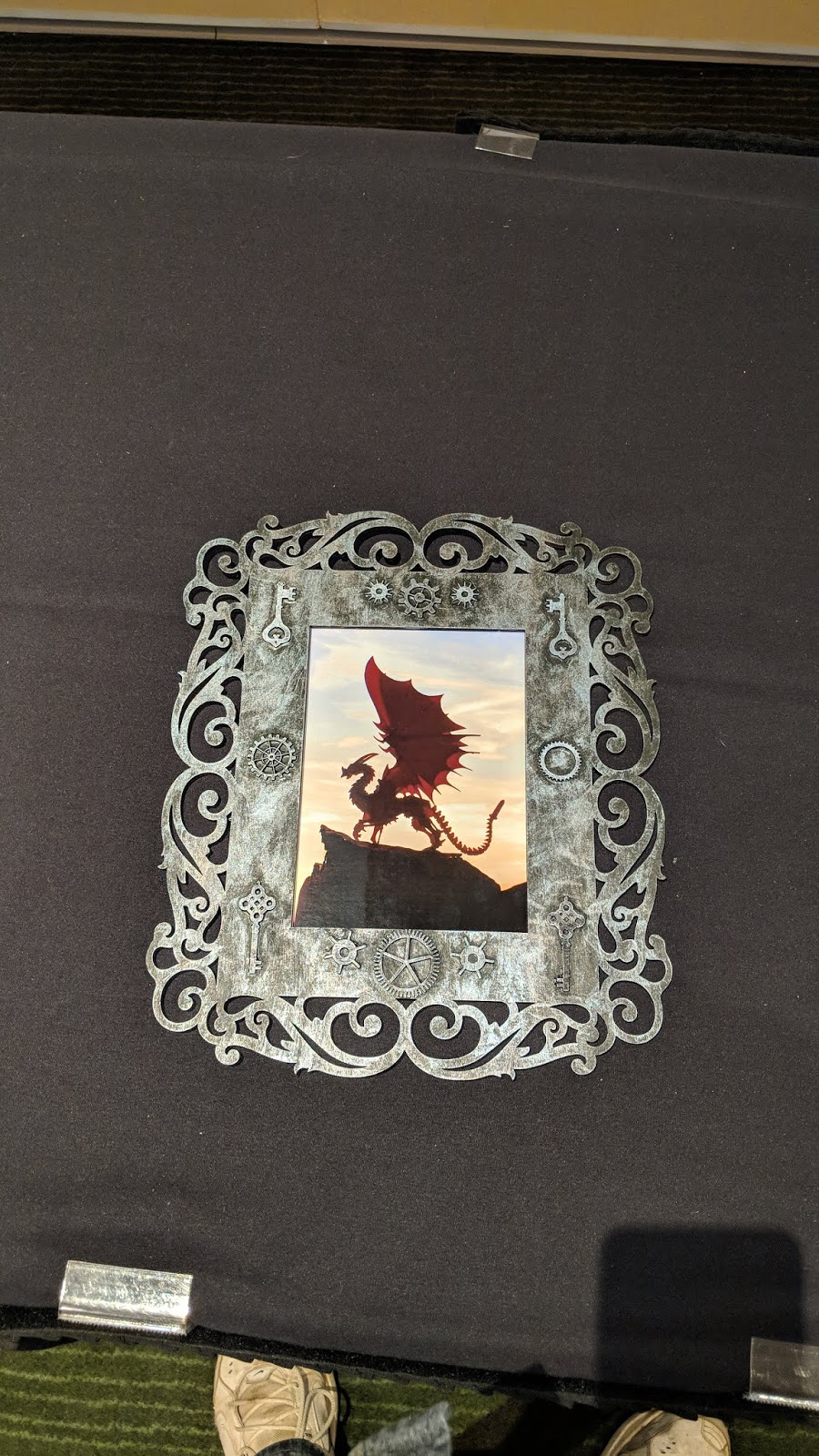
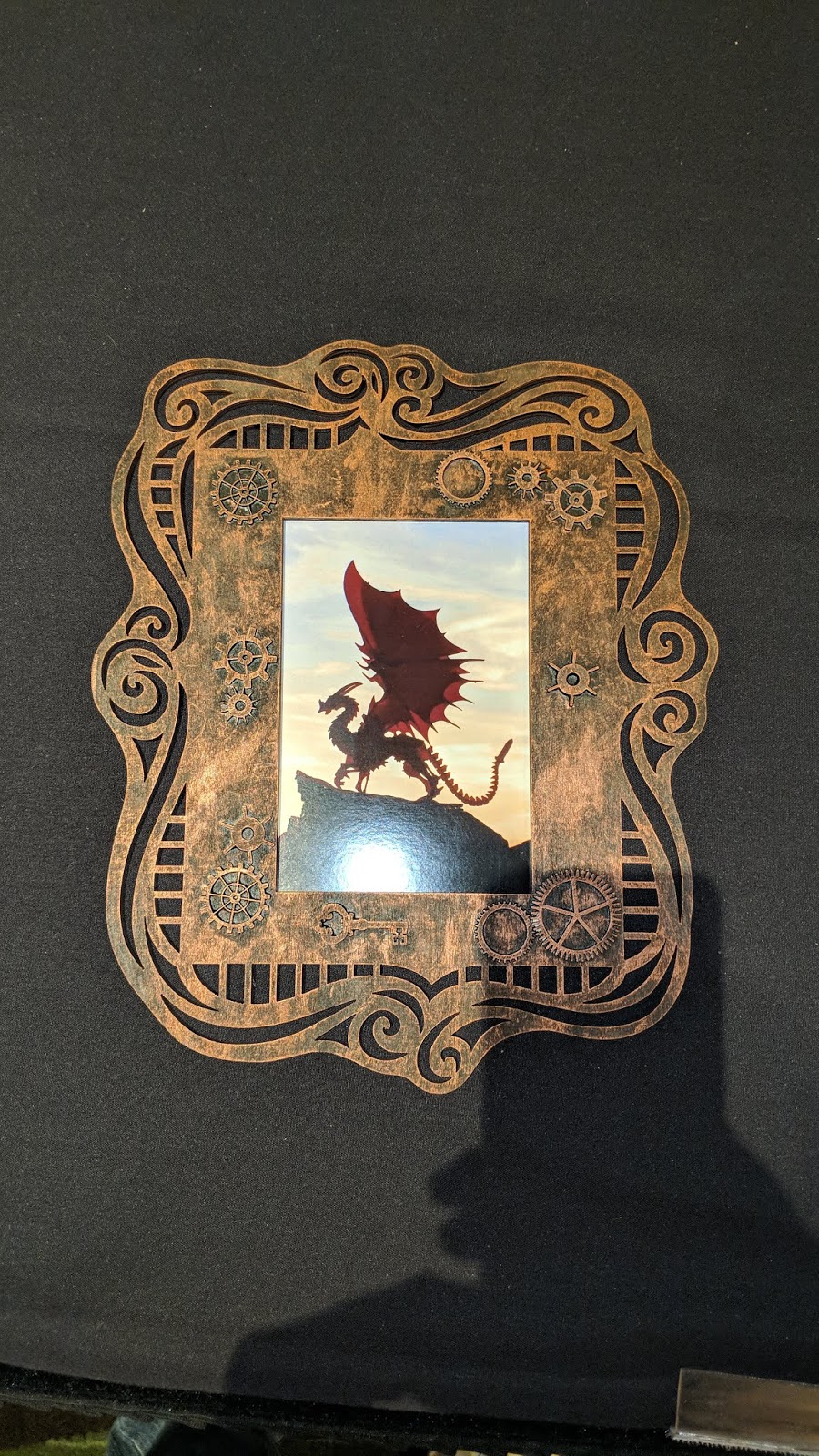 Setting up for the Robotic Rodeo, a steampunk festival in Durham. As I mentioned last week, I have a 10 foot space instead of the 6 and 8 foot tables I normally get. I'm adding dragon art to my inventory! I'm starting small with what I think is my best dragon at sunset photo. The frames are hand decorated. If there's any interest at all I'll branch out. I've got quite a few dragon pics. And, if no one even looks at them, I've got new decoration for my office!
January 27, 2019
Week Four: 10343 words
I made my goal this week despite still being sick for most of the week. My flu last week has settled into a bad case of bronchitis that's just completely sapping my energy. I get little bursts of feeling pretty good, but then try to do some minor task like unloading the dishwasher, wind up coughing for ten minutes, then, boom, I need a nap.
In contrast to my sickly physical state, my current draft of Dragonsgate is developing quite healthily. In every book, characters show up who I didn't originally include in my plans. This time, it was a "sister of the serpent" named Colobi. She's a minor character in the original Bitterwood trilogy, one of Blasphet's main sidekicks in the cult of human women who worship him as the Murder God and serve as his assassins. Colobi is the one who saves Blasphet in the tunnel after Bitterwood leaves him for dead, and in Dragonseed she defends Blasphet against Anza and winds up dead, only to be restored to life by Blasphet.
When I started writing Dragonsgate, the character wasn't on my radar. But, following Dragonsgate: Preludes and Omens, Anza was pretty badly injured and I needed to get her back in action again quickly. I'd introduced the healing power of the dragonseed previously, but who would still have one around, and who would be willing to use it? Colobi sprang to mind, and after I brought her back into the novel to heal Anza, she's been hanging around and generally acting crazy, talking about how Blasphet's not really dead and that's she's still intent on serving him. But even I wasn't certain if she was just there to be a bit player, or if she actually had a role in the plot. This week, finally, she stepped up and explained exactly what her master plan was and it's perfect. Her agenda is the thread that ties together the three diverging plots of the book and will pull them back together.
I can't tell you how much I envy people who can outline their novels in advance. Winging it and hoping it will out work out is stressful... even though, again and again, it does all work out. I'm reminded of the theory of the bicameral mind. The short and probably not precisely accurate summary of this theory is that human consciousness grew out of a more primal state where the left brain and right brain weren't really aware that they were part of the same mind. So primitive man would hear voices and obey these voices thinking they were gods or spirits, when in fact it was his own mind speaking to him. For me, writing fiction is something like this. I feel like there's a muse in my head who knows the whole story of what I will write, but can't be bothered to explain it to me in advance. She teases me along from plot twist to plot twist, and I'm always thinking it would be nice if she'd given me some advance warning. But, she knows that, if she did warn me in advance, I'd spill the beans. In this theory, I do have the whole novel planned out in advance, I'm just hiding it from myself.
The counter theory is that my brain contains ten thousand monkeys pressing keys randomly, and instead of recreating Shakespeare, I get James Maxey novels.
Next weekend: Robotic Rodeo in Durham! I'll have a bit more space than normal, so my plan is, in addition to books, to also have a small selection of dragon art for sale. I did a test run last year with some dragon greeting cards I gave away free to people who signed up for my newsletter. I ran out of stock pretty quickly, but, of course, it's easy to give stuff away, a bit harder to sell it. Still, I figure it's worth a shot for those occasions when I have ten feet of table space to fill up.
In contrast to my sickly physical state, my current draft of Dragonsgate is developing quite healthily. In every book, characters show up who I didn't originally include in my plans. This time, it was a "sister of the serpent" named Colobi. She's a minor character in the original Bitterwood trilogy, one of Blasphet's main sidekicks in the cult of human women who worship him as the Murder God and serve as his assassins. Colobi is the one who saves Blasphet in the tunnel after Bitterwood leaves him for dead, and in Dragonseed she defends Blasphet against Anza and winds up dead, only to be restored to life by Blasphet.
When I started writing Dragonsgate, the character wasn't on my radar. But, following Dragonsgate: Preludes and Omens, Anza was pretty badly injured and I needed to get her back in action again quickly. I'd introduced the healing power of the dragonseed previously, but who would still have one around, and who would be willing to use it? Colobi sprang to mind, and after I brought her back into the novel to heal Anza, she's been hanging around and generally acting crazy, talking about how Blasphet's not really dead and that's she's still intent on serving him. But even I wasn't certain if she was just there to be a bit player, or if she actually had a role in the plot. This week, finally, she stepped up and explained exactly what her master plan was and it's perfect. Her agenda is the thread that ties together the three diverging plots of the book and will pull them back together.
I can't tell you how much I envy people who can outline their novels in advance. Winging it and hoping it will out work out is stressful... even though, again and again, it does all work out. I'm reminded of the theory of the bicameral mind. The short and probably not precisely accurate summary of this theory is that human consciousness grew out of a more primal state where the left brain and right brain weren't really aware that they were part of the same mind. So primitive man would hear voices and obey these voices thinking they were gods or spirits, when in fact it was his own mind speaking to him. For me, writing fiction is something like this. I feel like there's a muse in my head who knows the whole story of what I will write, but can't be bothered to explain it to me in advance. She teases me along from plot twist to plot twist, and I'm always thinking it would be nice if she'd given me some advance warning. But, she knows that, if she did warn me in advance, I'd spill the beans. In this theory, I do have the whole novel planned out in advance, I'm just hiding it from myself.
The counter theory is that my brain contains ten thousand monkeys pressing keys randomly, and instead of recreating Shakespeare, I get James Maxey novels.
Next weekend: Robotic Rodeo in Durham! I'll have a bit more space than normal, so my plan is, in addition to books, to also have a small selection of dragon art for sale. I did a test run last year with some dragon greeting cards I gave away free to people who signed up for my newsletter. I ran out of stock pretty quickly, but, of course, it's easy to give stuff away, a bit harder to sell it. Still, I figure it's worth a shot for those occasions when I have ten feet of table space to fill up.
January 20, 2019
Week 3: 8344 Words
Missed my goal for the week. Every year, I get a flu shot and, every year, I still get the flu. It started as a scratchy throat Sunday and then three lost days where I pretty much stayed in bed around the clock. I pecked out a few words Thursday, Friday, and Saturday, but even though I started feeling good enough by yesterday to get up and get out of the house, my head still feels full of cotton. I really hope I can shake it off and get back into the game soon. Fortunately, I'd beaten my goal a little the first two weeks, so I'm still on target for the year.
Read another 150 pages or so of Roots. Past the halfway mark in the book.
Next weekend I head to Charlotte for the Charlotte Minicon. I've only got a half table, so I'm only taking dragon books, at least to display. After that, I'll be doing three days at Durham's Robotic Rodeo. My situation there is flipped and I've got more space than I usually get, so I'm planning to expand with some art offerings. More on that next week!
Read another 150 pages or so of Roots. Past the halfway mark in the book.
Next weekend I head to Charlotte for the Charlotte Minicon. I've only got a half table, so I'm only taking dragon books, at least to display. After that, I'll be doing three days at Durham's Robotic Rodeo. My situation there is flipped and I've got more space than I usually get, so I'm planning to expand with some art offerings. More on that next week!