James Maxey's Blog, page 3
April 16, 2019
Hey! I did some covers!
Stephen Euin Cobb and I have been doing panels together at conventions since probably 2003. He's the guy behind "The Future and You" podcast and I always look forward to going to dinner with him each year at ConCarolinas. He's a big old science geek, and, as you might expect, when he does write science fiction, he writes it hard. I've read his novel Bones Burnt Black and feel like it's an underrated gem of the genre. There's a mechanic who's been thrown from the ship following an explosion of the fuel tank. She's in a suit leaking air, with her tether severed, and a head injury that's stripped out her memory of how she got stranded in the void. She has to figure out how to get back on to the ship, which is damaged and tumbling toward the sun. Oh, and there's a killer aboard the ship murdering the crew one by one. Even if they figure out who the killer is, it doesn't change the hard orbital equations that there's no way to avoid certain death once the crippled ship's new orbit takes them so close to the sun they're all going to be burnt to ash. To call this novel a page-turner is an understatement.
Last year, I started talking to Stephen about it and seriously considered reprinting the book under the Word Balloon Books imprint I use for my own titles. In the end, I decided I should keep focused on my own publishing efforts, but by then I'd already been daydreaming about how I'd redesign the cover. So, here it is! (click on the links below the covers to be taken to Amazon)
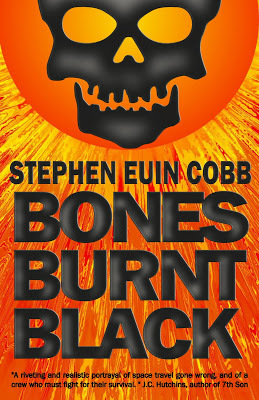 Bones Burnt Black
Stephen has two more novels, and while I haven't read them, I learned enough about them that I went ahead and designed covers for them as well so that all three books would share as similar visual style.
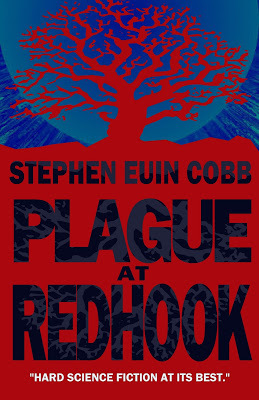 Plague at Redhook
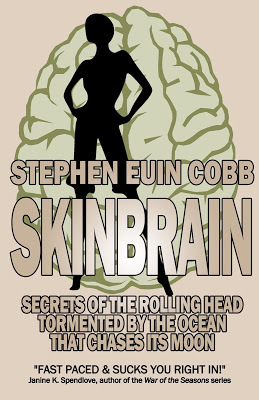 Skinbrain
These are the first covers I've ever designed for another author, but hopefully they won't be the last. My years of experience selling books directly at conventions has helped me learn what catches the eyes of potential readers when they see the book in print, but that also works as a tiny thumbnail on Amazon. So, if you're an artist looking for a cover designer, drop me a line!
Last year, I started talking to Stephen about it and seriously considered reprinting the book under the Word Balloon Books imprint I use for my own titles. In the end, I decided I should keep focused on my own publishing efforts, but by then I'd already been daydreaming about how I'd redesign the cover. So, here it is! (click on the links below the covers to be taken to Amazon)
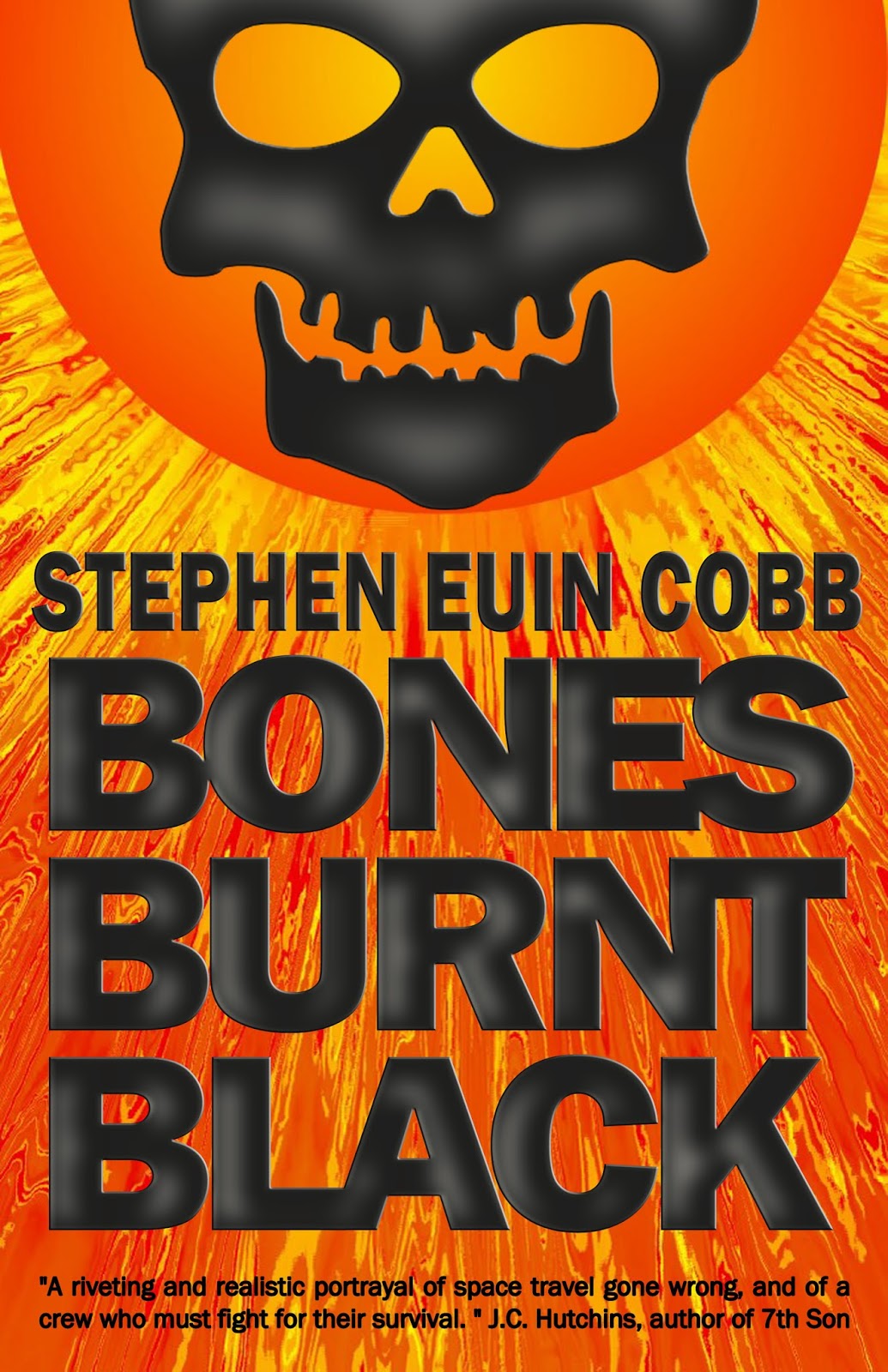 Bones Burnt Black
Stephen has two more novels, and while I haven't read them, I learned enough about them that I went ahead and designed covers for them as well so that all three books would share as similar visual style.
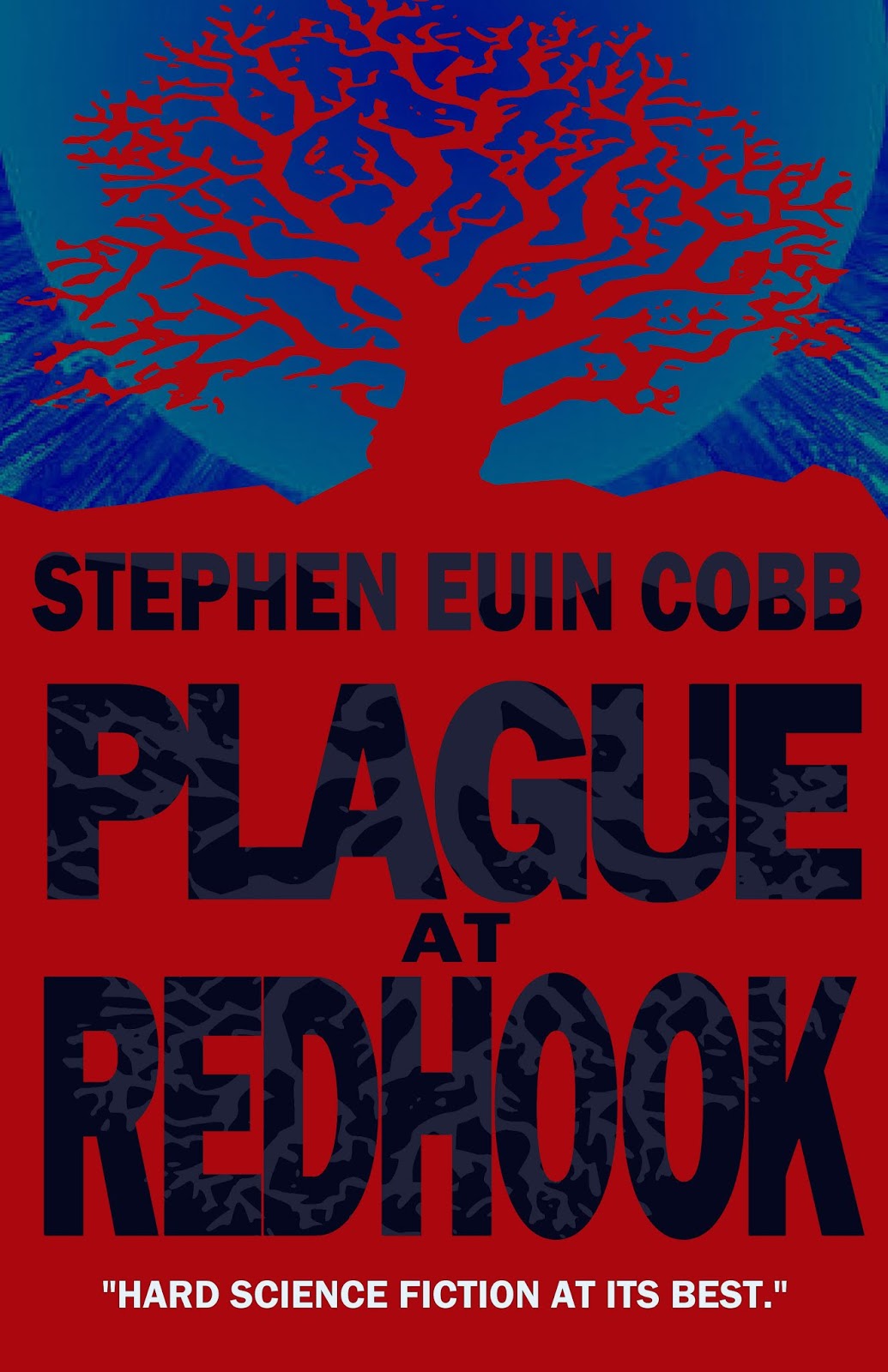 Plague at Redhook
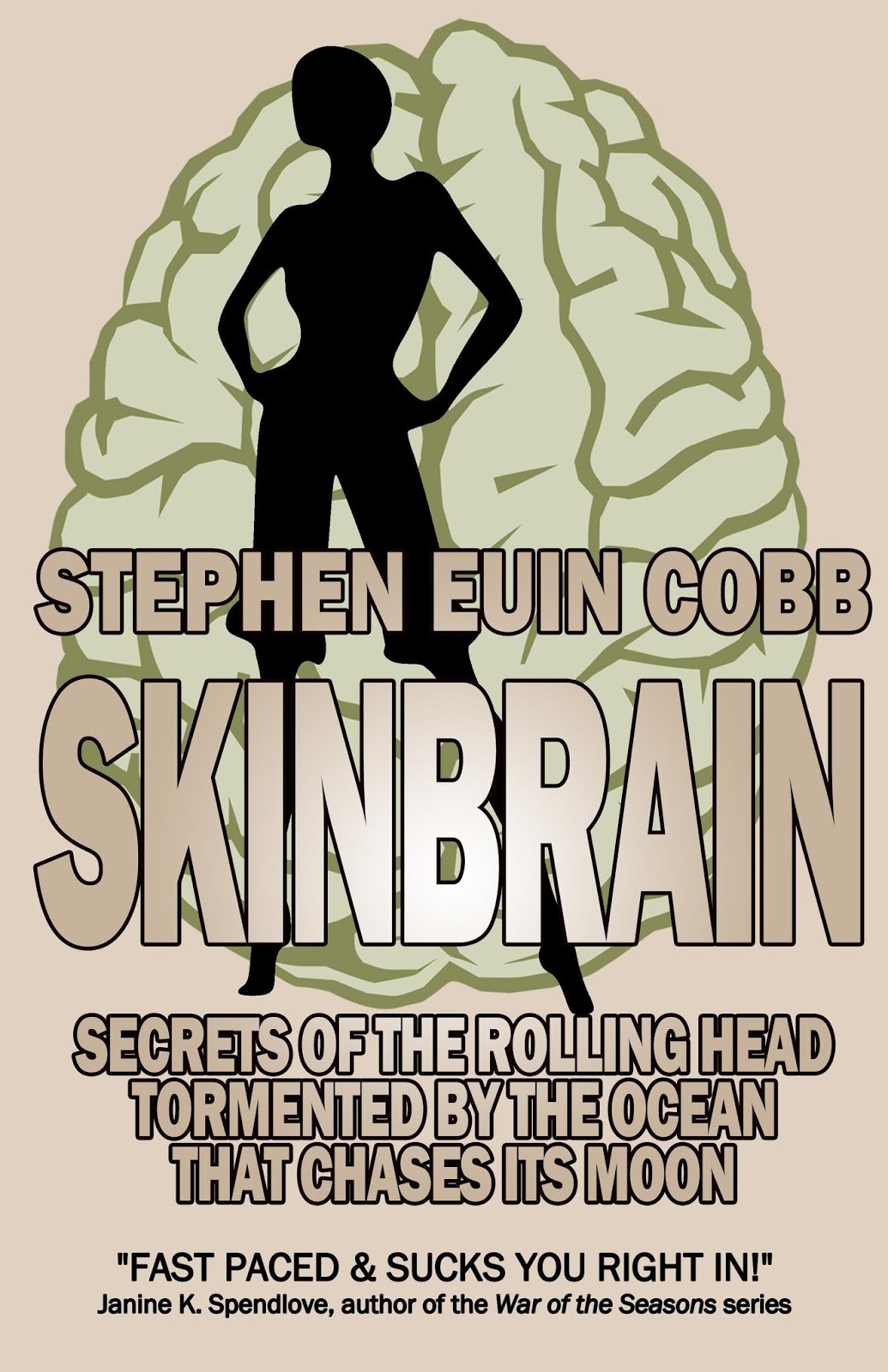 Skinbrain
These are the first covers I've ever designed for another author, but hopefully they won't be the last. My years of experience selling books directly at conventions has helped me learn what catches the eyes of potential readers when they see the book in print, but that also works as a tiny thumbnail on Amazon. So, if you're an artist looking for a cover designer, drop me a line!


April 14, 2019
10018 words for week 15
Didn't gain ground but at least I didn't lose ground, hitting my 10k for the week. A somewhat terse update this morning; I'm currently on site at Festival of Legends waiting for gates to open in 10 minutes. Sales yesterday at the Festival were very strong, but selling books outside during thunderstorm season is rough! Even with the tent blowing wind threatened the inventory several times. It's tough to sell stuff while they are under tarps. Still, this is definitely a dragon crazy crowd!
April 11, 2019
Week Fourteen Word Count Update: 2942
I normally post these on Sundays, but last Sunday I was literally too sick to get out of bed. Cheryl had been sick the week before, so I'd known I was in the crosshairs. As far as illness goes, if you absolutely must get sick, this was a fairly decent virus to get. No stomach issues, no sniffling, just a mild fever and complete exhaustion, so that pretty much all I could do Sunday and Monday was sleep around the clock.
Except for a cough, I'm mostly over it now, so this week I should be back on the word count wagon.
Last week was my worst word count of the year, 2942. But, really, that's not because I was getting sick, it's because I'd finished the first draft of Dragonsgate the week before and was mostly brain dead.
This week, I'm trying to get momentum going on Nobody Nowhere, but stumbled out of the gate when I discovered that I've lost the last chapter I finished. I wrote it on my chromebook offline while I was riding to an event with Cheryl. When we got to the event, I plainly recall signing in to wi-fi to make sure the chapter was saved to google drive. But, when I returned to google this week to download it, only the first two pages had been saved. I went back to my chromebook, and nothing. The other four pages I wrote have vanished.
In retrospect, going with a chromebook over a Windows laptop was a big mistake. My reasoning was that I now do 90% of all my writing in my office. I mean, all my life I dreamed of having my own writing office, and now that I do, I definitely want to make use of it. I've got a good desktop system, since I like typing on a big key board. I've also got a big monitor to make up for my poor eyesight. And, I like the modular nature of a desktop system. If I spill coffee on my keyboard, I haven't crippled the whole system. So, I didn't want to spend a lot of money on a laptop, and the chromebook was light, had a good monitor, and has amazing battery life. But, despite the promise that google docs will save your work when you're offline and update it later, I've found that my worries about losing work have come true. There are workarounds to save a local copy manually, but I've been spoiled by Windows to not worry about losing my work.
Anyway, gripe gripe, it's not the end of the world. I know what happens in the chapter I lost, have typed a few notes, and am already moving on. Still, it is frustrating.
Enough moaning. Time to finish another chapter of Nobody.
Except for a cough, I'm mostly over it now, so this week I should be back on the word count wagon.
Last week was my worst word count of the year, 2942. But, really, that's not because I was getting sick, it's because I'd finished the first draft of Dragonsgate the week before and was mostly brain dead.
This week, I'm trying to get momentum going on Nobody Nowhere, but stumbled out of the gate when I discovered that I've lost the last chapter I finished. I wrote it on my chromebook offline while I was riding to an event with Cheryl. When we got to the event, I plainly recall signing in to wi-fi to make sure the chapter was saved to google drive. But, when I returned to google this week to download it, only the first two pages had been saved. I went back to my chromebook, and nothing. The other four pages I wrote have vanished.
In retrospect, going with a chromebook over a Windows laptop was a big mistake. My reasoning was that I now do 90% of all my writing in my office. I mean, all my life I dreamed of having my own writing office, and now that I do, I definitely want to make use of it. I've got a good desktop system, since I like typing on a big key board. I've also got a big monitor to make up for my poor eyesight. And, I like the modular nature of a desktop system. If I spill coffee on my keyboard, I haven't crippled the whole system. So, I didn't want to spend a lot of money on a laptop, and the chromebook was light, had a good monitor, and has amazing battery life. But, despite the promise that google docs will save your work when you're offline and update it later, I've found that my worries about losing work have come true. There are workarounds to save a local copy manually, but I've been spoiled by Windows to not worry about losing my work.
Anyway, gripe gripe, it's not the end of the world. I know what happens in the chapter I lost, have typed a few notes, and am already moving on. Still, it is frustrating.
Enough moaning. Time to finish another chapter of Nobody.
April 2, 2019
How Much Science Do You Need to Know the Write Science Fiction? Part Four: The Art of Babble
How much science do you need to know to write science fiction? So far my answers have been "a lot," and "not a lot, as long as you know a lot about science fiction." Today we get to a third option available to every author, which is to know absolutely nothing about science.
This answer isn't going to make a lot of science teachers happy, nor will it make people who love well grounded hard science fiction very happy. Science fiction, for all of its attempt to ground itself in reality, is ultimately part of the larger umbrella of fantasy fiction. Fantasy takes place in a world not quite our own. This can be a fully magical fairy land, or it can be an alien planet. It can very closely resemble our world, but with vampires and wizards, or be our world transformed by some new technology, like an immortality pill.
The greatest gift to every writer is the seemingly innate human ability to accept nearly any premise as true, no matter how contrary to reality it might sound. This is so common we're almost blind to it. Children from an early age demonstrate a remarkable ability to buy a premise while still understanding that the premise isn't real. No kid watching cartoons on television stops to give a second thought about why a bunch of dogs are talking and wearing shirts, nor do they expect their own family pets to start having conversations. The fact that some people can fly and punch through walls after donning a cape or mask is accepted without a lot of follow up questions. That there were times in history where dragons terrorized villages and wizards teamed up with knights to fight them doesn't raise any red flags.
Novelists, playwrights, cartoonists, and puppeteers rely on this notion of "the willing suspension of disbelief." Readers enter into a novel, or a comic book, or a stage magician's performance agreeing to ignore their skepticism and allow the artist to present a new world where reality follows slightly different rules. In exchange, they expect to be rewarded with entertainment, and, in the very best art, with wisdom and wonder.
What's remarkable is how easy it is for the audience to transition to this new reality. This is a world populated by intelligent rabbits, and one of them has to solve a murder mystery? Got it. Move on. Tell your story.
You see this presentation of a wild premise a lot in comedic science fiction TV series, like Futurama or Rick and Morty. Here's a pill that will make you telepathic! This watch will let you jump back in time five minutes! That explosion has caused our minds to switch bodies! The audience will buy the bit and not worry about the underlying logic. Superhero shows on TV also run with this, often not trying to be comedic. "I got hit by a wave of dark matter and now I can talk to animals!" "I got injected with nanobots and accidentally de-aged into a baby!" "I caught an virus from an alien and my fever is letting me melt steel!" An utterly absurd idea about what would happen if a radioactive spider bit a nerdy teen has been selling comic books for as long as I've been alive, and can still pack movie houses.
It might sound like your audience will swallow anything you put before them, but this isn't quite true. They will accept nearly any alteration to reality you care to make, but with the following caveats:
The alteration to reality should be apparent very early on. If you write a book about an alien invasion, the readers will buy the premise if there's a UFO in the first chapter, or even a fleeting mention of one. If, in your thirty chapter novel, you wait until chapter twenty nine to mention that, oh, right, there are aliens and they're going to kidnap the hero's love interest, you will wind up with some very negative Amazon reviews. The premise should possess an internal logic and the story should follow the rules you set up front. Let's say that you're writing a novel about a genius who's built a shrink ray. All through the book, he keeps getting small and navigating under doors and riding cockroaches and dodging getting stepped on. Then, in the final confrontation with the bad guy, he does nothing at all with his shrinking powers, but instead pulls out a pistol and shoots the bad guy in the head. Most readers would feel cheated. Or, let's say that your character has designed a sentient artificial intelligence that borders on omniscient. Now your character is famous as a master detective because he uses the computer to help interpret clues. Great! But if he never asks once the obvious question, "Say, who killed this guy?" and you don't explicitly give a reason why the computer can't answer that, most readers will feel like you've not treating them with much respect. Know the commonly accepted "rules" of any premise you're recycling. Let's say you've come up with a science fictional explanation for vampires. But, your vampires aren't harmed by sunlight or even adverse to it. They don't need to drink blood, they can be killed by an ordinary bullet, and they can't fly or change shape. They don't even have pointy teeth! Calling a character lacking at least a few of these traits a vampire will likely not be well received by readers. Finally, the commonly used term to hide implausible technology beneath a sheen of science is "technobabble." You see it used a lot on television shows, and it's often cringeworthy. Scientific sounding words get tossed around to explain the essentially magical thing the writers need to happen. So, a supervillain is rampaging through the city, but the hero has built a device that can neutralize his powers: a neutrino ray! The writer might feel pretty clever. Neutralize and neutrino sound alike, one must have something to do with the other, right? Meanwhile, anyone who actually knows even a tiny bit about particle physics is on Twitter writing short, angry protests about scientific illiteracy. On the other hand, suppose your character needed to build goggles that would let him see into a bank vault. He can say with a straight face that his "neutrino goggles" can decode the "neutrino shadow" of the trillions of neutrinos streaming through the bank vault each second. It's still gibberish, but the fans of particle physics would appreciate the fact that you did at least get the part about the trillions of neutrinos passing through the vault each second right.
In a way, we've come full circle. Yes, this is fiction. You can just make stuff up. But knowing what the words you're using really mean is part of the craft of writing. No matter what exotic technologies your imagination comes up with, there's probably some appropriate realm of science that relates to it at least tangentially. The more science you know, the more authoritative you'll sound when you twist that science into pretzels to make it justify your story needs. Start studying!
This answer isn't going to make a lot of science teachers happy, nor will it make people who love well grounded hard science fiction very happy. Science fiction, for all of its attempt to ground itself in reality, is ultimately part of the larger umbrella of fantasy fiction. Fantasy takes place in a world not quite our own. This can be a fully magical fairy land, or it can be an alien planet. It can very closely resemble our world, but with vampires and wizards, or be our world transformed by some new technology, like an immortality pill.
The greatest gift to every writer is the seemingly innate human ability to accept nearly any premise as true, no matter how contrary to reality it might sound. This is so common we're almost blind to it. Children from an early age demonstrate a remarkable ability to buy a premise while still understanding that the premise isn't real. No kid watching cartoons on television stops to give a second thought about why a bunch of dogs are talking and wearing shirts, nor do they expect their own family pets to start having conversations. The fact that some people can fly and punch through walls after donning a cape or mask is accepted without a lot of follow up questions. That there were times in history where dragons terrorized villages and wizards teamed up with knights to fight them doesn't raise any red flags.
Novelists, playwrights, cartoonists, and puppeteers rely on this notion of "the willing suspension of disbelief." Readers enter into a novel, or a comic book, or a stage magician's performance agreeing to ignore their skepticism and allow the artist to present a new world where reality follows slightly different rules. In exchange, they expect to be rewarded with entertainment, and, in the very best art, with wisdom and wonder.
What's remarkable is how easy it is for the audience to transition to this new reality. This is a world populated by intelligent rabbits, and one of them has to solve a murder mystery? Got it. Move on. Tell your story.
You see this presentation of a wild premise a lot in comedic science fiction TV series, like Futurama or Rick and Morty. Here's a pill that will make you telepathic! This watch will let you jump back in time five minutes! That explosion has caused our minds to switch bodies! The audience will buy the bit and not worry about the underlying logic. Superhero shows on TV also run with this, often not trying to be comedic. "I got hit by a wave of dark matter and now I can talk to animals!" "I got injected with nanobots and accidentally de-aged into a baby!" "I caught an virus from an alien and my fever is letting me melt steel!" An utterly absurd idea about what would happen if a radioactive spider bit a nerdy teen has been selling comic books for as long as I've been alive, and can still pack movie houses.
It might sound like your audience will swallow anything you put before them, but this isn't quite true. They will accept nearly any alteration to reality you care to make, but with the following caveats:
The alteration to reality should be apparent very early on. If you write a book about an alien invasion, the readers will buy the premise if there's a UFO in the first chapter, or even a fleeting mention of one. If, in your thirty chapter novel, you wait until chapter twenty nine to mention that, oh, right, there are aliens and they're going to kidnap the hero's love interest, you will wind up with some very negative Amazon reviews. The premise should possess an internal logic and the story should follow the rules you set up front. Let's say that you're writing a novel about a genius who's built a shrink ray. All through the book, he keeps getting small and navigating under doors and riding cockroaches and dodging getting stepped on. Then, in the final confrontation with the bad guy, he does nothing at all with his shrinking powers, but instead pulls out a pistol and shoots the bad guy in the head. Most readers would feel cheated. Or, let's say that your character has designed a sentient artificial intelligence that borders on omniscient. Now your character is famous as a master detective because he uses the computer to help interpret clues. Great! But if he never asks once the obvious question, "Say, who killed this guy?" and you don't explicitly give a reason why the computer can't answer that, most readers will feel like you've not treating them with much respect. Know the commonly accepted "rules" of any premise you're recycling. Let's say you've come up with a science fictional explanation for vampires. But, your vampires aren't harmed by sunlight or even adverse to it. They don't need to drink blood, they can be killed by an ordinary bullet, and they can't fly or change shape. They don't even have pointy teeth! Calling a character lacking at least a few of these traits a vampire will likely not be well received by readers. Finally, the commonly used term to hide implausible technology beneath a sheen of science is "technobabble." You see it used a lot on television shows, and it's often cringeworthy. Scientific sounding words get tossed around to explain the essentially magical thing the writers need to happen. So, a supervillain is rampaging through the city, but the hero has built a device that can neutralize his powers: a neutrino ray! The writer might feel pretty clever. Neutralize and neutrino sound alike, one must have something to do with the other, right? Meanwhile, anyone who actually knows even a tiny bit about particle physics is on Twitter writing short, angry protests about scientific illiteracy. On the other hand, suppose your character needed to build goggles that would let him see into a bank vault. He can say with a straight face that his "neutrino goggles" can decode the "neutrino shadow" of the trillions of neutrinos streaming through the bank vault each second. It's still gibberish, but the fans of particle physics would appreciate the fact that you did at least get the part about the trillions of neutrinos passing through the vault each second right.
In a way, we've come full circle. Yes, this is fiction. You can just make stuff up. But knowing what the words you're using really mean is part of the craft of writing. No matter what exotic technologies your imagination comes up with, there's probably some appropriate realm of science that relates to it at least tangentially. The more science you know, the more authoritative you'll sound when you twist that science into pretzels to make it justify your story needs. Start studying!
March 31, 2019
Dragonsgate First Draft is Done! + word count update
Last Thursday, the Frankenstein's monster of a manuscript parts that is Dragonsgate, V1, was finally sewn together into something very closely resembling a novel.
I've written twenty six chapters, or roughly 120,000 words. I'm including in this count two versions of chapters ten and eleven, where the novel took a serious wrong track that led me to break my own rule about rewriting before a draft was done. My original plan had Graxen and Nadala meeting who I thought was going to be an important player in the plot, while Bitterwood and Anza encountered an earth-dragon named Delta who was also going to be a big character. I had to go back and switch things around so that Graxen and Nadala are the ones who first encounter Delta.
I'm aware, by the way, of just how boring it is to read about my changing my mind about characters that you don't know in a book no one has read. This is something I suspect all creatives struggle with. A painter of a vase of flowers will always be haunted by the fact that the person appreciating the painting will never understand hoe the flower he decided not to paint is what gives the canvas its beauty. The songwriter will never be able to explain how the song people are dancing to exists only because of the notes he decided not to play. Novelists will always see their books in the light of the characters and plots that could have been, or briefly were, before vanishing forever. Every book I've written emerges from a quantum froth of books I might have written, books that might have been better or worse.
A bit of trivia that I don't think I've shared before: In the first Bitterwood novel, for most of the first draft, there was a dragon named Belpantheron who was an explorer. He knew that the society of dragons was built upon several myths and was determined to get to the truth behind these myths. He was a useful frame for revealing the true story of how dragons had conquered mankind. I wrote several scenes with him, and he was a pretty good character, smart, courageous, and driven. And... poof! He's gone. His name got recycled into a literary work the dragons sometimes reference called The Ballad of Belpantheron. And, though it's been twenty years since I last wrote a scene featuring him, I still kind of feel like I let him down.
I've got a note file with a bunch of stuff I need to put into the next draft of Dragonsgate. Hex has several big scenes I need to write to give him a full character arc. Zeeky's story didn't really come together for me until around chapter fifteen, so pretty much every scene including her before then will need to be redone in the light of what I know now. She was a character with an established ability that I knew would be important to the plot. But that meant that for most of the book, I didn't know what to do with her until her gift became important later. I knew what she would do in the book, I just didn't know why she would do it. Now that I know, I think she'll have one of the more interesting storylines in the final novel.
For now, I'm putting the novel aside. I need to get a little distance from the book before I start a fresh draft. My goal is to work on Nobody Nowhere during April. After I'm done with that draft, I'll have a clearer picture of how ready I am to tackle Dragonsgate V2.
Completing Dragonsgate, plus a few blog posts, gave me 12,138 words for the week. At the end of week 13, one quarter into the year, my word count year to date is 132,496.
I've written twenty six chapters, or roughly 120,000 words. I'm including in this count two versions of chapters ten and eleven, where the novel took a serious wrong track that led me to break my own rule about rewriting before a draft was done. My original plan had Graxen and Nadala meeting who I thought was going to be an important player in the plot, while Bitterwood and Anza encountered an earth-dragon named Delta who was also going to be a big character. I had to go back and switch things around so that Graxen and Nadala are the ones who first encounter Delta.
I'm aware, by the way, of just how boring it is to read about my changing my mind about characters that you don't know in a book no one has read. This is something I suspect all creatives struggle with. A painter of a vase of flowers will always be haunted by the fact that the person appreciating the painting will never understand hoe the flower he decided not to paint is what gives the canvas its beauty. The songwriter will never be able to explain how the song people are dancing to exists only because of the notes he decided not to play. Novelists will always see their books in the light of the characters and plots that could have been, or briefly were, before vanishing forever. Every book I've written emerges from a quantum froth of books I might have written, books that might have been better or worse.
A bit of trivia that I don't think I've shared before: In the first Bitterwood novel, for most of the first draft, there was a dragon named Belpantheron who was an explorer. He knew that the society of dragons was built upon several myths and was determined to get to the truth behind these myths. He was a useful frame for revealing the true story of how dragons had conquered mankind. I wrote several scenes with him, and he was a pretty good character, smart, courageous, and driven. And... poof! He's gone. His name got recycled into a literary work the dragons sometimes reference called The Ballad of Belpantheron. And, though it's been twenty years since I last wrote a scene featuring him, I still kind of feel like I let him down.
I've got a note file with a bunch of stuff I need to put into the next draft of Dragonsgate. Hex has several big scenes I need to write to give him a full character arc. Zeeky's story didn't really come together for me until around chapter fifteen, so pretty much every scene including her before then will need to be redone in the light of what I know now. She was a character with an established ability that I knew would be important to the plot. But that meant that for most of the book, I didn't know what to do with her until her gift became important later. I knew what she would do in the book, I just didn't know why she would do it. Now that I know, I think she'll have one of the more interesting storylines in the final novel.
For now, I'm putting the novel aside. I need to get a little distance from the book before I start a fresh draft. My goal is to work on Nobody Nowhere during April. After I'm done with that draft, I'll have a clearer picture of how ready I am to tackle Dragonsgate V2.
Completing Dragonsgate, plus a few blog posts, gave me 12,138 words for the week. At the end of week 13, one quarter into the year, my word count year to date is 132,496.
March 29, 2019
How Much Science Do You Need to Know to Write Science Fiction? Part Three: On the Shoulders of Giants
The next best approach to writing science fiction, aside from studying actual science, is to study science fiction. In fact, you really should do both. If you study the science but not the science fiction, it's easy to come up with ideas that have already been thoroughly explored to the point that the ideas have become quaint or unpopular, or have been explored better elsewhere. For my own personal experience, in the early nineties I started reading about the possibility of virtual reality, usually explored in popular science magazines like, uh, Popular Science. Reading about virtual reality, I naturally started getting a lot of ideas about stories where people are trapped in computer generated worlds and don't know it.
I'd read science fiction almost exclusively through the early 1980s. Then I went to college. As an English major, I was trained to regard science fiction and fantasy as a lesser form of literature unworthy of my attention. (This is still a common attitude, but now there are respectable universities with programs that study these genres.) Because my college degree had steered me toward reading more "literary" fiction, I'd stopped reading contemporaneous science fiction just before the rise of cyberpunk novels. In this genre, virtual reality was a fairly common concept, and I was only vaguely aware the genre existed. When I was writing my VR stories I thought I was being original, but every editor reading my work probably wondered why I was wasting their time with stories they'd seen before.
This need to know what's already been done can create a real challenge for the would be science fiction author. If you read essays by professional editors of science fiction publications, one of the things you'll quickly discover is that they have a huge list of stories they never want to read again. The classic "don't send us this" story would be a male and female astronaut find themselves stranded on an alien world with that's eerily Earthlike. It turns out their names are Adam and Eve! Or, shocker, your neighbor/wife/mother is an alien! Or you discover you're living in an intergalactic zoo!
Ten thousands stories based on these ideas have already been written. What hope is there of writing an original story?
On the other hand, music is built out of a limited number of notes and chords and time signatures. People have been writing love songs since before there was even a way to write them down, let along record them. But, every day new love songs get written, and some of them are great. There is no idea so old or worn out that a good artist can't find a fresh use for it.
The cheesy alien zoo premise? It was old when Kurt Vonnegut wrote Slaughterhouse Five. So were stories about time travel. But, rather than shying away from these elements, Vonnegut just incorporates them with an audacious swagger and self-aware humor. Sure, the character travels through time. Sure, he's been exhibited in a zoo on an alien world. But these are included in a much larger story about war and justice and mortality. The story isn't built on time travel. Instead, the science fictional elements serve as a frame that provides an emotional distance that's required to tell the destruction of Dresden without being destroyed by the telling.
Beginning authors often assume that great science fiction stories are about exploring some cool science or technology. In reality, most great science fiction is about exploring larger human truths. Any tools you choose to need to show these truths are fair game.
Once you know this, the vast body of science fiction that's been written before is no longer a constraint on your originality. It's now part of our common cultural language, and fair game to be incorporated into art.
For instance, H. G. Wells wrote a book called The Time Machine. The technology behind the machine is somewhat blurry, but the science shown in demonstrating how man might evolve based on the theories of the day, and how the planet would change based on what's known about how the sun and moon will change, are reasonably sound. For any current author, the important thing about The Time Machine is the fact that anyone even vaguely familiar with popular culture knows what a time machine is. If you want to write a time travel story, you don't need to do serious research into the plausible construction of a time machine. You write, "I set the controls of my time machine to 1941 and pressed the button." Poof! The reader will follow you to 1941. The time machine can look like a Police Box, a fast car, or a watch. It can be a phone app, a special beverage you purchase at 7-11, or a do it yourself kit downloaded off the internet. It's a free idea, yours to use with gusto, with the caveat that your story shouldn't be about time travel. H. G. Wells wrote his book about time travel. His is the story that explains the concept. You, get to use the concept. You can use time travel as a plot gimmick, but the focus of the story can't be "wow, what an amazing technology." In my own case, my first novel Nobody Gets the Girl has a time machine in it. It exists not to explore the wonders of time travel, but to provide my protagonist with existential angst once his life gets erased. I use it as a device to take my character apart and put him back together in pursuit of exploring the larger question of just what, exactly, is a "normal" life. Oh, and there are some giant baby dolls and some superheroes and a trip to Mars, for literary merit.
The big advantage of stealing from existing science fiction is that you know going in what sort of market exists. If you want to write stories set on a post apocalyptic Earth, or about travelling to an alternative reality, or about first contact with aliens, you know that there's already a viable base of readers who've enjoyed the concept in the past and might have liked it enough to read another one. This is how genres come about--readers enjoy murder mysteries, or romances, or stories about robots that fall in love while solving murder mysteries, and want to recreate the pleasure of that experience.
The disadvantage of recycling old ideas is that, well, they're old ideas. Great science fiction thrives on instilling a sense of wonder. That can be tough to do when you're staying safely within the predefined lines drawn by authors who happened to have the unfair advantage of being born a century before you. Now, no matter how fresh you try to make your time travel story, it's probably going to vanish from bookstores in a few years, while H G Wells is still in print and being read over a century later. Writing the familiar is a great strategy for selling books. It's far less likely to earn you literary immortality.
I'd read science fiction almost exclusively through the early 1980s. Then I went to college. As an English major, I was trained to regard science fiction and fantasy as a lesser form of literature unworthy of my attention. (This is still a common attitude, but now there are respectable universities with programs that study these genres.) Because my college degree had steered me toward reading more "literary" fiction, I'd stopped reading contemporaneous science fiction just before the rise of cyberpunk novels. In this genre, virtual reality was a fairly common concept, and I was only vaguely aware the genre existed. When I was writing my VR stories I thought I was being original, but every editor reading my work probably wondered why I was wasting their time with stories they'd seen before.
This need to know what's already been done can create a real challenge for the would be science fiction author. If you read essays by professional editors of science fiction publications, one of the things you'll quickly discover is that they have a huge list of stories they never want to read again. The classic "don't send us this" story would be a male and female astronaut find themselves stranded on an alien world with that's eerily Earthlike. It turns out their names are Adam and Eve! Or, shocker, your neighbor/wife/mother is an alien! Or you discover you're living in an intergalactic zoo!
Ten thousands stories based on these ideas have already been written. What hope is there of writing an original story?
On the other hand, music is built out of a limited number of notes and chords and time signatures. People have been writing love songs since before there was even a way to write them down, let along record them. But, every day new love songs get written, and some of them are great. There is no idea so old or worn out that a good artist can't find a fresh use for it.
The cheesy alien zoo premise? It was old when Kurt Vonnegut wrote Slaughterhouse Five. So were stories about time travel. But, rather than shying away from these elements, Vonnegut just incorporates them with an audacious swagger and self-aware humor. Sure, the character travels through time. Sure, he's been exhibited in a zoo on an alien world. But these are included in a much larger story about war and justice and mortality. The story isn't built on time travel. Instead, the science fictional elements serve as a frame that provides an emotional distance that's required to tell the destruction of Dresden without being destroyed by the telling.
Beginning authors often assume that great science fiction stories are about exploring some cool science or technology. In reality, most great science fiction is about exploring larger human truths. Any tools you choose to need to show these truths are fair game.
Once you know this, the vast body of science fiction that's been written before is no longer a constraint on your originality. It's now part of our common cultural language, and fair game to be incorporated into art.
For instance, H. G. Wells wrote a book called The Time Machine. The technology behind the machine is somewhat blurry, but the science shown in demonstrating how man might evolve based on the theories of the day, and how the planet would change based on what's known about how the sun and moon will change, are reasonably sound. For any current author, the important thing about The Time Machine is the fact that anyone even vaguely familiar with popular culture knows what a time machine is. If you want to write a time travel story, you don't need to do serious research into the plausible construction of a time machine. You write, "I set the controls of my time machine to 1941 and pressed the button." Poof! The reader will follow you to 1941. The time machine can look like a Police Box, a fast car, or a watch. It can be a phone app, a special beverage you purchase at 7-11, or a do it yourself kit downloaded off the internet. It's a free idea, yours to use with gusto, with the caveat that your story shouldn't be about time travel. H. G. Wells wrote his book about time travel. His is the story that explains the concept. You, get to use the concept. You can use time travel as a plot gimmick, but the focus of the story can't be "wow, what an amazing technology." In my own case, my first novel Nobody Gets the Girl has a time machine in it. It exists not to explore the wonders of time travel, but to provide my protagonist with existential angst once his life gets erased. I use it as a device to take my character apart and put him back together in pursuit of exploring the larger question of just what, exactly, is a "normal" life. Oh, and there are some giant baby dolls and some superheroes and a trip to Mars, for literary merit.
The big advantage of stealing from existing science fiction is that you know going in what sort of market exists. If you want to write stories set on a post apocalyptic Earth, or about travelling to an alternative reality, or about first contact with aliens, you know that there's already a viable base of readers who've enjoyed the concept in the past and might have liked it enough to read another one. This is how genres come about--readers enjoy murder mysteries, or romances, or stories about robots that fall in love while solving murder mysteries, and want to recreate the pleasure of that experience.
The disadvantage of recycling old ideas is that, well, they're old ideas. Great science fiction thrives on instilling a sense of wonder. That can be tough to do when you're staying safely within the predefined lines drawn by authors who happened to have the unfair advantage of being born a century before you. Now, no matter how fresh you try to make your time travel story, it's probably going to vanish from bookstores in a few years, while H G Wells is still in print and being read over a century later. Writing the familiar is a great strategy for selling books. It's far less likely to earn you literary immortality.
March 24, 2019
Week 12: 17662, bringing me to 120358 for the year!
Finally! I confess I've been somewhat underwhelmed with my own writing output this year. Yeah, I've been writing steadily, but I've been shooting for 10k words a week and missing that goal more than I hit it, so that by last week I was in the hole over 7,000 words for where I'd planned to be at this point.
Then, this week, I'd hit my 10k for the week by Wednesday and went on to finish 17662 words for the week. Whew! Even though I swore I wasn't going to work on other fiction projects until I finished Dragonseed, I had a very clear picture for the next Nobody Nowhere chapter so I knocked that out. I did four blog posts, which don't translate into writing I get to sell, but, if I'm going to have blogs, I should occasionally put some content up. And, most importantly, I finished two really challenging chapters of Dragonsgate. These are not chapters full of deep character introspection. There's a couple of giant infodumps and a big messy fight scene. I'll need to do a lot of rewriting to smooth it out. But, the important thing is that these chapters were kind of a hump I've been needing to get over. I've had the plot put together a lot of characters who had only the thinnest reasons to be together and this is the chapter where they all decide to kill each other. For the rest of the book, most of the characters go their own ways, and I don't have to write any more chapters with five or six person dialogues. Also, this was the last big fight scene for the 'away' team following the more science fictional plot. Most of the rest of the book will be about Hex and Burke and I won't have to do any info dumps to explain how things that happened a thousand years ago are important to the plot. I just get to ramp up tensions in the human/dragon war, have a big final battle, bring the survivors of the b-plot back into the a-plot, then type "the end."
Then... I'll just need to write it all over again, only better.
Then, this week, I'd hit my 10k for the week by Wednesday and went on to finish 17662 words for the week. Whew! Even though I swore I wasn't going to work on other fiction projects until I finished Dragonseed, I had a very clear picture for the next Nobody Nowhere chapter so I knocked that out. I did four blog posts, which don't translate into writing I get to sell, but, if I'm going to have blogs, I should occasionally put some content up. And, most importantly, I finished two really challenging chapters of Dragonsgate. These are not chapters full of deep character introspection. There's a couple of giant infodumps and a big messy fight scene. I'll need to do a lot of rewriting to smooth it out. But, the important thing is that these chapters were kind of a hump I've been needing to get over. I've had the plot put together a lot of characters who had only the thinnest reasons to be together and this is the chapter where they all decide to kill each other. For the rest of the book, most of the characters go their own ways, and I don't have to write any more chapters with five or six person dialogues. Also, this was the last big fight scene for the 'away' team following the more science fictional plot. Most of the rest of the book will be about Hex and Burke and I won't have to do any info dumps to explain how things that happened a thousand years ago are important to the plot. I just get to ramp up tensions in the human/dragon war, have a big final battle, bring the survivors of the b-plot back into the a-plot, then type "the end."
Then... I'll just need to write it all over again, only better.
March 21, 2019
Does Science Fiction Have a Built in Political Bias?
This weekend, I'll be moderating a discussion at Fantisci, a science fiction convention in Raleigh, on the topic, "Does Science Fiction Have a Built in Political Bias?"
If you simply point to examples in the genre, there's an easy answer: No. Science fiction is broad and historically encompasses many points of view. Twenty years ago, before I broke into print and was still mastering my craft, I took part in workshops taught by two great writers of the genre, Harlan Ellison and Orson Scott Card. Harlan was a hard core liberal (at least in words, if not always in his actions toward women), while Card is well known for his conservative views. (Though, in truth, Card's political opinions are far more complex and nuanced than our current political labels allow for.)
But what makes me give the question of built in bias a second look is something I once read about the difference between liberals and conservatives that felt essentially right to me. The observation was that conservatives look at the past as a reservoir of virtues and wisdom. There's a reason Trump could campaign on the slogan Make America Great Again as a Republican. It's not that conservatives are blind to the sins of the past, but they also are quick to point to how society has already taken steps to correct those sins. For example, most conservatives would agree that slavery was abhorrent, but they'd also point out that our nation fought a very bloody and costly war that brought an end to the practice. For a conservative, the best way to ensure future happiness, security, and prosperity is to study what came before and hold onto proven values and systems that have served to bring humanity to its current peace and prosperity.
It's not that conservatives believe that today is perfect; Trump's slogan wasn't "Keep America Great." It's mainly a belief that conservatives already know from history the best practices that will carry us into the future. As a people, we should continue to rely on capitalism, the constitution, individual liberties as protected by guns and contracts, and religious values, especially regarding sexuality. The reason the world needs to be made great "again" is because we've deviated from such values, at least in the eyes of conservatives.
Curiously, liberals agree with conservatives on one fundamental premise: the world today isn't great. But, for liberals, it's not the values and practices of the past that can restore our world to greatness. They will never run on the slogan to make America great again because they can't say it was all that stellar in the past. Indeed, while liberals can find great individuals and great moments in the past, for the most part history isn't a reserve of wisdom and values to embrace, but a long list of injustices, prejudices, hypocrisies, and outright atrocities. What does it matter what Thomas Jefferson had to say on the questions of free speech or religious liberty? The man was a slave owner, and probably a rapist!
For a liberal, the best thing to do with the past is to either view it with suspicion or to outright erase it. To the extent that history is useful to liberals, it's mainly to provide a framework to explain the injustices they continue to see in the world today. Rather than viewing the past as a series of incremental improvements to the human condition, it's easy to craft a narrative as to how every seeming advance was actually a shift toward a new injustice. The Civil War might have freed blacks from slavery, but only by shifting them into poverty and powerlessness. Before, a slaveowner took your labor, but at least had to put a roof over your head. After, employers paid wages, but the system was designed to claw those wages back to leave a black citizen indebted, oppressed, and, increasingly, imprisoned. The total number of slaves a the time of the Civil War was roughly four million. The total number of prisoners plus people on probation and parole in the US today is roughly seven million, with a disproportionate number of those prisoners being black. Conservatives like to mock the liberal concept of being "woke." But, the liberal world view does seem built on an awareness of existing injustices that conservatives either deny or assume wouldn't exist if everyone simply adopted conservative values. Whatever structural disadvantages might confront a group of people, in the conservative mind any individual can overcome those disadvantages by adopting conservative ethics and values. In the liberal mind, the individual isn't to blame for poor outcomes, since the individual was born into a world designed to thwart their pursuit of happiness.
Thus, in general, a liberal would never promise to make America great again. Instead, they promise hope and change. The past is something to reject, the present is something to escape, and the future is the true home of liberty.
Before I go further, I will acknowledge that these are very broad definitions of conservatism and liberalism, and welcome criticism of these definitions. Any attempt to boil down two of the major political viewpoints of the modern world in under 1000 words is going to lack nuance. But, I felt like I needed to define my terms before plunging into grappling with the question that provides the title for this post.
Does science fiction have a built in political bias?
I think, given that science fiction is forward facing, it does have a built in bias, but not the bias you'd expect from a body of literature built around the assumption of scientific, technological, and cultural progress. Because of the dramatic demands of storytelling, the archetypical story places a protagonist at odds with his world. So, a common pattern in science fiction is to pit an individual against a corrupt and oppressive regime. The template for this, of course, is 1984. You also see it in Brave New World and Fahrenheit 451, and in more modern dystopian future such as Hunger Games or the Handmaid's Tale. Often, these stories project a conservative, authoritarian threat that makes the story a dark warning against the slippery slope of right wing politics. On the surface, this makes the genre seem to be continually warning against conservatism, and thus inherently promoting liberalism. As someone who's experienced US politics for the last fifty years, 1984 surges in popularity anytime Republicans rise to power. I've heard Reagan, both Bushes, and Trump referred to as Big Brother more than once.
Which always leaves me wondering, have people making the comparison actually read the book? Orwell himself was a socialist, but 1984 is a very comprehensive argument against communism, most notably the Soviet's careful control of language and entertainment and history itself. Orwell's protagonist is doomed by an all powerful state, but the book does offer glimpses that the one hope of the future is to again embrace the values and practices of the past. The future is nothing but a boot on the face of man, forever. The past is where great literature and music reside, where religion offered hope and comfort, and where a person was free to think his own thoughts and control his own destiny. Brave New World explicitly contrasts the works of Shakespeare with the vapid, empty entertainment of the modern world, and Fahrenheit 451 goes even further in romanticizing the culture of the past, with people willing to be burned alive rather than surrendering their old books.
Even among science fiction writers hoping to promote liberal values, I can't help but notice this undercurrent that, ultimately, the past was better than the future.
Of course, not all science fiction is dystopian. But, even in more hopeful futures like you find portrayed in Star Trek, conservative undertones sneak through. Interplanetary exploration isn't being conducted by unarmed ships in the Star Trek universe. There's a conservative's trust that that a military command structure is superior in dangerous situations to democratic decision making. Captain's might solicit advice, but they don't take votes. And diplomacy is a lot easier to conduct if you've got a heavily armed gunship in orbit around the planet you're negotiating with.
There are two counterarguments to the notion that science fiction has a built in political bias that I'd like to address. The first is the somewhat common complaint that modern science fiction publishers care more about diversity than quality.
I do think publishers are engaged in an active push to have more stories by authors who aren't straight white men. As a straight white man myself, this can feel like reverse discrimination. But, as a devoted reader who runs a classics book club at my local library, I'm pretty happy to see a more diverse range of authors hitting book stores. One of my criteria when I set up my First Monday Classics Book Club was that we wouldn't be studying recent books. I felt like a book needed to be at least fifty years old and still well regarded before it could rightfully be called a classic. When I'm selecting classics to be read in the coming year, I have plenty to choose from that were written by straight white male authors. It's not difficult to find classic books by straight white female authors. But when I start looking for black or Asian authors, or gay authors writing about gay characters, the cannon of "classic" literature starts getting slim. This isn't because white males were innately superior authors a century ago, but they were writing in a system where they would be published by other people who looked like them, critiqued by people who looked like them, and taught in colleges by people who looked like them. I'm hoping that organizers of classics book clubs fifty years from now won't face the same challenges in finding great books from diverse storytellers. I'm in no way arguing that straight white men shouldn't still write books. I certainly intend to. But to pretend that white men haven't benefited from past structural advantages in publishing is absurd. Also, just because modern publisher are trying to be more diverse, why assume that women or racial minorities are going to write from a liberal perspective? Ayn Rand wrote the book that many economic conservatives hold nearly as dear at the Bible.
The second argument that I regard as somewhat more valid is that science fiction has a somewhat negative view of capitalism. (Or, if you're a liberal, a chillingly accurate vision of capitalism.) In Soylent Green, consumers literally become the consumed. If you're the head of a corporation in a work of science fiction, you can trust that you are either evil or, at best, hopelessly naïve in the belief that you are doing any good at all in the world. Again and again in science fiction, a rich elite live on the backs of a poor underclass that are slaves in all but name. Corporations that run spaceships always program their robots to serve the good of the corporation rather than the safety of the crew. And there's no point in looking to politics for salvation, since the corporation owns the politicians, writes the laws, and appoints the judges. Honestly, I'm trying to think of a science fiction work where a corporation cares about its costumers and workers and operates its business to the highest possible ethical standards and am coming up completely short. Ironically, two hero CEO, Bruce Wayne and Tony Stark, are explicit lawbreakers who use their wealth to bypass political structures that would stand in the way of what they want to accomplish. They are written as heroes while engaging in open criminality, and we root for them because they are smarter and better more effective than, say, a cop or a teacher or a reporter who tried to improve the world.
The notion that workers are being exploited by greedy corporate masters is one of the foundational arguments for socialism, and it's just about the only economic system science fiction seems to imagine. The idea that modern corporate capitalism has lifted more people from poverty than any other social innovation in history seems not to have a home in fiction at all.
But maybe that's not so much a conservative or liberal bias as it is a product of the fact that art is made by artists. Most artists, myself included, function in a world where we feel like we craft a good product, then find that very few people choose to purchase this product. It's difficult to revere capitalism when you watch the masses spend their money on crap. It's challenging to spend years riting what you consider the next War and Peace and watch it vanish into obscurity while 50 Shades of Grey dominates (pun intended) best seller lists and gets turned into movies. It's not science fiction that has an anti-corporate bias, but all art, including motion pictures with hundred million dollar budgets produced and distributed by, yep, corporations.
I'd like to wrap up on a unifying note. No matter what world view authors and consumers bring to science fiction, whether they find their conservative gun-loving values reinforced by gun-toting heroes, or whether their liberal sensibilities are delighted by a growing rainbow of diverse characters fighting they system for the right to be who they wish to be, I think we can all agree that giant robots, alien pets, and rocket boots are awesome. As long as we still get a thrill from these things, science fiction will be just fine.
If you simply point to examples in the genre, there's an easy answer: No. Science fiction is broad and historically encompasses many points of view. Twenty years ago, before I broke into print and was still mastering my craft, I took part in workshops taught by two great writers of the genre, Harlan Ellison and Orson Scott Card. Harlan was a hard core liberal (at least in words, if not always in his actions toward women), while Card is well known for his conservative views. (Though, in truth, Card's political opinions are far more complex and nuanced than our current political labels allow for.)
But what makes me give the question of built in bias a second look is something I once read about the difference between liberals and conservatives that felt essentially right to me. The observation was that conservatives look at the past as a reservoir of virtues and wisdom. There's a reason Trump could campaign on the slogan Make America Great Again as a Republican. It's not that conservatives are blind to the sins of the past, but they also are quick to point to how society has already taken steps to correct those sins. For example, most conservatives would agree that slavery was abhorrent, but they'd also point out that our nation fought a very bloody and costly war that brought an end to the practice. For a conservative, the best way to ensure future happiness, security, and prosperity is to study what came before and hold onto proven values and systems that have served to bring humanity to its current peace and prosperity.
It's not that conservatives believe that today is perfect; Trump's slogan wasn't "Keep America Great." It's mainly a belief that conservatives already know from history the best practices that will carry us into the future. As a people, we should continue to rely on capitalism, the constitution, individual liberties as protected by guns and contracts, and religious values, especially regarding sexuality. The reason the world needs to be made great "again" is because we've deviated from such values, at least in the eyes of conservatives.
Curiously, liberals agree with conservatives on one fundamental premise: the world today isn't great. But, for liberals, it's not the values and practices of the past that can restore our world to greatness. They will never run on the slogan to make America great again because they can't say it was all that stellar in the past. Indeed, while liberals can find great individuals and great moments in the past, for the most part history isn't a reserve of wisdom and values to embrace, but a long list of injustices, prejudices, hypocrisies, and outright atrocities. What does it matter what Thomas Jefferson had to say on the questions of free speech or religious liberty? The man was a slave owner, and probably a rapist!
For a liberal, the best thing to do with the past is to either view it with suspicion or to outright erase it. To the extent that history is useful to liberals, it's mainly to provide a framework to explain the injustices they continue to see in the world today. Rather than viewing the past as a series of incremental improvements to the human condition, it's easy to craft a narrative as to how every seeming advance was actually a shift toward a new injustice. The Civil War might have freed blacks from slavery, but only by shifting them into poverty and powerlessness. Before, a slaveowner took your labor, but at least had to put a roof over your head. After, employers paid wages, but the system was designed to claw those wages back to leave a black citizen indebted, oppressed, and, increasingly, imprisoned. The total number of slaves a the time of the Civil War was roughly four million. The total number of prisoners plus people on probation and parole in the US today is roughly seven million, with a disproportionate number of those prisoners being black. Conservatives like to mock the liberal concept of being "woke." But, the liberal world view does seem built on an awareness of existing injustices that conservatives either deny or assume wouldn't exist if everyone simply adopted conservative values. Whatever structural disadvantages might confront a group of people, in the conservative mind any individual can overcome those disadvantages by adopting conservative ethics and values. In the liberal mind, the individual isn't to blame for poor outcomes, since the individual was born into a world designed to thwart their pursuit of happiness.
Thus, in general, a liberal would never promise to make America great again. Instead, they promise hope and change. The past is something to reject, the present is something to escape, and the future is the true home of liberty.
Before I go further, I will acknowledge that these are very broad definitions of conservatism and liberalism, and welcome criticism of these definitions. Any attempt to boil down two of the major political viewpoints of the modern world in under 1000 words is going to lack nuance. But, I felt like I needed to define my terms before plunging into grappling with the question that provides the title for this post.
Does science fiction have a built in political bias?
I think, given that science fiction is forward facing, it does have a built in bias, but not the bias you'd expect from a body of literature built around the assumption of scientific, technological, and cultural progress. Because of the dramatic demands of storytelling, the archetypical story places a protagonist at odds with his world. So, a common pattern in science fiction is to pit an individual against a corrupt and oppressive regime. The template for this, of course, is 1984. You also see it in Brave New World and Fahrenheit 451, and in more modern dystopian future such as Hunger Games or the Handmaid's Tale. Often, these stories project a conservative, authoritarian threat that makes the story a dark warning against the slippery slope of right wing politics. On the surface, this makes the genre seem to be continually warning against conservatism, and thus inherently promoting liberalism. As someone who's experienced US politics for the last fifty years, 1984 surges in popularity anytime Republicans rise to power. I've heard Reagan, both Bushes, and Trump referred to as Big Brother more than once.
Which always leaves me wondering, have people making the comparison actually read the book? Orwell himself was a socialist, but 1984 is a very comprehensive argument against communism, most notably the Soviet's careful control of language and entertainment and history itself. Orwell's protagonist is doomed by an all powerful state, but the book does offer glimpses that the one hope of the future is to again embrace the values and practices of the past. The future is nothing but a boot on the face of man, forever. The past is where great literature and music reside, where religion offered hope and comfort, and where a person was free to think his own thoughts and control his own destiny. Brave New World explicitly contrasts the works of Shakespeare with the vapid, empty entertainment of the modern world, and Fahrenheit 451 goes even further in romanticizing the culture of the past, with people willing to be burned alive rather than surrendering their old books.
Even among science fiction writers hoping to promote liberal values, I can't help but notice this undercurrent that, ultimately, the past was better than the future.
Of course, not all science fiction is dystopian. But, even in more hopeful futures like you find portrayed in Star Trek, conservative undertones sneak through. Interplanetary exploration isn't being conducted by unarmed ships in the Star Trek universe. There's a conservative's trust that that a military command structure is superior in dangerous situations to democratic decision making. Captain's might solicit advice, but they don't take votes. And diplomacy is a lot easier to conduct if you've got a heavily armed gunship in orbit around the planet you're negotiating with.
There are two counterarguments to the notion that science fiction has a built in political bias that I'd like to address. The first is the somewhat common complaint that modern science fiction publishers care more about diversity than quality.
I do think publishers are engaged in an active push to have more stories by authors who aren't straight white men. As a straight white man myself, this can feel like reverse discrimination. But, as a devoted reader who runs a classics book club at my local library, I'm pretty happy to see a more diverse range of authors hitting book stores. One of my criteria when I set up my First Monday Classics Book Club was that we wouldn't be studying recent books. I felt like a book needed to be at least fifty years old and still well regarded before it could rightfully be called a classic. When I'm selecting classics to be read in the coming year, I have plenty to choose from that were written by straight white male authors. It's not difficult to find classic books by straight white female authors. But when I start looking for black or Asian authors, or gay authors writing about gay characters, the cannon of "classic" literature starts getting slim. This isn't because white males were innately superior authors a century ago, but they were writing in a system where they would be published by other people who looked like them, critiqued by people who looked like them, and taught in colleges by people who looked like them. I'm hoping that organizers of classics book clubs fifty years from now won't face the same challenges in finding great books from diverse storytellers. I'm in no way arguing that straight white men shouldn't still write books. I certainly intend to. But to pretend that white men haven't benefited from past structural advantages in publishing is absurd. Also, just because modern publisher are trying to be more diverse, why assume that women or racial minorities are going to write from a liberal perspective? Ayn Rand wrote the book that many economic conservatives hold nearly as dear at the Bible.
The second argument that I regard as somewhat more valid is that science fiction has a somewhat negative view of capitalism. (Or, if you're a liberal, a chillingly accurate vision of capitalism.) In Soylent Green, consumers literally become the consumed. If you're the head of a corporation in a work of science fiction, you can trust that you are either evil or, at best, hopelessly naïve in the belief that you are doing any good at all in the world. Again and again in science fiction, a rich elite live on the backs of a poor underclass that are slaves in all but name. Corporations that run spaceships always program their robots to serve the good of the corporation rather than the safety of the crew. And there's no point in looking to politics for salvation, since the corporation owns the politicians, writes the laws, and appoints the judges. Honestly, I'm trying to think of a science fiction work where a corporation cares about its costumers and workers and operates its business to the highest possible ethical standards and am coming up completely short. Ironically, two hero CEO, Bruce Wayne and Tony Stark, are explicit lawbreakers who use their wealth to bypass political structures that would stand in the way of what they want to accomplish. They are written as heroes while engaging in open criminality, and we root for them because they are smarter and better more effective than, say, a cop or a teacher or a reporter who tried to improve the world.
The notion that workers are being exploited by greedy corporate masters is one of the foundational arguments for socialism, and it's just about the only economic system science fiction seems to imagine. The idea that modern corporate capitalism has lifted more people from poverty than any other social innovation in history seems not to have a home in fiction at all.
But maybe that's not so much a conservative or liberal bias as it is a product of the fact that art is made by artists. Most artists, myself included, function in a world where we feel like we craft a good product, then find that very few people choose to purchase this product. It's difficult to revere capitalism when you watch the masses spend their money on crap. It's challenging to spend years riting what you consider the next War and Peace and watch it vanish into obscurity while 50 Shades of Grey dominates (pun intended) best seller lists and gets turned into movies. It's not science fiction that has an anti-corporate bias, but all art, including motion pictures with hundred million dollar budgets produced and distributed by, yep, corporations.
I'd like to wrap up on a unifying note. No matter what world view authors and consumers bring to science fiction, whether they find their conservative gun-loving values reinforced by gun-toting heroes, or whether their liberal sensibilities are delighted by a growing rainbow of diverse characters fighting they system for the right to be who they wish to be, I think we can all agree that giant robots, alien pets, and rocket boots are awesome. As long as we still get a thrill from these things, science fiction will be just fine.
March 18, 2019
How Much Science Do You Need to Know to Write Science Fiction? Part Two: The Hard Stuff!
Science fiction has its subgenres, and one of the most respected subgenres is "hard science fiction." The term arose during the 50s as a way of dividing stories based on "hard" science like orbital mechanics from stories relying on "soft" sciences like sociology. (Ray Bradbury's Fahrenheit 451 would be soft science fiction. The world he portrays has a few technological innovations like fireproof houses and full wall televisions, but the plot of the story is built mostly around a societal change as reading gets branded as a dangerous activity... which, in fairness, it can be). The term also became a sort of filter to divide the wheat from the chaff in the genre. Science fiction had been popularized in pulp magazine and B-movies and any reasonable critic of the genre couldn't help but notice that a lot of tales labeled as science fiction were written by people who really didn't know much about science.
It's perhaps unfair to bring comic books into this, but the Golden Age Wonder Woman once fought invaders from Mars by riding a kangaroo into space. Don't panic, that last sentence isn't evidence that I've suffered a stroke while writing this paragraph. Space kangaroos happened. In fairness, they were very large kangaroos, and they could jump from asteroid to asteroid in outer space and... okay, look, let's not waste time thinking too much about this. At least the writers were aware that there were asteroids in outer space. Kangaroos in space were the sort of imaginative elements that could make science fiction exciting, but also made it difficult to take the stories seriously. Some science fiction authors wanted their stories as educational and explanatory, and hoped that readers might come away from their work knowing a little more about the way the world worked than they did before they read the story. Stories about space kangaroos muddied the waters and made it difficult for the general public to tell which of the fanciful notions being discussed in science fiction were plausible and which were mere fantasy.
In fairness, science fiction in the pulp era had more room to expand into the vague, gray areas of the slightly plausible. In 1920, life on Mars hadn't been ruled out, and telescopes were still fuzzy enough that features of the Martian terrain could maybe, possibly, be seen as structures built by ancient civilizations. Beneath the opaque clouds of Venus, why shouldn't there be rain forests? It was known that electricity could make the limbs of a corpse move. Why couldn't you electrify a living brain and become a superthinker? Physics in that era seemed to be in a state of constant churn, with new particles and rays being discovered every year. Why weren't tank mounted deathrays just around the corner? New elements were still being found. Why couldn't the next one be a miracle element, with the power to do just about anything the author imagined? Need an invulnerable hero? Element X! Need fuel for your jet belt? Element X!
Eventually, all this speculation came to dominate the genre. It knocked loose any feeble hold on respectability the genre may have gained from authors like Jules Vernes and H G Wells. The majority of people writing for pulp magazines were, obviously, pulp writers. Actual scientists could find real work. Pulp writers had a business model built around cranking out entertainment as fast as humanly possible. Tentacled aliens menacing Earth women sold magazines just as well (and probably better) than more serious examinations of what actual spacefarers might look like and what they might want.
The label "hard" applied to science fiction indicated a serious attempt by the author to strike out the sillier aspects of the genre and write about technologies and scientific principals that could stand up to scrutiny. A story I regard as a primary example of this genre is "The Cold Equations," by Tom Goodwin. In this story, a spaceship with medical supplies has been dispatched to a frontier planet desperately in need of them. A girl stows away aboard the ship to travel to the planet to be reunited with her brother. Alas, when she's discovered, the pilot explains that her added weight will doom the mission. The ship carries precisely enough fuel to land the ship with the expected cargo, and the addition of her weight will cause the ship to crash, dooming the colonists. To save the mission, the girl leaps from the airlock to perish in interplanetary space. We say of doing things that are easy, "it ain't rocket science." This story is literally rocket science. Which isn't to argue that it's a perfect story. The idea that interplanetary ships wouldn't have been engineered with enough margin of error to account for the relatively modest weight of a single girl is a bit hard to swallow, as is the idea that nothing else on the ship could have been jettisoned to save the mission. But, as the title hints, the heart of this story wasn't the girl or the pilot. It was the equations.
More recently, The Martian by Andy Weir takes pains to make a story of survival on Mars scientifically plausible. There are critics of the work who can point out gaps in the science, but that doesn't detract from the fact that the novel works in large part because the underlying science feels well researched and well thought out.
The important word in that last sentence for any would be writer is "feels." Ultimately, if your goal is to educate people on scientific principals with 100% accuracy, you should be writing textbooks. What a good author is aiming for is drama. People are presented with difficult challenges, and they overcome these challenges, or the challenges defeat them. If the challenges or the solutions involve real scientific concepts and technologies that can be extrapolated from known scientific principles, this can give the drama an extra layer of weight. The reader feels like, "this can really happen!" And, by explaining a real scientific concept or plausible technology, the author can possibly inspire inquisitive readers to delve into the subjects more deeply.
There are hundreds of objections that can be raised to the science in Michael Crichton's Jurassic Park. That doesn't undercut the fact that the books (and subsequent movies) have inspired people to learn more about dinosaurs and genetics. The book also had some interesting bits of biology drawn from the real world, such as the fact that there are species where members can change sex based on environmental conditions. The fact that Crichton explains genetic engineering even with big gaps and inaccuracies makes the book feel plausible. A reader can imagine this actually coming true.
There's an art to meshing the right explanation with the big thing you want to do in a book. Dinosaurs=DNA was a good fit. If Crichton had said that the dinosaurs were being plucked from the past via wormholes, this would have been harder to swallow, but still vaguely believable. We can't actually create wormholes to study, but pretty much all physicists agree that wormholes must exist in our reality, and any tunnel through space is also a tunnel through time. A time travel explanation would feel more speculative, but most readers would probably shrug and move on to the good bits about dinosaurs devouring people.
If Crichton had said that the dinosaurs had been discovered still surviving on an island in the Pacific, and compared their rediscovery to that of the coelacanth, plausibility would have been stretched further. In 1920, maybe an island could still be hidden. It's a big ocean, and ships and airplanes might plausibly have missed something. But by the time the book was written we had photographs of the globe from space. An island big enough to hold dinosaurs would have been spotted. It's not completely impossible if it was a very limited number of smaller dinosaur species, but still feels pretty lame.
Finally, Crichton could have just abandoned any pretense at a scientific explanation. The dinosaurs came into our world by the power of magic. The park organizers hired a coven of witches to chant over a cauldron and summon the creatures through the mists of time. Pretty much no one would have taken this seriously. It just doesn't feel right.
On the other hand, the coven of witches summoning vampires into the world, or raising an army of zombies doesn't feel off to most people. But, vampires are a mystical problem, so a mystical source for the problem works. Dinosaurs are found in museums. People with PhDs write about them in respectable journals. They aren't figments of imagination, so to write about them plausibly requires that the author demonstrate some authority on the underlying facts.
How do you get this authority? The hard way. Do some damned research. But, the important thing to understand is that the best science fiction isn't researched after you get the idea for a story. Instead, if you want to write science fiction, especially hard science fiction, you need to be learning this stuff years before you start typing. The libraries of the world are full of books explaining the various disciplines of science in language that laymen can grasp. In my novel Dragonforge, I talk a lot about the genetic hoops the sky-dragons have had to jump through in order to survive as a species while starting from a very small pool of breeding individuals. I didn't come up with this idea then go back and research it. I instead took inspiration from things I'd already read about actual real world attempts to save species from extinction after the number of members of that species has dwindled into the hundreds, or even the dozens.
For another example, when I was deciding how big my dragons should be and still be able to fly, I didn't just make up a number, nor did I have to sit down and work out a lot of math to figure out the surface area of the wings versus the total weight of the body. I didn't dig into the fine tuning of lung capacity or the type of jaws they'd need in order to have the most efficient diets to support a high calorie lifestyle of flight. Instead, things I'd read years before gave me good guidance for dragon wings because I knew just how big pterosaurs had gotten. I didn't need to do my math to make dragon flight plausible. I can just point to the fossil record as proof that huge animals can, in fact, get into the air.
If you want to write hard science fiction, my best advice is to never stop researching. Constantly map your ignorance, then strive to correct it. Pick something that already interests you then chase down all the ideas that spin of from it. My own interests began with a strong curiosity about evolution. Once you start studying evolution, you start learning about geology, and start thinking in very long time spans. Understanding the origins of life leads you to reading about the origins of our planet, and the formation of stars, and the role the moon has likely played in making Earth habitable. Evolution also led me into mysteries of the human body. Why aren't we as hairy as most of our fellow primates? Why are our arms and jaws so much weaker? There's also aspects of human behavior that look suspiciously similar to chimp behavior, which gives me a different perspective on some human customs and cultures, and made me want to read up on differences among human societies to see what behaviors are truly universal. A lot of the things I learn wind up making their way into what I write.
In the end, there's no half-assing it. If you want to write "hard" science fiction, you need to stay curious and continue studying. You need to have the capacity to feel excitement when you catch glimpses of things you don't know about, and stay hungry to chase down every new bit of information you can. Then, when you do write science fiction, don't write with the goal of showing off your mastery of the subject, but instead write the story you want to write with the confidence that you've done your homework. Each novel is a test, and readers will give a pass/fail grade on whether they stayed connected and engaged with your world. Getting the science right will help you pass that test.
It's perhaps unfair to bring comic books into this, but the Golden Age Wonder Woman once fought invaders from Mars by riding a kangaroo into space. Don't panic, that last sentence isn't evidence that I've suffered a stroke while writing this paragraph. Space kangaroos happened. In fairness, they were very large kangaroos, and they could jump from asteroid to asteroid in outer space and... okay, look, let's not waste time thinking too much about this. At least the writers were aware that there were asteroids in outer space. Kangaroos in space were the sort of imaginative elements that could make science fiction exciting, but also made it difficult to take the stories seriously. Some science fiction authors wanted their stories as educational and explanatory, and hoped that readers might come away from their work knowing a little more about the way the world worked than they did before they read the story. Stories about space kangaroos muddied the waters and made it difficult for the general public to tell which of the fanciful notions being discussed in science fiction were plausible and which were mere fantasy.
In fairness, science fiction in the pulp era had more room to expand into the vague, gray areas of the slightly plausible. In 1920, life on Mars hadn't been ruled out, and telescopes were still fuzzy enough that features of the Martian terrain could maybe, possibly, be seen as structures built by ancient civilizations. Beneath the opaque clouds of Venus, why shouldn't there be rain forests? It was known that electricity could make the limbs of a corpse move. Why couldn't you electrify a living brain and become a superthinker? Physics in that era seemed to be in a state of constant churn, with new particles and rays being discovered every year. Why weren't tank mounted deathrays just around the corner? New elements were still being found. Why couldn't the next one be a miracle element, with the power to do just about anything the author imagined? Need an invulnerable hero? Element X! Need fuel for your jet belt? Element X!
Eventually, all this speculation came to dominate the genre. It knocked loose any feeble hold on respectability the genre may have gained from authors like Jules Vernes and H G Wells. The majority of people writing for pulp magazines were, obviously, pulp writers. Actual scientists could find real work. Pulp writers had a business model built around cranking out entertainment as fast as humanly possible. Tentacled aliens menacing Earth women sold magazines just as well (and probably better) than more serious examinations of what actual spacefarers might look like and what they might want.
The label "hard" applied to science fiction indicated a serious attempt by the author to strike out the sillier aspects of the genre and write about technologies and scientific principals that could stand up to scrutiny. A story I regard as a primary example of this genre is "The Cold Equations," by Tom Goodwin. In this story, a spaceship with medical supplies has been dispatched to a frontier planet desperately in need of them. A girl stows away aboard the ship to travel to the planet to be reunited with her brother. Alas, when she's discovered, the pilot explains that her added weight will doom the mission. The ship carries precisely enough fuel to land the ship with the expected cargo, and the addition of her weight will cause the ship to crash, dooming the colonists. To save the mission, the girl leaps from the airlock to perish in interplanetary space. We say of doing things that are easy, "it ain't rocket science." This story is literally rocket science. Which isn't to argue that it's a perfect story. The idea that interplanetary ships wouldn't have been engineered with enough margin of error to account for the relatively modest weight of a single girl is a bit hard to swallow, as is the idea that nothing else on the ship could have been jettisoned to save the mission. But, as the title hints, the heart of this story wasn't the girl or the pilot. It was the equations.
More recently, The Martian by Andy Weir takes pains to make a story of survival on Mars scientifically plausible. There are critics of the work who can point out gaps in the science, but that doesn't detract from the fact that the novel works in large part because the underlying science feels well researched and well thought out.
The important word in that last sentence for any would be writer is "feels." Ultimately, if your goal is to educate people on scientific principals with 100% accuracy, you should be writing textbooks. What a good author is aiming for is drama. People are presented with difficult challenges, and they overcome these challenges, or the challenges defeat them. If the challenges or the solutions involve real scientific concepts and technologies that can be extrapolated from known scientific principles, this can give the drama an extra layer of weight. The reader feels like, "this can really happen!" And, by explaining a real scientific concept or plausible technology, the author can possibly inspire inquisitive readers to delve into the subjects more deeply.
There are hundreds of objections that can be raised to the science in Michael Crichton's Jurassic Park. That doesn't undercut the fact that the books (and subsequent movies) have inspired people to learn more about dinosaurs and genetics. The book also had some interesting bits of biology drawn from the real world, such as the fact that there are species where members can change sex based on environmental conditions. The fact that Crichton explains genetic engineering even with big gaps and inaccuracies makes the book feel plausible. A reader can imagine this actually coming true.
There's an art to meshing the right explanation with the big thing you want to do in a book. Dinosaurs=DNA was a good fit. If Crichton had said that the dinosaurs were being plucked from the past via wormholes, this would have been harder to swallow, but still vaguely believable. We can't actually create wormholes to study, but pretty much all physicists agree that wormholes must exist in our reality, and any tunnel through space is also a tunnel through time. A time travel explanation would feel more speculative, but most readers would probably shrug and move on to the good bits about dinosaurs devouring people.
If Crichton had said that the dinosaurs had been discovered still surviving on an island in the Pacific, and compared their rediscovery to that of the coelacanth, plausibility would have been stretched further. In 1920, maybe an island could still be hidden. It's a big ocean, and ships and airplanes might plausibly have missed something. But by the time the book was written we had photographs of the globe from space. An island big enough to hold dinosaurs would have been spotted. It's not completely impossible if it was a very limited number of smaller dinosaur species, but still feels pretty lame.
Finally, Crichton could have just abandoned any pretense at a scientific explanation. The dinosaurs came into our world by the power of magic. The park organizers hired a coven of witches to chant over a cauldron and summon the creatures through the mists of time. Pretty much no one would have taken this seriously. It just doesn't feel right.
On the other hand, the coven of witches summoning vampires into the world, or raising an army of zombies doesn't feel off to most people. But, vampires are a mystical problem, so a mystical source for the problem works. Dinosaurs are found in museums. People with PhDs write about them in respectable journals. They aren't figments of imagination, so to write about them plausibly requires that the author demonstrate some authority on the underlying facts.
How do you get this authority? The hard way. Do some damned research. But, the important thing to understand is that the best science fiction isn't researched after you get the idea for a story. Instead, if you want to write science fiction, especially hard science fiction, you need to be learning this stuff years before you start typing. The libraries of the world are full of books explaining the various disciplines of science in language that laymen can grasp. In my novel Dragonforge, I talk a lot about the genetic hoops the sky-dragons have had to jump through in order to survive as a species while starting from a very small pool of breeding individuals. I didn't come up with this idea then go back and research it. I instead took inspiration from things I'd already read about actual real world attempts to save species from extinction after the number of members of that species has dwindled into the hundreds, or even the dozens.
For another example, when I was deciding how big my dragons should be and still be able to fly, I didn't just make up a number, nor did I have to sit down and work out a lot of math to figure out the surface area of the wings versus the total weight of the body. I didn't dig into the fine tuning of lung capacity or the type of jaws they'd need in order to have the most efficient diets to support a high calorie lifestyle of flight. Instead, things I'd read years before gave me good guidance for dragon wings because I knew just how big pterosaurs had gotten. I didn't need to do my math to make dragon flight plausible. I can just point to the fossil record as proof that huge animals can, in fact, get into the air.
If you want to write hard science fiction, my best advice is to never stop researching. Constantly map your ignorance, then strive to correct it. Pick something that already interests you then chase down all the ideas that spin of from it. My own interests began with a strong curiosity about evolution. Once you start studying evolution, you start learning about geology, and start thinking in very long time spans. Understanding the origins of life leads you to reading about the origins of our planet, and the formation of stars, and the role the moon has likely played in making Earth habitable. Evolution also led me into mysteries of the human body. Why aren't we as hairy as most of our fellow primates? Why are our arms and jaws so much weaker? There's also aspects of human behavior that look suspiciously similar to chimp behavior, which gives me a different perspective on some human customs and cultures, and made me want to read up on differences among human societies to see what behaviors are truly universal. A lot of the things I learn wind up making their way into what I write.
In the end, there's no half-assing it. If you want to write "hard" science fiction, you need to stay curious and continue studying. You need to have the capacity to feel excitement when you catch glimpses of things you don't know about, and stay hungry to chase down every new bit of information you can. Then, when you do write science fiction, don't write with the goal of showing off your mastery of the subject, but instead write the story you want to write with the confidence that you've done your homework. Each novel is a test, and readers will give a pass/fail grade on whether they stayed connected and engaged with your world. Getting the science right will help you pass that test.
March 17, 2019
Week Eleven: Finally past 100,000!
Week eleven was my lowest word count of the year. Between SC Comicon last week and NC Comicon this weekend, the bookends of two big cons shifted my creative energies away from writing fiction and toward the business and promotional side of my job. Last weekend I sold out of several titles and was low on others, and with a lot of cons coming up in the next few months I spent a good chunk of Monday figuring out my inventory needs and placing orders for books. Then, this weekend, I wound up selling out of more stuff and this morning had to put in an order for even more books. (It's been a freakishly good two weeks for short story collections and superhero novels.) Also, in between cons, I wound up creating a lot of new mini-signage to place around the books, laminated book covers to stand in for sold out titles, and order forms for people still interested in buying a sold out title. And this weekend I've really been admiring some signs on a table across the aisle, so there's even more sign design in my near future.
The good news is that I'm not simply spinning my wheels. I've learned from some great self published book sellers at cons over the years, and now sell far more books than the typical author at the events I go to. Cons are a lot of work, but they do generate an increasingly large chunk of my revenue. This is balanced by a big investment in time in effort, but I'm still convinced that actually selling my books directly has made me a better writer overall. Figuring out how to pitch my books has helped me figure out what's important about my books, and when my enthusiasm for a book gets picked up by a buyer, it's a pretty great moment.
With the caveat, of course, that the more time and effort I put into selling my books, the less time and effort I spend on, you know, writing them. So, this week, 4757 words, bringing me to 102,696 for the year. More than a fifth of the way there! And, while I have a lot of cons still to go over the next several weeks, NC Comicon is my last three day con for a while, which should help me get back on track.
Forward!
The good news is that I'm not simply spinning my wheels. I've learned from some great self published book sellers at cons over the years, and now sell far more books than the typical author at the events I go to. Cons are a lot of work, but they do generate an increasingly large chunk of my revenue. This is balanced by a big investment in time in effort, but I'm still convinced that actually selling my books directly has made me a better writer overall. Figuring out how to pitch my books has helped me figure out what's important about my books, and when my enthusiasm for a book gets picked up by a buyer, it's a pretty great moment.
With the caveat, of course, that the more time and effort I put into selling my books, the less time and effort I spend on, you know, writing them. So, this week, 4757 words, bringing me to 102,696 for the year. More than a fifth of the way there! And, while I have a lot of cons still to go over the next several weeks, NC Comicon is my last three day con for a while, which should help me get back on track.
Forward!