James Maxey's Blog, page 15
January 19, 2014
Space Opera versus Epic Fantasy
Epic fantasy is the genre most of my novels have been published in. In general, epic fantasy is set in a pseudo-medieval setting with traditions drawn from European history. Magic plays a role, and usually fantastical creatures like dragons and ogres are present.
The parallel that struck me last weekend is that both genres seemed to be built around a disappointment with reality. Actual space travel is slow and difficult and unlikely to take us anywhere we'll find exotic alien kingdoms where humans can display their innate superiority. Space opera is the romance of the future stripped clean of facts. One of the founding works of science fiction spelled out in rather gruesome detail why we'll never have Trek-like adventures on other worlds. In War of the Worlds, HG Wells realized that, if aliens ever came here, they'd have no built in resistance to our microbes, and would pretty quickly find themselves digested and putrefied by bacteria. But the flip side of this is also true: If we ever went to a biologically active alien world, we'd have to be completely encased in suits that protected us from the environment. It's not just that we couldn't have Kirkian trysts with buxom alien ladies because we'd risk space cooties. We couldn't breathe the air or drink the water of any world with a biosphere. The thing that would make it interesting to visit would also guarantee it would be fatal to visit. (With a few caveats; it's possible we'd find a world where the biology isn't built around water and carbon, and microbes that went after silicon and ammonia beings might be uninterested in us. But such landscapes would almost certainly be fatal to us in other ways.)
Space opera is a genre that yearns for a future that can never be.
But, epic fantasy is a genre that seems to yearn for a past that never was. Our own history is full of dramatic tales of intrigue between kings and priests and explorers. But, all the magical creatures of our fairy tales just turned out to be, well, fairy tales. There were no dragons to slay, no witches turning princes into toads, no wizards building golems to defend their cities. Since our own history has failed us, we now construct these fantasy histories. We know they aren't our real past, but writers earn bonus points from making their worlds "realistic," and integrating as much historical detail as the story will bear.
None of this is a slam against space opera or epic fantasy. Escapism is a perfectly legitimate use of art. I, for one, have been quite content writing about dragon-centric ecosystems, and hope that readers have found these excursions enjoyable. Still, it will be interesting to see if I can make use of these insights in designing future novels.


January 1, 2014
Accidental Gods: Did a fast first draft hurt me?
Except for my earliest novels, I don't think I've ever changed a book so much between first and second drafts. I wrote my 60k first draft in a mere 4 days back in July, banging out the words in a white hot fire of creative inspiration. Of those 60k words, I doubt that more that 15k have survived into the second draft.
It's really left me wondering, was my fast first draft a mistake? Would I have created a more useable collection of words if I'd slowed down and wrote a draft at my more usual 10k words a week pace?
The main thing I need to remind myself is that throwing out a bunch of words doesn't mean I've wasted the time or energy it took to write them. Throwing out words is, I would argue, one of the most important skills of a writer. I think I'd be far more nervous about a second draft where I kept 90% of what I wrote in my first draft than one where I kept 25%. I think that would be evidence I wasn't approaching the material as objectively as possible. Also, a too perfect first draft would be a hint that the story might be coming too much from my brain and not enough from my heart. I've written enough that I'm perfectly capable of producing an acceptable book by following formulas. I think any experienced writer has templates for what constitutes a successful book in the back of his head, and there's a risk to just filling in these templates, turning the art of writing into going down a list and checking off boxes. Protagonist 1 needs traits A, B, and C to be likable, Love Interest needs traits D and E for tension, Antagonist brings F and G to the book, they meet, they have misunderstandings, there's a couple of fights, the tension builds, there's a moment of victory, a moment where the misunderstandings fall away and all is right with the world, and, boom, you have a book that looks and reads just like a real book, despite lacking any genuine soul.
What I got from that fast, messy, and mostly unusable first draft was a soul for my book. The characters weren't flowing into templates. They were surprising me and shocking me, going in directions that took them far outside the boundaries of the plot I'd mapped in advance. Writing fast kept me from weighing out whether their actions were logical or even plausible. And, that's useful, because, as near as I can tell, very few people live their lives in a fashion that shows much respect for logic or plausibility. People make terrible, self defeating choices. They respond to unexpected events in unexpected ways. If I don't get such things into my books, then I'm just writing about puppets.
So, my fast first draft was where I learned who my characters actually were. My second draft involved trying to build a framework around these characters that would allow the reader to follow their evolution without getting bored. Unlike previous books I've tackled, this book shows a character growing year after year from around the age of 12 to around the age of 23. That provided me with some big challenges, the biggest one being a sense of immediacy. In most of my previous books, events unfold quickly. It's easy to keep a sense of tension and urgency, as one thing just piles atop another thing. With this new book, years pass between some chapters. I can't use as many cliffhangers to keep readers turning pages. And, in a lot of my books, I only have to establish the central character and his or her goals once. This time, her goals change and evolve. She's a slightly different person at every phase of her life, and sometimes that person isn't really likeable. (For instance, she spends several of her teen years in an institution and is pretty sullen and moody. Deservedly so, but this is a phase of her life where she's utterly devoid of optimism and hope, and optimism and hope are some of the character traits that earn the most reader loyalty.) I'm having to reintroduce the character again and again throughout the book. This isn't necessarily a bad thing; I'm pretty happy with the solutions I came up with in the latest draft, and already have an even better overarching concept for revealing the character's inner life in the next draft.
In the end, absent a time machine, I guess I'll never really know if I would have a better book at this stage if I'd slowed down on my first draft. As I've said before, every book is haunted by the ghosts of the books it might have been. Fortunately, with a third draft in my near future, it's not too late to listen to those ghosts, to heed their omens and glean wisdom from their secrets, and move forward with the faith that, when this book is finally done. it will STAND ASTRIDE THE LITERARY WORLD LIKE A COLOSSUS! Or, at a minimum, that it at least won't embarrass me.
December 7, 2013
Year in Classics, a Recap
I started out the year mostly intending to stick to public domain novels. I could download them free on Kindle or listen to them free on Librivox, and free has always held a certain charm for me. But, in March, when Bitterwood came out on Audible, I signed up for an Audible account which gives me one download credit a month, so I started adding in classics not in the public domain yet, like One Flew Over the Cuckoo's Nest. I also added a few books I'd read before in high school or college but had only the dimmest memory of, like Old Man and the Sea. I'd intended to count only novels, but wound up with a couple of plays and books of the KJV Bible also making the list. In the end, I read 36 classics:
Catch-22, Joseph Heller
Gulliver's Travels, Jonathan Swift
Journey to the Center of the Earth, Jules Verne
Twenty Thousand Leagues Under the Sea, Jules Verne
The Invisible Man, H.G. Wells
The War of the Worlds, H.G. Wells
The Time Machine, H.G. Wells
The Island of Dr. Moreau, H.G. Wells
Murder on the Orient Express, Agatha Christie
Treasure Island, Robert Louis Stevenson
The Strange Case of Dr. Jekyll and Mr. Hyde, Robert Louis Stevenson
Jane Eyre, Charlotte Brontë
A Midsummer Night's Dream, Shakespeare, William
The Tempest, William Shakespeare
Much Ado About Nothing, William Shakespeare
Job, KJV
Ecclesiastes, KJV
King Solomon's Mines, H. Rider Haggard
A Princess of Mars, Edgar Rice Burroughs
Tarzan of the Apes, Edgar Rice Burroughs
Riders of the Purple Sage, Zane Grey
On the Road, Jack Kerouac
One Flew Over the Cuckoo's Nest, Ken Kesey
Of Mice and Men, John Steinbeck
Slaughterhouse-Five, Kurt Vonnegut
Cat's Cradle, Kurt Vonnegut
Brave New World, Aldous Huxley
The Old Man and the Sea, Ernest Hemingway
Walden, Henry David Thoreau
The Great Gatsby, F. Scott Fitzgerald
Dracula, Bram Stoker
Frankenstein, Mary Shelley
Wuthering Heights, Emily Brontë
The Jungle, Upton Sinclair
Pride and Prejudice, Jane Austen
Lolita, Vladimir Nabokov
These aren't all the books I read this year. I read a couple of novels of recent vintage, and five or six non fiction books (Walden's the only one I felt merited inclusion on my list of classics).
Next year, I'll probably stay focused on classics, since there's still plenty I haven't read, but will probably start adding in more contemporary fiction as well. If you're interested in finding out what I thought were the best and worst of the classics I read, check out my other blog, Jawbone of an Ass, where I'll be publishing my list of the five most deserving and five most overrated classics.
December 1, 2013
My biggest E-Book sale ever! Get 'em while they're hot!
Bitterwood: The first book of my Dragon Age Quartet, but also a critically acclaimed stand alone novel and by far my most popular title to date, having been through four print editions and translations into French and German. Set in a world where civilized dragons rule and mankind exists only as their slaves, their pets, or their prey, Bitterwood is a legendary dragon-slayer waging a one man war of vengeance against the dragon-king Albekizan. But when he kills Albekizan's beloved son, the dragons respond with an all out war to wipe out humanity. It's non-stop action as a ragged band of refugees fight to save mankind.
Available on Kindle and Nook.
Nobody Gets the Girl: Richard Rogers wakes one day trapped in a world where he was never born, an intangible ghost invisible to everyone save for a family of superheroes. He's recruited to join the superheroes in their battle against an army of meta-human terrorists, operating under the code name Nobody. As the battles escalate, whole cities are wiped off the map, and the fate of the world hangs in the balance. Who can save us? Nobody!
On Kindle. On Nook.
There is No Wheel: A shark swims through a kitchen. A biology teacher dumps a dead angel onto his grandmother's dining room table. A billion bees swarm the Empire State Building. In an empty attic, a teapot filled with lizards reaches a boil. Everything is understood when a small town sheriff bites into an eyeball. These are the door through which you enter the world of James Maxey's award winning short fiction. Good luck finding your way back out.
Kindle! Nook!
Finally, it's not a dollar, but it's still a great deal: Solaris has bundled all three of the Dragon Apocalypse novels together into a single e-book package and have priced the whole thing at a mere $9.99. This series combines both my love of superheroes and my love of epic fantasy, meshed together by general bad-assery and a generous dose of humor. The first chapter of Greatshadow might just be the best 5000 words I've ever put onto paper. Download a free sample if you doubt me!
For Kindle! for Nook!
Update on the Accidental Gods project
I mean that the book has grown on me in the sense that the 50k words I've completed on this draft were only 30k words in the first draft, and I wound up completely rewriting all but maybe three scenes of that first draft. I've been doing my best to take a closer look at the supporting cast and the larger world and add more detail and depth. I'm really excited about the possibilities for future stories that keep opening up as I explore all the characters. Seriously, I feel like this one novel has the potential to spawn dozens more. The protagonist, Cut-Up Girl, is part of a larger universe where I've created over 30 original superheroes who either play some role in the plot or are at least referenced as being part of the world.
This is a role call, in a alphabetical order, of the superheroes in the Accidental Gods universe. In future blog posts, I'll start revealing more about who they are. Some have already appeared in my short story Where Their Worm Dieth Not in the Masked Anthology. A few others appeared in a short story I published under the pen name called Tendrils. I'll probably be adding that story as bonus material to some future book in the Accidental Gods Universe. Also, the Final Flight of the Blue Bee is set in this world.
I know just reading a list of superhero names probably isn't particularly satisfying, but here goes:
Apex
Atomahawk
Big Ape
Blister Betty
Blue Bee
Brain Boy
Chopper
Crimson Shroud
Cut-Up Girl
Dr. Dragon
Everyman
Fogman
Golden Victory
Honey
Hourglass
Humanzee
Icer
Imp
Jailer
Kelvin
Lava
Monkey Boy/Monkey Man
Nubile
Owl Girl
Punk
Queen Kong
Reset
Retaliator
Rose Rifle
Screaming Jenny
She-Devil
Sky Clad
Stinger
Tempo
Unwelcome Guest
Velvet Mask
Witness
X-Ray Robinson
Yodeler
Zapper
Names in bold either appear in my current project or are at least discussed by other characters. In future blog posts, I plan to flesh out details on all these heroes. Stay tuned!
November 5, 2013
Little by little, the work gets done: A Cut-Up Girl update.
I wrote the first draft sequentially, but planned to thread all four stories together and tell them simultaneously. Mostly, this is because I admire a lot of works with this sort of interwoven timelines, but also because I had really uneven quantities of action sequences. The second part of the novel, her vigilante years, is filled with lots of big superhero battles as well as a sordid sexual relationship. But, her childhood had exactly one action sequence, and a lot of scenes detailing important events in her life that shaped her personality, but that weren't exactly gripping action sequences. Stuff like a crush on a boy at school, and the story of how she meets her one friend who stays faithful to her through the rest of the book. Important, but not exactly action packed.
But, the interweaving approach wasn't working for me. It felt too disjointed, more an instrument of confusion than clarity, and I worried that my underlying motives for attempting it weren't good ones. I was trying to hide the dull parts of the character's life among more interesting ones, with the effect of making it all dull.
Cutting out her childhood years was an option, but not an attractive one, since some of the stuff, like her relationship with her father, is really important for the later plot.
Finally, though, I've figure out a better approach to her childhood years... don't make them dull. Duh. There were plenty of interesting things happening in this part of the story. There's a freaking alien invasion, for god's sake. Also, a city gets obliterated by an asteroid. And she's kidnapped by a secret government organization! And somehow, I was making all this dull, mostly by having the big stuff happen at a distance. I really couldn't place her at ground zero for the asteroid strike and have the book continue, right? Luckily, I've figured out how to change her from an removed reporter of these major events into an engaged participant. Now, I can simply tell the story sequentially and keep the reader engaged all the way through.
So, I'll call this draft 2.5. Since my revelation of how to tell the story right occurred on November 2, I'll call this my NaNoWriMo novel. Forward!
October 29, 2013
Joe's Spider Farm--The most important story I ever wrote, finally in print.


The new horror anthology Soon: Four Chilling Tales, has just gone live on Kindle. It contains horror stories by Abby Goldsmith, Rebecca Roland, Sarah Kelderman, and myself. At .99 cents, it's a perfect way to get yourself into a Halloween mood.
My contribution to the collection is "Joe's Spider Farm." This is kind of an ancient story for me, one I wrote all the way back in the year 2000. It's a horror story about a trailer park of retired carnival freaks who get a visit from a former carnival geek. The fire king, Pete Pyro, is none to happy about the new arrival and conspires to chase him off. Things go down hill after that.
So, it's a 14 year old story that I wasn't able to sell when I wrote it. I think the reason I couldn't sell it was that there weren't a lot of paying markets for non-supernatural horror when I wrote the story. I shelved it and mostly forgot about it, despite feeling like it was a really solid tale.
So, why do I call it the most important story I ever wrote in the title of this post? Because my earliest big sales have their roots in this novel. First, one of the highlights of my short fiction career was my first sale to Asimov's, "To the East a Bright Star." In it, Tony, the former circus tightrope walker, makes mention of his old friends... Pete Pyro and the Wolfman, both of whom are featured in "Joe's Spider Farm." The existence of JSF gave Tony a rich back story that helped make him a fully realized character. It's a story behind the story, a larger universe not seen in the Asimov's tale, but the foundation that the visible story rests upon.
If Spider Farm had just got me my first pro magazine sale, that would be noteworthy. But, it did a whole lot more than that. Shortly after I wrote "Joe's Spider Farm," I wrote my superhero novel Nobody Gets the Girl. I wrote Nobody very quickly, making up stuff as I went along, and at one point I hit the scene where I knew I needed to introduce some low-level villains for my heroes to face off against. I still had the villainous geek from "Joe's Spider Farm" kicking around in my head, so I decided to make him one of the villain gang. Instead of having him bite the head of chickens, I decided to give him the power to bite through anything, and also implied that he could survive any injury. If you've read Nobody Gets the Girl, then read "Joe's Spider Farm," you'll instantly see what I'm talking about: Except for the superpowers, it's the same character in both stories. So, I got an important supporting cast member for my first published novel from my little unpublished story.
Of course, that led to Burn Baby Burn, a novel where Pit Geek graduates from supporting cast to protagonist for the entire novel. He's fleshed out considerably in the novel, of course, but there are still elements of his character that originated in the short story. For instance, in the short story, the geek has suffered enough brain damage that he doesn't remember his own name any more, just as Pit in Burn Baby Burn is unable to remember who he used to be.
If there's a larger lesson to be drawn here, it's that nothing a writer puts on paper is ever a waste of time. "Joe's Spider Farm" took a lot of time and energy to write and polish, and back in 2000, it probably seemed like the time and energy I'd put into it weren't going to be repaid with publication. But... without it, I might never have sold anything to Asimov's, and I might never have sold my first novel, let alone wrote a sequel to it.
So, now's your chance to discover the short story that did more to shape my later career than anything else I wrote from that period. Even if you haven't read Nobody or Burn Baby, check it out. It's a pretty kick ass tale on it's own merit, and I'm thrilled to finally see it in print.
October 28, 2013
Classics Update
I also read One Flew Over the Cuckoo's Nest. Wow! I can't believe I hadn't read this before. Definitely one of the best books I've ever read. The voice was perfect, the characters were rich and complex, and the humor was spot on. The only drawback was the outright misogyny of the book, since all the female characters are either evil castrating control freaks or saintly whores who sleep with men and expect nothing from them but a good time.
One of the worst books I've read, hands down, has to be Dr. Jeckyl and Mr. Hyde. It's told at such a distance, from the POV of a not particularly close friend, that anything interesting in the novel is kept from actually happening before the reader's eyes.
So, it was with some delight that I moved on to Treasure Island by the same author and discovered that it was fairly awesome. Fast paced, lots of immediacy, interesting characters, an actual plot, and the writing felt crisp and sharp, something that could be published today. The flaw of the book is that Long John Silver is kind of an incompetent dud. He loses his ship, loses his treasure, and basically escapes by being a sniveling boot licker.
Another old book that surprised me way Jane Eyre. Wow! I was indifferent to Pride and Prejudice, mostly disliked Wuthering Heights, but Jane Eyre really drew me in. I liked that she was working class for most of the book. While the book ends, of course, with her marrying the rich man of her dreams, I thought he journey to the happy ending was really interesting and that the characters paid a big price for their final happiness. The only thing I didn't like was Jane inheriting a fortune from a long lost uncle. I always wondered where that cliche came from! But, the book would have worked if she hadn't come into a fortune. And, Jane did nothing to earn her fortune, it was pure luck that she wound up with the money. These gripes aside, it's definitely my favorite romance novel to date.
War of the Worlds: Just finished this and was impressed by how plausible every thing seemed even given how much we now know he was wrong about Mars. Not quite as gripping as Island of Dr. Moreau, but much better than the Time Machine.
Finally, I also read Murder on the Orient Express. Meh. I know all mysteries are contrived to some degree, but this was kind of ridiculous. Still, I did appreciate the pacing and the handling of the various characters.
I'm probably forgetting something... I shouldn't wait two months to update next time! Coming up: The Invisible Man, Kidnapped, and Journey to the Center of the Earth.
October 21, 2013
Nobody Gets the Girl giveaway on Goodreads!
.goodreadsGiveawayWidget { color: #555; font-family: georgia, serif; font-weight: normal; text-align: left; font-size: 14px;
font-style: normal; background: white; }
.goodreadsGiveawayWidget img { padding: 0 !important; margin: 0 !important; }
.goodreadsGiveawayWidget a { padding: 0 !important; margin: 0; color: #660; text-decoration: none; }
.goodreadsGiveawayWidget a:visted { color: #660; text-decoration: none; }
.goodreadsGiveawayWidget a:hover { color: #660; text-decoration: underline !important; }
.goodreadsGiveawayWidget p { margin: 0 0 .5em !important; padding: 0; }
.goodreadsGiveawayWidgetEnterLink { display: block; width: 150px; margin: 10px auto 0 !important; padding: 0px 5px !important;
text-align: center; line-height: 1.8em; color: #222; font-size: 14px; font-weight: bold;
border: 1px solid #6A6454; border-radius: 5px; font-family:arial,verdana,helvetica,sans-serif;
background-image:url(https://www.goodreads.com/images/layo... background-repeat: repeat-x; background-color:#BBB596;
outline: 0; white-space: nowrap;
}
.goodreadsGiveawayWidgetEnterLink:hover { background-image:url(https://www.goodreads.com/images/layo...
color: black; text-decoration: none; cursor: pointer;
}
Goodreads Book Giveaway
Nobody Gets the Girl
by James Maxey
Giveaway ends October 31, 2013.
See the giveaway details
at Goodreads.
Enter to win
October 9, 2013
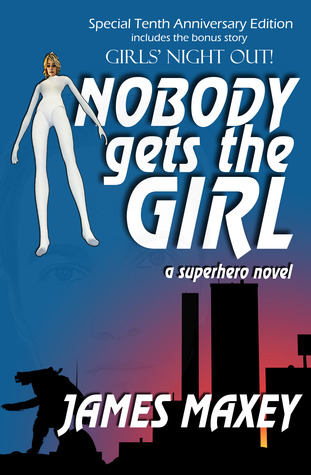
Nobody Gets the Girl: Tenth Anniversary Edition!

Ten years ago in October, my debut novel Nobody Gets the Girl officially hit bookstores. Not a lot of bookstores as it turned out, but enough to officially mark the beginning of my career as a novelist.
To celebrate the anniversary, I've written a new story, Girl's Night Out, that tells the story of the first appearance of Baby Gun and Rail Blade, and explains why Sarah (the Thrill) first decided to go along with being a superhero despite her underlying cynicism about her father's mission. For now, this new story is only available in the new paperback, not in the e-book. I won't say I'll never include the story in the e-book, but for now I want there to be at least a little bonus available to people who still like to read books on paper.
In addition to the bonus story, I think the new cover is a vast improvement over the cover of the first edition. Can you see Nobody?
Odds are low you'll discover copies of this edition at your local bookstore, though they can always order a copy. And, of course, the book's available at Amazon, currently at the bargain price of $8.99! That's a full buck off the cover price? How can you afford to say no? Honestly, not ordering a copy is like burning money.