James Maxey's Blog, page 14
May 16, 2014
Choosing What Novel to Write Next: Part Three
Today's category are novels I have every intention of writing, but am reluctant to start for business reasons:
Soulless, Book Four of the Dragon Apocalypse: The novel opens twenty years after the events of Greatshadow. Tempest, the Dragon Lord of Hell, has unleashed an army of the damned upon the world. The primal dragons most aligned with humanity have fallen, and the ones hostile to mankind unleash waves of destruction. In a climatic final battle, Stagger, Primal Spirit of the Sun, falls to the forces of evil. As eternal darkness falls, Rott, the Dragon of Death, wakes for his final meal.
And that's the first chapter. Of course, we know from previous books that one person survives the end times--the Black Swan, who once more travels into the past in an effort to halt the apocalypse. This time, her plan to save the world centers on the daughter of Stagger and Infidel, a child conceived in the spirit world, who possesses vast powers. Of course, she also possesses a very opinionated, very protective mother, who's never much liked the Black Swan. Hijinks ensue. Also tragedies. Lots and lots of tragedies.
Meanwhile, Sorrow, Slate, and the Romers are still in hell, with the enigmatic Walker as their guide. Together, they must cross the surreal landscape of the netherworld in search of the soul of Lord Stark Tower, the man Slate is cloned from. Can Slate locate his missing soul and redeem it? In doing so, can he and the others find a path to lead them out of hell and back to the land of the living? And, if they do find the path, will there be a living world to return to if when the Black Swan fails once more?
If you haven't read the first three books of the Dragon Apocalypse, I imagine this synopsis just sounds like eye-glazing fantasy mumbo jumbo. If you have read the Dragon Apocalypse, you're probably thinking, "Yeah. I want that."
And I want to write it! But, here's the legal reality: Solaris still owns all rights to the first three books. There's a chance I can get the rights reverted to me around the end of this year... assuming the books don't see a spike in sales. Releasing a fourth book independently of Solaris might cause a spike that would cause Solaris to hold onto the rights longer. So, while I could write the book now, economically it makes more sense to hold out until the rights to the first three books are controlled by me again. Then I can release new ebook editions off all three books, make Greatshadow completely free and advertise the heck out of it to bring in new fans, and reap the full financial rewards of my efforts. While I hate, truly hate, leaving existing fans of this series hanging, the economics of publishing argue for me waiting at least another 8 months before I put my time and energy into this novel.
The Adventures of a Big Ape/Silent Seven: A sequel to Cut Up Girl. There's a human/chimp hybrid in the series named Harry who's Cut Up Girl's best friend through the first novel. He goes through several hero identities, first as Humanzee, then Monkey Boy, Monkey Man, Sock Monkey, and finally Big Ape, after a regenerative drug given to save his life causes him to grow bigger than a gorilla. Harry's an interesting character because his attitude is mostly optimistic through the first book despite his circumstances being much worse than Cut Up Girl's. He's never going to pass as human, but instead of being alienated and mopey about how alone he is, he throws himself with a whole heart into being a costumed crime fighter. At the end of Cut Up Girl, he has to quit his current super-team. This book would follow his adventures as he's recruited into the mysterious Silent Seven, a group of super humans with the somewhat sinister but socially necessary mission of uncovering the secrets of other costumed heroes. Just what these secrets are being used for isn't clear to Harry; he's just happy to once again have a job where he gets to punch people. But when the Silent Seven investigates one of his oldest friends, the hero known as Atomahawk, Harry discovers a dark secret that will change everything the world believes about its greatest heroes.
This is another book I feel like I could start typing tomorrow. I've got some really cool ideas, and if I wind up self publishing Cut Up Girl, I'd like to have the sequel ready to release quickly. But, there is an "if" in that sentence. Right now, my agent is considering whether or not he'll represent the book. If he does, and the book winds up in the hands of a publisher, I'd rather wait to see if there are things they want me to change about the first novel before I'm half way through the second. So, again, it's on the back burner.
There's one more reason I'm not going to write one of these novels next, a more important one than simple economics. Both of these books would be easy for me to write. At least, as easy as any book can be. I know the characters, I know the worlds, I've been thinking about the plot lines for a while. Of course, both books will present challenges. Once I get into them, I'll quickly run into logistical issues of trying to tie dozens of plot lines together within the constraints of my established continuity. But, these are challenges I'm comfortable handling. And, bluntly, while I'm not under contract, I think it's time for me to try a novel that makes me at least a little uncomfortable. I want to do something new, to push myself to write stuff I haven't tried before, so I can continue to hone my craft as a writer.
So, next up: The two books I'm actually going to choose between to write this summer.
Soulless, Book Four of the Dragon Apocalypse: The novel opens twenty years after the events of Greatshadow. Tempest, the Dragon Lord of Hell, has unleashed an army of the damned upon the world. The primal dragons most aligned with humanity have fallen, and the ones hostile to mankind unleash waves of destruction. In a climatic final battle, Stagger, Primal Spirit of the Sun, falls to the forces of evil. As eternal darkness falls, Rott, the Dragon of Death, wakes for his final meal.
And that's the first chapter. Of course, we know from previous books that one person survives the end times--the Black Swan, who once more travels into the past in an effort to halt the apocalypse. This time, her plan to save the world centers on the daughter of Stagger and Infidel, a child conceived in the spirit world, who possesses vast powers. Of course, she also possesses a very opinionated, very protective mother, who's never much liked the Black Swan. Hijinks ensue. Also tragedies. Lots and lots of tragedies.
Meanwhile, Sorrow, Slate, and the Romers are still in hell, with the enigmatic Walker as their guide. Together, they must cross the surreal landscape of the netherworld in search of the soul of Lord Stark Tower, the man Slate is cloned from. Can Slate locate his missing soul and redeem it? In doing so, can he and the others find a path to lead them out of hell and back to the land of the living? And, if they do find the path, will there be a living world to return to if when the Black Swan fails once more?
If you haven't read the first three books of the Dragon Apocalypse, I imagine this synopsis just sounds like eye-glazing fantasy mumbo jumbo. If you have read the Dragon Apocalypse, you're probably thinking, "Yeah. I want that."
And I want to write it! But, here's the legal reality: Solaris still owns all rights to the first three books. There's a chance I can get the rights reverted to me around the end of this year... assuming the books don't see a spike in sales. Releasing a fourth book independently of Solaris might cause a spike that would cause Solaris to hold onto the rights longer. So, while I could write the book now, economically it makes more sense to hold out until the rights to the first three books are controlled by me again. Then I can release new ebook editions off all three books, make Greatshadow completely free and advertise the heck out of it to bring in new fans, and reap the full financial rewards of my efforts. While I hate, truly hate, leaving existing fans of this series hanging, the economics of publishing argue for me waiting at least another 8 months before I put my time and energy into this novel.
The Adventures of a Big Ape/Silent Seven: A sequel to Cut Up Girl. There's a human/chimp hybrid in the series named Harry who's Cut Up Girl's best friend through the first novel. He goes through several hero identities, first as Humanzee, then Monkey Boy, Monkey Man, Sock Monkey, and finally Big Ape, after a regenerative drug given to save his life causes him to grow bigger than a gorilla. Harry's an interesting character because his attitude is mostly optimistic through the first book despite his circumstances being much worse than Cut Up Girl's. He's never going to pass as human, but instead of being alienated and mopey about how alone he is, he throws himself with a whole heart into being a costumed crime fighter. At the end of Cut Up Girl, he has to quit his current super-team. This book would follow his adventures as he's recruited into the mysterious Silent Seven, a group of super humans with the somewhat sinister but socially necessary mission of uncovering the secrets of other costumed heroes. Just what these secrets are being used for isn't clear to Harry; he's just happy to once again have a job where he gets to punch people. But when the Silent Seven investigates one of his oldest friends, the hero known as Atomahawk, Harry discovers a dark secret that will change everything the world believes about its greatest heroes.
This is another book I feel like I could start typing tomorrow. I've got some really cool ideas, and if I wind up self publishing Cut Up Girl, I'd like to have the sequel ready to release quickly. But, there is an "if" in that sentence. Right now, my agent is considering whether or not he'll represent the book. If he does, and the book winds up in the hands of a publisher, I'd rather wait to see if there are things they want me to change about the first novel before I'm half way through the second. So, again, it's on the back burner.
There's one more reason I'm not going to write one of these novels next, a more important one than simple economics. Both of these books would be easy for me to write. At least, as easy as any book can be. I know the characters, I know the worlds, I've been thinking about the plot lines for a while. Of course, both books will present challenges. Once I get into them, I'll quickly run into logistical issues of trying to tie dozens of plot lines together within the constraints of my established continuity. But, these are challenges I'm comfortable handling. And, bluntly, while I'm not under contract, I think it's time for me to try a novel that makes me at least a little uncomfortable. I want to do something new, to push myself to write stuff I haven't tried before, so I can continue to hone my craft as a writer.
So, next up: The two books I'm actually going to choose between to write this summer.


May 15, 2014
Choosing What Novel to Write Next: Part Two
I've no shortage of ideas on what to write next. These ideas fall into three broad categories:
Today I'll look at novels I could write, but probably won't, at least not soon:
Frankenstein's Daughters: The Frankenstein monster has been busy since last seen in the eponymous novel. With his unique biology able to regenerate him from any injury, the monster is effectively immortal, and even today lurks in the shadows of civilization. Always torn between his hatred of humanity and his desire for companionship, the Big F has taken human wives over the centuries. As a consequence, he's had many offspring. His sons are always monsters, both mentally and physically, hideous creatures with violent natures. But, his daughters look completely normal, and pass for ordinary humans, though they share many of their father's attributes of physical strength and toughness and his mental attributes of genius and an nearly inexhaustible well of hatred for mankind. The daughters are protective of their father and male siblings, and during the centuries they've worked themselves into positions of great influence in order to advance their father's long term plan to wipe humanity from the earth and replace it with a race of his own kind.
But, there is a secret society who knows the truth about the Monster's schemes and has worked together to oppose them. The novel would explore the life of the Monster's youngest daughter as she matches wits with the secret society's newest monster hunter.
Pros: One of my more commercial ideas. Built in audience familiar with Frankenstein lore, would be told either as a modern urban fantasy, or set earlier and told as a Gothic steampunk novel.
Cons: My indecision on the setting is a bad sign that this novel hasn't matured to readiness yet. Ideally, setting, character, and plot are all bound together so tightly you can't have one without the others. Also, I hardly ever read urban fantasy or steam punk, so perhaps I shouldn't barge into these genre's expecting great results. On the other hand, lack of actual knowledge on a subject has never held me back before!
The real reason I probably won't write this novel any time soon is that it sounds very much like the premise of any number of novels you could already pick up in the fantasy section of a bookstore. And, yes, that means I would have a real shot of pitching it to a publisher. I just feel like I need a more challenging subject, something that sounds dumb as hell when people hear about it, then turns out to be brilliant. You know, like the rest of my books! (Ahem.)
Orthogonal: A man is confronted in his living room by a gun-wielding stranger who looks just like him. The stranger asks a lot of questions about key events in his life, looking pleased with some answers, dismayed with others. There's a struggle, the stranger is shot, and while examining his body the man discovers what looks like a smart phone. He tries to turn it on to see if he can identify the stranger, and instead triggers a dimensional warp that places him in an alternative universe where his life has gone horribly awry. The stranger was him from this dimension, in this life a physicist, a subject he'd been fascinated by, but didn't pursue at his father's urging to study law. The physicist version of himself has built a device to hop between alternate universes looking for a life better than the one he's ruined, with the intention of killing that universe's copy of himself and taking over his life. Now, our hero has to return home, but it's no easy task when there are an infinite number of alternate worlds to investigate. In his journey across dimensions, he discovers many possible ways the events in his life could have flowed differently, and is forced to grapple with the question of whether anything in his life has meaning if every possible version of himself exists.
Pros: I really want to write a serious science fiction novel. I think there's a lot of artistic potential in this topic.
Cons: I'm still iffy on far too many details to feel ready to write this. Also, I don't know that I yet have an answer to the big philosophical question. What if every possibility is true somewhere? If every good thing you've ever done is negated in the multiverse by an equal number of evil things? How would you find meaning, other than just shrugging and focusing on what's in front of you and pretending you don't know about all the other yous? When I feel like I have an answer, I'll feel like I have a novel.
Next entry: Novels I'll almost certainly write, but not yet due to practical considerations.
Today I'll look at novels I could write, but probably won't, at least not soon:
Frankenstein's Daughters: The Frankenstein monster has been busy since last seen in the eponymous novel. With his unique biology able to regenerate him from any injury, the monster is effectively immortal, and even today lurks in the shadows of civilization. Always torn between his hatred of humanity and his desire for companionship, the Big F has taken human wives over the centuries. As a consequence, he's had many offspring. His sons are always monsters, both mentally and physically, hideous creatures with violent natures. But, his daughters look completely normal, and pass for ordinary humans, though they share many of their father's attributes of physical strength and toughness and his mental attributes of genius and an nearly inexhaustible well of hatred for mankind. The daughters are protective of their father and male siblings, and during the centuries they've worked themselves into positions of great influence in order to advance their father's long term plan to wipe humanity from the earth and replace it with a race of his own kind.
But, there is a secret society who knows the truth about the Monster's schemes and has worked together to oppose them. The novel would explore the life of the Monster's youngest daughter as she matches wits with the secret society's newest monster hunter.
Pros: One of my more commercial ideas. Built in audience familiar with Frankenstein lore, would be told either as a modern urban fantasy, or set earlier and told as a Gothic steampunk novel.
Cons: My indecision on the setting is a bad sign that this novel hasn't matured to readiness yet. Ideally, setting, character, and plot are all bound together so tightly you can't have one without the others. Also, I hardly ever read urban fantasy or steam punk, so perhaps I shouldn't barge into these genre's expecting great results. On the other hand, lack of actual knowledge on a subject has never held me back before!
The real reason I probably won't write this novel any time soon is that it sounds very much like the premise of any number of novels you could already pick up in the fantasy section of a bookstore. And, yes, that means I would have a real shot of pitching it to a publisher. I just feel like I need a more challenging subject, something that sounds dumb as hell when people hear about it, then turns out to be brilliant. You know, like the rest of my books! (Ahem.)
Orthogonal: A man is confronted in his living room by a gun-wielding stranger who looks just like him. The stranger asks a lot of questions about key events in his life, looking pleased with some answers, dismayed with others. There's a struggle, the stranger is shot, and while examining his body the man discovers what looks like a smart phone. He tries to turn it on to see if he can identify the stranger, and instead triggers a dimensional warp that places him in an alternative universe where his life has gone horribly awry. The stranger was him from this dimension, in this life a physicist, a subject he'd been fascinated by, but didn't pursue at his father's urging to study law. The physicist version of himself has built a device to hop between alternate universes looking for a life better than the one he's ruined, with the intention of killing that universe's copy of himself and taking over his life. Now, our hero has to return home, but it's no easy task when there are an infinite number of alternate worlds to investigate. In his journey across dimensions, he discovers many possible ways the events in his life could have flowed differently, and is forced to grapple with the question of whether anything in his life has meaning if every possible version of himself exists.
Pros: I really want to write a serious science fiction novel. I think there's a lot of artistic potential in this topic.
Cons: I'm still iffy on far too many details to feel ready to write this. Also, I don't know that I yet have an answer to the big philosophical question. What if every possibility is true somewhere? If every good thing you've ever done is negated in the multiverse by an equal number of evil things? How would you find meaning, other than just shrugging and focusing on what's in front of you and pretending you don't know about all the other yous? When I feel like I have an answer, I'll feel like I have a novel.
Next entry: Novels I'll almost certainly write, but not yet due to practical considerations.
May 14, 2014
Choosing What Novel to Write Next: Part One
Last Sunday night, I emailed my latest revision of Bad Wizard to Antimatter Press. This was a post editorial draft for the high level, story content changes. I probably cut about 10,000 words of old stuff and added about as much new stuff. There was other material I shifted around, and the story now has a prologue and epilogue. In the earlier draft, I had a scene, where Dorothy Gale first tries on the silver slippers five years after she's returned from Oz and uses them to travel Paris. This happened in flashback and really messed up the flow of the story around it. On the other hand, I couldn't find a good place for Dorothy to just tell her story first hand, at least not this particular element of it. Changing it to an epilogue solved a second structural problem for the novel. In earlier drafts, the book doesn't open in Dorothy's POV. There are good things and bad things about this earlier choice, and hopefully the epilogue mitigates the bad and elevates the good.
The biggest bad part of not starting in her POV was that it might lead some readers to think that the novel was going to be about a completely different character. The biggest good part was that when Dorothy does appear, the reader should be intrigued about her identity, piecing it together from visual clues. But, those clues would have been obvious to someone familiar with the book, not someone who only knew of Oz from the movie, where the slippers are ruby and Dorothy hasn't been kissed on the forehead by the Witch of the North, leaving a visible mark. Now, there won't be a mystery about who Dorothy is, so the reader can instead focus on the mystery of what she'd doing and why she'd doing it, a mystery that pays off in the following chapter.
There will still be one more draft of the novel, following line editing, then of course there will be galleys. But, when I arrived home from work Monday and sat down at my computer, I had the strangest sensation. For the first time since I turned in Dragonseed almost six years ago, I don't have a next novel lined up to work on, nor am I immediately needing to plunge into revisions of an already drafted novel. (Yet. I will be revising Cut Up Girl eventually, but it's not urgent, no deadline.)
The sensation is both a great relief and more than a little unsettling.
The relief is easy enough to understand. It's late spring. If I'm not stuck in front of a computer, I can be out hiking or biking or-dare I dream?-fishing. In a more sedentary mode, maybe I can catch up on some of the movies I've missed in the last couple of years. People get vacations from other jobs. Why should writing be an exception?
It's a little unsettling because, writing is more than just a job for me. It's built into my structure, it's what I think about constantly, it's part of my identity. If I didn't write, I don't have any idea how I would know myself. Who am I if I'm not the person typing away at stories in the evening? Writing is my drug of choice. It takes me away from the world, alters my mind and mood, makes me neglect important stuff, but also gives me highs I can never fully explain to anyone else. If I go too long without writing, I get withdrawal symptoms. My real fear is... what if I got through the withdrawal, came out the other side free of my need to write, free of my dependence on the habit? I spend my days pondering "what ifs." This is a "what if" I'm terrified of contemplating too deeply.
So, I need a novel to write. In the next few days, I'll talk about my candidate novels, and go through the pros and cons of each, and try to document my process for making a decision.
The biggest bad part of not starting in her POV was that it might lead some readers to think that the novel was going to be about a completely different character. The biggest good part was that when Dorothy does appear, the reader should be intrigued about her identity, piecing it together from visual clues. But, those clues would have been obvious to someone familiar with the book, not someone who only knew of Oz from the movie, where the slippers are ruby and Dorothy hasn't been kissed on the forehead by the Witch of the North, leaving a visible mark. Now, there won't be a mystery about who Dorothy is, so the reader can instead focus on the mystery of what she'd doing and why she'd doing it, a mystery that pays off in the following chapter.
There will still be one more draft of the novel, following line editing, then of course there will be galleys. But, when I arrived home from work Monday and sat down at my computer, I had the strangest sensation. For the first time since I turned in Dragonseed almost six years ago, I don't have a next novel lined up to work on, nor am I immediately needing to plunge into revisions of an already drafted novel. (Yet. I will be revising Cut Up Girl eventually, but it's not urgent, no deadline.)
The sensation is both a great relief and more than a little unsettling.
The relief is easy enough to understand. It's late spring. If I'm not stuck in front of a computer, I can be out hiking or biking or-dare I dream?-fishing. In a more sedentary mode, maybe I can catch up on some of the movies I've missed in the last couple of years. People get vacations from other jobs. Why should writing be an exception?
It's a little unsettling because, writing is more than just a job for me. It's built into my structure, it's what I think about constantly, it's part of my identity. If I didn't write, I don't have any idea how I would know myself. Who am I if I'm not the person typing away at stories in the evening? Writing is my drug of choice. It takes me away from the world, alters my mind and mood, makes me neglect important stuff, but also gives me highs I can never fully explain to anyone else. If I go too long without writing, I get withdrawal symptoms. My real fear is... what if I got through the withdrawal, came out the other side free of my need to write, free of my dependence on the habit? I spend my days pondering "what ifs." This is a "what if" I'm terrified of contemplating too deeply.
So, I need a novel to write. In the next few days, I'll talk about my candidate novels, and go through the pros and cons of each, and try to document my process for making a decision.
April 16, 2014
Six Impossible Things Before Breakfast
Alice laughed. "There's no use trying," she said. "One can't believe impossible things."
"I daresay you haven't had much practice," said the Queen. "When I was your age, I always did it for half-an-hour a day. Why, sometimes I've believed as many as six impossible things before breakfast."
I gave a talk at Orange County High School earlier, discussing my experiences as a writer. Being a writer isn't all that hard. You just have to be able to mentally reconcile six completely contrary truths at once:
1. Always be original.
There's nothing new under the sun.
Every story idea you'll ever have has already been told. But, the easiest way to appear to be original is to stuff your head with as many books and stories as possible. Then, you can be aware of how your ideas are similar to what has been done before, and consciously choose to steer your stories in a direction that you haven't seen anyone yet try. New ideas are as rare as new elements on the periodic table. But, a few dozen basic elements can be rearranged and combined into a nearly infinite number of chemicals. You can make fresh ideas from combining and rearranging old ones.
2. Writing requires confidence, almost arrogance.
Writing requires doubt and humility.
You have to believe in yourself to be a writer. You have to think that what you're writing is good enough to stand out from the millions of other stories being written at any given time. You have to be able to ignore your critics and have faith that, in the long run, what you are writing will matter. At the same time, you have to doubt every word you put on the page. Always assume that what you've just written can be made better. And when people are generous enough to offer criticism, listen to it. Don't be defensive. Be open to anything that can help you improve your craft.
3. You have to learn the rules and follow them.
You have to break the rules.
Commercially successful stories follow formulas. A hero you care about has an goal you agree is important, faces obstacles and adversaries in pursuit of the goal, and either succeeds and improves the world or fails but improves himself. 90% of all stories published follow this broad formula.
But, once you know the 'rules' of how a story works, you can figure out how to break them. In Bitterwood, I broke the 'hero you care about' part of the formula by making Bitterwood himself a bitter, hateful man who was very difficult to love. In Burn Baby Burn, I broke the formula by giving Sunday a goal of overthrowing Western civilization, which most readers would agree would be a bad thing. Breaking the formula comes at a price. You're going to turn off some readers. But, you probably won't bore them.
4. The best writing comes from inspiration and enthusiasm.
The best writing comes from long, tedious slogs through draft after draft.
I bang out a lot of my first drafts in a white hot blaze of creativity where I can put a crazy number of words on the page in a very short time. Burn Baby Burn, seven days! Cut Up Girl, four days! It's like I have lightning in my brain. It feels great!
But people rarely see my first drafts. My published work is a result of numerous drafts, probably never fewer than seven. Each pass refines and changes the work a little, and each pass gets both easier and harder. It's easier, because the story takes shape and becomes something you're proud of. It gets harder, because the mistakes you're looking for get tinier and tinier.
Right now, I'm doing my 6th draft of Bad Wizard. I've changed the opening lines from:
George “Grinder” Greer was a little drunk as he stumbled up the steps of the State, War, and Navy Building in the dead of night. He hoped to rectify his situation by becoming a lot drunk.
To:
George “Grinder” Greer stumbled up the steps of the State, War, and Navy Building in the dead of night, a little drunk. His mission was to become a lot drunk.
The second example is tighter. The contrast between a little drunk and a lot drunk is closer. 'Stumbled' is now the first verb you hit instead of 'was.' To my ear, the second version is plainly better. But the first version was perfectly acceptable. It wasn't wrong. It just wasn't as tight as it could have been. These small tweaks take forever to find. The reward for doing so feels small; it's not as if a reader saw the original version and can congratulate you for the improvement. It's tedious, but it's the where the real craft of writing comes into play.
If I wasn't trying to be period accurate, I would just call the building he's going into the "War Building." I may yet change it to George “Grinder” Greer stumbled up the steps in the dead of night, a little drunk. His mission was to become a lot drunk. Then introduce the name of the building later. This will haunt me for days. And it's just two lines, out of a novel with 50 chapters. And I'll agonize over tweaks like this in probably every chapter.
5. The best way to write a good novel is to write a terrible one.
This is similar to the last rule. Your good final draft will grow from an ugly first draft. But it's also true of your whole writing career. While there are writers who write one novel and see it go to print, for most of us, I think you have to write at least one novel that will never be published just to discover all the things you don't know about writing a novel. It might seem demotivational to think that you're writing something that can never be published, but if you look at it in the context of a long career, writing a practice novel makes a lot of sense.
6. You'll know you're on the path to success if you have a lot of failures.
Fifteen years ago, all I had to show for my efforts as a writer was a big stack of rejection letters. I wrote at least fifty stories that I never sold to major markets. I accumulated easily a hundred rejections, maybe even two hundred. Now, I sell probably 90% of short stories that I write. For the sake of using round numbers, let's say that it was my 100th submission that finally sold professionally. If I'd given up at rejection 99, finally admitting to myself that, wow, I'm just not good at this, that would have been the end. Submission 100 would never have sold.
If you're a writer trying to break in, your magic number is somewhere out there. Maybe it's 5 submissions. Maybe it's 50, or 500. Yes, each rejection letter represents a failure. But, if those failures grow into a giant pile, excellent. Stand on top of that pile; you're closer to your goal than ever.
April 2, 2014
Boredom. My Secret Weapon.
I've pitched a couple ideas to my agent for my next novel. I'd love to get started on the fourth Dragon Apocalypse book, but, strategically, it doesn't make sense to put it on the market before the rights to the first three books revert back to me. There's a chance that could happen later this year. Then, I can return to that world, and tell the story of the Black Swan's final attempt to change the fate of the world. Stagger will be there, and Infidel, and their daughter, and all the characters I left in hell at the end of Witchbreaker. It will be awesome. And it is coming. Just not this year, alas.
Meanwhile, I'm busy developing my next book. Though "busy" is a bit of an oxymoron. Because, at this stage, the most important thing I can do to build my book is to make sure I'm bored.
It's surprisingly difficult to be bored. I have internet enabled devices at my fingertips everywhere I go. I can pluck books out of thin air at a whim off of Amazon, I can listen to any song I want any time I want, I have thousands and thousands of television shows I can stream with a few clicks of a button. Even in my car, I have audio books and satellite radio. There's not a single waking moment where I ever need to be bored.
And that's really dangerous. Because, for me, boredom is a valuable commodity. I daydream when I'm bored. My mind wanders. I put stuff together that I've never put together before. My imaginary friends start talking to one another. I eavesdrop.
So, I now have to deliberately make time in my schedule for boredom. Long bike rides are good. I don't listen to headphones since I want to be aware of cars, so I'm mostly alone with my thoughts. Long car trips are good. I can turn off the radio and tune into the plays in my head. Shorter snips of boredom can be grabbed here and there, in the shower, when I'm cooking, while I'm doing something repetitive at work.
Writing a 100,000 words requires me to sit and type for 100 hours. But, to get those 100,000 words, I have to put in almost an equal number of hours of daydreaming. The books I'm going to write next, I didn't just think of them yesterday. They're based on ideas I had years ago, ideas that have had time to mature. Now, I'm trying to go deeper, thinking of specific scenes, trying to understand my characters better, thinking of odd places they can visit. A month from now, when I finally sit down and start typing... it will all mutate and warp and turn into something I never imagined. It will change because it will be more interesting for me to change it, because I'll be bored of my original ideas by then. I couldn't get there, though, if I didn't have a huge mountain of daydreams to sift through.
Now you know. Boredom. It's my secret weapon.
Meanwhile, I'm busy developing my next book. Though "busy" is a bit of an oxymoron. Because, at this stage, the most important thing I can do to build my book is to make sure I'm bored.
It's surprisingly difficult to be bored. I have internet enabled devices at my fingertips everywhere I go. I can pluck books out of thin air at a whim off of Amazon, I can listen to any song I want any time I want, I have thousands and thousands of television shows I can stream with a few clicks of a button. Even in my car, I have audio books and satellite radio. There's not a single waking moment where I ever need to be bored.
And that's really dangerous. Because, for me, boredom is a valuable commodity. I daydream when I'm bored. My mind wanders. I put stuff together that I've never put together before. My imaginary friends start talking to one another. I eavesdrop.
So, I now have to deliberately make time in my schedule for boredom. Long bike rides are good. I don't listen to headphones since I want to be aware of cars, so I'm mostly alone with my thoughts. Long car trips are good. I can turn off the radio and tune into the plays in my head. Shorter snips of boredom can be grabbed here and there, in the shower, when I'm cooking, while I'm doing something repetitive at work.
Writing a 100,000 words requires me to sit and type for 100 hours. But, to get those 100,000 words, I have to put in almost an equal number of hours of daydreaming. The books I'm going to write next, I didn't just think of them yesterday. They're based on ideas I had years ago, ideas that have had time to mature. Now, I'm trying to go deeper, thinking of specific scenes, trying to understand my characters better, thinking of odd places they can visit. A month from now, when I finally sit down and start typing... it will all mutate and warp and turn into something I never imagined. It will change because it will be more interesting for me to change it, because I'll be bored of my original ideas by then. I couldn't get there, though, if I didn't have a huge mountain of daydreams to sift through.
Now you know. Boredom. It's my secret weapon.
March 30, 2014
Full Nobody & Burn Baby Covers Revealed!


Hey, remember, like, a month ago when I mentioned I'd be revealing the full covers for Nobody Gets the Girl and Burn Baby Burn soon? Have I mentioned that time really flies when you're writing a book? I've spent the last month hunkered down in imagination land, reading out loud my latest superhero novel Cut Up Girl so that I could get it sent off to my agent. I had a good deal of editing to do, putting in new scenes and smoothing out continuity errors created by a few simple changes near the start of the novel. But, I emailed the manuscript to my agent a couple of days ago, so now I can do stuff like making a few posts to my sadly neglected blogs.
One irony of blogging is that I started these blogs to promote my writing back when I was still producing about one book every couple of years. Then, boom, my output of novels suddenly exploded, so that now I'm striving to write two novels a year. I have more work I need to promote, but when I get locked into a novel, my brain won't let me spend time on much else.
But, enough whining! Look at those awesome covers! I think the backs are actually my favorite parts. The legion of headless Sundays launching from Pangea, the terrifying eyes of Pit, the tubes of prisoners, and Baby Gun looming above the skyline, are all images from the novels that I think capture the blend of the surreal and pulpy that I'm aiming for in my work. Seriously, they're gorgeous. You should buy two copies of each book, just so you can display both the fronts and the backs on your shelves. (Okay, I'm probably the only one who will actually do that. But, still, buy the books. You know you want them! And if you don't there's some geek in your life who does. The world would be a kinder, gentler place if we all gave more books as gifts!)
March 3, 2014
Retro Nobody and Burn Baby Burn Covers Unveiled!

Behold, the new front covers for Nobody Gets the Girl and Burn Baby Burn from artist Jeremy Cavin. The covers have been designed with the new print versions in mind, so that when they are sitting next to each other on a table they combine to form one image. The covers are already uploaded to the ebook editions, but it may be next week before the physical books are available for shipping. When they're good to go, I'll show off the back covers of the books, which I think are just as awesome as the fronts!
March 1, 2014
Coming soon....
I've been working with ace artist Jeremy Cavin on new covers for my superhero books. Here's the blue line sketches to whet your appetites:
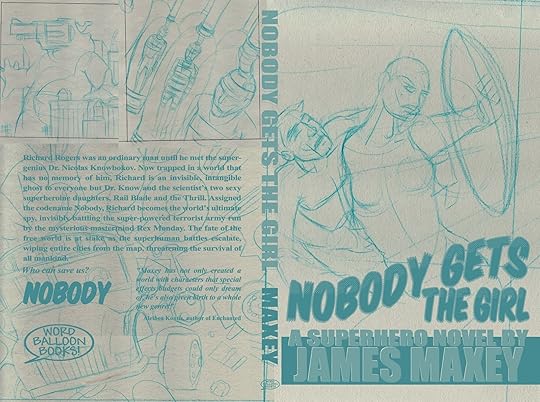
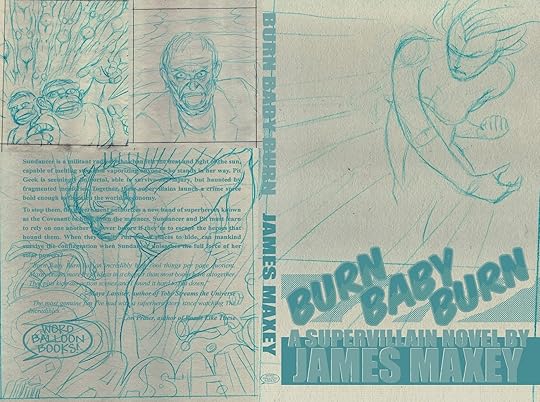 I should be ready for the full unveiling on Monday! Watch this space!

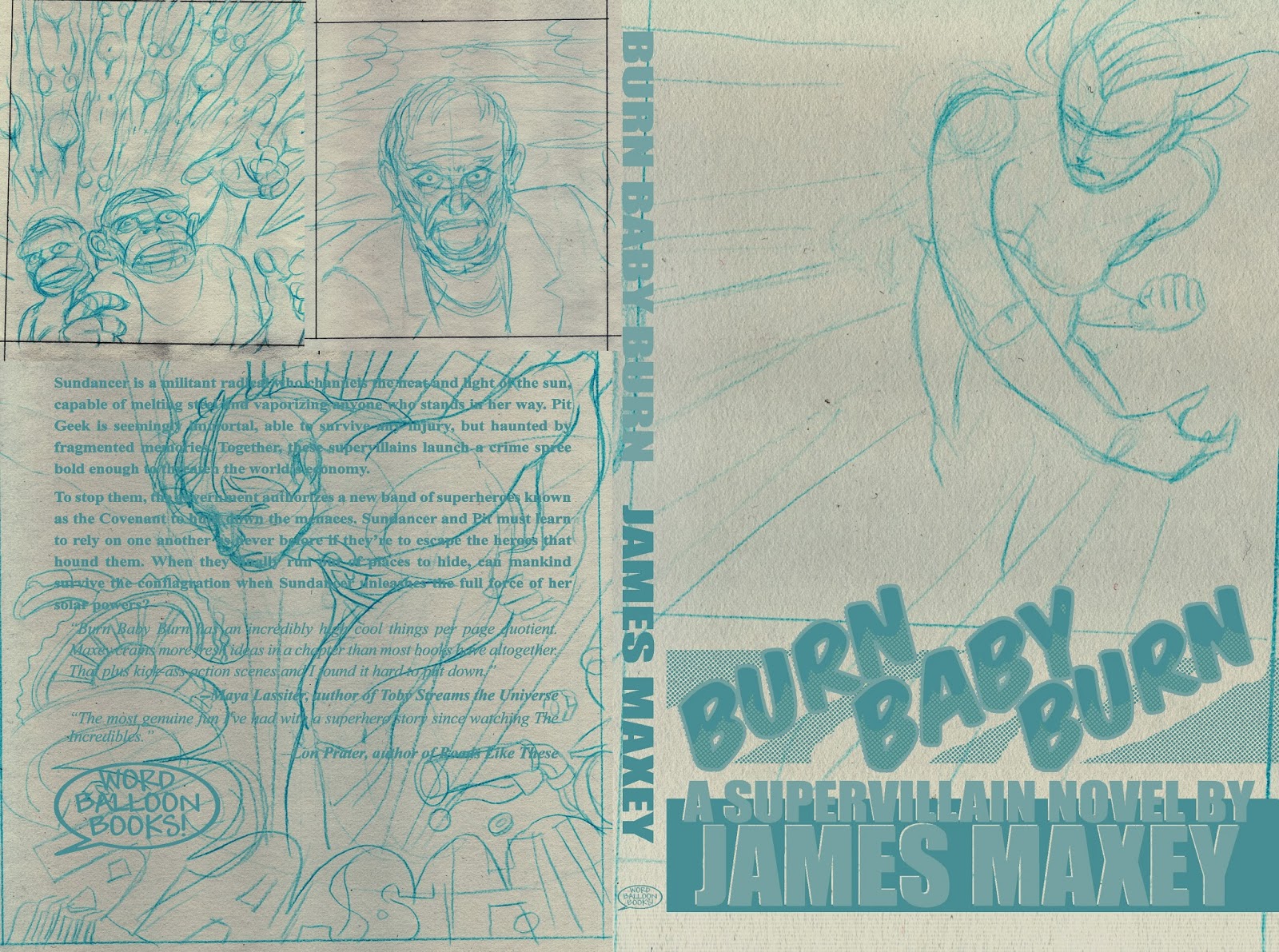 I should be ready for the full unveiling on Monday! Watch this space!
February 16, 2014
First Monday Classics: HG Wells and the Island of Dr. Moreau

Join me and authors Clay Griffith and Nathan Kotecki on Monday, March 3, as we help the Orange County Library launch a new series dedicated to the discussion of classic authors and books. The plan currently is to meet at 6:30 on the first Monday of each month for March, April, and May to discuss a different author, with a focus on one of their better known books.
For March, we'll be discussing HG Wells and the Island of Dr, Moreau. Until last year, I'd never actually read HG Wells. His four core novels of The Time Machine, The Invisible Man, War of the Worlds, and The Island of Dr. Moreau have been so heavily adapted and borrowed from I felt like I knew the books without having read them. I first read The Time Machine and was impressed by the ideas of the book, but found it to be a rather thin read when it came to plot and characters. Still, it was well written, in a style I thought was quite easy for a modern reader to get through, so I decided to try a second novel, The Island of Dr. Moreau.
Wow. The Island of Dr. Moreau is one of the most amazing books I've ever read. The characters are complex, the plot unfolds at a methodical but engaging pace, and they style is the model of clarity. What lifts this book beyond the merely good into the realm of great art are the themes Wells tackles. Man's relationship to nature, man's relationship with God, the exploration of the line between man and beast and the many ways in which it can be blurred... you can't read this book without thinking through the moral questions placed before you. It's the kind of book I longed to talk about the second I closed the covers, which led me to propose this series discussing classic books to the library.
While the monthly discussions will be led by local authors, my goal is to have the audience share their thoughts and experiences with the authors in question. I want it to feel like a bunch of friends getting together to talk about favorite books.
Coming in April: Jane Austen and Pride and Prejudice.
February 11, 2014
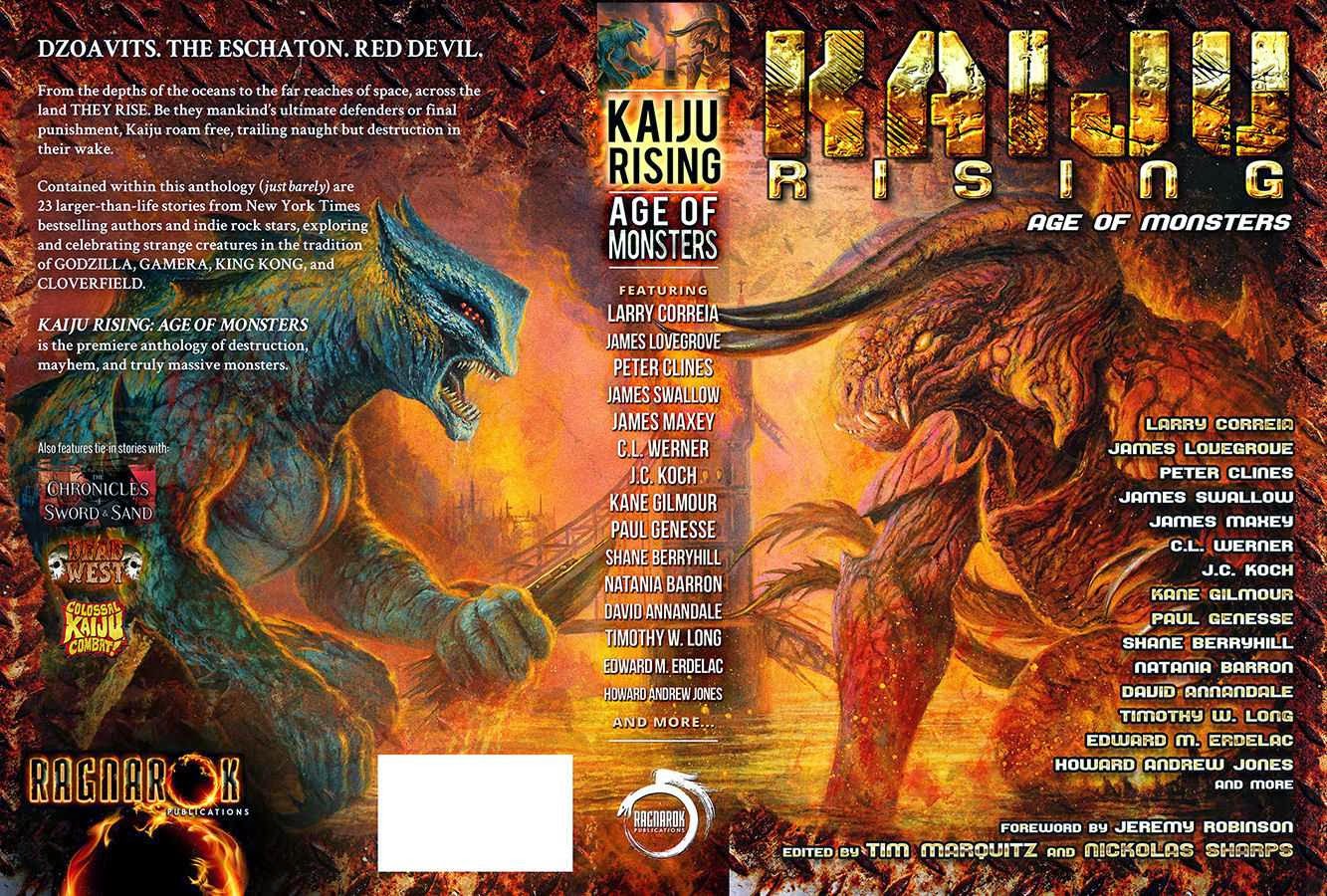
Kaiju Rising: Age of Monsters
The ebook edition of Kaiju Rising: Age of Monsters is now available for purchase.
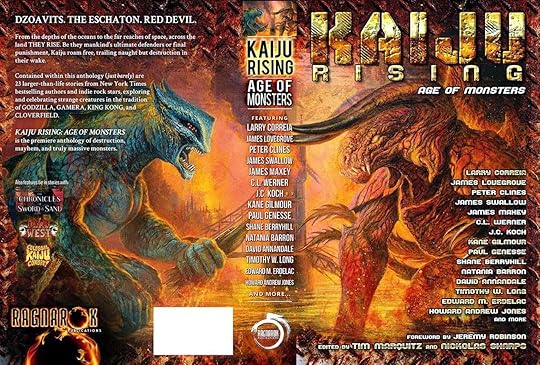 KAIJU RISING: Age of Monsters is a collection of 23 stories focused around the theme of strange creatures in the vein of Pacific Rim, Godzilla, Cloverfield, and more. The anthology opens with a foreword by JEREMY ROBINSON, author of Project Nemesis, the highest selling Kaiju novel in the United States since the old Godzilla books—and perhaps even more than those. Then, from New York Times bestsellers to indie darlings KAIJU RISING: Age of Monsters features authors that are perfectly suited for writing larger than life stories, including:
Peter Clines, Larry Correia, James Lovegrove, Gini Koch (as J.C. Koch), James Maxey, Jonathan Wood, C.L. Werner, Joshua Reynolds, David Annandale, Jaym Gates, Peter Rawlik, Shane Berryhill, Natania Barron, Paul Genesse & Patrick Tracy, Nathan Black, Mike MacLean, Timothy W. Long, Bonnie Jo Stufflebeam, Kane Gilmour, Peter Stenson, Erin Hoffman, Sean Sherman, Howard Andrew Jones (The Chronicles of Sword and Sand tie-in), Edward M. Erdelac (Dead West tie-in), James Swallow (Colossal Kaiju Combat tie-in)
My story in the book is Fall of Babylon. Instead of drawing on monster movies for inspiration, I retell the Book of Revelation as a Kaiju battle, with the Lamb of God, the Whore of Babylon, and the Old Great Dragon duking it out on the streets of Manhattan. A good time is had by all, except those who are slaughtered by the Four Horsemen and the 200 million angels charged with killing a third of mankind. It's the end times as you've never seen them before. Buy today!
 KAIJU RISING: Age of Monsters is a collection of 23 stories focused around the theme of strange creatures in the vein of Pacific Rim, Godzilla, Cloverfield, and more. The anthology opens with a foreword by JEREMY ROBINSON, author of Project Nemesis, the highest selling Kaiju novel in the United States since the old Godzilla books—and perhaps even more than those. Then, from New York Times bestsellers to indie darlings KAIJU RISING: Age of Monsters features authors that are perfectly suited for writing larger than life stories, including:
 Peter Clines, Larry Correia, James Lovegrove, Gini Koch (as J.C. Koch), James Maxey, Jonathan Wood, C.L. Werner, Joshua Reynolds, David Annandale, Jaym Gates, Peter Rawlik, Shane Berryhill, Natania Barron, Paul Genesse & Patrick Tracy, Nathan Black, Mike MacLean, Timothy W. Long, Bonnie Jo Stufflebeam, Kane Gilmour, Peter Stenson, Erin Hoffman, Sean Sherman, Howard Andrew Jones (The Chronicles of Sword and Sand tie-in), Edward M. Erdelac (Dead West tie-in), James Swallow (Colossal Kaiju Combat tie-in)
My story in the book is Fall of Babylon. Instead of drawing on monster movies for inspiration, I retell the Book of Revelation as a Kaiju battle, with the Lamb of God, the Whore of Babylon, and the Old Great Dragon duking it out on the streets of Manhattan. A good time is had by all, except those who are slaughtered by the Four Horsemen and the 200 million angels charged with killing a third of mankind. It's the end times as you've never seen them before. Buy today!